Prevod
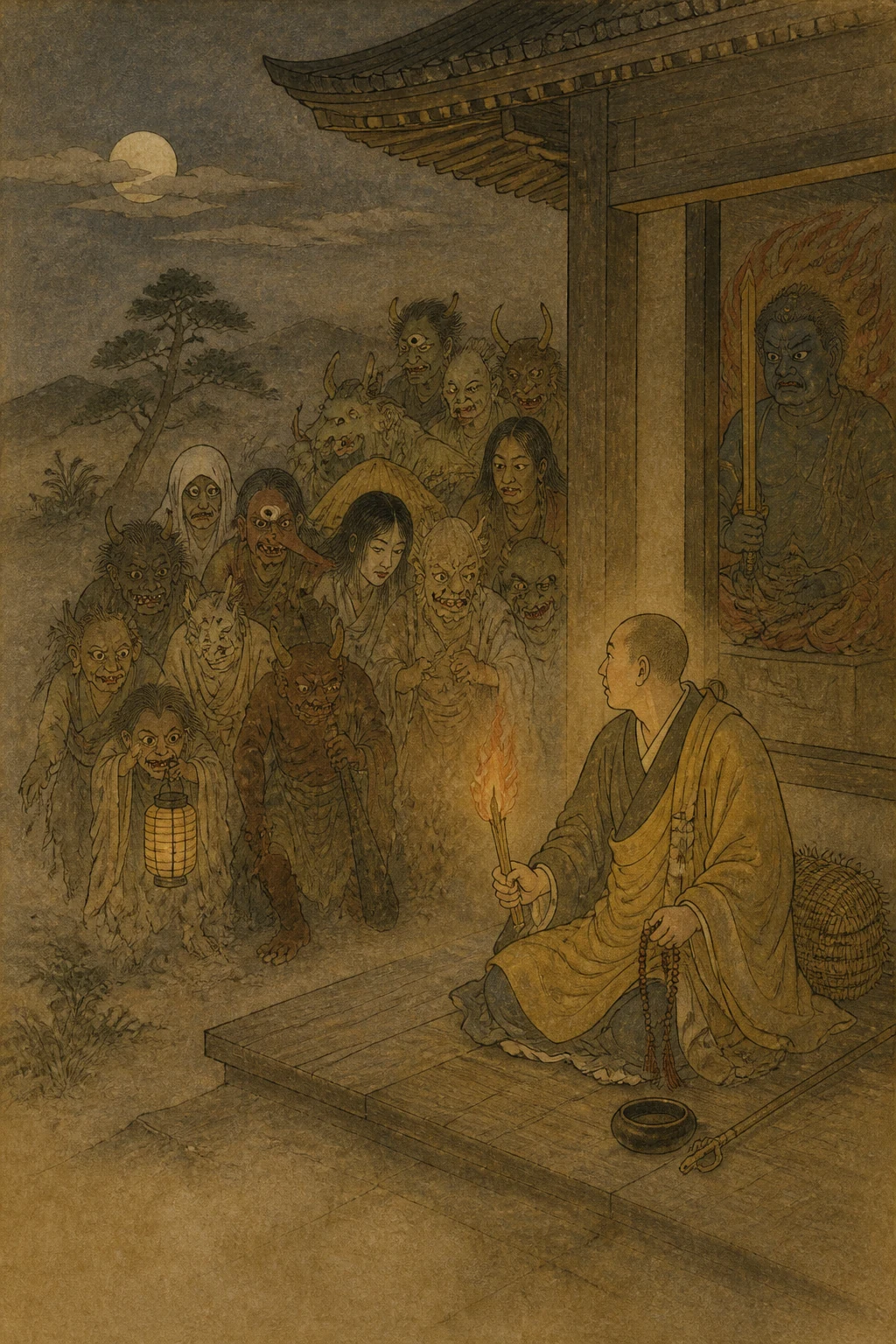
This, too, happened long ago. In Tsukushi there was a deity known as Tōsaka no Sae. A monk traveling on pilgrimage once lodged for the night in his shrine. At what he judged to be about midnight, he heard the hoofbeats of many horses passing by, and then a voice called, “Is Sae here?” As the monk lay listening in wonder, a voice answered from within the shrine, “I am.” Still more astonished, he listened as the first voice asked, “Will you be going to Buzōji tomorrow?” “I had no such intention. What is happening there?” came the reply. “Have you not heard? A new Buddha is to appear at Buzōji tomorrow, and Brahmā, Śakra, the heavenly beings, and the dragon deities are all gathering there.” “No word of this had reached me. How kind of you to tell me! How could I fail to attend? I shall certainly go.” “Then come tomorrow at about the hour of the Snake. Be sure to come. We shall be waiting for you.” With that, they passed on. Hearing all this, the monk thought, “What an extraordinary thing I have heard! I had meant to go elsewhere tomorrow, but I must see this before I go anywhere.” Scarcely able to wait for dawn, he went to Buzōji, yet found no sign of anything unusual. Indeed, the place was quieter than ever, with not a soul in sight. “There must be some reason for this,” he thought, and sat before the Buddha, waiting for the hour of the Snake. Before long it would be the hour of the Horse. As he sat wondering what could have happened, an old man of seventy or more came along. His head was bald, with only a sparse scattering of white hair, and over it he had pulled a soft black cap. Small to begin with and now bent far over at the waist, he walked leaning on a staff. Behind him came a nun, carrying a small black bucket with something in it. They entered the hall, and the old man bowed his forehead to the ground two or three times before the Buddha, then sat rubbing a long strand of large soapberry prayer beads between his hands. The nun set the little bucket beside him and went away, saying, “I shall fetch the reverend.” After a little while, a monk of about sixty came in. He paid reverence to the Buddha and asked, “What have you called me for?” The old man replied, “I have reached the point where I cannot tell whether I shall live another day. I wish to have these few remaining white hairs shaved off and become your disciple.” Wiping his eyes, the monk said, “What a blessed wish! Let us do it at once.” The little bucket proved to contain warm water. With it he washed the old man’s head, shaved it, and bestowed the precepts upon him. The old man again bowed before the Buddha and departed. Nothing else happened after that. So it must have been to rejoice in this old man’s becoming a monk that the heavenly beings had gathered, speaking of the appearance of a new Buddha. That renouncing the world brings merit according to one’s capacity is nothing newly discovered; yet from this we may judge all the more clearly how great must be the merit of those who, while still young and in their prime, sincerely awaken the desire to follow the Way and devote themselves to it with all their strength.