Prevod
By now Medea’s love and all she had done were known to proud Aeetes and all the Colchians. They gathered in the assembly place under arms, as countless as the waves that rise before the wind on a stormy sea, or the leaves that fall to earth from a branching forest in the month of falling leaves—who could number them? corrected diacritic error (δέ) in the source text.
So their endless ranks streamed along the riverbanks, clamoring in their fury. Among them Aeetes stood out in his well-built chariot, drawn by the horses the Sun had given him, swift as the blowing wind. In his left hand he raised a rounded shield, and in the other a towering pine torch; beside him his enormous spear stretched straight before him. Apsyrtus held the horses’ reins in his hands. But far ahead the ship was already cleaving the sea, driven onward by her mighty oarsmen and the descending current of the great river.
The king lifted his hands in the anguish of his ruin and called upon the Sun and Zeus to witness these wicked deeds. Terribly he shouted to all his people that, unless they found his daughter, whether on land or aboard the ship still sailing the swelling sea, and brought her back into his hands, so that he might glut his heart with vengeance for all these wrongs, they would learn at the cost of their own heads what his wrath could do, and bear the full burden of his calamity.
So spoke Aeetes. That very day the Colchians hauled their ships down, put their tackle aboard, and sailed out to sea. You would have thought it not so much a fleet of ships as a boundless host of birds, flock upon flock, clamoring over the waters.
Meanwhile, a brisk wind blew for the heroes at the bidding of the goddess Hera, so that Medea of Aea might reach the Pelasgian land as swiftly as possible, to bring destruction upon the house of Pelias. On the third morning they made fast their ship’s stern cables on the Paphlagonian coast, before the river Halys.
For Medea had urged them to go ashore and appease Hecate with sacrifices. But what rites the maiden devised as she prepared the offering—let no one learn of them, nor let my heart urge me to sing them.
Awe forbids me to speak. Yet the shrine the heroes built for the goddess on the shore has remained ever since, for later generations to see even now. Then the son of Aeson, and the other heroes with him, remembered Phineus, who had said that their voyage from Aea would follow another course; but none of them knew that way. As they longed to learn it, Argus spoke: “We shall reach Orchomenus by the route that the unerring prophet you met before foretold you must follow.
“For there is another passage, made known by the priests of the immortals who come from Tritonian Thebes. Not all the stars that wheel in heaven yet existed, nor had anyone inquiring heard of the sacred race of the Danaans. Only the Apidanian Arcadians lived then—the Arcadians, who are said to have lived even before the moon, feeding on acorns in the mountains. Nor was the Pelasgian land yet ruled by the glorious sons of Deucalion, when Aeria was already renowned for its rich harvests—Egypt, mother of men born in the earliest ages—and the fair-flowing river Triton, which waters all Aeria. No rain from Zeus ever drenches it; yet its fields yield abundant grain through the river’s flooding.
“From there, they say, a certain man traveled throughout Europe and Asia, trusting in the strength and might and courage of his people. As he went he founded countless cities, some still inhabited, others perhaps no longer so; for a vast stretch of time has passed since then.
“But Aea still stands to this day, and the descendants of those men whom he settled there remain. They preserve their fathers’ written records, tablets on which are marked all the roads and the boundaries of land and water for those who journey around the world.
“There is a river, the farthest horn of Ocean, broad and deep enough for a merchant ship to sail upon. Men have traced it far inland and call it the Ister. For a long way it cuts alone, in a single stream, through a boundless country; its springs murmur far away in the Rhipaean mountains, beyond the blasts of the north wind.
“But when it reaches the borders of the Thracians and Scythians, it divides: one branch pours its waters here into the eastern sea, while the other flows in the opposite direction into a deep gulf opening from the Trinacrian Sea, which lies beside your own country—if indeed the Achelous rises in your land.”
So he spoke, and the goddess granted them a favorable sign. At the sight of it they all acclaimed that route and agreed to take it. For a trail of heavenly light stretched out before them in the very direction they were to travel.
Joyfully they left Lycus’s son there and sailed over the sea with their canvas spread, gazing at the mountains of Paphlagonia. They did not round Carambis, for the winds and the gleam of the heavenly fire held steady until they reached the great stream of the Ister.
Meanwhile, some of the Colchians, searching in vain, passed out of the Pontus through the Cyanean Rocks. Others followed the river under Apsyrtus’s command, turning aside to enter by the Fair Mouth.
Thus he outstripped the heroes and, crossing the neck of land, reached the innermost gulf of the Ionian Sea before them. For an island called Peuce lies enclosed by the Ister, triangular in shape, with its broad end facing the seashore and its narrow point upstream. Two mouths divide around it: one is called the Mouth of Narex, and the other, farther down, the Fair Mouth. Through this Apsyrtus and the Colchians hurried more swiftly, while the heroes sailed far away along the island’s uppermost end. The shepherds in the fields abandoned their countless flocks in the water meadows, terrified by the ships, which they took for beasts rising from the sea with all its mighty monsters.
For never before had they seen seagoing ships—not the Scythians mingled with the Thracians, nor the Sigynni, nor the Graucenii, nor the Sindi who by then inhabited the vast, deserted plain of Laurium.
But when the heroes had passed Mount Angurum, and the crag of Cauliacus far from Mount Angurum, around which the Ister divides its stream and sends it into the sea on either side, and had passed the Laurian plain, they found that the Colchians had already come out into the Cronian Sea and blocked every passage, so that they could not slip through unseen.
Following behind, they descended the river and sailed out toward two nearby islands sacred to Brygean Artemis. On one stood her holy temple; on the other they landed, wary of Apsyrtus’s host. For out of reverence for the daughter of Zeus the Colchians had left these islands, alone among the many, unoccupied. The others were crowded with Colchians guarding the sea passages.
Apsyrtus had also stationed great numbers on the mainland near the islands, as far as the river Salangon and the land of Nestis. There the Minyans, few against so many, would have succumbed in a disastrous battle. But first, to avoid a mighty conflict, they made an agreement: the heroes should keep the golden fleece as their rightful possession, since Aeetes himself had promised it to them if they accomplished the trials, whether they had taken it by guile or openly against his will. Medea, however—for she was the matter in dispute—should be placed apart from the company in the keeping of Leto’s daughter, until some king who administered justice should decide whether she must return to her father’s house or follow the heroes to the land of Greece.
When the maiden had weighed every part of this agreement in her mind, sharp anguish shook her heart without respite. At once she called Jason out alone from among his comrades and led him aside until they were far away. Then, face to face, she spoke in grief: “Son of Aeson, what is this plan you have made concerning me? Has your triumph made you utterly forgetful? Do you care nothing for all you said when you were trapped by need? Where are your oaths by Zeus, protector of suppliants? Where have your honeyed promises gone?
“Trusting in them, I shamelessly and against all decency abandoned my country, the glory of my home, and my own parents, who were dearest of all to me. Now, far away and alone, I am borne over the sea with the sorrowing kingfishers, all for the sake of your trials, so that you might survive and accomplish your tasks with the bulls and the earthborn men.
“Last of all, when the fleece’s hiding place was known, you took it through my folly, and I poured dreadful shame upon all womankind. That is why I say I follow you to the land of Greece as your daughter, your wife, your own sister.
“Now stand resolutely by me in every way. Do not leave me alone, far from you, while you go visiting kings. Defend me yourself. Let the justice and the law we both accepted stand firm—or else take your sword at once and cut straight through this throat, so that I may receive the fitting reward for my madness.
“Wretched that I am, if the king to whom you have both entrusted this cruel agreement should judge that I belong to my brother! How shall I face my father’s eyes? With glory, no doubt! What punishment, what grievous calamity shall I not suffer in misery for the dreadful things I have done? And are you to win a happy homecoming?
“May the all-sovereign wife of Zeus, in whom you glory, never bring that to pass. And may you one day remember me, corrected diacritic error (δέ) in the source text. when you are wrung with suffering. May your fleece vanish like a dream into darkness, all to no purpose. May my Furies drive you at once from your country, as I myself have suffered through your cruelty. These curses must not fall unfulfilled to the earth. For you have broken a mighty oath, pitiless man. Yet you shall not long sit at ease, mocking me because of these agreements.”
So she spoke, seething with bitter anger. She longed to burn the ship, shatter all its tackle, and fling herself into the raging flames. Alarmed, Jason answered her with gentle words: “Restrain yourself, unhappy girl. These arrangements please me no more than they please you.
“But we are seeking some respite from battle, so vast a cloud of hostile men has gathered around us on your account. All who dwell in this country are eager to help Apsyrtus, so that they may carry you home again to your father as though you had been taken captive.
“If we join battle, we shall all perish in a hateful death; and it will be still more bitter grief for you if we die and leave you as their prey. But this agreement will serve a trick by which we shall bring him to ruin. The people here will not so readily oppose us and favor the Colchians in their struggle over you once they lack their leader, who is both your champion and your brother. Nor shall I shrink from fighting the Colchians openly if they refuse to let me pass.”
So he spoke to soothe her, and she answered with deadly words: “Then consider this. Since I first went astray in my folly and, driven by a god, fulfilled my wicked purposes, I must devise this too, to crown my shameful deeds.
“You must ward off the Colchians’ spears in battle; I will beguile him into coming into your hands. Welcome him with splendid gifts. If only I can persuade the heralds, when they leave, to bring him alone to hear my words in private! Then, if this deed pleases you, I shall not begrudge it: kill him, and raise war against the Colchians.”
Thus the two agreed and prepared a mighty deception for Apsyrtus. They offered him many gifts of friendship, and among them the sacred crimson robe of Hypsipyle. The divine Graces themselves had woven it for Dionysus on sea-girt Dia. Later he gave it to his son Thoas, who in turn left it to Hypsipyle; and she gave it to the son of Aeson among many beautiful treasures, a finely wrought gift of hospitality to take away with him. Neither touching it nor gazing upon it could ever sate one’s sweet desire.
And an immortal fragrance had clung to it ever since the lord of Nysa himself lay upon it—ἐγκατελεκτο corrected diacritic error (ἐγκατελεκτο) in the source text.
—flushed with wine and nectar, clasping the lovely breast of Minos’s daughter, whom Theseus had once brought from Cnossus and abandoned on the island of Dia. Medea charged the heralds with a message to beguile her brother: as soon as he came to the goddess’s temple in accordance with their agreement, and the black darkness of night had fallen, he was to meet her so that she might help him devise a plan to take the great golden fleece and return with it to Aeetes’s house. For, she said, the sons of Phrixus had forcibly handed her over to the strangers to be carried away. With these deceitful words she scattered enchantments upon the air and the winds, spells that could have drawn even a wild beast from afar down from a sheer mountain.
Cruel Love, great affliction, great bane of mankind! From you spring deadly strife, sighs and lamentations, and countless other sorrows rage in their wake.
Rise up, god, and arm yourself against the children of my enemies as you once planted hateful madness in Medea’s heart. For how did she overcome Apsyrtus with a dreadful death when he came to meet her? That is the next task of my song.
When they had left her on Artemis’s island according to their agreement, the two parties separated and moored their ships apart. Jason went into hiding to await Apsyrtus, and afterward his own comrades.
But Apsyrtus, deceived by those terrible promises, quickly crossed the swelling sea in his ship and landed on the sacred island under the black night. Coming alone to meet his sister face to face, he sounded her out with words, like a young child testing a winter torrent that not even grown men can cross,
to see whether she would devise some trick against the strangers. As the two were agreeing upon every detail, the son of Aeson suddenly sprang from his close ambush, bare sword raised in his hand. At once the maiden turned her eyes away and covered herself with her veil, so that she should not see her brother struck down and murdered.
Watching for his chance, Jason struck him as a slaughterer fells a great, strong-horned bull, close beside the temple that the Brygians dwelling on the opposite mainland had once built for Artemis. In its porch he fell to his knees. As the hero breathed out his life, he cupped both hands beneath his wound to catch the dark blood, and reddened his sister’s silvery veil and robe as she shrank away.
With a sharp, sidelong glance the pitiless Fury, who subdues all things, saw the murderous deed they had done. The hero, Aeson’s son, cut off the dead man’s extremities as an offering; three times he licked the blood, and three times spat the pollution from his teeth, as murderers must do to appease the guilt of a treacherous killing.
He hid the still-moist corpse in the earth, where those bones lie to this day among the people of Apsyrtus. Meanwhile, as soon as the heroes saw ahead of them the light of the torch that the maiden raised as their signal to approach, they brought their own ship alongside the Colchian vessel. They slew the Colchian company as hawks fall upon flocks of doves, or wild lions leap into the folds and scatter a great flock of sheep.
Not one of them escaped death. Like a ravaging fire the heroes swept through the whole company. Jason came to meet them afterward, eager to lend help where little help was needed; already they were anxious about him.
There they sat and took careful counsel about their voyage. The maiden joined them as they deliberated, and Peleus was the first to speak: “I urge you now, while it is still night, to board the ship and row straight through the passage our enemies are guarding. For when morning comes and they discover all that has happened, I do not think they will listen to any single voice urging them to pursue us farther. Bereft of their leader, they will be scattered by bitter dissension.
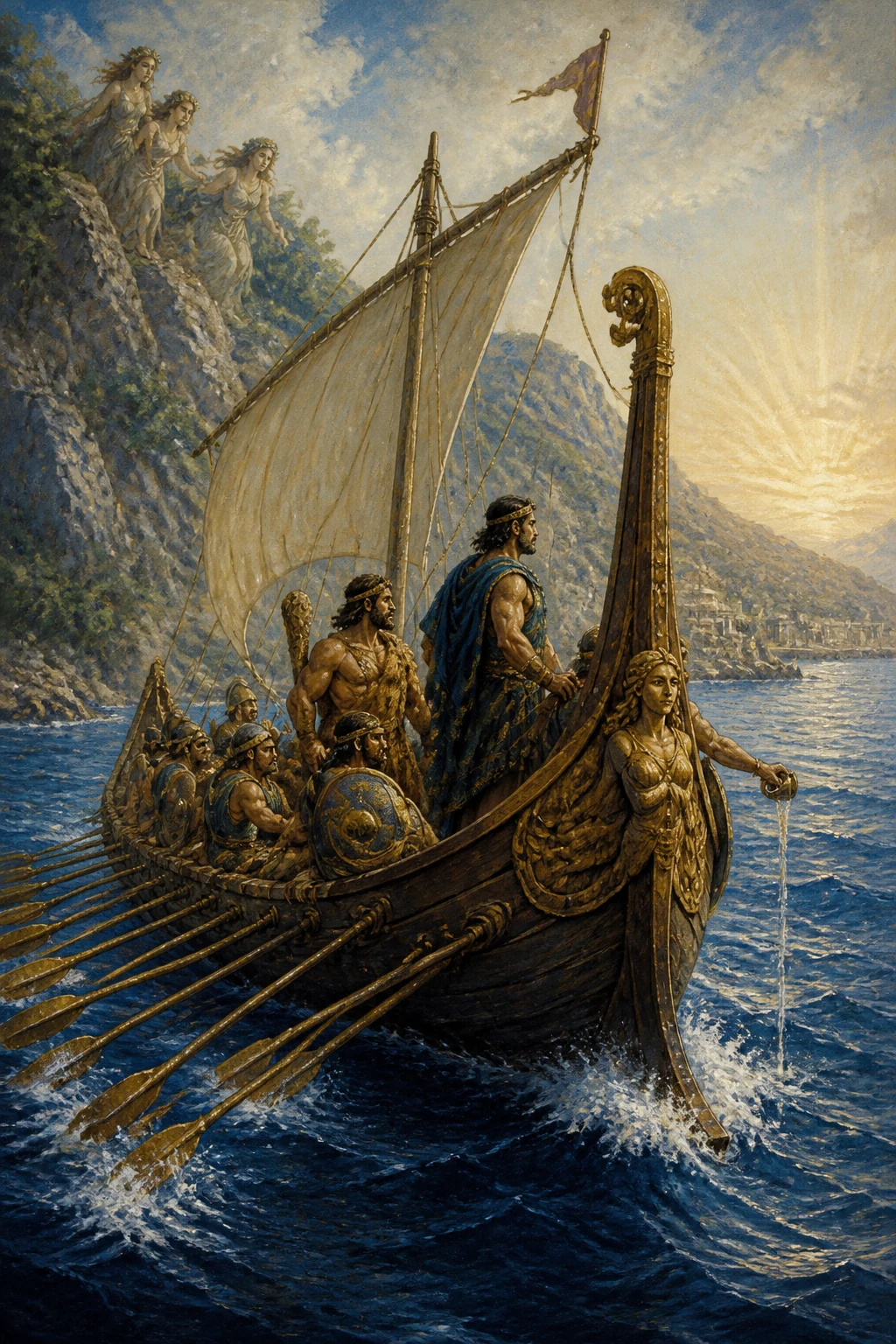
“And once their forces have broken up, our return journey will be easy.” So he spoke, and the young men approved the words of Aeacus’s son. Swiftly they boarded the ship and labored unceasingly at their firwood oars until they reached the sacred island of Electris, the farthest of the islands, near the river Eridanus.
When the Colchians learned of their leader’s death, they were eager to search throughout the Cronian Sea for Argo and the Minyans. But Hera held them back with dreadful lightning from the sky.
In the end they shrank from returning to their homes in the Cytaean land, terrified of Aeetes’s savage wrath, and set out in different directions to settle permanently elsewhere. Some landed on the very islands where the heroes had stopped, and live there under the name of Apsyrtus. Others built a fortified town beside the dark, deep Illyrian river, where the tomb of Harmonia and Cadmus stands, and made their home among the Encheleans. Others dwell in the mountains called Ceraunian ever since the thunderbolts of Zeus, son of Cronus, prevented them from crossing to the island opposite.