Prevod
Once upon a time there was a poor cottager who had many children and little to give them, either to eat or to wear. They were all good-looking, but the prettiest was the youngest daughter, who was so lovely there was no end to it.
Now, one Thursday evening late in the autumn, the weather outside was foul and dreadfully dark, and the rain and wind beat so hard that the walls creaked. They were all sitting round the hearth, each with something to do, when all at once there came three taps at the window. The man went out to see what was the matter, and when he stepped outside, there stood a great, great White Bear.
“Good evening to you!” said the White Bear. “Good evening!” said the man. “Will you give me your youngest daughter? If you will, I shall make you as rich as you are now poor,” said the bear. Well, the man thought it would be a fine thing to become so rich, but he felt he ought to speak to his daughter first. So he went inside and told her there was a great White Bear outside who promised to make them all rich if only he could have her. She said no, and would not hear of it, so the man went out again and agreed with the White Bear that he should come back the following Thursday evening for his answer. In the meantime they coaxed her, talking of all the wealth they would have and how well she herself would live;
at last she consented, washed and mended her rags, dressed herself as well as she could, and made ready for the journey. She had little enough to take with her. The following Thursday evening the White Bear came to fetch her;
she climbed onto his back with her little bundle, and away they went. When they had travelled a long way, the White Bear said, “Are you afraid?” No, she was not. “Then just hold tight to my shaggy coat, and there will be no danger,” he said.
She rode far, far away, until they came to a great mountain. The White Bear knocked on it, a gate swung open, and they entered a castle with many brightly lit rooms gleaming with gold and silver. There was a great hall, too, with a table laid so splendidly that you cannot imagine how splendid it was. Then the White Bear gave her a silver bell: whenever she wanted anything, she need only ring it, and she would have it. Well, when she had eaten and the evening wore on, she grew sleepy after her journey and thought she would like to go to bed. So she rang the bell, and scarcely had she touched it before she found herself in a chamber with a bed made up, as lovely as anyone could wish to sleep in, with silken quilts and hangings and golden fringe. Everything in the room was gold and silver. But when she had gone to bed and put out the light, someone came and lay down beside her, and this was the White Bear, who shed his bearskin at night;
but she never saw him, for he always came after she had put out the light, and before dawn he was gone again. All went well for a while, but then she began to grow quiet and sorrowful, for she spent the whole day alone and longed to go home to her parents and brothers and sisters.
One day, when the White Bear asked what was troubling her, she said it was so desolate there, and she was so lonely, and she longed to go home to her parents and brothers and sisters. It was because she could not visit them that she went about in such sorrow.
“That can be arranged,” said the White Bear, “but you must promise me not to speak to your mother alone, only when the others are there to hear. For she will take you by the hand,” he said, “and try to lead you into a room to speak to you alone, but you must not do that, or you will bring misfortune on us both.” One Sunday the White Bear came and said they could now go to her parents. So off they went, with her riding on his back, and they travelled far and long. At last they came to a large white farmhouse. Her brothers and sisters were playing outside, and it was all so pretty that it was a joy to see. “That is where your parents live,” said the White Bear, “but do not forget what I have told you, or you will bring misfortune on yourself and me alike.” No, goodness, she would certainly not forget; and when she had arrived, the White Bear turned back.
There was no end to the rejoicing when she went in to her parents. They felt they could never thank her enough for what she had done for them; now they were so very, very comfortable. And they all asked her how she fared in the place where she lived. She was perfectly well, she said, and had everything she could wish for. What else she told them I cannot say, but I do not think they learned much about it. Then, in the afternoon, after they had eaten dinner, it happened just as the White Bear had said: her mother wanted to speak to her alone in the bedroom.
But she remembered what the White Bear had told her and would not hear of it. “Whatever we have to talk about,” she said, “we can talk about at any time.” But somehow or other her mother persuaded her at last, and then she had to tell her how she lived. She said that someone always came and lay down beside her after she had put out the light at night, but she never saw him, for he was always gone before daybreak. This grieved her, for she felt she would so dearly like to see him; and all day she went about alone, and it was so desolate and lonely. “Ugh! It may well be a troll you are sleeping with,” said her mother. “But I shall tell you a way to see him. I will give you a piece of candle to take with you in your bosom. Light it and look at him while he is asleep! Only take care not to drip any tallow on him.” So she took the candle and hid it in her bosom, and that evening the White Bear came to fetch her.
But when they had gone a little way, the White Bear asked whether things had not happened just as he had said. Yes, she could not deny that. “Well, if you have listened to your mother’s advice, you have brought misfortune on us both, and all is over between us,” he said. No, she had done nothing of the kind.
When she had come home and gone to bed, everything happened as usual: someone came and lay down beside her. But late in the night, when she heard that he was asleep, she got up, struck a light, lit the candle, and shone it on him. Then she saw that he was the handsomest prince anyone could ever set eyes on, and she fell so deeply in love with him that she felt she could not live unless she kissed him that very instant. So she did, but as she did so she let three hot drops of tallow fall onto his shirt, and he woke. “What have you done?” he said. “Now you have brought misfortune on us both. If only you had held out for the year, I should have been saved. For I have a stepmother who has bewitched me, so that I am a White Bear by day and a man by night. But now all is over between us, and I must leave you and go to her. She lives in a castle east of the sun and west of the moon, and there is a princess there with a nose three ells long. Now I must marry her.” The girl wept and lamented, but there was nothing to be done: he had to go. Then she asked whether she might not go with him. No, that was impossible. “If you tell me the way, I shall come and find you. Surely I may do that?” she said. Yes, she might, he said, but there was no road to the place. It lay east of the sun and west of the moon, and she would never find her way there.
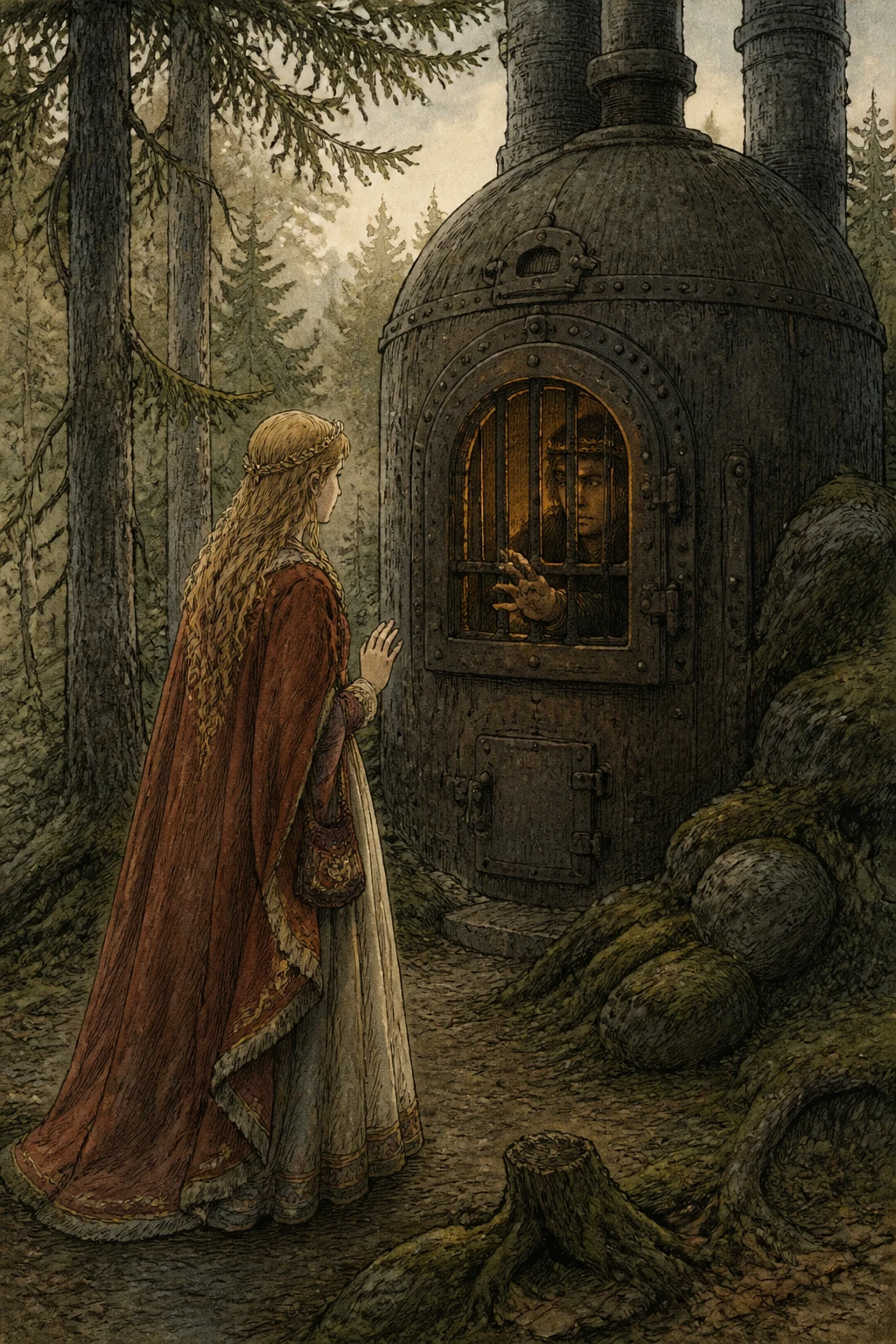
In the morning, when she woke, both the prince and the castle were gone. She lay on a little green patch in the midst of the dark, thick forest, and beside her lay the same bundle of rags she had brought from home. When she had rubbed the sleep from her eyes and cried herself weary, she set out, and walked for many, many days until she came to a great mountain. Outside it sat an old woman playing with a golden apple. The girl asked her whether she knew the way to the prince who was with his stepmother in a castle east of the sun and west of the moon, and who was to marry a princess with a nose three ells long. “How do you know him, then?” asked the old woman. “Perhaps you are the one who was to have married him?” Yes, she was. “Oh, so it is you?” said the old woman. “Well, I know nothing more about him than that he lives in the castle east of the sun and west of the moon, and you will be a long time getting there, if ever you do. But you may borrow my horse and ride to my neighbour. Perhaps she can tell you. When you get there, just give the horse a tap under its left ear and tell it to go home again. And you may take this golden apple with you.”
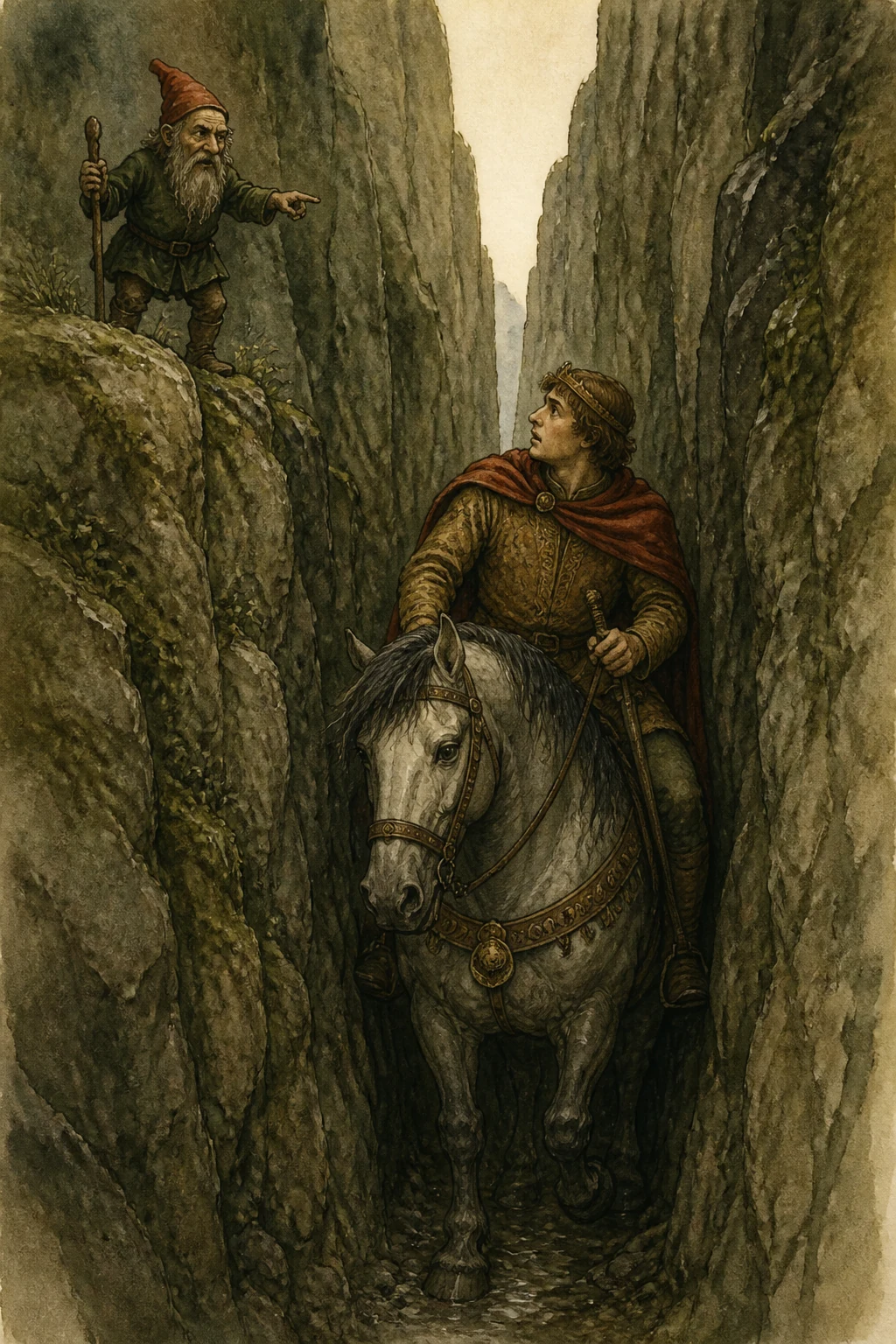
She mounted the horse and rode for a long, long time, until at last she came to a mountain where an old woman sat outside with a golden yarn-reel. The girl asked her whether she knew the way to the castle east of the sun and west of the moon. Like the first old woman, she said she knew nothing about it, except that it was indeed east of the sun and west of the moon. “And you will be a long time getting there, if ever you do. But you may borrow my horse to ride to my nearest neighbour; perhaps she may know. When you get there, you need only give it a tap under its left ear and tell it to go home again.” Then she gave her the yarn-reel, saying she might find a use for it. So the girl mounted the horse and rode for a long while once more, and at long last she came to a great mountain where an old woman sat spinning at a golden spinning wheel. The girl asked her whether she knew the way to the prince, and where the castle east of the sun and west of the moon might be. Once again it was the same. “Perhaps you are the one who was to have married that prince?” said the old woman. Yes, she was indeed. But the old woman knew the way no better than the other two. East of the sun and west of the moon it was; that much she knew. “And you will be a long time getting there, if ever you do,” she said. “But you may borrow my horse, and I think you had better ride to the East Wind and ask him. Perhaps he knows the place and can blow you there. When you arrive, you need only tap the horse under the ear, and it will go home again.” Then she gave her the golden spinning wheel. “Perhaps you may find a use for it,” said the old woman.
She rode for many days and a long, long time before she got there; but at last she arrived, and asked the East Wind whether he could tell her the way to the prince who lived east of the sun and west of the moon. Yes, the East Wind said, he had heard tell of that prince, and of the castle too, but he did not know the way, for he had never blown so far. “But if you like, I will go with you to my brother, the West Wind. Perhaps he may know, for he is much stronger than I am. You may sit on my back, and I will carry you there.” So she did, and away they went at a fine pace. When they arrived, they went inside, and the East Wind said that the girl he had brought was the one who was to have married the prince who lived in the castle east of the sun and west of the moon. Now she was travelling in search of him, and he had brought her there to ask whether the West Wind knew where it was. “No, I have never blown so far,” said the West Wind. “But if you like, I will go with you to the South Wind, for he is much stronger than either of us, and he has roamed far and wide. Perhaps he can tell you. You may sit on my back, and I will carry you there.” So she did; they set off for the South Wind, and I dare say they were not long on the way. When they arrived, the West Wind asked whether he could tell her the way to the castle east of the sun and west of the moon, for this was the girl who was to have married the prince there. “Oh,” said the South Wind, “is it she? Well, I have wandered here and there in my time,” he said, “but I have never blown so far. Still, if you like, I will go with you to my brother, the North Wind;
he is the oldest and strongest of us all, and if he does not know where it is, no one in the world can tell you. You may sit on my back, and I will carry you there.” So she climbed onto his back, and off he went at a splendid pace. They made short work of the journey.
When they reached the place where the North Wind lived, he was so wild and furious that they could feel his icy blasts a long way off. “What do you want?” he roared from afar, sending a chill through them. “Oh, you need not be so fierce,” said the South Wind, “for it is only me, and this is the girl who was to have married the prince who lives in the castle east of the sun and west of the moon. Now she wants to ask whether you have been there and can tell her the way, for she would dearly like to find him again.” “Yes, I know where it is,” said the North Wind. “Once I blew an aspen leaf there, but afterwards I was so weary that I could not blow for many days.
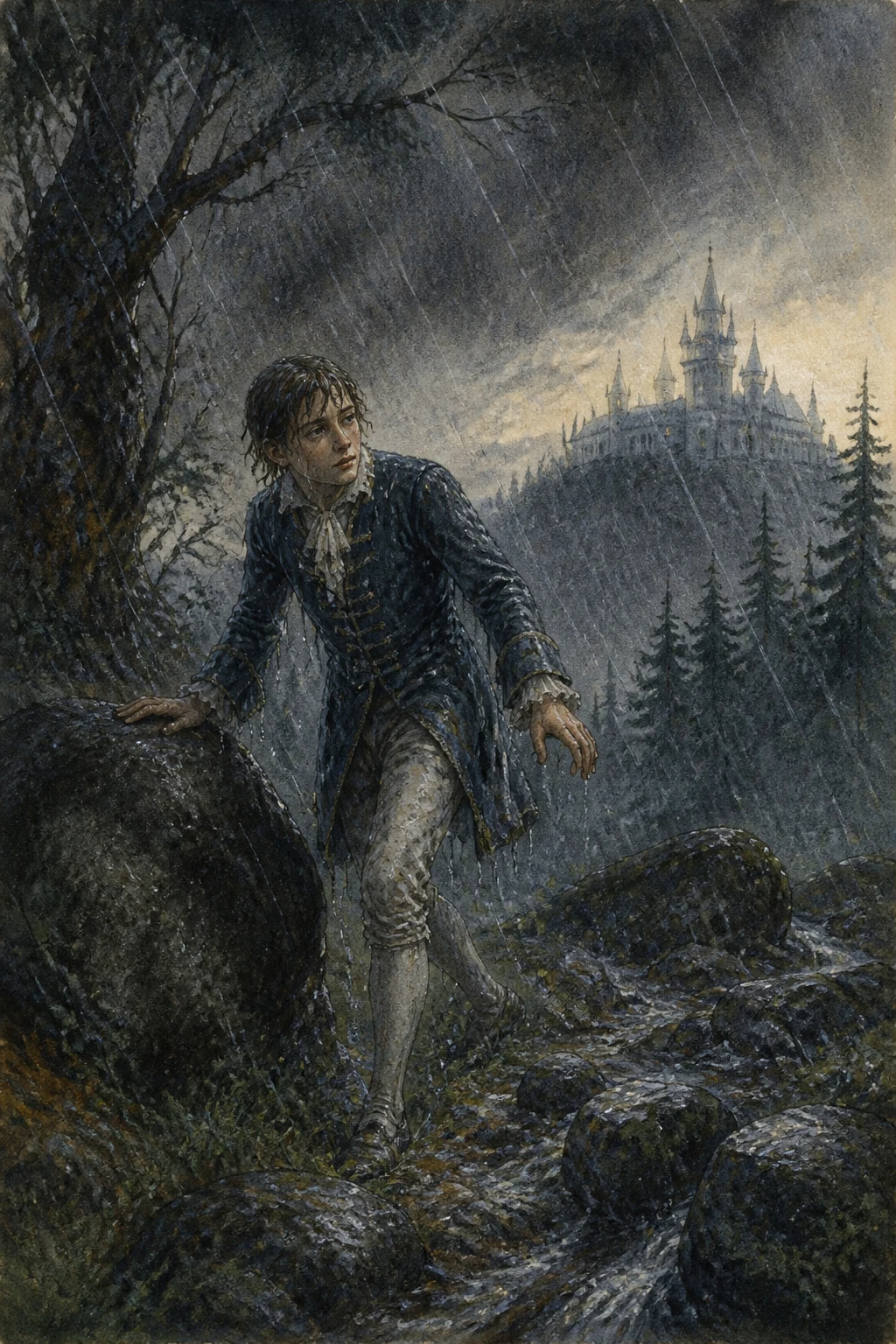
But if you are determined to go, and are not afraid to come with me, I will take you on my back and see whether I can blow you there.” Yes, she wished to go, and go she must, if there was any possible way of getting there; and she was not afraid, however bad the journey might be. “Well, well, you must stay here tonight,” said the North Wind, “for we shall need the whole day if we are to get there.” Early the next morning the North Wind woke her, then swelled himself up and made himself so great and strong that he was dreadful to behold. Away they went, high through the air, as though they were bound straight for the world’s end. Such a storm swept over the countryside that great stretches of forest and houses alike were blown down; and when they came out over the open sea, ships were wrecked by the hundred. On they rushed, so far, so far that no one could believe how far they went, and still they were over the sea. The North Wind grew wearier and wearier, and so exhausted that he could scarcely blow any longer. Lower and lower they sank, until at last they were so low that the crests of the waves washed about her heels. “Are you afraid?” said the North Wind. “No,” she said, she was not. But they were not far from land now, and the North Wind had just enough strength left to fling her onto the shore beneath the windows of the castle east of the sun and west of the moon. By then he was so weary and spent that he had to rest for many days before he could go home again.
The next morning she sat down outside the castle windows and began to play with the golden apple, and the first person she saw was the long-nosed creature who was to marry the prince. “What do you want for that golden apple of yours?” she asked, opening the window.
“It is not for sale for gold or money,” said the girl. “Not for gold or money? Then what do you want for it? You may have whatever you wish!” said the princess. “Well, if I may go to the prince who is here and stay with him tonight, you shall have it,” said the girl who had come with the North Wind. Yes, she might do that; it could be arranged. The princess took the golden apple, but when the girl went up to the prince’s room that evening, he was asleep. She called to him and shook him, and wept between times, but she could not wake him. In the morning, as day broke, the princess with the long nose came and drove her out again.
During the day she sat down outside the castle windows and began winding yarn on her reel, and the same thing happened again. The princess asked what she wanted for it, and she said it was not for sale for gold or money, but if she might go up to the prince and stay with him that night, the princess could have it. Yet when she went up, he was asleep once more; and for all her calling and crying and shaking, and all her weeping, he slept on, and she could not rouse him. As day broke the next morning, the princess with the long nose came and drove her out again.
Later that day the girl sat down outside the castle windows and began spinning at her golden spinning wheel, and the princess with the long nose wanted that as well. She opened the window and asked what she wanted for it. The girl answered as she had twice before: it was not for sale for gold or money, but if she might go up to the prince who was there and stay with him that night, the princess could have it. Yes, she was quite welcome to do so. Now, there were some Christian folk held captive there, and they had been in the room next to the prince’s. They had heard a woman in his chamber weeping and calling to him for two nights running, and they told the prince about it. That evening, when the princess brought him his bedtime drink, he pretended to drink it, but threw it over his shoulder instead, for he guessed that it was a sleeping draught.
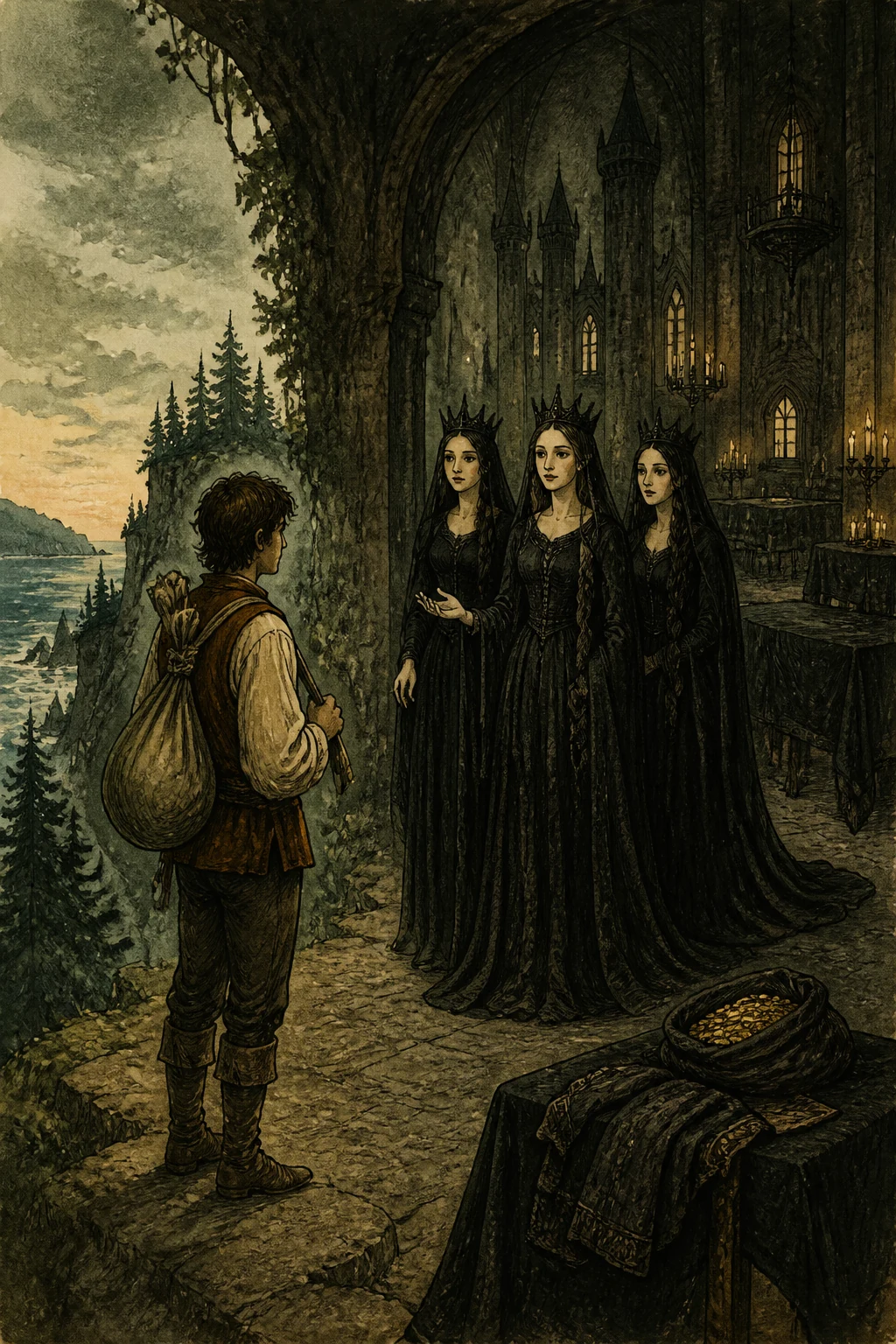
When the girl came in, the prince was awake, and she had to tell him how she had reached the castle. “You have come just in time,” said the prince, “for tomorrow was to be my wedding day. But I will not marry that long-nosed creature, and you are the only one who can save me. I shall say that I want to see what my bride is good for, and ask her to wash the three tallow stains out of my shirt. She will agree, for she does not know it was you who spilled them. But only Christian hands can do it, not such troll rabble as these. Then I shall say that I will have no other bride than the one who can do it, and ask you to try.” There was great joy and gladness between them that night. But the next day, when the wedding was to take place, the prince said, “I should like to see what my bride is good for first.” Yes, that was fair enough, said his stepmother. “I have a fine shirt that I want to wear for my wedding, but it has three tallow stains on it that I want washed out. And I have vowed to marry no one but the woman who can do it. If she cannot manage that, she is not worth having.” Well, they thought that was a simple matter, and agreed to it, and the one with the long nose began washing as hard as she could. But the more she washed and rubbed, the larger the stains grew. “Oh, you cannot wash,” said the old troll-woman, her mother. “Give it to me!” But scarcely had she touched the shirt before it grew much dirtier still; and the more she washed and rubbed, the larger and blacker the stains became, and the more dreadful the shirt looked. Then the other trolls tried their hands at washing, but as time went on the shirt grew dirtier and fouler, until at last it looked as though it had been up the chimney. “Oh, none of you is any use!” said the prince. “There is a beggar girl sitting outside the window here. I am sure she can wash far better than any of you. Come in, girl!” he called. So she came in. “Can you wash this shirt clean?” he asked. “Oh, I do not know,” she said. “I think I might.” And scarcely had she taken the shirt and dipped it into the water before it was white as freshly fallen snow, and whiter still. “You are the one I will marry!” said the prince. Then the old troll-woman flew into such a rage that she burst, and the princess with the long nose and the little trolls must have burst too, for I have heard nothing of them since. The prince and his bride freed all the Christian folk who were held captive there, then took with them a great deal of gold and silver and moved far away from the castle east of the sun and west of the moon.