Prevod
(To Carlos Toribio Robinet.) At the beginning of the Alameda de Acho, on the side of the street behind the chapel of San Lorenzo, built in 1834, stands a dilapidated house which, around the year 1788, was the scene not of some nursery tale of trinkets and bibs, but of a drama that tradition has handed down to us in all its terrible detail.
I Twenty lovely springs; a complexion of that charming, velvety brown which made the women of Lima so famous before the accursed fashion spread of plastering their faces with concoctions and slapping on rose-scented rice powder like a mason coating a wall; eyes blacker than a night of mischief, veiled by curling lashes; a tempting mouth, like a little meringue sweet; a figure as graceful as any ever seen, and a foot that gave one every temptation to kiss it: such, in the year of grace 1776, was Benedicta Salazar.
When her parents died, they left her without house or dowry, under the protection of an aunt who was half witch and half procuress, as Quevedo put it, and more ill-tempered than a mastiff guarding its scraps. This aunt took it into her head to marry her niece to a crony of hers, a Spaniard whose particular tang proclaimed him a son of Catalonia a mile away, and who, to crown it all, had calloused hands and a beard that had grown longer than the national debt. Benedicta regarded her suitor with the same annoyance as a whining mosquito, and, not daring to give him the resounding rejection he deserved, resorted to the well-worn expedient of becoming extravagantly devout, acquiring a spiritual director, and declaring that she aspired to the convent rather than the marriage bed.
The Catalan, observing the girl's scruples, would mutter: “Girl with so many sweethearts, yet you marry none at all; if you're saving yourself for a king, there are four in a pack of cards.”
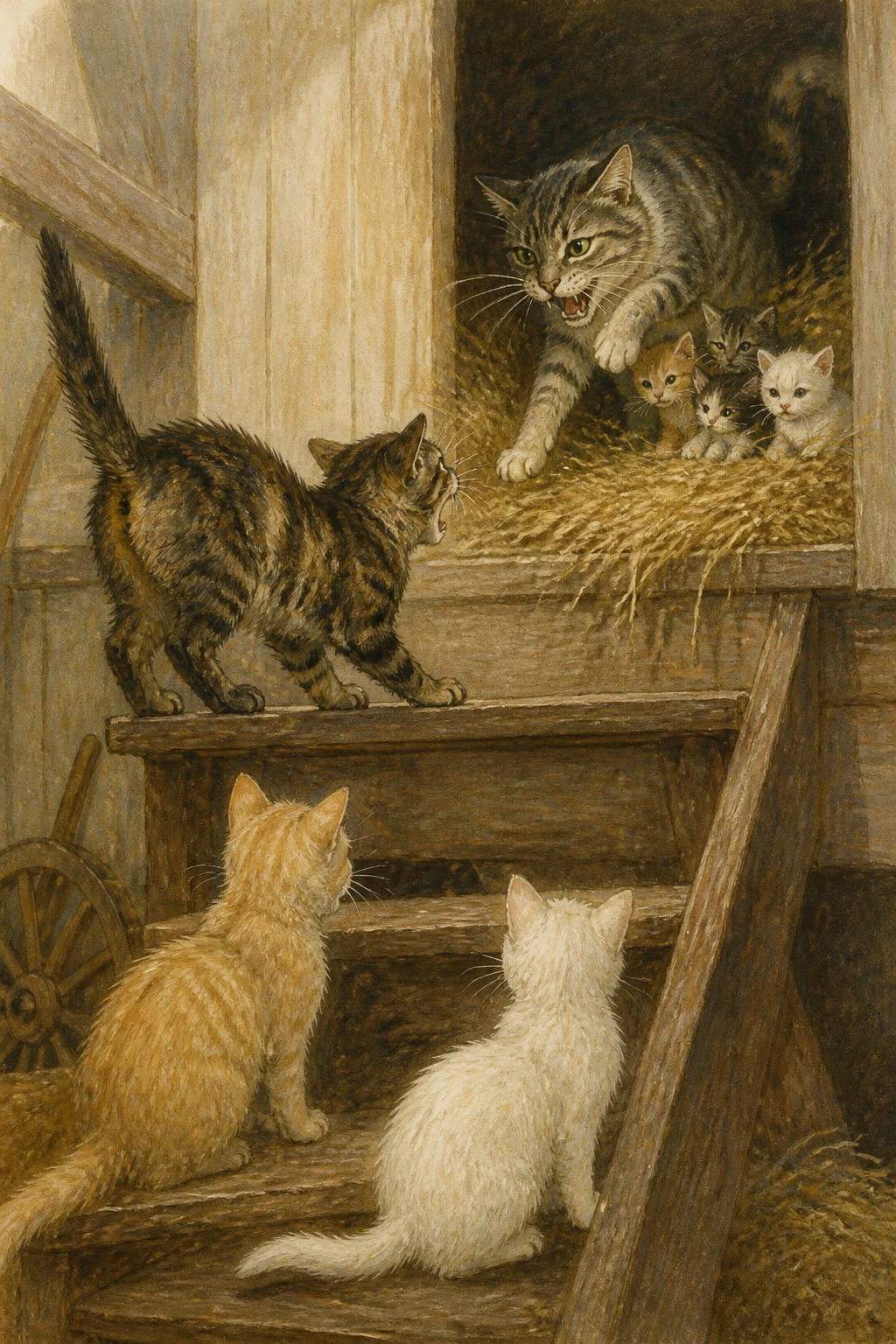
This gave rise to quarrels between niece and aunt. The old woman called her a sanctimonious hypocrite and a wafer-gobbler, and the girl would burst into tears like one of God's blessed innocents, which only enraged the harridan further and made her shout: “Hypocrite! You won't wheedle me with your holy little airs. What's all this sniveling for? You're like Juan Molleja's dog, whining before the stick has even landed. So, a convent, is it? Let anyone who doesn't know you buy you, you little sack of cockroaches! Anyone would think you wouldn't break a plate, and yet you're capable of scratching out the eyes of Grano de Oro the hangman. As though I didn't know the grapes in my own vineyard! So beards offend your delicate nose? Look at Miss Priss of Jurquillos, who washed the bones before frying them! Well, you'll see some sport when I get my claws on the smooth-cheeked fellow who's turned your head! Look, just look at Mari-Ramos's kitten, who turned up her nose at mice and gobbled down worms! A curse on the precious little miss!”
Since these squabbles were their daily bread, the neighborhood girls, envious of Benedicta's beauty, took to calling her Mari-Ramos's Kitten; and soon, throughout the parish, the young lads and other gawky boys who met her coming out of high mass would say:
“How sweet and demure Mari-Ramos's Kitten looks!” The truth of the matter is that the aunt's suspicions were not far off the mark. A dandy named Don Aquilino de Leuro was the cause of her niece's heartache; and whether he grew exasperated at forever being at loggerheads over trifles, or his love had reached the point of trampling every propriety and sending the whole business to the devil, the fact is that one night there happened... what was bound to happen. Mari-Ramos's kitten slipped away over the roof, in the loving company of a sprightly tomcat who smelled of musk and had soft hands.
II Let time take its course, and let us have no fiddle-faddle or beating about the bush. Which is to say that while the lovers drain their honeymoon to make way for their moon of gall, we may, dearest reader, insert our customary little historical paragraph.
His Excellency Don Teodoro de Croix, Chevalier de Croix, commander of the most distinguished Teutonic Order in Germany, captain of the Walloon Guards, and lieutenant general of the royal armies, made his entry into Lima on April 6, 1784.
For many years he had served in Mexico under his uncle, the viceroy Marquis de Croix; and after he returned to Spain, Charles III appointed him his representative in these kingdoms of Peru. “His Excellency,” says a chronicler, “was a man of eminent virtue, particularly distinguished for his charity, for on several occasions he was left holding a candle in his hand because he had given the silver candlestick to the poor, having no money at hand with which to assist them. He frequently received the sacraments and was a true Christian.”
The administration of the Chevalier de Croix, known as the Fleming, was of great benefit to the country. The viceroyalty was divided into seven intendancies, and these into districts or subdelegations. The Royal Audiencia of Cuzco and the Mining Tribunal were established, the valleys of Víctor and Acobamba were repopulated, and the exemplary Bishop Chávez de la Rosa founded in Arequipa the famous orphanage which has since given the republic more than a few illustrious men.
It was then that the first vessel of the Philippine Company arrived at Callao, consigned to the Count of San Isidro; and to demonstrate the great expansion of trade during Croix's five years in office, it is enough to record that imports rose to forty-two million pesos and exports to thirty-six million.
State revenues amounted to a little over four and a half million, and expenditure did not exceed that sum, so that for the first and only time among us, the phenomenon of a balanced budget became a reality. It is true that, to achieve this, the viceroy resorted to economies, reducing the number of officials, cutting salaries, disbanding the Soria and Extremadura battalions, and reducing his escort to a third of the force maintained by his predecessors since Amat.
The quarrel between the Marquis of Lara, intendant of Huamanga, and Señor López Sánchez, bishop of the diocese, was the scandal of the age. Casting off his priestly meekness, His Lordship allowed his bile to overflow to the point of slapping the royal notary who was serving him with an order. The case ended, to the angry prelate's discredit, with a ruling by the Council of the Indies.
Lorente, in his History, relates an incident bearing some resemblance to the trial of the false nuncio of Portugal. “A poor Galician,” he says, “who had come out as a soldier and subsequently pursued the unprofitable trades of peddler and furniture broker, burdened with family, wants, and years, remembered that he was the natural son of a brother of the cardinal patriarch, president of the Council of Castile. To exploit the foolishness of the rich, he pretended to receive letters from the king and other exalted personages, which he had a Mercedarian friar answer for him. The deception could hardly have been cruder, and yet he deceived several people with it. When the imposture was discovered and he was threatened with torture, he confessed everything. His masquerade was deemed a crime against the state, and in view of mitigating circumstances he was sentenced to ten years in a penal fortress, while his accomplice the friar was sent to Spain under official custody.”
The learned Don Hipólito Unanue, who wrote scholarly articles under the pseudonym Aristeo in the celebrated Mercurio peruano; the eloquent Mercedarian friar Cipriano Jerónimo Calatayud, who signed his writings in the same paper with the name Sofronio; the eminent physician Dávalos, so highly praised by the University of Montpellier; the priest Rodríguez de Mendoza, known for his vast learning as the Bacon of Peru, and rector of San Carlos for thirty years; the Andalusian poet Terralla y Landa, and other no less distinguished men made up His Excellency's circle. Yet despite his enlightenment and the prestige of so intelligent a gathering, he issued strict orders to prevent the works of the Encyclopedists from entering the country.
This viceroy, so passionately fond of the caustic and libertine poet of riddles, could not endure the fact that the Augustinian friar Juan Alcedo should bring him a manuscript in person and recommend that he read it. It was a satire, in mediocre verse, on the conduct of the Spaniards in America. His Excellency declared the presumption an affront to his person, and the poor son of Apollo was banished to the mother country as a warning to grumbling friars and insipid poets.
The Chevalier de Croix sailed for Spain on April 7, 1790, and died in Madrid in 1791, shortly after reaching his homeland. III “Any eggs?” “Try the next corner.”
(Popular saying.) Well, gentlemen, now that I have written this summary of the ruler's administration, I shall not leave in my inkwell the origin of a game known to every boy in Lima, since it is connected with His Excellency. I shall add nothing of my own, for the colleague at La Broma [3] who told me the story you are about to read is a truthful man.
[Note 3: La Broma was a humorous newspaper published in Lima in 1878.] The fact is that His Excellency Don Teodoro de Croix was in the habit of having four fresh, soft-boiled eggs for breakfast every day; and he was so particular on this point that his steward, Julián de Córdova y Soriano, was charged with choosing and buying the eggs himself every morning.
But if the viceroy was particular, the steward carried his niggling and his stinginess so far as to haggle with the shopkeepers to save a trifle on the purchase. At the same time, he insisted on choosing the largest and heaviest eggs, bringing a ring along to test them and also putting them on the scales. If an egg passed through the ring or weighed a dram less than another, he rejected it.
He so annoyed the shopkeepers at the corners of Arzobispo, Palacio, Las Mantas, and Judíos that one day, when they were gathered at the town hall to elect an inspector of weights, the conversation turned to the steward Don Julián de Córdova y Soriano, and the aforesaid shopkeepers agreed to sell him no more eggs.
The day after this agreement, Don Julián appeared at one of the shops, and the assistant told him: “No eggs, Señor Don Julián. Try the next corner.”
The steward received the same answer at all four corners and had to go farther afield to make his purchase. Before long, the shopkeepers within eight blocks of the square were sick of the fussy Don Julián and adopted the same resolution as their four comrades.
Someone was sure to tell the viceroy of his steward's wanderings and difficulties in obtaining fresh eggs, and one day, when His Excellency was in a good humor, he said to him:
“Julián, where did you buy the eggs today?” “At the corner of San Andrés.” “Then tomorrow you'll go to the next corner for them.” “Sure enough, sir, and the day will come when I'll have to go looking for them in Jetafe.”
Having related the origin of the children's egg game, I think I may leave the viceroy in peace and return to our tale. IV A proverb says that both a mule and patience wear out if hurried, and we think the same of love. Benedicta and Aquilino hurried so much that, six months after their elopement, the gallant, now sated, took French leave—that is, without so much as a goodbye, leaving the cheese for the mice to breakfast on—and carried his person off to Cerro de Pasco, a flourishing mining center at the time. Benedicta spent days and weeks waiting for the smoke to return, or, in other words, the ingrate who had left her as bare as a door bolt; until, convinced of her misfortune, she resolved not to return to her aunt's house but to rent a set of mezzanine rooms on Alameda Street.
In her new dwelling, our kitten led a most mysterious life. She kept herself shut away and avoided any acquaintance with the neighbors. On Sundays she went out to dawn mass, bought her provisions for the week, and did not set foot in the street again until Thursday at nightfall, when she delivered and collected her work. Benedicta was seamstress to the Marchioness of Sotoflorido, earning eight pesos a week.
But however secluded Benedicta's life, and however closely she hid her face in the folds of her mantle when she went out, this veiled lady cannot have looked like a sack of straw to a neighbor in the room with the barred window. Whenever he caught sight of her, he took to firing a couple of flirtatious remarks at her point-blank, mingled with sighs enough to drive a granite statue out of its wits.
Some names seem an irony, and one of them was that of her neighbor Fortunato, who, where feminine conquests were concerned, might well have passed for the most unfortunate of mortals. He had an itch for every girl in the parish of San Lázaro, and they troubled themselves and thought about him just as much as they did about the cock of the Passion—which, served with fluffy rice, mirasol chili, and coriander, must have made a finger-licking stew.
The fellow—not the cock of the Passion, but Fortunato—was what is known as a poor devil, with a tolerable pair of side-whiskers and good blood in his veins, for he was reputed to be the natural son of the Count of Pozosdulces. He worked as a copyist in the government's chief notarial office, whose chief notary was then the Marquis of Salinas. The marquis paid our young man twenty hard dollars a month, gave him a respectable Christmas bonus, and turned a blind eye when the lad contrived to obtain what are known in bureaucratic jargon as lawful pickings.
It must be said that Benedicta never paid the slightest attention to her neighbor's billing and cooing, never cast him a furtive glance, and never even opened her lips to dismiss him with: “Forgive me, brother, and knock at another door, for this one offers no lodging to pilgrims.”
But one night, returning from delivering her sewing, the young woman found Fortunato beneath the doorway of the house, and before he could launch into one of his customary compliments, she spoke in a voice as sweet and silvery as a shower of pearls, which must have sounded like heavenly music to the lovesick youth:
“Good evening, neighbor.” The pen-pusher, who was a sly young fellow and fond of a jest, said into his shirt collar: “At last this little lady has struck her colors and wants to parley. Clearly I have a certain something, a certain charm for the ladies, and once I wink my left eye at one of them—the eye on the side of the heart—she has no choice but to admit defeat.”
“I conquer every woman's pride; no Saguntum or Numantia can hold out against me...” And with the swagger of a tough fellow and a conqueror, he followed the seamstress without further ado to her mezzanine door. The key was stiff, and the young man, being a gentleman, could not allow the girl to hurt her hand. Gratitude for so great a service required Benedicta, half blushing and half pleased, to murmur: “Do come in, though my home is hardly worthy of you.”
We suppose that this, or something like it, must have happened, and that Fortunato did not have to be told twice that he might enter paradise, for such, to any lover, is a private chat with a girl as delicious as a sweet almond. He was passionate and eloquent:
“Words of love are the beads of a necklace: once the first comes out, all the others follow.” She, with broken phrases and little affectations, gave him to understand that her heart was not made of brick and mortar, but that, since men were such rogues and so deceitful, one had to take one's time and gain confidence before venturing into a game in which almost every card turned against one. He swore, by a whole Calvary of crosses, not only to love her eternally but all the other nonsense customarily sworn on such occasions; and to celebrate the adventure, he added that he had in his room two bottles of the exquisite muscatel sent as a gift to His Excellency the viceroy. Swift as a rocket, he went downstairs and came back up armed with the aforesaid bottles.
Fortunato would not have sold his victory for a penny less than its full value. The family living on the main floor was away in the country, and there was not even the excuse of a scandal to fear. Adam and Eve had been no more alone in paradise when they plotted that little prank whose consequences their offspring, without having had any hand in it, are still paying for, century after century, with no end to the debt in sight. Besides, our gallant was counting on reinforcements from the muscatel; and, as the proverb has it, God made Cañete from less, and undid him with one blow.
He was already draining his second glass, seeking the courage to launch a decisive attack, when the clock on the bridge began to strike ten, and Benedicta cried out in great agitation and distress:
“My God! We're lost! Go into this other room, and whatever happens, not a word, and don't try to come out until I fetch you.”
Fortunato was not distinguished for bravery and would gladly have taken to his heels; but hearing footsteps in the courtyard, he broke out in gooseflesh and, as meekly as a child, allowed himself to be locked in the adjoining room.
V Let us open a brief parenthesis to relate what had happened a few hours earlier. At seven that evening, as Benedicta passed the corner of Palacio, she met Aquilino. Far from reproaching him for his conduct, she spoke to him affectionately; and for brevity's sake, let us say that, since where there has been fire some embers always remain, the lover asked for and obtained a rendezvous at ten that night.
Benedicta knew that the ingrate had abandoned her to marry the daughter of a wealthy mine owner; and from that moment she had sworn, by God and her own soul, to live for revenge. When she met Aquilino that evening and agreed to see him, the woman's fertile imagination swiftly devised her plan. She needed an accomplice, remembered the pen-pusher, and there you have the secret of her sudden flirtatiousness toward Fortunato.
Now let us return to the mezzanine. VI Between the two reconciled lovers there were neither complaints nor recriminations, only words of love. Not a word about the past, nothing about the faithlessness of the young man who was deceiving her yet again, concealing the fact that he was no longer free and promising never to leave her again. Benedicta pretended to believe him and intoxicated him with caresses, the better to secure her revenge.
Meanwhile, the muscatel was playing a terrible part. Benedicta had put a narcotic into her seducer's glass. Here the proverb fits: supper has killed more than Avicenna ever cured.
Once Leuro had succumbed to its soporific influence, the young woman bound him tightly to the posts of her bed, drew out a dagger, and waited impassively for an hour until the drug's power began to fade.
At midnight she moistened her handkerchief with vinegar and passed it over the drugged man's forehead, and then the horrible tragedy began. Benedicta was both tribunal and executioner.
She flung the vileness of his conduct in Aquilino's face, rejected his excuses, and then told him: “You are condemned! You have one minute to think of God.”
And with a steady hand she plunged the blade into the heart of the man she had loved so much... The poor copyist was trembling like a leaf. He had heard and seen everything through a hole in the door.
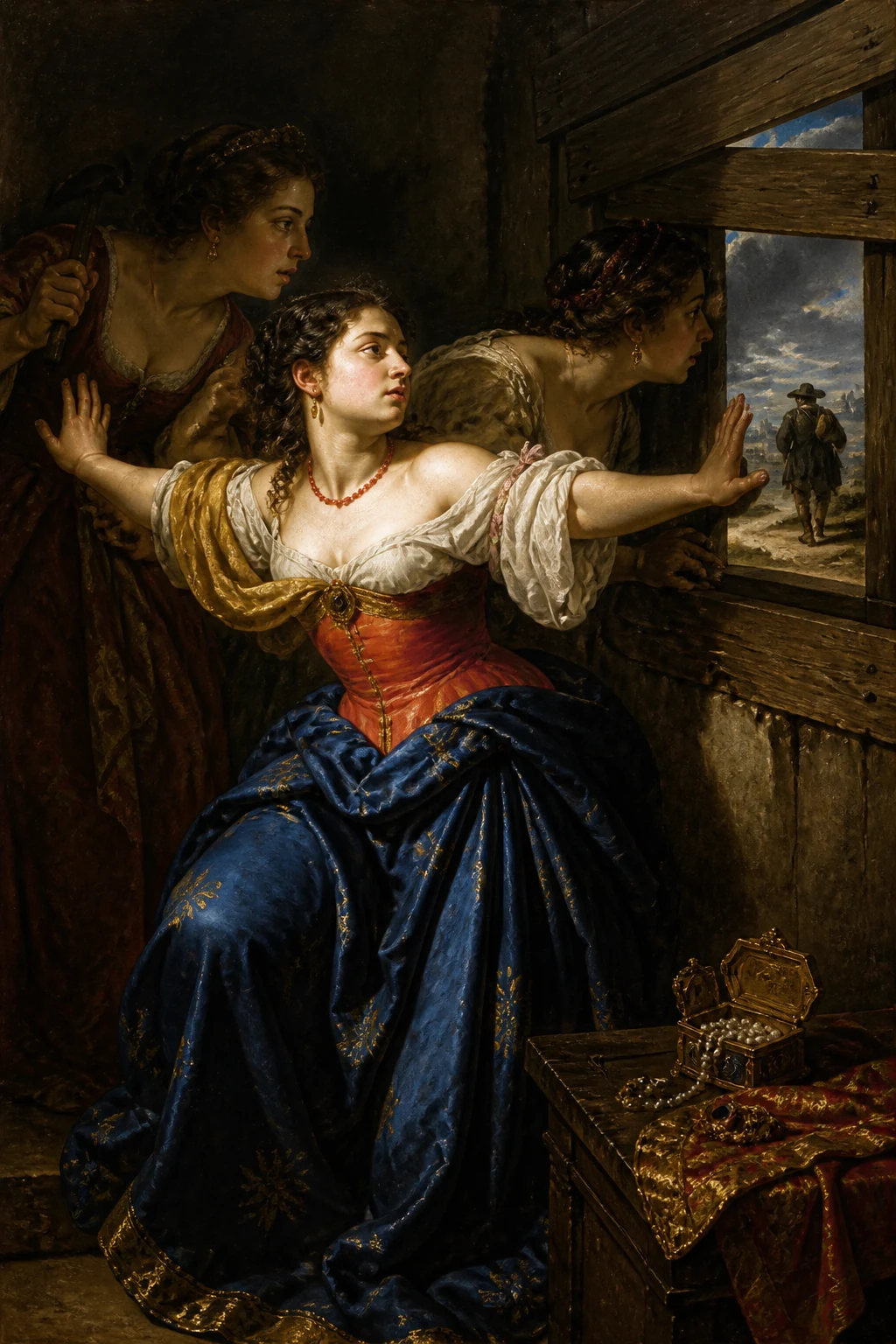
Her revenge accomplished, Benedicta turned the key and released him from his confinement. “If you aspire to my love,” she told him, “begin by being my accomplice. You shall have your reward when this body has disappeared from here. The street is deserted, the night is dark, the river runs in front of the house... Come and help me.”
And to overcome every hesitation in the terrified young man's mind, that woman, a demon's soul incarnate in an angel's form, sprang like a panther leaping on its prey and pressed a burning kiss upon Fortunato's lips.
The spell was complete. That kiss carried the contagion of crime into the young man's blood and conscience. If today, with gas lamps and a much larger police force, it takes a bold man to venture along the Alameda de Acho after eight at night, the reader may imagine what the place was like in the last century, when even the central streets of the city had acquired lighting only in 1776.
The darkness that night was dreadful. It seemed as though nature itself was taking a share in the crime. The small door of the house opened a crack, and Fortunato cautiously emerged, carrying Aquilino's corpse on his shoulder, sewn into a blanket. Benedicta followed him, and while with one hand she helped support the weight, with the other, armed with a needle and coarse thread, she sewed the blanket to the young man's coat. His anxiety and the darkness served as accomplices to a new crime.
The living shadows reached the foot of the river parapet. Fortunato, with his funereal burden on his shoulders, climbed the adobe wall and leaned forward to throw the corpse into the water.
Horror!... In its fall, the dead man dragged the living one after him. Three days later, some fishermen found the body of the unfortunate Fortunato on the beaches of Bocanegra. His father, the Count of Pozosdulces, and his employer, the Marquis of Salinas, suspecting that the young man had fallen victim to an enemy, had a man arrested on whom there rested we know not what suspicions of ill will toward the deceased.
And the months went by, and the case moved at a snail's pace, and the poor devil found himself entangled in a maze of accusations, and the prosecutor saw the clearest evidence where everyone else found chaos, and the judge wavered between sentencing him to the gallows or to prison.
But Providence, which watches over the innocent, has mysterious means of bringing crime to light. Benedicta, dying and consumed by remorse, revealed everything to a priest, begging him to make her confession public in order to save the imprisoned man; and that is how, in the form of a court record, the dark legend of Mari-Ramos's Kitten has come beneath our chronicler's pen.