Prevod
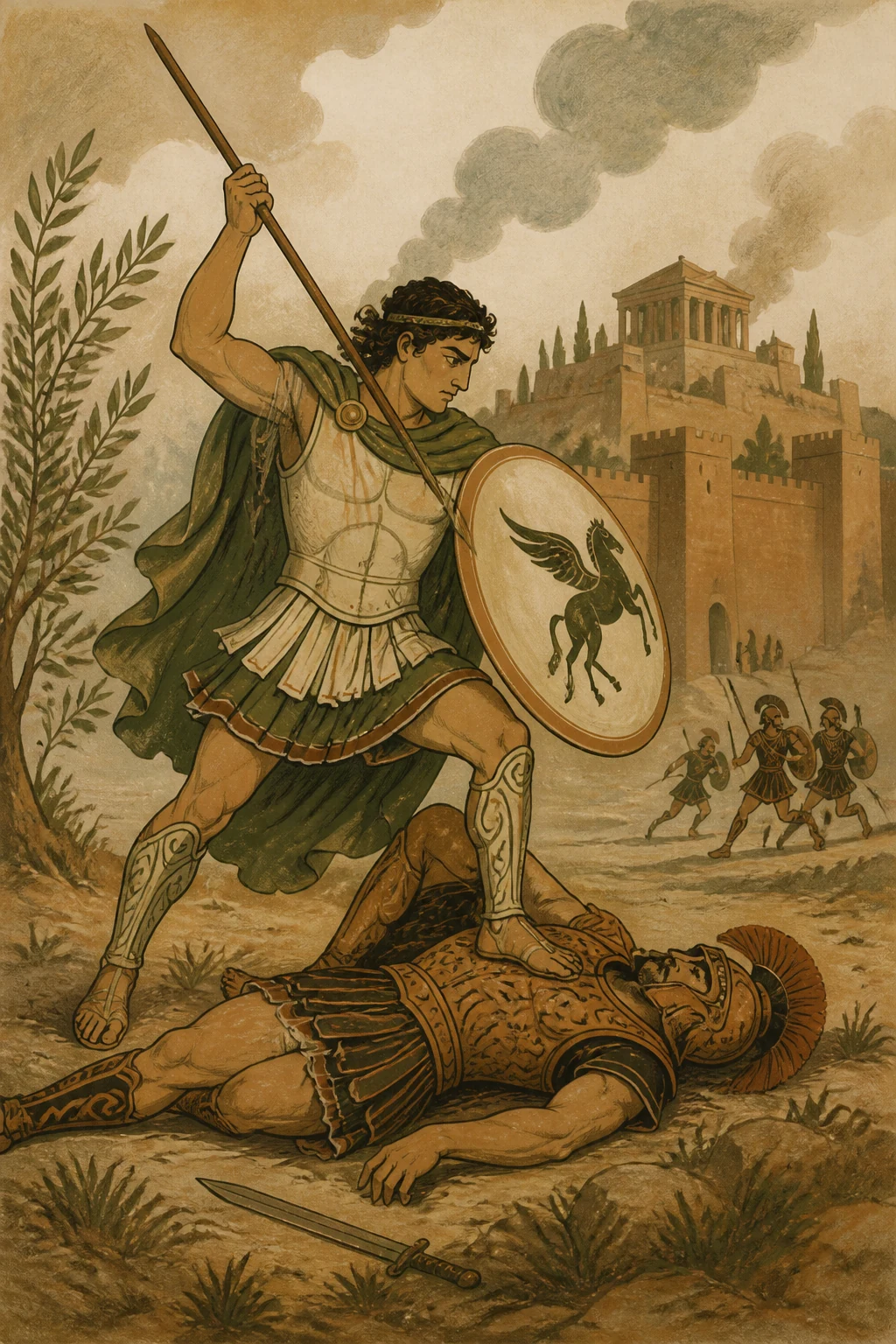
1. After Heracles had passed into the company of the gods, his children fled from Eurystheus and came to Ceyx. But when Eurystheus demanded their surrender and threatened war, they took fright, left Trachis, and fled through Greece. Pursued, they reached Athens, where they seated themselves at the altar of Mercy and begged for help. The Athenians refused to surrender them and undertook a war against Eurystheus. They killed his sons Alexander, Iphimedon, Eurybius, Mentor, and Perimedes. Eurystheus himself fled in a chariot, but Hyllus pursued him and killed him as he was driving past the Scironian Rocks. He cut off his head and gave it to Alcmene, who gouged out his eyes with weaving pins.
2. After Eurystheus had perished, the Heraclids came to the Peloponnese and captured all its cities. But a year after their return, a pestilence swept through the whole Peloponnese, and an oracle declared that the Heraclids were the cause, for they had returned before the appointed time. They therefore left the Peloponnese, withdrew to Marathon, and settled there.
Now, before they left the Peloponnese, Tlepolemus had unintentionally killed Licymnius: while he was striking a servant with his staff, Licymnius had run between them. He fled with a considerable band of followers to Rhodes and settled there. Hyllus married Iole in accordance with his father's instructions and sought to bring about the return of the Heraclids. He therefore went to Delphi and asked how they might return. The god told them to wait for the third harvest before returning. Hyllus took “the third harvest” to mean three years, and after waiting that long, he marched into the Peloponnese with the army of Heracles, while Tisamenus, son of Orestes, was king of the Peloponnesians. Another battle took place; the Peloponnesians prevailed, and Aristomachus was killed. When the sons of Cleodaeus had grown to manhood, they consulted the oracle about their return. The god gave the same answer as before, and Temenus reproached him, saying that obedience to this advice had brought them disaster. But the god replied that they themselves were to blame for their misfortunes, since they had failed to understand the oracles. By the third harvest he had meant the third generation, not the third harvest of the earth; and by the narrow passage he had meant the broad-bellied sea to the right of the Isthmus. On hearing this, Temenus made ready his army and built ships at the place in Locris now called Naupactus from that shipbuilding. While the army was there, Aristodemus was struck by lightning and died, leaving twin sons, Eurysthenes and Procles, by Argeia, daughter of Autesion.
3. Disaster also befell the army at Naupactus. A seer appeared among them, uttering oracles in a divine frenzy, and they took him for a sorcerer sent by the Peloponnesians to bring ruin upon the army.
Hippotes, son of Phylas, son of Antiochus, son of Heracles, hurled a javelin at him and killed him. After this, the fleet was lost, its ships destroyed, while the land army suffered from famine, and the force broke up. Temenus consulted the oracle about the disaster, and the god declared that these things had happened because of the seer's death. He ordered them to banish the killer for ten years and take a three-eyed man as their guide. So they banished Hippotes and searched for the three-eyed man. They came upon Oxylus, son of Andraemon, riding a one-eyed horse, whose other eye had been shot out by an arrow. Oxylus had fled to Elis after committing a killing and was now, after a year's absence, returning from there to Aetolia. Understanding the oracle, they made him their guide. They engaged the enemy and defeated them both on land and at sea, killing Tisamenus, son of Orestes. Pamphylus and Dymas, the sons of Aegimius, also died fighting as their allies.
4. Once they had gained control of the Peloponnese, they set up three altars to Ancestral Zeus, offered sacrifices upon them, and cast lots for the cities. The first lot was for Argos, the second for Lacedaemon, and the third for Messene. They brought a jar of water and agreed that each should cast a token into it. Temenus and the sons of Aristodemus, Procles and Eurysthenes, put in stones, but Cresphontes, wishing to obtain Messene, put in a clod of earth. When it dissolved, only the other two lots could be drawn. The lot of Temenus came out first, and that of the sons of Aristodemus second, so Cresphontes received Messene.
5. On the altars where they had sacrificed, they found omens: those who had drawn Argos found a toad, those who had drawn Lacedaemon a serpent, and those who had drawn Messene a fox. Interpreting these signs, the seers said that those who had found the toad would do best to remain in their city, since the creature had no strength when on the move; those who had found the serpent would be formidable in attack; and those who had found the fox would be crafty. Now Temenus passed over his sons Agelaus, Eurypylus, and Callias, and bestowed his favour on his daughter Hyrnetho and her husband Deiphontes. His sons therefore hired men to murder their father. After the murder, however, the army ruled that Hyrnetho and Deiphontes should hold the kingdom. Cresphontes had reigned over Messene only a short time when he was murdered along with two of his sons. Polyphontes, himself one of the Heraclids, became king and married Merope, the murdered man's wife, against her will. But he too was killed. For Merope had a third son, named Aepytus, whom she had entrusted to her own father to bring up. When he reached manhood, he returned in secret, killed Polyphontes, and recovered his father's kingdom.