Prevod
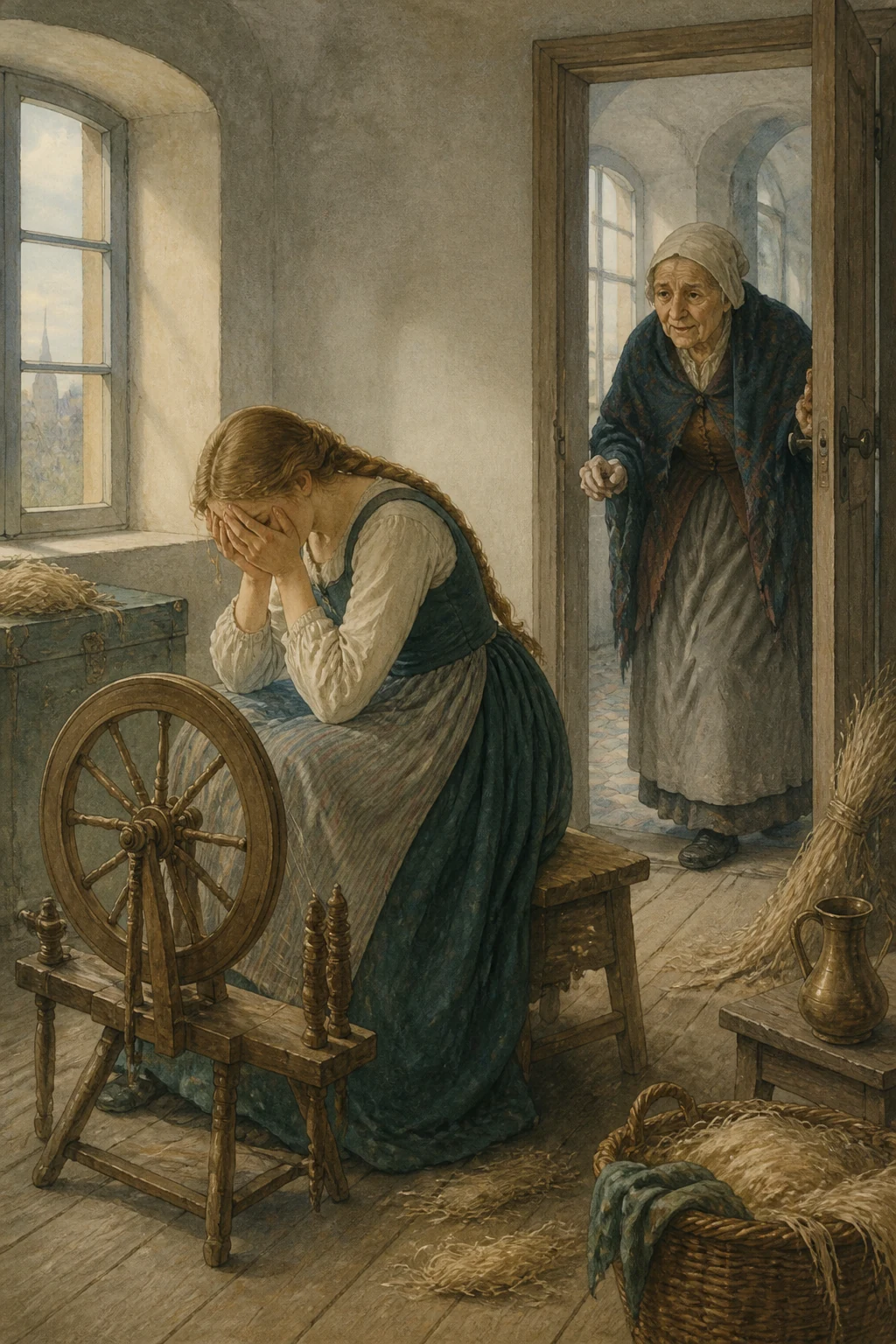
Once upon a time there was a girl whose father and mother died when she was still a little child. At the far end of the village, her godmother lived all alone in a little cottage, earning her living by spinning, weaving, and sewing. The old woman took the orphaned child into her home, taught her to work, and brought her up in all piety. When the girl was fifteen, the old woman fell ill, called the child to her bedside, and said, “Dear daughter, I feel that my end is drawing near. I leave you this little cottage, where you will be sheltered from wind and weather, and also my spindle, shuttle, and needle, with which you can earn your bread.” Then she laid her hands on the girl’s head, blessed her, and said, “Only keep God in your heart, and all will be well with you.” With that she closed her eyes, and when she was laid to rest, the girl walked behind the coffin, weeping bitterly, and paid her last respects.
The girl now lived all alone in the little house. She worked diligently, spinning, weaving, and sewing, and the good old woman’s blessing rested on everything she did. It was as though the flax in the storeroom multiplied of its own accord, and whenever she had woven a piece of cloth or a carpet, or sewn a shirt, a buyer was soon found who paid handsomely for it, so that she wanted for nothing and still had something to share with others.
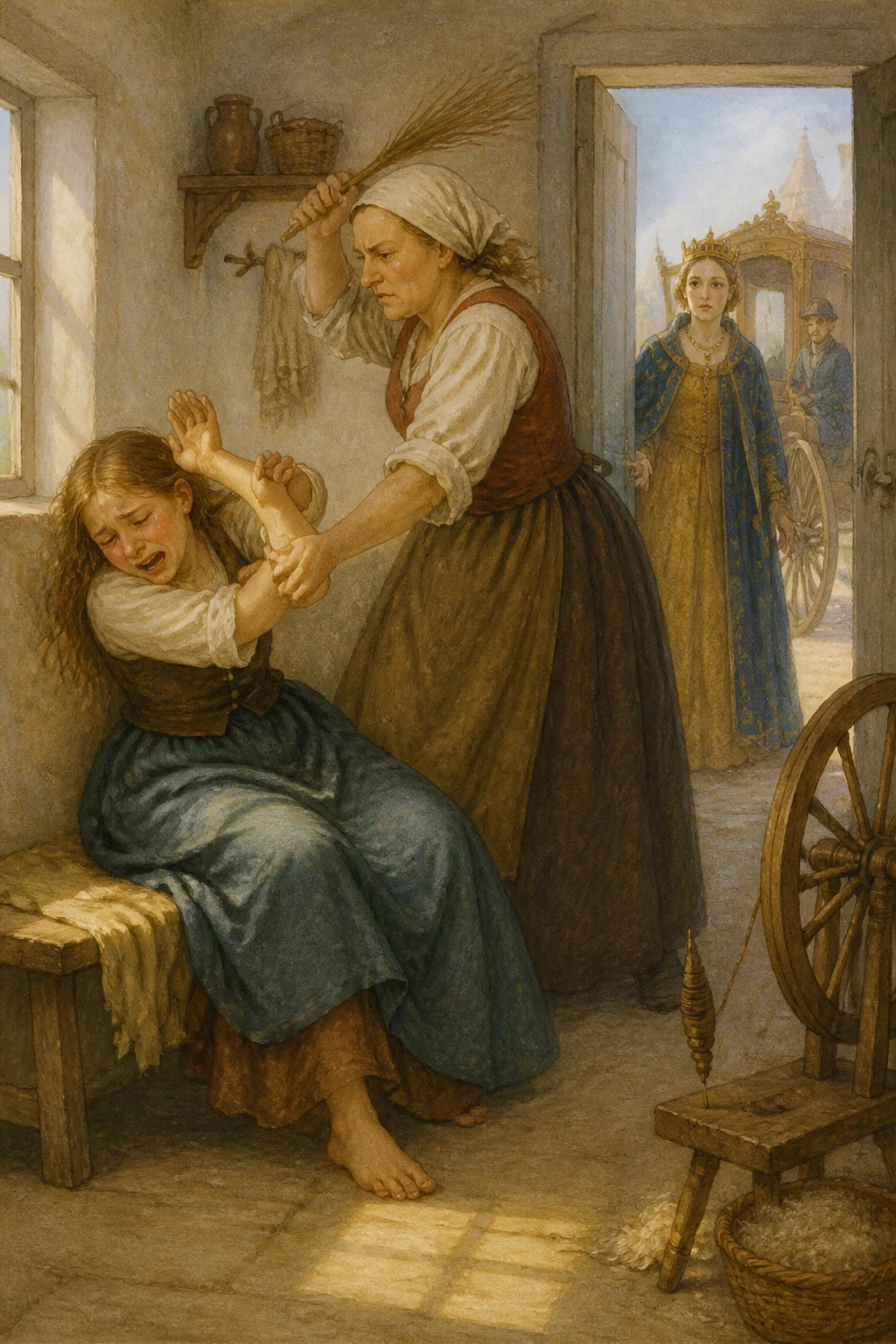
At about this time, the king’s son was travelling through the country in search of a bride. He was not supposed to choose a poor girl, and he did not want a rich one. So he said, “The girl who is both the poorest and the richest shall be my wife.” When he came to the village where the girl lived, he asked, as he did everywhere, who was the richest and who the poorest person in the place. They named the richest girl first; the poorest, they said, was the girl who lived in the little house at the very end of the village. The rich girl sat outside her door in all her finery, and as the king’s son approached, she rose, went to meet him, and bowed before him. He looked at her, said not a word, and rode on. When he reached the poor girl’s house, she was not standing at the door but sitting in her little room. He reined in his horse and looked through the window, where the bright sunshine streamed in, and saw her sitting at her spinning wheel, spinning busily. She looked up, and when she noticed the king’s son peering in, she blushed crimson, lowered her eyes, and went on spinning. Whether the thread came out quite even this time, I cannot say, but she spun until the king’s son had ridden away. Then she went to the window, opened it, and said, “It is so hot in this room,” but she gazed after him as long as she could still make out the white feathers in his hat.
The girl sat down to her work in the little room again and went on spinning. Then she remembered a rhyme the old woman had sometimes recited while she sat at her work, and she sang softly to herself:
“Spindle, spindle, off you roam, bring the suitor to my home.” What happened then? The spindle sprang from her hand at once and out through the door; and when she rose in astonishment and looked after it, she saw it dancing merrily away across the fields, trailing a gleaming golden thread behind it. Before long it had vanished from sight. Since she no longer had a spindle, the girl took up her shuttle, sat down at the loom, and began to weave.
But the spindle danced on and on, and just as the thread ran out, it reached the king’s son. “What is this I see?” he cried. “Does the spindle mean to show me the way?” He turned his horse and rode back along the golden thread. Meanwhile, the girl sat at her work and sang:
“Shuttle, shuttle, weave away, bring my suitor in to stay.” At once the shuttle sprang from her hand and out through the door. Just beyond the threshold it began to weave a carpet more beautiful than any ever seen. Roses and lilies bloomed along both sides, and in the middle, against a golden ground, green tendrils climbed, with hares and rabbits leaping among them. Stags and deer stretched their heads between the vines, and colourful birds perched in the branches above; all that was wanting was their song. The shuttle darted to and fro, and it seemed as though everything were growing of its own accord.
Since the shuttle had run away, the girl had sat down to sew. She held the needle in her hand and sang, “Needle, needle, sharp and fine, make the house for my suitor shine.”
Then the needle sprang from her fingers and flew about the room as swiftly as lightning. It was just as though invisible spirits were at work: in an instant, the table and benches were covered with green cloth, the chairs with velvet, and silken curtains hung at the windows. Scarcely had the needle made its final stitch when the girl saw through the window the white feathers in the hat of the king’s son, whom the spindle had led there along the golden thread. He dismounted, walked across the carpet into the house, and when he entered the room, the girl stood there in her poor dress, yet she glowed in it like a rose upon the bush. “You are both the poorest and the richest,” he said to her. “Come with me; you shall be my bride.” She said nothing, but held out her hand to him. Then he kissed her, led her outside, lifted her onto his horse, and took her to the royal castle, where their wedding was celebrated with great joy. The spindle, shuttle, and needle were kept in the treasury and held in great honour.