Waltey
Spet kačji ženin
Srpske narodne pripovijetke · Vuk Stefanović KaradžićO besedilu
Spet kačji ženin
- Vir
- Srpske narodne pripovijetke
- Avtor
- Vuk Stefanović Karadžić
- Jezik branja
- English
- Jezik izvirnika
- Српски
- Čas branja
- 10 min branja
- Obseg
- 8 strani
- Naslov izvirnika
- 010 Опет змија младожења
O izvirniku
Srpske narodne pripovijetke
Srbske ljudske pripovedi o junakih, čudežnih bitjih, preizkušnjah in ljudski modrosti. Bralni jezik je English, izvirnik pa prihaja iz vira Srpske narodne pripovijetke v jeziku Српски.
Besedilo
Spet kačji ženin
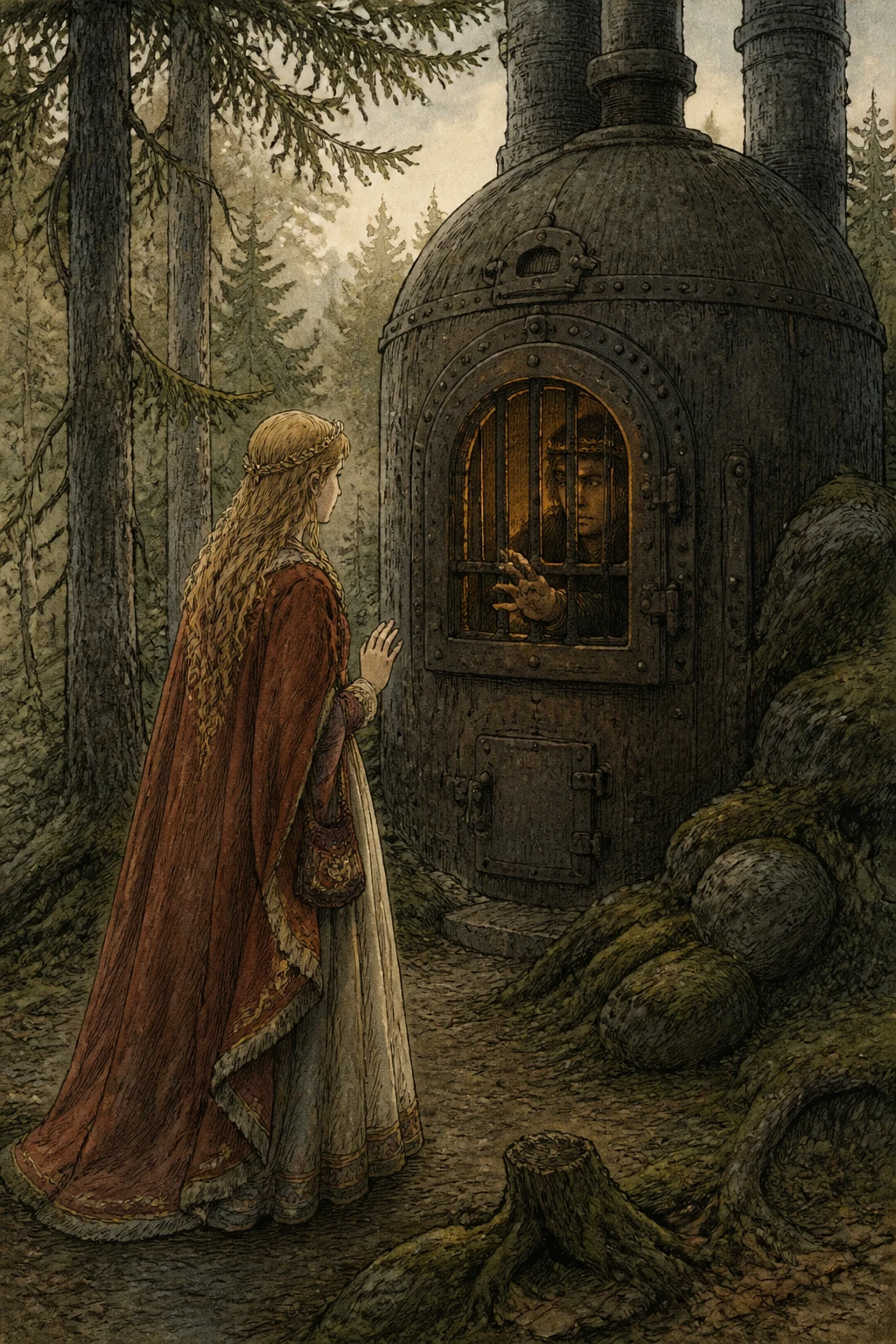
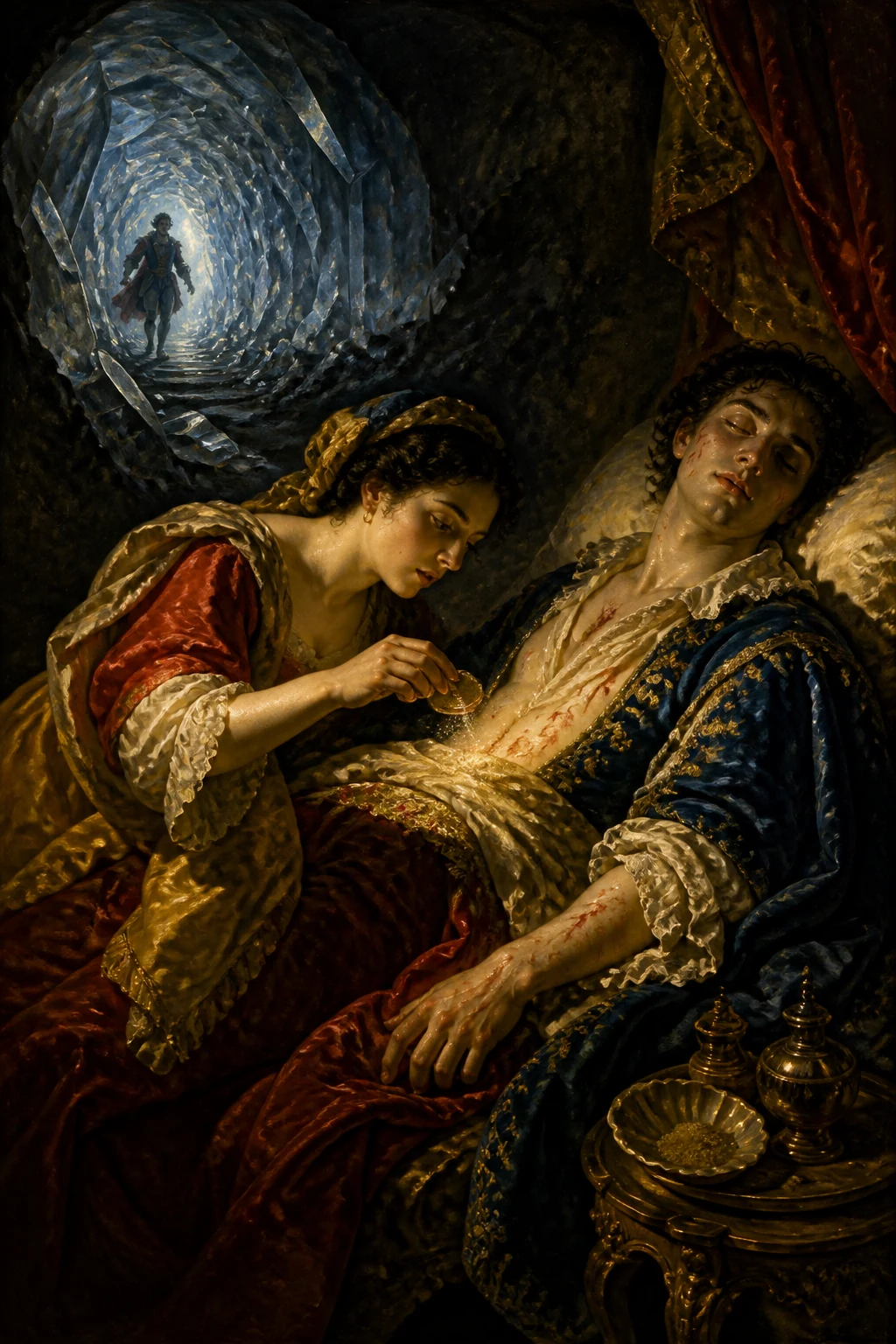
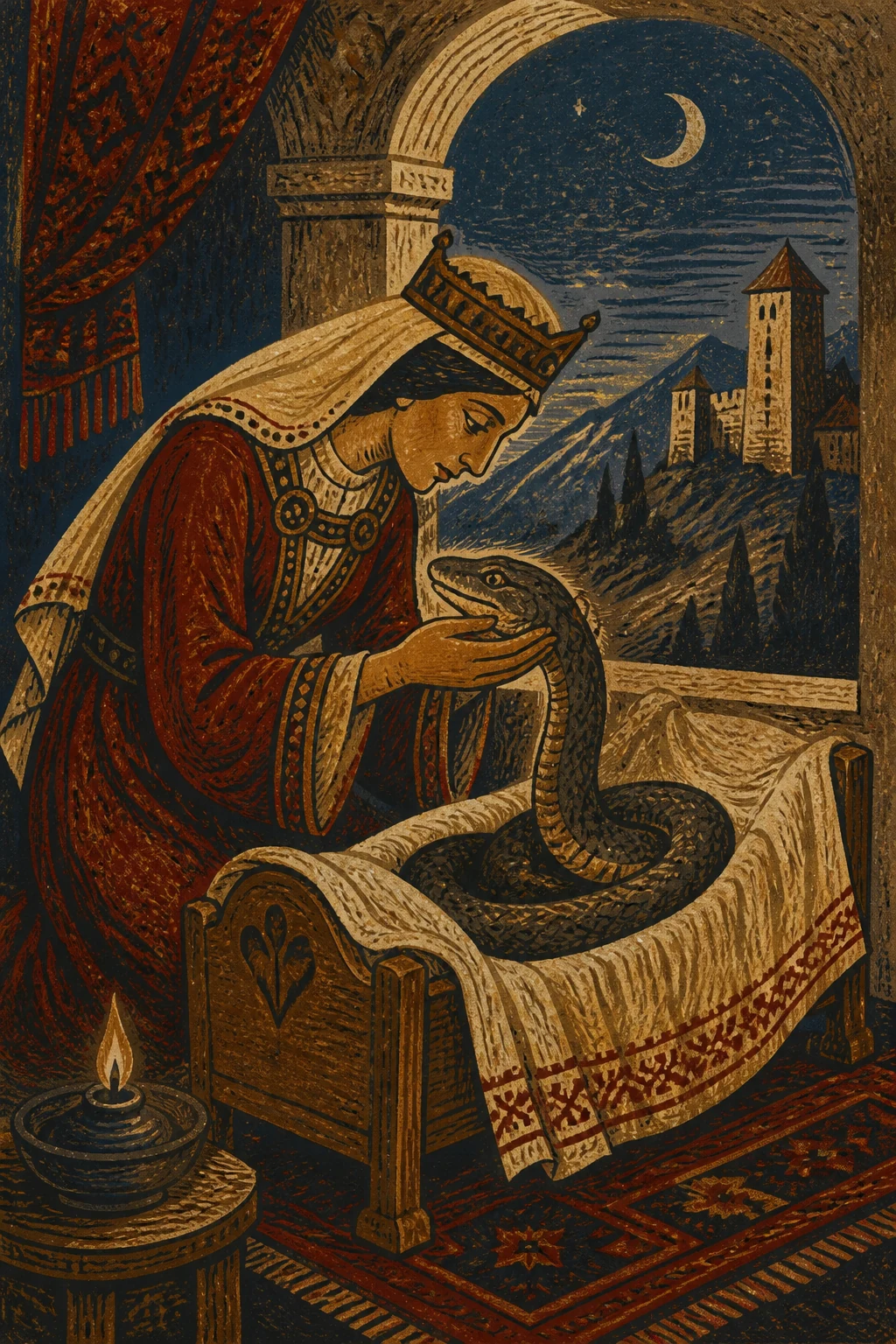
There was once an empress who had no child of her own, and she prayed continually to God to let her bear one. One evening, as she prayed, she sighed and said, “Only grant me a child of my own, O God, even if it should be a venomous snake!” Some time later she found herself with child, and when her time came, she gave birth to a snake. She began to tend it, feed it, and nurse it at her breast, as any mother would her child. For twenty-two years the snake made no sound at all, but when those twenty-two years were over, it spoke and said to its father and mother, “Now I want you to find me a wife.” They answered, “Who would give his daughter to a snake, and what maiden would marry one?” “Well,” the snake replied, “do not look among the daughters of emperors or noblemen, but for one who would be glad to come and live in a palace.” His father and mother then told him to choose for himself whichever girl he wished. So he found a poor girl and sent his father to ask for her hand. His father went and made the proposal, and the girl, living as she did in poverty, accepted gladly and joyfully. They gave her a betrothal ring, brought her to the palace, and married them. The snake began to live with his bride, and before long she was with child. Then her mother-in-law said to her, “For heaven’s sake, daughter, how did you come to be with child by a snake?” At first she would not tell her, but when her mother-in-law pressed her with the same question for several days, she at last said that he was no snake, but a young man whose equal in beauty could not be found in all the world. “By day,” she said, “he is a snake, but as soon as evening comes, he slips off his snakeskin and steps out a young man, the fairest in the world. If only he were by day what he is at night! But as soon as dawn begins to break, he slips back into his skin and becomes a snake again.” When her mother-in-law heard this, she was overjoyed and said, “Well, if that is so, we shall see to it that he remains as he is with you at night.” Then they agreed on what to do. That evening he took off his snakeskin, put it beneath his pillow as usual, and lay down to sleep. When he had fallen into his first deep sleep, his wife gently drew the skin from beneath his head and passed it through the window to his mother, who at once threw it into the fire. The moment the skin began to burn, he sprang from his sleep and cried, “What have you done? May God punish you! You see me now, but you shall not see me again until you have worn out iron opanci and worn down an iron staff in your search for me. Nor shall you be delivered of the child beneath your heart until I lay my arm across you.” With these words he vanished. She carried the child for three full years, until at last she could bear it no longer and resolved to seek her husband. So she had a pair of iron opanci and an iron staff made, and set out into the world. Wandering on and searching everywhere, she came to the Sun’s mother and found her heating an oven and raking out the fire with her bare hands. Seeing this, she quickly cut a piece from the hem of her dress and wrapped the woman’s hands in it. The Sun’s mother asked her, “What brings you here, dear earthly soul?” She answered, “Trouble drove me here, mother,” and told her all she had suffered, how her husband had cursed her, and how she was wandering through the world in search of him. “So I have come,” she said, “to ask your son whether he can tell me anything of him, whether he has seen him anywhere, for he passes over the whole world.” The Sun’s mother felt great pity for her and told her to hide behind the door for a while. “The Sun will soon be home, weary from his journey, and perhaps the clouds have angered him as well. In his anger he might do you harm, so keep out of sight until he has rested.” She hid behind the door, and just then the Sun came home. He wished his mother a good evening and said, “Mother, I smell an earthly soul here.” His mother answered, “There is no one here, my son. Why, not even a bird can fly this far, so how could an earthly soul come here?” The Sun replied, “There is someone here, Mother, there is. Let her come out without fear. I shall do her no harm.” Then she came out and told him all her troubles, saying at last, “O radiant Sun! You shine over the whole world. Have you seen anywhere a man such as this?” And she described her husband to him. The Sun answered that he had seen no such man anywhere by day, and sent her to the Moon to ask whether he had seen him somewhere by night. As she was leaving, the Sun’s mother gave her a golden distaff with golden flax and a golden spindle. When she came to the Moon’s house, she found his mother at home, kissed her hand, and greeted her. “God be with you, mother of the Moon!” “And may God be with you, dear earthly soul,” she replied. “What brings you here?” Then the woman told her all her troubles, and how she had been to the Sun. She showed her the gifts his mother had given her, and said that the Sun had sent her to ask the Moon whether he had seen her husband anywhere. The Moon’s mother told her to hide behind the door for a little while, for the Moon would soon be home, weary and cross. She hid, and just then the Moon arrived. He wished his mother a good morning and said, “I smell an earthly soul here.” His mother answered, “There is no one here, my son. Why, not even a bird can fly this far, so how could an earthly soul come here?” But the Moon said again, “There is someone here, Mother, there is. Let her come out without fear. I shall do her no harm.” Then she came out and told him everything that had happened, and at last she said, “O shining Moon! You shine all night over the whole world. Have you seen anywhere a man such as this?” And she described her husband. The Moon answered, “Dear earthly soul, I have seen no such man anywhere on earth at night. But go to the Wind and ask whether he has seen him. He turns over trees and stones and makes his way into every nook and cranny.” As she was leaving, the Moon’s mother gave her a golden hen with golden chicks. After that she came to the Wind’s mother and told her all she had suffered, and how she had come to ask her son, the Wind, whether he had seen a man such as the one she described. The Wind’s mother said, “Hide behind the door for a little while, dear earthly soul, for my son will soon come home in a rage, and he might tear you to pieces.” She hid behind the door, and just then the Wind came rushing in, blowing, toppling, breaking, and overturning whatever lay in his path, all scratched and tattered himself. As he came in, he greeted his mother with “God be with you!” and said, “Mother, I smell an earthly soul here.” She answered, “God be with you, my son! Not even a bird can fly this far, so how could an earthly soul come here?” The Wind replied, “There is someone here, Mother, there is. Let her come out without fear. I shall do her no harm.” So she came out before the Wind and told him her troubles. The Wind answered, “I have seen him. He is far away in another empire, where he has married and now rules as emperor. My mother will give you a golden loom with golden yarn and a spinning wheel. When you reach that city, set up the loom opposite the emperor’s palace and begin to weave. Let the hen and chicks loose and feed them, and bring out the distaff as well.” She did just as he said. When she reached the city, her iron opanci wore through and her staff broke. She set up the loom opposite the emperor’s palace, let the hen and chicks loose, brought out the distaff, and began to weave. The empress caught sight of her from the palace and said to herself, “Oh, my God! I am an empress, yet I have neither a golden loom nor a golden distaff, nor a golden hen and chicks.” She sent her servant to ask the woman whether she would sell these things. The woman answered, “I will not sell them. But if the empress will let me spend one night with her emperor, I will give her the distaff.” The empress drugged the emperor and allowed the woman to spend the night with him. As soon as the emperor lay down in bed, he sank into a stupor and lay as still as the dead. When she was alone with him, the woman began to say, “Illustrious emperor, may the sun shine upon you! Lay your right arm across me, that I may be delivered of your child.” But the emperor neither saw nor heard anything. The next day she gave the empress the golden distaff with its golden flax and golden spindle. Then the empress asked for the hen and chicks as well, and the woman said she would give them to her if she would let her spend another night with her emperor. The empress agreed to this too, and drugged the emperor once more. Again he sank into a stupor and did not hear the woman crying, “Illustrious emperor, may the sun shine upon you! Lay your right arm across me, that I may be delivered of your child.” In the morning, the guards told the emperor that this woman had spent two nights with him, crying all the while for him to lay his right arm across her so that she might be delivered of his child. When the empress received the hen and chicks, she asked for the loom with its golden yarn and spinning wheel as well. The woman promised to give them to her if she would allow her to spend one more night with her husband. The empress agreed, intending to drug her husband again. But he, having learned from the servants what was happening, placed a sponge beneath his chin that evening and poured into it the drink the empress brought him, so that he remained in his senses. When they lay down in bed, he pretended to be asleep, and the woman cried, “Illustrious emperor, may the sun shine upon you! Lay your arm across me, that I may be delivered of your child.” As soon as the emperor heard this, he laid his arm across her, and that very moment her labour began. She bore him a son with golden hands and golden hair. Then he left that land and its empress, and returned with his first wife and their child to his former empire.
Izvirnik
010 Опет змија младожења
Naslednje strani prikazujejo izvirno besedilo za primerjavo.
Била једна царица која није имала од срца порода, па се једнако молила Богу да јој да да роди. Једно вече молећи се тако уздахне и рече: „Та дај ми, Боже, од срца порода, да би и љута змија била!” После некога времена она се осети трудна, и кад буде на том доба, роди змију, па је стане неговати, хранити, дојити, као свака мати своје дете. Та змија за двадесет и две године није од себе пустила никаква гласа, а кад јој се наврше двадесет и две године, она проговори и рече оцу и матери: „Сад хоћу да ме жените.” А они јој одговоре: „Ко ће дати за змију девојку, која ли ће девојка поћи за змију? „Е,” одговори им змија, „ви не гледајте од царскога или господског рода, него ону која ће доћи у царство да живи.” На то му реку отац и мати да би он сам себи изабрао коју хоће. Он онда | нађе сам једну сироту и пошље оца да му је проси. Отац отиде и девојку запроси, а она онако у сиротињи пође радо и весело. После је прстенују, доведу је и венчају их, и змија стане живети са својом невестом, те ти она богме затрудни. Онда рече свекрва снаси: „Како, ћерко, за Бога, остаде трудна са змијом?” А она јој не хтедне одмах казати, али кад је свекрва заокупи неколико дана једнако за то питати, најпосле јој рече да он није змија него момак да га лепшег у свету нема, „преко дан је” вели „змија, али како вече дође, он свуче са себе ону змијињу кошуљу те изиђе момак, лепота на свету. Кад би само и дању онакав био као што ноћу бива, али како зора забели, он се опет увуче у своју кошуљу и постане змија.” Свекрва кад то чује, врло се обрадује, па рече снаси: „Е кад је тако, то ћемо ми учинити да он такав остане какав је ноћу с тобом.” Па се онда договоре шта ће радити. Кад буде у вече, а он свуче кошуљу змијињу са себе, те је као и прије метне под узглавље, па легне спавати. Кад га први сан ухвати, жена му полако извуче кошуљу испод главе, и матери кроз пенџер дода, а мати је одмах баци у ватру. Како кошуља почне горети а он скочи од сна па повиче: „Шта то | уради, да од Бога нађеш! Сад ме видиш, па ме више не ћеш видети док не подереш гвоздене опанке и не сатреш гвозден штап тражећи ме, нити ћеш се с тим дететом што ти је под срцем пре растати докле руку преко тебе не пребацим.” То изрече па га нестане. Она је после носила оно дете пуне три године, и на послетку јој дотужи па науми тражити свога мужа. И тако начини гвоздене опанке и гвозден штап па пође у свет. Идући тако и тражећи га свуда, дође к сунчевој мајци и нађе је где пећ жари и голим рукама ватру изгрће. А она кад то види, брже боље одреже свој скут па јој руке њим умота, а сунчева је мајка запита: „Од куд ти овде, рајска душице?” Она јој одговори: „Невоља ме, мајко, натерала.” па јој приповеди како је страдала, како је муж проклео и како иде по свету те га тражи, „па сам” вели „дошла питати твога сина, не би ли ми могао он зањга што казати, није ли га где видео, јер он преко свега света прелази.” Сунчевој се мајци на то врло ражали, па јој рече да се склони мало за врата: „Ето иде сунце уморно, а може бити да су га и облаци наљутили, пак ти у љутини може што учинити, већ се притаји док се оно не одмори.” И она се склони за врата, али ето ти сунца, па назвавши матери добар вече, рече јој: „Мајко! ту мирише рајска душица.” А мајка му одговори: „Нема ту, синко, никога; та не може овамо ни тица долетети, а како би рајска душица дошла?” Сунце јој одговори: „Има, има, мајко, него нека изиђе слободно, не ћу јој ништа.” Она онда изиђе, пак му приповеди сву своју невољу, најпосле му рече: „Јарко сунце! ти сијаш по целоме свету, ниси ли гдегод видело такога и такога човека.” Сунце јој одговори да га оно није дању нигде видело, и пошаље је к месецу да пита њега није ли га он где видео ноћу. На походу оданде поклони јој сунчева мајка златну преслицу са златном кудељом и са златним вретеном. Кад она отиде к месецу, нађе месечеву мајку код куће, па је пољуби у руку и назове: „Помози Бог, месечева мајко!” А она јој одговори: „Бог ти помогао, рајска душице. А од куд ти овде?” Онда јој она каже сву невољу своју, и како је била код сунца, и покаже јој што јој је његова мајка поклонила, и рече како је сунце послало да пита месеца није ли он где видео њезина мужа. Месечева јој мајка одговори да се мало склони за врата, јер ће сад доћи месец љутит и уморан, и она се склони, кад али ето ти месеца, како дође, назва матери добро јутро, па јој рече: „Овде мирише рајска | душица.” А мати му одговори: „Нема, синко, никога; та овамо не може ни тица долетети, а како ће рајска душица доћи?” Месец јој опет рече: „Има, мајко, има, него нека изиђе слободно, не ћу јој ништа.” Онда она изиђе, па му приповеди све што је и како је, па му најпосле рече: „Сјајни месече! ти сјаш целу ноћ по свему свету, ниси ли гдегод видео такога и таког човека?” А месец јој одговори: „Рајска душице, ја га ноћу на земљи нисам нигде видео, него иди ти к ветру, те њега запитај није ли га где видео, он преврће дрвље и камење и завлачи се свуда.” Кад она оданде пође, поклони јој месечева мајка златну квочку с пилићима. По томе она дође к ветровој мајци, те јој приповеди све како је страдала, и како је дошла да пита њенога сина ветра није ли он гдегод видео такога и таког човека. Ветрова јој мајка на то рече: „Уклони се малко за врата, рајска душице, јер ће сад мој син срдит доћи, па те може сву издрапати.” И она се склони за врата, кад али ето ти ветра, дува, руши, крши, преврће гдегод што нађе, сав изгребен и подеран, па како дође, назва матери помоз' Бог! па јој рече: „Мајко! овде мирише рајска душица.” А она му одговори: „Бог с тобом синко! овамо не може ни тица долетети, а како ће рајска душица доћи?” Ветар јој одговори: „Има, мајко, има, већ нека изиђе слободно, не ћу јој ништа.” И тако она изиђе пред ветра, и приповеди му невољу своју; а ветар јој одговори: „Ја сам га видео, он је чак у другоме царству, тамо се оженио и царује. Него моја ће ти мајка дати златан разбој са златном пређом и чекрком, па кад дођеш у онај град, а ти намести према царевоме двору тај разбој, па ткај, и пусти квочку и пилиће пак их храни, и изнеси преслицу.” Она тако и учини. Кад дође у онај град, и опанци јој се подеру и штап пребије; она према царевоме двору намести разбој, пусти квочку с пилићима, и изнесе преслицу, па стане ткати. Али је царица угледа с двора, па стане говорити сама себи: „О Боже мој! ја сам царица, пак немам златног разбоја ни преслице, ни златне квочке ни пилића”, и пошље свога слугу к жени да је пита хоће ли продати те ствари. Она одговори: „Ја не ћу продавати, него да ме пусти царица да преноћим једну ноћ с царем њеним, па ћу јој дати преслицу.” Царица обенђелучи цара и допусти јој преноћити с њиме. Цар како легне у постељу, он се занесе и као мртав утиша се, а она кад остане сама с њим, стане му говорити: „Светли царе, сунце огрејало! баци десну руку преко мене, не бих ли се растала с твојим де тетом.” Али цар нити што види ни чује. Сутрадан она да царици златну преслицу са златним повесмом и златним вретеном, а царица заиште и квочку с пилићима, а она јој рекне да ће јој дати ако је пусти још једну ноћ да преноћи с њеним царем. Царица пристане и на то, па цара опет обенђелучи, и тако се цар опет занесе и не чује кад она стане викати: „Светли царе, сунце огрејало! баци десну руку преко мене, не бих ли се растала с твојим дететом.” Кад буде ујутру, стража приповеди цару како већ две ноћи она жена с њиме спава, и једнако виче да пребаци десну руку преко ње, не би ли се растала с његовим дететом. Кад царица прими квочку с пилићима, заиште и разбој са златном пређом и чекрком, и жена јој обећа ако јој допусти још једну ноћ с њеним мужем да преноћи. Она допусти у мисли да мужа опет опоји, али он дознавши од слугу шта је и како је, метне у вече под браду сунђер, те уњ саспе оно пиће које му царица донесе, и тако остане при себи. Кад легну у кревет, он се учини као да спава, а она повиче: „Светли царе, сунце огрејало! пребаци руку преко мене, не бих ли се растала с твојим дететом.” А цар кад то чује, одмах руку преко ње пребаци, и онај час почне се она трудити, и роди му мушко чедо златоруко и златокосо. По том он остави ону земљу и царицу а с првом се женом и дететом врати у пређашње царство своје.
Nadaljuj z branjem