Prevod
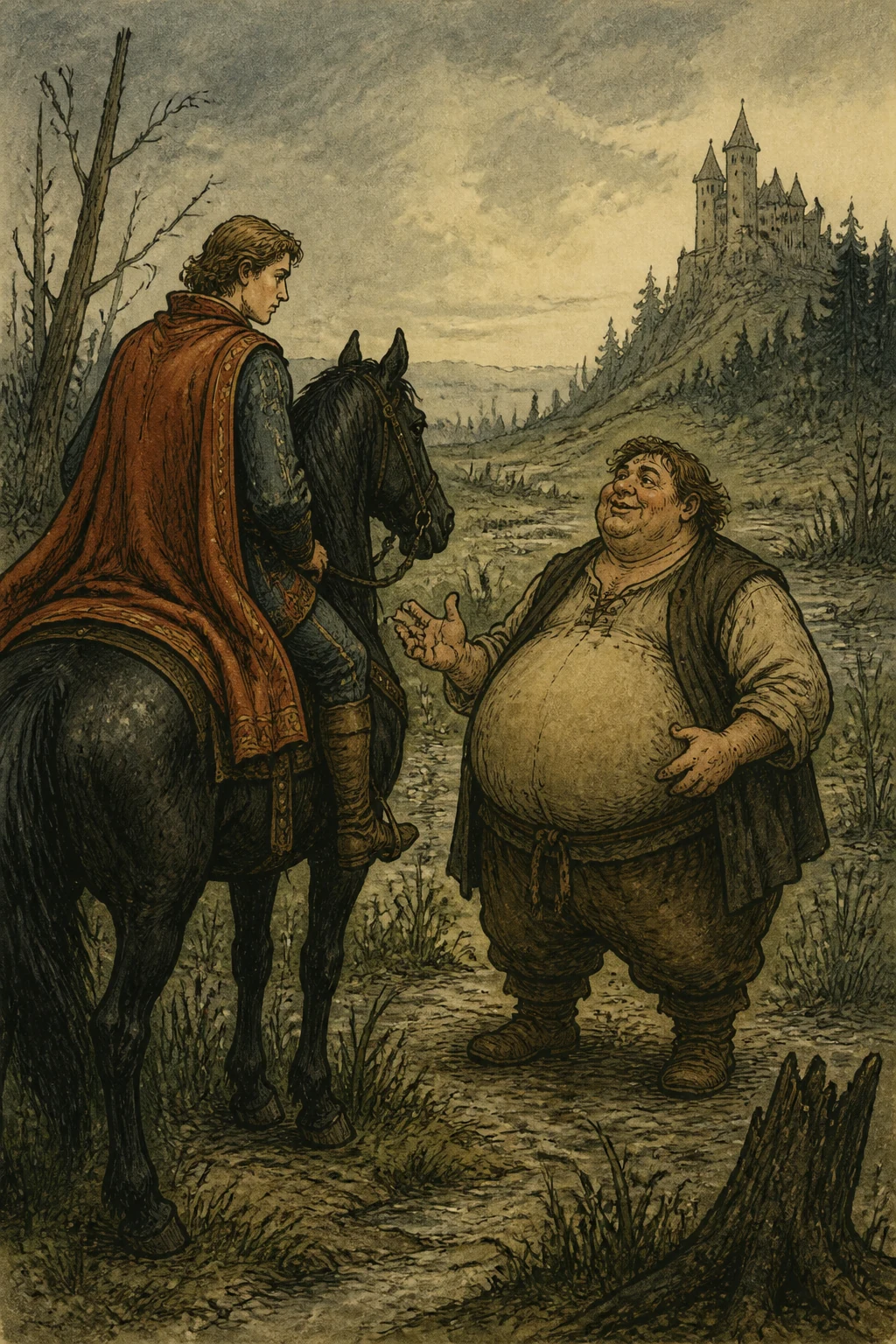
Once upon a time there was a king’s son who took it into his head to travel about the world, taking no one with him but a faithful servant. One day he came into a great forest, and when evening fell he could find no lodging and did not know where to spend the night. Then he saw a girl walking toward a little cottage, and as he drew nearer he saw that she was young and beautiful. He spoke to her, saying, “Dear child, can my servant and I find shelter for the night in that little cottage?” “Oh yes,” said the girl in a sorrowful voice, “you certainly can, but I would not advise it. Do not go inside.” “Why should I not?” asked the prince. The girl sighed and said, “My stepmother practices wicked arts, and she means strangers no good.”
Then he understood that he had come to a witch’s house, but as it was growing dark and he could go no farther, and as he felt no fear, he went inside. The old woman sat in an armchair by the fire and stared at the strangers with her red eyes. “Good evening,” she rasped, making a great show of friendliness. “Sit down and rest.” She blew on the coals, over which she was cooking something in a little pot. The daughter warned them both to be careful and neither to eat nor drink anything, for the old woman brewed wicked potions.
They slept peacefully until early morning. As they were preparing to leave, and the prince was already mounted on his horse, the old woman said, “Wait a moment. Let me offer you a farewell drink first.” While she went to fetch it, the prince rode away, and the servant, who still had to fasten his saddle, was the only one there when the wicked witch returned with the drink. “Take this to your master,” she said. But at that moment the glass shattered, and the poison splashed onto the horse. It was so powerful that the animal fell dead on the spot. The servant ran after his master and told him what had happened, but he did not want to abandon the saddle, so he went back to fetch it. When he reached the dead horse, a raven was already perched on it, feeding on its flesh. “Who knows whether we shall find anything better today?” said the servant, and he killed the raven and took it with him.
They traveled on through the forest all day, but could not find their way out. At nightfall they came upon an inn and went inside. The servant gave the raven to the innkeeper to prepare for their supper. But they had stumbled into a den of murderers, and under cover of darkness twelve murderers arrived, intending to kill and rob the strangers. Before setting to work, however, they sat down at the table, and the innkeeper and the witch joined them. Together they ate a bowl of soup into which the raven’s meat had been chopped.
Hardly had they swallowed a few mouthfuls when they all fell down dead, for the poison in the horse’s flesh had passed into the raven. Now no one was left in the house but the innkeeper’s daughter, who was honest and had taken no part in their wicked deeds. She opened every door to the stranger and showed him the hoarded treasures. But the prince told her she could keep it all, for he wanted none of it, and rode on with his servant.
After traveling about for a long time, they came to a town where there lived a beautiful but haughty princess. She had proclaimed that whoever set her a riddle she could not solve should become her husband; but if she solved it, he would have to forfeit his head. She was allowed three days to think it over, but she was so clever that she always solved the riddles before the appointed time. Nine men had already died in this way when the prince arrived and, dazzled by her great beauty, resolved to stake his life on the venture.
He went before her and gave her his riddle. “What is this?” he said. “One killed no one, yet killed twelve.” She did not know what it could be. She thought and thought, but could not work it out. She opened her books of riddles, but it was not in them. In short, she had come to the end of her wisdom. At her wits’ end, she ordered her maid to creep into the prince’s bedchamber and listen to his dreams, thinking that he might talk in his sleep and reveal the answer. But the clever servant had lain down in his master’s place, and when the maid approached, he tore off the cloak in which she had wrapped herself and drove her out with a birch rod.
On the second night the princess sent her lady’s maid to see whether she might have better luck listening, but the servant took her cloak away too and drove her out with a birch rod. Now the prince thought himself safe for the third night and lay down in his own bed. Then the princess herself came, wrapped in a mist-gray cloak, and sat beside him. When she thought he was asleep and dreaming, she spoke to him, hoping he would answer in his dreams, as many people do.
But he was awake and heard and understood everything perfectly. She asked, “One killed no one—what is that?” He answered, “A raven that ate from a dead, poisoned horse and died of it.” Then she asked, “Yet killed twelve—what is that?” “Those are twelve murderers who ate the raven and died of it.”
Once she knew the answer to the riddle, she tried to steal away, but he held her cloak fast, so that she had to leave it behind. The next morning the princess announced that she had solved the riddle, summoned the twelve judges, and gave the answer before them. But the young man asked to be heard and said, “She crept into my room in the night and questioned me, for otherwise she could not have solved it.” The judges said, “Bring us some proof.” Then the servant brought in the three cloaks, and when the judges saw the mist-gray one that the princess was accustomed to wearing, they said, “Have the cloak embroidered with gold and silver, and let it be your wedding cloak.”