Waltey
Trije Mohamedi
Tunisische Märchen und Gedichte · Hans StummeO besedilu
Trije Mohamedi
- Vir
- Tunisische Märchen und Gedichte
- Avtor
- Hans Stumme
- Jezik branja
- English
- Jezik izvirnika
- Tunisian Arabic in Latin transcription
- Čas branja
- 6 min branja
- Obseg
- 5 strani
- Naslov izvirnika
- 013 Elmhammëdât
O izvirniku
Tunisische Märchen und Gedichte
Tunizijske pripovedi v zgodovinskem latiničnem zapisu govorjenega arabskega jezika. Bralni jezik je English, izvirnik pa prihaja iz vira Tunisische Märchen und Gedichte v jeziku Tunisian Arabic in Latin transcription.
Besedilo
Trije Mohamedi
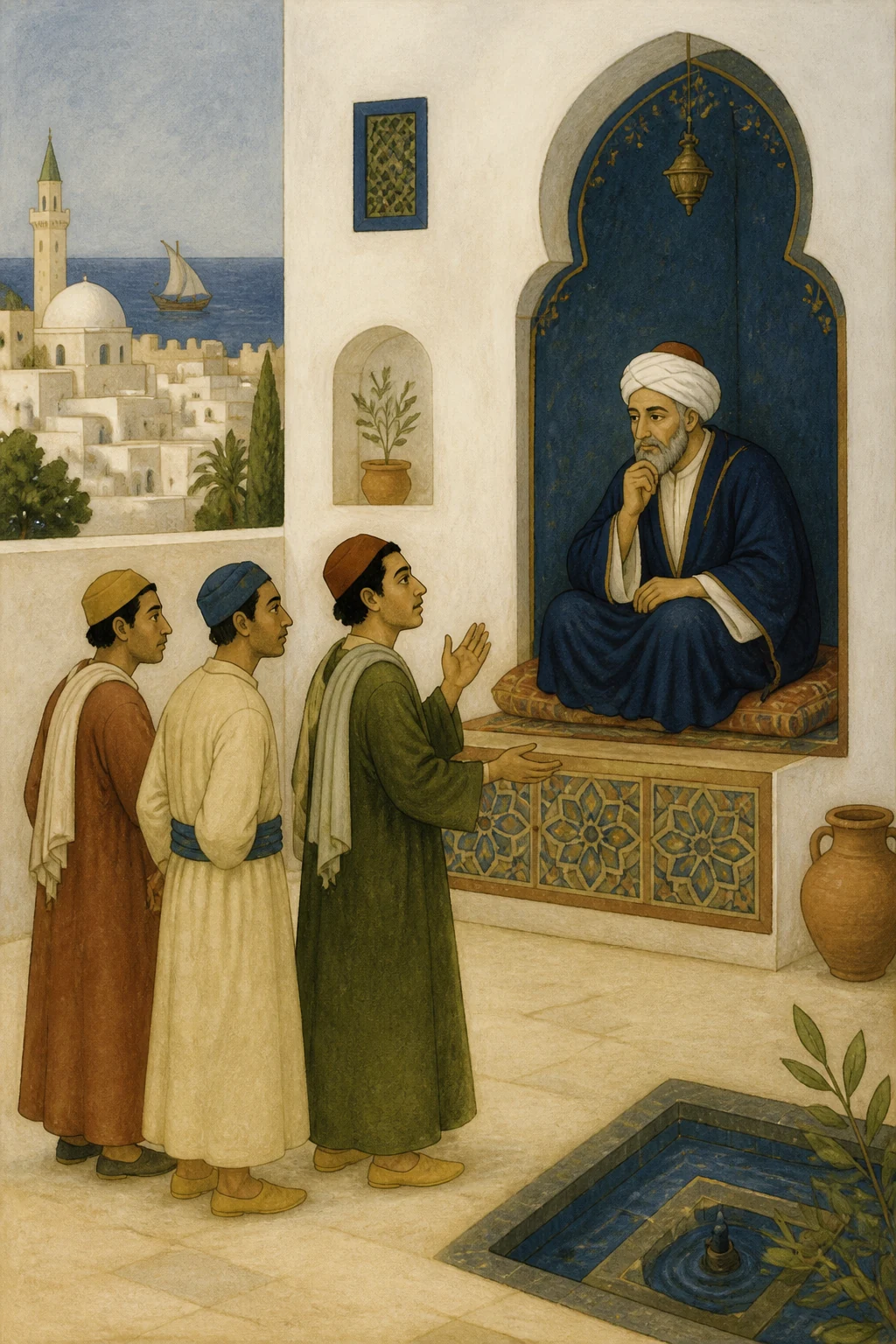
There was once a man who had three sons, all named Mohammed. As he lay dying, he suspected that one of them was not his son. “Mohammed shall inherit,” he said, “and Mohammed shall inherit, but Mohammed shall not inherit.” When their father died and they came to divide his estate, they looked at one another. “Father said, ‘Mohammed shall inherit, and Mohammed shall inherit, but Mohammed shall not inherit.’” They began to quarrel, until at last they brought their case before the ruler. Finding their dispute too difficult to settle, he said, “Judge Hiddl shall decide between you.” So they put their trust in God and set off. Along the road, they came upon a place where a camel had knelt. One of them looked at it and said, “That camel has no tail.” Another spoke up: “That camel is blind in one eye.” Then the third said, “The load it carries is sweet on one side and sour on the other.” They went on their way and met the camel’s owner, who was looking for it. “Have you come across a camel?” he asked. One of them said, “Does your camel have no tail?” “Yes,” he replied. Another said, “Is your camel blind in one eye?” “Yes,” he replied. The third said, “Does your camel carry something sweet on one side and something sour on the other?” “Yes,” he replied. “You have my camel! You have described all its distinguishing marks.” “My good man,” they told him, “we haven’t got your camel.” “Then where did you see it?” he asked. “We haven’t seen it,” they said. He seized them and would not let them go. “We are on our way to Judge Hiddl,” they told him. “Come with us.” When they reached the judge, the camel’s owner stepped forward first.
“Those young men have my camel,” he said. “Give him back his camel,” the judge told them. “God is our witness,” they replied, “we haven’t got his camel.” The camel’s owner spoke up: “But they told me all its distinguishing marks: my camel has no tail, it is blind in one eye, and its load is sweet on one side and sour on the other.” The judge turned to the first brother. “How did you know it had no tail?”
“When a camel drops its dung,” he replied, “it flicks its tail and scatters the droppings. But when I looked at these droppings, I found them all in a single heap. That was how I knew it had no tail.” The judge turned to the second. “And how did you know it was blind in one eye?” “I could tell from its tracks. On the side of its good eye, it had eaten the grass, while on the side of its blind eye, the grass was untouched.” He turned to the third. “And how did you know the camel carried something sour on one side and something sweet on the other?” “Where the sour load had dripped, mosquitoes were swarming; where the sweet load had dripped, flies had gathered.” The judge turned to the camel’s owner. “Is that how your camel is, my good man?” “Exactly so. My camel has no tail, it is blind in one eye, and it carries something sour on one side and something sweet on the other: vinegar and honey.” “Then go and look for your camel,” said the judge. “These men worked out its distinguishing marks by deduction 1. They are men of keen understanding.” Then he turned to the three brothers. “And you—what is your dispute?” “Sir,” they said, “when our father was dying, he said, ‘Mohammed shall inherit, and Mohammed shall inherit, but Mohammed shall not inherit.’
“We don’t know whom he meant, for all three of us are named Mohammed.” “Stay here as my guests tonight,” he told them, “and tomorrow I shall settle your dispute.” He took them upstairs, then called his shepherd and said, “Go and slaughter a lamb for them.” The shepherd slaughtered and skinned a lamb, then brought it to the house to be cooked. Supper was served, and the brothers began to eat. Meanwhile, the judge sat outside the room, listening to what they were saying. One of them spoke up. “This meat is dog meat.” Another said, “The woman who cooked this supper has her monthly bleeding.” The third said, “The judge is a bastard.”
“No, no, man!” the others protested. “Don’t call the judge a bastard! How do you know he is one?” “A man who brings supper but does not eat with his guests is a bastard,” he replied. The judge heard them and went away. He called the shepherd. “Why have you disgraced me when I have guests? Did you slaughter a dog for them?” “No, sir, I swear by your head! I slaughtered nothing but a lamb. But its mother died when it was still young, and a bitch suckled it.”
He went into the house. “Who cooked supper for the guests?” A woman came forward. “I did, sir.” He questioned her. “Are you in the days when you may not pray?” “Yes, I am,” she replied. He went to his mother, seized her, threw her to the ground, and drew his dagger to kill her.
“Tell me who my father is, or I’ll kill you!” Terrified, she said, “My son, your father could not beget children. There was a butcher who used to bring us meat. It was written by God: I lay with him, conceived by him, and bore you.” He let his mother go. The next morning, he went to sit in judgment, and the young men came before him. He asked the one who had said the meat was dog meat, “How did you know it was dog meat?” “Mutton does not have stringy fibres,” he replied, “but dog meat does.” He turned to the second. “And how did you know the woman who cooked supper had her monthly bleeding?” “Because the food was tasteless.” He said nothing to the third. Then he rose and declared, “Mohammed shall inherit, and Mohammed shall inherit, but you, Mohammed, shall not inherit!” “Why?” he asked. “Because only a bastard can recognize a bastard!”
Izvirnik
013 Elmhammëdât
Naslednje strani prikazujejo izvirno besedilo za primerjavo.
Eémma râzel xándu tlät' üläd uttläta ésmhum mühammedät. hâkerrâzel kïf za imût, xándü síkk fîh mos wúldü. hzár, qâl uihám- med jûryt, umhámmed jûryt, umhámmed mâ jüryts. mât bûhum, jâqsmûh. házrü lbxádhum, qalü bâba qâl: mhámmed jûryt, um- hámmed jûryt, umhámmed mâ jür3'ts. qáxadü ithâsmu hátta wúslu quddäm elhâkem. kïf wúslu lilhâkem, sôxbët xalíh-hkümythum, qâl jáhkum xalîkum elqâdy hiddl. tämmü mitwakklîn xalálla umsâu. kîf zâu fittnîja, jelqâu mibrik ëzmâl. hzár wâhed, qâl hazzmél bilâsi baxbôs. fézz labor, qâl hazzmél áxwar. qâm ettâlit, qâl hazzmél elhmyl élli häzzü, farda hlû ufárda qârës. tämmu mâsîn, xarúdhuin mûl' ezzmél, ilauuz xalazémlû; qälylbum xârudkûmsi zmél? hzár wâhed mynhum, qâl zemlek biläsi baxbôs? qâllû naxám. hzár labor,
qâl zémlek áxwar? qâllû naxám. bzár ettâlit, qâl zémlek häz farda hlû ufárda qârës? qâllû naxám; zémlï xándkum, hâkum zibtûh amârtû. qalûlû zémlek, ja wûldi, mâ xannäs. qälylbum mälla wîn îo siftûh? qâlû áhna mâ sifnäs. séddbum, mâ ihäbs isèijibhum. qâlûlû áhna mâsîn lilqâdy hiddl, îza mxâna. — hàltû lilqârly, tqáddem mûl' ezzmél hûa lûël, qâllû zémll xandhâk elüläd. qälylhum axtiûh zémlû.
bînna ûbînû rábbi, wálla zémlû mâ xannäs. hzár mill' ezzmél, qâl hâu zâbûlj-amârtû: zémlï bläsi baxbôs, wáxwar, uhymlû fárda hlû ufárda qârës. bzár elqâdy, qâl bäs xaréftu énti biläsi baxbôs? qâllu ezzmél kîf ibáxrer, iniss baxbôsû 'lbaxrôr itférret; wäna kîf ljzárt lilbaxrôr, nelqâh mkéddes fárd kûds; hakessâxa xaréftu bläsi baxbôs. tlâffët elqâdy, qâl littäni wûnti bäs xaréftu áxwar? qâl xaréftu fïtnîtu minsîret xainu esshêha klâ 'lhsîs uminsîret xäinu 'lxôra elhsîs qâxad. tläffet littälit, qâllû wûnti bas xaréft ezzmél häz fárda qârës ufárda hlû? qâllu essîra fîha elqârës, fïbuqxôtha hâdëb xâlîh ennâmûs, usîrt elhlû mgäzgez xalîh eddybbän. tläffet elqâdy, qâl lïmûl' ezzmél, kïfââ zémlek ja wûldi? qâl bilminzídd zémlï bläsi baxbôs wáxwar uhäz fárda qârës ufárda hlû, fárda hall
ufárda xasél. qâl elqâdy âja bárra láuuz xalazémlek, hannäs bilhéndza 1 tallxûlek amârd-zémlek , näs ashâb xâqûl. — hazrylhum ettläta, qâl wuntûma asnîâ hsümytkum entûma? qâlûlû ja sîdi, bûna kîf za imût, qâl: mbámmed jûryt, umhámmed jûryt, umhámmed mâ jûryts ; áhna mâ xärefnäs âskûnû, áhna ettlâta isemna mhammedät. qalilhum ellîla bätu dyfân xândi uxûdwa nûfsël hsûmytkum. talláhhum lilxalî, näda lisärah mtâxu, qâllu ämsi âdebhëlhum xallûs. dbahelhum xallûs usâlhû, uzabu liddâr itaijebhôlhum. zâbûlhum laxsâ, bdâu itxassâu, uhûa elqâdy elbárra mymbab elbît qâxad isánnat fîbum âs iqûlû. fezz wâhed mynhum, qâl hallhám lhám elkélb. hzár lâhor, qâl élli tâijëbt elxasâ, xalîha dhárha . qâl ettâlit elqâdy wûldë harâm.
qâlû läla ja râzel, mâ tqûls elqâdy wûldë hrâm; bäs xaréftû wûldë hrâm? qâl élli 'zîb elxasâ umâ itxaSsâs mxaddyf, hadâka hûa wûlde hram, smáhhum elqâdy umsä. näda lissärah, qâllû xäläs zaûni dyfân uthassémnï, tâdebhëlhuni kélb? qâl lä jä sîdi, urâsek, âna mâ dbáht ülä xallûs", ämm' elxallûs úmmu mätet ulula sxîr, raddexëttu kélba. msä liddâr, qâl askûn taijeb elxasâ Mdyfân? tqaddëmytlû wáhda, qâlt äna, jä sîdi. nsidhä, qälilhä xándek hórmt esslât? qâlet naxám, xándl. msä lúmmu, séddhâ, ltáhha fillôtâ uzbidílh' elhánzer mäs' jidbáhha, qälilhä qyrrli âskûn bâba willä núqtlek. häfet, qälitlü jä wúldi, bûk mâ jadnâs, kan xándena zâzzâr izïbinna fñlhám, ktlb minxánd rábbi, uqáxte mxâh, rfáxt mynnu, zíbtk ónti. seíjib úmmü, ussbâh msä lilhúkm. tqáddemu läuläd. qâl Ulli qâl ellhám lhám ío
elkélb: énti bas xaréft ellhám lhám elkélb? qâl elxánami mâ jax- méls ëslûk, wulhám elkélb jáxmel slûk. tläffet littani, qâllû wúnti bäs xaréft élli taïjëbt elxasâ xalîha dhárhS? qâl hâtr ettaxâm mâsët . skit xattälit, qâm, qâl mhámmed jûryt, umhámmed jûryt, wúnti jä mhámmed, mâ türyts! qâllû läs? qâllû mâ itállax wúlde hrâm illä wúlde hrâm!
Nadaljuj z branjem