Prevod
_Minec’Aniello, through the virtue of a stone found in a cock’s head, becomes young and rich; but when two necromancers trick him out of it, he becomes old and penniless again. Searching the world, he reaches the Kingdom of the Mice, where he hears news of the ring; and with the help of two mice he recovers it, regains his former condition, and takes revenge on the rogues._ _The thief’s wife does not laugh forever. Whoever plots deceit weaves his own ruin; there is no trick that will not be discovered, nor treachery that will not come to light. Walls are spies upon scoundrels;
theft and whoring make the very earth crack open and tell the tale, as I shall let you hear, if you will only keep your ears at home._ Once upon a time, in the city of Grotta-negra, there lived a certain Minec’Aniello, so dogged by ill fortune that all his property, movable and immovable, amounted, from top to bottom, to a country cock he had raised on crumbs. But one morning, finding himself ravenous—for hunger drives the wolf out of the woods—he decided to turn it into a little cash. Taking it to market, he met two great owls of necromancers, struck a bargain with them, and sold it for half a patacca. They told him to carry it to their house, where they would count out the coins for him. So the magicians set off, with Minec’Aniello following behind, and he heard them speaking to each other in thieves’ cant. “Who would ever have thought we should stumble on such a stroke of luck, Jennarone? This cock will certainly make our fortune, thanks to that stone you know of, which it has inside its skull. We shall have it set in a ring at once, and then we can have anything we know how to ask for.” And Ghiennarone answered:
“Hush, Jacovuccio! I can already see myself rich, and scarcely believe it. I cannot wait to crack this cock’s skull, give poverty a kick in the teeth, and stretch my legs at ease; for in this world virtue without money is valued no more than a footrag, and people judge you by the clothes you wear.” Minec’Aniello, who had travelled far and eaten bread from more than one oven, understood their jargon. As soon as they reached a narrow alley, he changed tack and took to his heels. Running home, he wrung the cock’s neck, opened its head, and found the stone, which he immediately had set in a brass ring. Wishing to test its power, he said, “I should like to become a lad of eighteen.” Scarcely were the words spoken when his blood grew livelier, his sinews stronger, his legs steadier, his flesh fresher, and his eyes brighter. His silver hair turned to gold; his mouth, which had been a plundered village, filled with teeth; his beard, once a preserve where nothing might be taken, became a field ripe for harvesting. In short, transformed into a handsome young fellow, he spoke again: “I should like a magnificent palace, and to marry into the King’s family.” And there, before his eyes, sprang up a palace of incredible beauty, with marvellous chambers, astonishing columns, and paintings to leave you dumbfounded. Silver overflowed everywhere, gold was trodden underfoot, jewels flashed in your face, and servants swarmed about;
the horses and carriages were beyond counting. In short, he made such a display of wealth that the King opened his eyes wide and was delighted to give him his daughter Natalizia. Meanwhile, the necromancers discovered Minec’Aniello’s great good fortune and resolved to take this fine prize out of his hands. They made a beautiful doll that played music and danced by means of counterweights, dressed themselves as merchants, and went to see Pentella, Minec’Aniello’s daughter, pretending they wished to sell it to her. When she saw so lovely a thing, she asked what price they wanted for it.
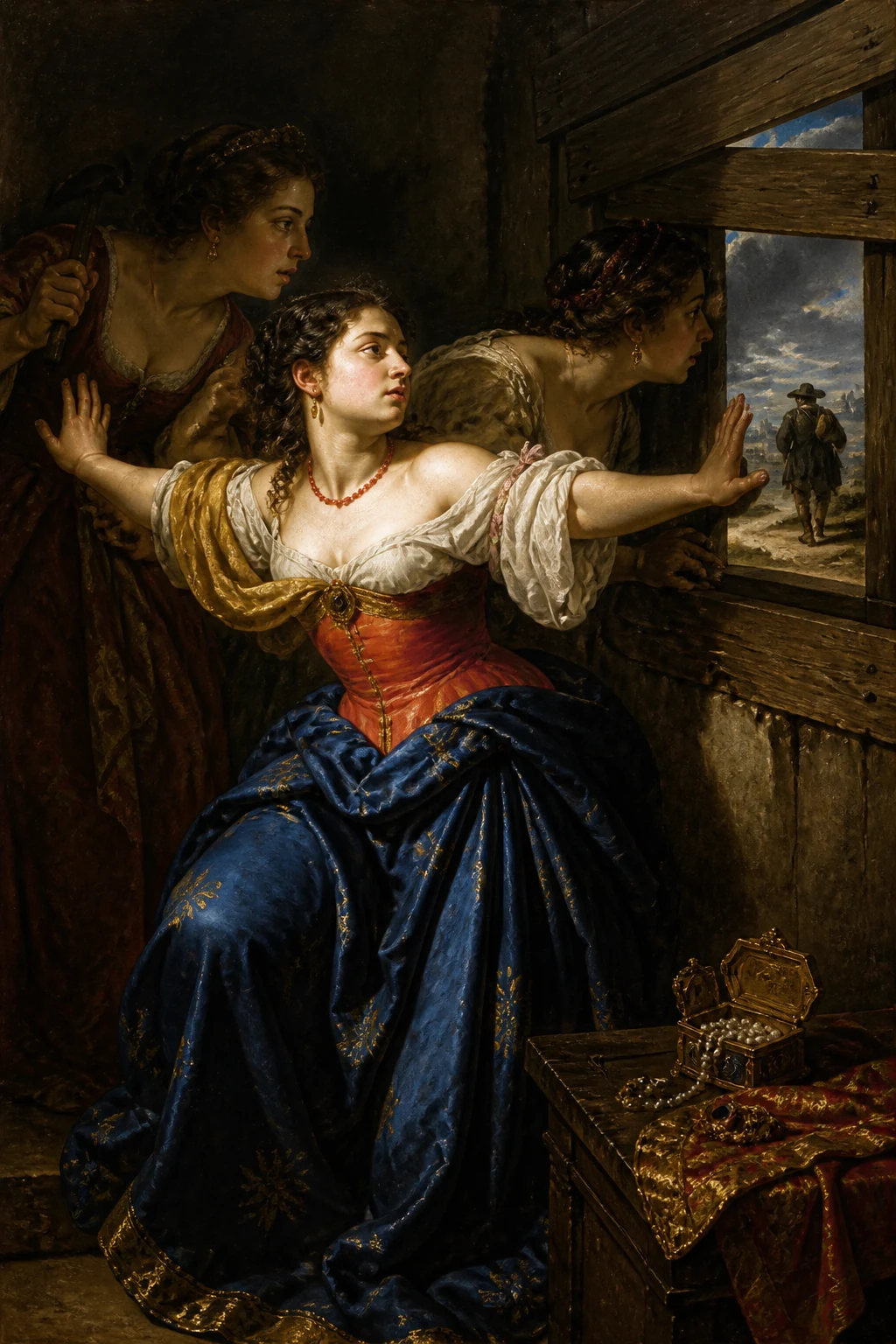
They replied that no amount of money could pay for it, but that she might have it if she would do them just one favour: let them examine the workmanship of her father’s ring, so that they could take a pattern from it and make another like it. In return, they would give her the doll without asking a penny. Pentella, who heard this offer and had never heard the proverb, “Think twice about a bargain,”
accepted the terms at once, telling them to return the next morning, when she would have borrowed the ring from her father. The magicians went away, and when her father came home she told him so many pretty tales and coaxed him so sweetly that she persuaded him to lend her the ring, making the excuse that she felt melancholy and wanted something to cheer her heart.
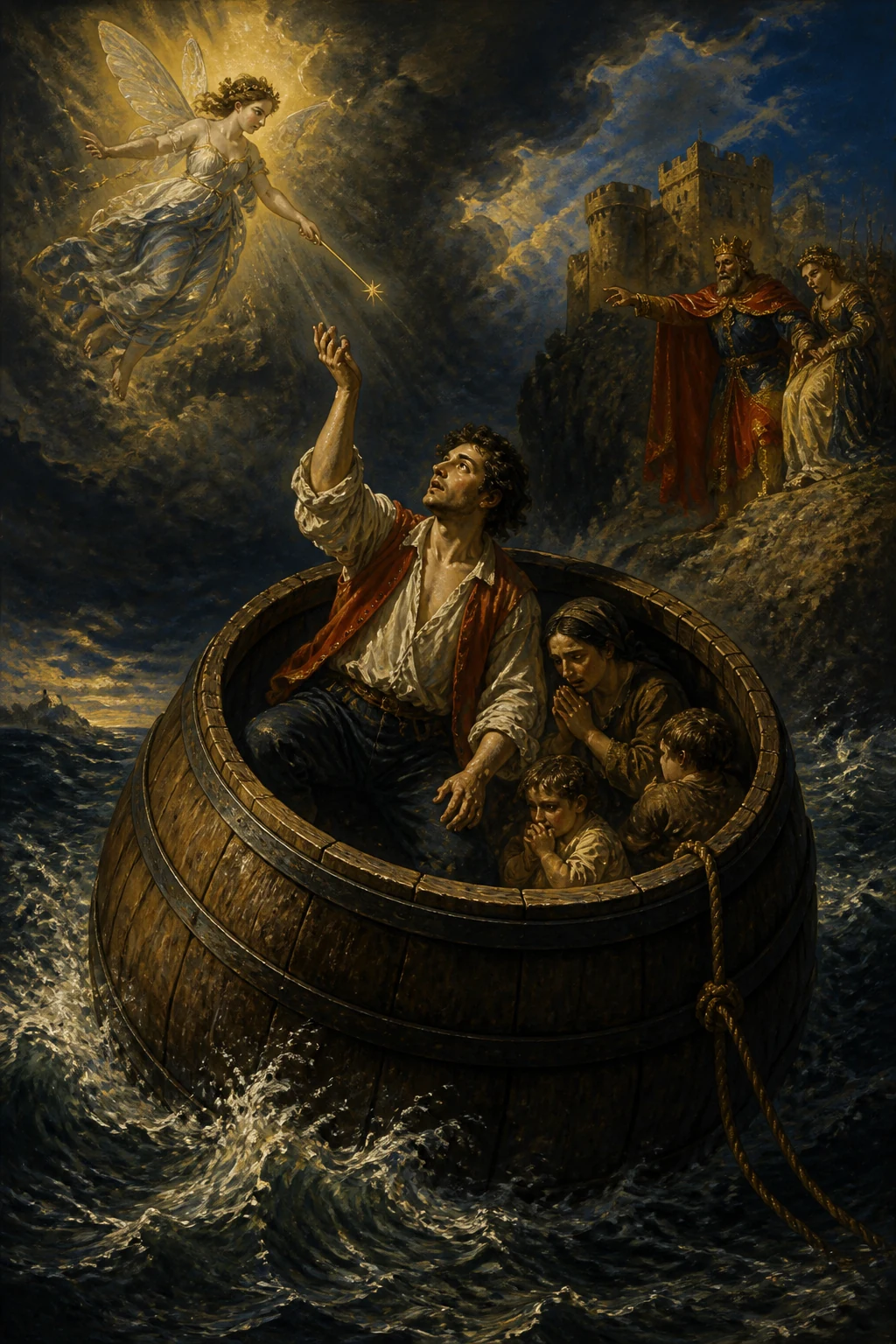
But when the following day came, and the Sun’s scullion was sweeping the filth of the shadows from the squares of heaven, the magicians returned. No sooner had they got their hands on the ring than they melted away like something conjured out of existence, leaving not so much as a wisp of smoke behind; and poor Pentella nearly died of anguish. Once the magicians reached a wood, where some of the branches formed a trellis while others played hot cockles with one another, they told the ring to undo everything that had been done for the rejuvenated old man. He happened to be in the King’s presence at that very moment, and all at once he felt his hair bristle and whiten, his forehead wrinkle, his eyebrows grow bushy, his eyes sink, his face shrivel, his teeth fall out, his beard grow sparse, his back rise into a hump, and his legs tremble. Above all, his splendid clothes turned back into rags and tatters.
At this, the King, seeing such an ugly beggar sitting there conversing with him, had him driven out at once with blows and insults. Finding himself brought so low in an instant, Minec’Aniello went weeping to his daughter and asked for the ring, to remedy this disaster. When he heard of the trick the sham merchants had played on her, he very nearly threw himself out of a window, cursing his daughter’s foolishness a thousand times over: for the sake of a wretched doll she had left him looking like a hideous bogeyman; for the sake of a thing made of rags, she had driven him to acts of madness. For he was resolved to wander, an outcast and a vagabond, like a bad penny, until he heard news of those merchants. With these words he put on a hooded cloak, slipped his feet into rough shoes, slung a bag across his shoulders, took a staff in his hand, and, leaving his daughter cold and numb, set off in despair. He wore out so much shoe leather that at last he reached the Kingdom of Pertuso-Cupo, which was inhabited by mice. There he was taken for a spy in the service of the cats and brought straight before Rosecone, the King, who asked him who he was, where he had come from, and what he was doing in those parts. Minec’Aniello first presented the King with a pork rind as a token of tribute, then told him all his misfortunes, one by one. He ended by saying that he meant to wear out his wretched hide until he had news of those damned souls who had robbed him of so precious a jewel, taking from him at the same time the flower of youth, the fountain of wealth, and the support of honour. At these words, Rosecone felt pity gnawing at his heart. Wishing to give the poor man some comfort, he summoned the oldest mice to council, asked their advice about Minec’Aniello’s misfortune, and ordered them to make diligent inquiries to see whether any news could be had of these counterfeit merchants. Among them happened to be Rudolo and Sautariello, mice well versed in the ways of the world, who had spent some six years at a wayside inn. “Take heart, comrade,” they said. “Things will turn out better than you think. You must know that one day, while we were in a room at the Inn of the Horn, where the world’s most highly esteemed men lodge and make merry, two fellows from Castiello Rampino passed that way. After dinner, having seen the bottom of the wine jug, they began discussing a trick they had played on a certain old man from Grottanegra, whom they had cheated out of a stone of great power. One of them, whose name was Jennarone, said that he would never take it off his finger, lest he have occasion to lose it, as the old man’s daughter had done.” When Minec’Aniello heard this, he told the two mice that if they felt able to guide him to the rogues’ town and help him recover the ring, he would give them a whole pack-load of cheese and salted meat, which they might enjoy together with His Majesty the King. Since there was something to grease their palms, they offered to move heaven and earth for him; and, having asked leave of the mouse monarch, they set out. After a long journey they reached Castiello-rampino, where the mice had Minecaniello wait beneath some trees beside a river that, like a leech, sucked up the blood of labourers and poured it into the sea. They themselves found the magicians’ house and saw that Ghiennarone never took the ring off his finger. They therefore sought to win their victory by a stratagem. They waited until Night had bathed the sunburnt face of heaven with sour grape juice, and, once he had stretched himself out in bed, Rudolo began to gnaw at the finger that wore the ring. Feeling the pain, Ghiennarone took it off and laid it on a table at the head of the bed. Seeing this, Sautariello took it in his mouth, and in four bounds they were back with Minec’Aniello. Happier than a man on the gallows when his pardon arrives, he immediately turned the necromancers into two donkeys. Spreading his cloak over one of them, he mounted it like a fine count; then he loaded the other with bacon and cheese and set off towards Pertuso-Cupo. There he presented his gifts to the King and his councillors and thanked them for all the good he had received through their help, praying that Heaven would never let a mousetrap hinder them, a cat harm them, or arsenic cause them any grief. Taking his leave of that country, he returned to Grotta-negra, handsomer than ever, and was welcomed by the King and his daughter with all the affection in the world. He had the donkeys hurled down a mountain, then lived happily with his wife, never again taking the ring from his finger, lest he suffer another such calamity: _For a dog once scalded by hot water_ _Is afraid even of cold_.