Prevod
Through its power he challenges even the gods for a place in heaven.
The weaver said, “That is true. Still, I shall ask my wife.”
The barber said, “My good man! To consult a woman is contrary to the teachings of the scriptures, for women have little understanding. As it is said:
“Give women food and clothing, and lie with them in their season;
Give them ornaments and the like—but a wise man should not seek their counsel.
“Where a woman, a gambler, or a child holds sway,
That household goes to ruin: so Bhargava declared.
“A man remains cheerful and devoted to his elders
Only so long as he does not listen to women’s whispered counsel.
“These women pursue their own ends, intent on their own pleasure alone;
No one is dear to them, not even a son, apart from the happiness he brings them.”
The weaver said, “Even so, I must ask her, for she is a faithful wife. Besides, I do nothing without consulting her.”
With these words he hurried home and said to her, “My dear! Today a spirit has granted me his favor. He will give me whatever I wish, and so I have come to consult you. Tell me, what should I ask for? My friend the barber says I should ask for a kingdom.” She said, “My dear husband! What understanding do barbers have? You must not follow his advice. As it is said:
“With wandering bards, flatterers, low fellows, barbers, or children,
Nor yet with mendicants, should a sensible man take counsel.
“Besides, ruling a kingdom is one long succession of troubles. With peace-making, war, marching against enemies, holding one’s ground, seeking protection, and pursuing a double policy, it never gives a man any happiness. For:
“The very moment a king is anointed, his mind turns to troubles;
At his coronation, the jars pour out calamity along with the water.
“And again: Think of Rama’s departure for the forest, of Pandu’s sons dwelling in the woods,
Of the destruction of the Vrishnis, of King Nala’s fall from his throne;
Consider Saudasa’s plight, Arjuna’s death, and the lord of Lanka,
Brought to humiliation for the sake of kingship—then never covet a kingdom.
“For its sake even a king’s own brothers and sons
Desire his death: keep far away from such a kingdom.”
The weaver said, “You have spoken truly. Tell me, then, what should I ask for?” She replied, “As things stand, you weave one piece of cloth every day, and that covers all our expenses. Now ask for another pair of arms and a second head, so that you can weave two pieces of cloth, one in front of you and one behind. The price of one will meet our household expenses as before, while the price of the other will pay for special undertakings. In this way you will pass your days in comfort, honored among your own community, and gain rewards both in this world and the next.”
Delighted to hear this, he said, “Well said, faithful wife! Well said! Your advice is sound. That is what I shall do. My mind is made up.”
Then he went to the spirit and made his request: “Sir, if you will grant my wish, give me a second pair of arms and another head.”
No sooner had he spoken than he became two-headed and four-armed. Overjoyed, he set off for home. But the people, taking him for a demon, beat him with clubs and stones until he died.
“That is why I say, ‘He who has no wisdom of his own.’”
Chakradhara said, “Indeed, that is true. Anyone possessed by the deceptive she-demon of hope becomes a laughingstock. Someone has put it well:
“He who dreams of an impossible future
Ends up lying white with flour, like Somasharma’s father.”
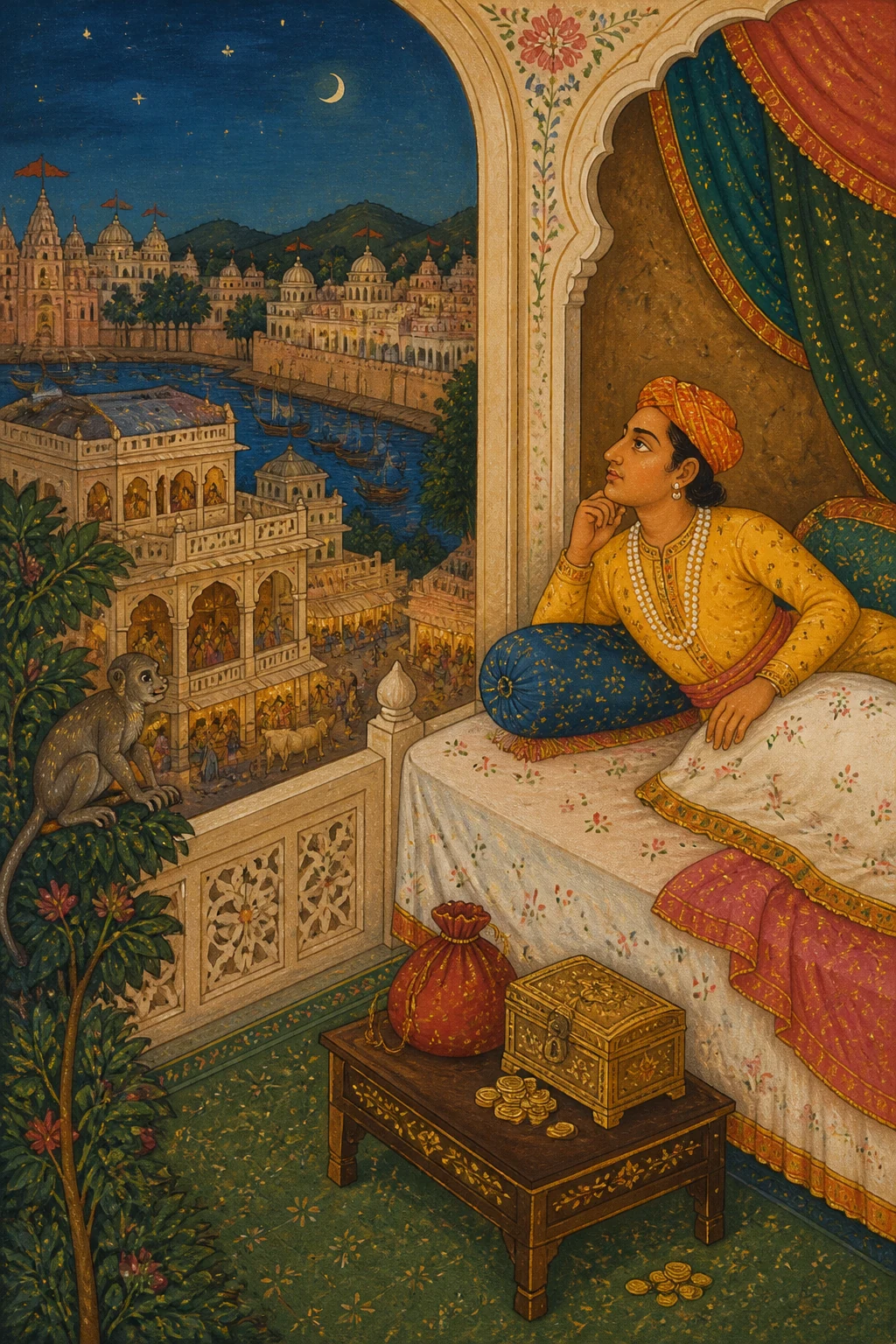
Suvarnasiddhi asked, “How did that happen?” He replied, “Story 8: The Tale of Somasharma’s Father. In a certain town there lived a Brahmin named Svabhavakripana, the Miser by Nature. He had filled a pot with the barley flour left over from the alms he collected. Hanging this pot on a wall peg, he placed his bed beneath it and gazed at it constantly, never taking his eyes off it. One night, as he lay in bed, he thought, ‘This pot is quite full of flour. If a famine comes, it will fetch a hundred silver coins. With those I shall buy a pair of goats. Since they breed every six months, I shall soon have a herd. With the goats I shall buy a great many cows; with the cows, buffaloes; and with the buffaloes, mares. As the mares foal, I shall acquire many horses. Selling them will bring me a great deal of gold. With that gold I shall build a house with four wings. Then some Brahmin will come to my house and give me his beautiful daughter of marriageable age. She will bear me a son, and I shall name him Somasharma. When he is old enough to crawl, I shall sit behind the stable with a book in my hand and study it. Meanwhile, Somasharma will see me, slip from his mother’s lap, and crawl toward me, close to the horses’ hooves. Then I shall angrily call to my wife, “Pick up the child!” But she will be busy with her housework and will not hear me. So I shall get up and give her a kick.’
“Absorbed in these thoughts, he actually kicked out, smashing the pot and covering himself in white flour. That is why I say, ‘He who dreams of an impossible future.’”
*********************************************************************** Suvarnasiddhi said, “So it is. Why blame yourself, when everyone who is made a fool of by greed comes to grief? As it is said:
“He who acts out of greed, without considering the consequences,
Comes to humiliation, as King Chandra did.”
Chakradhara asked, “How did that happen?” He replied, “Story 9: The Tale of King Chandra. In a certain town there lived a king named Chandra. His sons delighted in playing with monkeys and kept a troop of them, feeding them every day on all kinds of food and delicacies. The leader of the monkeys knew the teachings of Ushanas, Brihaspati, and Chanakya, followed their precepts, and taught them to all the others. In that palace there was also a flock of sheep on which the young princes could ride. One of these sheep, greedy for food, would boldly enter the kitchen at all hours and eat whatever he saw. The cooks would beat him with whatever came to hand—a piece of wood, an earthen pot, a bronze dish, or a copper vessel. Seeing this, the leader of the monkeys reflected, ‘Alas! This quarrel between the sheep and the cooks will bring about the destruction of the monkeys. This sheep is addicted to tasty food, and the cooks are so hot-tempered that they strike him with anything within reach. If one day they find nothing else and hit him with a burning brand, his thick fleece will catch fire at the slightest touch of flame. Burning, he will run into the nearby stable. That too will catch fire, for it is full of hay, and the horses will be burned. Now Shalihotra has said that burns in horses can be cured with monkey fat. This is sure to happen; there is no doubt about it.’ Having reached this conclusion, he called all the monkeys together and told them in private:
“‘This quarrel that has arisen between the sheep and the cooks
Will surely bring destruction upon the monkeys.
“‘Therefore, anyone who values his life should keep far away
From a house where senseless quarrels are always breaking out.
“‘Quarrels bring down households; harsh words put an end to friendship;
Bad kings destroy kingdoms, and evil deeds a man’s good name.
“‘So let us leave this palace and go to the forest before we are all destroyed.’ But the monkeys, puffed up with pleasure, refused to believe him. Laughing, they said, ‘Sir, old age has addled your wits, or you would not talk like this. As it is said:
“‘The mouth is toothless, and saliva dribbles constantly;
Understanding fails in childhood, and especially in old age.
“‘We are not going to give up these heavenly pleasures and all the nectar-like delicacies the princes give us, only to eat astringent, pungent, bitter, salty, dry fruits out in the forest.’
“Hearing this, his eyes filled with tears, and he said, ‘You fools! You have no idea how this happiness will end. Sweet as the taste of the kimpaka fruit, it will turn to poison in the end. I will not stay to witness the destruction of my kin. I am leaving for the forest at once. As it is said:
“‘Blessed are those who never see a friend in distress, their home oppressed by enemies,
The ruin of their country, or the destruction of their family.’
“With these words the leader abandoned them all and went into the forest. Some days after his departure, the sheep entered the kitchen. Finding nothing else at hand, a cook struck him with a half-burning log. His body burst into flames, and he ran bleating into the nearby stable. As he rolled on the ground, which was thick with hay, flames sprang up everywhere. Some of the horses died with their eyes bursting from the heat; others broke their tethers and ran about neighing, their bodies half-burned, throwing everyone into confusion.
“The king, deeply distressed, summoned physicians versed in Shalihotra’s teachings and said, ‘Tell me, is there any remedy to relieve these horses’ burns?’
“They consulted their books and replied, ‘Your Majesty, the venerable Shalihotra has said on this subject:
“‘The harm caused to horses by burns from fire is dispelled by monkey fat,
As darkness is dispelled by sunrise.
“‘Let this treatment be applied at once, before the horses die of their burns.’
“On hearing this, the king ordered all the monkeys to be killed. In short, every one of them was slaughtered with weapons, clubs, stones, and the like.
“When the leader of the monkeys learned that his sons, grandsons, brothers’ sons, nephews, and all his other kin had been destroyed, he was overcome with grief. He stopped eating and wandered from forest to forest, thinking, ‘How can I repay that vile king for what he has done? As it is said:
“‘He who endures an outrage inflicted on his family by another,
Whether through fear or desire, must be counted the lowest of men.’
“One day, wandering about tormented by thirst, the old monkey came upon a lake adorned with beds of lotuses. Examining it closely, he saw the footprints of wild animals and human beings leading into the water, but none coming out. He thought, ‘Surely some wicked water monster lurks here. I shall take a lotus stalk and drink through it from a distance.’ When he had done so, a demon emerged from the lake, a jeweled necklace adorning his throat, and said, ‘Anyone who enters this water becomes my food. There is no one as clever as you, who have found this way to drink. I am pleased with you. Ask for your heart’s desire.’ The monkey said, ‘Sir, how much can you devour?’
“He replied, ‘Hundreds, thousands, tens of thousands, hundreds of thousands—I can devour them all if they enter the water. Outside it, even a jackal can overpower me.’
“The monkey said, ‘I have a bitter feud with a certain king. If you give me that jeweled necklace, I shall entice him with cunning words and bring him and his whole household into this lake.’
“Trusting his words, the demon gave him the necklace and said, ‘My friend, do whatever you think best.’
“With the jeweled necklace adorning his throat, the monkey was seen by people as he roamed over trees and palaces. They asked him, ‘Leader of the troop, where have you been all this time? Where did you find such a necklace? Its brilliance outshines even the sun!’ The monkey replied, ‘Deep in a certain forest is a great, well-hidden lake made by Dhanada, the god of wealth. Anyone who plunges into it on a Sunday, when the sun is halfway above the horizon, comes out wearing just such a jeweled necklace, by Dhanada’s favor.’ When the king heard this, he summoned the monkey and asked, ‘Leader of the troop, is this true? Is there really a lake that yields jeweled necklaces?’
“The monkey said, ‘My lord, here is visible proof: the necklace around my neck. If you want one, send someone with me, and I shall show him the place.’
“Hearing this, the king said, ‘If that is so, I shall come myself with my household, so that we may obtain many necklaces.’
“The monkey said, ‘By all means.’
“And so the king set out with all his wives and servants, lured by the prospect of jeweled necklaces. The king rode in a palanquin, with the monkey comfortably seated in his lap, receiving every mark of affection. Well indeed is it said:
“‘Goddess Craving, homage to you! You drive even the wealthy
To shameful deeds and send them wandering through impassable places.
“And again:
“‘He who has a hundred wants a thousand; he who has a thousand longs for a hundred thousand;
The lord of a hundred thousand wants a kingdom, and a king longs for heaven.
“‘With age the hair grows old, and the teeth decay;
The eyes and ears grow old, but craving alone grows young.’
“When they reached the lake at dawn, the monkey said to the king, ‘Your Majesty, those who enter when the sun is halfway above the horizon receive their reward. Let everyone go in at once. You, however, should enter with me, so that I can take you to the spot I have already seen and show you a great many jeweled necklaces.’ All the people entered the water and were devoured by the demon. When they had been gone a long time, the king said to the monkey, ‘Leader of the troop, why is my household taking so long?’
“At this, the monkey quickly climbed a tree and said to the king, ‘Wicked king! The demon beneath the water has devoured your household. I have avenged the destruction of my family. Now go! I did not send you into the lake because I remembered that you were my master. As it is said:
“‘Repay a deed with a like deed, and an injury with an injury;
I see no wrong in treating a wicked man wickedly.
“‘You destroyed my family, and I have destroyed yours.’
“Hearing this, the king, overcome with anger, departed alone on foot by the way he had come. When he was gone, the demon emerged from the water and said joyfully:
“‘Your enemy is destroyed, a friend has been gained, and the jeweled necklace has not been lost.
Well done, monkey, who drank water through a stalk!’
“That is why I say, ‘He who acts out of greed.’”
***********************************************************************
Having said this, he spoke again to Chakradhara: “My friend, give me leave to go home.”
Chakradhara said, “My good friend! Wealth and friends are gathered for times of trouble. Where will you go, abandoning me in this condition? As it is said:
“He who heartlessly abandons a friend in distress and goes away
Is an ingrate, and for that sin will surely go to hell.”
Suvarnasiddhi said, “My friend, that is true when there is some way to help. But this place lies beyond human reach. No one has the power to free you. Besides, the more I see your face contorted by the pain of the spinning wheel, the more certain I become that I must leave at once, lest some calamity befall me too. For:
“Judging by the look upon your face, monkey,
Vikala has you in his grasp. He who gets away survives.”
Chakradhara asked, “How did that happen?” He replied, “Story 10: The Tale of Vikala and the Monkey. In a certain town there lived a king named Bhadrasena. He had a daughter named Ratnavati, endowed with every auspicious mark. A demon wished to carry her off. He came at night and enjoyed her, but because she was protected by charms, he could not take her away. Whenever he was near, she felt his presence in trembling and other symptoms. Time passed in this way. One night the demon was standing in a corner of her room at midnight when the princess said to her companion, ‘My friend, see how this wretched twilight torments me every day when it comes! Is there no way to ward off the vile thing?’
“Hearing this, the demon thought, ‘Surely someone else named Vikala comes here every day, just as I do, to carry her off. But he too is unable to take her. I shall turn myself into a horse and wait among the horses to see what he looks like and what powers he possesses.’ So the demon assumed the form of a horse and stood among the others.
“That very night, a horse thief entered the palace. After looking over all the horses, he decided that the demon was the finest of them and mounted him.”