Waltey
Damanaka zaseje razdor med prijateljema
Pančatantra · indijska zbirka pripovediO besedilu
Damanaka zaseje razdor med prijateljema
- Vir
- Pančatantra
- Avtor
- indijska zbirka pripovedi
- Jezik branja
- English
- Jezik izvirnika
- Sanskrit
- Čas branja
- 16 min branja
- Obseg
- 13 strani
- Naslov izvirnika
- Tantra 01 mitra-bheda chunk 10
O izvirniku
Pančatantra
Indijske zgodbe o zvijači, prijateljstvu in modrosti v svetu živali in vladarjev. Bralni jezik je English, izvirnik pa prihaja iz vira Pančatantra v jeziku Sanskrit.
Besedilo
Damanaka zaseje razdor med prijateljema
Damanaka said, “My friend, what is there to puzzle over? Here is how you may know for certain. If, on seeing you, his eyes turn red, his brow gathers into three furrows, and he licks the corners of his mouth, then he means you harm. Otherwise, he is well disposed toward you. Now give me leave to return to my own quarters. You must take care that this secret is not betrayed. If you can get away at nightfall, you should leave the country. For—
Abandon one person for the sake of the family, and a family for the sake of the village;
Abandon a village for the sake of the country, and the whole earth to save yourself.
Preserve wealth against adversity; preserve your wife even at the cost of wealth;
But always preserve yourself, even at the cost of wife and wealth.
“When overpowered by someone stronger, sound policy is either to go abroad or to submit to him. You should therefore leave this country. Or else you must protect yourself by conciliation and the other expedients. As it is said—
A wise man should preserve his life even at the cost of children and wife;
For while life remains, all these may be gained again.
“And again—
By whatever means he can, whether fair or foul,
A man should rescue himself from distress; once secure, he may practice virtue.
The fool who clings to wealth and possessions when his life is at stake
Loses his life; and when that is lost, his wealth is lost as well.
Having said this, Damanaka went to Karaṭaka. Seeing him approach, Karaṭaka asked, “My friend, what have you accomplished?” Damanaka replied, “For my part, I have sown the seed of policy. What follows rests with fate. As it is said—
Even when fortune turns against him, a wise man must do what ought to be done,
To free himself from blame and steady his own heart.
“And again— Fortune comes to the enterprising lion among men;
‘Fate must bestow it,’ say only cowards.
Set fate aside and exert yourself with all your strength. If effort fails, what blame is yours?
Karaṭaka said, “Tell me, then, what sort of seed of policy have you sown?”
He replied, “By telling each of them false tales about the other, I have driven such a wedge between them that you will never again see them sitting together in counsel.”
Karaṭaka said, “Ah, you have done wrong! Their hearts were warm with affection for one another, and they lived at ease; you have hurled them into an ocean of anger. As it is said—
Whoever drives a peaceful, happy man onto the path of suffering
Will surely suffer himself, birth after birth.
“Moreover, it is wrong to rejoice merely because you have divided them. Anyone can do harm; not everyone can do good. As it is said—
A base man knows only how to ruin another’s undertaking, not how to advance it;
The wind has strength to fell a tree, but not to raise it up.
Damanaka said, “You speak like this because you know nothing of statecraft. For it is said—
He who does not quell an enemy or a disease as soon as it appears,
Though immensely strong, will be destroyed by it once it has grown.
“This fellow has become our enemy by taking away our ministerial office. As it is said—
Whoever covets the position held by a man’s father and grandfather
Is that man’s natural enemy, and must be uprooted even if he is dear to him.
“I brought him here as a harmless outsider, granting him safe conduct; and no sooner had I done so than he displaced me from my ministry. Indeed, this is well said— If a good man allows a scoundrel a foothold in his own position,
The scoundrel, coveting it himself, gains the power to destroy him.
Therefore the wise should give no opening to the base:
As the saying goes, even a lover may become master of the house.
“That is why I am devising a way to have him killed—or at least driven from the country. No one but you will know of it. I have told you because this was done in your interest. As it is said—
Make your heart as hard as a sword and your speech as sweet as sugarcane juice;
Do not hesitate: kill the man who has harmed you.
“Besides, once dead, he will provide us with food. That alone is an excellent gain. We shall also regain our ministry and fill our bellies. With these three advantages before us, why do you stupidly find fault with me? As it is said—
A clever man, while harming another, secures his own advantage;
Let him not be foolish, but feast as Caturaka did in the forest.
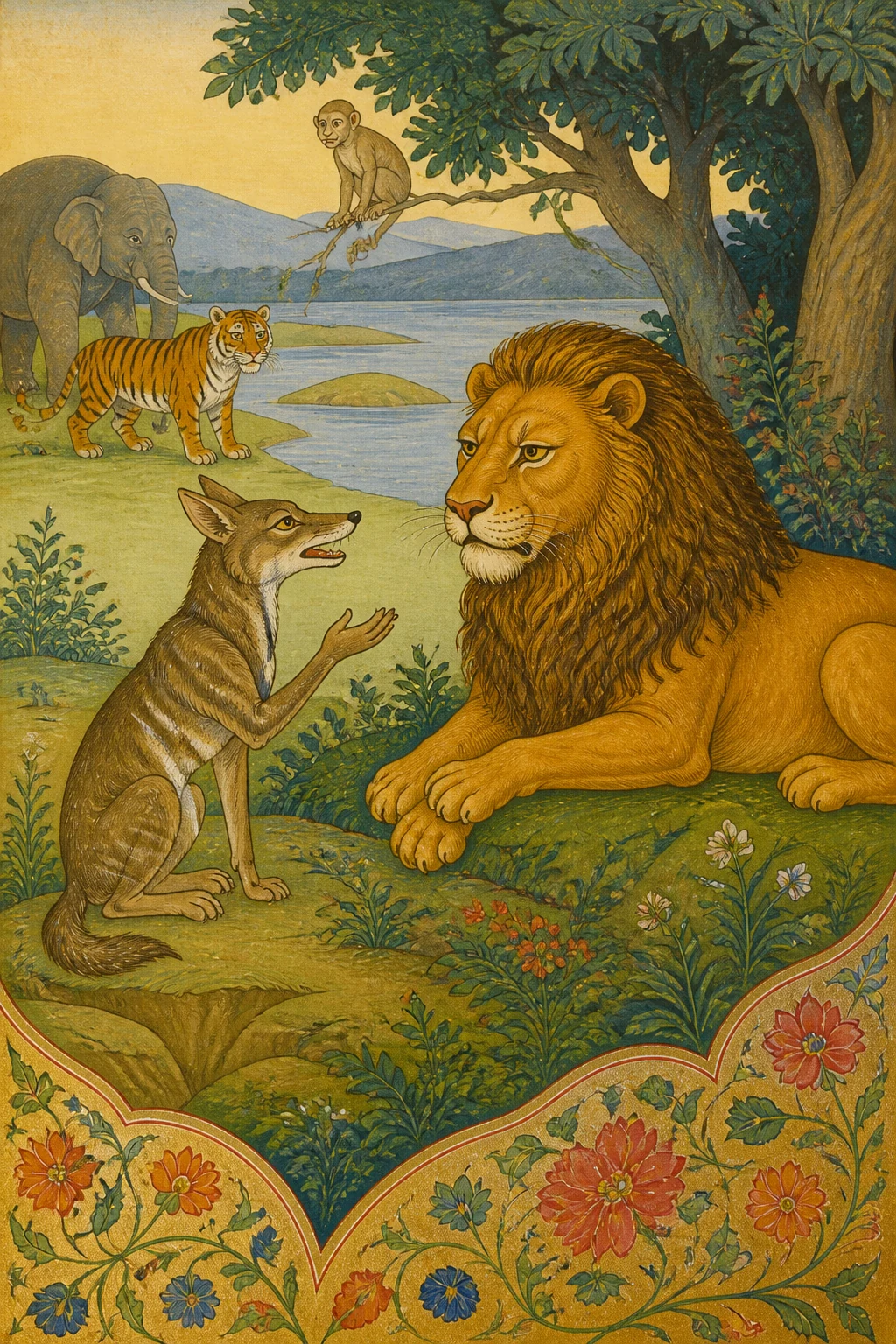
Karaṭaka asked, “How was that?” Damanaka replied: Story 16. The Lion Named Vajradaṃṣṭra. In a certain forest lived a lion named Vajradaṃṣṭra. His servants, a jackal named Caturaka and a wolf named Kravyamukha, lived in the same forest and always followed him. One day the lion came upon a she-camel lying in a dense thicket. She was close to giving birth and had strayed from her herd in the pains of labor. He killed her, and when he tore open her belly, a little camel calf emerged alive. The lion and his followers ate their fill of the mother’s flesh. But out of affection he spared the little calf, brought him home, and said, “My friend, you need fear death neither from me nor from anyone else. Roam freely through this forest. Since your ears are shaped like pegs, your name shall be Śaṅkukarṇa, ‘Peg-Ear.’” So the four of them lived together, roaming about and enjoying all kinds of pleasant conversation. Even when Śaṅkukarṇa grew to maturity, he would not leave the lion for a moment. One day Vajradaṃṣṭra fought a wild elephant in rut. With the fierce strength of its frenzy, the elephant wounded him so badly with its tusks that he could not move. His throat wasted with hunger, the lion said to his followers, “Find some creature that I can kill even in this condition, so that I may relieve both your hunger and my own.” The three wandered through the forest until evening, but found no creature at all. Then Caturaka thought, “If Śaṅkukarṇa were killed, he would feed us all for several days. But the master will not kill him, because he is a friend and has taken refuge under his protection. Still, by the power of my wits I shall persuade the master and contrive to have him killed. As it is said—
For the intelligent in this world, there is nothing that cannot be killed, reached, or accomplished;
Therefore I shall put my intelligence to work.
Having thought this over, he said to Śaṅkukarṇa, “Śaṅkukarṇa, our master is tormented by hunger for want of suitable food. Without our master, we too are certain to perish. I have a proposal to make for his sake. Please hear it.”
Śaṅkukarṇa said, “Tell me at once, so that I may carry out your suggestion without hesitation. Besides, by serving our master I shall earn the merit of a hundred good deeds.”
Caturaka said, “My good friend, lend your body to the master at double interest. You will thus receive a body twice as large, while the master will be able to sustain his life.”
Hearing this, Śaṅkukarṇa said, “My friend, if that is so, present this proposal on my behalf. Let our master be served. But Dharma must stand surety for the bargain.”
Having agreed, they all went to the lion. Caturaka said, “Your Majesty, we have found no creature, and the blessed sun has already set. Now, if our master will repay him with twice his body, Śaṅkukarṇa will lend his own body at double interest, with Dharma as surety.”
The lion said, “Well, if that is so, nothing could be better. Let Dharma stand surety for this transaction.”
No sooner had the lion spoken than the wolf and jackal tore open both Śaṅkukarṇa’s flanks, and he died.
Then Vajradaṃṣṭra said to Caturaka, “Caturaka, I shall go to the river to bathe and perform my worship of the gods. Until I return, keep a careful watch here.” With these words he went to the river.
Once he had gone, Caturaka thought, “How can I make this camel a feast for myself alone?” Having considered the matter, he said to Kravyamukha, “Kravyamukha, you are hungry. Eat some of this camel’s flesh before our master returns. I shall see that he holds you blameless.”
The wolf had scarcely begun to taste the flesh when Caturaka said, “Kravyamukha! The master is coming. Leave the carcass and stand at a distance, so that he will not suspect you of eating it.”
The wolf did as he was told. The lion returned and looked at the camel, only to find that its heart had been eaten. Furrowing his brow, he demanded fiercely, “Who has defiled this camel with his leavings? I shall kill him too!” At these words Kravyamukha looked at Caturaka’s face. Caturaka laughed and said, “What! After disregarding me and eating the flesh, you now look to me? Taste the fruit of your own misconduct!” Hearing this, Kravyamukha fled far away in fear for his life. Just then a caravan of heavily laden camels came along that road. A large bell hung from the neck of the leading camel. Hearing its sound even from afar, the lion said to the jackal, “My friend, find out what that dreadful noise is. I have never heard anything like it.”
Caturaka went a short way into the forest, then hurried back and said, “Master, run! Run, if you can!”
The lion said, “My friend, why do you alarm me like this? Tell me what it is.” Caturaka replied, “Master, this is Dharmarāja, the Lord of Justice, furious with you. ‘This fellow has killed my camel before its time,’ he has declared. ‘I shall exact a thousand camels from him in repayment.’ With this resolve he has brought a great measure for reckoning the debt, tied a bell around the leading camel’s neck, and come to take revenge, bringing with him even the fathers and grandfathers attached to the slaughtered camel.” Hearing this, the lion looked about from a distance, abandoned the dead camel, and fled for his life. Caturaka then ate the camel’s flesh at his leisure. That is why I say, ‘A clever man, while harming another’ (399). Meanwhile, after Damanaka had left, Sañjīvaka reflected, “Alas, what have I done? Though a grass-eater, I have become the follower of a flesh-eater. Indeed, this is well said—
A man who goes where he should not go and serves those he should not serve
Invites death, as a she-mule does by conceiving.
“What shall I do? Where shall I go? How shall I find peace? Perhaps I should go to Piṅgalaka himself. He may protect me if I seek refuge with him, and spare my life. For it is said— If, through fate, misfortunes sometimes befall even those who strive for virtue,
The wise must use particular care in choosing a policy to allay them.
For this saying is well known throughout the world:
A burn caused by fire may be soothed by an application of heat born of that same fire.
“And again— For creatures in this world who ever live subject to the ripening of their own deeds,
Even when their actions are wholesome,
Whatever good or evil they have earned through past existence—
What is to be will be; there is no cause to ponder it further.
“Besides, even if I go elsewhere, I may be killed by some vicious flesh-eating creature. Better, then, to die at the hands of a lion. As it is said—
Even defeat is glorious for one who contends with the great;
An elephant is praised even when it breaks its tusks in rending a mountain.
“And again—
Even a lowly creature wins renown by meeting its end at the hands of the mighty,
Like a bee seeking the fragrant ichor of an elephant and struck down by its ear.
Having resolved upon this, he walked slowly, with faltering steps, toward the lion’s dwelling. Looking at it, he recited, “Ah, this is well said— Like a house with a serpent hidden within, like a forest harboring a savage lion,
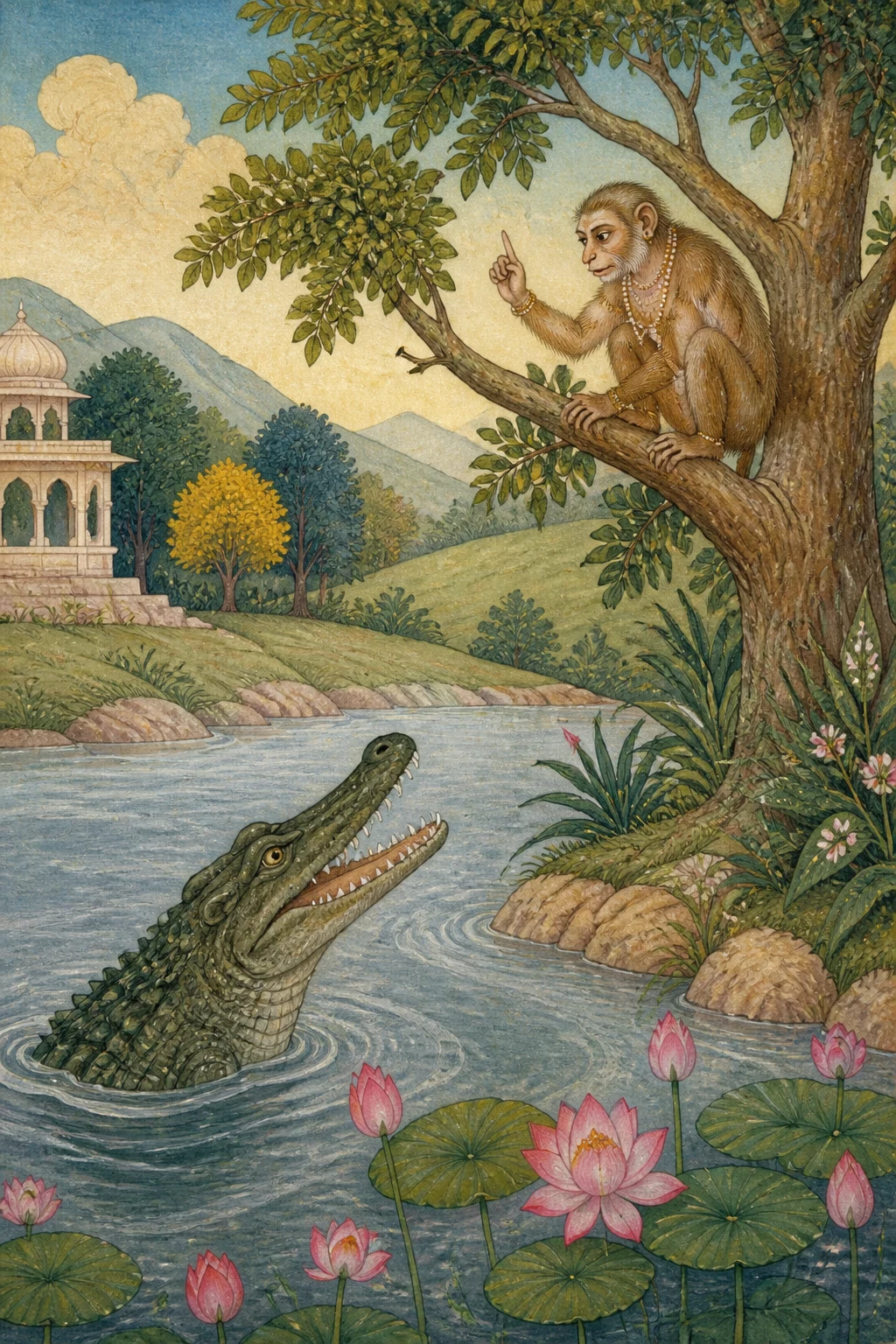
Like a lake shaded by lovely lotuses yet teeming with crocodiles,
The hearts of kings, clouded by passions and beset in time by petty, ignoble slanderers of the good,
Can be entered only with difficulty and fear.
As he recited this, he saw Piṅgalaka displaying the signs Damanaka had described. Terrified, he drew himself together and sat down at some distance without even making his customary bow. Piṅgalaka, seeing him behave in this fashion, believed Damanaka’s words and sprang upon him in anger. His back slashed by the lion’s sharp claws, Sañjīvaka tore at the lion’s belly with his horns, somehow broke free, and stood ready to fight, intent on goring him to death. Seeing the two of them, red as flowering palāśa trees and each bent on killing the other, Karaṭaka said to Damanaka, “You fool! You have done wrong in stirring up enmity between these two. You know nothing of the true principles of policy. Those versed in statecraft have said—
True ministers are skilled in policy: through friendly conciliation alone they settle affairs that would otherwise require great effort, harsh punishment, and violence.
But those who improperly seek worthless, trifling gains by resorting to force—
Through their misguided actions they place the king’s fortune in the balance.
“If the master is killed, what good will your clever counsel have done? And even if Sañjīvaka is not killed, that too will be disastrous. Even his death can be achieved only by putting the master’s life in danger. Fool! How can you aspire to be a minister? You do not know how to succeed through conciliation. Your ambition is vain, for you delight only in force. As it is said—
The Self-born has declared that policy begins with conciliation and ends with force;
Of these means, force is the worst, and should be employed last.
“And again—
Where conciliation alone can succeed, a wise man should not employ force.
If sugar will soothe a bilious disorder, what need is there for bitter colocynth?
“And again—
A discerning man should first employ conciliation;
Affairs settled by conciliation never go awry.
Neither moonlight, nor medicine, nor sunlight, nor fire
Can dispel the darkness born of hatred: conciliation alone can do so.
“Your aspiration to become a minister is equally misguided, for you do not understand a minister’s duties. Counsel has five parts: the means of beginning an undertaking, the provision of men and resources, the proper choice of place and time, remedies for disaster, and the accomplishment of the objective. Now disaster threatens either the master or his counselor—or both. If you have any ability at all, devise a remedy for this disaster. A minister’s intelligence is tested in repairing broken alliances. But, fool, you cannot do that, for your understanding works backward. As it is said—
A minister’s wisdom is revealed in healing a breach, a physician’s in treating a dangerous combination of disorders;
When all is well, who is not wise?
“And further—
A base man knows only how to ruin another’s work, not how to accomplish it;
A rat has the strength to overturn a basket of grain, but not to lift it up.
“Or perhaps the fault is not yours, but the master’s, since he believes what you say. As it is said— Kings who follow base men
And do not walk the path taught by the wise
Enter a cage of calamity, cramped on every side,
With paths hard to traverse and exits hard to find.
“If you become his minister, no other good man will ever come near him. As it is said—
A king with a wicked minister is unapproachable, though he himself be a storehouse of virtues,
Like a lake of clear, sweet water infested with vicious crocodiles.
“And deprived of worthy men, the master himself will perish. As it is said—
When kings delight in servants whose only skill is telling varied, charming tales, and whose bows are never strained,
Their enemies delight in their wealth.
“But what use is there in advising a fool? It brings nothing but harm, and no good. As it is said—
Wood that will not bend cannot be bent; a razor cannot work upon a stone.
Remember Sūcīmukha: one should not instruct an unteachable pupil.
Damanaka asked, “How was that?” Karaṭaka replied: Story 17. The Troop of Monkeys. On a mountainside lived a troop of monkeys. Once, in the cold season, their bodies shook under the touch of a bitter wind, and they were battered by dense torrents of icy rain. They could find no relief. Some of the monkeys gathered guñjā berries, which resembled glowing embers, and sat around them blowing, hoping to kindle a fire. A bird named Sūcīmukha saw their futile efforts and said, “You are all fools! These are not embers, but guñjā berries. Why labor in vain? They will not protect you from the cold. Look for some sheltered spot in the forest, a cave, or a mountain cleft. The clouds are still massing threateningly.” One old monkey among them said to him, “You fool! What business is this of yours? Be off! As it is said—
A discerning man who desires his own welfare should not address one whose work has been repeatedly thwarted,
Or a gambler who has lost.
“And again—
A hunter whose efforts have been fruitless, a fool sunk in misfortune—
Izvirnik
Tantra 01 mitra-bheda chunk 10
Naslednje strani prikazujejo izvirno besedilo za primerjavo.
Source ID: panchatantra_gretil_tantra_01_chunk_10
Source URL: https://gretil.sub.uni-goettingen.de/gretil/1_sanskr/5_poetry/4_narr/vispancu.htm
damanaka āha-bhadra, kim atra jñeyam ? eṣa te pratyayaḥ | yadi rakta-netras triśikhāṃ bhrūkuṭiṃ dadhānaḥ sṛkkaṇī parilelihan tvāṃ dṛṣṭvā bhavati, tad duṣṭa-buddhiḥ | anyathā suprasādaś ceti | tad ājñāpaya mām | svāśrayaṃ prati gacchāmi | tvayā ca yathāyaṃ mantra-bhedo na bhavati tathā kāryam | yadi niśāmukhaṃ prāpya gantuṃ śaknoṣi tad-deśa-tyāgaḥ kāryaḥ | yataḥ-
tyajed ekaṃ kulasyārthe grāmasyārthe kulaṃ tyajet |
grāmaṃ janapadasyārthe svātmārthe pṛthivīṃ tyajet
āpad-arthe dhanaṃ rakṣed dārān rakṣed dhanair api |
ātmānaṃ satataṃ rakṣed dārair api dhanair api
balavatābhibhūtasya videśa-gamanaṃ tad-anupraveśo vā nītiḥ | tad-deśa-tyāgaḥ kāryaḥ | athavātmā sāmādibhir upāyair ābharakṣaṇīyaḥ | uktaṃ ca-
api putra-kalatrair vā prāṇān rakṣeta paṇḍitaḥ |
vidyamānair yatas taiḥ syāt sarvaṃ bhūyo 'pi dehinām
tathā ca-
yena kenāpy upāyena śubhenāpy aśubhena vā |
uddhared dīnam ātmānaṃ samartho dharmam ācaret
yo māyāṃ kurute mūḍhaḥ prāṇa-tyāge dhanādiṣu |
tasya prāṇāḥ praṇaśyanti tair naṣṭair naṣṭam eva tat
evam abhidhāya damanakaḥ karaṭaka-sakāśam agamat | karaṭako 'pi tam āyāntaṃ dṛṣṭvā provāca-bhadra ! kiṃ kṛtaṃ tatrabhavatā ?
damanaka āha-mayā tāvan nīti-bīja-nirvāpaṇaṃ kṛtam | parato daiva-vihitāyattam | uktaṃ ca-
parāṅmukhe'pi daive'tra kṛtyaṃ kāryaṃ vipaścitā |
ātma-doṣa-vināśāya sva-citta-stambhanāya ca
tathā ca-
udyoginaṃ puruṣa-siṃham upaiti lakṣmīr
daivena deyam iti kāpuruṣā vadanti |
daivaṃ nihatya kuru pauruṣam ātma-śaktyā yatne kṛte yadi na sidhyati ko 'tra doṣaḥ
karaṭaka āha-tat kathaya kīdṛk tvayā nīti-bījaṃ nirvāpitam |
so 'bravīt-mayānyonyaṃ tābhyāṃ mithyā-prajalpena bhedas tathā vihito yathā bhūyo 'pi mantrayantāv eka-sthāna-sthitau na drakṣyasi |
karaṭaka āha-aho, na yuktaṃ bhavatā vihitaṃ yat parasparaṃ tau snehārdra-hṛdayau sukhāśrayau kopa-sāgare prakṣiptau | uktaṃ ca-
aviruddhaṃ sukha-sthaṃ yo duḥkha-mārge niyojayet |
janma-janmāntare duḥkhī sa naraḥ syād asaṃśayam
aparaṃ tvaṃ yad bheda-mātreṇāpi hṛṣṭas tad apy ayuktam, yataḥ sarvato 'pi jano virūpa-karaṇe samartho bhavati nopakartum | uktaṃ ca-
ghātayitum eva nīcaḥ para-kāryaṃ vetti na prasādayitum |
pātayitum asti śaktir vāyor vṛkṣaṃ na connamitum
damanaka āha-anabhijño bhavān nīti-śāstrasya, tenaitad bravīṣi | uktaṃ ca yataḥ-
jāta-mātraṃ na yaḥ śatruṃ vyādhiṃ ca praśamaṃ nayet |
mahā-balo 'pi tenaiva vṛddhiṃ prāpya sa hanyate
tac-chatru-bhūto 'yam asmākaṃ mantri-padāharaṇāt | uktaṃ ca-
pitṛ-paitāmahaṃ sthānaṃ yo yasyātra jigīṣate |
sa tasya sahajaḥ śatrur ucchedyo 'pi priye sthitaḥ
tan mayā sa udāsīnatayā samānīto 'bhaya-pradānena yāvat tāvad aham api tena sācivyāt pracyāvitaḥ | athavā sādhv idam ucyate-
dadyāt sādhur yadi nija-pade durjanāya praveśaṃ
tan-nāśāya prabhavati tato vāñchamānaḥ svayaṃ saḥ |
tasmād deyo vipula-matibhir nāvakāśo 'dhamānāṃ
jārāpi syād gṛha-patir iti śrūyate vākyato 'tra
tena mayā tasyopari vadhopāya eva viracyate | deśa-tyāgāya vā bhaviṣyati | tac ca tvāṃ muktvānyo na jñāsyati | tad uktam etat te svārthāyānuṣṭhitam | uktaṃ ca-
nistriṃśaṃ hṛdayaṃ kṛtvā vāṇīm ikṣu-rasopāmām |
vikalpo 'tra na kartavyo hanyāt tatrāpakāriṇam
aparaṃ mṛto 'py asmākaṃ bhojyo bhaviṣyati | tad ekaṃ tāvad vara-sādhanam | aparaṃ sācivyaṃ ca bhaviṣyati tṛptiś ceti | tad-guṇa-traye'sminn upasthite kasmān māṃ dūṣayasi tvaṃ jāḍya-bhāvāt | uktaṃ ca-
parasya pīḍanaṃ kurvan svārtha-siddhiṃ ca paṇḍitaḥ |
mūḍha-buddhir na bhakṣeta vane caturako yathā
karaṭaka āha-katham etat ?
sa āha-
kathā 16
vajra-daṃṣṭra-nāma-siṃha-kathā
asti kasmiṃścid vanoddeśe vajra-daṃṣṭro nāma siṃhaḥ | tasya caturaka-kravyamukha-nāmānau śṛgāla-vṛkau bhṛtya-bhūtau sadaivānugatau tatraiva vane prativasataḥ | athānya-dine siṃhena kadācid āsanna-prasavā prasava-vedanayā sva-yūthād bhraṣṭoṣṭry upaviṣṭā kasmiṃścid vana-gahane samāsāditā | atha tāṃ vyāpādya yāvad udaraṃ sphoṭayati, tāvaj jīvan laghu-dāseraka-śiśur niṣkrāntaḥ | siṃho 'pi dāserakyāḥ piśitena saparivāraḥ parāṃ tṛptim upāgataḥ | paraṃ snehād bāla-dāsekaṃ tyaktaṃ gṛham ānīyedam uvāca-bhadra, na te'sti mṛtyor bhayaṃ matto nānyasmād api | tataḥ svecchayātra vane bhrāmyatām iti | yatas te śaṅku-sadṛśau karṇau | tataḥ śaṅkukarṇo nāma bhaviṣyati |
evam anuṣṭhite catvāro 'pi na eka-sthāne vihāriṇaḥ parasparam aneka-prakāra-goṣṭhī-sukham anubhavantas tiṣṭhanti | śaṅkukarṇo 'pi yauvana-padavīm ārūḍhaḥ kṣaṇam api na taṃ siṃhaṃ muñcati |
atha kadācid vajra-daṃṣṭrasya kenacid vanyena matta-gajena saha yuddham abhavat | tena mada-vīryāt sa danta-prahārais tathā kṣata-śarīro vihito yathā pracalituṃ na śaknoti | tadā kṣut-kṣāma-kaṇṭhas tān provāca-bhoḥ ! anviṣyatāṃ kiñcit sattvaṃ yenāham evaṃ sthito 'pi taṃ vyāpādyātmano yuṣmākaṃ ca kṣut-praṇāśaṃ karomi |
tac chrutvā te trayo 'pi vane sandhyā-kālaṃ yāvad bhrāntāḥ, paraṃ na kiñcit sattvam āsāditam | atha caturakaś cintayāmāsa-yadi śaṅkukarṇo 'yaṃ vyāpādyeta tataḥ sarveṣāṃ katicid dināni tṛptir bhavati | paraṃ nainaṃ svāmī mitratvād āśraya-samāśritatvāc ca vināśayiṣyati | athavā buddhi-prabhāveṇa svāminaṃ pratibodhya tathā kariṣye yathā vyāpādayiṣyati | uktaṃ ca-
avadhyaṃ vāthavāgamyam akṛtyaṃ nāsti kiṃcana |
loke buddhimatām atra tasmāt tāṃ yojayāmy aham
evaṃ vicintya śaṅkukarṇam idam āha-bhoḥ śaṅkukarṇa ! svāmī tāvat pathyaṃ vinā kṣudhayā paripīḍyate | svāmya-bhāvād asmākam api dhruvaṃ vināśa eva | tato vākyaṃ kiñcit svāmy-arthe vadiṣyāmi | tac chrūyatām |
śaṅkukarṇa āha-bhoḥ śīghraṃ nivedyatāṃ, yena te vacanaṃ śīghraṃ nirvikalpaṃ karomi | aparaṃ svāminohite kṛte mayā sukṛta-śataṃ kṛtaṃ bhaviṣyati |
atha caturaka āha-bho bhadra ! ātma-śarīraṃ dviguṇa-lābhena svāmine prayaccha, yena te dviguṇaṃ śarīraṃ bhavati | svāminaḥ punaḥ prāṇa-yātrā bhavati |
tad ākarṇya śaṅkukarṇaḥ prāha-bhadra ! yady evaṃ tan madīya-prayojanam etad ucyatām | svāmy-arthaḥ kriyatām iti | param atra dharmaḥ pratibhūḥ iti |
te vicintya sarve siṃha-sakāśam ājagmuḥ | tataś caturaka āha-deva ! na kiñcit sattvaṃ prāptam | bhagavān ādityo 'py astaṃ gataḥ | tad yadi svāmī dviguṇaṃ śarīraṃ prayacchati | tataḥ śaṅkukarṇo 'yaṃ dviguṇa-vṛddhyā sva-śarīraṃ prayacchati dharma-pratibhuvā |
siṃha āha-bhoḥ, yady evaṃ tat sundarataram | vyavahārasyāsya dharmaḥ pratibhūḥ kriyatām iti |
atha siṃha-vacanānantaraṃ vṛka-śṛgālābhyāṃ vidāritobhaya-kukṣiḥ śaṅkukarṇaḥ pañcatvam upāgataḥ |
atha vajra-daṃṣṭraś caturakam āha-bhoś caturaka ! yāvad ahaṃ nadīṃ gatvā snānaṃ devatārcana-vidhiṃ kṛtvāgacchāmi, tāvat tvayātrāpamattena bhāvyam ity uktvā nadyāṃ gataḥ |
atha tasmin gate caturakaś cintayāmāsa-kathaṃ mamaikākino bhojyo 'yam uṣṭro bhaviṣyati iti vicintya kravyamukham āha-bhoḥ kravyamukha ! kṣudhālur bhavān | tad yāvad asau svāmī nāgacchati, tāvat tvam asyoṣṭrasya māṃsaṃ bhakṣaya | ahaṃ tvāṃ svāmino nirdoṣaṃ pratipādayiṣyāmi |
so 'pi tac chrutvā yāvat kiñcin māṃsam āsvādayati tāvac caturakeṇoktam-bhoḥ kravyamukha ! samāgacchati svāmī | tat tyaktvainaṃ dūre tiṣṭha, yenāsya bhakṣaṇaṃ na vikalpayati |
tathānuṣṭhite siṃhaḥ samāyāto yāvad uṣṭraṃ paśyati tāvad riktīkṛta-hṛdayo dāserakaḥ | tato bhṛkuṭiṃ kṛtvā paruṣataram āha-aho kenaiṣa uṣṭra ucchiṣṭatāṃ nīto, yena tam api vyāpādayāmi |
evam abhihite kravyamukhaś caturaka-mukham avalokayati | atha caturako vihasyovāca-bhoḥ ! mām anādṛtya piśitaṃ bhakṣayitvādhunā man-mukham avalokayasi | tad-āsvādayāsya durṇaya-taroḥ phalam iti |
tad ākarṇya kravyamukho jīva-nāśa-bhayād dūra-deśaṃ gataḥ | etasminn antare tena mārgeṇa dāseraka-sārtho bhārākrāntaḥ samāyātaḥ | tasyāgresaroṣṭrasya kaṇṭhe mahatī ghaṇṭā baddhā | tasyāḥ śabdaṃ durato 'py ākarṇya siṃho jambukam āha-bhadra, jñāyatāṃ kim eṣa raudraḥ śabdaḥ śrūyate'śruta-pūrvaḥ ?
tac chrutvā, caturakaḥ kiñcid vanāntaraṃ gatvā satvaram abhyupetya provāca-svāmin ! gamyatāṃ gamyatāṃ yadi śaknoṣi gantum |
so 'bravīt-bhadra, kim evaṃ māṃ vyākulayasi | tat kathaya kim etat ?
iti caturaka āha-svāmin, eṣa dharmarājas tavopari kupitaḥ | yad anenākāle dāserako 'yaṃ madīyo vyāpāditaḥ | tat sahasra-guṇam uṣṭram asya sakāśād grahīṣyāmi | iti niścitya bṛhan-mānam ādāyāgresarasyoṣṭrasya grīvāyāṃ ghaṇṭāṃ baddhvā badhya-dāseraka-saktān api pitṛ-pitāmahān ādāya vaira-niryātanārtham āyāta eva |
siṃho 'pi tac chrutvā sarvato dūrād evāvalokya mṛtam uṣṭraṃ parityajya prāṇa-bhayāt praṇaṣṭaḥ | caturako 'pi śanaiḥ śanais tasyoṣṭrasya māṃsaṃ bhakṣayāmāsa | ato 'haṃ bravīmi-parasaya pīḍanaṃ kurvan (399) iti |
atha damanake gate sañjīvakaś cintayāmāsa-aho kim etan mayā kṛtam ? yac chaṣpādo 'pi māṃsāśitas tasyānugaḥ saṃvṛttaḥ | athavā sādhv idam ucyate-
agamyāni pumān yāti yo 'sevyāṃś ca niṣevate |
sa mṛtyum upagṛhṇāti garbham aśvatarī yathā
tat kiṃ karomi ? kva gacchāmi ? kathaṃ me śāntir bhaviṣyati ? athavā tam eva piṅgalakaṃ gacchāmi | kadācin māṃ śaraṇāgataṃ rakṣati | prāṇair na viyojayati | yata uktaṃ ca-
dharmārthaṃ yatatām apīha vipado devād yadi syuḥ kvacit
tat tāsām upaśāntaye sumatibhiḥ kāryo viśeṣān nayaḥ |
loke khyātim upāgatātra sakale lokoktir eṣā yato
dagdhānāṃ kila vahninā hita-karaḥ seko 'pi tasyodbhavaḥ
tathā ca-
loke'thavā tanu-bhṛtāṃ nija-karma-pākaṃ
nityaṃ samāśritavatāṃ suhita-kriyāṇām |
bhāvārjitaṃ śubham athāpy aśubhaṃ nikāmaṃ
yad bhāvi tad bhavati nātra vicāra-hetuḥ
aparaṃ cānyatra gatasyāpi me kasyacid duṣṭa-sattvasya māṃsāśinaḥ sakāśān mṛtyur bhaviṣyati | tad varaṃ siṃhāt | uktaṃ ca-
mahadbhiḥ spardhamānasya vipad eva garīyasī |
danta-bhaṅge'pi nāgānāṃ ślāghyo giri-vidāraṇe
tathā ca-
mahato 'pi kṣayaṃ labdhvā ślāghyaṃ nīco 'pi gacchati |
dānārthī madhupo yadvad gaja-karṇa-samāhataḥ
evaṃ niścitya sa sthalita-gatiṃ mandaṃ gatvā siṃhāśrayaṃ paśyann apaṭhat-aho, sādhv idam ucyate-
antar-līna-bhujaṅgamaṃ gṛham ivāntaḥsthogra-siṃhaṃ vanaṃ
grāhākīrṇam ivābhirāma-kamala-cchāyā-sanāthaṃ saraḥ |
kālenārya-janāpavāda-piśunaiḥ kṣudrair anāryaiḥ śritaṃ
duḥkhena pravigāhyate sa-cakitaṃ rājñāṃ manaḥ sāmayam
evaṃ paṭhan damanakoktākāraṃ piṅgalakaṃ dṛṣṭvā pracakitaḥ saṃvṛta-śarīro dūrataraṃ praṇāma-kṛtiṃ vināpy upaviṣṭaḥ | piṅgalako 'pi tathāvidhaṃ taṃ vilokya damanaka-vākyaṃ śraddadhānaḥ kopāt tasyopari papāta |
atha sañjīvakaḥ khara-nakha-vikartita-pṛṣṭhaḥ śṛṅgābhyāṃ tad-udaram ullikhya katham api tasmād apetaḥ śṛṅgābhyāṃ hantum icchan yuddhāyāvasthitaḥ | atha dvāv api tau puṣpita-palāśa-pratimau paraspara-vadha-kāṅkṣiṇau dṛṣṭvā karaṭako damanakam āha-bho mūḍha-mate ! anayor virodhaṃ vitanvatā tvayā sādhu na kṛtam | na ca tvaṃ nīti-tattvaṃ vetsi | nītividbhir uktaṃ ca-
kāryāṇy uttama-daṇḍa-sāhasa-phalāny āyāsa-sādhyāni ye prītyā saṃśamayanti nīti-kuśalāḥ sāmnaiva te mantriṇaḥ |
niḥsārālpa-phalāni ye tv avidhinā vāñchanti daṇḍodyamais
teṣāṃ durnaya-ceṣṭitair narapater āropyate śrīs tulām
tad yadi svāmy-abhighāto bhaviṣyati tat kiṃ tavdīya-mantra-buddhyā kriyate | atha sañjīvako na badhyate tathāpy abhavyam | yataḥ prāṇa-sandehāt tasya ca vadhaḥ | tan mūḍha ! kathaṃ tvaṃ mantri-padam abhilaṣasi | sāma-siddhiṃ na vetsi | tad vṛthā manoratho 'yaṃ te daṇḍaruceḥ | uktaṃ ca-
sāmādi-daṇḍa-paryanto nayaḥ proktaḥ svayambhuvā |
teṣāṃ daṇḍas tu pāpīyāṃs taṃ paścād viniyojayet
tathā ca-
sāmnaiva yatra siddhir na tatra daṇḍo budhena viniyojyaḥ |
pittaṃ yadi śarkarayā śāmyati ko 'rthaḥ paṭolena
tathā ca-
ādau sāma prayoktavyaṃ puruṣeṇa vijānatā |
sāma-sādhyāni kāryāṇi vikriyāṃ yānti na kvacit
na candreṇa na cāuṣadhyā na sūryeṇa na vahninā |
sāmnaiva vilayaṃ yāti vidveṣa-prabhavaṃ tamaḥ
tathā yat tvaṃ mantritvam abhilaṣasi, tad apy ayuktam | yatas tvaṃ mantri-gatiṃ na vetsi | yataḥ pañca-vidho mantraḥ | sa ca karmaṇām ārambhopāyaḥ, puruṣa-dravya-sampat, deśa-kāla-vibhāgaḥ, vinipāta-pratīkāraḥ, kārya-siddhiś ceti | so 'yaṃ svāmy-amātyayor ekatamasya kiṃ vā dvayor api vinipātaḥ samutpadyate lagnaḥ | tad yadi kācic chaktir asti tad vicintyatāṃ vinipāta-pratīkāraḥ | bhinna-sandhāne hi mantriṇāṃ buddhi-parīkṣā | tan mūrkha ! tat kartum asamarthatvaṃ yato viparīta-buddhir asi | uktaṃ ca-
mantriṇāṃ bhinna-sandhāne bhiṣajāṃ sāṃnipātike |
karmaṇi vyajyate prajñā susthe ko vā na paṇḍitaḥ
anyac ca-
ghātayitum eva nīcaḥ para-kāryaṃ vetti na prasādhayitum |
pātayitum eva śaktir nākhoruddhartum anna-piṭakam
athavā na te doṣo 'yam | svāmino doṣaḥ | yas te vākyaṃ śraddadhāti | uktaṃ ca-
narādhipā nīca-janānuvartino
budhopadiṣṭena pathā na yānti ye |
viśanty ato durgama-mārga-nirgamaṃ
samasta-sambādham anartha-pañjaram
tad yadi tvam asya mantrī bhaviṣyasi tadānyo 'pi kaścin nāsya samīpe sādhu-janaḥ sameṣyati | uktaṃ ca-
guṇālayo 'py asan mantrī nṛpatir nādhigamyate |
prasanna-svādu-salilo duṣṭa-grāhyo yathā hradaḥ
tathā ca śiṣṭa-jana-rahitasya svāmino 'pi nāśo bhaviṣyati | uktaṃ ca-
citrāsvāda-kathair bhṛtyair anāyāsita-kārmukaiḥ |
ye ramante nṛpās teṣāṃ ramante ripavaḥ śriyā
tat kiṃ mūrkhopadeśena | kevalaṃ doṣo na guṇaḥ | uktaṃ ca-
nānāmyaṃ namate dāru nāśmani syāt kṣura-kriyā |
sūcī-mukhaṃ vijānīhi nāśiṣyāyopaśyate
damanaka āha--katham etat ?
so 'bravīt-
kathā 17
vānara-yūtha-kathā
asti kasmiṃścit parvataika-deśe vānara-yūtham | tac ca kadācid dhemanta-samaye'tikaṭhora-vāta-saṃsparśa-vepamāna-kalevaraṃ tuṣāra-varṣoddhata-pravarṣa-ghana-dhārā-nipāta-samāhataṃ na kathañcic chāntim agamat | atha kecid vānarā vahni-kaṇa-sadṛśāni guñjā-phalāny avacitya vahni-vāñchayā phūtkurvantaḥ samantāt tasthuḥ |
atha sucīmukho nāma pakṣī teṣāṃ taṃ vṛthāyāsamavalokya provāca-bhoḥ, sarve mūrkhā yūyam | naite vahni-kaṇāḥ guñjā-phalāni etāni | tat kiṃ vṛthā śrameṇa | naitasmāc chīta-rakṣā bhaviṣyati | tad anviṣyatāṃ kaścin nirvāto vana-pradeśo guhā giri-kandaraṃ vā | adyāpi sa-ṭopā medhā dṛśyante |
atha teṣām ekatamo vṛddha-vānaras tam uvāca-bho mūrkha ! kiṃ tāvad anena vyāpāreṇa | tad gamyatām | uktaṃ ca-
muhur vighnita-karmāṇaṃ dyūta-kāraṃ parājitam |
nālāpayed viveka-jño yadīcchet siddhim ātmanaḥ
tathā ca-
ākheṭakaṃ vṛthākleśaṃ mūrkhaṃ vyasanasaṃsthitam |
Nadaljuj z branjem