Prevod
He said, “How did this happen? Tell me the reason.”
At his question, the other told him the whole story of the wheel.
Hearing this, he reproached him: “My friend! I warned you again and again, but you would not listen. What can be done now? Though learned and wellborn, you are utterly without sense. Indeed, it is well said:
Better good sense than learning; good sense surpasses scholarship.
Those without sense perish, like the men who made the lion.
Cakradhara asked, “How was that?” Suvarṇasiddhi replied: Tale 3 The Foolish Brahmans Who Made a Lion In a certain town lived four young Brahmans, bound together by the closest friendship. Three were thoroughly versed in the scriptures but lacked good sense. The fourth had good sense but no taste for scholarly study. One day the friends consulted together: “What use is learning unless we travel abroad, win the favor of kings, and earn wealth? Let us go east.” They set out, and after they had traveled some distance, the eldest said, “Look here! The fourth among us is an ignoramus. He has nothing but good sense. Yet without learning, mere good sense will never win gifts from a king. We shall not give him a share of our earnings. Let him go home.”
The second said, “Subuddhi, go back to your own home, for you have no learning.”
But the third said, “No, it is not right to act like this. We have played together since childhood. Let this good fellow come along and share equally in whatever wealth we earn. For it is said:
What use is wealth kept to oneself, like a wife,
If it is not shared, like a courtesan, for travelers to enjoy?
And again:
‘This man is one of us, that man a stranger’—such is the reckoning of small minds.
To those of generous spirit, the whole earth is one family.
“So let him come too.”
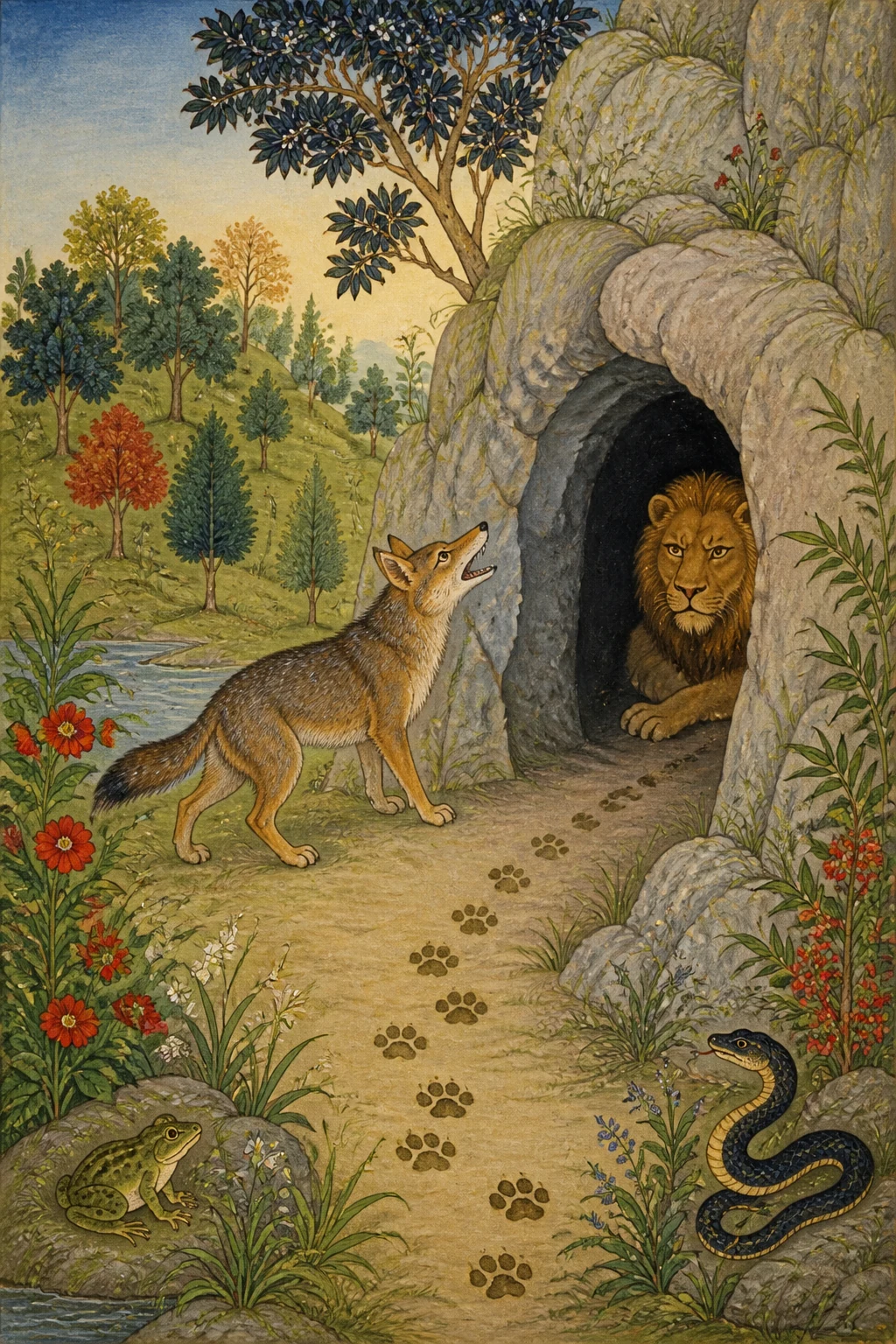
They agreed and continued on their way. In a forest they came upon the bones of a dead lion. One of them said, “Ah! Today we shall put our learning to the test. Here lies some dead creature. Let us restore it to life through the power of our knowledge. I shall assemble the bones.” Eagerly he put the bones together. The second supplied skin, flesh, and blood. Just as the third was about to breathe life into it, Subuddhi stopped him: “Wait, sir! What you have made is a lion. If you bring it to life, it will kill us all.”
At this, the other said, “Shame on you, fool! I will not let my learning go to waste.”
“Then wait a moment,” said Subuddhi, “while I climb a tree.”
He did so. No sooner had the lion been brought to life than it sprang up and killed all three. Subuddhi then climbed down from the tree and went home. That is why I say, “Better good sense than learning.”
*********************************************************************** Suvarṇasiddhi then went on:
Even those skilled in scripture, if ignorant of the ways of the world,
Become a laughingstock, like those foolish scholars.
Cakradhara asked, “How was that?” He replied: Tale 4 The Foolish Scholars
In a certain town lived four Brahmans who were friends with one another. While still young, they conceived a plan: “Let us travel to another country and acquire learning.”
One day, having agreed among themselves, the Brahmans went to Kānyakubja to study. There they entered a college and devoted themselves to their books. After twelve years of single-minded study, all four had become accomplished scholars. Then they met and said, “We have mastered every branch of learning. Let us take leave of our teacher and return to our own country.” “So be it,” they agreed. They took leave of their teacher, obtained his permission, gathered their books, and set out. After traveling some distance, they came to a fork in the road and all sat down. One asked, “Which road shall we take?”
Just then, a merchant’s son had died in the nearby town, and a large company had set out to cremate him. One of the four consulted his book and read, “The path is that by which the great have gone.” “Then let us follow this great company,” he said.
The scholars went along with the funeral procession, and at the cremation ground they saw a donkey. The second opened his book and read:
In times of celebration or distress, in famine or danger from enemies,
At the king’s court or the cremation ground, whoever stands beside you is your kinsman.
“Ah! This is our kinsman!” One threw his arms around its neck, while another washed its feet. Then, as the scholars looked about, they noticed a camel. “What is that?” they asked.
The third opened his book and said, “Dharma moves swiftly. Surely, then, this must be Dharma.”
The fourth said, “One should unite what one loves with Dharma.”
So they tied the donkey to the camel’s neck. Someone reported this to the donkey’s owner, a washerman. When the washerman came to beat the foolish scholars, they fled. A little farther along the road, they came to a river. Seeing a palāśa leaf floating down the current, one scholar said, “The leaf that comes will carry us across.” With these words he threw himself upon the leaf and was swept away by the river. Seeing him being carried off, another scholar seized him by the hair and declared:
When faced with the loss of everything, a wise man gives up half.
With the half remaining he can accomplish his purpose, but total loss is unbearable.
Afterward they continued on and reached a village. The villagers invited them in and took them to separate houses. One was served thin noodles with clarified butter. The scholar reflected and said, “He who spins things out at length comes to ruin.” With that, he abandoned his meal and left. The second was given broad, flat cakes. He declared, “Whatever spreads too wide will not live long,” and left his food untouched. The third was served cakes with holes in them. He too quoted a maxim: “Misfortunes multiply wherever there are openings.” Thus all three scholars, their throats wasted with hunger and everyone laughing at them, left that place and returned to their own country.
Suvarṇasiddhi said, “You too, ignorant of the ways of the world, refused to stop despite my warnings, and so have fallen into this plight. That is why I say, ‘Even those skilled in scripture.’”
Hearing this, Cakradhara said, “Ah, that is not the cause. For:
Even men of good sense perish when evil fate destroys them,
While a man of little wit may flourish forever in a favored family.
And it is said:
What fate protects stands safe though unguarded; what fate strikes down perishes though well guarded.
A helpless man abandoned in the forest lives, while another, tended with every care at home, dies.
And again:
There is Hundred-Wits upon a head, and Thousand-Wits hangs dangling.
But I, One-Wit, my dear, play in the clear water.
Suvarṇasiddhi asked, “How was that?” He replied: Tale 5 The Fish and the Frog In a certain pool lived two fish, Śatabuddhi, Hundred-Wits, and Sahasrabuddhi, Thousand-Wits. They had made friends with a frog named Ekabuddhi, One-Wit. The three would spend their leisure pleasantly conversing on the bank, then return to the water. One day, while they were talking, some fishermen came to the pool. Looking at it, they said to one another, “This pool seems full of fish, and there is little water. We shall come here tomorrow morning.” With that, they went home. The fish, their faces downcast, began to confer. The frog said, “Śatabuddhi, did you hear what the fishermen said? What should we do—flee or stand our ground? Tell us today what course is best.” Hearing this, Sahasrabuddhi laughed and said, “My friend, do not be afraid! We should not take fright merely because we have heard them speak. There is no need to fear. For it is said:
The designs of snakes, villains, and all the evil-minded
Do not always succeed; that is why the world endures.
“They may never come at all. And if they do, I shall save both you and myself through the power of my wit, for I know many ways of moving through the water.”
Hearing this, Śatabuddhi said, “Well spoken! You truly are Thousand-Wits. Indeed, it is well said:
Nothing in this world lies beyond the reach of an intelligent mind.
By his intelligence Cāṇakya destroyed the Nandas, though they stood sword in hand.
And again:
Where neither the wind nor the rays of the sun can find a way,
The intelligence of the wise swiftly enters.
“We cannot abandon our birthplace, handed down from our forefathers, merely because we have heard a few words. For it is said:
Not even in heaven, radiant with divine delights, does a man find such happiness
As in the place where he was born, however wretched it may be.
“So there must be no question of leaving. I shall protect you through the power of my wit.” The frog said, “My good friends, I have only one wit, and it counsels flight. I shall leave for another pool with my wife this very day.” With these words, the frog went to another pool that very night. In the morning the fishermen came and caught the creatures of the water, great, middling, and small—fish, turtles, frogs, crabs, and the rest. Śatabuddhi and Sahasrabuddhi fled with their wives, and for a long time protected themselves by their knowledge of special movements and their twisting courses. But they too fell into the net and were killed. In the afternoon the delighted fishermen set off for home. Because of their weight, one man carried Śatabuddhi on his shoulder, while Sahasrabuddhi was carried hanging down. The frog, who had come to the bank of his new pond, saw them being carried along in this fashion and said to his wife, “My dear, look! Look!
There is Hundred-Wits upon a head, and Thousand-Wits hangs dangling.
But I, One-Wit, my dear, play in the clear water.
“As for your saying, ‘Better good sense than learning,’ my opinion is that even intelligence cannot be relied upon absolutely.”
Suvarṇasiddhi said, “Even if that is so, a friend’s advice should not be disregarded. But what can be done? Despite my warnings, you would not stop, so great were your greed and your pride in your learning. Indeed, it is well said:
Well sung, Uncle! Though I warned you, you would not stop.
A splendid new jewel hangs about your neck—the reward of your singing!
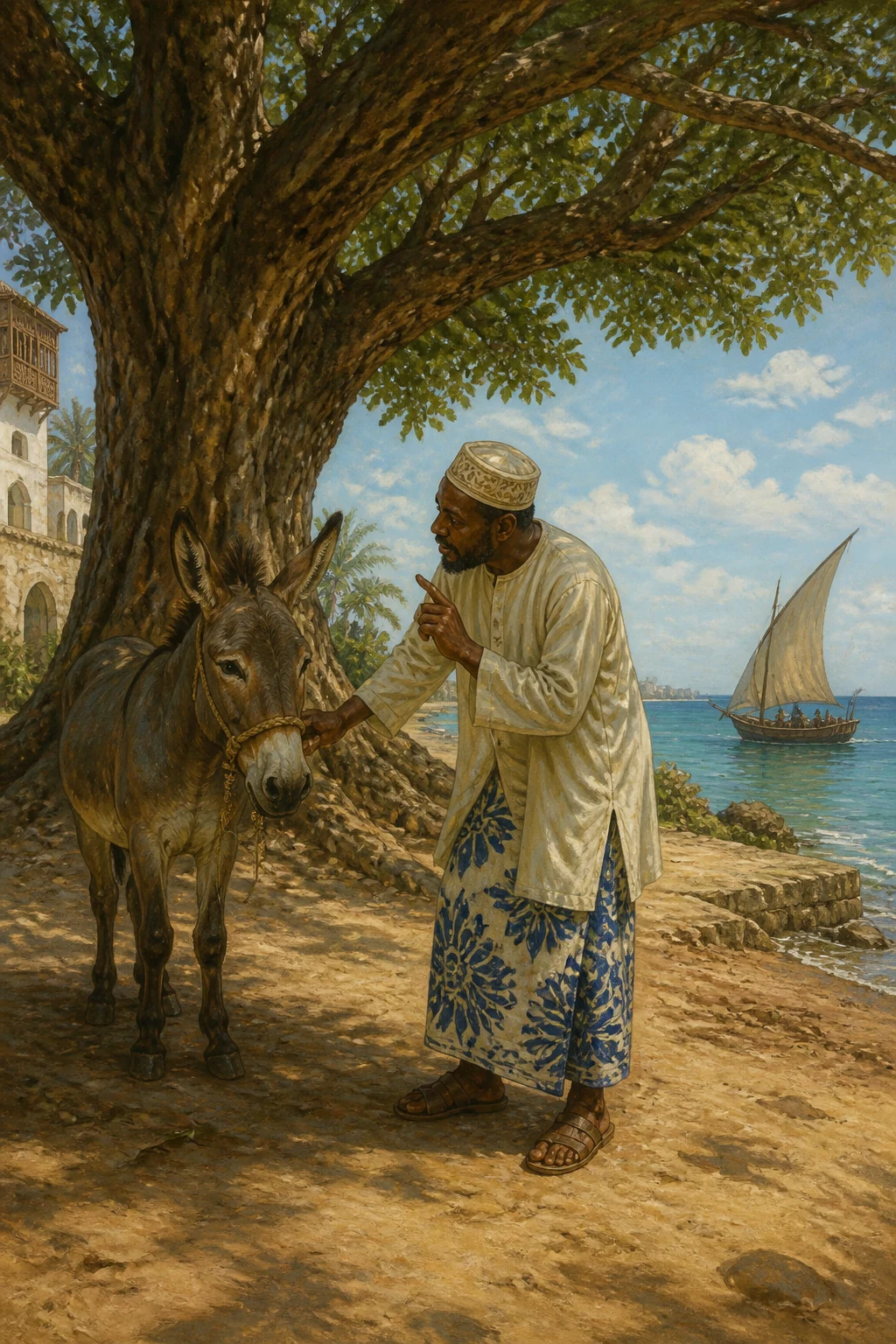
Cakradhara asked, “How was that?” He replied: Tale 6 The Donkey and the Jackal In a certain town lived a donkey named Uddhata. All day he carried loads for a washerman, and at night he roamed wherever he pleased. At dawn he returned of his own accord to the washerman’s house, afraid of being kept tied up. The washerman then put him in harness again. One night, while wandering through the fields, he made friends with a jackal. Being strong and well fed, he would break through a fence and enter a cucumber field with the jackal. There the two ate cucumbers to their hearts’ content, returning to their own places each day at dawn. One night, standing in the middle of the field and carried away by high spirits, the donkey said to the jackal, “Nephew, look! What a wonderfully clear night! I shall sing. Tell me, which rāga shall I choose?” The jackal replied, “Uncle, why stir up trouble for nothing? We are engaged in theft. Thieves and lovers on secret errands must keep quiet. For it is said:
A man with a cough should avoid theft; a sleepy man, an adulterous affair;
And a sick man, indulgence of the tongue—if he wishes to stay alive.
“Besides, your singing is not sweet. It sounds like a conch blast and can be heard far away. The field guards are sleeping soundly here. They will wake up and kill you or tie you up. Just eat these nectar-sweet cucumbers, and do not busy yourself with singing.” Hearing this, the donkey said, “You live in the wild and know nothing of the pleasures of music. That is why you talk like this. For it is said:
When autumn moonlight has driven the darkness far away and one’s beloved is near,
Into the ears of the fortunate flows the nectar born of music’s ringing notes.
The jackal said, “Uncle, that is true. But you do not know how to sing. You merely bray. What good is that, when it will ruin your own interests?” The donkey replied, “Shame, shame on you, fool! Do I not know music? Listen, then, to its divisions:
There are seven notes, three scales, thirty-one melodic progressions,
Forty-nine melodic patterns, three measures, and three tempos;
Three vocal registers, six forms of rhythmic movement, nine sentiments,
Thirty-six rāgas, and forty emotional states are recognized.
Thus the elements of music are reckoned at one hundred and eighty-five,
As Bharata himself declared long ago, in accordance with sacred revelation.
Nothing in this world is dearer than music, even to the gods.
By the delightful music of dried sinews, Rāvaṇa won over the Three-Eyed God.
“How, then, nephew, can you call me ignorant and try to stop me?”
The jackal said, “Uncle, if that is how it is, I shall stand at the gap in the fence and watch for the field guard. You may sing to your heart’s content.”
So they did. Hearing the donkey bray, the field guard came running, grinding his teeth in anger. As soon as he saw the donkey, he beat him with a club until he fell to the ground. Then he tied a mortar with a hole in it around the donkey’s neck and went back to sleep. The donkey, true to the nature of his kind, soon ceased to feel the pain and got up. For it is said:
In a dog, a horse, and especially a donkey,
The pain caused by blows does not last beyond a little while.
Then, dragging the mortar with him, he smashed through the fence and began to flee. The jackal saw him from a distance and said with a smile:
Well sung, Uncle! Though I warned you, you would not stop.
A splendid new jewel hangs about your neck—the reward of your singing!
“You too refused to stop, despite my warnings.”
Hearing this, Cakradhara said, “My friend, that is true. Indeed, it is well said:
He who has no judgment of his own and will not follow a friend’s advice
Goes straight to his destruction, like Manthara the weaver.
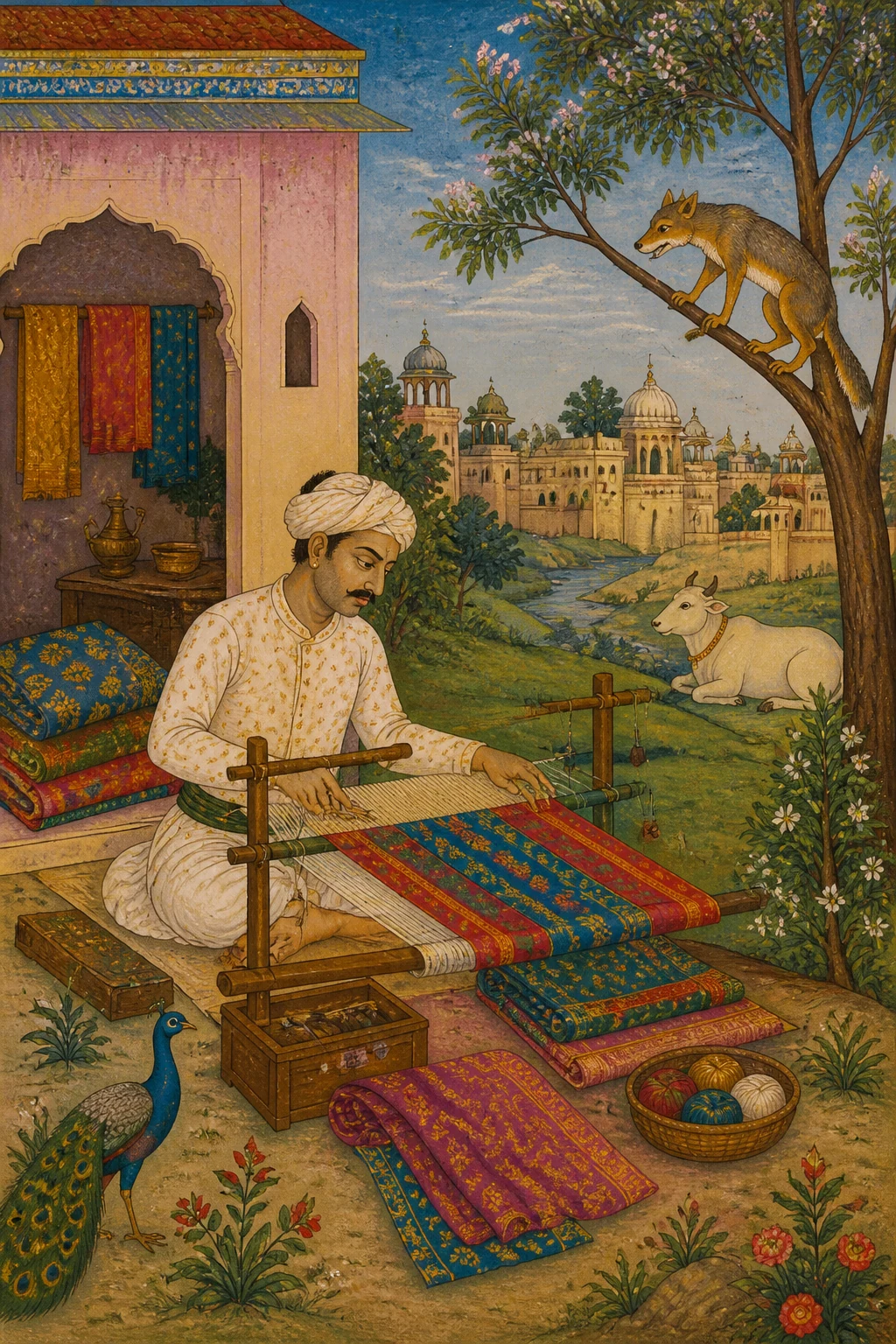
Suvarṇasiddhi asked, “How was that?” He replied: Tale 7 Manthara the Weaver In a certain town lived a weaver named Mantharaka. One day, while he was weaving, all the wooden parts of his loom broke. Taking an axe, he went to the forest for timber. As he wandered along the seashore, he saw a śiṃśapā tree. He thought, “This is a large tree. If I cut it down, it will provide plenty of wood for my weaving equipment.” Having decided this, he raised his axe against it. Now a spirit had made its home in that tree. It said, “My good man, this tree is my dwelling and must be spared. I live here in great comfort, refreshed by the cool breeze that passes over the ocean waves.”
The weaver said, “What am I to do? Without wood for my equipment, my family will suffer from hunger. Go elsewhere at once. I am going to cut it down.”
The spirit said, “I am pleased with you. Ask for whatever you desire, but spare this tree.”
The weaver replied, “If that is so, I shall go home, consult my friend and my wife, and return. Then you may grant my wish.”
The spirit agreed, and the delighted weaver turned toward home. As he approached the village, he met his friend the barber. He told him what the spirit had said: “My friend, a spirit has offered to grant me a wish. Tell me what I should ask for. I have come to consult you.” The barber replied, “My good fellow, if that is so, ask for a kingdom. Then you will be king, and I shall be your minister. We shall both enjoy happiness in this world and happiness in the next. For it is said:
A king who is always devoted to giving, having won renown in this world—