Waltey
Tat in njegov mojster
Grimmove pravljice · Jacob in Wilhelm GrimmO besedilu
Tat in njegov mojster
- Vir
- Grimmove pravljice
- Avtor
- Jacob in Wilhelm Grimm
- Jezik branja
- English
- Jezik izvirnika
- Deutsch
- Čas branja
- 5 min branja
- Obseg
- 4 strani
- Naslov izvirnika
- Der Gaudieb und sein Meister
O izvirniku
Grimmove pravljice
Gozdovi, čarobni predmeti in ljudska logika evropske pripovedne tradicije. Bralni jezik je English, izvirnik pa prihaja iz vira Grimmove pravljice v jeziku Deutsch.
Besedilo
Tat in njegov mojster
Jan wanted his son to learn a trade, so he went to church and prayed to our Lord to tell him what would suit the boy best. The sexton was standing behind the altar and said, "Thieving, thieving." So Jan went back to his son and told him he must learn the art of thieving, for our Lord had said so. Then he set off with his son to find a man who knew the art. They walked for a long time and came to a great forest, where there stood a little cottage with an old woman inside. Jan said to her, "Do you know a man who can teach the art of thieving?" "You can learn that here," said the woman. "My son is a master of it." So Jan spoke to her son and asked whether he really knew his trade. The master thief said, "I'll teach your son properly, never fear. Come back in a year's time. If you can still recognize your son, I shall ask no fee at all; but if you cannot, you must give me two hundred thalers."
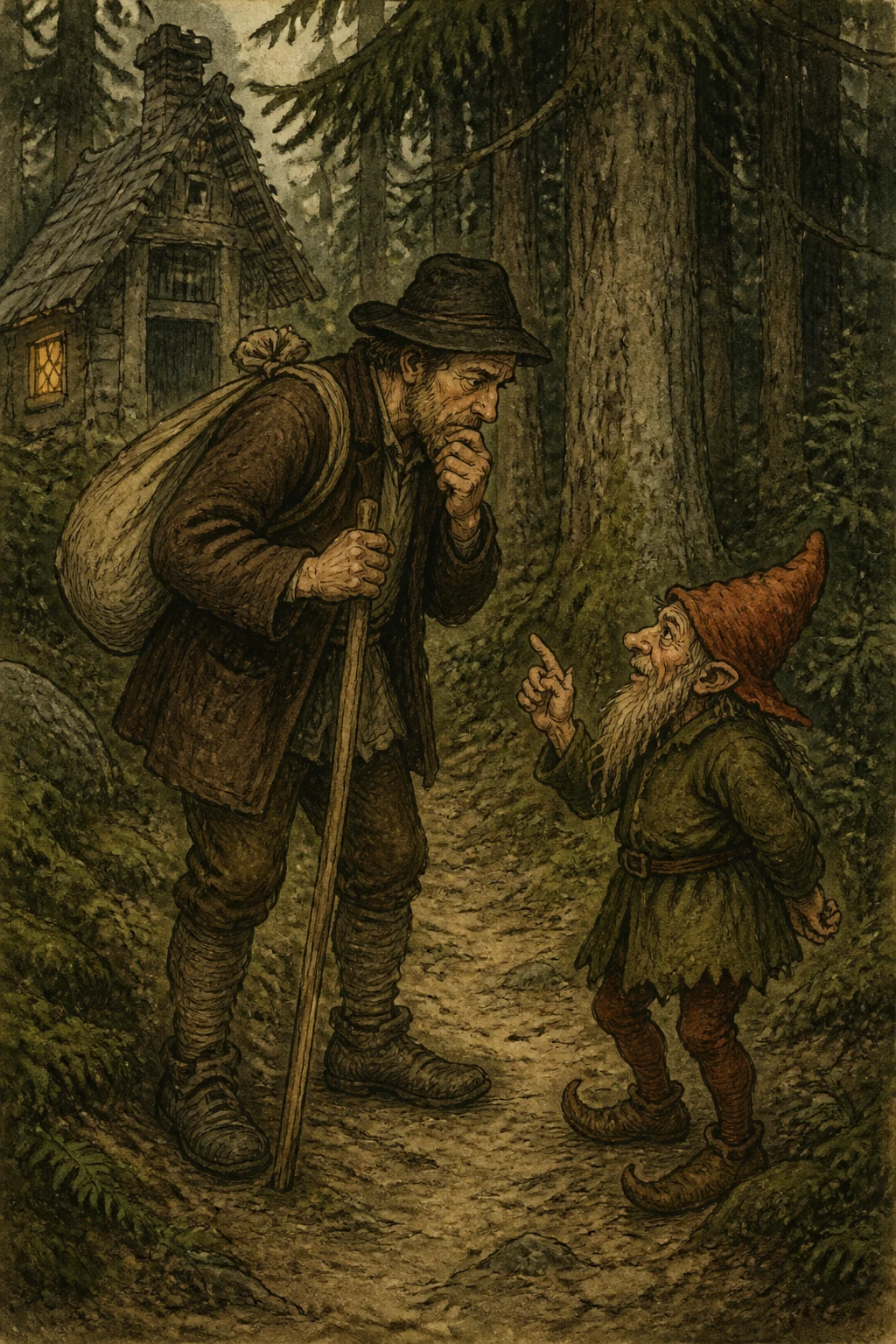
The father went home again, and the son became well versed in magic and thieving. When the year was up, the father set out, worrying all the while about how he was to recognize his son. As he walked along, lost in thought, a little man came towards him and said, "What's the matter, my good man? Why are you so downcast?" "Oh," said Jan, "a year ago I apprenticed my son to a master thief, who told me to come back in a year's time. If I couldn't recognize my son, I was to give him two hundred thalers; but if I knew him, I would owe him nothing. Now I'm so afraid I shan't recognize him, and I don't know where I am to get the money."
The little man told him to take a crust of bread and stand beneath the chimney with it. "There is a basket up on the pole, with a little bird peeping out of it. That is your son."
So Jan went there and tossed a crust of black bread in front of the basket. The little bird came out and looked at it. "Hello, my son! Is that you?" said the father. The son was delighted to see his father, but the master said, "The devil put that into your head! How else could you have recognized your son?" "Father, let's go," said the boy.
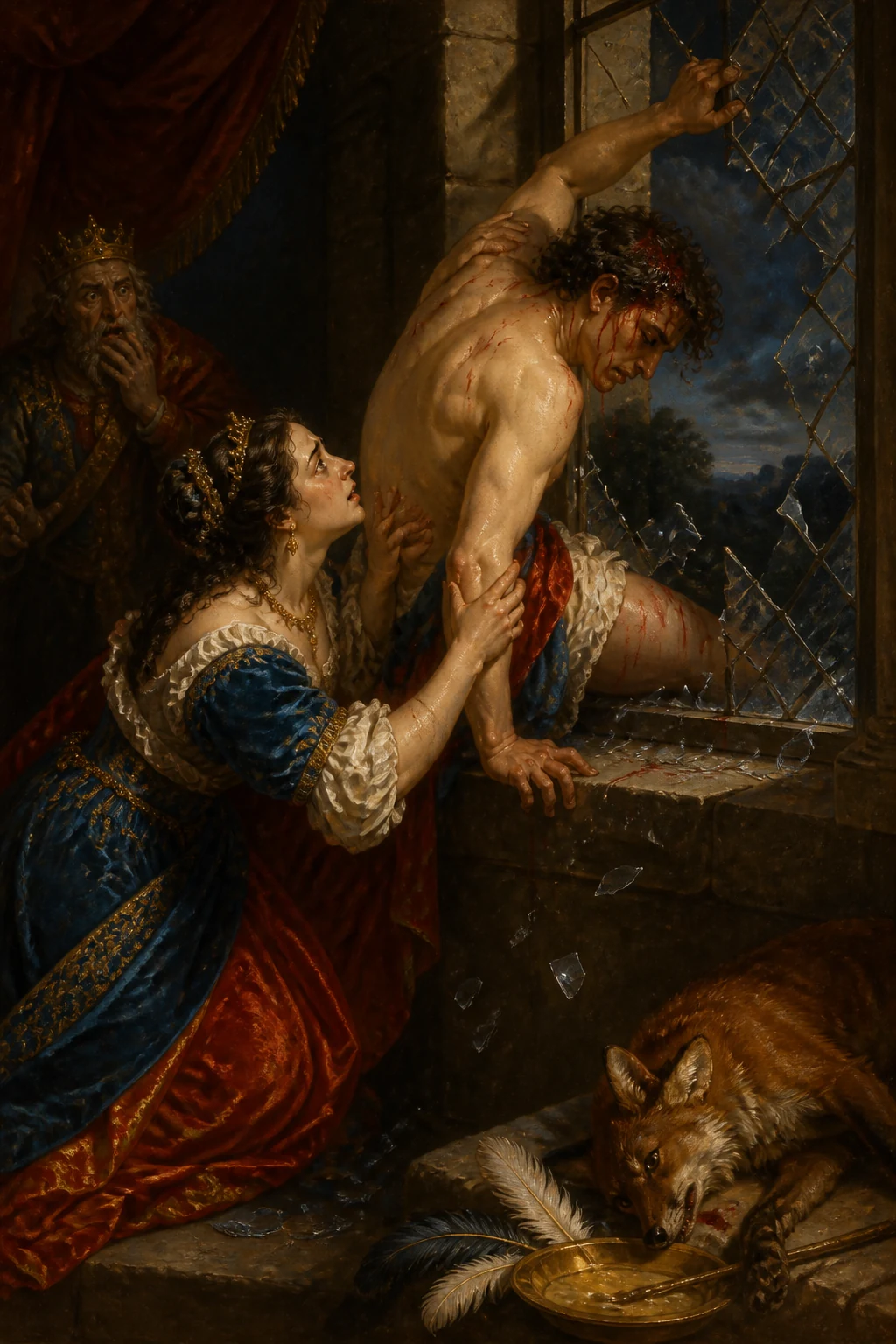
The father set off home with his son, and on the way a carriage came driving along. The son said to his father, "I'll turn myself into a fine big greyhound, and then you can make a good deal of money out of me." The gentleman in the carriage called out, "My good man, will you sell that dog?" "Yes," said the father. "How much do you want for him?" "Thirty thalers." "Well, my good man, that's a great deal, but never mind. He's such a magnificent hound that I'll take him." The gentleman put him in his carriage, but they had scarcely driven a little way when the dog leapt through the glass and out of the carriage, and there he was, no longer a greyhound, back beside his father.
Then they went home together. The next day was market day in the neighbouring village, and the boy said to his father, "Now I'll turn myself into a handsome horse, and you can sell me. But once you've sold me, you must take off my bridle, or I shan't be able to become human again." So the father took the horse to market, where the master thief came along and bought it for a hundred thalers. But the father forgot and did not take off the bridle. The man took the horse home and put it in the stable. As the maid was crossing the yard, the horse said, "Take off my bridle! Take off my bridle!" The maid stopped and listened. "Why, can you talk?" She went over and took off the bridle. At once the horse became a sparrow and flew out over the door, but the sorcerer turned into a sparrow too and flew after him. They flew at one another and fought, but the master got the worst of it, so he plunged into the water and became a fish. The boy became a fish as well, and again they bit at one another until the master had to yield. Then the master turned himself into a chicken, and the boy became a fox and bit off his head. So the master died, and dead he lies to this very day.
Izvirnik
Der Gaudieb und sein Meister
Naslednje strani prikazujejo izvirno besedilo za primerjavo.
Ein Märchen der Brüder Grimm
Jan wollte seinen Sohn ein Handwerk lehren lassen; da ging Jan in die Kirche und betete zu unserem Herrgott, was ihm wohl zuträglich wäre. Da steht der Küster hinter dem Altar und sagt: "Das Gaudieben, das Gaudieben." Da geht Jan wieder zu seinem Sohn, er müßte das Gaudieben lernen, das hätte ihm unser Herrgott gesagt. Geht er mit seinem Sohn und sucht sich einen Mann, der das Gaudieben kann. Da gehen sie dann eine ganze Zeit und kommen in einen großen Wald, da steht so ein kleines Häuschen mit so einer alten Frau darin. Sagt Jan zu ihr: "Wißt Ihr nicht einen Mann, der das Gaudieben kann?" - "Das könnt ihr hier wohl lernen," sagt die Frau, "mein Sohn ist ein Meister darin." Da spricht er mit dem Sohn, ob er auch richtig gaudieben könne. Der Gaudiebsmeister sagt: "Ich will's Euren Sohn schon richtig lehren. Kommt nur übers Jahr wieder, wenn Ihr dann Euren Sohn noch kennt, dann will ich gar kein Lehrgeld haben, und kennt Ihr ihn nicht, dann müßt Ihr mir zweihundert Taler geben."
Der Vater geht wieder nach Hause, und der Sohn lernt gut hexen und gaudieben. Als das Jahr um ist, geht der Vater und denkt traurig darüber nach, wie er das anfangen will, daß er seinen Sohn erkennt. Wie er nun so geht und vor sich hinsinnt, da kommt ihm ein kleines Männchen entgegen, das sagt: "Mann, was ist Euch? Ihr seid ja so betrübt?" - "Oh," sagt Jan, "ich habe meinen Sohn vor einem Jahr bei einem Gaudiebsmeister vermietet, der sagte mir, ich solle übers Jahr wiederkommen, und wenn ich dann meinen Sohn nicht kenne, dann sollte ich ihm zweihundert Taler geben; wenn ich ihn aber erkennen würde, dann hätt ich ihm nichts zu geben. Nun bin ich aber so bange, daß ich ihn nicht erkenne, und ich weiß nicht, wo ich das Geld herkriegen soll."
Da sagt das Männchen, er solle ein Krüstchen Brot mitnehmen und sich damit unter den Kamin stellen: "Da auf der Stange steht ein Körbchen, da guckt ein Vögelchen heraus, das ist Euer Sohn."
Da geht Jan hin und wirft ein Krüstchen Schwarzbrot vor den Korb; da kommt das Vögelchen heraus und blickt darauf: "Holla, mein Sohn, bist du hier?" sagt der Vater. Da freute sich der Sohn, daß er seinen Vater sah, aber der Lehrmeister sagte: "Das hat dir der Teufel eingegeben; wie könnt Ihr sonst Euren Sohn erkennen?" - "Vater, laß uns gehen," sagte der Junge.
Da will der Vater mit seinem Sohn nach Hause gehen; unterwegs kommt da eine Kutsche angefahren. Da sagt der Sohn zu seinem Vater: "Ich will mich in einen großen Windhund verwandeln, dann könnt Ihr viel Geld mit mir verdienen." Da ruft der Herr aus der Kutsche: "Mann, wollt Ihr den Hund verkaufen?" - "Ja," sagte der Vater. "Wieviel Geld wollt Ihr denn dafür haben?" - "Dreißig Taler." - "Ja, Mann, das ist viel, aber meinetwegen, da er so ein gewaltig schöner Rüde ist, so will ich ihn behalten." Der Herr nimmt ihn in seine Kutsche, aber kaum ist er ein Stück gefahren, da springt der Hund durch das Glas aus dem Wagen, und da war er kein Windhund mehr und war wieder bei seinem Vater.
Da gehen sie nun zusammen nach Hause. Am andern Tag ist Markt im nächsten Dorf; da sagt der Junge zu seinem Vater: "Ich will mich nun in ein schönes Pferd verwandeln, dann verkauft mich; aber wenn Ihr mich verkauft habt, dann müßt Ihr mir den Zaum abnehmen, sonst kann ich kein Mensch wieder werden." Da zieht der Vater nun mit dem Pferd zum Markt; da kommt der Gaudiebsmeister und kauft das Pferd für hundert Taler, und der Vater vergißt's und nimmt ihm den Zaum nicht ab. Da nimmt nun der Mann das Pferd mit nach Hause und stellt es in den Stall. Als die Magd über die Diele geht, da sagt das Pferd: "Nimm mir den Zaum, nimm mir den Zaum ab!" Da bleibt die Magd stehen und lauscht: "Ja, kannst du reden?" Geht hin und nimmt den Zaum ab. Da wird das Pferd ein Sperling und fliegt über die Türe, aber der Hexenmeister wird auch ein Sperling und fliegt ihm nach. Da kommen sie miteinander zusammen und beißen sich, aber der Meister verspielt und macht sich ins Wasser und ist ein Fisch. Da wird der Junge auch ein Fisch, und sie beißen sich wieder, daß der Meister verspielen muß. Da verwandelt sich der Meister in ein Huhn, und der Junge wird ein Fuchs und beißt dem Meister den Kopf ab; da ist er gestorben und liegt tot bis auf den heutigen Tag.
Nadaljuj z branjem