Waltey
Smejoči se povodni konj
006 The Laughing Hippopotamus
American Fairy Tales · L. Frank BaumO besedilu
Smejoči se povodni konj
- Vir
- American Fairy Tales
- Avtor
- L. Frank Baum
- Jezik branja
- Slovenščina
- Jezik izvirnika
- English
- Čas branja
- 16 min branja
- Obseg
- 13 strani
- Naslov izvirnika
- 006 The Laughing Hippopotamus
O izvirniku
American Fairy Tales
Dvanajst Baumovih avtorskih ameriških pravljic, igrivih, mestnih in zavestno modernih. Bralni jezik je Slovenščina, izvirnik pa prihaja iz vira American Fairy Tales v jeziku English.
Besedilo
Smejoči se povodni konj
Ob enem izmed zgornjih rokavov reke Kongo je živela starodavna plemiška rodbina povodnih konjev, ki se je ponašala z rodovnikom, segajočim daleč pred Noetove čase — še pred obstoj človeštva — globoko v meglene davnine, ko je bil svet še mlad.
Od nekdaj so prebivali na bregovih prav te reke, zato so jim bili vsak njen zavoj in okljuk, vsaka kotanja in plitvina v njeni strugi, vsaka skala, štor in blatna kotanja na njenem bregu tako domači kakor njihove lastne matere. In domnevam, da tam živijo še danes.
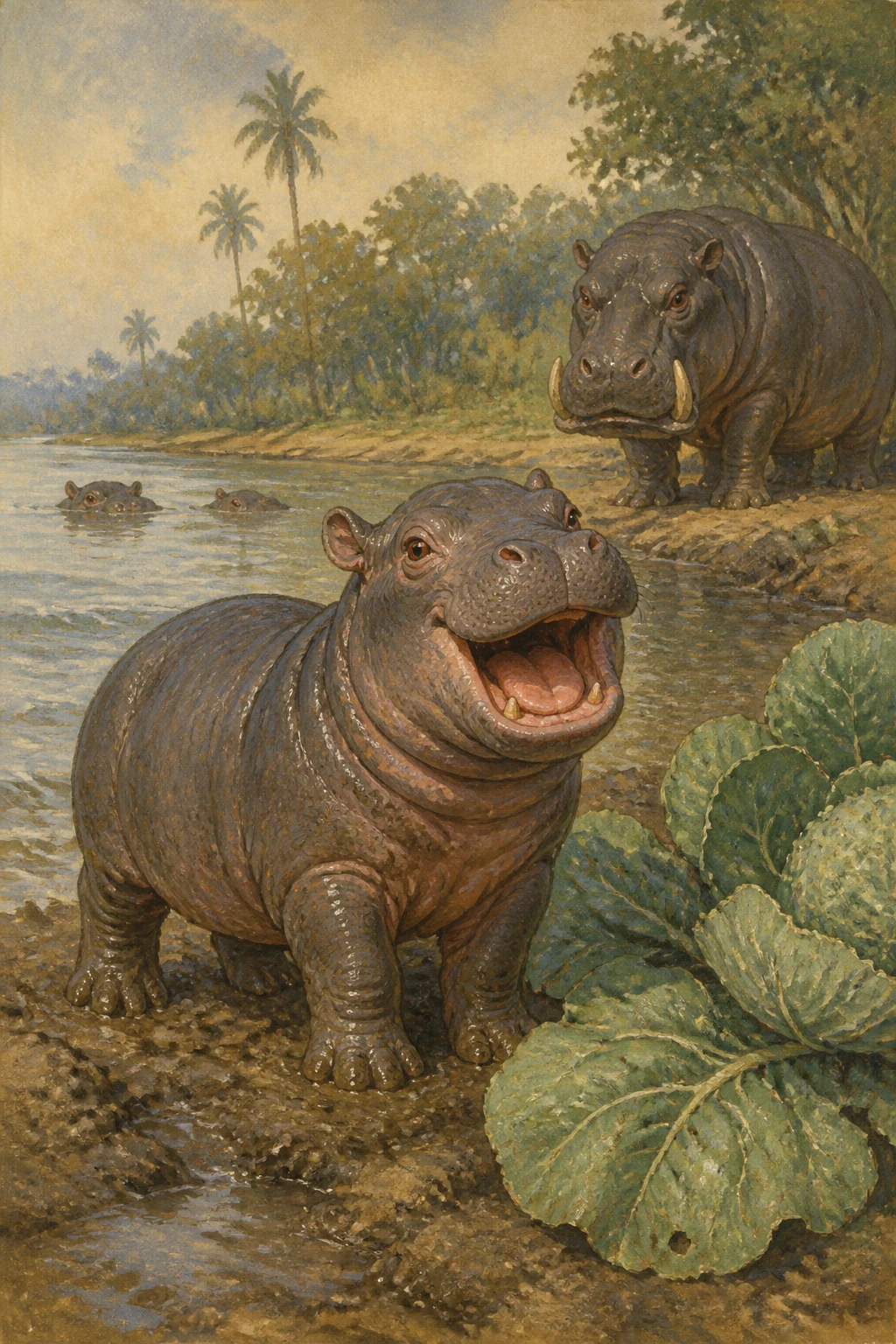
Nedolgo tega je kraljica tega plemena povodnih konjev dobila mladiča in ga poimenovala Keo, ker je bil tako debel in okrogel. Da pa vas ne bi zavedel, naj povem, da v jeziku povodnih konjev »Keo« pravzaprav pomeni »debel in len«, ne pa debel in okrogel. Vendar kraljice nihče ni opozoril na to zmoto, saj je imela strašansko dolge in ostre okle, Keo pa se ji je zdel najljubkejši otročiček na svetu.
Za povodnega konja je bil res čisto v redu. Valjal se je in igral v mehkem blatu na rečnem bregu, racal v notranjost dežele ter grizljal liste divjega zelja, ki je raslo tam, in bil od jutra do večera srečen in zadovoljen. Bil je tudi najbolj vesel povodni konj, kar jih je ta starodavna rodbina kdaj poznala. Njegove drobne rdeče oči so se nenehno hudomušno iskrile in ob vsaki priložnosti se je veselo smejal, naj je bilo kaj smešnega ali ne.
Zato so ga temnopolti ljudje, ki so živeli v tistih krajih, imenovali »Ippi« — veseljak, čeprav se mu zaradi njegove divje matere ter prav tako divjih stricev, tet in bratrancev, ki so živeli v veliki koloniji na rečnem bregu, niso upali približati.
Čeprav si ti temnopolti ljudje, ki so živeli v majhnih vaseh, raztresenih med drevjem, niso drznili odkrito napasti kraljevske rodbine povodnih konjev, so nadvse radi jedli njihovo meso, kadar so ga le mogli dobiti. Povodni konji so to dobro vedeli. Kadar pa je temnopoltim uspelo katero teh živali ujeti živo, so jo radi jezdili skozi džunglo, kakor da bi bila konj, in jo tako zasužnjili.
Zaradi vsega tega so povodni konji, kadar so zavohali oljnati vonj temnopoltih ljudi, besno planili nadnje; in če so katerega izmed sovražnikov po naključju dohiteli, so ga razparali z ostrimi okli ali ga s svojimi ogromnimi nogami poteptali v zemljo.
Med povodnimi konji in temnopoltimi ljudmi je divjala nenehna vojna. V eni izmed njihovih vasic je živel Gouie. Bil je sin poglavarjevega brata in vnuk vaškega vrača, ostarelega moža, ki so mu pravili »čudo brez kosti«, ker se je znal zvijati v toliko zavojev kakor kača in ni imel kosti, ki bi ga ovirale, ko je svoje telo upogibal v najrazličnejše položaje. Zaradi tega je hodil opotekaje, vendar so ga temnopolti ljudje zelo spoštovali.
Gouiejeva koča je bila narejena iz drevesnih vej, zlepljenih z blatom, njegovo oblačilo pa je bilo rogoznica iz trave, privezana okoli pasu. Toda sorodstvo s poglavarjem in vračem mu je dajalo nekaj dostojanstva, poleg tega pa je zelo rad premišljeval v samoti. Morda je bilo povsem naravno, da so se njegove misli pogosto vrtele okoli njegovih sovražnikov, povodnih konjev, in da je tuhtal o najrazličnejših načinih, kako bi jih ujel.
Naposled je izdelal načrt in se lotil kopanja velike jame na pol poti med dvema ostrima rečnima zavojema. Ko je bila jama izkopana, jo je prekril z drobnimi vejami in po njih nasul prst, površino pa tako spretno zgladil, da nihče ne bi posumil, da se pod njo skriva velika luknja. Nato se je Gouie tiho zasmejal sam pri sebi in odšel domov na večerjo.
Tistega večera je kraljica rekla Keu, ki je za svojo starost zrasel v prav krepkega mladiča: »Skoči čez okljuk in prosi strica Nikkija, naj pride sem. Našla sem nenavadno rastlino in rada bi, da mi pove, ali je užitna.«
Veseljak se je ob odhodu na svojo nalogo od srca zasmejal, saj se je počutil tako pomembnega kakor deček, ki ga prvič pošljejo v trgovino na vogalu po kocko kvasa.
»Guk-uk-uk-uk! Guk-uk-uk-uk!« Tako se je smejal; in če mislite, da se povodni konji ne smejejo tako, morate le prisluhniti kateremu izmed njih, pa boste ugotovili, da imam prav.
Zlezel je iz blata, v katerem se je valjal, in odhlačal skozi grmovje. Zadnje, kar je slišala njegova mati, ki je ležala napol v vodi in napol na suhem, je bil njegov melodični »guk-uk-uk-uk!«, ki je zamiral v daljavi.
Keo je bil tako dobre volje, da je komaj opazil, kam stopa, zato je bil silno presenečen, ko so se mu sredi smeha tla udrla pod nogami in je padel na dno Gouiejeve globoke jame. Ni se hudo poškodoval, vendar si je pri padcu pošteno potolkel nos; zato se je nehal smejati in začel premišljevati, kako naj spet pride ven. Tedaj je ugotovil, da so stene višje od njegove glave in da je ujetnik.
Malce se je zasmejal svoji nesreči in smeh ga je zazibal v spanec, tako da je smrčal vso noč, dokler se ni zdanilo.
Ko je Gouie naslednje jutro pokukal čez rob jame, je vzkliknil: »Saj to je vendar Ippi — Veseljak!« Keo je prepoznal vonj temnopoltega človeka in skušal dvigniti glavo dovolj visoko, da bi ga ugriznil. Ko je Gouie to videl, je spregovoril v jeziku povodnih konjev, ki se ga je naučil od svojega deda, vrača.
»Pomiri se, malček; moj ujetnik si.« »Kos tvoje noge bi me že pomiril, če bi ga le dosegel,« je odvrnil Keo in se nato zasmejal svoji šali: »Guk-uk-uk-uk!«
Toda Gouie, ki je bil preudaren človek, je brez nadaljnjega pogovora odšel in se vrnil šele naslednje jutro. Ko se je spet nagnil nad jamo, je bil Keo od lakote tako slaboten, da se je komaj še lahko smejal.
»Se vdaš?« je vprašal Gouie. »Ali se še vedno želiš boriti?« »Kaj se bo zgodilo, če se vdam?« je vprašal Keo. Temnopolti mož se je v zadregi popraskal po glavi, poraščeni z volnatimi lasmi.
»Težko rečem, Ippi. Premlad si za delo, in če te ubijem za hrano, bom prikrajšan za tvoje okle, ki še niso zrasli. Zakaj si, o Veseljak, padel v mojo jamo? Ujeti sem hotel tvojo mater ali enega izmed tvojih stricev.«
»Guk-uk-uk-uk!« se je zasmejal Keo. »Navsezadnje me boš moral izpustiti, temnopolti mož, saj nimaš od mene nobene koristi!« »Tega ne bom storil,« je izjavil Gouie, »razen če,« je dodal, ko se je nečesa domislil, »skleneš kupčijo z menoj.«
»Povej mi, kakšno kupčijo, temnopolti mož, kajti lačen sem,« je rekel Keo. »Izpustil te bom, če prisežeš pri oklih svojega deda, da se čez leto in dan vrneš k meni in spet postaneš moj ujetnik.«
Mladi povodni konj je za trenutek pomislil, saj je vedel, da je prisega pri dedovih oklih slovesna reč; toda bil je neznansko lačen, leto in dan pa sta se mu zdela še daleč, zato je z novim brezskrbnim smehom rekel:
»Prav; če me zdaj izpustiš, prisegam pri oklih svojega deda, da se čez leto in dan vrnem k tebi in postanem tvoj ujetnik.« Gouie je bil nadvse zadovoljen, saj je vedel, da bo Keo čez leto in dan že skoraj odrasel. Zato je začel odkopavati en konec jame in vanjo metati prst, dokler ni naredil klančine, po kateri je povodni konj lahko zlezel ven.
Keo je bil tako vesel, ko se je spet znašel na površju, da se je prepustil izbruhu veselega smeha, nato pa rekel:
»Zbogom, Gouie; čez leto in dan me boš spet videl.« Potem je odracal proti reki, da bi videl mater in dobil zajtrk, Gouie pa se je vrnil v svojo vas.
V naslednjih mesecih je temnopolti mož, ko je ležal v svoji koči ali lovil v gozdu, od časa do časa zaslišal oddaljeni »guk-uk-uk-uk!« smejočega se povodnega konja. Toda le nasmehnil se je sam pri sebi in pomislil: »Leto in dan bosta kmalu minila!«
Ko se je Keo živ in zdrav vrnil k materi, je vse člane njegovega plemena navdalo veselje, saj so imeli Veseljaka vsi radi. Ko pa jim je povedal, da mora čez leto in dan spet postati suženj temnopoltega moža, so začeli tarnati in jokati, in pretočili so toliko solz, da se je gladina reke dvignila za nekaj palcev.
Keo se je njihovi žalosti seveda le smejal; toda sklicali so velik zbor plemena in se o zadevi resno pogovorili. »Ker je prisegel pri oklih svojega deda,« je rekel stric Nikki, »mora držati obljubo. Naša dolžnost pa je, da ga skušamo kako rešiti smrti ali suženjskega življenja.«
S tem so se vsi strinjali, vendar se nihče ni mogel domisliti, kako bi Kea rešili njegove usode. Tako so minevali meseci, v katerih so bili vsi kraljevski povodni konji žalostni in potrti, razen Veseljaka samega.
Naposled je Keu ostal le še teden svobode, njegova mati, kraljica, pa je postala tako nemirna in zaskrbljena, da so sklicali nov zbor plemena. Smejoči se povodni konj je medtem zrasel do velikanske velikosti in je meril skoraj petnajst čevljev v dolžino ter šest v višino, njegovi ostri okli pa so bili bolj beli in trši od slonovih.
»Če ne storimo nečesa, da bi rešili mojega otroka,« je rekla mati, »bom umrla od žalosti.« Nekateri njeni sorodniki so začeli dajati nespametne predloge, toda kmalu je stric Nep, moder in zelo velik povodni konj, rekel:
»Iti moramo h Glinkomoku in ga prositi za pomoč.« Tedaj so vsi utihnili, kajti stopiti pred mogočnega Glinkomoka je terjalo precej poguma. Toda materinska ljubezen je bila kos vsakršnemu junaštvu.
»Sama bom šla k njemu, če me bo stric Nep spremljal,« je brž rekla. Stric Nep je zamišljeno potrepljal mehko blato s sprednjo nogo in počasi pomahal s kratkim repom sem ter tja.
»Glinkomoku smo bili vedno poslušni in smo mu izkazovali veliko spoštovanje,« je rekel. »Zato se ne bojim nevarnosti, če stopim predenj. Šel bom s teboj.«
Vsi drugi so odobravajoče zafrktali, zelo veseli, da jim ni bilo treba iti zraven. Tako sta se kraljica in stric Nep odpravila na pot, Keo pa je plaval med njima. Ves tisti dan in ves naslednji so plavali proti toku, dokler niso ob sončnem zahodu prispeli do visoke skalne stene, pod katero je bila votlina, kjer je prebival mogočni Glinkomok.
To strašno bitje je bilo deloma zver, deloma človek, deloma ptica in deloma riba. Živelo je že od začetka sveta. Z modrostjo, nabrano skozi dolga leta, je postalo deloma vrač, deloma čarovnik, deloma mag in deloma vilinsko bitje. Človeštvo ga ni poznalo, starodavne živali pa so ga poznale in se ga bale.
Trije povodni konji so obstali pred votlino, s sprednjimi nogami na bregu in telesi v vodi, ter v en glas pozdravili Glinkomoka. Takoj zatem je vhod v votlino potemnel in bitje je neslišno zdrsnilo proti njim.
Povodni konji si ga niso upali pogledati in so sklonili glave med noge. »Prišli smo, o Glinkomok, da bi te prosili milosti in prijateljske pomoči!« je začel stric Nep; nato je povedal, kako je bil Keo ujet in kako je obljubil, da se bo vrnil k temnopoltemu možu.
»Držati mora obljubo,« je reklo bitje z glasom, podobnim vzdihu. Mati povodnega konja je glasno zastokala. »Toda usposobil ga bom, da bo premagal temnopoltega moža in si spet pridobil svobodo,« je nadaljeval Glinkomok.
Keo se je zasmejal. »Dvigni desno šapo,« je ukazal Glinkomok. Keo je ubogal in bitje se je je dotaknilo s svojim dolgim, kosmatim jezikom. Nato je nad Keovo sklonjeno glavo iztegnilo štiri koščene roke ter zamrmralo nekaj besed v jeziku, ki ga niso poznali ne ljudje ne zveri ne ptice ne ribe. Potem je spet spregovorilo v jeziku povodnih konjev:
»Tvoja koža je zdaj postala tako trda, da te noben človek ne more raniti. Tvoja moč presega moč desetih slonov. Tvoje noge so tako hitre, da lahko prehitiš veter. Tvoj um je ostrejši od najostrejšega trna. Naj se človek boji, ti pa za vedno preženi strah iz svojih prsi; kajti najmočnejši si izmed vsega svojega rodu!«
Nato se je strašni Glinkomok sklonil h Keu in ta je začutil, kako ga ožiga njegov ognjeni dih, ko mu je na uho zašepetal še nekaj napotkov. V naslednjem trenutku je bitje zdrsnilo nazaj v svojo votlino, za njim pa so odmevale glasne zahvale treh povodnih konjev, ki so zdrsnili v vodo in se nemudoma odpravili domov.
Materino srce je bilo polno veselja; stric Nep se je enkrat ali dvakrat zdrznil, ko se je spomnil bežnega pogleda, ki ga je ujel na Glinkomoka; Keo pa je bil kar najbolj razigran, in ker mu ni bilo dovolj le plavati ob svojih dostojanstvenih starejših sorodnikih, se je potapljal pod njunima telesoma, švigal okoli njiju in se veselo smejal vso pot domov.
Nato je vse pleme bučno praznovalo in hvalilo mogočnega Glinkomoka, ker je pomagal sinu njihove kraljice. Ko pa je napočil dan, ko se je moral Veseljak predati temnopoltemu možu, so ga vsi poljubili v slovo brez najmanjšega strahu za njegovo varnost.
Keo je odšel dobre volje in njegov smejoči se »guk-uk-uk-uk!« so slišali še dolgo potem, ko je izginil v džungli. Gouie je štel dneve in vedel, kdaj lahko pričakuje Kea; vendar ga je osupnilo, kako velikanski je postal njegov ujetnik, in čestital si je za modro kupčijo, ki jo je sklenil. Keo je bil tako debel, da se je Gouie odločil, da ga bo pojedel — se pravi toliko, kolikor ga bo le mogel, preostanek trupla pa bo zamenjal s sovaščani za druge dobrine.
Vzel je torej nož in ga skušal zabosti v povodnega konja, vendar je bila koža tako trda, da je nož ob njej otopel. Nato je poskusil še drugače, toda Keo je ostal nepoškodovan.
In tedaj se je Veseljak res zasmejal s svojim najbolj radostnim smehom, tako da je po vsem gozdu odmevalo »guk-uk-uk-uk-uk!« Gouie se je odločil, da ga ne bo ubil, saj je bilo to nemogoče, temveč ga bo uporabljal za tovorno žival. Povzpel se je Keu na hrbet in mu ukazal, naj gre. Keo je živahno oddirjal skozi vas, njegove drobne oči pa so se iskrile od veselja.
Drugi temnopolti možje so bili navdušeni nad Gouiejevim ujetnikom in so ga prosili, naj jim dovoli jezditi na Veseljakovem hrbtu. Gouie je za to od njih zahteval zapestnice, ogrlice iz školjk in drobne zlate okraske, dokler si ni nabral kar precejšnjega kupa dragocenosti. Nato je na Keov hrbet splezalo dvanajst temnopoltih mož, da bi uživali v ježi, in tisti, ki je sedel najbliže njegovemu nosu, je zavpil:
»Teci, blatni pes — teci!« In Keo je stekel. Hiter kakor veter je drvel proč od vasi, skozi gozd in naravnost navzgor ob rečnem bregu. Temnopolti možje so tulili od strahu, Veseljak je rjovel od smeha, in drveli so naprej, naprej, naprej!
Tedaj se je pred njimi na nasprotnem bregu reke prikazalo črno žrelo Glinkomokove votline. Keo je planil v vodo, se potopil do dna in prepustil temnopolte ljudi, da so se trudili izplavati. Toda Glinkomok je slišal Keov smeh in vedel, kaj mora storiti. Ko se je Veseljak dvignil na površje in iz grla izpihnil vodo, ni bilo videti nobenega temnopoltega moža več.
Keo se je sam vrnil v vas in Gouie ga je presenečeno vprašal: »Kje so moji bratje?« »Ne vem,« je odgovoril Keo. »Odpeljal sem jih daleč proč in ostali so tam, kjer sem jih pustil.«
Gouie bi ga še naprej spraševal, toda druga gruča temnopoltih mož je že nestrpno čakala, da zajezdi smejočega se povodnega konja. Plačali so torej zahtevano ceno in splezali na svoja mesta, nato pa je prvi rekel:
»Teci, blatni valjavec — teci!« In Keo je stekel kakor prej, jih odnesel do vhoda v Glinkomokovo votlino ter se vrnil sam. Toda zdaj je Gouieja že zaskrbela usoda njegovih tovarišev, saj je bil edini temnopolti mož, ki je še ostal v vasi. Zato je zajezdil povodnega konja in zaklical:
»Teci, rečni prašič — teci!« Keo se je zasmejal s svojim veselim »guk-uk-uk-uk!« in stekel s hitrostjo vetra. Tokrat pa se je napotil naravnost proti rečnemu bregu, kjer je živelo njegovo pleme, in ko ga je dosegel, je zabredel v reko, se potopil do dna in pustil Gouieja plavati sredi toka.
Temnopolti mož je začel plavati proti desnemu bregu, toda tam je zagledal strica Nepa in polovico kraljevskega plemena, ki so čakali, da ga poteptajo v mehko blato. Zato se je obrnil proti levemu bregu, tam pa sta stala kraljica mati in stric Nikki, rdečeoka in besna, pripravljena, da ga raztrgata z okli.
Tedaj je Gouie glasno zakričal od groze in ko je zagledal Veseljaka, ki je plaval blizu njega, je zavpil: »Reši me, Keo! Reši me in osvobodil te bom suženjstva!«
»To ni dovolj,« se je zasmejal Keo. »Služil ti bom vse življenje!« je zavreščal Gouie. »Storil bom vse, kar mi boš ukazal!« »Se boš čez leto in dan vrnil k meni in postal moj ujetnik, če ti dovolim pobegniti?« je vprašal Keo.
»Bom! Bom! Bom!« je zavpil Gouie. »Prisezi pri kosteh svojega deda!« je ukazal Keo, saj se je spomnil, da temnopolti ljudje nimajo oklov, pri katerih bi lahko prisegli.
In Gouie je prisegel pri kosteh svojega deda. Nato je Keo priplaval do njega in mož mu je spet splezal na hrbet. Tako sta prispela na breg, kjer je Keo materi in vsemu plemenu povedal za kupčijo, ki jo je sklenil z Gouiejem: ta naj bi se čez leto in dan vrnil in postal njegov suženj.
Zato so temnopoltemu možu dovolili v miru oditi, Veseljak pa je spet živel med svojimi in bil srečen. Ko sta minila leto in dan, je Keo začel čakati na Gouiejevo vrnitev; toda ni ga bilo, ne takrat ne kdaj pozneje.
Temnopolti mož je namreč svoje zapestnice, ogrlice iz školjk in drobne zlate okraske povezal v culo ter odpotoval mnogo milj daleč v drugo deželo, kjer starodavnega kraljevskega plemena povodnih konjev niso poznali. Zaradi svojega bogastva se je tam razglasil za velikega poglavarja in ljudje so se mu klanjali.
Podnevi je bil ponosen in bahav. Ponoči pa se je premetaval po ležišču in ni mogel zaspati. Pekla ga je vest. Kajti prisegel je pri kosteh svojega deda; njegov ded pa ni imel kosti.
Izvirnik
006 The Laughing Hippopotamus
Naslednje strani prikazujejo izvirno besedilo za primerjavo.
On one of the upper branches of the Congo river lived an ancient and aristocratic family of hippopotamuses, which boasted a pedigree dating back beyond the days of Noah—beyond the existence of mankind—far into the dim ages when the world was new.
They had always lived upon the banks of this same river, so that every curve and sweep of its waters, every pit and shallow of its bed, every rock and stump and wallow upon its bank was as familiar to them as their own mothers. And they are living there yet, I suppose.
Not long ago the queen of this tribe of hippopotamuses had a child which she named Keo, because it was so fat and round. Still, that you may not be misled, I will say that in the hippopotamus language “Keo,” properly translated, means “fat and lazy” instead of fat and round. However, no one called the queen’s attention to this error, because her tusks were monstrous long and sharp, and she thought Keo the sweetest baby in the world.
He was, indeed, all right for a hippopotamus. He rolled and played in the soft mud of the river bank, and waddled inland to nibble the leaves of the wild cabbage that grew there, and was happy and contented from morning till night. And he was the jolliest hippopotamus that ancient family had ever known. His little red eyes were forever twinkling with fun, and he laughed his merry laugh on all occasions, whether there was anything to laugh at or not.
Therefore the black people who dwelt in that region called him “Ippi”—the jolly one, although they dared not come anigh him on account of his fierce mother, and his equally fierce uncles and aunts and cousins, who lived in a vast colony upon the river bank.
And while these black people, who lived in little villages scattered among the trees, dared not openly attack the royal family of hippopotamuses, they were amazingly fond of eating hippopotamus meat whenever they could get it. This was no secret to the hippopotamuses. And, again, when the blacks managed to catch these animals alive, they had a trick of riding them through the jungles as if they were horses, thus reducing them to a condition of slavery.
Therefore, having these things in mind, whenever the tribe of hippopotamuses smelled the oily odor of black people they were accustomed to charge upon them furiously, and if by chance they overtook one of the enemy they would rip him with their sharp tusks or stamp him into the earth with their huge feet.
It was continual warfare between the hippopotamuses and the black people.
Gouie lived in one of the little villages of the blacks. He was the son of the chief’s brother and grandson of the village sorcerer, the latter being an aged man known as the “the boneless wonder,” because he could twist himself into as many coils as a serpent and had no bones to hinder his bending his flesh into any position. This made him walk in a wabbly fashion, but the black people had great respect for him.
Gouie’s hut was made of branches of trees stuck together with mud, and his clothing consisted of a grass mat tied around his middle. But his relationship to the chief and the sorcerer gave him a certain dignity, and he was much addicted to solitary thought. Perhaps it was natural that these thoughts frequently turned upon his enemies, the hippopotamuses, and that he should consider many ways of capturing them.
Finally he completed his plans, and set about digging a great pit in the ground, midway between two sharp curves of the river. When the pit was finished he covered it over with small branches of trees, and strewed earth upon them, smoothing the surface so artfully that no one would suspect there was a big hole underneath. Then Gouie laughed softly to himself and went home to supper.
That evening the queen said to Keo, who was growing to be a fine child for his age:
“I wish you’d run across the bend and ask your Uncle Nikki to come here. I have found a strange plant, and want him to tell me if it is good to eat.”
The jolly one laughed heartily as he started upon his errand, for he felt as important as a boy does when he is sent for the first time to the corner grocery to buy a yeast cake.
“Guk-uk-uk-uk! guk-uk-uk-uk!” was the way he laughed; and if you think a hippopotamus does not laugh this way you have but to listen to one and you will find I am right.
He crawled out of the mud where he was wallowing and tramped away through the bushes, and the last his mother heard as she lay half in and half out of the water was his musical “guk-uk-uk-uk!” dying away in the distance.
Keo was in such a happy mood that he scarcely noticed where he stepped, so he was much surprised when, in the middle of a laugh, the ground gave way beneath him, and he fell to the bottom of Gouie’s deep pit. He was not badly hurt, but had bumped his nose severely as he went down; so he stopped laughing and began to think how he should get out again. Then he found the walls were higher than his head, and that he was a prisoner.
So he laughed a little at his own misfortune, and the laughter soothed him to sleep, so that he snored all through the night until daylight came.
When Gouie peered over the edge of the pit next morning he exclaimed:
“Why, ’tis Ippi—the Jolly One!”
Keo recognized the scent of a black man and tried to raise his head high enough to bite him. Seeing which Gouie spoke in the hippopotamus language, which he had learned from his grandfather, the sorcerer.
“Have peace, little one; you are my captive.”
“Yes; I will have a piece of your leg, if I can reach it,” retorted Keo; and then he laughed at his own joke: “Guk-uk-uk-uk!”
But Gouie, being a thoughtful black man, went away without further talk, and did not return until the following morning. When he again leaned over the pit Keo was so weak from hunger that he could hardly laugh at all.
“Do you give up?” asked Gouie, “or do you still wish to fight?”
“What will happen if I give up?” inquired Keo.
The black man scratched his woolly head in perplexity.
“It is hard to say, Ippi. You are too young to work, and if I kill you for food I shall lose your tusks, which are not yet grown. Why, O Jolly One, did you fall into my hole? I wanted to catch your mother or one of your uncles.”
“Guk-uk-uk-uk!” laughed Keo. “You must let me go, after all, black man; for I am of no use to you!”
“That I will not do,” declared Gouie; “unless,” he added, as an afterthought, “you will make a bargain with me.”
“Let me hear about the bargain, black one, for I am hungry,” said Keo.
“I will let your go if you swear by the tusks of your grandfather that you will return to me in a year and a day and become my prisoner again.”
The youthful hippopotamus paused to think, for he knew it was a solemn thing to swear by the tusks of his grandfather; but he was exceedingly hungry, and a year and a day seemed a long time off; so he said, with another careless laugh:
“Very well; if you will now let me go I swear by the tusks of my grandfather to return to you in a year and a day and become your prisoner.”
Gouie was much pleased, for he knew that in a year and a day Keo would be almost full grown. So he began digging away one end of the pit and filling it up with the earth until he had made an incline which would allow the hippopotamus to climb out.
Keo was so pleased when he found himself upon the surface of the earth again that he indulged in a merry fit of laughter, after which he said:
“Good-by, Gouie; in a year and a day you will see me again.”
Then he waddled away toward the river to see his mother and get his breakfast, and Gouie returned to his village.
During the months that followed, as the black man lay in his hut or hunted in the forest, he heard at times the faraway “Guk-uk-uk-uk!” of the laughing hippopotamus. But he only smiled to himself and thought: “A year and a day will soon pass away!”
Now when Keo returned to his mother safe and well every member of his tribe was filled with joy, for the Jolly One was a general favorite. But when he told them that in a year and a day he must again become the slave of the black man, they began to wail and weep, and so many were their tears that the river rose several inches.
Of course Keo only laughed at their sorrow; but a great meeting of the tribe was called and the matter discussed seriously.
“Having sworn by the tusks of his grandfather,” said Uncle Nikki, “he must keep his promise. But it is our duty to try in some way to rescue him from death or a life of slavery.”
To this all agreed, but no one could think of any method of saving Keo from his fate. So months passed away, during which all the royal hippopotamuses were sad and gloomy except the Jolly One himself.
Finally but a week of freedom remained to Keo, and his mother, the queen, became so nervous and worried that another meeting of the tribe was called. By this time the laughing hippopotamus had grown to enormous size, and measured nearly fifteen feet long and six feet high, while his sharp tusks were whiter and harder than those of an elephant.
“Unless something is done to save my child,” said the mother, “I shall die of grief.”
Then some of her relations began to make foolish suggestions; but presently Uncle Nep, a wise and very big hippopotamus, said:
“We must go to Glinkomok and implore his aid.”
Then all were silent, for it was a bold thing to face the mighty Glinkomok. But the mother’s love was equal to any heroism.
“I will myself go to him, if Uncle Nep will accompany me,” she said, quickly.
Uncle Nep thoughtfully patted the soft mud with his fore foot and wagged his short tail leisurely from side to side.
“We have always been obedient to Glinkomok, and shown him great respect,” said he. “Therefore I fear no danger in facing him. I will go with you.”
All the others snorted approval, being very glad they were not called upon to go themselves.
So the queen and Uncle Nep, with Keo swimming between them, set out upon their journey. They swam up the river all that day and all the next, until they came at sundown to a high, rocky wall, beneath which was the cave where the mighty Glinkomok dwelt.
This fearful creature was part beast, part man, part fowl and part fish. It had lived since the world began. Through years of wisdom it had become part sorcerer, part wizard, part magician and part fairy. Mankind knew it not, but the ancient beasts knew and feared it.
The three hippopotamuses paused before the cave, with their front feet upon the bank and their bodies in the water, and called in chorus a greeting to Glinkomok. Instantly thereafter the mouth of the cave darkened and the creature glided silently toward them.
The hippopotamuses were afraid to look upon it, and bowed their heads between their legs.
“We come, O Glinkomok, to implore your mercy and friendly assistance!” began Uncle Nep; and then he told the story of Keo’s capture, and how he had promised to return to the black man.
“He must keep his promise,” said the creature, in a voice that sounded like a sigh.
The mother hippopotamus groaned aloud.
“But I will prepare him to overcome the black man, and to regain his liberty,” continued Glinkomok.
Keo laughed.
“Lift your right paw,” commanded Glinkomok. Keo obeyed, and the creature touched it with its long, hairy tongue. Then it held four skinny hands over Keo’s bowed head and mumbled some words in a language unknown to man or beast or fowl or fish. After this it spoke again in hippopotamese:
“Your skin has now become so tough that no man can hurt you. Your strength is greater than that of ten elephants. Your foot is so swift that you can distance the wind. Your wit is sharper than the bulthorn. Let the man fear, but drive fear from your own breast forever; for of all your race you are the mightiest!”
Then the terrible Glinkomok leaned over, and Keo felt its fiery breath scorch him as it whispered some further instructions in his ear. The next moment it glided back into its cave, followed by the loud thanks of the three hippopotamuses, who slid into the water and immediately began their journey home.
The mother’s heart was full of joy; Uncle Nep shivered once or twice as he remembered a glimpse he had caught of Glinkomok; but Keo was as jolly as possible, and, not content to swim with his dignified elders, he dived under their bodies, raced all around them and laughed merrily every inch of the way home.
Then all the tribe held high jinks and praised the mighty Glinkomok for befriending their queen’s son. And when the day came for the Jolly One to give himself up to the black man they all kissed him good-by without a single fear for his safety.
Keo went away in good spirits, and they could hear his laughing “guk-uk-uk-uk!” long after he was lost in sight in the jungle.
Gouie had counted the days and knew when to expect Keo; but he was astonished at the monstrous size to which his captive had grown, and congratulated himself on the wise bargain he had made. And Keo was so fat that Gouie determined to eat him—that is, all of him he possibly could, and the remainder of the carcass he would trade off to his fellow villagers.
So he took a knife and tried to stick it into the hippopotamus, but the skin was so tough the knife was blunted against it. Then he tried other means; but Keo remained unhurt.
And now indeed the Jolly One laughed his most gleeful laugh, till all the forest echoed the “guk-uk-uk-uk-uk!” And Gouie decided not to kill him, since that was impossible, but to use him for a beast of burden. He mounted upon Keo’s back and commanded him to march. So Keo trotted briskly through the village, his little eyes twinkling with merriment.
The other blacks were delighted with Gouie’s captive, and begged permission to ride upon the Jolly One’s back. So Gouie bargained with them for bracelets and shell necklaces and little gold ornaments, until he had acquired quite a heap of trinkets. Then a dozen black men climbed upon Keo’s back to enjoy a ride, and the one nearest his nose cried out:
“Run, Mud-dog—run!”
And Keo ran. Swift as the wind he strode, away from the village, through the forest and straight up the river bank. The black men howled with fear; the Jolly One roared with laughter; and on, on, on they rushed!
Then before them, on the opposite side of the river, appeared the black mouth of Glinkomok’s cave. Keo dashed into the water, dived to the bottom and left the black people struggling to swim out. But Glinkomok had heard the laughter of Keo and knew what to do. When the Jolly One rose to the surface and blew the water from his throat there was no black man to be seen.
Keo returned alone to the village, and Gouie asked, with surprise:
“Where are my brothers:”
“I do not know,” answered Keo. “I took them far away, and they remained where I left them.”
Gouie would have asked more questions then, but another crowd of black men impatiently waited to ride on the back of the laughing hippopotamus. So they paid the price and climbed to their seats, after which the foremost said:
“Run, mud-wallower—run!”
And Keo ran as before and carried them to the mouth of Glinkomok’s cave, and returned alone.
But now Gouie became anxious to know the fate of his fellows, for he was the only black man left in his village. So he mounted the hippopotamus and cried:
“Run, river-hog—run!”
Keo laughed his jolly “guk-uk-uk-uk!” and ran with the speed of the wind. But this time he made straight for the river bank where his own tribe lived, and when he reached it he waded into the river, dived to the bottom and left Gouie floating in the middle of the stream.
The black man began swimming toward the right bank, but there he saw Uncle Nep and half the royal tribe waiting to stamp him into the soft mud. So he turned toward the left bank, and there stood the queen mother and Uncle Nikki, red-eyed and angry, waiting to tear him with their tusks.
Then Gouie uttered loud screams of terror, and, spying the Jolly One, who swam near him, he cried:
“Save me, Keo! Save me, and I will release you from slavery!”
“That is not enough,” laughed Keo.
“I will serve you all my life!” screamed Gouie; “I will do everything you bid me!”
“Will you return to me in a year and a day and become my captive, if I allow you to escape?” asked Keo.
“I will! I will! I will!” cried Gouie.
“Swear it by the bones of your grandfather!” commanded Keo, remembering that black men have no tusks to swear by.
And Gouie swore it by the bones of his grandfather.
Then Keo swam to the black one, who clambered upon his back again. In this fashion they came to the bank, where Keo told his mother and all the tribe of the bargain he had made with Gouie, who was to return in a year and a day and become his slave.
Therefore the black man was permitted to depart in peace, and once more the Jolly One lived with his own people and was happy.
When a year and a day had passed Keo began watching for the return of Gouie; but he did not come, then or ever afterwards.
For the black man had made a bundle of his bracelets and shell necklaces and little gold ornaments and had traveled many miles into another country, where the ancient and royal tribe of hippopotamuses was unknown. And he set up for a great chief, because of his riches, and people bowed down before him.
By day he was proud and swaggering. But at night he tumbled and tossed upon his bed and could not sleep. His conscience troubled him.
For he had sworn by the bones of his grandfather; and his grandfather had no bones.
Nadaljuj z branjem