Prevod
“His opinion, too, should be heard. For it is said:
Plans considered from many angles, discussed with many advisers, and carefully worked out,
When devised by the learned, do not easily come to nothing.
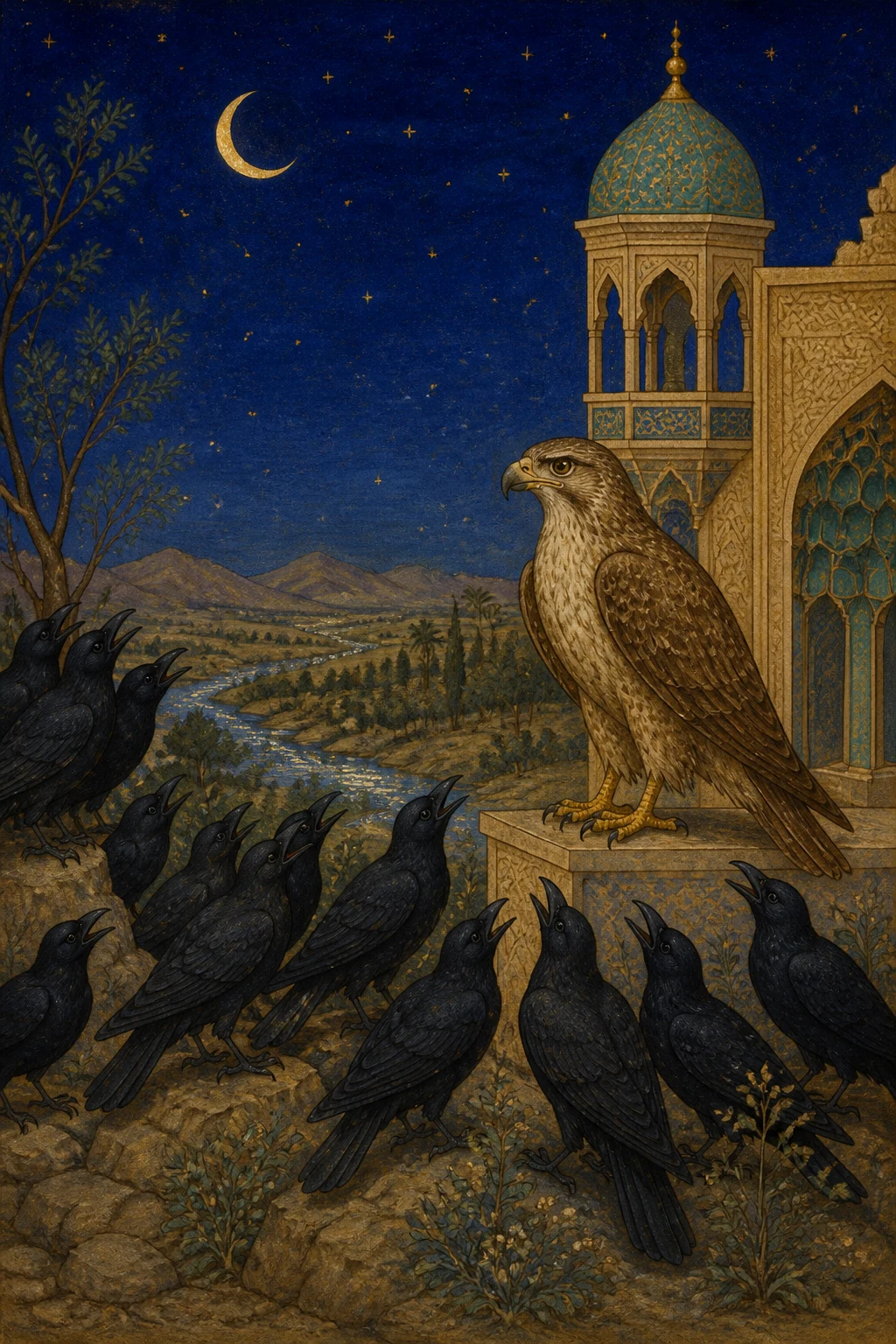
“Then the crow approached the gathering and said, ‘Well now! What is this great assembly, and what splendid festival is being celebrated?’
“They replied, ‘Friend, the birds have no king. So all the birds have resolved to anoint this owl as their sovereign. Give us your opinion too. You have arrived at just the right moment.’
“The crow laughed and said, ‘Oh, this is quite wrong! While such distinguished birds as peacocks, swans, cuckoos, ruddy geese, parrots, ducks, green pigeons, and cranes are among us, you propose to crown this day-blind creature with his hideous face! Here is what I think:
With a crooked beak and squinting eyes, fierce and unpleasant to behold—
If this is his face when he is not angry, what must it be when he is?
Savage by nature, exceedingly fierce, cruel, and harsh of speech—
What good can come to us from making an owl our king?
“‘Besides, while Garuḍa, the son of Vinatā, remains our lord, why make this day-blind creature king? Even if he possessed good qualities, a second sovereign is not desirable while one lord still reigns.
A single mighty ruler brings welfare to the earth;
Many bring destruction, like the suns at the end of an age.
“‘His very name will make you unassailable to others. For it is said:
Merely invoking the name of a mighty lord
Brings instant safety in the presence of the wicked.
“‘And again:
By claiming the protection of the great, one wins the highest success.
By invoking the moon, the hares live in peace.
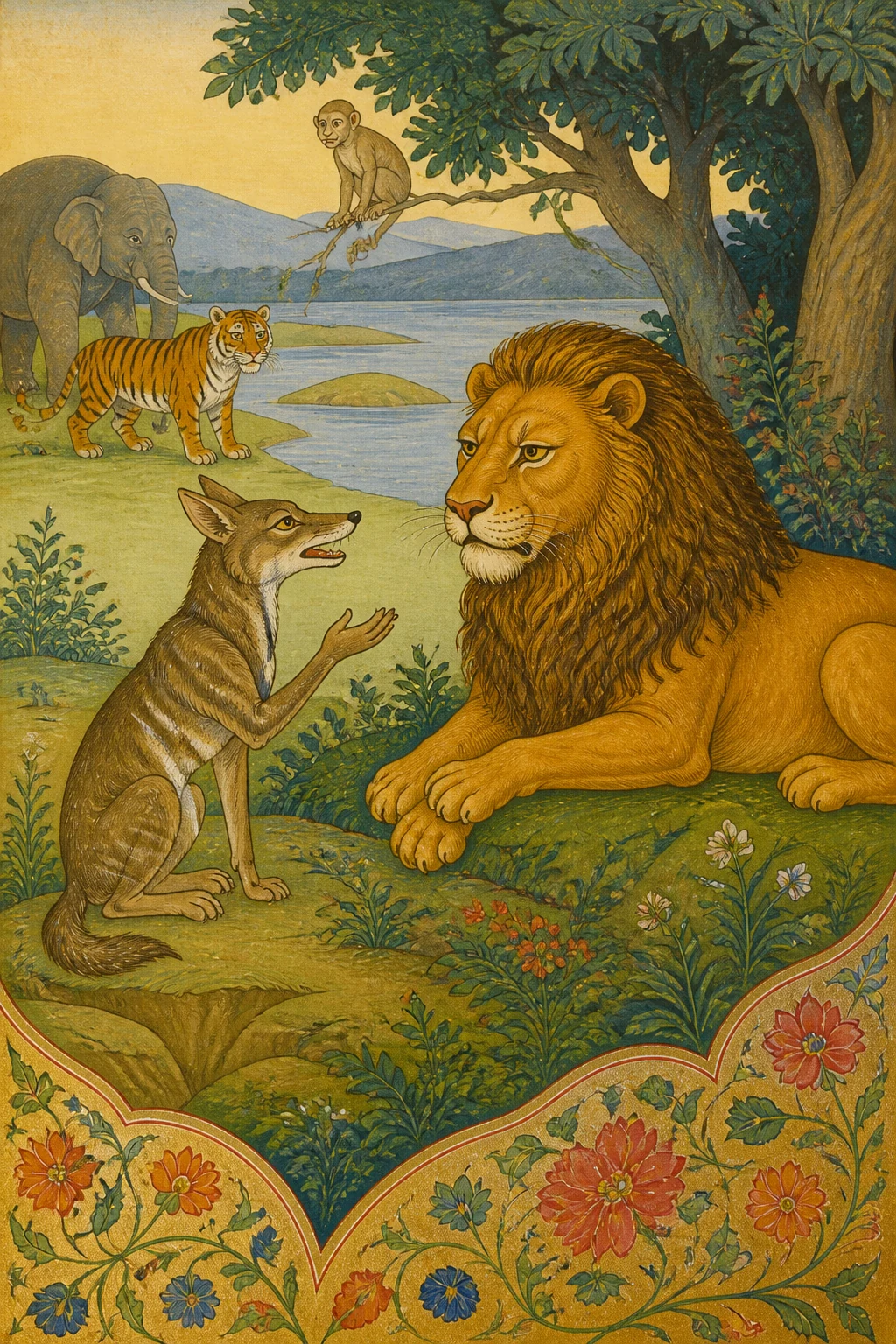
“The birds asked, ‘How was that?’ He told them: ‘Story 1. The Great Elephant Named Caturdanta. In a certain forest lived a great elephant named Caturdanta, the leader of a herd. Once a terrible drought arose there and lasted many years. The reservoirs, deep pools, ponds, and lakes all dried up. Then all the elephants said to their king, “Lord, the young elephants are tormented by thirst. Some are nearly dead, and others have already died. Find us some body of water where they may drink and recover.”
“‘After pondering for a long time, he said, “There is a great lake in a secluded place, in the midst of the land, always filled by the waters of the underground Ganges. Let us go there.”
“‘They set out, and after travelling for five nights they reached the lake. They entered the water and bathed to their hearts’ content, coming out at sunset. Now, in the soft earth all around that lake were countless hare burrows. As the elephants wandered to and fro, they crushed them all. Many hares had their legs, heads, or necks broken. Some died, and others were barely alive. When the herd had gone, the terrified hares gathered together, their homes trampled by the elephants’ feet. Some had broken legs; others were battered and covered in blood; others, whose young had been killed, had eyes veiled with tears. They took counsel together. “Alas, we are ruined! This herd of elephants will come here every day, for there is no water anywhere else. We shall all perish. As it is said:
An elephant kills with a mere touch; a serpent, with a mere sniff.
A king kills even while smiling; a wicked man, even while showing honour.
“‘“We must think of some remedy.” One of them said, “Let us leave this country. What else can we do? As Manu and Vyāsa have said:
Abandon one person for the sake of a family, and a family for the sake of a village;
Abandon a village for the sake of a country, and the whole earth to save yourself.
Even a land that is safe, that always yields grain and nourishes thriving herds,
A king should abandon without hesitation to save himself.
Save wealth against calamity; spend wealth to protect your wife;
But always protect yourself, even at the cost of wife and wealth.
“‘Others said, “Friends, we cannot simply abandon the home of our fathers and grandfathers. Let us devise some means of frightening the elephants, so that, with a little luck, they will not return. For it is said:
Even a snake without venom should spread a mighty hood.
Whether or not it has poison, the show of its hood inspires fear.
“‘Then others said, “If that is so, there is something that could frighten them so greatly that they would never return. But this threat must be delivered by a clever envoy. Our lord, the hare Vijayadatta, lives in the orb of the moon. Let us send a pretended messenger to the leader of the herd to say, ‘The moon forbids you to come to this lake, for his subjects live all around it.’ If the message is delivered convincingly, perhaps he will turn back.” Others said, “In that case, there is a hare named Lambakarṇa. He is skilled at composing speeches and understands an envoy’s duties. Let him be sent. For it is said:
Of pleasing appearance, free from greed, eloquent, well versed in many branches of learning,
And able to read the minds of others—such is the envoy a king should choose.
“‘“And again:
He who employs a foolish, greedy man to represent him at a royal court,
Especially one who speaks falsely, will not accomplish his purpose.
“‘“Let us see, then, whether he can deliver us safely from this calamity.”
“‘The others said, “Yes, that is a sound plan. We have no other way to save our lives. Let it be done.”
“‘So Lambakarṇa was appointed and sent to the leader of the elephant herd. He made his way to the elephants’ path, climbed onto a spot beyond their reach, and called to the elephant, “Ho there, wicked elephant! Why do you come so carelessly and fearlessly to the Moon’s Lake? You must not come here. Turn back!” Astonished to hear this, the elephant said, “Who are you?”
“‘He replied, “I am a hare named Lambakarṇa, and I live in the orb of the moon. The blessed Moon has now sent me to you as his envoy. You surely know that a messenger must not be punished for reporting the truth. All kings speak through their envoys. For it is said:
Even when weapons are raised, even when kinsmen have been slain,
A king must not kill envoys, though they speak harsh words.
“‘On hearing this, the elephant said, “Hare, tell me the blessed Moon’s message, so that I may carry it out at once.”
“‘The hare said, “This is his message: ‘The other day, when you came here with your herd, you struck down many hares. Do you not know that they are under my protection? If you value your life, you must never come to this lake again, for any reason whatever.’”
“‘The elephant asked, “And where is the blessed lord Moon?”
“‘The hare replied, “He has come to this lake to comfort the hares who survived the havoc wrought by your herd, and he is here now. I, meanwhile, have been sent to you.”
“‘The elephant said, “If that is so, show me the lord, so that I may bow to him and go elsewhere.”
“‘The hare said, “Come with me alone, and I will show him to you.”
“‘So, when night came, the hare led him to the shore of the lake and showed him the moon’s reflection in the water. “Look,” he said, “our lord is deep in meditation in the water. Bow to him quietly and leave. Otherwise, angered by the disturbance of his meditation, he will be more furious still.”
“‘Terrified, the elephant bowed to him and set off home. From that day onward, the hare and all his kin lived happily in their own homes.
*********************************************************************** “‘That is why I say, “By claiming the protection of the great.” Moreover:
One who wishes to live should never appoint as his master a petty, idle coward, a man enslaved to vice, an ingrate,
Or one who habitually speaks ill of others behind their backs.
“‘And again:
Seeking justice, the hare and Kapiñjala once approached a base judge,
And both met their destruction.
“The birds asked, ‘How was that?’ He told them: ‘Story 2. The Hare and Kapiñjala. Once I lived in a certain tree. In a hollow at its base lived a sparrow named Kapiñjala. Every evening, when we both returned home, we passed the time in the greatest happiness, discussing wise sayings, recounting the ancient deeds of divine sages, Brahman sages, and royal sages, and telling one another of the many wonders we had seen on our travels. One day Kapiñjala went with other sparrows to feed in a region rich in ripened rice. When night came and he had still not returned, I grew anxious and grieved at his absence. “Why has Kapiñjala not come home today?” I wondered. “Has he been caught in a snare? Or has someone killed him? Surely, if he were safe, he would not stay away from me.” Many days passed while I worried in this way. Then one evening a hare named Śīghraga came and entered the hollow. Having given up hope of Kapiñjala’s return, I did not stop him. But one day Kapiñjala, grown very plump from eating rice, remembered his home and returned. Indeed, it is well said:
Not even in heaven do living creatures find such happiness
As they find, even in poverty, in their own country, town, and home.
“‘Seeing the hare inside the hollow, he said indignantly, “Hare, you have behaved badly, entering my dwelling. Come out at once!”
“‘The hare replied, “This is not your home, but mine. Why do you make false accusations and speak so harshly? For it is said:
Once a reservoir, well, pond, temple, or tree has been relinquished,
No claim of ownership can afterward be made.
“‘“And again:
When someone has openly enjoyed possession of a field or other property for ten years,
Possession is the proof of title, not witnesses or written documents.
This is the law the sages have laid down for human beings;
For beasts and birds, ownership lasts only as long as occupancy.
“‘“So this home is mine, not yours.”
“‘Kapiñjala said, “Well, if you accept the authority of the law books, come with me. Let us consult someone versed in them, and whichever of us he awards it to shall have it.”
“‘When they set out, I thought, “What will happen now? I must see how this case is judged.” So I followed them out of curiosity. Meanwhile, a wildcat named Tīkṣṇadaṃṣṭra heard their dispute and went to the riverbank beside their path. Holding sacred kuśa grass, with his eyes closed and his arms raised, touching the earth with only part of his feet, he faced the glorious sun and delivered this sermon: “Ah, this worldly existence is without substance! Life crumbles in an instant. The company of loved ones is like a dream. This circle of family and possessions is a conjurer’s illusion. There is no refuge but righteousness. For it is said:
Bodies are impermanent, and riches do not last forever.
Death is always near: therefore gather merit through righteous deeds.
He whose days come and go without righteousness
Breathes, but does not live, like a blacksmith’s bellows.
It neither covers one’s nakedness nor keeps off gnats and mosquitoes:
Learning without righteousness is as useless as a dog’s tail.
“‘“And again:
Like empty husks among grains, like carrion birds among birds,
Like mosquitoes among mortals are those whose lives are not guided by righteousness.
The finest yield of a tree is its flowers and fruit; the finest yield of curds is butter;
The finest yield of oilseed is oil; the finest yield of a human life is righteousness.
Those without righteousness exist merely to eat and void their waste,
And, like beasts, to serve the purposes of others.
Those versed in prudence commend deliberation in all undertakings;
But righteousness, beset by many obstacles, must be pursued with haste.
People, I shall tell you righteousness in brief—what need have you of lengthy speeches?
Helping others brings merit; harming others brings sin.
Hear the whole essence of righteousness, and having heard it, take it to heart:
Do not do to others what you would find hateful yourself.
“‘Hearing this sermon, the hare said, “Kapiñjala, look! There is an ascetic on the riverbank preaching righteousness. Let us ask him.”
“‘Kapiñjala replied, “But he is our natural enemy. Let us question him from a distance, in case he should fail to keep his vow.” So the two stood at a distance and called, “Ascetic! Teacher of righteousness! We have a dispute. Settle it for us according to the sacred law. Whichever of us is in the wrong shall be your food.” He replied, “My good friends, no, no! Do not speak like that. I have renounced violence, the road to hell. Nonviolence alone is the path of righteousness. For it is said:
Since righteousness begins with nonviolence and seeks the welfare of all,
One should protect even lice, bedbugs, gnats, and the like.
He who kills even harmful creatures is merciless
And goes to a terrible hell—how much more so one who kills the harmless!
“‘“Those priests who kill animals in sacrificial rites are fools. They do not understand the true meaning of the sacred revelation. It says, ‘One should sacrifice with aja.’ But aja means rice that is seven years old, not the animal called a goat. For it is said:
If, by cutting down trees, slaughtering animals, and making a mire of blood,
One reaches heaven, how does one reach hell?
“‘“So I shall not eat either of you. I shall merely decide which of you is right and which is wrong. But I am old and cannot hear clearly from a distance. Knowing this, come close and state your cases before me, so that I may understand the true nature of your dispute and pronounce judgment without endangering my welfare in the next world. For it is said:
Whether from pride or greed, from anger or fear,
The man who gives a false judgment goes to hell.
A lie about livestock destroys five; a lie about cattle destroys ten;
A lie about a maiden destroys a hundred; a lie about a man destroys a thousand.
One who sits in an assembly but does not speak plainly,
Or who fails to declare the truth, should be shunned from afar.
“‘“So come without fear and state your cases clearly beside my ear.” In short, the villain so completely won their confidence that they came right into his lap. Then, in the same instant, he pinned one beneath his paw and seized the other with his sawlike fangs. Having killed them both, he ate them. That is why I say, “Seeking justice, they approached a base judge” (91). You too, being blind at night, will follow the hare and Kapiñjala to destruction if you accept this base, day-blind creature as your lord. Consider this, and do what is fitting.’ Hearing his words, all the birds said, ‘He has spoken well,’ and, declaring, ‘We shall meet again to discuss the matter of a king,’ they went wherever they pleased. Only the day-blind owl remained, seated on the throne and awaiting his consecration, with Kṛkālikā beside him. He called out, ‘Who is there? Why has my consecration still not begun?’
“Hearing this, Kṛkālikā said, ‘My dear, this crow has thwarted your consecration. All the birds have gone off in whatever direction they pleased. Only this one crow remains, for some reason. Get up quickly, and I will take you home.’ At this, the owl said sorrowfully to the crow, ‘You wicked creature! What harm have I done you, that you should obstruct my consecration as king? From this day forward there is enmity between us and all our descendants. For it is said:
A wound pierced by arrows heals; a cut made by a sword heals.
But the wound left by cruel and hateful words never heals.
“Having said this, he went home with Kṛkālikā. Then the crow, overcome with fear, reflected, ‘Alas! I have made an enemy for no reason. Why did I say all that? For it is said: Words spoken without regard for time and place, heedless of their consequences,
Unpleasant words that lower the speaker in others’ eyes—
When a man speaks such words without cause,
They are not words at all, but poison.
A wise man, though endowed with strength,
Should not needlessly make enemies of others.
What sensible man would swallow poison without cause,
Thinking, “I have a physician”?
A wise man should never speak ill of others in an assembly.
Even the truth should remain unspoken when speaking it brings misery.
He who acts only after repeated consultation with trusted friends,
And after examining the grounds for action with his own judgment,
Is truly wise;
He alone deserves prosperity and fame.
“Reflecting thus, the crow too departed. From that time onward, enmity between the owls and ourselves has passed down through the generations.”
Meghavarṇa said, “Father, since that is how matters stand, what should we do?”