Waltey
Slepec
Cuentos de Navidad y Reyes
Cuentos de Navidad, de la patria y antiguos · Emilia Pardo BazánO besedilu
Slepec
- Vir
- Cuentos de Navidad, de la patria y antiguos
- Avtor
- Emilia Pardo Bazán
- Jezik branja
- English
- Jezik izvirnika
- Español
- Čas branja
- 7 min branja
- Obseg
- 6 strani
- Naslov izvirnika
- 012 El ciego
O izvirniku
Cuentos de Navidad, de la patria y antiguos
Sedemintrideset avtorskih zgodb v treh zgodovinskih knjižnih skupinah. Bralni jezik je English, izvirnik pa prihaja iz vira Cuentos de Navidad, de la patria y antiguos v jeziku Español.
Besedilo
Slepec
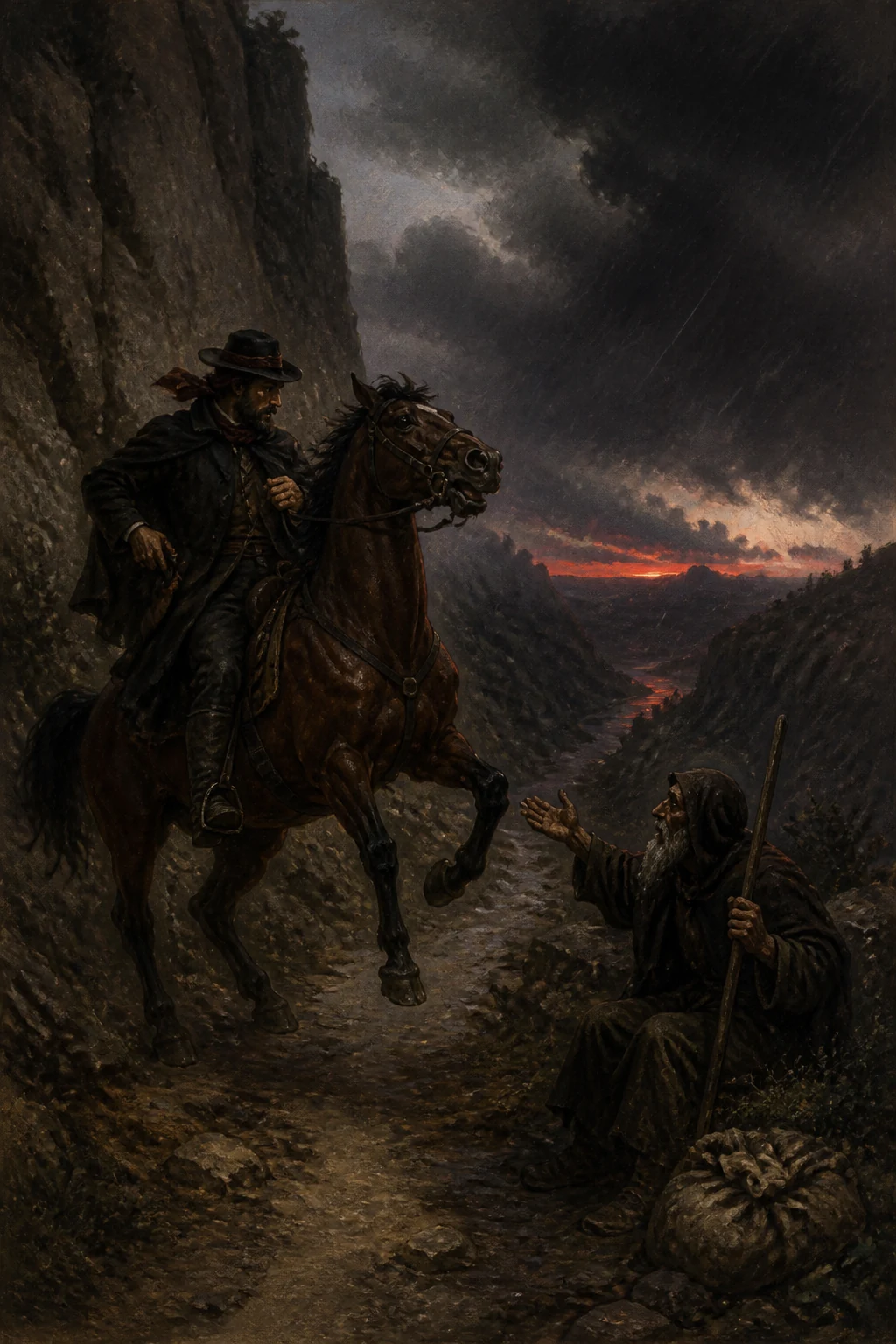
The evening of December 24 caught him on horseback in open country, with a storm threatening. It was the hour when, in winter, daylight suddenly goes out, as though it were a lamp and someone had turned the switch. Without transition, darkness descended, effacing the outlines of a landscape perhaps peaceful at midday, but now bleak and desolate.
He was in the gorge of one of those rivers that run deep between two steep escarpments; to the right lay the road, to the left a rocky mountain, almost sheer, bare and leaden in hue. Far below, nothing could be made out but a blackish ribbon where a red reflection of the sunset lay dying, writhing like a crimson asp; above rose dense masses, strange, phantasmal shapes; everything was solemn, one might even say menacing. Mauricio was no coward, yet the sight of the mountain impressed him; he longed to reach the Pazo as soon as possible, though three long leagues still lay between him and it, and urged on his mount with voice and spur as the animal pricked up its ears uneasily.
The wind strengthened, forcing him to tie his hat down with a handkerchief beneath his chin; thunder, still distant, rumbled mysteriously; gusts of rain lashed the rider’s face, and he stifled an oath. What cursed luck! For it to start raining just halfway home! At that very moment the horse reared and shied sideways: a figure had emerged from the undergrowth. Mauricio was already reaching for the revolver in the inside pocket of his sheepskin jacket when he heard these words in the local dialect:
“A little charity! For the love of God, who is about to be born... a little charity, sir!” Reassured, Mauricio looked angrily at the man who had the impudence to beg in such a place and at such a moment. He was a tall, strapping fellow, his feet and legs bare, with a pair of saddlebags over his shoulder, leaning on a stout cudgel. The darkness made it impossible to distinguish his face; his age could be guessed from his cracked voice and the faint silvery gleam of his shaggy white hair.
“Stand aside,” the young gentleman muttered impatiently. “Can’t you see you’re frightening the horse? Another moment and I’d have gone headfirst into the river... What a time to be begging, and what a place to jump out in front of a horse! Brutes!”
The beggar stood as though turned to stone. “Where is the river?” he cried in profound terror. “Isn’t this the road to the church at Cimáis? Sir, by the soul of the woman who bore you... Sir, don’t leave me helpless... I’m blind! May Our Lady preserve your sight! Pity the man who cannot see!”
Mauricio understood. The sightless old man had lost his way, had no idea where he was, and needed a guide to keep him from falling over the precipice. Yes, agreed; he needed a guide... And who was that to be? He, Mauricio Acuña, returning home from Orense on Christmas Eve to dine and spend a merry evening playing julepe or golfo with his brothers and cousins, smoking and laughing? If he checked his horse’s pace to match the slow walk of a blind man; if he turned aside toward the church at Cimáis, a good way off, at what ungodly hour would he make his entrance into the drawing room of the Pazo de Portomellor? For a moment he hesitated: he thought he could hardly do less than sacrifice a few minutes to set the blind man on the road to Cimáis, then leave him, once pointed in the right direction, to manage as best God allowed. Only that meant venturing into the oakwood, risking a stumble over stumps and boulders, and above all, yielding to the pleas of the beggar, who would not readily let go of his improvised guide, and who, if granted one request, would demand another... These paupers were such wheedlers, so hard to shake off! “Better slip away,” he decided; and taking a silver duro from his pocket, he placed it in the trembling hand the old man held out, more in supplication than in begging; then he spurred his horse and fled like a criminal escaping justice.
Yes, like a criminal—that was how he himself described his conduct a little later, as he reined in Maceo, his black Andalusian crossbreed, and realized that night had fallen completely. Veiled by gloomy banks of cloud, the moon showed a livid glimpse of itself, like the face of a corpse shrouded in a monk’s habit. The road stretched ahead, suspended above the river, which slumbered silent and sinister at a terrifying depth. The wind battered the sturdy tree trunks, making them creak; lightning lit the surface of the water, and thunder sounded, quite close now; Mauricio shuddered. He seemed to hear strange noises besides those of the storm. Could the old man have fallen into the water? Behind him, on the rocky path, he thought he heard the footsteps of a man feeling his way with a stick, as blind men do. An obvious absurdity, since Maceo’s gallop must already have left the beggar a quarter of a league behind. Yet Mauricio would have sworn that someone was following him: someone breathing with difficulty, stumbling, moaning, pleading for compassion. An irresistible uneasiness drove him to urge his mount on again, to reach the turning where the road left the river, whose very sight filled him with fears of a tragedy. Could he have fallen?... What tormented Mauricio was the thought of having abandoned a blind man on such a night. “But how could I have done it...? It seems impossible! If someone told me afterward, I wouldn’t believe it... Tonight of all nights, I should never have left a poor wretch alone...” he brooded, driving his spurs into Maceo’s flanks. “And the foulest, vilest part of what I did was to give him money. Money! If his body is floating in the Sil by now... what use is money to him? We think money puts everything right... Wretch that I am! I ought to turn back. Is there no one coming behind me?...”
Maceo flew: a sweat of anguish dampened his rider’s temples. Neither the buzzing in his ears nor the swirling wind, deep as a waterspout, kept him from hearing, ever closer, the footsteps of the man who was now, beyond any doubt, following him, or from catching that same broken breathing, that same sorrowful moan; and the truth was that he dared not turn around: because if he did, he might see the figure of the blind beggar, tall, his feet and legs bare, his bag over his shoulder, his staff in his hand, and the silver of his shaggy white hair gleaming in the darkness...
“Am I going mad?” he thought. “Come, courage... I must turn around...” And still he did not turn; his constricted throat, his pounding heart betrayed him: he was in the grip of a terrible, supernatural fear. He pressed home his spurs, and the excited horse quickened its headlong gallop, striking sparks from the stones in the road. The storm was now directly overhead: lightning flashed; a tremendous thunderclap burst above the young gentleman’s very head, deafening him. Maceo panicked; he spun sharply on his hind legs and plunged toward the slope above the Sil. Mauricio saw the dreadful danger when another flash revealed the abyss and the surface of the water: he closed his eyes, accepting the judgment of Providence... and the horse, in its fatal frenzy, dragged its rider to the bottom of the precipice, snapping pines as it fell and dislodging stones from the escarpment, whose crashing roar, as they tumbled down the rocks, still mimicked the frantic footsteps of the blind man stumbling and moaning.
Izvirnik
012 El ciego
Naslednje strani prikazujejo izvirno besedilo za primerjavo.
La tarde del 24 de Diciembre le sorprendió en despoblado, á caballo, y con anuncios de tormenta. Era la hora en que, en invierno, de repente se apaga la claridad del día, como si fuese de lámpara y alguien diese vuelta á la llave sin transición, las tinieblas descendieron borrando los términos del paisaje acaso apacible á medio día, pero en aquel momento tétrico y desolado.
Hallábase en la hoz de uno de esos ríos que corren profundos, encajonados entre dos escarpes; á la derecha el camino, á la izquierda una montaña pedregosa, casi vertical, escueta y plomiza de tono. Allá abajo no se divisaba más que una cinta negruzca, donde moría, culebreando, áspid de carmín, un reflejo rojo del poniente; arriba, densas masas erguidas, formas extrañas, fantasmagóricas; todo solemne y aun pudiera decirse que amenazador. No pecaba Mauricio de cobarde, y sin embargo, le impresionó el aspecto de la montaña; sintió deseos de llegar cuanto antes al Pazo, del cual le separaban aún tres largas leguas, y animó con la voz y la espuela á su montura, que empinaba las orejas recelosa.
Arreció el viento y le obligó á atar el sombrero con un pañuelo bajo la barba; el trueno, lejano aún, retumbó misteriosamente; ráfagas de lluvia azotaron la cara del jinete, que ahogó un juramento. ¡Aquello era mala sombra! ¡Justamente empezaba á llover á la mitad del camino! Al punto mismo el caballo se encabritó y pegó un bote de costado: de entre la maleza había salido un bulto. Echaba ya Mauricio mano al revólver que llevaba en el bolsillo interior de la zamarra, cuando oyó estas palabras en dialecto:
--¡Una limosnita! ¡Por amor de Dios que va á nacer... una limosnita, señor!
Mauricio, tranquilizándose, miró enojado al que en tal sitio y ocasión cometía la importunidad de pedir limosna. Era un hombrachón alto, descalzo de pie y pierna, que llevaba al hombro unas alforjas, y se apoyaba en recio garrote. La obscuridad no permitía distinguir cómo tenía el rostro; la ancianidad se adivinaba en lo cascado de la voz y en el vago reflejo plateado de las greñas blancas.
--Apártese--murmuró impaciente el señorito.--¿No ve que el caballo se asusta? Si me descuido, al río de cabeza... ¡Vaya unas horas de pedir, y un sitio á propósito para saltar delante de la montura! ¡Brutos!
El pordiosero se había quedado como hecho de piedra.
--¿Dónde está el río?--gritó con hondo terror.--¿No es aquí el camino de la iglesia de Cimáis? Señor, por el alma de quien lo ha parido... Señor, no me desampare... ¡Soy un ciego! ¡Nuestra Señora le conserve la vista! ¡Pobre del que no ve!
Mauricio comprendió. El viejo sin ojos se había perdido, ignoraba dónde se encontraba, y para no despeñarse necesitaba un guía. Sí, convenido; necesitaba un guía... ¿Y quién iba á ser? ¿Él, Mauricio Acuña, que desde Orense regresaba á su casa en tarde de Navidad, á cenar, á pasar alegremente la velada, jugando al julepe ó al golfo con sus hermanos y primos, fumando y riendo? Si sujetaba el paso de su caballo al lento andar de un ciego; si torcía su rumbo cara á la iglesia de Cimáis, distante buen rato, ¿á qué santas horas iba á hacer su entrada en la sala del Pazo de Portomellor? Un instante titubeó: pensaba que no podía menos de sacrificar algunos minutos á colocar al ciego en la dirección de Cimáis, y dejarle, ya orientado, arreglarse como Dios le diese á entender. Sólo que era internarse en la carballeda, exponerse á tropezar en los cepos y en los pedruscos, y sobre todo, era condescender á los ruegos del mendigo, que no soltaría á dos por tres á su lazarillo improvisado, y si le complaciese en lo primero exigiría lo segundo... ¡Estos pobres son tan lagoteros y tan pegajosos! «Más vale escurrirse», decidió; y sacando del bolsillo un duro, lo dejó en la mano temblona que el viejo extendía, más para implorar que para mendigar; picó al caballo y escapó como un criminal que huye de la justicia.
Sí, como un criminal--así definió su conducta él mismo, luego, en el punto de refrenar á Maceo, su negro andaluz cruzado, y darse cuenta de que había caído enteramente la noche.--Velada por sombríos nubarrones, la luna se entreparecía lívida, semejante á la faz de un cadáver amortajado con hábito monacal. La carretera se desarrollaba suspendida sobre el río que, á pavorosa profundidad, dormitaba mudo y siniestro. El viento combatía, haciéndolos crugir, los troncos robustos de los árboles; un relámpago alumbró la superficie del agua, un trueno resonó ya bastante cercano; Mauricio se estremeció. Le parecía escuchar ruidos extraños, además de los de la tormenta. ¿Se habrá caído el viejo al agua? Detrás, sobre la peñascosa senda, creía escuchar el paso de un hombre que tentaba el suelo con un palo, como hacen los ciegos. Absurdo evidente, pues con la galopada que Maceo había pegado ya, quedaría el mendigo atrás un cuarto de legua. Lo cierto es que Mauricio juraría que le seguía alguien: alguien que respiraba trabajosamente, que tropezaba, que gemía, que imploraba compasión. Invencible desasosiego le impulsó á apurar nuevamente á su montura, para alcanzar pronto el cruce en que la carretera se desvía del río, cuya vista le sugería el temor de una desgracia. ¿Se habrá caído?...--Lo que á Mauricio le acongojaba era la idea de haber abandonado á un ciego en tal noche. «Pero, ¿cómo fuí capaz...? ¡Si parece mentira! Me lo contarían después y no lo creería... Hoy no debí dejar solo á un infeliz...» cavilaba, hincando la espuela en los ijares de Maceo. «Y lo más sucio, lo más vil de mi acción fue darle dinero. ¡Dinero! Si á estas horas flota en el Sil su cuerpo..., el dinero ¿de qué le sirve? Creemos que el dinero lo arregla todo... ¡Miserable yo! Estoy por volverme. ¿No viene nadie detrás?...»
Maceo volaba: un sudor de angustia humedecía las sienes del jinete. El zumbido de sus oídos y el remolino del viento, profundo como una tromba, no le impedían oir, cada vez más próximas, las pisadas del que le seguía, ya sin género de duda, y percibir la misma respiración entrecortada, el mismo doliente gemido; y el caso es que no se atrevía á volverse: porque si se volviese, quizás vería la figura del ciego mendigo, alto, descalzo de pie y pierna, con el zurrón al hombro, el cayado en la mano, y reluciente en la obscuridad la plata de sus blancas greñas...
--¿Estaré loco?--pensó.--Ea, ánimo... Debo volverme...--Y no se volvía; su garganta apretada, su corazón palpitante, le hacían traición: sufría un miedo espantoso, sobrenatural. Apretó las espuelas, y el caballo, excitado, aceleró el tendido galope, sacando chispas de los guijarros del camino. La tempestad estaba ya encima: el relámpago brilló; un trueno formidable rimbombó sobre la misma cabeza del señorito, aturdiéndole. Alborotóse Maceo; giró bruscamente sobre sus patas traseras, y se arrojó hacia el talud que dominaba el Sil. Vió Mauricio el tremendo peligro, cuando otro relámpago le mostró el abismo y la superficie del agua: cerró los ojos, aceptando el juicio de la Providencia... y el caballo, en su vértigo mortal, arrastró al jinete al fondo del despeñadero, tronchando en su caída los pinos y empujando las piedras del escarpe, cuyo ruido fragoroso, al rodar peñas abajo, remedaba aún los desatentados pasos del ciego que tropezaba y gemía.
Nadaljuj z branjem