Waltey
Začarani prašič
Legende sau basmele românilor · Petre IspirescuO besedilu
Začarani prašič
- Vir
- Legende sau basmele românilor
- Avtor
- Petre Ispirescu
- Jezik branja
- English
- Jezik izvirnika
- Română
- Čas branja
- 24 min branja
- Obseg
- 19 strani
- Naslov izvirnika
- 005 Porcul cel fermecat
O izvirniku
Legende sau basmele românilor
Romunske ljudske pravljice o začaranih kraljestvih, preizkušnjah in junakih, zapisane iz ustnega izročila. Bralni jezik je English, izvirnik pa prihaja iz vira Legende sau basmele românilor v jeziku Română.
Besedilo
Začarani prašič
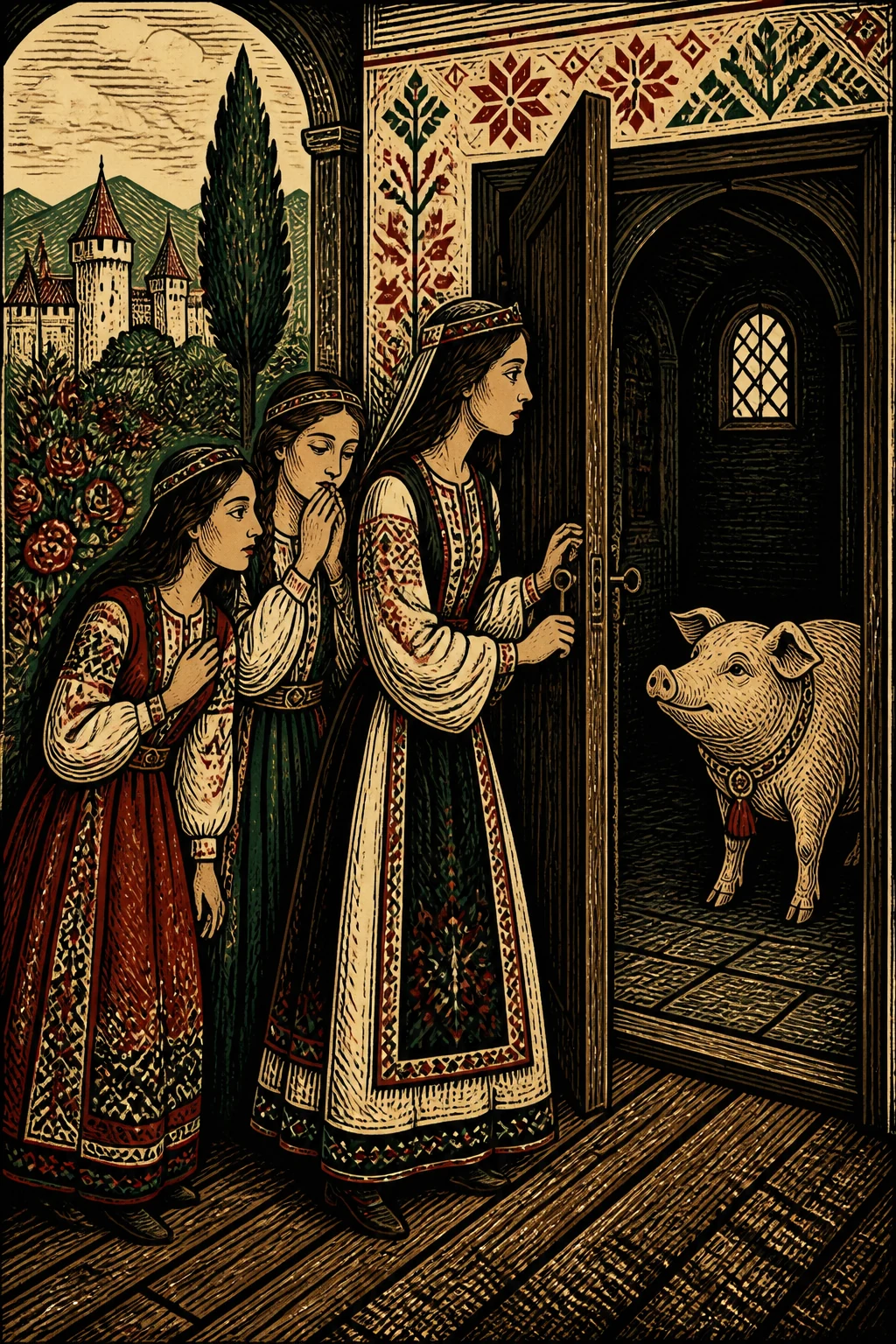
Once upon a time, as there never was before, there lived an emperor who had three daughters. When the time came for him to go to war, he called his daughters to him and said, “My dear girls, I must go to battle. An enemy has risen against us with a mighty army. It grieves me sorely to part from you. While I am away, be sensible, behave yourselves, and see to the affairs of the household. You may walk in the garden and enter every room in the palace; only do not go into the room at the back, in the right-hand corner, or no good will come of it.” “Rest easy, Father,” they answered. “We have never disobeyed you. Go without a care, and may God grant you a glorious victory.” When everything was ready for his departure, the emperor gave them the keys to all the rooms, reminded them once more of his counsel, and bade them farewell. With tears in their eyes, his daughters kissed his hand and wished him victory, and the eldest took the keys from him. When the girls found themselves alone, they scarcely knew what to do for sorrow and loneliness. To pass the time, they decided to spend part of each day working, part reading, and part walking in the garden. They did so, and all went well. But the Evil One begrudged the girls their peace and began to meddle. “My sisters,” said the eldest, “all day long we spin, sew, and read. We have been alone for several days now, and there is not a corner of the garden where we have not walked. We have been into every room in our father’s palace and seen how richly and beautifully they are furnished. Why should we not go into that room too, the one Father forbade us to enter?” “Heaven help us, Sister!” said the youngest. “How could such a thought enter your head, that you should urge us to disobey our father? If Father told us not to go in there, he must have known what he was saying and why he wished us to obey.” “Well, we shan’t tear a hole in heaven by going in,” said the middle sister. “Surely there are no dragons in there to eat us, or any other beasts. Besides, how will Father ever know whether we have been in or not?” Talking in this way and egging one another on, they came to the very door of the room. The eldest sister, who kept the keys, put one into the lock and turned it, and the door creaked open. The girls went in. And what should they see? The room had no ornaments at all, but in the middle stood a large table covered with a costly carpet, and on it lay a great open book. Impatient to know what the book said, the eldest stepped forward and read: “The eldest daughter of this emperor shall marry an emperor’s son from the east.” The middle sister went up, turned the page, and read in her turn: “The middle daughter of this emperor shall marry an emperor’s son from the west.” The girls laughed and rejoiced, giggling and teasing one another. The youngest, however, did not want to go near it. Her elder sisters would not leave her alone, but brought her to the table whether she wished it or not. Full of misgivings, she too turned the page and read: “The youngest daughter of this emperor shall be taken to wife by a pig.” Had a thunderbolt fallen from the sky, it could not have struck her more cruelly than those words. She nearly died of grief. If her sisters had not caught her, she would have split her head as she fell. When she recovered from the swoon into which her anguish had thrown her, her sisters began to comfort her. “What!” they said. “Do you really believe all that? Whoever heard of an emperor’s daughter marrying a pig?” “What a child you are!” said the other. “Hasn’t Father soldiers enough to save you, even if so loathsome a beast should come to ask for your hand?” The emperor’s youngest daughter would gladly have believed what her sisters told her, but her heart would not let her. Her thoughts kept returning to the book, which had promised her sisters such splendid fortunes, while for her alone it foretold something never before heard of in the world. And then her disobedience to their father gnawed at her heart. She began to pine. In only a few days she changed beyond recognition: once rosy and cheerful, she grew wan and withered, and nothing pleased her. She no longer cared to play with her sisters in the garden, to gather flowers for her hair, or to sing with them as they spun or sewed. Meanwhile, the girls’ father, the emperor, had won a victory greater than he had hoped, defeating his enemies and driving them away. As his thoughts were always with his daughters, he arranged matters so that he could return home sooner. Crowds upon crowds came out to meet him with horns, drums, and pipes, rejoicing at the emperor’s victorious return. Before going home, he first gave thanks to the Lord for helping him overcome the enemies who had risen against him. Then he went to the palace, where his daughters came out to greet him. His joy grew when he saw them safe and well. The youngest did all she could to hide her sadness. Even so, before long the emperor noticed that she was growing thinner and more downcast by the day. A burning iron seemed to pierce his heart at the thought that perhaps they had disobeyed him. And how could it be otherwise? To make certain, he summoned his daughters and questioned them, commanding them to tell the truth. They confessed, but took care not to say which of them had urged the others on. When the emperor heard what had happened, he lamented bitterly to himself and was almost overcome with grief. Yet he mastered himself and tried to comfort the daughter whom he could see wasting away. What was done was done, and he knew that a thousand words would not now be worth a penny. The affair was beginning to fade from their minds when, one day, the son of an emperor from the east appeared before him and asked for the eldest daughter’s hand. The emperor gladly gave her to him. They held a magnificent wedding, and after three days he sent her on her way with great honor, escorting her to the borders of his realm. Before long he did the same for his middle daughter, whose hand had been sought by an emperor’s son from the west. The more closely the words of the book came true, the more sorrowful the youngest daughter became. She would no longer eat, dress herself finely, or go out walking. Rather than become the laughingstock of the world, she wished to let herself die. But the emperor gave her no opportunity to carry out so sinful a deed, comforting her with every kind of counsel. Some time passed, and then, one day, lo and behold, a great pig came into the emperor’s palace and said, “Health to you, Emperor! May you be rosy and cheerful as the rising sun on a cloudless day.” “Welcome, friend, and may you be well. But what wind brings you here?” “I have come to ask for a bride,” answered the pig. The emperor marveled to hear such fine words from a pig and at once suspected that there was something uncanny in all this. He would have liked to find some way to avoid giving him his daughter, but when he heard that the courtyard and the streets were swarming with pigs who had accompanied the suitor, he had no choice but to promise her to him. The pig was not content with a promise alone: he entered into discussions and settled that the wedding should take place in a week. Only after securing the emperor’s word did he leave. In the meantime, the emperor counseled his daughter to submit to her fate, if that was God’s will. Then he said, “My daughter, this pig’s speech and wise behavior are not those of a beast. I would stake my life that he was not born a pig. There must be some enchantment or other devilry at work here. But you must be obedient and do as he says, for God will not leave you to suffer long.” “If you think this is right, Father,” answered the girl, “I shall obey you and put my hope in God. Let Him do with me as He wills. Such is the fate allotted to me; I see that I cannot escape it.” At last the wedding day arrived. The marriage was performed rather secretly. Then the pig and his wife got into an imperial carriage and set off for his home. On the way they had to pass a great patch of mud. The pig ordered the carriage to stop, climbed down, and rolled in the mire until he was covered in filth. Then he got back in and told his bride to kiss him. What could the poor girl do? She took out her handkerchief, wiped his snout a little, and kissed him, remembering to follow her father’s advice. By the time they reached the pig’s home in a great forest, evening had fallen. They rested a little after their journey, ate supper together, and went to bed. During the night, the emperor’s daughter felt that it was a man lying beside her, not a pig. She was astonished, but remembered her father’s words and began to take heart, full of hope in God’s help. In the evening the pig slipped out of his pigskin without the girl noticing, and in the morning, before she woke, he put it on again. One night passed, then two, then many more, and the girl could not understand how her husband could be a pig by day and a man by night. For he was under an enchantment, bewitched to live in this way. In time she began to love him, and she felt the fruit of their marriage stirring within her. Only one thing troubled her: she did not know what sort of child she would bring into the world in a few months’ time. Then one day she saw an old woman passing by, who was a witch. Having seen no other human being for so long, she longed for company and called the old woman over to talk. The witch said that she could tell fortunes, give remedies, and do all manner of wonders. “May you live long, good old mother,” said the girl. “Tell me, I beg you, what is wrong with my husband, that he is a pig by day, yet at night, when he sleeps beside me, I feel that he is a man?” “What you tell me, my little chick, I was just about to tell you myself. They do not call me a fortune-teller for nothing. Let your old mother give you a remedy to break his spell.” “Then give it to me, dear little mother, and I shall pay whatever you ask, for I can no longer bear to see him so.” “Here, my little darling, take this thread. He must know nothing about it, or it will have no power. Get up very quietly when he is asleep and tie it around his left leg as tightly as you can. You will see, my dear, that in the morning he will remain a man. I want no money. I shall be paid well enough when I hear that you have escaped such a curse. My heartstrings are breaking with pity for you, my little flower, and I grieve and grieve that I did not hear of this sooner, so that I might have come to your aid.” When the wicked old witch had gone, the emperor’s daughter carefully hid the thread. That night she rose so softly that not even the fairy birds could have heard her, and with her heart pounding she tied the thread around her husband’s leg. But as she pulled the knot tight—snap! The thread broke, for it was rotten. Her husband woke with a start and cried, “What have you done, unhappy woman! I had only three days left before I was free of this filthy enchantment. Now who knows how much longer I must wear this loathsome beast’s skin? And you will find me again only when you have worn out three pairs of iron shoes and an iron staff in searching for me, for I am going away.” With that, he vanished. When the poor emperor’s daughter found herself utterly alone, she began to weep and wail so bitterly that it would have broken your heart. She heaped fiery curses on the accursed fortune-teller, but all in vain. Seeing that lamentation would get her nowhere, she rose and set out wherever God’s mercy and her longing for her husband might lead her. When she reached a town, she ordered three pairs of iron shoes and a steel staff, made ready for the road, and began her journey in search of him. On and on she went, across nine seas and nine lands, through great forests whose tree trunks were as thick as vats. She stumbled over fallen trees, and as often as she fell, she rose again. Branches struck her face and thickets scratched her hands, but she kept going forward and never looked back. At last, weary from her journey and her pregnancy, bowed down by sorrow yet still hopeful at heart, she came to a house. This was where the Holy Moon lived. She knocked at the little gate and begged to be allowed inside to rest a while, all the more urgently because her labor pains had begun. The Holy Moon’s mother took pity on her suffering, brought her in, and cared for her. Then she asked, “How can a mortal from another realm have made her way as far as this?” The poor emperor’s daughter told her everything that had happened and ended by saying, “First I thank God for guiding my steps to this place, and then I thank you for not leaving me to perish in childbirth. Now I beg you to tell me whether your daughter, the Holy Moon, might know where my husband is.” “She cannot know, my dear,” answered the Holy Moon’s mother. “But go eastward until you reach the Holy Sun. Perhaps he may know something.” She gave her a roast chicken to eat and told her to take care not to lose a single bone, for they would be of great use to her. After thanking her once more for her kind hospitality and helpful counsel, the girl cast off one pair of iron shoes, which had worn through, and put on another. She tied the chicken bones in a bundle, took her child in her arms and her staff in her hand, and set out again. On and on she walked, across plains of nothing but sand. The going was so hard that for every two steps forward she slipped one step back. She struggled and struggled until she was through the sandy wastes, then crossed jagged, hollowed-out mountains, leaping from boulder to boulder and crag to crag. Whenever she reached a level stretch of mountainside, she felt as though she had caught God Himself by the foot. After resting a little, she would set off once more, always pressing onward. The sharp stones and flinty peaks scraped her feet, knees, and elbows until they were covered in blood, for I must tell you that those mountains rose higher than the clouds. Where there were no chasms for her to leap, she could only crawl upward on her hands, helping herself along with her staff. At last, utterly exhausted, she reached a palace. This was where the Sun lived. She knocked at the gate and begged to be admitted. The Sun’s mother welcomed her, amazed to see a mortal from another realm in that place, and wept with pity when she heard her story. Then, promising to ask her son about the girl’s husband, she hid her in the cellar so that the Sun would not sense her presence when he came home, for he always returned in an ill temper in the evening. The next day the emperor’s daughter learned that she had nearly been eaten, for the Sun had caught the scent of a human being from the other world. But his mother had soothed him with kind words, telling him he was imagining things. Encouraged by the kindness with which she was treated, the girl asked, “But tell me, dear mother, how can the Sun be unhappy, when he is so beautiful and does so much good for mortals?” “This is why,” answered the Sun’s mother. “In the morning he stands at the gates of heaven, and then he is joyful, joyful, and smiles upon the whole world. During the day he is full of disgust, because he sees all the wickedness of humankind, and that is why he sends down such scorching heat. In the evening he is sorrowful and angry, because he stands at the gates of hell. That is his accustomed path, and from there he comes home.” She also told the girl that she had asked about her husband, but her son had answered that he knew nothing of him. For if he lived in a great, dense forest, the Sun’s gaze could not penetrate every hidden corner and hollow. Her only hope, he had said, was to go to the Wind. There too she was given a chicken to eat and told to keep its bones with care. She cast off her second pair of iron shoes, for those too had worn through, took the bundle of bones, her child in her arms and her staff in her hand, and set out toward the Wind. On this journey she met with still greater hardships, for one after another she came upon mountains of flint from which flames burst forth, forests where no foot had ever trodden, and fields of ice heaped with snowdrifts. The poor woman nearly perished. Yet through perseverance and God’s help she overcame these great difficulties too and reached a hollow
in the flank of a mountain, so vast that seven cities could have fitted inside it. This was where the Wind lived. The fence around it had a little gate. She knocked and begged to be admitted. The Wind’s mother took pity on her and let her in to rest. As at the Sun’s house, she was hidden so that the Wind would not sense her presence. The next day his mother told her that her husband lived in a great, thick forest where no axe had ever reached. There he had built himself a kind of house by piling logs one upon another and weaving branches between them, and there he lived all alone for fear of wicked people. After giving her a chicken to eat and telling her to keep the bones, the Wind’s mother advised her to follow the Slaves’ Road, which can be seen across the sky at night, and to keep going until she arrived. And so she did. With tears of joy she thanked her hostess for her kindness and the good news, then set out. The poor woman turned night into day. She no longer cared about food or rest, so fiercely did she long to find the husband fate had given her. On and on she walked until these shoes too wore through. She cast them off and went barefoot. She paid no heed to the sharp stones, the thorns piercing her feet, or the blows she suffered when she stumbled over a rock. At last she reached a lovely green clearing at the edge of a forest. Her heart grew a little lighter at the sight of the flowers and the soft grass. She stopped and rested a while. Then, seeing the little birds sitting in pairs on the branches, she burned with longing for her husband and began to weep bitterly. With her child in her arms and the bundle of bones over her shoulder, she set off into the forest. She took no notice of the lovely green grass caressing her feet, would not listen to the birds whose chirping filled the air, and paid no heed to the flowers hiding in the thickets, but went feeling her way through the woods. From the signs the Wind’s mother had given her, she knew that this must be the forest where her husband lived. For three days and three nights she wandered blindly through it, finding nothing. So utterly worn out was she that she fell and lay where she had fallen for a day and a night, without moving, without eating or drinking anything. At last she gathered all her strength and rose, swaying, and tried to walk with the help of her staff. But that was impossible, for it too had worn down until it was of no use at all. Yet out of pity for the child, who could no longer find milk at her breast, and longing for the husband she sought with faith in God, she struggled onward as best she could. She had scarcely gone ten paces when, beside a thicket, she caught sight of a house just like the one the Wind’s mother had described. She made her way toward it and barely managed to reach it. The house had neither windows nor a door. Its entrance, it seemed, was up above. She walked all around it, but there was no ladder. What was she to do? She wanted to get inside. She thought and thought again, and tried to climb up, but in vain. Despair was almost overcoming her. How could she let herself drown just as she reached the shore? Then she remembered the chicken bones she had carried so far and said to herself, “Surely I was not told to keep these bones for no reason, but because they would help me in my hour of need.” She took them out of the bundle, considered a little, thought a little more, and put two of the bones end to end. To her wonder, they stuck together. She added another, and then another, and saw that those too held fast. So she made two poles of bones as tall as the house. She leaned them against the wall a royal handspan apart. Then she joined more bones end to end to make little bars, which she laid crosswise between the long poles to form the rungs of a ladder. As she set each rung in place, it too held fast. Thus she went on, one by one, all the way up. As she put a rung in place, she climbed onto it; then she added another, and another, until she reached the top. But just at the very top of the ladder, she had not enough bones left for one last rung. What could she do? She could not manage without it. It seemed she had lost one little bone. She could not stay where she was, and she could not bear to give up entering the house. So she cut off her little finger, and as soon as she set it in place, it held fast. She took her child in her arms, climbed up once more, and entered the house. There she marveled at how neatly everything was arranged. She set about tidying a little herself. Then she caught her breath, laid the child in a wooden trough she found there, and placed it on the bed. When her husband came home, he was frightened by what he saw. He could scarcely believe his eyes as he gazed at the ladder of bones and the finger at its top. He feared that some new enchantment was at work and very nearly abandoned his house. But God put it into his mind to go inside. Then, turning himself into a dove so that no spell could take hold of him, he flew up without touching the ladder and slipped quietly into the house. There he saw a woman tending a child. He remembered then that his wife had been with child when he left her, and such longing for her and such pity swept over him, as he thought of all she must have endured before finding him, that he became a man again at once. He almost failed to recognize her, so greatly had suffering and hardship changed her. The emperor’s daughter sprang to her feet when she saw him, her heart pounding with fear, for she did not know who he was. But once he made himself known, she regretted nothing and forgot all she had suffered. He was a man as handsome and straight as a fir tree. They sat down to talk. She told him all her adventures, and he wept with pity for her. Then he began his own story. “I am an emperor’s son,” he said. “My father once went to war against some dragons, neighbors of his, who were very wicked and kept invading his lands. In that war I killed the youngest of them. As it happened, you had been promised to him by fate. Then his mother, a witch whose spells could make even water stand still, cursed me
to wear the skin of that loathsome beast, thinking that she would keep me from marrying you. But God thwarted her, and I took you to wife. The old woman who gave you the thread to tie around my leg was she. And though I had only three days left before I escaped the curse, I was condemned to wear the pig’s foul hide for another three years. Now you have suffered for me, and I for you. Let us give thanks to the Lord and return to our parents. Without you, I had resolved to live as a hermit. That is why I chose this deserted place and built my house so that no human soul could reach me.” Then they embraced for joy and promised each other that they would both forget their past sorrows. Early the next morning they rose and set out together, going first to the emperor who was his father. When word spread that he and his wife had come, everyone wept for joy to see them. His father and mother clasped him tightly in their arms, and the celebrations lasted three days and three nights. Then they went to the emperor who was his wife’s father. He nearly went out of his mind with joy at the sight of them. He listened as they told him all that had happened. Then he said, “Did I not tell you that I could not believe the beast who asked for your hand had been born a pig? You did well to obey me, my daughter.” And because he was old and had no heir, he stepped down from his imperial throne and set them upon it. They ruled as rulers do who have passed through every kind of trial, sorrow, and hardship. And if they have not died, they are still alive to this very day, reigning in peace. And I mounted a saddle, and so on.
Izvirnik
005 Porcul cel fermecat
Naslednje strani prikazujejo izvirno besedilo za primerjavo.
fotsd odata ca nici °date etc. A. fostfi °date' unit imperatti si avea tree fete. Si fiinde a merge la betalie, isi chema fetele §i le cfise : Each' dragele mele, sunte silitu se merge la rasboiii. s'a sculatfi cu este mare asupra nestra. Cu mare durere me despartii de voi. In lipsa mea beg* de seine se fiti cu minte, se ye purtati bine si sa ingrijiti de trebile easel. Aveti voe se ye preamblati prin gradina, se intrati prin tote camarile easel ; numai in camera din Wilda din coltulli din drepta se nu intrati, a nu va fi bine de vol. Fii pe pace, tats, respunsera ele. Niel o data n'amu e- HA din cuvintulil dumitale. Du-te fare grije, §i Dumneciee sa-11 dea o isbanda stralucita. Tote flindu gate de pornire, Imperatulfi le dete cheile de la tote camarile, mai aducendu-le aminte Inca odata povetele ce le deduse, lua (Poe buns de la ele. Fetele imperatului, cu lacramile in ochi, II serutaKa mane, ii poftira biruinta ; iar cea mai mare din ele priimi cheile din mana imperatului. Nu se seia ce sa se face de mahnire si de uritii, fetele, and se veclura singure. Apoi, ca se le treed de uritti, hoterara ea o Fate din di sa lucreze, o parte se citesca si o parte se se plimbe prin gradina. A§a fe'cura §i le mergea bine. Viclenulti pismuia pacea fetelorti viii coda. Suriorele mele, cjise feta cea mai mare, catu-i c.liulica de Vrajnmulit si-sl
mare tercet-nil, cosemii, citimu. Suntii cite -va clile de cAndu ne aflamit singure, n'a mai rernasif nici unit collif de gradina pe unde sA nu ne fi plimbatu. Amu intratd prin tote carnarile palatului tatalui nostru, si amu ve4utd catfi suntd de frumosu si bogatit Impodobite; de ce sA nu intramit ci in camera ceea, in care ne-a opritu tatalu nostru de a intra. -- Val de mine, lelita, clise cea mai mica, me midi cum ti -a datii in ganda una ca acesta, ca sa ne indemnI durnneta sa calcamu porunca tatalui nostru. Ganda tata a (lief sA nu ntramit acolo, trebue sa fi sciutif elu ce a (Asti si pentru ce a clisu sa facemii asa. Ca doll nu s'o face gaurd in cerd, d'omn" intra clise cea mijlocie ; CA dera n'o nicai-va smei sa ne me.nance, on alto lighione, *'apoi de unde o sa scie tata daca not amit intrattl au ba ? Toth vorbindii sl indemnAndu-se, ajunserd tocmai pe din naintea acelei camarT; cea mai mare din surori, care era pastraterea cheilorif, baga cheia in bresca uGei, si Intorcend-o scartit usa se deschise. Fetele intrard. Cand cold, ce sa va4a ? Casa n'avea nici o podoba; darn in mijlocii era o masa mare cu unit covoril stump pe dense, si d'asupra o carte mare deschisa. Fetele, nerabdatere, voira a sci ce clicea In cartea aceea. Si cea mare Inainta si eta ce ceti : Pe fata cea mare a acestui imperatii are s'o is und flu de Imperatit de la rasdrit. Merse si cea mijlocie, si intorcend foia, ceti si ea : Pe fata cea mijlocie a acestui imperattl, are s'o is unit fit' de Imperatd de la apusti. Risers fetele si se veselira, hihotandit, si glumind Intre ele. Fata cea mica insa nu voia sa se duca. Cele mai marl' nu o lasara In pace, ci cu voe fara voe, o aduse si pe densa lAnga masa, si cam cu indoiala intorse si ea feia si ceti : fi nilele,
M Pe fata cea mica a acestui imporatit are s'o is de solie unii porcii. Trasnetulii din cern de aril fl c tdutu nu i-aru 11 facutu mai multil reil ca ceea ce i-a facutil citirea acestor vorbe. P'ac i p'aci era A moil de mahnire. Si data n'o tineau surorile, 41 si spArgea capulii cadendu. Dupt ce se desmeteci din lesinulii ce-i venise, de inima rea, incepurt s'o mang,ae surorile. Ce! ii qisera, mai crecli si tu la tote alea! uncle at mai pomenitii tu, ca o fata de imporatil sa 3e marite dui it unit porcit ? Ce copild esti ! ii dise cea-1-11tt, dart tata n'are destula ostire sa te scape, chiar cand s'aril intempla sa vie sa te cent unit dobitocit asa de scarbosil ? Fata cea mica a imperatului ar fl voitil sa se induplece a crede cele ce II spuneail surorile ; dart n'o ltqa inima. Candid el era mereil la cartea care spuse ca noroculii celorill-alte surori era sa fie asa de frumosil si numai ei ii spusese ca o sa i se intemple ceea ce nu se mai au4ise pint atuna pe lume. Si apoi o rodea la ficati calcarea poruncil tatdlui lore. Ea incepu a lancedi. Si numai in cafe -va dile asa se schimbase, in cat nu o mai cunosceai ; din rumens si veselt ce era, ajunsese de se ofilise si nu-i mai intra nimeni in voe. Se ferea de a se mai juca cu surorile prin grddint, d'a culege fiori ca sa le pue la cap"' si d'a canta cu totele cand eraci la furca, on la cusatura Litre acestea tatalii leteloril, imperatuhl, facuse o isbanda cum nu se astepta, biruind si gonindu pe vrajmasil. Si fiind-ct ganduld ii era la fiicele sale, fa'cu ce facu si se intorse mai curandil acast. Lumea durd lume esise intru intimpinarea lul, cu buciume, en tobe si cu surle, Inveselindu se ca imperatul se intorcea biruitoru. Cum ajunse, pint a nu merge acasa, imperatubl dete lauda Domnului ca-i ajutase asupra protivniciloril, carii se sctlase asupra lui, de-i infranse. Apoi mergendu accsii, flicele lui ii
esird inainte. Bucuria lui crescu cand vedu a fetele ii er' sanatose. Fata cea mica se feri calf" putu a nu se areta trista. Cu tote astea, nu dupa mutt timpfi, imperatuld MO de soma ca fie-sa cea. mica din ce in ce slabea si se posomora. Indata II trecu un' fern arsd prin inima, gandindu-se ca pole calcatil porunca. Si de unde sa nu fie asa I Ca sa se incredinteze, isi chema fetele, le intreba, poruncindu-le spue dreptd. Ele marturisird. Se ferira insa d'a spune care din ele fuse indemaatorea. Cum audi Imperatuld una ca acesta, se tanguia in sine cu amard, si cad p'aci era birue mahnirea. Isi tinu insa firea si cauta a-si mangaia fata care vedea ca se perde. Ce s'a facutii s'a facutd vedu all ca acum o mie de vorbe un' band nu face. Incepuse a se cam uita intemplarea acesta. Cand, intr'o se infatise la Imperatuld fiuld until imperatit de la rasaritii si-i cent de sotie pe fata cea mai mare. Imperatuld i-o dete cu multumire. Facura nunta infricosata si peste trei chile o petrecu cu einste mare pins la otait. Peste putinh, asa face si cu fata cea mijlocie pe care o ceruse unit fid de imperatd de la apusti. cat' vedea ca se implinesce intocmai cele scrise in cartea ce citise, cu atatil fata imperatulul se intrista si mai mutt. Ea nu mai voia sa manance, nu se mat gatea, nu mai esea la plimbare ; voia sa se lase sa moil, mai bine, de cat' BA' ajunga de batjocura lumii.DarA imperatulii nu -i da regazii sa pue in lucrare o fapta asa de nelegiuita, ci o mangaia cu fel de fel de povete. Mai trecu ce mai trecu si eta, mare, ca intr'o di 'nyeratulu se pomenesce cu un pored mare ca intra in palatuld lui si-i dice: Sanatate tie, Imperate ; sa fit rumen' si voiosti ca Ilisarituld sdrelui intro di sening. Bine at venitd sanatosh, prietene. Dara ce viral to aduce pe la not ? i-aa sa-I geld Cu sli,
Am venitii in petitil, respunse porculii Se mira imperatuld cand aucli de la pored' asa vorbe frumose, si indata isi dete cu parerea ca aci nu putea sa fie lucru curatii. Aril fi voitir s'o carmescd imperatuld spre a nu-1 da fata de sotie ; darn dupa ce aucli ea curtea si ulitile gem' de porci, care venise cu petitoruld, n'avu in cotro, si-I fagadui. Porculd nu se lass numal pe fagaduiala, ci intra in vorbit, si, si hotari ca nunta sa se faca peste o septemanit. Numal dupa ce priimi cuvintil build de la imperatuld, porculii pleca. Pina una alta, imperatuld isi povalui fata sa se supue ursitei, data asa a voitil Dumnecleil. Apoi ii clise : Fata mea, cuvintele si purtarea cea intelepta a acestui pored, nu este de dobitocil ; o data cu capulii nu creqii ell ca 61 sa se 11 nascutii pored. Trebue sa fie vre-o fermecatarie sail vre-o alta dracie aci. Insa to sa fl ascultatore, sa nu esl din cuvintuld luI ; cacl Dumnecleii nu te va lam sa te chinuescI multi' timpil. Daca dumneata, tata, gasescI cu tale asa, respunse tata. te ascult si-mi puiu nadejdea in Dumnecleil. Ce o vrea elit cu mine. Asa mi-a fostil tristea ; vecld eft ca. n 'amid in cotro. Intre acestea sosi si clioa. nuntii. Cununia se facu cam pe sub ascunsil. Apol puindu-se porculd cu sotia sa intr'o caruta imperatesca, porni la densuld acasa. Pe drumit trebuia sa treca pe rang& und noroid mare ; porculd porunci sa stea carvta ; se dete jos §i se tavali in noroiii, pind se facu una cu tina. apoi suindu-se, clise mireseI sa-lii sarute. Biata fata, ce sa faca ? Scose batista, nil sterse nitelii la botit si-lii saruta, gandindu-se sa asculte povetile tatalui ski. Cand ajunsera acasii la porcii, care era intr'o padure mare se si insera. Segura nitelit de se odihnira de drumii, cinard impreuna si se culcara. Peste nOpte fata imperatului sirnti ca linga densa era und omit, darn nu unit porcii. Se mill. lnsa isi aduse aminte de cuvintele tatana-sed, si
5'i ucepu a mai insufleti plena de nadejde in ajutorulu lui Dumnedeu. Porculd sera se desbraca de pielea de pored, fara sa simta fata, si diminet a, pind a nu se destepta ea, eld era se imbraea cu densa. Trecu o nopte, trecura doue, trecura mai mite nopti, si fata nu se putea domiri e,tm se face de barbatu-seti cliva este pored si noptea omit Pasami-te elit era fermecatii, vrajitil sa fie asa. Mai tardid incepu a prinde dragoste de densul, (And simt i rodurile easatoriei : atatd numai se mAhnea ea nu seta ce o sä dealumel peste cite-va luni. Gaud, intr'o di vertu trecendu pe acolo o baba clout& vrajitore. Ea, care nu \recluse Omeni de atata mare de timpti, era jinduita, si o chema sa mai vorbesca Cu dAnsa cite ce-va. Vrajitdrea spuse ca scie sa ghicesed, sa dea lecuri si eke nagode tote. Asa sa traesci, betranico, is spune-mi d'a minune, ce are barbatu-med de este ctioa pored si ndptea, cand ddrme Linga mine, lid simtil ea este om ? Ceea ce-mi spui, puica mami, erarnii sa ti-o spuid ed mai inainte ; eaci nu de surda suntd ghicitore. SA-ti dea mamulica lecuri can sa-1 tale fermecele. Da -mi, ded, mamusdra, si ti-oid plati unit mi-Y cere, ca mi s'a uritu cu eld asa. Tine icea, puisoruld mamei, ata acesta. Sa nu scie elu de densa, ca n'are lecd. SA to scoll cand dorme elu, biniisord, si sa i-o legi de piciorul stangd, cat se pote de stransii, si sa vecli, Braga babi, ca dimineta remane omti. Parale nu-mi trebue. Ed void et destuld de platita cand void Oa ca o sä scapi de asa urgie. Mi se rupe, uite, baerile inimii de mila, pentru dumneta, boboceluld mamei, si me caescd, me caeseti, cum de sa nu aflu mai din nainte, ca sa -ti yid in-. tru'ajutord. Dupe ce plea sgriptordica de vrajitore, fata de imperat ascunse cu Ingrijire ata ; era peste nopte se scula binisor, in ii u
catil sa n'o situp nici maiastrele, si cu inima tacainda, lega ata de piciorulit ba'rbatului Wt. Gaud sä strang a noduld pic ! se rupse ata, cad era putreda. Desteptandu-se barbatuld speriatit, clise Ce al facutti, nenorocito! Ma! avearnit Ire! clile, si scapamit de spurcatele aStea de vraji ; acum tine scie catit v °ill mai avea sa porta acesta scarboisa pele de dobitocii. Si numai atunci vei da cu maim de mine, cand vel rupe trei perechi de opinci de ferii ;i cand vet toci un toiagh' de otelit, cautandu-me, cad ed. 1116 due. vise si se facu nevNutd. S&mma fata de imphatii cand se vec,1 singura cucit, unde incepu a plange si a se boci, de ti se rupea inima. Blestema cu fool si cu pars pe afurisita de ghicitore. Dara tote in zadar. Data veep ca n'o stole la ca'petaia cu tanguirea, se scula si pleca in cotro va duce-o miLa Domnului si do. ruld barbatului. Ajungenda intr'o cetate porunci de -! Neu trei perechi de opine!' de feru si un toiagu de otel, se gati de drum, si se porni in caletorie, spre a-si gasi barbatuld. Se duse, se duse, peste none marl, peste noud teri, trecu prin nisce paduri marl cu busteni ca butia, se poticnea lovindu-se de copacil eel resturrnti, si de cate on cadea, de atatea ori se si scula; ramurile copacilor o isbeau peste fatA, crangurile ii sgariase mainele, si ea told inainte mergea, si indarat nu se uita. Cand, obosita de drum si de sarcina.', abatuta de malmire si cu nadejdea in inima, ajunse la o &sup. Pasami-te acolo sedea Santa Luna. Batu la portita, se rugs sa o lase in nauntru sa se odihnesca nitel, mai cu sema ca it si abatuse sa fach. Muma sante! Lune, avu mils de dansa si de suferintele sale ; o priimi dar inautru si o ingriji. Apol o intreba. Cum se pate ca omit de pe alte tdremuri sa rasbesca pans aci. it
Biata fats de imperatti Iii povesti atunci tote IntamplArile si sfirsi clicendti: Multumescii mai intaid lui Dumnecled a mi-a indreptatti pasii catre acestit locd, si alit doilea, dumitale, ca nu m'ai lasat sa pierit la cesulti nasceril. Acum to mai rogiz sa-rni spui, nu care turn -va Qanta Luna, fiica dumitale, scie pe unde q'arti afla barbatuld med ? Nu pOte sä scie, draga mea, Ii respunse muma santei Lune, dar du-te incolo spre rAsaritd pans vel ajunse la santuld Sore; pOte eld sit scie ce-va. dete sa manance o gains fripta si Ii clise sa bage de sema sa nu piarcla nici unit oscior, ca-I va ft de mare trebuinta. Dupa ce mai multumi Inca o data de buna gAsduire si de povetele cele folositore, si dupA ce lepadA o pereche de opinci care se sparsese, incalla altele, puse osciarele gainei inter) legatura, MA in brate copilasuld si toiaguld in mina si o porni er5s1 la drumir. Merse, merse, prin nisce campil numai de nisip ; asa de gred era drumul, in cat facea doi pasi inainte si unul inapoi ; se lupta, se lupta si scapa de asta campie, apoi trecu prin nisce munti coltorosi si scorborosi; sgrea din bolovand in bolovanit si din coltd in coltd. Cand ajungea pe sate unit pieptil de munte yes, i se parea ca apuca pe Dumneded de unit picior ; si dui:4 ce se odihnea eke nitelti, iar o lua la drum, si totri inainte mergea. Glodurile, coltil de munte care erait totti de cremend, atat 11 sgariase piciOrele, genuchii si cotele, in cat erad numal sange ; caci trebue sa ye spund ca muntii erati 'nalff in cat intrecead norii. i pe unde nu erad prapastii peste care trebuia sa sara, nu putea merge alt-feld, de Gatti suindu-se pe brand si ajutandu-se cu toiaguld. cele mai de pe urmd, stAtuta de ostenealA, ajunse la nisce palaturi. Acolo sedea SOrele. Batu la pOrt5 si se rugs sa o priimescA. Muma Sorelui o It
priimi si se miry cand veclu °mu de pe alte teremuri pe acolo, si plinse de mila ei cand it povesti intemplarile. Apoi, dupa ce-1 fagadui ca va intreba pe despre barbatula el, o ascunse in pivnita, ca sa n'o simla &Vele cand o veni acasa, cad sera se intOrce tot d'auna superatii. A doua Ali afla fata de imperatf ea era s'o pap, fiind-ca, Sore le cam mirosise a omit de pe alta lume. Bard* muma-sa it linisti cu vorbe bune, (licendu-i, Ca suntu pareri. Fii ca de imreratil prinse curagiii cand veclu cu cats bunatate este primita si intreba Bine, frate draga, cum se pate ca SOrele sa fie superatii, elf. care este data de frumosil si face atata bine muri- ? Eaca pentrn ce, respunse muma Sorelui: Elf dimineta sta in porta raiului, si atunci este veself, veselii si ride in Mid lumea. Peste di este plinu de scarba, fiind-ca vede tote necuratiile omeniloril, si d'aia isi lass arsila asa de cu zapusela ; era sera este mahnitti si superatii, flind-ca sta in lorta iadului ; acesta este drumulf lui obicinuitti, de unde apoi vine acasa. Ii mai spuse ca l'a intrebatf despre barbatulf ei, si fiiisea II respunse ca nu scie de semi lui nimicu; find -ca de va sedea in vr'o padure desa si mare, vederea lui nu pote strabate prin tote colturile si afundaturile, ci ca alta naclejde nu e, de catil sa merga la Yenta. Ii dete si acolo o gaina sa manence, si ii clise sa rastreze osciOrele cu ingrijire. Dupa ce lepadd si a doua pereche de opine! care se spars ese si acelea, lua legatura cu osciorele, copilulii in brace si toiagulii In mans si porni spre Vent& In calea acesta intalni nisce greutati si mai marl, cad dete, una dur a alta, restemunti de cremena, din care tisnea flacari de foci!, peste paduri ne mai umblate si campil de ghiata cu narniecli de zapadd. P'aci, p'aci era sa se prapadisca, biata femee ; lug cu staruinta ei si cu ajutorulf lui Dumnecleil, birui si aceste greulati marl', si ajunse in o vagauna care era torilorti flii-sdA :
intr'unu coliti de inunte, mare, de putea sa intre septe cetatc inteensa. Acolea sedea Ventuld. Gardulii care o inconjura avea a portita. Batu si se rugs. sd o priimesca. Mu.na Ventului avu mild de densa si o prime sA se otlihnesca. Ca si la Sore fu ascunsa ca sa nu o simta Ventuld A doua di souse a barbatuld sed locuia intr'o padure marl si (160, pe unde nu ajunsese toporuld Inca ; ca acolo facutii und felt de casa gramadindd bustem unuld peste altuld, si fmpletindu -i cu nuele, unde traia singurti sing,ureld de -Loma omenilord rei. Dupd ce ii dete si aci o gaina de maned si ii clise sA pastreze osetorele, mums Ventului o pavatai sa se is dupS dru - MUM robilorti care se vede nOptea pe cent, si sa merga, sä merga pand va ajunge. Asa si fa'cu. Dupa ce multumi cu lacrami de bucurie pentru buna gasduire, si pentru vestea cea bung, porni la drumii. Biata femee nopfile le facea di. Nu i se mat alegea nici de mancare, nici de odihnA. Atata dordsi focu avea sd-si gasesca harbatulii pe care ursita i-lu dedese. ;Terse, merse Oita' ce i se rupse si opincite aceste. Le lepada' si incepu a merge cu piciorele gale. Nu cauta gloduri, nu baga semi la ghimpii ce-i intra in piciore, nici la loviturile, ce suferea candd se impedica de vre-o petra. In cele mai de pe unna ajunse la o poiana verde.si frumosa de marginea unei pacluri. Acu-n se mai inveseli si sufletuld el cand vedu floricelele si erba cea mole. Statu si se odihni nitelii. Apoi vedendd paserelele cat doue, doue. pe ramurelele copaceilord, se incinse foculd inteensa de doruld barbatului set, incepu a plange cu amarti, si cu copiluld in brate, si cu legatura cu osciorele pe umerd, porni Infra in padure. Nu se uita nici la erba cea vedere si frumosa ce'I mangaia piciorele, nu voia sä asculte aid la paserelele ce ciripeati de asurdea, nu auta nici la lioncelele ce se ascuudead prin desisurile crangurilorti, ci mergea dibuindu prin padure. Ea bagase de seta ca acesta eras!. ti-a
trebue sa 'fie padurea in care locuia barbatul sea, dupa semnele ce-i spusese muma Ventului. Trel dile si trel nopti orbacai prin padure, si nu putu afla nimicii. Atatti de multd era rupta de ostene1d, in cat cadit si remase acolo o di s'o nopte fara sal se misce, fara sa bea si Sa manance ce-va. In cele mai de pe urma, puse tote puterile, se scula., si asa sovaindil, cerc5 sa umble sprijinindu-se in toiagulu sed, dard ii fu cu neputinta, caci si acesta se tocise, in. catil nu mai era de nici o -trebuinfa. Insa de mila copilului care nu mai gasea lapte la peptuld el, de doruld barbatului pe care HA cauta en credinta la Dumneded, porni asa cum putu. Nu mai facu dece pasi i zari catre un desisii un fel de casa precum ii spusese muma Ventului. Porni intr'acolo si abia, abia ajunse. Acea casa n'avea nici ferestre, nici usa. Pasami-te usa era pe d'asupra. dete ocol, Scam nu era. Ce sd. lack' ? Voia sa intre. Se gandi, se resgandi ; se cerca sa se sue ; in zadai'. Sta sta s'o dolaire cu totuld intristarea cum se pole sä se lase ea sd se inece tocmai la mald. Cand, isi aduse aminte de osciOrele de gaind ce le purtase atata cale si-si dise nu se pole sa mi se fi dis de florile merului sa pastrez aceste osciore, ci ca imi va fi de mare aju lord la nevoe. Atunci scose osciarele din legatura ce o avea, ge socot, niteld, mai cug-eth, si luandu time din aceste osciore, le puse verfli in verfii, si vedu ca se lipi ca printr'o minune. Mai puse unulu, apoi imul, si vedu ea se lipira si acelea. Fdeu deci, din osciore, doui drug! cat casa de inaIti. Ii rezema de casa la o departare de o palma domnesca unul de altuld. Pupa aceea puse iarasi, capeteid la capeteid cele- l'alte osciore si tam nisce drugulell mici, fie -care puindu-i d'a curmedisuld pe drugii cei mar!, inchipui treptele unel sari ; cum punea aceste trepte se lipeati si ele. Si astir -felfi unulu cafe unuld puse pina susii. Cum punea o trepta se urea pe ea. Apoi alta, apoi alta, pind unde ajunse. and tocmai susti in verfulti sari!, nu-i ajungea sä mai faca o trepta. is1 it
Ce sa faca ? Fara astA trepta nu se putea. Pasd-mi-te ea perduse un osciorti. SA stea acolo, era peste pole. SA nu intre induntru ii era ciuda. Se aptica true degetulit celu mic, si cum ilu puse acolo se lipi. LuA copilulti in brate, se urea din no si infra in casa. Aci se miry ea de buna renduiala ce gasi. Se apnea si ea si mal deritica o lecA. Apoi mal resulla nitelu, puse copilulu intr'o albie ce gasi si o a.secla in pate. Candu veni barbatu-see., se sperie de ceea-ce vedu. Para nu-I venea sa creda ochilorti seI tau uitAndu-se la scara. de osciore si la degetulii din verfulii scariI. Frica WI era, sa nu fie era niscai-va fermece, si cat p'aci era sa -si parAsesca casa. dara Dumnecleil II dete in gand sa intre. Atunci, facendu-se unu porumbelii, ca sa nu se lipesca farmecele de elu, sbura pe d'asupra, fArA sa se atinga de scara, si infra in induntru in shoal. Acolo vedu o femee ingrijinde de unii aduse aminte atuncI ca femdea sa era insarcinata and plecase de la ea, si uncle it coprinse mail dor de densa si o mild, gandindu-se la cite trebuia as fl patit ea pant sa dea cu mama de densulti, in cite se Mu numai de cat omii. CAM p'aci era sa n'o cunosca ; atAtil de multd se schimbase din pricina suferintilorii si necazurilore. Fata de imperatil, curnii II vedu, se scula in suer, si ii tach'ia inima de fricA, tlind-ca ea nu-111 cunoscea. DupA ce elu i se facu cunoccute, ea nu se cai, ba si uitA tote. ce suferise. Elu era mill barbat ca unti brad de frumose. Se puse dee! la vorbA. Ea ii povesti tote intAmplarile; era elii planse de mila ei. Apoi incepu si elu a spune : EA, clise elu, suntil flu de imperat. La unit resboill ce avu tats -meii cu nisce smei, vecini al lug, care erail forte rel calcati mosia, amii morale pe cela mai Pasa-mi-te, ursita to fagaduise luI. Atunci masa care era o vrAjitore de inchiega si apele cu fermecele el me blestemA sill copilii. Elii isi si-I told midi.
sa porta pielea acelui scarbosd dobitocu, cu gandii ca sa nu ajungil sa mi-te iau eti. Dumnec,led i-a statit impotriva, eil to -amd luatd. Baba care fi-a data ata sa mi-o leg! de piciord, era ea. Si de unde m ii aveamil Ire! dile sa, scapd de blestemil, amu fostd glau sa porLd Inca trei an! starvul poreului. Acura to ai suferitil pentru mine si ed pentru tine, sa damd 'Lauda Domnului si sa ne intorcemd la parinlii notri. Fara tine eramti hotaritd sa traescit ca und pustnied, d'aia §i alesd acestd loco pustid si mi-amii facutd casa a9ta, a§a, ca puid de oind sa nu mai pots resbi la mine. Apoi se imbracipra de bucurie si se fagaduira ca amandoi sa uite necazurile trecute. A doa di de dimineta se sculard, si pornird amandol, mai intaiii la imp6ratulti, tatalit lui. Cand se audi de venirea lui §i a sofiei sale, kith lumea plangea de bucurie ca iI vedea. Era tatatil qi mum lui II imbrafi§e strans, si finura veseliile trei dile si trei nopli. Apol msrse §i la i nperatuld, tatalii femeil lui. Elu catti p'aci era sa-0 esa din minri, de bucurie, cand ii vedu. Asculla povestindu-i-se intemplarile lord. Apol dise Ti -amd spusti ed ca nu credeamil sa se fi nascutii porcu aceld dobitocii, ce te-a cerutd de sofie ? §i bine ai facutd, fata ',flea, de m'al ascultatil. Si Iiindd-ca era b6trand, si niotenitori n'avea, se cobori din scaunul imperaliel sale, si ii puse pe d6n§ii. Era ei domnira cum se domnesce, cand imporalii treed prin felu de fell de ispite, necazuri §i nevoi. Si de n'orti fi muritd, traescd §i astadi. domnind in pace Era ed incalecaid p'o Gea, etc.
Nadaljuj z branjem