Waltey
Sestavljanka
Cuentos de Navidad y Reyes
Cuentos de Navidad, de la patria y antiguos · Emilia Pardo BazánO besedilu
Sestavljanka
- Vir
- Cuentos de Navidad, de la patria y antiguos
- Avtor
- Emilia Pardo Bazán
- Jezik branja
- English
- Jezik izvirnika
- Español
- Čas branja
- 7 min branja
- Obseg
- 6 strani
- Naslov izvirnika
- 016 El rompecabezas
O izvirniku
Cuentos de Navidad, de la patria y antiguos
Sedemintrideset avtorskih zgodb v treh zgodovinskih knjižnih skupinah. Bralni jezik je English, izvirnik pa prihaja iz vira Cuentos de Navidad, de la patria y antiguos v jeziku Español.
Besedilo
Sestavljanka
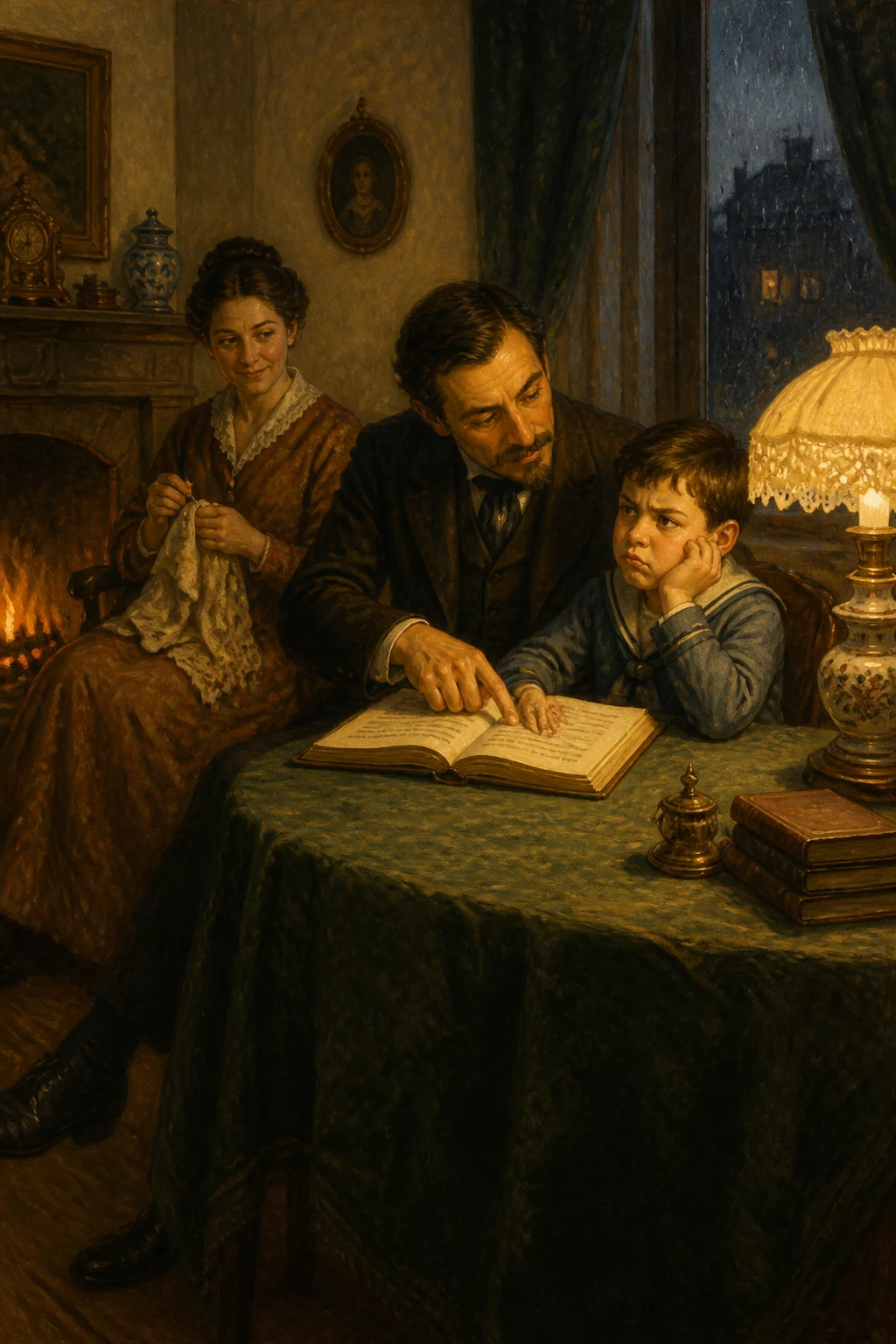
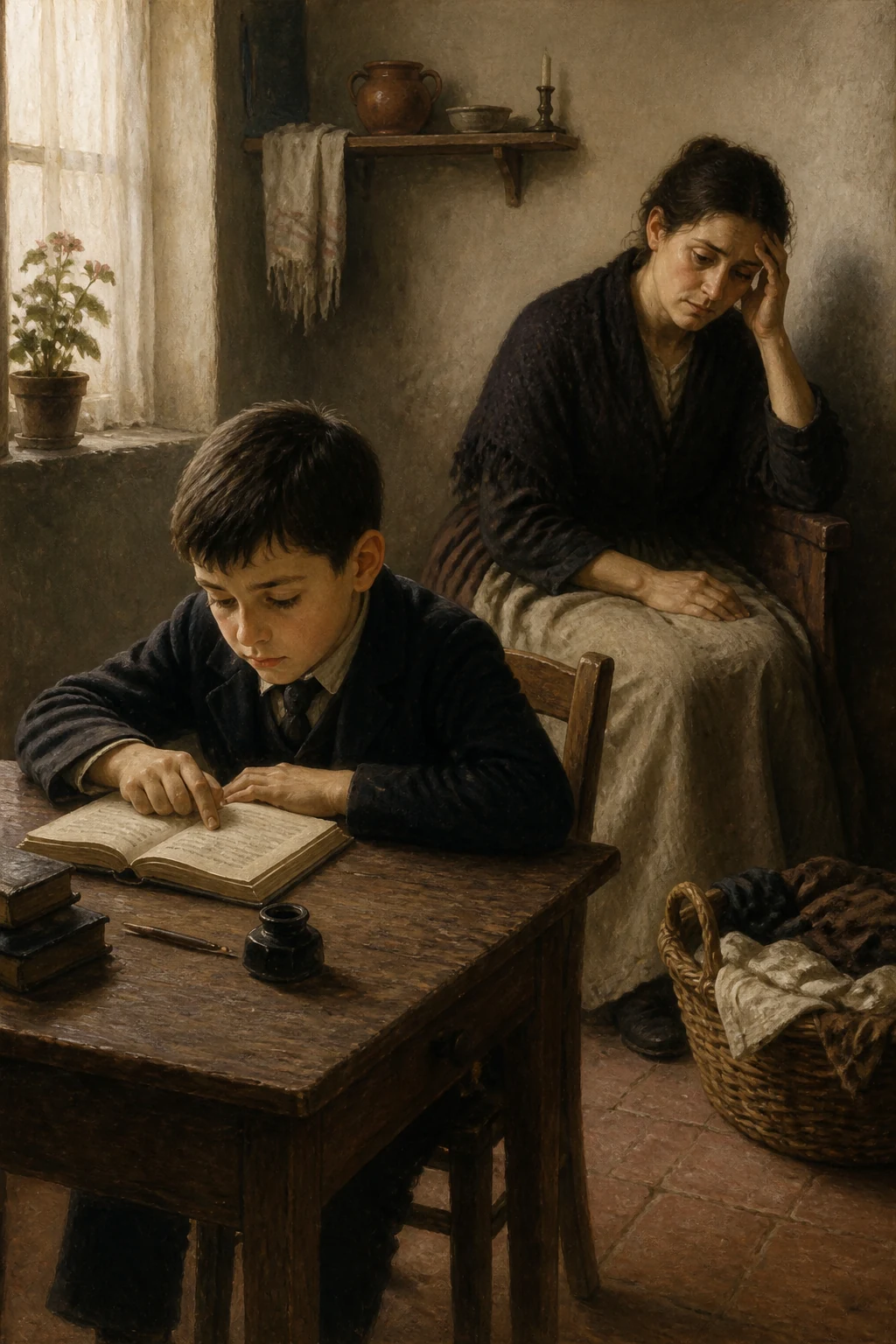
The boy is one of those delicate, precociously clever creatures who grow up in large cities, deprived of air, light, exercise, and sound, wholesome food, victims of the straitened circumstances of the middle class, sometimes needier than the poor. Always neat and clean, his hair carefully smoothed, solemn, docile, and restrained by nature, Eloy gives no trouble at home. Indeed, if he did, how would his poor mother manage to keep him in line—a widow, alone, and suffering from a chronic heart complaint? The true cause of Eloy’s good manners and conduct is precisely that ardent, early-awakened sensitivity which fear so often stirs in children: fear of making someone dearly loved suffer, of saddening a mother’s eyes, of adding to a sorrow whose depth they sense but cannot fathom.
Eloy learned his lessons word for word because his mother smiled a wan smile when she heard him recite them from memory; Eloy took great care of his clothes and shoes because he realized that his mother had no money to replace anything stained or torn; Eloy came straight home from school instead of lingering to play the rascal and get up to mischief with his companions because his mother was glad to see him return, and the little boy, with the intuition of his loving heart, sensed that Mama’s melancholy eased in his presence, and that in sending him off to learn, parting with him for long hours, she was making a sacrifice.
Yet Eloy remembered, both hazily and in minute detail, as children do, a recent time when his mother had not complained, when her life had been happy. In those days, to be sure, a young man had lived in the house, vigorous and lively, with a firm tread and black mustaches.—Papa!—Eloy associated his memory with rides on his knees or on the tip of his foot, fierce kisses on the cheeks, a pleasant smell of fine cigars, laughter and games and pranks as though he were another boy... Then... Papa disappeared, and Mama’s eyelids were always swollen and red. The house grew quiet and mournful, and Eloy felt uneasy, afraid to play or call loudly for his afternoon snack, because he felt as though he were inside a dark church or a tomb. Acquaintances he met spoke to him in pitying voices when they asked “whether there was any news of Papa, who was away at the war.” At the war! From the tone in which his mother and their friends spoke those words, Eloy understood that war was something very dreadful, atrocious, wicked. Could Papa perhaps die in the war? Ah, indeed he could! For one afternoon, on coming home from school, Eloy found his mother in a faint, the maid sobbing, and the women from the second floor taking him away and stuffing him with sweets “so he wouldn’t be upset, poor little thing...” The next day Mama sent for him, embraced him silently, without shedding a tear, and dressed him in black, all in black, from his stockings to his beret... The boy could not have defined death or explained what it was, but he was certain that it was something terrible, and that this something would forever prevent them from living happily again. He wept in secret so as not to distress his mother further, and said the prayers he knew, over and over, “for Papa’s soul.” From then on he began to study his lessons diligently, to do nothing naughty, to fold his little jacket before going to bed, to come home from school “like clockwork,” with his books strapped together under his arm. Papa’s soul surely approved of such conduct.
Still, even the most sensible boy is a boy after all, and when, in the first days of the year, Eloy heard his schoolmates guessing what the Three Kings would bring them, and making plans to leave their shoes by the window or the fireplace, he could not help letting his imagination run free. He, too, wanted the Kings to bring him something... And why shouldn’t they, pray? Hadn’t he been good the whole year long? If he put his shoe on the windowsill, would it be fair for him to find it in the morning as empty as an old hazelnut?
Fortunately, the same notion of fairness had found its way into his mother’s mind. She, who never went out, who felt herself dying on the stairs, ventured into the street on the afternoon of the fifth, wrapped in her modest, old-fashioned cloth jacket, and stopped at the toy shop. When she returned home she had a small, flat cardboard box hidden away. By forcing us to calculate, poverty destroys many a budding fancy. What would that mother not have given to bring her boy the spirited mechanical horse, the gleaming bicycle, the marvelous cinematograph, the steam locomotive with its tender and carriage, real rails, and copper boiler! But alas! Such fancies cost half an ounce of gold, ten duros, fifteen, and her purse shrank back in terror... No, no; the gift from the holy Magi, those wise and learned Kings, ought not to be something useless, but something that would help the boy’s education... And so, for a modest sum, his mother bought a geographical puzzle, nothing less than a map of Spain... In this way Eloy, as he played, would learn still better what he had already proved he knew, for he was top of his class in geography.
Rising at midnight, the fatherless boy left his shoe among the cold ashes in the sitting-room fireplace, the only one in the house, and very seldom lit. In the morning he leaped out of bed, barefoot and shivering, to see whether the Kings... An unforgettable surprise! Their Majesties had deigned to come: there lay their gift, their offering... What could be inside that little flat box, so pretty with its gilt edging?... Eloy seized it eagerly and went back to his soft, warm bed, where, with his arms out and his body snugly covered, he untied the ribbon and looked... Well, goodness! The Kings had brought him a map... Since they knew how well Eloy behaved, how he always knew his lessons... Still, a map! Pshaw!... Wouldn’t an Ariston organ have been better, or a magic lantern like Pepito Ponzano’s, which he was forever showing off under the other boys’ noses?... Eloy began to forgive the Kings when he discovered that the little map was made of pieces and could be taken apart and put together again... And once he was up and had drunk his hot coffee, while Mama was getting ready to go to Mass, Eloy amused himself assembling and dismantling the country, shuffling Spain a hundred times, mixing Zaragoza up with Valladolid and Salamanca with Vigo...
Suddenly, lost in thought, he broke off his task and anxiously questioned his mother:—Mama, they’ve cheated you... The toy isn’t complete. There’s a lot of Spain missing here. I can’t find the island of Cuba. Or Puerto Rico... There’s some of Spain missing!
His mother’s eyes filled with tears, and she stood motionless, her little veil half fastened. At last she shrugged her shoulders.—Those lands were so far away!—she said.—And they don’t belong to Spain anymore, you see... The puzzle is right, because... they don’t anymore. Your father died there...!
Eloy fell silent: a sorrow greater than his usual sorrows, immeasurable, too vast for a child’s soul to contain, weighed upon his thoughts for an instant. And with an eloquent gesture he pushed away, rejected, the gift of the Kings.
Izvirnik
016 El rompecabezas
Naslednje strani prikazujejo izvirno besedilo za primerjavo.
El niño es una de esas criaturas delicadas y precozmente listas, que se crían en las grandes poblaciones, privadas de aire, de luz, de ejercicio, de alimento sólido y sano, víctimas de las estrecheces de la clase media, más menesterosa á veces que el pueblo. Siempre limpito, con su pelo bien alisado, formal, dócil y reprimido naturalmente, Eloy no da en la casa quebraderos de cabeza. Verdad que si los diese, ¿cómo se las arreglaría para meterle en costura su infeliz mamá, viuda, sola y atacada de un padecimiento crónico al corazón? Precisamente la verdadera causa del buen porte y conducta de Eloy es esa vehemente y temprana sensibilidad que suele despertar en las criaturas el temor de hacer sufrir á un ser muy amado, de entristecer unos ojos maternales, de agravar una pena que adivinan sin poder medir su profundidad.
Eloy estudiaba las lecciones al dedillo, porque su madre sonreía con descolorida sonrisa cuando le oía recitarlas de memoria; Eloy cuidaba mucho la ropa y el calzado, porque se daba cuenta de que su madre no tenía para comprar y reponer lo manchado ó roto; Eloy se recogía á casa al salir de la escuela, en vez de quedarse pilleando y haciendo demoniuras con sus compañeros, porque su madre se alegraba al verle volver, y el chiquillo, con la intuición del corazoncito cariñoso, olfateaba que la melancolía de mamá se aliviaba con su presencia, y que al enviarle á aprender, separándose de él por largas horas, realizaba un sacrificio.
Recordaba Eloy, sin embargo, confusa y minuciosamente á la vez, como recuerdan los niños, tiempos recientes en que su madre no se quejaba, en que vivía gozosa. Es cierto que entonces un hombre joven, brioso, animado, de pisar fuerte y negros bigotes, vivía en la casa.--¡El papá!--Eloy asociaba su memoria á la de cabalgatas en las rodillas ó sobre la punta del pie, violentos besos en los carrillos, un simpático olor á cigarro fino, risas y juegos y humoradas como de otro muchacho... Después... el papá desaparecía, y la mamá tenía á toda hora los párpados hinchados y rojos. La casa se volvía callada y tristona, y Eloy sentía escrúpulos, recelos de jugar ó de pedir alto la merienda, porque le parecía estar dentro de una iglesia obscura ó de un sepulcro. Los conocidos que encontraba le hablaban en tono compasivo al preguntarle «si había noticias de papá, que estaba en la guerra» ¡En la guerra! Por el acento con que madre y amigos modulaban la frase, comprendía Eloy que la guerra era una cosa muy terrible, atroz, malísima. ¿Quizás en la guerra papá se podía morir? ¡Ah! ¡vaya si podía! Como que una tarde, al volver de la escuela, Eloy encontró a su madre con un síncope, á la criada hipando, á las vecinas del segundo que se lo llevaron y le atracaron de golosinas «para que no se impresionase, pobre pequeño...» Y al otro día mamá le reclamó, le abrazó silenciosa, sin verter una lágrima, y le vistió de negro; traje entero, desde las medias hasta la boina... El muchacho no sabía definir, no acertaría á explicar en qué consistía la muerte, pero estaba seguro de que era algo espantoso, y que ese algo les impediría ya para siempre vivir contentos. Lloró á escondidas por no afligir más á su madre, y rezó las oraciones que sabía, muchas veces, «por el alma de papá». Desde entonces empezó á empollar firme las lecciones, á no hacer nada malo, á doblar la chaquetita antes de acostarse, á volver «al reloj» de la escuela, con los libros atados bajo el brazo. El alma de papá de seguro aprobaba tal proceder.
Sin embargo, el chico más juicioso es chico al fin, y Eloy, como oyese en los primeros días del año las conjeturas de sus compañeros acerca de lo que traerían los Reyes, y los proyectos de zapatos colocados en la ventana ó la chimenea, no pudo menos de dar suelta á la imaginación. También él deseaba que los Reyes le trajesen algo... ¿Por qué no se lo habían de traer, señores? ¿No había sido bueno el año enterito? Si pusiese su zapato en el alféizar de la ventana, ¿era justo que el zapato amaneciese vano como avellana vieja?
Afortunadamente, la misma idea de equidad se había abierto camino en el espíritu de la madre de Eloy. Ella, que jamás salía, que se ponía á morir en las escaleras, se echó á la calle la tarde del 5 envuelta en su modesto coleto de paño pasado de moda, y se detuvo en la tienda de juguetes. Cuando volvió á casa llevaba escondida una cajita plana de cartón. La escasez, al imponer el cálculo, destruye muchos gérmenes de poesía. ¡Qué no hubiese dado aquella madre por traer á su niño el fogoso caballo mecánico, la reluciente bicicleta, el caprichoso cinematógrafo, la locomotiva de vapor con ténder y vagón, raíles verdaderos y caldera de cobre! Pero ¡ay! eran caprichos de media onza, diez duros, quince, y el bolsillo se encogía aterrado... No, no; convenía que el regalo de los Santos Reyes Magos sabios y doctos no fuese una inutilidad, sino que coadyuvase á la instrucción del niño... Y la madre adquirió por módico precio un rompecabezas geográfico, nada menos que el mapa de España... Así Eloy, jugando, aprendería mejor lo que ya había dado pruebas de no ignorar, pues en geografía llevaba el número uno.
Levantándose á media noche, dejó el huérfano su zapato entre la fría ceniza de la chimenea del gabinete, la única de la casa, encendida rarísima vez. Por la mañana saltó de la cama, descalzo y tiritando, á ver si los Reyes... ¡Sorpresa inolvidable! Sus majestades se habían dignado venir: allí estaba la dádiva, el obsequio... ¿Qué encerrará aquella cajita chata, tan mona con sus filetes dorados?... Eloy la cogió afanoso, se volvió á la cama blanda y tibia, y allí, con los brazos fuera y el tronco bien abrigado, desató la cinta y miró... ¡Anda, corcho! Los Reyes le habían traído un mapa... Como les constaba el comportamiento de Eloy, su costumbre de sabérsela... ¡De todos modos, un mapa! ¡Pch!... ¿No valía más un aristón ó una linterna mágica igual á la de Pepito Ponzano, que siempre la estaba refregando por las narices á los otros?... Empezó Eloy á reconciliarse con los Reyes, al averiguar que el mapita era de pedazos y se desbarataba y volvía á arreglarse... Y ya levantado, tomado el café caliente, mientras mamá se preparaba para ir á misa, Eloy se divirtió, armó y desarmó el país, barajó á España cien veces, revolviendo á Zaragoza con Valladolid y á Salamanca con Vigo...
De pronto, meditabundo, interrumpió su tarea, é interrogó inquieto á su madre:
--Mamá, te han engañado... El juguete está incompleto. Falta aquí mucha España. No encuentro la isla de Cuba. Ni á Puerto Rico... ¡Falta España!
Arrasáronse los ojos de la madre, y se quedó parada, con el velito á medio prender. Por último, encogiéndose de hombros:
--¡Esas tierras estaban tan lejos!--dijo.--Y ya no son de España, mira... Acierta el rompecabezas, porque... ya no son. ¡Allí murió tu padre...!
Eloy calló: una tristeza mayor que las habituales, desmedida, que no cabía en el alma de un niño, pesó un instante sobre su pensamiento. Y con ademán expresivo apartó, rechazó el regalo de los Reyes.
Nadaljuj z branjem