Waltey
Sedemglavi zmaj
Legende sau basmele românilor · Petre IspirescuO besedilu
Sedemglavi zmaj
- Vir
- Legende sau basmele românilor
- Avtor
- Petre Ispirescu
- Jezik branja
- English
- Jezik izvirnika
- Română
- Čas branja
- 11 min branja
- Obseg
- 9 strani
- Naslov izvirnika
- 018 Balaurul cel cu șapte capete
O izvirniku
Legende sau basmele românilor
Romunske ljudske pravljice o začaranih kraljestvih, preizkušnjah in junakih, zapisane iz ustnega izročila. Bralni jezik je English, izvirnik pa prihaja iz vira Legende sau basmele românilor v jeziku Română.
Besedilo
Sedemglavi zmaj
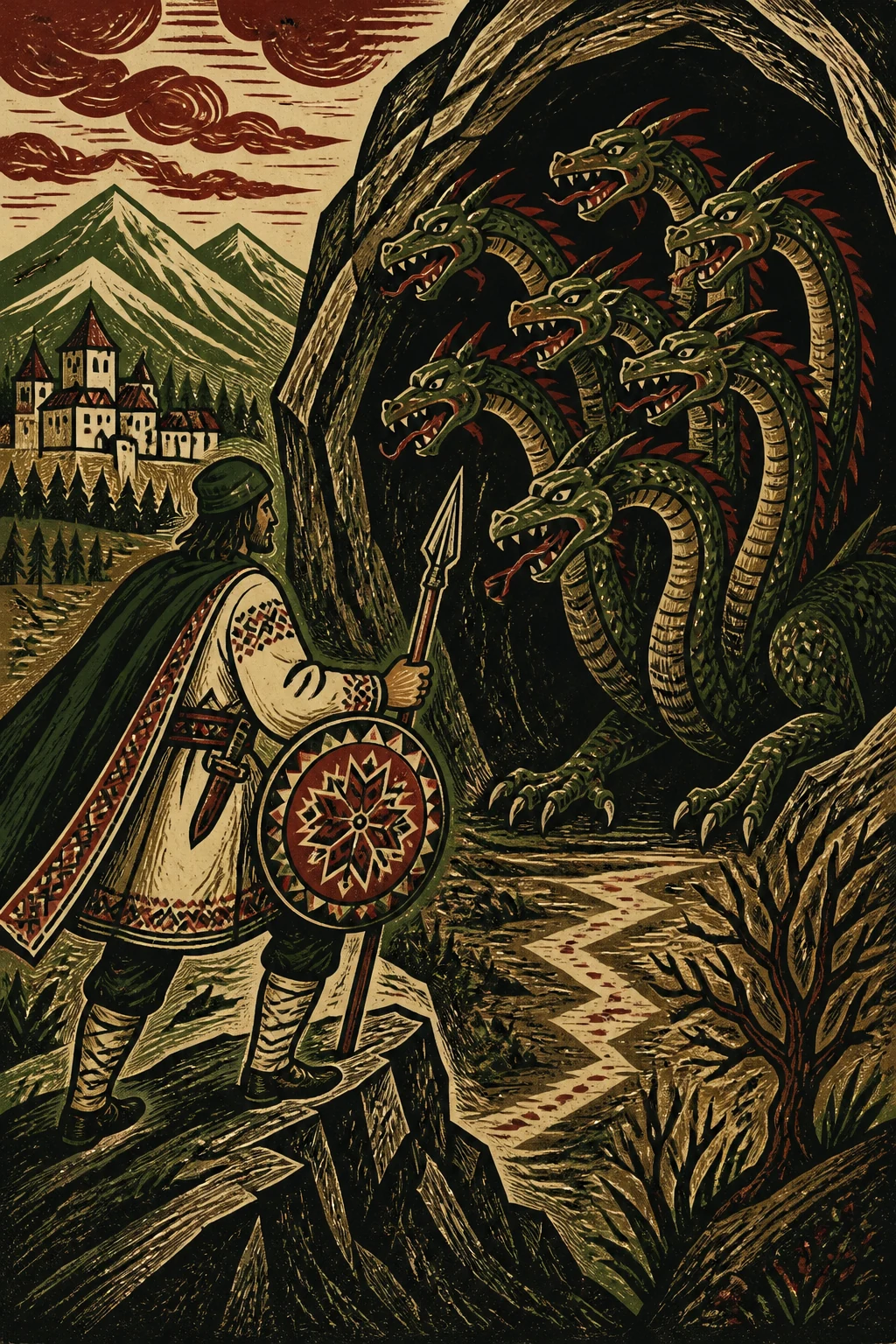
Once upon a time, as never before, and so on. There once lived in a certain land a great dragon, a dreadful monster. He had seven heads, lived in a pit, and fed on human beings alone. Whenever he came out to eat, everyone fled, shut themselves indoors, and stayed hidden until he had satisfied his hunger with some travelers whom ill fortune had brought his way. All the people of that land lamented the dragon’s cruelty and lived in terror of him. Prayers beyond counting were offered far and wide, that God might deliver poor humankind from this insatiable dragon, but all in vain. Sorcerers of every kind were brought in, and all were put to shame, spells and all. At last, when the emperor saw that nothing availed, he resolved to give his daughter in marriage, together with half his empire, to the brave man who would rid the land of this scourge, and he made his decision known to everyone. Once the news had spread through the country, several brave young men agreed to go together and lie in wait, to deliver the land from so fearsome a dragon. They decided to build a fire on the outskirts of the city nearest the dragon’s lair, which was also the seat of the empire, and to keep watch there by turns, one at a time, while the others rested. And lest the man on watch should fall asleep and the dragon come upon them like a ready-served meal, they swore that whoever let the fire go out would be put to death, as punishment for sleeping when he ought to have been awake. These brave men were joined by a stouthearted fellow, a true son of Romania, the very sort you know, who had heard of the emperor’s promise and had come to try his luck too. So they all set out, chose a place near the pit, and settled down to watch. They watched one day, they watched two, they watched several, and nothing happened. Then one day, a little after sunset, when it was our hero’s turn to keep watch, the dragon came out of his pit and headed toward the young men sleeping beside the fire. The heart of the man on watch shrank to the size of a flea, but he plucked up his courage, rushed forward, and flung himself at the dragon with his naked sword in his hand. He fought until he found his opening, and swish! off came one head; swish! off came another; and so, one by one, he cut off six heads. The dragon writhed in agony and lashed his tail so fiercely that the sight would have made you shudder with fear. Our hero, however, was fighting for his life and had grown weary, while his companions slept like logs. When he saw that they would not wake, he gathered all his strength, threw himself once more upon the dreadful dragon, and cut off its last remaining head. Then black blood poured from the foul creature, flowing and flowing until it put out the fire altogether. What was our hero to do now, so that his companions would not find the fire out when they woke? For their agreement was to kill whoever let it die. First he cut the tongues out of the dragon’s heads and tucked them inside his shirt; then, as quickly as he could, he climbed a tree and looked all around, hoping to catch a glimmer of light somewhere, so that he might go and ask for a little fire to rekindle their own. He looked this way and that, but nowhere could he see a light. He looked once more, with the greatest care, and far, far away, somewhere between earth and sky, at an unspeakable distance, he caught sight of a spark that barely flickered. Down he climbed and set off toward it. He walked and walked until he came to a forest, where he met Murgilă, the spirit of dusk, and stopped him in his tracks, to make the night last longer. Going farther, he came upon Miază-noapte, Midnight herself, and had to tie her up too, so that she would not catch up with Murgilă. What could he do, what trick could he devise to manage it? He asked her to help him hoist a tree onto his back, saying that he had cut it through at the roots. He told her to set her back against it while he, with his own back to the other side, pulled with his hands, so that it would fall onto his shoulders and he could go about his business. Miază-noapte, moved by pity and his entreaties, put her back against the tree he pointed out, and while she pushed, he bound her tightly to the trunk and hurried on, for he had no time to lose. He had not gone far when he met Zorilă, the spirit of dawn. Now Zorilă was in no mood to stand about talking, for he said he was pursuing Miază-noapte and meant to overtake her. By one means or another, our hero secured him as he had the other two, though it took far more trouble. Then he went on until he reached a great cave, where he had seen the fire. Here fresh troubles awaited him. In that cave lived some giants, each with a single eye in his forehead. He asked them for fire, but instead of giving him any, they seized him and tied him up. Then they set a cauldron of water over the flames and prepared to boil him for their supper. But just as they were about to throw him into the pot, a noise was heard not far from the cave. They all went out, leaving one of their old men to finish the task. As soon as our hero found himself alone with the old fellow, he began plotting against him. The old man untied him to put him into the cauldron, but the young man instantly snatched up a burning brand and hurled it straight into his eye, blinding him. Then, before the old fellow could utter so much as a peep, he tripped him and sent him tumbling into the pot. He took the fire he had come for, took to his heels, and escaped safe and sound. When he reached Zorilă, he set him free. Then he ran on until he came to Miază-noapte, untied her too, and went to Murgilă, whom he likewise sent about his business. When he reached his companions, they were all still asleep. You see, the first pale light of day had not yet begun to show, so long had the night been. The young man had halted its course, and thus had ample time to roam in search of the fire he needed. He had scarcely got the fire burning again when his companions woke and said, “What a long night that was, cousin!” “Long indeed, cousin,” he answered, puffing out his cheeks as he blew on the flames. They got up and began stretching and yawning, but shuddered when they saw the monstrous beast beside them and a great pool of blood spreading all around. They stared wide-eyed and, to their astonishment, noticed that the dragon’s heads were missing. Our hero said nothing of what had happened to him, for fear of stirring up envy among them, and they all returned to the city. When they arrived, everyone, young and old, was rejoicing over the dragon’s death, giving thanks to God that the long night had passed and they had lived to see daylight once again, and praising their deliverer to the skies. Our hero, who had also noticed the missing heads, was not troubled in the least, for he knew his conscience was clear. He made his way to the imperial court to see what would come of those tongueless heads, having guessed that some devilry must be afoot. As it happened, the emperor’s cook, a black-skinned, thick-lipped Gypsy, had gone out on the off chance of seeing how the young men keeping watch were getting along. Finding them asleep and the foul beast lying dead, he had at once set to work with his kitchen cleaver and chopped off its heads. Then he had carried them to the emperor and displayed them, boasting that he was the one who had done the mighty deed.
When the emperor saw his cook appear with these trophies of victory, he ordered a great feast to celebrate his betrothal to his daughter, and planned a wedding to which he would invite all the emperors. The Gypsy showed everyone his clothes, which he had drenched in blood to make his story believable. When our hero arrived at the palace, the emperor was sitting at table with his guests, in high spirits, while the scoundrel occupied the place of honor, perched on seven cushions. Approaching the emperor, the young man said, “Most exalted emperor, I have heard that someone has boasted to Your Majesty that he killed the dragon. It is not true, Your Majesty. I am the one who slew him.” “You lie, you lout!” shouted the swaggering Gypsy, ordering the servants to throw him out. But the emperor, who could not quite believe the Gypsy had performed such a feat, said, “What proof have you of your words, brave young man?” “My words,” replied the hero, “can readily be proved. Only command that someone first examine the dragon’s heads displayed over there and see whether they still have their tongues.” “Let them look, let them look,” said the scoundrel. He was beginning to lose his nerve, though he pretended not to care. They searched, and found no tongue in any of the heads. The guests sat dumbfounded, wondering what this could mean. The Gypsy, who was now utterly dismayed and regretted not having looked inside the heads’ mouths before bringing them to the emperor, shouted, “Throw him out! He’s a madman and doesn’t know what he’s saying!” But the emperor said, “So, young man, you mean us to understand that whoever can produce the tongues is the one who killed the dragon?” “Come now, emperor,” said the Gypsy, trembling like a leaf and turning yellow as wax, “can’t you see this beggar is a half-wit who has come here to deceive us?” “Let whoever is deceiving you be punished,” the young man answered calmly. Then he began taking the tongues from inside his shirt and showing them to the whole gathering. With every tongue he displayed, a cushion fell from beneath the Gypsy, until at last he himself fell from his chair, so terrified had the wretch become. Then our hero told everything that had happened to him, and how he had managed to hold back the night for so long. It took the emperor little thought to see that the young man was speaking the truth. Furious with the Gypsy for his villainy and shameless lies, he gave an order, and two unbroken horses and two sacks of walnuts were brought at once. He had the Gypsy and the sacks of walnuts tied to the horses’ tails, and let them loose. Away they galloped through the marshes, and wherever a walnut fell, a little piece of the Gypsy fell too, until both he and the walnuts were scattered far and wide. Afterward, when all the preparations had been made, a great wedding was held a few days later. Our Romanian lad took the emperor’s daughter as his wife, and there was such merry celebration as had never been seen, lasting several weeks; he was also placed upon the imperial throne. The maiden wept and thanked God for saving her from that hideous creature, that foul black wretch. I was there too, helping at the wedding, carrying water in a sieve; and at the end of the feast they brought a basket of dried plums to toss into all the gaping mouths. Then I mounted a saddle, and so on.
Izvirnik
018 Balaurul cel cu șapte capete
Naslednje strani prikazujejo izvirno besedilo za primerjavo.
fostit odata ca nici °data; etc. A fosta o data intr'o tera unti balaura mare, nevoe de capti. Elu avea sepLe capete, traia lntr'o grOpa, si se hranea numal cu Omeni. Gaud esea elu la mancare, Vita lumea fugea, se inchidea in case si stl ascunsa pans ce-si potolea 16 mea cu vre-unii drumetil pe care flu tragea ata la mode. Tot): Omenii locului se tanguiati de reutatea si de frica balaurului. Rugaciuni si cate in lung si in sore se fa'cusera, ca ca scape Dumnecleti pe biata omenire de acesta nesafiosii balauril, darn in dpserta Felt' de felt' de fermecatori fusers adusi, tug remasera rusinati cu vrajele loru cu tota. In cele de pe urma, data veclu imp6ratulti ca tote suntfi in desertii, hotari ca sä dea pe fiica lui de sotie si jumatate imperatia sa acelui voinica; care va scapa fere de acesta urgie, si dete in scire la tots lumea hotararea sa. Ears dupa ce se duse vestea in Ord, mai multi voiniel se vorbird sa merga impreuna la panda si sa mantuiasca fera de unii asa balauril infricosatil. El se infelesera intre (Musa ca sa faca una focil la marginea cetatii, care era mai apropiata de local unde traia balaurula, si in care cetate era si scaunula imperatiei, si acolo sa stea sa privegheze pe rancid ate unulti, pe canda cei- lalli sa se odihnesca ; si ca nu care cumva cela ce fi de panda sa dOrma, si sa vie balaurula samanance d'a gata, Newt' legatura ca cela care va lasa sa se unuld, aru
stings foculd, sa fie omoritil, dreptu pedepsa, data va dormi cand aril trebui sa fie desteptil. Cu acesti voinici se intovarasi si und omii verde, puid de Romani', scii colea, care audise de fagaduinta Imperatului si venise sa-si incerce si elu noroculiz. Pornira, deci, cu top, t i alesera und loci' aprope de gropa, si se pusera la panda. Pandira o di, pandira doue, pandira mai multe si nu se intampla aimicu. Ears cand intr'una din Mile, cam dupa sfintituld sorelui, pe cand era de rand vitezuld nostru sa pandesca, esi balauruld diu grOpa 0 se Indrepta calve voinicii cari dormeaii pe langa Vitezului care priveghia, i se facu inima catii und purice, darn, imbarbatandu-se, se repedi, si unde se arunca, mare asupra balaurului cu sabia gela In mans, si se lupta cu densulil, pans ii veni bine, si hirst ! ii taie und capd, bust ! si-I tale unulii, si asa cate unuld, cite unuld, pana taie sese capete. Balauruld se svarcolea de durere si plesnea din coda, de to lua ilori de spaima ; vitezuld nostru Insa se lupta de mOrte si obosise ; era tovarasii sei dormeail dust. Pack' vedu eld ca tovarkii sei nu se destepta, puse tote puterile, se mai arunca o data asupra grozavului balauril tale si capuld ce-i mai ramasese. Atunci und singe negru lass din ea, flail spurcata, si curse, si curse, pins ce stinse si fool si tutu. Acura ce sa faca vitezuld nostru, ca sa nu gasesca foculd cand s'ord destepta tovarkii lui ; cad legatura le era ca sa om6re pe acela care va rasa sa se stings foculd. S'apuca mai intaid si scose limbile din capetele balaurului, le bag,s in sine si iute, cum putu, se sui intr'unit copaciii si se uita in tote partite, ca de va vedea unde-va vr'o Aare de lumina, sa se clued si sa corn nitelu foci', ca sa atile 0 elf" pe aid lord, ce se stinsese. Cats lute° parte si intr'alta si nu vedu nicairI lumina. Se uita °data cu mare bagare de soma si ;Uri intr'o deparclile, toed. mai 1s1 Mind, mai pi-I fnaltd,
tare nespusa o scbintee ce abia licaria. Atunci se dete josii si o porni inteacolo. Se duse, se duse, pand ce dete de o pddure, in care intalni -pe Murgild, si pe care ilii opri in loci', ca O. mai inta'rdie nOptea. Merle dupd aceea mai departe si dete peste MiadanOptea, si trebui sal o lege si pe densa ca sal nu dea peste Murgild. Ce sal faca, cum O. drega ca sal isbutesca ? 0 rugs sal -i ajute a lua unu copacid in spinare, care, dicea 61, ilu taiase de la radacind: o inveta elu sal se pus cu spatele sit pe cAnd eld totii cu spatele la copacIti de ceea-l-altd parte va trage cu mainile, ca sal -I pice in spinare, si is sal se ducal la treba lui. Miadd-nOpte, de mild si de rugAciunea ce-i fAcu, se puse cu spatele la copaciuld care 1-111 ardid vitezulii, si pe cAnd impingea, eld o legs de copaciii, cobzd, si porni inaintea, ca n'ayea vreme de perdutd. Nu facu multi tale si intalni pe porn& ; dart lui Porild nu prea ii da mesii a sta multi de vorbA, cfici, dicea &A se duce dupd Miada-nopte, pe care o luase in gong. Facu ce fAcu puse si pe densuld la bunt rAnduiald, ca si pe cei-l-alri doui, dar cu mai mare batae de capti. Apoi plea inainte si se duse pant ce ajunse la o pesterd mare, in care ddrise foculd. Aci dete peste alte nevoi. In pesters acolo traiau nisce (5meni uriasi carii avead numai eke und °chid in frunte. Ceru foci' de la densii, dar ei in loci]. de foci', puserd mina pe densuld legard. Dupa aceea asedard si und cazanii pe foci' cu apA si se gateau sal -lii ferbd ca manance. Dart tocmal cand era sal -ld arunce in cdIdare, und sgomotu se audi nu departe de pestera aceea ; toli esird, si Ward pe unit betrAnu de ai lord ca sal fact asta treba. Cum se vedu vitezuld nostru singurd numal cu unchiasuld, II puse gandd red. Unchiasuld fit deslegd ca sal -1i' bage in Ca- .zand ; dart voiniculd indatd puse !liana pe und taciune asvirli dreptti in ocbiuld betranului, flu orbi, si apoi Lard sal -1 dea -ragazil a dice nici care I II puse o piedeca facu vintd in cazanii. impinge, sa-ld §1-111 sa-ld §i-ld ei-M ei-1
Lua foculu dupa care venise, o apuca la sanatosa, si scap& cu fala curata. Ajungend la Vorila, 11 dete drumulii. Dupd aceea o tuli la fug& si fugi pins ce ajunse 1a Miacla-nopte, o deslega si pe (Musa,. si apoi se duse si la Murgila pe care flu trimise vaclA de treba. Cand ajunse la tovarasii sei, ei tad mai dormeati. Nu incepuse, vecli, 'Inca a se areta albulii clilei, atatti de lungs fu noptea, Voiniculti ti oprise cursulii, si asa avu timpti destulti sa colinde dupa foculti care ii trebuia. N'apuca sa ate foculti bine, si tovarasii sei desteptandu-se clisera : Dara lungs nopte fu asta, mei, vere. Lunga da, vericule, respunse *i se umfla din fele ca sa aprincla focull Ei se sculara, apol incepura a se 'ntinde si a cassea; dna. se cutremurara cand veclura namila de lighiona langa densii si unit' lacti de sange eatti pe colo. Sgaira ochii si cu mare mirare laggard de sena ca capetele balaurului lipsescu ; era vitezulii nu le spune nimicti din cele ce pafise, de tem& sa nu intre ura intre densii, si se intorserd cu top In orasti. Cand ajunsera in cetate, UFO lumea se veselea cu micil cu mare de uciderea balaurului, da lauds sfantului ea trecuse noptea aia Lunga, mai ajunsera odata era la clioa si ridica pird in cerului pe mantuitorulil Vitezulti nostru, care \recluse si elu lipsa capetelorti, nu se framanta de locil cu firea, fiindu ea se scia curatti la inima, si porni catre curtea imperatesca, ca sa vacla ce s'o alege cu capetele fara limbi ; cad elu intelesese ca aici trebue sa se jocevre-o dracie. Pasami-te, bucatarulii Imperatului, unu figanti negru si buzatti, se dusese d'a minune sa vacla ce mai ala, bala, pe la Recall ce stair de panda. Si daca dete peste densii dormindii .si peste dihania spurcata fara rasuflare, OA se arunea cu satArul. de la bucatarie si-i taie capetele. Apoi merse la imperatulii en capetele si i le arata, falindu-se ca elil a facutu isbanda. sail flindri-ca vitezulti. 'naltulii lore.
Fara imperatulti dna velu ca se Infatiseza bucatarulit curet cu isbanda, facu o masa mare, ca logodesca cu fie-sa, si pusese in gandti sa faca o nunta, unde sä theme pe top fmperati I. Tiganulti arata la tots lumea hainele sale pe care le urnplusese de sange, ca sä fie creclutti. Gand ajunse vitezulti nostru la palatti, imperatulft cu mesei voie luna sedea la masa ; era cioropina sea in capulti pe septe perne. Cum ajunse la imperatulti, fi Vise voiniculti Prea inallate imperate, mil auclitti ca ore -tine s'ard fi laudatti catre Maria Ta ca elu arit fi ucisti pe balaurti. Nu e adeveratil, Maria Ta, eti snafu care fame omoritti. Minp, mojicule, striga tiganuld inga mfatii. Si poruncea slujitoriloril dea afara. Imperatulii, care nu prea credea sa fie facutti figanulti asta voinicie, Vise : Cu ce pop dovedi Visele tale, volnicule? Pisele mele, respunse vitezulti, se potil dovedi prea bine; poruncip numal ca mai intaifi sa se caute data capetele balaurultiI, care sfaCt colea la iveld, aft si limbile SA caute, sa caute, Vise bahnita. Insa o cam bagase pe manta, dara ce prefacea ca nu -i pas& Atunci cautara, si la nici unulti din capete nu gasira limbs; era mesenii Inmarmurira, cad ce va sa Vica asta. Tiganulti, care o sfeclise de tote, si care se caia de ce n'a cautatu capetele in gura, mai nainte de a Le aduce la imperatulti, striga Dafi-lft afara ca e unit smintitu si nu scie ce vorbesce. Imperatultt insa Vise : Tu, voinicule, va sa Vica ne dal sä intelegemti ca acela_ a omoritti pe balaurti care va arata limbile. Fugi d'acolo, imperate, Vise liganulu care tremura ca varga si se 'ngalbenise ca cera, nu veVI ca caliculii asta este unt. desuchiatil, care a venitil aid sa ne amagesca? as -ld sa-id lord. Eli
20i Gine amagesce, respunse voiniculii lini;titil, sAlI is peclepsa. Elii incepu apoi a suite limbile din dna ;i a le areta la tot& -adunarea, ;i de Cate on arata cate o limbs, de atatea on cadea ;i cate o perna de sub liganti, pang ce, in cele din urma, caclu -0 elil de pe scaunti, atatti de tare se speriase dihania. Dupa aceea voiniculti nostru spuse tote cite a WW1, ;i cum a iambi de a finutti neptea atatil de multil timpti. Nu-i trebui imp6ratulti sA se gandesca multti ;i sa vaclA cA voiniculti care vorbia avea dreptate ; ;i cum. era de superat4 pe 4iganti pentru mi;elia ;i minciuna lui cea neru;inata, porunci, ;i numai de atu se aduse doui cal neinvelafi ;i duoi sad de nuci ; legs pe liganil de cOdele cailorti ;i sacii de nuci .;i le dete drumulti. El o War/ la NO prin smarcuri ; ;i unde cadea nuca, cadea vi bucafica, pans ce s'a prapaditil 0 liganti ;i. tail. In urmapregatindu-se lucruri le, dupa cate-va Pe facu nunt6 mare, ;i lug Rot-Annul:a nostru pe fata imperatului de sofie, -;i tinu veselie mare ;i nepomenitA mai multe s6ptemani, puindu-lti ;i in scaunulil imperatiei ; era fata lacramh ;i mullumi lui Dumnecleil ca a scapat'o de slutenia pamealului, de harapina spurcatA. Eramil ;i ell p'acolo ;i.dedeamil ajutorti la nunta, unde ca- Tamil apal cu ciurulti, era la sfar;itulti nunteI adusera unit' co;ii de prune uscate sA arunce in ale guri cascate. incalecaiii p'o ;ea, etc
Nadaljuj z branjem