Waltey
Ugrabitev Prozerpine in Cererino iskanje
Ovidove preobrazbe · OvidO besedilu
Ugrabitev Prozerpine in Cererino iskanje
- Vir
- Ovidove preobrazbe
- Avtor
- Ovid
- Jezik branja
- English
- Jezik izvirnika
- Latin
- Čas branja
- 10 min branja
- Obseg
- 8 strani
- Naslov izvirnika
- Proserpina and the Search of Ceres
O izvirniku
Ovidove preobrazbe
Pesniški tok antičnih preobrazb, kjer bogovi, ljudje in narava stalno menjavajo obliko. Bralni jezik je English, izvirnik pa prihaja iz vira Ovidove preobrazbe v jeziku Latin.
Besedilo
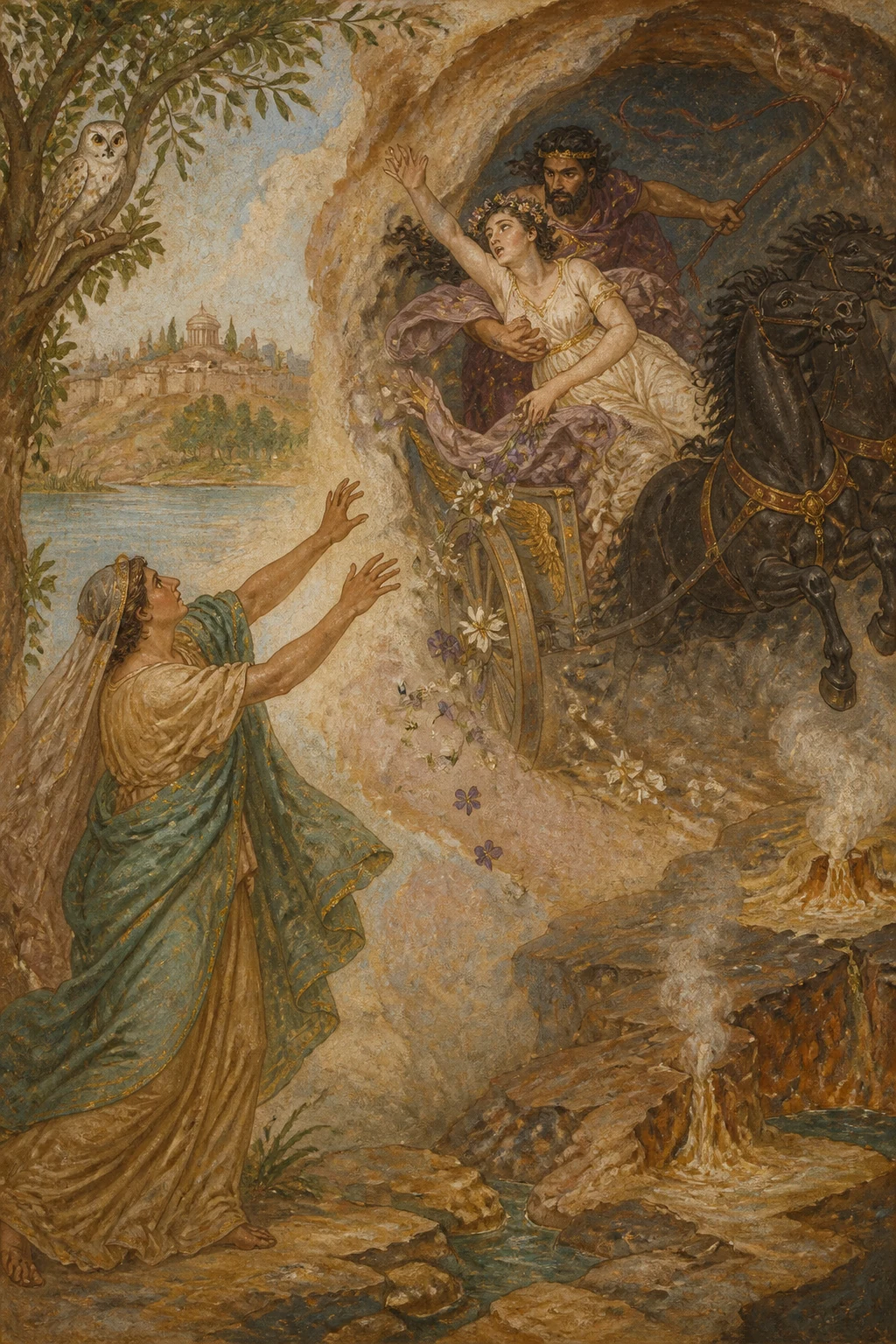
Ugrabitev Prozerpine in Cererino iskanje
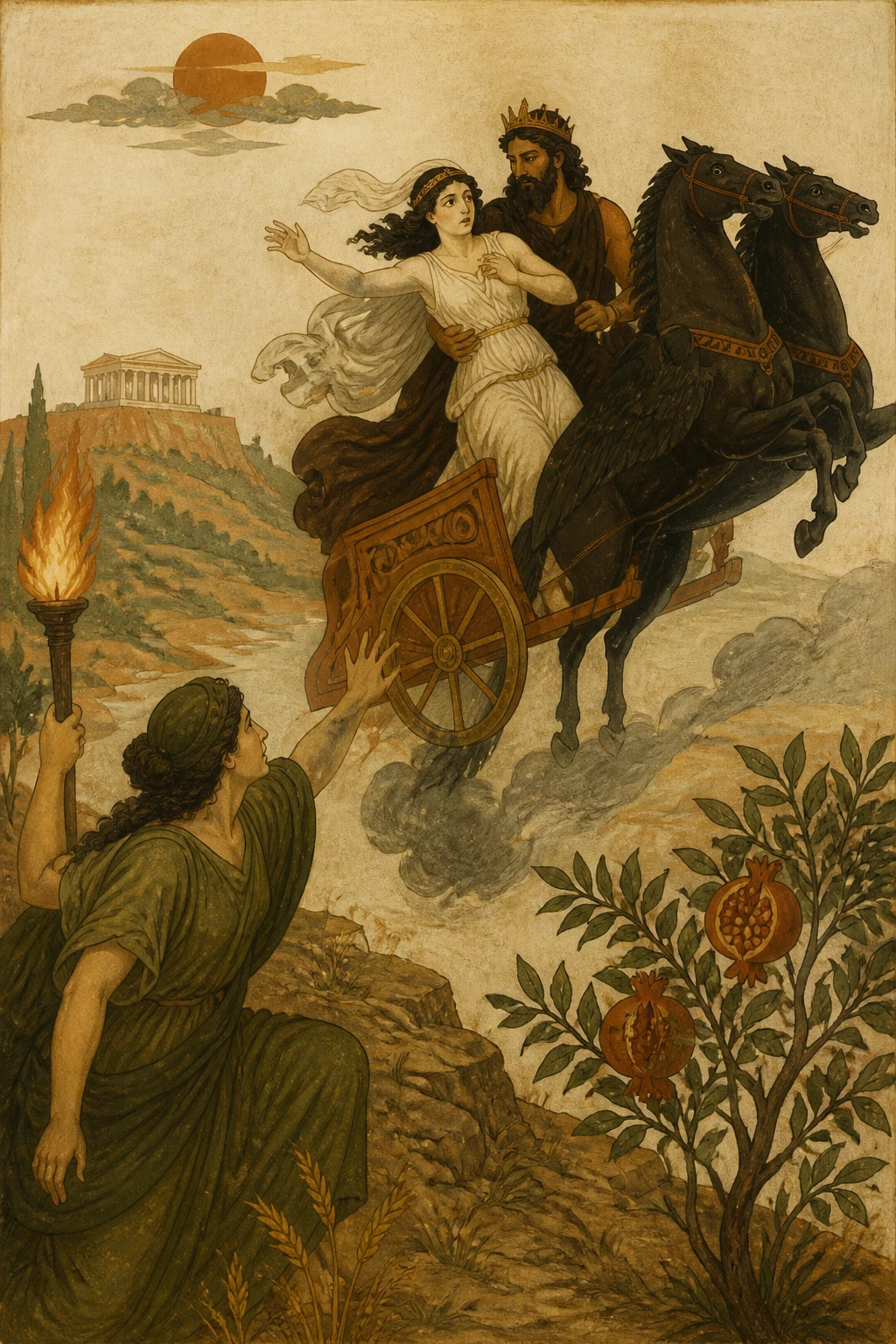
Not far from the walls of lofty Henna lies a lake, Pergus by name. Not even Cayster hears more songs of swans upon its gliding waters. A forest crowns the lake, encircling every shore, and with its leaves, like a veil, keeps out Phoebus’ rays. The branches offer coolness, the moist earth Tyrian-purple flowers: spring reigns forever. While Proserpina played in this grove, gathering violets or white lilies, and with a young girl’s eagerness filled her baskets and the folds of her dress, striving to outdo her companions in gathering, Dis saw her, loved her, and carried her away almost at once: so headlong was his love. The terrified goddess, with mournful
cries, called to her mother and her companions, but to her mother most often; and, as she had torn her dress at its upper edge, the gathered flowers fell from its loosened folds. Such was the innocence of her tender years that even this loss stirred grief in her maiden heart. Her abductor drove his chariot, calling each horse by name to urge it on, and over their necks and manes shook the reins, stained dark as rust.
He sped past deep lakes and the sulphurous pools of the Palici, seething through the broken earth, and past the place where the Bacchiadae, a people sprung from Corinth between two seas, built their walls between unequal harbors. Between Cyane and Arethusa of Pisa lies a stretch of water, narrowed between enclosing headlands. Here lived Cyane, from whom the pool itself took its name, the most renowned among the nymphs of Sicily.
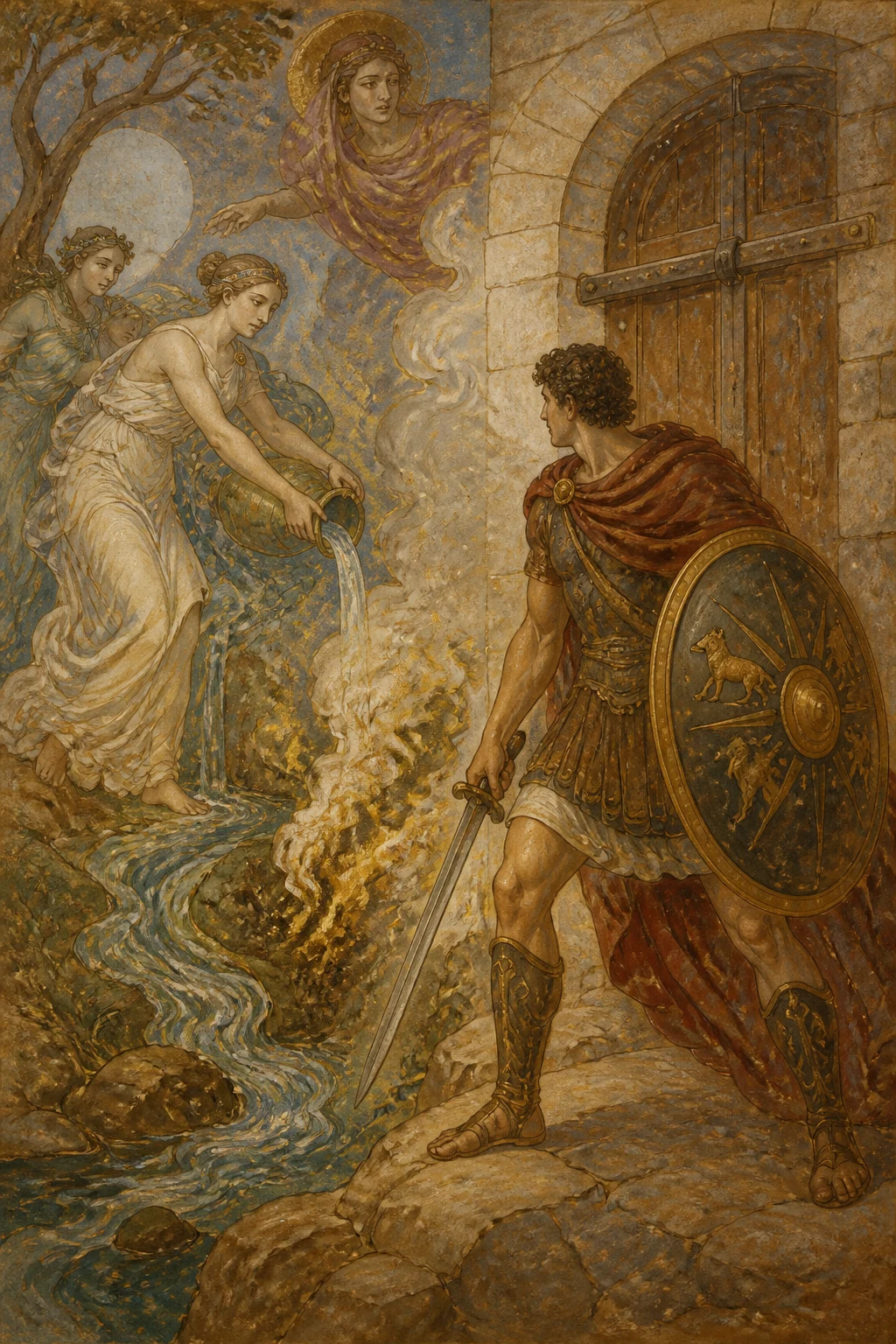
She rose waist-high from the midst of the waters and recognized the goddess. “You shall go no farther!” she said. “You cannot become Ceres’ son-in-law against her will: the girl should have been courted, not abducted. And if I may compare small things with great, Anapis loved me too; yet I was won by pleading, not frightened into marriage like her.” She spoke and stretched her arms out on either side, barring his way. Saturn’s son could no longer restrain his anger: urging on his fearsome horses, into the depths of the pool he hurled his royal scepter with his mighty arm and drove it home. The stricken earth opened a path to Tartarus and through the gaping crater swallowed the plunging chariot.
But Cyane, grieving for the stolen goddess and the violated sanctity of her spring, bore an inconsolable wound in her silent heart and dissolved entirely into tears, into those waters over which she had so lately been a mighty deity. You could see her bones grow pliant, her nails lose their hardness; she dwindled into water, her limbs softening, and first the slenderest parts of her whole body melted: her blue-green hair, her fingers, her legs and feet.
For slight is the passage from slender limbs into cool water. Then her shoulders, her back, her sides, and her breast vanished, flowing away in slender streams. At last, instead of living blood, water entered her altered veins, and nothing remained that hands could grasp. Meanwhile, the frightened mother searched in vain for her daughter through every land and over every sea.
Neither Dawn, arriving with dew-wet hair, nor Hesperus saw her resting. With both hands she kindled pine torches at Aetna’s fires and carried them unresting through the frosty darkness. Again, when kindly daylight dimmed the stars, she sought her child from the setting of the sun to its rising. Weary with toil, she had grown thirsty, and no spring had moistened her lips, when she happened to see a thatched cottage and knocked at its little door. An old woman came out, saw the goddess, and, when she asked for water, gave her a sweet drink sprinkled with toasted barley meal.
While she drank what she had been given, a bold, impudent boy stood before the goddess, laughed, and called her greedy. She took offense, and, before she had drunk it all, the goddess drenched him as he spoke with the barley meal mixed in the drink. His face absorbed its spots, and where he had borne arms he bore legs; a tail was added to his altered limbs. And lest he have much power to do harm, his body shrank to a tiny shape, smaller than a little lizard.
As the old woman marveled and wept and tried to touch the strange creature, he fled from her and sought a hiding place. He bears a name suited to his coloring, his body starred with speckled drops. Through what lands and over what waters the goddess wandered would take too long to tell: the world itself was too small for her search. She returned to Sicily, and, searching everywhere as she went, came at last to Cyane. Had the nymph not been transformed, she would have told her everything; but though she longed to speak, she had neither mouth nor tongue, no means of utterance.
Yet she gave a clear sign, showing the mother on the surface of her waters Persephone’s familiar girdle, which had happened to fall there into the sacred pool. As soon as the goddess recognized it, as though only then had she learned of the abduction, she tore her unadorned hair and struck her breast again and again with her hands. She still did not know where her daughter was; yet she reproached all lands, calling them ungrateful and unworthy of the gift of grain, and Trinacria above all, where she had found the traces of her loss. There, with cruel hands, she broke the plows that turned the clods, and in her anger dealt the same death to farmers and their laboring oxen. She ordered the fields
to betray the seed entrusted to them and blighted what was sown. The land’s fertility, famed throughout the wide world, proved false: the crops died as soon as their first shoots rose, and now excessive sun, now excessive rain destroyed them; stars and winds brought harm, and ravenous birds picked up the scattered seeds; darnel, thistles, and indomitable grass choked the harvests of wheat.
Then Alpheus’ beloved raised her head from her Elean waters, brushed her dripping hair back from her forehead to her ears, and said: “Mother of the maiden sought throughout the world, and mother of the crops, cease your boundless labors, and do not rage so fiercely at a land faithful to you. The earth has done no wrong: unwillingly it opened to the abductor. Nor do I plead for my native country: I came here as a stranger.
Pisa is my home, and from Elis I trace my birth. I dwell in Sicily as a foreigner, yet this land is dearer to me than any other. Here I, Arethusa, now have my home, here my dwelling: spare it, most gentle goddess. Why I left my native place and journeyed over so vast a sea to Ortygia—a fitting time will come to tell my story, when you are relieved of care and wear a happier face. The earth opens a path for me, and, borne beneath its deepest caverns, I lift my head here and behold stars long unfamiliar.
So, while I glided beneath the earth through Stygian waters, there I saw your Proserpina with my own eyes. She was sad indeed, and fear had not yet left her face, but she was a queen nevertheless, the greatest in that shadowy world, the powerful consort of the lord of the underworld.” At these words the mother stood stunned, as though turned to stone, and remained for a long time like one struck senseless. Then, when grief’s heavy weight drove out her deep stupor, she rose in her chariot to the realms of heaven. There, her whole face clouded, her hair disheveled, she stood before Jupiter in bitter reproach.
“I come to plead with you, Jupiter,” she said, “for my own flesh and blood, and yours. If the mother finds no favor, let the daughter move her father; and, I beg you, do not care less for her because it was I who gave her birth. See, after long searching I have at last found my daughter— if you call a surer loss a finding, or if knowing where she is means finding her. I will bear her abduction, provided he gives her back. For your daughter deserves no robber for a husband, even if she is no longer mine.”
Jupiter replied: “Our daughter is a bond and a care shared equally by you and me. But if we choose to call things by their true names, this deed is not an outrage, but love. Nor will such a son-in-law disgrace us, goddess, if only you consent. Though all else were lacking, how much it means to be Jupiter’s brother! Yet all else is not lacking, and only the drawing of lots placed him below me. Still, if your desire to part them is so great, Proserpina shall return to heaven, but on this fixed condition: that she has touched no food there with her lips. So the Fates have decreed.”
He had spoken. But Ceres was resolved to bring her daughter out. The Fates would not allow it, for the maiden had broken her fast: while wandering innocently through the tended gardens, she had plucked a pomegranate from a bending tree and, taking seven seeds from its pale rind, had pressed them in her mouth. Of them all, only Ascalaphus had seen it—he whom Orphne, they say, a nymph by no means unknown among the nymphs of Avernus, once bore to her own Acheron beneath the dark woods.
He saw, and cruelly robbed her of her return by telling. The queen of Erebus groaned and changed the witness into an ill-omened bird. Sprinkling his head with water from Phlegethon, she transformed it into a beak, feathers, and enormous eyes. Robbed of himself, he was clothed in tawny wings; his head swelled, his long nails curved into talons, and he could scarcely stir the feathers grown along his sluggish arms.
He became a loathsome bird, the herald of approaching sorrow, a torpid eagle owl, a dreadful omen to mortals. Yet he may seem to have deserved his punishment for his tale-bearing tongue. But you, daughters of Achelous—why have you feathers and birds’ feet, though you keep the faces of maidens? Was it because, when Proserpina gathered spring flowers, you, melodious Sirens, were among her companions?
After you had sought her in vain throughout the world, so that the seas too might know your anxious search, you prayed to hover above the waves on the oar strokes of wings. The gods were willing, and you saw your limbs suddenly grow golden with feathers. Yet lest that song, born to soothe the ear, and your mouths’ great gift should lose the use of speech, your maiden faces and your human voices remained.
But Jupiter, mediating between his brother and his grieving sister, divided the revolving year into equal portions. Now the goddess, a divinity shared by two kingdoms, spends as many months with her mother as with her husband. At once her spirit and her countenance were transformed: for she who only lately might have seemed sorrowful even to Dis now wore a radiant face, like the sun that, hidden before behind rain-laden clouds, breaks through and shines again.
Izvirnik
Proserpina and the Search of Ceres
Naslednje strani prikazujejo izvirno besedilo za primerjavo.
Source ID: ovid_metamorphoses_story_036 Citation: Ovid, Metamorphoses 5.385-5.571 Original language: Latin Source: PerseusDL canonical-latinLit Source URL: https://github.com/PerseusDL/canonical-latinLit/blob/master/data/phi0959/phi006/phi0959.phi006.perseus-lat2.xml Segmentation certainty: medium 385: Haud procul Hennaeis lacus est a moenibus altae, 386: nomine Pergus, aquae. Non illo plura Caystros 387: carmina cycnorum labentibus audit in undis.
388: Silva coronat aquas cingens latus omne, suisque 389: frondibus ut velo Phoebeos submovet ictus. 390: Frigora dant rami, tyrios humus umida flores: 391: perpetuum ver est. Quo dum Proserpina luco 392: ludit et aut violas aut candida lilia carpit, 393: dumque puellari studio calathosque sinumque 394: implet et aequales certat superare legendo, 395: paene simul visa est dilectaque raptaque Diti: 396: usque adeo est properatus amor. Dea territa maesto 397: et matrem et comites, sed matrem saepius, ore 398: clamat; et, ut summa vestem laniarat ab ora, 399: conlecti flores tunicis cecidere remissis.
400: Tantaque simplicitas puerilibus adfuit annis, 401: haec quoque virgineum movit iactura dolorem. 402: Raptor agit currus et nomine quemque vocando 403: exhortatur equos, quorum per colla iubasque 404: excutit obscura tinctas ferrugine habenas, 405: perque lacus altos et olentia sulphure fertur 406: stagna Palicorum, rupta fervenu terra, 407: et qua Bacchiadae, bimari gens orta Corintho, 408: inter inaequales posuerunt moenia portus.
409: Est medium Cyanes et Pisaeae Arethusae, 410: quod coit angustis inclusum cornibus aequor. 411: Hic fuit, a cuius stagnum quoque nomine dictum est, 412: inter Sicelidas Cyane celeberrima nymphas. 413: Gurgite quae medio summa tenus exstitit alvo 414: agnovitque deam. “Nec longius ibitis!” inquit, 415: “non potes invitae Cereris gener esse: roganda, 416: non rapienda fuit. Quodsi componere magnis 417: parva mihi fas est, et me dilexit Anapis: 418: exorata tamen, nec, ut haec, exterrita nupsi.”
419: Dixit et in partes diversas bracchia tendens 420: obstitit. Haud ultra tenuit Saturnius iram, 421: terribilesque hortatus equos in gurgitis ima 422: contortum valido sceptrum regale lacerto 423: condidit. Icta viam tellus in Tartara fecit 424: et pronos currus medio cratere recepit. 425: At Cyane, raptamque deam contemptaque fontis 426: iura sui maerens, inconsolabile vulnus 427: mente gerit tacita lacrimisque absumitur omnis, 428: et quarum fuerat magnum modo numen, in illas 429: ossa pati flexus, ungues posuisse rigorem; 430: extenuatur aquas. Molliri membra videres,
431: primaque de tota tenuissima quaeque liquescunt, 432: caerulei crines digitique et crura pedesque: 433: nam brevis in gelidas membris exilibus undas 434: transitus est: post haec umeri tergusque latusque 435: pectoraque in tenues abeunt evanida rivos. 436: Denique pro vivo vitiatas sanguine venas 437: lympha subit, restatque nihil, quod prendere possis. 438: Interea pavidae nequiquam filia matri 439: omnibus est terris, omni quaesita profundo.
440: Illam non udis veniens Aurora capillis 441: cessantem vidit, non Hesperus. Illa duabus 442: flammiferas pinus manibus succendit ab Aetna 443: perque pruinosas tulit inrequieta tenebras. 444: Rursus ubi alma dies hebetarat sidera, natam 445: solis ab occasu solis quaerebat ad ortus. 446: Fessa labore sitim conlegerat oraque nulli 447: colluerant fontes; cum tectam stramine vidit 448: forte casam parvasque fores pulsavit: at inde 449: prodit anus divamque videt, lymphamque roganti 450: dulce dedit, tosta quod texerat ante polenta.
451: Dum bibit illa datum, duri puer oris et audax 452: constitit ante deam risitque avidamque vocavit. 453: Offensa est neque adhuc epota parte loquentem 454: cum liquido mixta perfudit diva polenta. 455: Combibit os maculas, et quae modo bracchia gessit, 456: crura gerit; cauda est mutatis addita membris; 457: inque brevem formam, ne sit vis magna nocendi, 458: contrahitur, parvaque minor mensura lacerta est.
459: Mirantem flentemque et tangere monstra parantem 460: fugit anum latebramque petit; aptumque colori 461: nomen habet, variis stellatus corpora guttis. 462: Quas dea per terras et quas erraverit undas, 463: dicere longa mora est: quaerenti defuit orbis. 464: Sicaniam repetit; dumque omnia lustrat eundo, 465: venit et ad Cyanen. Ea ni mutata fuisset, 466: omnia narrasset: sed et os et lingua volenti 467: dicere non aderant, nec quo loqueretur habebat.
468: Signa tamen manifesta dedit notamque parenti, 469: illo forte loco delapsam in gurgite sacro, 470: Persephones zonam summis ostendit in undis. 471: Quam simul agnovit, tamquam tunc denique raptam 472: scisset, inornatos laniavit diva capillos 473: et repetita suis percussit pectora palmis. 474: Nescit adhuc, ubi sit: terras tamen increpat omnes 475: ingratasque vocat nec frugum munere dignas, 476: Trinacriam ante alias, in qua vestigia damni 477: repperit. Ergo illic saeva vertentia glaebas 478: fregit aratra manu, parilique irata colonos 479: ruricolasque boves leto dedit arvaque iussit
480: fallere depositum vitiataque semina fecit. 481: Fertilitas terrae latum vulgata per orbem 482: falsa iacet: primis segetes moriuntur in herbis, 483: et modo sol nimius, nimius modo corripit imber 484: sideraque ventique nocent, avidaeque volucres 485: semina iacta legunt; lolium tribulique fatigant 486: triticeas messes et inexpugnabile gramen. 487: Tum caput Eleis Alpheias extulit undis 488: rorantesque comas a fronte removit ad aures 489: atque ait: “O toto quaesitae virginis orbe 490: et frugum genetrix, inmensos siste labores 491: neve tibi fidae violenta irascere terrae.
492: Terra nihil meruit patuitque invita rapinae. 493: Nec sum pro patria supplex: huc hospita veni; 494: Pisa mihi patria est et ab Elide ducimus ortus; 495: Sicaniam peregrina colo, sed gratior omni 496: haec mihi terra solo est: hos nunc Arethusa penates, 497: hanc habeo sedem: quam tu, mitissima, serva. 498: Mota loco cur sim tantique per aequoris undas 499: advehar Ortygiam, veniet narratibus hora 500: tempestiva meis, cum tu curaque levata 501: et vultus melioris eris. Mihi pervia tellus 502: praebet iter, subterque imas ablata cavernas 503: hic caput attollo desuetaque sidera cerno.
504: Ergo dum Stygio sub terris gurgite labor, 505: visa tua est oculis illic Proserpina nostris: 506: illa quidem tristis neque adhuc interrita vultu, 507: sed regina tamen, sed opaci maxima mundi, 508: sed tamen inferni pollens matrona tyranni.” 509: Mater ad auditas stupuit ceu saxea voces 510: attonitaeque diu similis fuit. Utque dolore 511: pulsa gravi gravis est amentia, curribus oras 512: exit in aetherias. Ibi toto nubila vultu 513: ante Iovem passis stetit invidiosa capillis 514: “pro” que “meo veni supplex tibi, Iuppiter” inquit, 515: “sanguine proque tuo. Si nulla est gratia matris,
516: nata patrem moveat, neu sit tibi cura, precamur, 517: vilior illius, quod nostro est edita partu. 518: En quaesita diu tandem mihi nata reperta est, 519: si reperire vocas amittere certius, aut si 520: scire, ubi sit, reperire vocas. Quod rapta, feremus, 521: dummodo reddat eam: neque enim praedone marito 522: filia digna tua est, si iam mea filia non est.” 523: Iuppiter excepit: “Commune est pignus onusque 524: nata mihi tecum. Sed si modo nomina rebus 525: addere vera placet, non hoc iniuria factum, 526: verum amor est; neque erit nobis gener ille pudori, 527: tu modo, diva, velis. Ut desint cetera, quantum est
528: esse Iovis fratrem! — Quid quod non cetera desunt 529: nec cedit nisi sorte mihi? sed tanta cupido 530: si tibi discidii est, repetet Proserpina caelum, 531: lege tamen certa, si nullos contigit illic 532: ore cibos; nam sic Parcarum foedere cautum est.” 533: Dixerat. At Cereri certum est educere natam. 534: Non ita fata sinunt, quoniam ieiunia virgo 535: solverat et, cultis dum simplex errat in hortis, 536: Poeniceum curva decerpserat arbore pomum 537: sumptaque pallenti septem de cortice grana 538: presserat ore suo. Solusque ex omnibus illud 539: Ascalaphus vidit, quem quondam dicitur Orphne,
540: inter Avernales haud ignotissima nymphas, 541: ex Acheronte suo silvis peperisse sub atris: 542: vidit et indicio reditum crudelis ademit. 543: Ingemuit regina Erebi testemque profanam 544: fecit avem, sparsumque caput Phlegethontide lympha 545: in rostrum et plumas et grandia lumina vertit. 546: Ille sibi ablatus fulvis amicitur in alis, 547: inque caput crescit, longosque reflectitur ungues 548: vixque movet natas per inertia bracchia pennas: 549: foedaque fit volucris, venturi nuntia luctus, 550: ignavus bubo, dirum mortalibus omen.
551: Hic tamen indicio poenam linguaque videri 552: commeruisse potest: vobis, Acheloides, unde 553: pluma pedesque avium, cum virginis ora geratis? 554: an quia, cum legeret vernos Proserpina flores, 555: in comitum numero, doctae Sirenes, eratis? 556: Quam postquam toto frustra quaesistis in orbe, 557: protinus, ut vestram sentirent aequora curam, 558: posse super fluctus alarum insistere remis 559: optastis, facilesque deos habuistis et artus 560: vidistis vestros subitis flavescere pennis.
561: Ne tamen ille canor mulcendas natus ad aures 562: tantaque dos oris linguae deperderet usum, 563: virginei vultus et vox humana remansit. 564: At medius fratrisque sui maestaeque sororis 565: Iuppiter ex aequo volventem dividit annum. 566: Nunc dea, regnorum numen commune duorum, 567: cum matre est totidem, totidem cum coniuge menses. 568: Vertitur extemplo facies et mentis et oris: 569: nam modo quae poterat Diti quoque maesta videri, 570: laeta deae frons est, ut sol, qui tectus aquosis 571: nubibus ante fuit, victis e nubibus exit.
Nadaljuj z branjem