Prevod
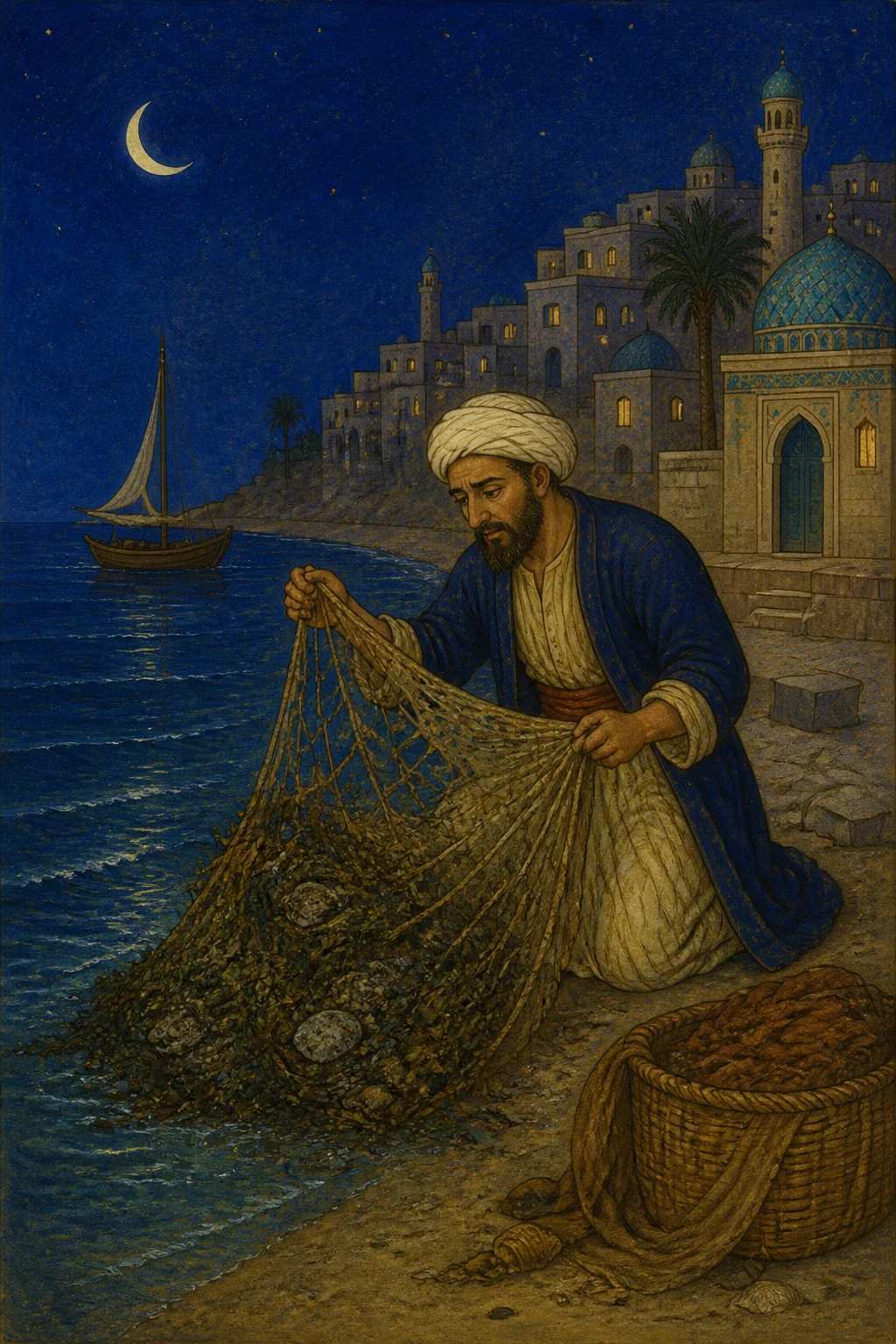
It is also told that in ancient times, in the days and ages long gone by, there lived in the city of Baghdad a fisherman named Khalifa. He was a poor, penniless fellow who had never married in all his life. One day he took his net and went down to the river, as was his custom, to fish before the other fishermen arrived. When he reached the water, he tightened his belt, tucked up his clothes, stepped forward, spread his net, and cast it once, then twice, but brought up nothing. He went on casting until he had thrown it ten times, yet still caught nothing at all. His heart grew heavy, and he was at a loss what to do. “I ask forgiveness of Almighty God,” he said, “beside whom there is no god, the Ever-Living, the Eternal Sustainer, and to Him I turn in repentance. There is no power and no strength save in God, the Most High, the Almighty. What God wills comes to pass, and what He does not will cannot be. Our sustenance rests with God, mighty and glorious. When God gives to a servant, no one can withhold His gift; and when He withholds, no one can give.” Then, in the depth of his distress, he recited these two verses:
When fate one day assails you with misfortune, prepare your patience and make room within your breast; for the Lord of all the worlds, in His bounty, will grant you ease by His grace when hardship is past. Then he sat for a while pondering his plight, his head bowed toward the ground, after which he recited these verses:
Be patient with the sweetness and the bitterness of time, and know that God will bring His purpose to completion. How many a night of grief, throbbing like a boil, have you endured until at last you won its dawn! Calamities may pass over a man, then vanish, never to return even to his thoughts. Then he said to himself, “I shall cast once more and put my trust in God. Perhaps He will not disappoint my hopes.” He stepped forward and flung the net into the river as far as his arms could reach, gathered in its cord, and waited a while. Then he hauled it in and found it heavy. But morning overtook Shahrazad, and she fell silent, leaving her permitted tale untold.
When it was the eight hundred and thirty-second night,
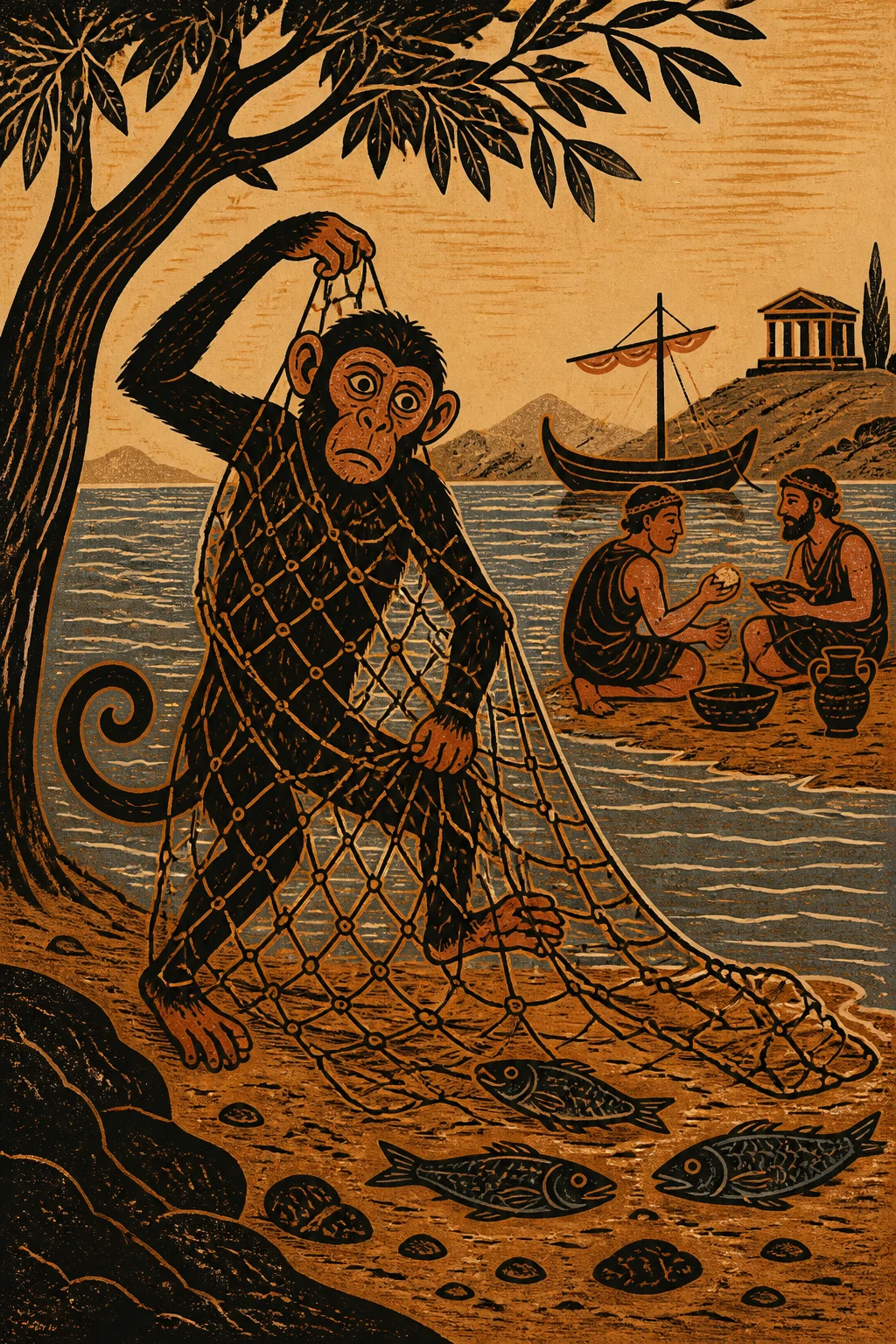
She said: It has reached me, O fortunate King, that when Khalifa the fisherman had cast his net into the river repeatedly and caught nothing, he pondered his plight and recited the verses already given. Then he said to himself, “I shall cast once more and put my trust in God. Perhaps He will not disappoint my hopes.” He rose, cast his net, and waited a while, then hauled it in and found it heavy. Feeling its weight, he worked it gently and drew it toward him until it came ashore. There inside was a one-eyed, lame monkey. When Khalifa saw it, he cried, “There is no power and no strength save in God! To God we belong, and to Him we return! What is this filthy, foul creature, this ill-omened apparition? What has befallen me on this blessed day? Yet all this is ordained by God Most High.” He took the monkey, tied a rope around it, and led it to a tree growing on the riverbank, where he tethered it. He had a whip with him, and he took it in his hand, raised it in the air, and was about to bring it down on the monkey when God granted the creature eloquent speech. “Khalifa,” it said, “stay your hand and do not strike me. Leave me tied to this tree, go to the river, cast your net, and trust in God, for He will bring you your livelihood.” When Khalifa heard the monkey’s words, he took his net, went down to the river, and cast it. He let out the cord, then hauled it in and found it heavier than before. He kept working at it until he brought it ashore, and there inside was another monkey, with a gap between its front teeth, kohl-darkened eyes, and hands dyed with henna. It was laughing, and wore a ragged cloth about its waist. “Praise be to God,” said Khalifa, “who has replaced the fish in the river with monkeys!” Then he went to the monkey tied to the tree and said, “Look, you bringer of ill luck! What wretched advice you gave me! You alone landed me with this second monkey. Ever since you greeted me this morning with your lameness and your one eye, I have been a weary, miserable wretch, without a dirham or a dinar to my name.” He took the whip in his hand, swung it through the air three times, and was about to bring it down on the monkey when it cried out for mercy. “I beg you by God to forgive me for the sake of this companion of mine. Ask him for what you need, and he will show you how to obtain it.” So Khalifa threw down the whip and spared him.
Then he went to the second monkey and stood beside it. “Khalifa,” the monkey said, “all this talk will do you no good unless you listen to what I have to say. If you heed me, obey me, and do not go against my advice, I shall be the means of making you rich.” “What do you have to tell me,” asked Khalifa, “that I should obey you?” The monkey replied, “Leave me tied here where I am, and go to the river and cast your net. Then I shall tell you what to do next.” Khalifa took the net, went to the river, cast it, and waited a while. Then he drew it in and found it heavy. He worked at it until he brought it ashore, and there inside was yet another monkey. This one, however, was red, with blue clothes about its waist, henna on its hands and feet, and kohl around its eyes. When Khalifa saw it, he said, “Glory be to Almighty God! Glory be to the Lord of all dominion! This day is blessed from beginning to end, for its good fortune was heralded by the face of that first monkey. A letter’s contents may be known from its heading! This is a day for monkeys. There is not a single fish left in the river, and we have come out today only to catch monkeys. Praise be to God, who has replaced the fish with monkeys!”
Then he turned to the third monkey and said, “And what might you be, you other ill-omened wretch?” “Do you not know me, Khalifa?” it asked. “No,” he replied. “I am the monkey of Abu al-Sa‘adat, the Jewish money changer.” “And what do you do for him?” Khalifa asked. “I greet him at the beginning of the day,” it said, “and he earns five dinars; and I greet him at the end of the day, and he earns five dinars.” Khalifa turned to the first monkey and said, “Look, you miserable creature, how fine other people’s monkeys are! As for you, you greet me in the morning with your lameness, your one eye, and your ill-omened face, and I become poor, penniless, and hungry.” Then he took the whip and swung it through the air three times, meaning to bring it down on the monkey. But Abu al-Sa‘adat’s monkey said, “Leave him alone, Khalifa. Stay your hand and come here, so I can tell you what to do.” Khalifa threw down the whip, went over to it, and said, “What would you have me do, O master of all monkeys?” “Take the net and cast it into the river,” it replied. “Leave me and these monkeys here beside you, and whatever comes up in it, bring it to me. I shall tell you something that will gladden your heart.” But morning overtook Shahrazad, and she fell silent, leaving her permitted tale untold.
When it was the eight hundred and thirty-third night,
She said: It has reached me, O fortunate King, that when Abu al-Sa‘adat’s monkey said to Khalifa, “Take your net and cast it into the river, and whatever comes up in it, bring it here to me, so that I may tell you something to gladden your heart,” Khalifa replied, “I hear and obey.” Then he took the net, folded it over his shoulder, and recited these verses:
When my heart is heavy, I seek my Maker’s aid; He has the power to make every hardship easy. Before an eye can blink, our Lord in His kindness may free a captive and mend a broken man. Entrust all your affairs to God, for every discerning soul knows His bounty. Then he also recited these two verses:
You who have cast mankind into affliction, You who dispel sorrow and the causes of calamity: do not tempt me with hopes of what I cannot gain; how many a hopeful man has failed to win his heart’s desire! When Khalifa had finished his verses, he went down to the river, cast his net, and waited a while. Then he drew it in, and there inside was a great fish with an enormous head, a tail like a ladle, and eyes like two dinars. Khalifa rejoiced at the sight, for he had never caught its like in all his life. Marveling at it, he took it to the monkey of Abu al-Sa‘adat the Jew, feeling as though he possessed the whole world. The monkey asked, “What do you mean to do with this, Khalifa? And what will you do with your monkey?” Khalifa replied, “I shall tell you what I intend, O master of all monkeys. First of all, I shall contrive the destruction of this accursed monkey of mine, take you in his place, and feed you whatever you desire every day.” “Since you have chosen me,” said the monkey, “I shall tell you what to do, and, God Most High willing, it will improve your fortunes. Pay close attention to what I say. Find a rope for me too, and tie me to a tree. Then leave me, go to the middle of the quay, and cast your net into the waters of the Tigris. Once you have cast it, wait a little, then draw it in. You will find in it a fish more beautiful than any you have seen in all your life. Bring it here to me, and I shall tell you what to do next.”
Khalifa rose at once, cast his net into the Tigris, and drew it in. There inside he saw a white fish as large as a sheep, the like of which he had never seen in his life, and bigger than the first fish. He took it and brought it to the monkey. The monkey said, “Gather some green grass, put half of it in a basket, lay the fish on top, and cover it with the other half. Leave us tied here, shoulder the basket, and carry it into Baghdad. Whoever speaks to you or questions you, do not answer until you enter the money changers’ market. At the far end of the market you will find the shop of Master Abu al-Sa‘adat the Jew, chief of the money changers. You will see him seated on a cushion, with a pillow behind him and two chests before him, one for gold and the other for silver. Around him will be mamluks, slaves, and servants. Go up to him, set the basket before him, and say, ‘Abu al-Sa‘adat, I went fishing today and cast my net in your name, and God Most High sent this fish.’ He will ask, ‘Have you shown it to anyone else?’ Say, ‘No, by God.’ He will take it from you and give you a dinar. Return it to him. Then he will give you two dinars; return those as well. Whatever he offers you, give it back, and even if he offers you its weight in gold, accept nothing. He will ask, ‘Tell me what you want.’ Say, ‘By God, I shall sell it only for a few words.’ When he asks, ‘What words?’ tell him, ‘Stand up and say: Bear witness, all who are present in the market, that I have exchanged Khalifa the fisherman’s monkey for my own, his allotted portion for mine, and his fortune for mine. That is its price; I have no need of gold.’ If he does this for you, I shall greet you every morning and evening, and you will earn ten gold dinars each day. As for Abu al-Sa‘adat the Jew, this one-eyed, lame monkey will greet him in the morning, and God will afflict him every day with some loss he must pay. So it will continue until he is poor and has nothing left at all. Listen to what I tell you, and you will prosper and find the right path.”
When Khalifa the fisherman heard the monkey’s words, he said, “I accept your advice, O king of all monkeys. But as for this ill-omened wretch—may God grant him no blessing—I do not know what to do with him.” The monkey replied, “Let him loose in the water, and let me loose as well.” “I hear and obey,” said Khalifa. Then he went to the monkeys, untied them, and let them go, and they went down into the river. Khalifa took the fish and washed it, laid green grass beneath it in the basket, and covered it with more grass. Then he shouldered it and set off, singing this ballad:
Entrust your affairs to the Lord of heaven, and you will be safe; do good, and you will live long without regret. Do not keep company with the suspect, lest you too fall under suspicion; guard your tongue from insults, lest you be insulted in return. But morning overtook Shahrazad, and she fell silent, leaving her permitted tale untold.
When it was the eight hundred and thirty-fourth night,
She said: It has reached me, O fortunate King, that when Khalifa the fisherman had finished singing, he shouldered his basket and went on until he entered Baghdad. The people recognized him and began wishing him good morning, saying, “What have you there, Khalifa?” But he paid no heed to any of them until he reached the money changers’ market. He passed the shops as the monkey had instructed him, then looked at the Jew and saw him seated in his shop, with servants attending him, like a king among the kings of Khurasan. Khalifa recognized him at once, approached, and stood before him. The Jew raised his head, recognized Khalifa, and said, “Welcome, Khalifa! What do you need? What is it you want? If anyone has spoken against you or quarreled with you, tell me, and I shall go with you to the governor, who will see that you have your rights.” “No, by your life, O leader of the Jews,” Khalifa replied. “No one has said a word to me. But today I left my house relying on your good fortune, went to the river, cast my net into the Tigris, and brought up this fish.” Then he opened the basket and laid the fish before the Jew. When the Jew saw it, he admired it and said, “By the Torah, the sacred verses, and the holy words! Last night, as I slept, I dreamed that I stood before the Virgin, and she said to me, ‘Know, Abu al-Sa‘adat, that I have sent you a fine gift.’ Surely this fish must be that gift.”
Then he turned to Khalifa and asked, “By your faith, has anyone seen it besides me?” Khalifa replied, “No, by God, and by the truth of Abu Bakr al-Siddiq, O leader of the Jews, no one has seen it but you.” The Jew turned to one of his servants and said, “Come, take this fish home, and have Sa‘ada prepare it, frying some and roasting some, until I finish my business and come.” Khalifa also said to him, “Go, boy, and have your master’s wife fry some of it and roast some.” “I hear and obey, master,” the servant replied. He took the fish and carried it home. The Jew then held out a dinar to Khalifa the fisherman and said, “Take this, Khalifa, and spend it on your household.” When Khalifa saw it in his palm, he cried, “Glory be to the Lord of all dominion!” It was as though he had never seen gold in his life. He took the dinar and walked a little way, then remembered the monkey’s instructions. Returning, he tossed down the dinar and said, “Take your gold and give me back my fish! Do you make a laughingstock of people?” When the Jew heard this, he thought Khalifa was joking, and offered him two dinars in addition to the first. But Khalifa said, “Give me the fish and stop playing games! Do you think I sell fish at such a price?” The Jew held out two more dinars and said, “Take these five dinars for the fish and curb your greed.” Khalifa took them and went off delighted, gazing at the gold in wonder and saying, “Glory be to God! The Caliph of Baghdad himself has no more than I have today!”
He walked on until he reached the end of the market, then remembered the monkey’s words and instructions. He returned to the Jew and threw down the gold. “What is the matter with you, Khalifa?” the Jew asked. “What do you want? Would you like your dinars changed into dirhams?” “I want neither dirhams nor dinars,” he replied. “I only want you to give me back my fish.” The Jew grew angry and shouted at him, “Fisherman! You bring me a fish not worth one dinar, I give you five, and still you are not satisfied! Are you mad? Tell me, how much will you sell it for?” Khalifa answered, “I shall not sell it for silver or gold. I shall sell it only for a few words that you must say to me.” When the Jew heard him speak of a few words, his eyes bulged in his head, his breath grew short, and he ground his teeth. “Oh, the outrageousness of Muslims!” he cried. “Do you want me to abandon my religion for the sake of your fish, and destroy the faith and belief I inherited from my forefathers?” He shouted for his servants, and when they came before him, he said, “Wretches! Seize this bringer of ill luck! Rain blows upon the nape of his neck, and give him a sound beating!” They fell upon him and beat him until he collapsed beneath the shopfront. Then the Jew said, “Leave him alone so that he can get up.” Khalifa sprang to his feet as though nothing had happened. The Jew said, “Tell me what you want for this fish, and I shall give it to you. You have certainly had no kindness from us just now.” “Do not worry about me on account of the beating, master,” Khalifa replied. “I can take as much beating as ten donkeys.” The Jew laughed and said, “For God’s sake, tell me what you want, and, by my religion, I shall give it to you.” Khalifa replied, “Nothing will satisfy me as the price of this fish but a few words from you.” “I suppose you want me to become a Muslim,” said the Jew. Khalifa answered, “By God, Jew, if you embrace Islam, your conversion will neither benefit the Muslims nor harm the Jews; and if you remain in unbelief, your unbelief will neither harm the Muslims nor benefit the Jews. All I ask is that you stand up and say, ‘Bear witness, people of the market, that I have exchanged my monkey for Khalifa the fisherman’s monkey, my lot in this world for his, and my fortune for his.’” “If that is what you want,” the Jew replied, “it is easy enough for me.” But morning overtook Shahrazad, and she fell silent, leaving her permitted tale untold.
When it was the eight hundred and thirty-fifth night,
She said: It has reached me, O fortunate King, that the Jew said to Khalifa the fisherman, “If that is what you want, it is easy enough for me.” Then he rose at once, stood upright, and said exactly what Khalifa the fisherman had told him to say. Afterward he turned to him and asked, “Do I owe you anything more?” “No,” said the fisherman. “Then go in peace,” said the Jew. Khalifa immediately took his basket and net and went to the Tigris, where he cast his net. When he hauled it in, he found it heavy and brought it ashore only after much effort. Once it was out, he saw that it was full of fish of every kind. A woman came to him carrying a platter and gave him a dinar, for which he gave her fish. Then a servant came and bought a dinar’s worth. So it went until he had sold ten dinars’ worth of fish. He continued to sell ten dinars’ worth every day for ten days, until he had amassed a hundred gold dinars.
Now the fisherman had a house off the merchants’ passageway. One night, as he lay in bed, he said to himself, “Khalifa, everyone knows that you are a poor fisherman, yet now you have a hundred gold dinars. The Commander of the Faithful, Harun al-Rashid, is bound to hear about you from someone. Perhaps he will need money and send for you, saying, ‘I need a sum of dinars, and I have heard that you have a hundred. Lend them to me.’ I shall say, ‘Commander of the Faithful, I am a poor man. Whoever told you I had a hundred dinars lied about me. I have nothing of the sort in my possession.’ Then he will hand me over to the governor and say, ‘Strip him and beat him until he confesses and produces the hundred dinars he has.’ The wisest course, which will save me from this predicament, is to get up this very moment and whip myself, so that I become accustomed to a beating.” And his hashish said to him, “Get up and take off your clothes.” He rose at once, stripped, and took a whip he had in the house. He also had a leather cushion, and he began striking the cushion once and his own skin once, crying, “Ah! Ah! By God, master, this is all false! They are lying about me! I am a poor fisherman, and I possess none of this world’s goods!”
The people heard Khalifa the fisherman punishing himself and striking the cushion with his whip, for the blows upon his body and the cushion echoed loudly through the night. Among those who heard him were the merchants, who said, “What can be wrong with this poor fellow, crying out while we hear blows falling on him? Thieves must have broken into his house and be torturing him!” They all rose at the sound of the blows and cries, left their houses, and went to Khalifa’s door, which they found locked. “Perhaps the thieves broke in from the back,” they said to one another. “We must go over the rooftops.” So they climbed onto the roofs and came down through the roof opening, where they found him naked, flogging himself. “What is the matter, Khalifa?” they asked. “What has happened to you?” He replied, “My friends, I have come by a few dinars, and I fear that word will reach the Commander of the Faithful, Harun al-Rashid. He will summon me before him and demand those dinars. If I deny having them, I fear he will have me beaten. So here I am, beating myself to prepare for what is to come.” The merchants laughed at him and said, “Stop this nonsense! May God bless neither you nor the dinars you have acquired! You have disturbed our night and filled our hearts with alarm.” So Khalifa stopped beating himself and slept until morning. When he awoke and was about to go to work, he thought about the hundred dinars he had acquired. “If I leave them in the house,” he told himself, “thieves will steal them. If I put them in a belt around my waist, someone may notice and lie in wait until I am alone in a deserted place, then kill me and take them. But I shall devise a trick, a very fine and useful one.” He rose at once and sewed a pocket inside the neck of his robe, tied the hundred dinars in a purse, and put it in the pocket he had made. Then he took his net, basket, and staff and set off until he reached the Tigris. But morning overtook Shahrazad, and she fell silent, leaving her permitted tale untold.
When it was the eight hundred and thirty-sixth night,
She said: It has reached me, O fortunate King, that when Khalifa the fisherman had put the hundred dinars into his pocket, he took his basket, staff, and net, went to the Tigris, and cast his net into it. Then he drew it in, but caught nothing. He moved to another spot and cast again, but still caught nothing. He kept moving from place to place until he was half a day’s journey from the city, casting his net all the while without catching a thing. Then he said to himself, “By God, I shall cast my net into the water only this once more, and then, come what may, I am done!” In his fury he flung the net with all his strength, and the purse containing the hundred dinars flew out of his collar, fell into the middle of the river, and was carried away by the strong current. He dropped the net, stripped off his clothes, left them on the bank, and plunged into the river after the purse. He dived and surfaced nearly a hundred times, until his strength failed, but could find no trace of it. When he gave up hope, he climbed onto the bank and found nothing but his staff, net, and basket. He searched for his clothes, but there was no sign of them. Then he said to himself the coarsest of proverbs: “The pilgrimage is not complete until the camel has fucked you.” He spread out his net, wrapped himself in it, took his staff in his hand and his basket on his shoulder, and set off at a trot like a camel gone mad, darting right and left, backward and forward, disheveled and dusty as a rebellious demon newly escaped from Solomon’s prison.
Such was the case of Khalifa the fisherman. As for the Caliph Harun al-Rashid, he had a friend, a jeweler called Ibn al-Qarnas. Everyone—merchants, auctioneers, and brokers alike—knew that Ibn al-Qarnas was the Caliph’s merchant. No rarity or other precious object offered for sale in Baghdad was sold before it had been shown to him, and this included male and female slaves. One day, as Ibn al-Qarnas sat in his shop, the chief auctioneer approached him with a slave girl whose like no eye had ever seen. She was perfect in beauty and loveliness, stature and proportion. Among her other accomplishments, she was versed in every science and art, composed poetry, and played every musical instrument. Ibn al-Qarnas the jeweler bought her for five thousand gold dinars, spent another thousand dinars clothing her, and brought her to the Commander of the Faithful. She passed that night with him, and the Caliph tested her in every art. He found her skilled in all branches of learning and accomplishment, without equal in her age. Her name was Qut al-Qulub, and she was as the poet described:
Whenever she unveils, my eyes return to her, though her disdain sends them away again. Her neck is like a gazelle’s whenever she turns—and gazelles, as all men say, have lovely turns of the head. Yet how does this compare with another poet’s words:
Who will bring me a dusky beloved, whose slender, swaying form is the model for tall, supple spears? With languid eyelids and cheeks downy as silk, he holds dominion in his weary lover’s heart. When morning came, the Caliph Harun al-Rashid sent for Ibn al-Qarnas the jeweler. When he arrived, the Caliph ordered ten thousand dinars to be paid to him as the girl’s price. Then the Caliph’s heart became so absorbed in Qut al-Qulub that he forsook Lady Zubayda, daughter of al-Qasim and his own cousin, as well as all his other favorites. For an entire month he remained with the girl, leaving her only for Friday prayers, after which he returned to her at once. The officers of state were greatly troubled by this and complained to the vizier Ja‘far al-Barmaki. The vizier waited patiently until Friday, then entered the mosque and met the Commander of the Faithful. He told him all the strange tales of love that had come his way, hoping to draw him out. The Caliph said, “Ja‘far, by God, this is not a matter of my own choosing. My heart is caught in the snare of love, and I do not know what to do.” The vizier Ja‘far replied, “Know, Commander of the Faithful, that this favorite, Qut al-Qulub, is now at your command and numbered among your servants. What the hand possesses, the soul soon tires of. Let me tell you something else: the finest pursuits in which kings and the sons of kings take pride are hunting, the chase, and seizing opportunities for pleasure. If you occupy yourself with these, you may be distracted from her, and perhaps even forget her.” “Excellent advice, Ja‘far,” said the Caliph. “Let us go hunting at once, this very hour.” When Friday prayers were over, they left the mosque, mounted without delay, and set off for the hunt. But morning overtook Shahrazad, and she fell silent, leaving her permitted tale untold.
When it was the eight hundred and thirty-seventh night,
She said: It has reached me, O fortunate King, that the Caliph Harun al-Rashid and Ja‘far went out hunting and rode until they reached the open country. The Commander of the Faithful and his vizier Ja‘far were riding two mules. They became so engrossed in conversation that the troops went on ahead of them. The heat grew fierce, and al-Rashid said, “Ja‘far, I am terribly thirsty.” Then he looked out and saw a figure on a high mound. “Do you see what I see?” he asked the vizier. “Yes, Commander of the Faithful,” replied the vizier. “I see a figure on a high mound. It must be the keeper of an orchard or a melon patch. In either case, there must be water nearby.” Then the vizier added, “I shall go to him and bring you some water.” But al-Rashid said, “My mule is faster than yours. Stay here and wait for the troops, while I go myself, drink with this fellow, and return.” He urged his mule forward, and it sped like the wind, or water flowing through a channel, until in the twinkling of an eye it brought him to the figure, who proved to be none other than Khalifa the fisherman. Al-Rashid saw him naked, wrapped in his net, his eyes so red that they looked like flaming torches. His appearance was frightful, his posture crooked, and he was wild-haired and dusty, like a demon or a lion. Al-Rashid greeted him, and Khalifa returned the greeting angrily, inwardly blazing with rage. “My good man,” al-Rashid asked, “have you any water?” Khalifa replied, “You there! Are you blind or mad? There is the Tigris, just behind this mound.” Al-Rashid went around the mound, descended to the Tigris, drank, and watered his mule. Then he came straight back up to Khalifa the fisherman and asked, “What are you doing standing here, my good man? What is your trade?” Khalifa replied, “That question is stranger and more astonishing than your question about the water! Can you not see the tools of my trade upon my shoulder?” “You seem to be a fisherman,” said al-Rashid. “Yes,” he replied. “Then where is your robe?” asked al-Rashid. “Where is your wrap? Where is your blanket? Where are your clothes?” Now these were exactly the garments Khalifa had lost. When he heard the Caliph name them, he concluded that this must be the man who had taken his clothes from the riverbank. He flew down from the mound faster than a flash of lightning, seized the bridle of the Caliph’s mule, and said, “You there! Give me back my things, and stop your games and jokes!” “By God,” said the Caliph, “I have neither seen your clothes nor know anything about them.” Al-Rashid had broad cheeks and a small mouth, and Khalifa said, “Perhaps your trade is singing or playing the pipe. But give me back my clothes peaceably, or I shall beat you with this staff until you wet yourself and foul your garments!”
When the Caliph saw the staff in Khalifa’s hand, he said to himself, “By God, I could not endure even half a blow from this beggar’s staff.” Al-Rashid was wearing a satin coat, so he took it off and said, “My good man, take this coat in place of your clothes.” Khalifa took it, turned it over, and said, “My clothes are worth ten of this gaudy cloak!” “Put it on,” said al-Rashid, “until I bring you your clothes.” Khalifa put it on and found it too long. He had a knife tied to the handle of his basket, so he took it and cut about a third off the coat’s hem, until it reached just below his knees. Then he turned to al-Rashid and said, “For God’s sake, piper, tell me how much your master pays you each month for your piping.” The Caliph replied, “My monthly wages are ten gold dinars.” “By God, poor fellow,” said Khalifa, “you have burdened me with concern for you! Why, I earn ten dinars every day. Would you like to enter my service? I shall teach you to fish and share the profits with you. You will earn five dinars a day and be my servant, and I shall protect you from your master with this staff.” “I agree,” said al-Rashid. “Then get off that she-ass,” said Khalifa, “and tie her up, so we can use her to carry the fish. Come here, and I shall teach you to fish this very moment.” Al-Rashid dismounted, tied up his mule, and tucked the skirts of his clothes into his belt. Khalifa said, “Piper, hold this net like this, arrange it over your arm like this, and cast it into the Tigris like this.” Al-Rashid took courage, did as Khalifa had shown him, and cast the net into the river. Then he pulled at it, but could not bring it out. Khalifa came to help him haul, but still they could not draw it ashore. “You ill-omened piper!” Khalifa cried. “The first time I took your cloak in exchange for my clothes. This time, if I find my net torn, I shall take your she-ass in exchange for it, and beat you until you foul yourself!” “Let us pull together,” said al-Rashid. They both pulled, and only with great difficulty did they manage to bring the net ashore. When they looked, they found it full of fish of every kind and color. But morning overtook Shahrazad, and she fell silent, leaving her permitted tale untold.
When it was the eight hundred and thirty-eighth night,
She said: It has reached me, O fortunate King, that when Khalifa the fisherman and the Caliph brought up the net, they saw that it was full of every kind of fish. Khalifa said, “By God, piper, you are an ugly fellow, but if you apply yourself to fishing, you will make a splendid fisherman. The best thing now is for you to mount your she-ass, go to the market, and bring back a pair of panniers. I shall watch the fish until you return, and then you and I can load them onto your she-ass. I have scales, weights, and everything else we need, so we shall take it all with us. You will have only to hold the scales and collect the money, for we have twenty dinars’ worth of fish here. Hurry back with the panniers, and do not delay.” “I hear and obey,” said the Caliph. Then he left Khalifa and the fish and urged his mule away, filled with delight. He laughed all the way back to Ja‘far at what had happened to him with the fisherman. When Ja‘far saw him, he said, “Commander of the Faithful, perhaps when you went to drink you found a lovely garden, entered it, and enjoyed its delights all by yourself?” When al-Rashid heard Ja‘far’s words, he laughed.
Then all the Barmecides rose, kissed the ground before him, and said, “Commander of the Faithful, may God perpetuate your joys and banish your sorrows! What delayed you when you went to drink? What happened to you?” The Caliph replied, “A strange thing befell me, a most delightful and astonishing adventure.” Then he told them the story of Khalifa the fisherman: how the man had accused him of stealing his clothes, how he had given him his own robe, and how the fisherman, finding it too long, had cut it short. Jaafar said, “By God, Commander of the Faithful, I had been thinking of asking you for that robe. But I shall go to the fisherman this very moment and buy it from him.” The Caliph replied, “By God, he has cut a third of it off at the hem and ruined it! But, Jaafar, I am worn out with fishing, for I caught a great many fish. They are on the riverbank with my master Khalifa, who is waiting there for me to return with a pair of panniers. Then he and I are to go to market, sell them, and divide the proceeds.” Jaafar said, “Commander of the Faithful, I shall bring you buyers.” The Caliph replied, “Jaafar, by my pure forefathers, whoever brings me a fish from those lying before Khalifa, who taught me to fish, shall receive a gold dinar for it.” So a herald proclaimed throughout the army, “Go and buy fish for the Commander of the Faithful!” The mamluks rode off toward the riverbank. While Khalifa was waiting for the Commander of the Faithful to bring him the panniers, the mamluks swooped upon him like eagles, snatched up the fish, wrapped them in gold-embroidered kerchiefs, and began fighting over them. Khalifa said, “These must surely be fish from Paradise!” Then he took two fish in his right hand and two in his left, waded into the water up to his throat, and began saying, “O God, by the virtue of these fish, let Your servant the piper, my partner, come this very moment!” Just then a black slave approached him. He was chief of all the Caliph’s slaves, and had fallen behind the mamluks because his horse had stopped to make water on the road. When he reached Khalifa, he found that not a single fish remained. He looked right and left and saw Khalifa the fisherman standing in the water with his fish. “Fisherman, come here!” he called. “Be off, and leave me alone!” replied the fisherman. The eunuch went closer and said, “Give me those fish, and I shall pay you for them.” Khalifa replied, “Have you no sense? I am not selling them.” The eunuch drew his mace on him, and Khalifa cried, “Do not strike, you wretch! A gift is better than a mace!” Then he threw him the fish. The eunuch took them, put them in his kerchief, and reached into his pocket, but found not so much as a single dirham. “Fisherman,” he said, “your luck is wretched. By God, I have no money with me. But come tomorrow to the Caliph’s palace and say, ‘Show me the eunuch Sandal.’ The servants will direct you to me. When you come, you shall receive whatever falls to your share, take it, and go your way.” At this Khalifa said, “This is a blessed day indeed, and its blessings have been plain from the beginning!”
Then he shouldered his net and walked on until he entered Baghdad. As he passed through the markets, people saw the Caliph’s robe of honor upon him and stared at him all the way to his quarter. The Commander of the Faithful’s tailor had his shop at the entrance to the lane. Seeing Khalifa the fisherman wearing one of the Caliph’s robes, worth a thousand dinars, he said, “Khalifa, where did you get that gown?” Khalifa replied, “What business is it of yours? I got it from a fellow I taught to fish, who became my apprentice. I let him off having his hand cut off, for he stole my clothes, and he gave me this cloak in their place.” The tailor realized that the Caliph must have passed him while he was fishing, jested with him, and given him the gown. And dawn overtook Shahrazad, and she fell silent, leaving her tale untold.
When it was the eight hundred and thirty-ninth night,
She said: It has reached me, O fortunate King, that the tailor realized the Caliph had passed Khalifa the fisherman while he was fishing, jested with him, and given him the gown. Then the fisherman went home. Such was his case. As for the Caliph Harun al-Rashid, he had gone out hunting only to distract himself from the slave girl Qut al-Qulub. When Zubayda heard of the girl and the Caliph’s infatuation with her, she was seized by the jealousy that afflicts women, until she would neither eat nor drink and forsook the sweetness of sleep. She waited for the Caliph to be absent or away on a journey so that she might lay a snare for Qut al-Qulub. When she learned that he had gone out hunting, she ordered the slave girls to furnish the hall, adorned it with lavish splendor, and had food and sweetmeats set out. Among them she prepared a porcelain dish of the most exquisite confection, into which she mixed a sleeping drug. Then she ordered one of the servants to go to Qut al-Qulub and invite her to the table of Lady Zubayda, daughter of al-Qasim and wife of the Commander of the Faithful. He was to tell her, “The wife of the Commander of the Faithful has taken medicine today. She has heard of your beautiful music and wishes to enjoy a display of your art.” The girl replied, “I hear and obey God and Lady Zubayda.” She rose at once, knowing nothing of what fate held in store for her, took the instruments she needed, and accompanied the servant until she came into Lady Zubayda’s presence. There she kissed the ground before her many times, then stood upright and said, “Peace upon the lofty veil and the unassailable presence, the scion of the Abbasids and the flesh of the Prophet! May God grant you prosperity and peace through all the days and years.” Then she stood among the slave girls and servants. Lady Zubayda raised her head and looked at her beauty, and saw a maiden with smooth cheeks and breasts like pomegranates, a moon-bright face, a radiant brow, and eyes of deepest black and clearest white. Languor dwelt upon her eyelids and light shone from her face. The sun seemed to rise from her brow and the darkness of night to flow from her hair; musk breathed from her mouth, and flowers borrowed their splendor from her loveliness. The moon appeared in her forehead, and a branch swayed in her slender form. She was like the full moon shining through the wings of darkness. Her eyes spoke of love, her eyebrows were arched, and her lips were fashioned of coral. Her beauty bewildered all who looked upon her, and her glance bewitched all who saw her. Glory be to Him who created her, perfected her, and gave her form! She was as the poet said of one who resembled her:
When she is angry, you see men lying slain; when she is pleased, their spirits live again. Her eyes have glances full of sorcery, with which she kills or quickens whom she will. With those two eyes she takes the world captive, as though all humankind were slaves to her. Then Lady Zubayda said, “Welcome, Qut al-Qulub, a thousand welcomes! Sit down and delight us with your accomplishments and the beauty of your art.” “I hear and obey,” she replied. Then she sat, reached out, and took up the tambourine, of which one who described it composed these verses:
O player of the tambourine, my heart takes flight with longing, and cries out in its anguish as you strike. You have captured only a wounded heart; all men yearn for the rhythms that you play. Sing in a solemn measure or a light one, and fashion any melody you please: you cannot fail to ravish us. Rejoice, cast off restraint, O lover; rise and dance and sway, marvel and make others marvel! Then she played at length and sang until the very birds stopped to listen and the whole company was stirred with rapture. Next she laid down the tambourine and took up the flute, of which this verse was spoken:
It has eyes whose pupils are fingers, pointing to a faultless melody without written signs. And another poet said: When its songs attain their purpose, the hour grows sweet with the rapture of union. Then, having delighted everyone present, she laid down the flute and took up the lute, of which the poet said:
A tender branch became a singing girl’s lute, for which the noble and generous yearn. With exquisite skill her fingertips feel and pluck the strings so finely wrought. She tightened its strings and turned its pegs, laid it in her lap, and bent over it as a mother bends over her child. It was as though the poet had spoken these verses of her and her lute:
She gave eloquence to the foreign string, and understanding to those who understood not. She told how love is a slayer, robbing a Muslim man of reason. A maiden—God bless her!—whose hand gives shape to a voice as though it came from living lips. With her lute she checked the course of passion as a skillful physician checks the flow of blood. Then she played fourteen modes and sang a complete suite, astonishing those who watched and delighting those who listened. Afterward she recited these two verses:
A blessed arrival is yours, bringing joy unveiled; its good fortune comes unceasingly, its bliss will never fail. And dawn overtook Shahrazad, and she fell silent, leaving her tale untold.
When it was the eight hundred and fortieth night,
She said: It has reached me, O fortunate King, that when Qut al-Qulub sang her verses and played her strings before Lady Zubayda, the lady almost fell in love with her herself. “My cousin al-Rashid cannot be blamed for loving her,” she thought. Then the girl kissed the ground before Zubayda and sat down. They brought her food, followed by sweetmeats, and set before her the dish containing the drug. She ate some, and scarcely had the sweetmeat reached her stomach when her head reeled and she fell to the ground asleep. Lady Zubayda said to the slave girls, “Carry her to one of the private chambers until I call for her.” “We hear and obey,” they replied. Then she told one of the servants, “Have a chest made for us and bring it to me.” She also ordered a sham grave to be prepared and the rumor spread that the girl had choked and died. She warned her intimates that anyone who said the girl was alive would have his head struck off. At that very hour the Caliph returned from hunting, and his first question was about the girl. One of his servants came forward; Lady Zubayda had instructed him to say, if the Caliph asked after her, that she was dead. He kissed the ground before him and said, “My lord, may your own life be spared! Know that Qut al-Qulub choked on her food and died.” The Caliph cried, “May God never give you good tidings, you evil slave!” Then he rose and entered the palace, where everyone told him of her death. “Where is her grave?” he asked. They brought him to the burial ground, showed him the false grave, and said, “This is her grave.” At the sight of it he cried aloud, embraced the tomb, wept, and recited these two verses:
By God, O grave, has her beauty passed away? Has that fresh loveliness been changed? O grave, you are neither garden nor sky: how can you hold both branch and moon? Then the Caliph wept bitterly over her and remained there for an hour. At last he rose from the grave in the deepest sorrow. Lady Zubayda knew that her trick had succeeded, and said to the servant, “Bring the chest.” He brought it before her, and she had the girl fetched and laid inside it. “Do your best to sell this chest,” she told him, “and stipulate that whoever buys it must buy it locked. Then give the price away in charity.” The servant took it, left her, and carried out her orders.
Such was their case. As for Khalifa the fisherman, when morning dawned and spread its light, he said, “I have nothing better to do today than visit the eunuch who bought my fish. He told me to come to him at the Caliph’s palace.” So Khalifa left his house and made for the palace. When he arrived, he found mamluks, slaves, and servants standing and sitting about. Looking among them, he saw the eunuch who had taken his fish seated with mamluks attending him. One of the mamluks shouted at Khalifa, and the eunuch turned to see who it was. There stood the fisherman. When Khalifa knew that he had seen and recognized him, he said, “You have done handsomely, Redhead! That is how an honest man keeps his trust!” Hearing this, the eunuch laughed and said, “By God, fisherman, you speak the truth.” Sandal was about to give him something and had reached into his pocket when a great clamor arose. He raised his head to see what was happening, and there was the vizier Jaafar the Barmecide coming from the Caliph’s presence. At the sight of him, the eunuch rose, went forward to attend him, and walked along talking with him. Their conversation went on for some time, while Khalifa stood waiting and the eunuch paid him no attention. At last the fisherman beckoned to him from a distance and called, “My lord Redhead, let me be off!” The eunuch heard him but was ashamed to answer in the vizier Jaafar’s presence, so he continued talking to the vizier and pretended not to notice the fisherman. Khalifa said, “You dawdler! God confound every tiresome fellow who takes people’s goods and then makes them wait! I beg you, my lord Bran-Belly, give me what is mine so that I may go!” The eunuch heard him and was embarrassed before Jaafar. Jaafar, too, saw the man waving his hands and speaking to the eunuch, though he could not make out what he was saying. He asked reproachfully, “Eunuch, what does this poor beggar want of you?” Sandal replied, “Do you not know him, my lord Vizier?” Jaafar said, “By God, I do not. How should I know him, when I have never seen him until this moment?” The eunuch replied, “My lord, this is the fisherman whose fish we plundered on the bank of the Tigris. I arrived too late to get any and was ashamed to return empty-handed to the Commander of the Faithful when all the mamluks had taken some. When I reached him, I found him standing in the middle of the river, praying to God, with four fish in his hands. I told him, ‘Give me what you have, and take the price.’ When he gave me the fish, I put my hand in my pocket to pay him, but found nothing there. So I said, ‘Come to me at the palace, and I shall give you something to help you in your poverty.’ He came today, and I had reached into my pocket to give him something when you arrived. I rose to attend you and was distracted from him by your presence, so he has been kept waiting a long time. That is his story, and that is why he is standing here.” And dawn overtook Shahrazad, and she fell silent, leaving her tale untold.
When it was the eight hundred and forty-first night,
She said: It has reached me, O fortunate King, that when Sandal the eunuch had told Jaafar the Barmecide the story of Khalifa the fisherman, he concluded, “That is his story, and that is why he is standing here.” The vizier smiled at the eunuch’s words and said, “How could this fisherman come to you in his hour of need, and you fail to satisfy him? Do you not know him, chief of the eunuchs?” “No,” he replied. Jaafar said, “This is the Commander of the Faithful’s teacher and partner. Our lord the Caliph woke today oppressed in spirit, sorrowful at heart, and troubled in mind. Nothing will cheer him but this fisherman. Do not let him go until I have spoken to the Caliph about him and brought him into his presence. Perhaps God will make his coming a relief to the Caliph’s distress and console him for the loss of Qut al-Qulub. Then he may give the man something to help him, and you will have been the cause of it.” The eunuch replied, “My lord, do as you wish. May God Most High preserve you as a pillar of the Commander of the Faithful’s realm! May He perpetuate its shelter and protect both its branches and its roots!” Then the vizier Jaafar set off toward the Caliph, while the eunuch ordered the mamluks not to leave the fisherman. Khalifa said, “What handsome kindness, Redhead! The claimant has become the accused. I came to claim my money, and they have locked me up for arrears!” When Jaafar entered the Caliph’s presence, he found him sitting with his head bowed to the ground, heavy-hearted and deep in thought, softly reciting the poet’s words:
Those who reproach me bid me forget her; but what power have I over a heart that will not obey? How can I endure the loss of a young beloved, when patience in separation avails me nothing against my love? I have not forgotten her as the cup passed between us, and I swayed, drunk with the wine of her glances. When Jaafar stood before the Caliph, he said, “Peace be upon you, Commander of the Faithful, defender of the sanctity of religion, cousin of the lord of the messengers—God bless him and all his family and grant them peace!” The Caliph raised his head and replied, “And upon you be peace, and God’s mercy and blessings.” Jaafar said, “With the Commander of the Faithful’s leave, may his servant speak without offense?” The Caliph replied, “When have you ever been forbidden to speak, you who are chief of the viziers? Say what you wish.” Jaafar said, “My lord, I left your presence intending to go home, and saw your master, teacher, and partner, Khalifa the fisherman, standing at the gate. He is displeased with you and complains of you, saying, ‘Glory be to God! I taught him to fish, and he went to fetch me a pair of panniers but never came back. That is no way to treat a partner or a teacher!’ If you wish to remain his partner, well and good. Otherwise, let him know, so that he may take another.” When the Caliph heard this, he smiled, and his heaviness of heart departed. He said to Jaafar, “By my life, is it true that the fisherman is standing at the gate?” Jaafar replied, “By your life, Commander of the Faithful, he is standing there.” The Caliph said, “Jaafar, by God, I shall see that he receives his due. If God wills that misfortune should come to him through my hands, it shall come; and if He wills him good fortune through my hands, that too shall come.”
Then the Caliph took a sheet of paper, cut it into pieces, and said, “Jaafar, write with your own hand twenty sums, ranging from one dinar to a thousand; then ranks of office and command, from the humblest appointment to the caliphate; and twenty kinds of punishment, from the lightest chastisement to death.” “I hear and obey, Commander of the Faithful,” replied Jaafar. He wrote out the slips with his own hand as the Caliph had ordered. Then the Caliph said, “Jaafar, I swear by my pure forefathers and my kinship with Hamza and Aqil that I shall summon Khalifa the fisherman and order him to take one of these slips, whose contents are known only to you and me. Whatever it contains, I shall bestow upon him. Even if it is the caliphate, I shall abdicate and give it to him, without begrudging it. But if it prescribes hanging, mutilation, or death, I shall inflict it upon him. Go and bring him to me.” Hearing this, Jaafar said to himself, “There is no power and no might save in God, the Most High, the Almighty! Perhaps this poor fellow will draw something that destroys him, and I shall be the cause. But the Caliph has sworn, and there is nothing left but to bring him in. Nothing will happen save what God wills.” Then he went to Khalifa the fisherman, took him by the hand, and led him toward the palace. Khalifa was beside himself with terror and thought, “What folly made me come to this ill-omened slave Redhead, so that he could throw me into the hands of Bran-Belly?” Jaafar kept leading him on, with mamluks before and behind him, while he said, “Was imprisonment not enough, that now these men must surround me and prevent my escape?” Jaafar led him through seven corridors, and then the Caliph said, “Beware, fisherman! You stand before the Commander of the Faithful and defender of the Faith.” Then the great curtain was raised, and Khalifa caught sight of the Caliph seated upon his throne, with the dignitaries of the realm standing in attendance. Recognizing him, he went forward and said, “Well, welcome, piper! It was no way to behave, setting up as a fisherman and then leaving me to guard the fish while you went off and never came back! Before I knew it, the mamluks were upon me, riding beasts of every color, and they snatched the fish away while I stood there all alone. It is all your fault! If you had brought the panniers quickly, we could have sold a hundred dinars’ worth. But I came to claim my money, and they shut me up. Who has shut you up in this place?” The Caliph smiled, lifted the edge of the curtain, put his head out from beneath it, and said, “Come forward and take one of these slips.” Khalifa said to the Commander of the Faithful, “You were a fisherman, and now I see you have become a fortune-teller! But the more trades a man has, the poorer he grows.” Jaafar said, “Take a slip quickly, without talking, and do as the Commander of the Faithful commands.” Khalifa stepped forward and reached out his hand, saying, “There is little hope now of this piper becoming my apprentice again and fishing with me!” Then he took a slip, handed it to the Caliph, and said, “Piper, whatever has fallen to my lot, hide none of it from me.” And dawn overtook Shahrazad, and she fell silent, leaving her tale untold.
When it was the eight hundred and forty-second night,
She said: It has reached me, O fortunate King, that when Khalifa the fisherman took one of the slips and handed it to the Caliph, he said, “Piper, whatever has fallen to my lot, hide none of it from me.” The Caliph took it and passed it to the vizier Jaafar, saying, “Read what it says.” Jaafar looked at it and exclaimed, “There is no power and no might save in God, the Most High, the Almighty!” The Caliph said, “Good, good, Jaafar! What do you see there?” He replied, “Commander of the Faithful, the slip says, ‘The fisherman shall receive a hundred strokes of the rod.’” The Caliph ordered him to be given a hundred strokes, and they obeyed and beat Khalifa a hundred times. Then he rose, saying, “God curse this game, Bran-Belly! Are imprisonment and beating part of the sport?” Jaafar said, “Commander of the Faithful, this poor fellow has come to the sea: how can he return thirsty? We beg of your generosity that he be allowed to draw another slip. Perhaps he will win something to take away and ease his poverty.” The Caliph replied, “By God, Jaafar, if he draws a slip that prescribes death, I shall kill him, and you will be the cause.” Jaafar said, “If he dies, he will be at rest.” Khalifa said to him, “May God never give you good tidings! Have I left you so little room in Baghdad that you want me killed?” Jaafar replied, “Take a slip, and ask God Most High to choose for you.” He reached out, drew a slip, and gave it to Jaafar, who read it and fell silent. The Caliph asked, “Why are you silent, son of Yahya?” He replied, “Commander of the Faithful, the slip says, ‘The fisherman shall be given nothing.’” The Caliph said, “There is no provision for him with us. Tell him to get out of my sight.” Jaafar replied, “By your pure forefathers, let him draw a third. Perhaps he will find some bounty in it.” The Caliph said, “Let him take one slip, and no more.” So Khalifa reached out and drew a third slip, and it said, “The fisherman shall be given one dinar.” Jaafar told him, “I sought good fortune for you, but God has willed you only this dinar.” Khalifa replied, “A dinar for every hundred strokes—a handsome bargain! May God never grant you health!” The Caliph laughed, and Jaafar took Khalifa by the hand and led him out.
When he reached the gate, Sandal the eunuch saw him and said, “Come, fisherman, share with us something of what the Commander of the Faithful gave you while he was jesting with you.” Khalifa replied, “By God, you speak truly, Redhead! Do you want to go halves with me, black-skinned fellow? I swallowed a hundred strokes and received a single dinar. You are welcome to it!” Then he threw the dinar to the eunuch and went out with tears streaming down his cheeks. When the eunuch saw him in that state, he knew that he was telling the truth. He went after him and called to the servants to bring him back. They did so, and he put his hand into his pocket and drew out a red purse. He opened it and emptied it, revealing a hundred gold dinars. “Fisherman,” he said, “take this gold as payment for your fish, and go your way.” Khalifa rejoiced, took the hundred dinars and the Caliph’s dinar, and departed, having forgotten his beating. Now, because God Most High wished to bring His decree to pass, Khalifa went through the slave-girls’ market, where he saw a great crowd gathered in a ring. “What are all these people doing?” he wondered. Then he went forward and pushed his way among the merchants and the rest. The merchants said, “Make way for Captain Zalit!” They made room for him, and Khalifa saw an old man standing before a chest, upon which a eunuch was seated. The old man was calling, “Merchants! Men of wealth! Who will venture a bid for this chest with its unknown contents, from the household of Lady Zubayda, daughter of al-Qasim, wife of the Commander of the Faithful al-Rashid? What will you offer? God bless you!” One merchant said, “By God, it is a gamble. I shall make a bid, and no one can blame me for it: twenty dinars!” Another said, “Fifty!” The merchants continued bidding until the price reached a hundred dinars. The auctioneer called, “Will you offer more, merchants?” Khalifa the fisherman said, “A hundred and one dinars!” Hearing this, the merchants thought he was joking. They laughed at him and said, “Eunuch, sell it to Khalifa for a hundred and one dinars!” The eunuch replied, “By God, I shall sell it to no one else! Take it, fisherman, and may God bless you in it. Hand over the gold.” Khalifa brought out the money, gave it to the eunuch, and the bargain was concluded. The eunuch distributed the gold in charity on the spot, then returned to the palace and told Lady Zubayda what he had done. She was delighted.
Then Khalifa tried to hoist the chest onto his shoulder, but could not carry it that way because of its great weight. So he lifted it onto his head and brought it to his lane. There he set it down, exhausted, and sat thinking over what had happened. “I wonder what is in this chest,” he said to himself. Then he opened his door and struggled with the chest until he had got it inside. Afterward he tried to open it, but could not. “What came over me,” he thought, “that I bought this chest? I must break it open and see what is inside.” He wrestled with the lock but could not force it, so he said to himself, “I shall leave it until tomorrow.” Then he wanted to sleep, but found nowhere to lie down, for the chest took up the whole room. So he climbed onto it and lay down. He had been there an hour when suddenly something moved. Khalifa started in terror, sleep fled from him, and he was beside himself with fear. And dawn overtook Shahrazad, and she fell silent, leaving her tale untold.
When it was the eight hundred and forty-third night,
She said: It has reached me, O fortunate King, that when Khalifa the fisherman lay down upon the chest, he remained there an hour, and then something moved. He started up in terror, beside himself with fear, and said, “There must be jinn inside! Praise be to God who kept me from opening it! Had I opened it, they would have risen against me in the dark and destroyed me, and I should have got no good from them.” Then he lay down again, but the chest moved a second time, more violently than before. Khalifa sprang up, saying, “Another bout, and a disturbing one at that!” He hurried to find a lamp but had none, nor any money with which to buy one. So he went outside and shouted, “People of the lane!” Most of his neighbors were asleep, but his cries woke them, and they said, “What is the matter, Khalifa?” He replied, “Bring me a lamp! The jinn have come out upon me!” They laughed at him and gave him a lamp. He took it into his house, struck the lock of the chest with a stone, broke it, and opened the lid. There lay a maiden like a houri, asleep inside. She had been drugged, but just then she had vomited up the drug and come to her senses. Opening her eyes and feeling herself confined, she had begun to move. When Khalifa saw her, he went up to her and said, “For God’s sake, my lady, where have you come from?” She opened her eyes and said, “Bring me jasmine and narcissus.” Khalifa replied, “There is nothing here but henna berries.” She recovered her senses, looked at Khalifa, and asked, “What are you?” Then she said, “Where am I?” “In my house,” he replied. “Am I not in the palace of the Caliph Harun al-Rashid?” she asked. He answered, “What is all this about al-Rashid, you madwoman? You are my slave girl. I bought you today for a hundred and one dinars and brought you home asleep in this chest.”
When the girl heard his words, she asked, “What is your name?” He replied, “My name is Khalifa. How is it that my star has turned fortunate, when I know it to be otherwise?” She laughed and said, “Enough of that talk. Have you anything to eat?” He replied, “By God, not even anything to drink! I have eaten nothing for two days, and am in need of a mouthful myself.” She asked, “Have you no money?” He replied, “God preserve this chest that has beggared me! I put everything I had into it and have been left penniless.” The girl laughed at him and said, “Go and ask your neighbors for something for me to eat, for I am hungry.” Khalifa rose, went out, and cried, “People of the lane!” They had been asleep, but woke and asked, “What is it, Khalifa?” He said, “Neighbors, I am hungry and have nothing to eat.” One came down with a loaf, another with a crust, another with a piece of cheese, and another with a cucumber, until his lap was full. He went inside, set it all before her, and said, “Eat.” She laughed and said, “How can I eat this when I have not a jug of water to drink? I am afraid I might choke on a mouthful and die.” Khalifa said, “I shall fill this jar for you.” He took the jar, went out into the middle of the lane, and shouted, “People of the lane!” They replied, “What is your trouble tonight, Khalifa?” He said, “You gave me food and I ate, but now I am thirsty. Give me water.” One brought him a jug, another a ewer, and another a pitcher, until he had filled the jar. He carried it inside and said, “My lady, now you lack nothing.” She replied, “True, I lack nothing for the moment.” He said, “Speak to me and tell me your story.” She replied, “Why, if you do not know me, I shall tell you who I am. I am Qut al-Qulub, the slave girl of the Caliph Harun al-Rashid. Lady Zubayda grew jealous of me, drugged me, and put me in this chest.” Then she said, “Praise be to God that it was so light a misfortune and nothing worse! But this has happened only to bring you good fortune. You are certain to receive a great deal of money from the Caliph al-Rashid, enough to make you rich.” Khalifa asked, “Is he the al-Rashid in whose palace I was imprisoned?” “Yes,” she replied. He said, “By God, I have never seen anyone more miserly than that piper, so lacking in goodness and sense! Yesterday he gave me a hundred strokes and a single dinar, though I had taught him to fish and taken him as my partner. He betrayed me!” She replied, “Enough of this ugly talk! Open your eyes, and be respectful when you see him again. Then you will gain what you desire.” Hearing her words, he was like a man waking from sleep, and God opened his inward sight to prepare him for good fortune. “Upon my head and eyes,” he said. Then he told her, “In God’s name, lie down and sleep.” She rose and lay down, and he slept at a distance from her until morning.
When morning came, she asked him for an inkwell and paper. He brought them, and she wrote to the merchant who was the Caliph’s friend, telling him of her plight and all that had happened to her: how she was with Khalifa the fisherman, who had bought her. Then she gave Khalifa the letter and said, “Take this to the jewelers’ market. Ask for the shop of Ibn al-Qarnas the jeweler, give him the letter, and say nothing.” “I hear and obey,” replied Khalifa. He took the letter from her hand and went to the jewelers’ market, where he asked for Ibn al-Qarnas’s shop and was directed to it. He approached the jeweler and greeted him. The man returned his greeting, looked upon him with contempt, and asked, “What do you want?” Khalifa handed him the letter. He took it but did not read it, supposing him to be a pauper asking for alms. He said to one of his servants, “Give him half a dirham.” Khalifa replied, “I have no need of charity. Read the letter.” The jeweler took the letter and read it. When he understood its contents, he kissed it and laid it upon his head. And dawn overtook Shahrazad, and she fell silent, leaving her tale untold.
When it was the eight hundred and forty-fourth night,
She said: It has reached me, O fortunate king, that when Ibn al-Qarnas read the note and understood its contents, he kissed it, laid it upon his head, then rose to his feet and said, “Brother, where is your house?” Khalifa replied, “What do you want with my house? Do you mean to go there and steal my slave girl?” “No,” he answered, “I mean to buy something for you and her to eat.” Khalifa said, “My house is in such-and-such a quarter.” “Very good,” said the merchant. “May God never grant you health, you rascal!” Then he called to two of his slaves and told them, “Go with this man to the shop of Muhsin the money changer and say to him, ‘Muhsin, give this man a thousand gold dinars,’ and bring him back to me quickly.” The two slaves went with Khalifa to the money changer’s shop and said, “Muhsin, give this man a thousand gold dinars.” He gave him the money, and Khalifa took it and returned with the two slaves to their master’s shop. They found him mounted on a starling-grey mule worth a thousand dinars, with his mamluks and servants about him. Beside his mule stood another just like it, saddled and bridled. He said to Khalifa, “In God’s name, mount this mule.” Khalifa replied, “I will not ride it. By God, I am afraid it will throw me.” The merchant Ibn al-Qarnas said, “By God, you must ride.” So Khalifa stepped forward to mount, but seated himself backward, seized the mule’s tail, and screamed. It threw him to the ground, and they laughed at him. He got up and said, “Did I not tell you I would not ride this great donkey?” Then Ibn al-Qarnas left Khalifa in the market and went to the Commander of the Faithful to tell him about the slave girl. Afterward he returned and took her to his own house. Khalifa, meanwhile, went home to see the girl and found the people of the quarter gathered together, saying, “Khalifa is someone to be reckoned with today! Where can he have got this slave girl?” One of them said, “He is a mad pimp. Perhaps he found her drunk in the street and carried her home. He has only stayed away because he knows he has done wrong.”
While they were talking, Khalifa came up to them, and they said, “How are you faring, poor fellow? Do you not know what has happened to you?” “No, by God,” he answered. They said, “Just now some mamluks came and took your slave girl away. They asked for you, but could not find you.” Khalifa cried, “How could they take my slave girl?” One of them said, “Had he fallen into their hands, they would have killed him.” Khalifa paid them no heed, but ran back to Ibn al-Qarnas’s shop. Finding him mounted, he said, “By God, this is no way to behave! You kept me occupied while you sent your mamluks to take my slave girl.” “You madman,” said the merchant, “come along and hold your tongue.” He took him to a handsomely built house and led him inside. There Khalifa saw the girl seated on a golden couch, surrounded by ten slave girls as lovely as moons. When Ibn al-Qarnas saw her, he kissed the ground before her, and she asked him, “What have you done for my new master, who spent all he possessed to buy me?” He replied, “My lady, I have given him a thousand gold dinars.” Then he told her Khalifa’s story from beginning to end. She laughed and said, “Do not take him to task, for he is a simple fellow.” Then she added, “Here are another thousand dinars as a gift from me to him. God Most High willing, he shall receive enough from the Caliph to make him rich.”
While they were talking, a servant arrived from the Caliph to fetch Qut al-Qulub, for he had learned that she was at Abu al-Qarnas’s house. Once he knew this, he could no longer bear to be parted from her and ordered that she be brought to him. When she set out, she took Khalifa with her and went to the Caliph. Upon reaching him, she kissed the ground before him. He rose to greet her, welcomed her warmly, and asked how she had fared with the man who had bought her. She replied, “He is a man called Khalifa the fisherman, and he is standing at the door. He has told me that he has an account to settle with our lord the Commander of the Faithful concerning a fishing partnership between them.” “Is he standing there?” asked the Caliph. “Yes,” she said. He ordered him to be brought in, and Khalifa entered, kissed the ground before him, and prayed that his glory and blessings might endure. The Caliph marvelled at him and laughed, saying, “Fisherman, were you truly my partner yesterday?” Khalifa understood the Commander of the Faithful’s words, took heart, and steadied himself. He said, “By Him who bestowed upon you the caliphate of your cousin, I know nothing of her circumstances. I did no more than look at her and speak with her.” Then he recounted everything that had happened to him from beginning to end, while the Caliph laughed. He told him about the servant and what had passed between them, and how the servant had given him a hundred dinars for the one he had received from the Caliph. He also told him how he had gone into the market and bought the chest for a hundred dinars without knowing what was inside it, relating the whole tale from first to last. The Caliph laughed and was delighted, and said, “We shall grant what you wish, O you who restore what is due to its rightful owners.” Then he fell silent. Afterward the Caliph ordered that he be given fifty thousand gold dinars, a splendid robe of honour of the kind worn by the greatest caliphs, and a mule. He also presented him with black slaves to attend him, so that he became like one of the kings of that age. The Caliph rejoiced at his slave girl’s return, and knew that all this had been the doing of Lady Zubayda, his cousin. Then morning overtook Shahrazad, and she ceased her permitted tale.
When it was the eight hundred and forty-fifth night,
She said: It has reached me, O fortunate king, that the Caliph rejoiced at Qut al-Qulub’s return and knew that all this had been the doing of Lady Zubayda, his cousin. His anger against her grew, and he shunned her for a time, neither visiting her nor showing her affection. When she became certain of this, his anger caused her great distress, and her rosy cheeks turned pale. At last, when her patience was exhausted, she sent to her cousin, the Commander of the Faithful, apologizing and confessing her fault, and recited these verses:
I long for the favour you once showed me, to quench this burning grief and vain regret. O my lords, have mercy on my yearning: what I have suffered at your hands is enough. My patience has failed since you left me, beloved; you have troubled the life that once ran clear. My life is yours if you keep your pledges; my death is certain if you will not be true. Grant that I sinned, yet forgive my offence: by God, how sweet is the beloved who forgives! When Lady Zubayda’s letter reached the Commander of the Faithful and he read it, he saw that she had confessed her fault and written to apologize for what she had done. He said to himself, “God forgives all sins; He is indeed the All-Forgiving, the Merciful.” He sent her a reply expressing his favour and forgiveness, pardoning all that had passed, and she was filled with joy. Then the Caliph granted Khalifa a monthly allowance of fifty dinars, and he came to enjoy great favour and high standing with the Caliph, together with honour and respect. When Khalifa took his leave, he kissed the ground before the Commander of the Faithful and went out strutting proudly. At the door, the servant who had given him the hundred dinars caught sight of him, recognized him, and said, “Fisherman, where did you get all this?” Khalifa told him what had happened from beginning to end. The servant was delighted, since he himself had been the cause of his good fortune, and said, “Will you not give me a present out of this wealth that has come to you?” Khalifa reached into his pocket, drew out a purse containing a thousand gold dinars, and handed it to the servant. But the servant said, “Keep your money, and may God bless it for you.” He marvelled at his noble spirit and generosity, despite his poverty. Then Khalifa left the servant and rode off on his mule, with attendants holding its crupper, until he reached the inn. People watched him and marvelled at the honour he had attained. When he dismounted, they came up to him and asked the reason for his good fortune, and he told them all that had happened from first to last. Then he bought a fine, well-built house and spent a great sum upon it, until it was perfect in every respect. He settled there and would recite these two verses:
Behold a house like the abode of bliss, banishing sorrow, healing the sick. Its walls are raised to lofty heights, and goodness dwells within it evermore. Once he had settled in his house, he sought the hand of a beautiful daughter of one of the city’s leading families. He married her and consummated the marriage, finding the greatest companionship, good fortune, and delight. He lived amid abundant blessings and perfect happiness, and when he saw himself enjoying such bliss, he thanked God, glorified and exalted be He, for the plentiful blessings and favours He had showered upon him. He praised his Lord with a grateful heart, chanting the poet’s words:
Praise be to You, whose bounty never ceases, whose generosity embraces all. To You I offer praise: accept it from me, for I remember all Your goodness, grace, and favour. You have bestowed Your blessings freely upon me, Your kindness and Your bounty, and I give thanks. All creatures drink from the ocean of Your giving, and You are their helper in adversity. Lord, You have granted us the fruits of blessing and lavished them upon us, O Forgiver of my sins. For the sake of him who came as a mercy to mankind, a noble Prophet, truthful and pure, may God’s blessings and His peace be upon him, his helpers and his kin, so long as pilgrims come; and upon his radiant, noble Companions, men of understanding, for all time, so long as birds sing in the groves. Thereafter Khalifa became a frequent visitor to the Caliph Harun al-Rashid, who received him with favour and continued to shower him with kindness and generosity. Khalifa lived on in the fullest happiness and prosperity, in honour and delight, his blessings ever increasing and his standing ever rising, enjoying a pleasant, carefree life and pure, untroubled pleasures, until there came to them the Destroyer of Delights and the Sunderer of Companies. Glory be to Him to whom belong might and everlasting life, the Ever-Living, who never dies.