Prevod
Once upon a time there was a girl who was young and beautiful, but her mother had died when she was still a child, and her stepmother inflicted every imaginable sorrow upon her. Whenever she was given a task, however difficult it might be, she set to work without complaint and did all that lay within her power. Yet nothing she did could soften the wicked woman’s heart: she was always dissatisfied, and it was never enough. The harder the girl worked, the more work she was given, and the woman thought of nothing but how to heap ever greater burdens upon her and make her life a misery.
One day she said to the girl, “Here are twelve pounds of feathers. You are to strip them from their quills, and if you have not finished by this evening, you shall have a beating. Do you think you can idle away the whole day?” The poor girl sat down to work, but tears streamed down her cheeks, for she could plainly see that it was impossible to finish the task in a single day. Whenever she had gathered a little heap of feathers before her and sighed or wrung her hands in distress, they scattered, and she had to pick them up and begin again. At last she rested her elbows on the table, buried her face in her hands, and cried, “Is there no one on God’s earth who will take pity on me?” Just then she heard a gentle voice say, “Take heart, my child. I have come to help you.” The girl looked up, and an old woman was standing beside her. She took the girl kindly by the hand and said, “Only tell me what is troubling you.” She spoke so warmly that the girl told her of her sorrowful life, of how one burden after another was laid upon her, until she could no longer finish the tasks she was given. “If I have not finished these feathers by this evening, my stepmother will beat me. She has threatened me, and I know she keeps her word.” Her tears began to flow again, but the good old woman said, “Do not worry, my child. Rest awhile, and I will do your work in the meantime.” The girl lay down on her bed and soon fell asleep. The old woman sat down at the table beside the feathers, and oh, how they flew from the quills, though her withered hands scarcely touched them! Before long she had finished all twelve pounds. When the girl awoke, great snow-white heaps lay piled up, and the whole room had been tidied, but the old woman had vanished. The girl thanked God and sat quietly until evening came. Then her stepmother entered and stared in astonishment at the finished work. “You see, you slattern,” she said, “what one can accomplish by working hard? Couldn’t you have found something else to do? But there you sit with your hands in your lap.” As she went out, she said, “The creature can do more than eat her bread. I must give her harder work.”
The next morning she called the girl and said, “Here is a spoon. Take it and empty the great pond beside the garden. And if you have not finished by this evening, you know what will happen.” The girl took the spoon and saw that it was full of holes, though even if it had not been, she could never have emptied the pond with it. She set to work at once, kneeling beside the water, into which her tears fell, and began to scoop. But the good old woman appeared again, and when she learned the cause of the girl’s distress, she said, “Take heart, my child. Go and lie down among the bushes and sleep. I will see to your work.” When the old woman was alone, she merely touched the pond, and the water rose into the air like mist and mingled with the clouds. Little by little the pond emptied, and when the girl awoke before sunset and came back, she saw nothing but the fish wriggling in the mud. She went to her stepmother and told her that the work was done. “You ought to have finished long ago,” the woman said, turning pale with anger, but already she was devising something new.
On the third morning she said to the girl, “You must build me a beautiful castle out there on the plain, and it must be finished by evening.” The girl was frightened and said, “How can I accomplish so great a task?” “I will have no objections!” screamed her stepmother. “If you can empty a pond with a spoon full of holes, you can build a castle too. I mean to move into it this very day, and if anything is missing, even the smallest thing in the kitchen or cellar, you know what awaits you.” She drove the girl away, and when she reached the valley, she found great rocks piled one upon another. With all her strength, she could not move even the smallest of them. She sat down and wept, yet she hoped that the good old woman would come to her aid. Nor did she have long to wait. The old woman came and comforted her, saying, “Just lie down in the shade over there and sleep. I will build the castle for you. If it pleases you, you may live in it yourself.” When the girl had gone, the old woman touched the grey rocks. At once they stirred, drew together, and stood as though giants had built the walls. Then the building rose, as if countless invisible hands were at work, laying stone upon stone. The ground rumbled, great pillars rose of their own accord and arranged themselves in rows. The tiles settled into place upon the roof, and by noon the great weather vane, shaped like a golden maiden with flowing robes, was already turning on the top of the tower. By evening the inside of the castle was finished. How the old woman managed it I do not know, but the walls of the rooms were hung with silk and velvet; there were brightly embroidered chairs and richly ornamented armchairs beside marble tables; crystal chandeliers hung from the ceilings and were reflected in the polished floors. Green parrots sat in golden cages, and exotic birds sang sweetly. Everywhere there was such splendour as though a king were about to take up residence. The sun was just setting when the girl awoke and saw the radiance of a thousand lights shining towards her. She hurried over and entered the castle through the open gateway. The stairs were covered with red cloth, and flowering trees adorned the golden balustrade. When she saw the splendour of the rooms, she stood rooted to the spot. Who knows how long she might have stood there if the thought of her stepmother had not come to her? “Oh,” she said to herself, “if only she would be satisfied at last and stop making my life a torment.” The girl went and told her that the castle was ready. “I shall move in at once,” she said, rising from her seat. When she entered the castle, she had to shield her eyes with her hand, so dazzling was its splendour. “You see,” she said to the girl, “how easy it was for you. I ought to have given you something harder.” She went through every room and searched every corner to see whether anything was missing or amiss, but she could find nothing. “Now we shall go downstairs,” she said, giving the girl a spiteful look. “The kitchen and cellar must still be inspected, and if you have forgotten anything, you shall not escape your punishment.” But the fire was burning on the hearth, food was cooking in the pots, the tongs and shovel stood close by, and gleaming brass utensils were arranged along the walls. Nothing was missing, not even the coal scuttle and the water buckets. “Where is the entrance to the cellar?” she cried. “If it is not well stocked with barrels of wine, things will go badly for you.” She lifted the trapdoor herself and started down the steps, but scarcely had she taken two steps when the heavy door, which had only been propped open, fell shut. The girl heard a scream and quickly lifted the door to help her, but her stepmother had tumbled down the stairs, and she found her lying dead at the bottom.
Now the magnificent castle belonged to the girl alone. At first she hardly knew what to make of her good fortune. Beautiful dresses hung in the wardrobes, the chests were filled with gold and silver, pearls and precious stones, and there was no wish she could not fulfil. Before long, word of her beauty and wealth spread throughout the world. Suitors came every day, but none pleased her. At last a king’s son arrived who knew how to win her heart, and she became betrothed to him. In the castle garden stood a green linden tree, and one day, as they sat lovingly together beneath it, he said to her, “I will go home and ask my father’s consent to our marriage. Wait for me here beneath this linden, I beg you. I shall return in a few hours.” The girl kissed him on the left cheek and said, “Be true to me, and let no other woman kiss you on this cheek. I will wait here beneath the linden until you return.”
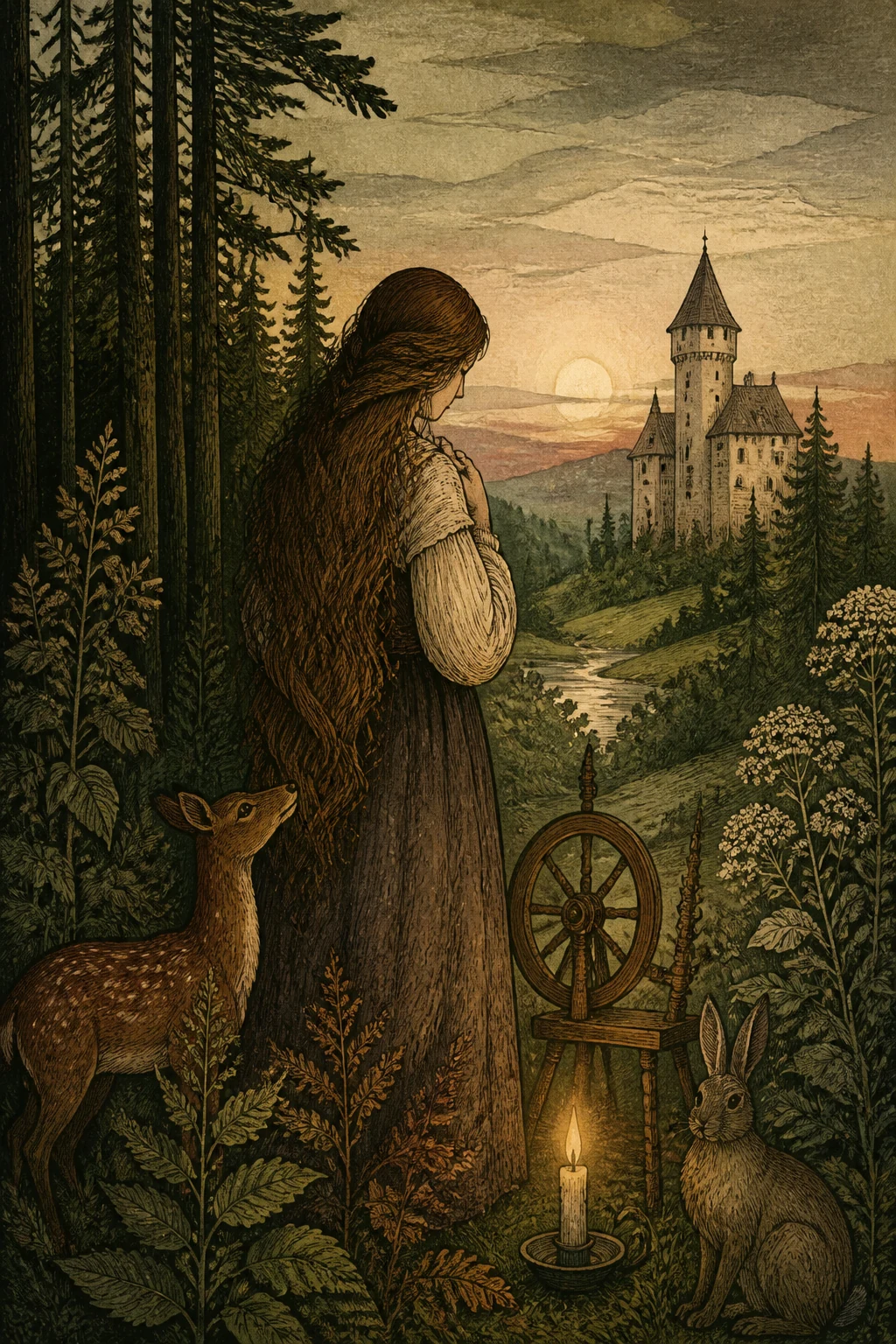
The girl remained beneath the linden until the sun went down, but he did not return. For three days she sat there from morning until evening, waiting for him, but in vain. When he had still not come on the fourth day, she said, “Surely some misfortune has befallen him. I will go out and search for him, and I will not return until I have found him.” She gathered up three of her finest dresses, one embroidered with glittering stars, the second with silver moons, and the third with golden suns, tied a handful of precious stones in her kerchief, and set out. Everywhere she went she asked after her bridegroom, but no one had seen him, and no one knew anything of him. She wandered far and wide through the world, but she could not find him. At last she hired herself out to a farmer as a herdswoman and buried her dresses and jewels beneath a stone.
Now she lived as a herdswoman, tending her herd, sorrowful and full of longing for her beloved. She had a little calf that she tamed and fed from her hand, and whenever she said:
“Little calf, little calf, kneel down to me, and never forget your herdswoman, as he, the prince, forgot his bride so fair, who sat beneath the green linden there,” the little calf would kneel down, and she would stroke it.
After she had lived for a few years in loneliness and sorrow, word spread through the land that the king’s daughter was to celebrate her wedding. The road to the city passed the village where the girl lived, and it happened that one day, as she was driving her herd out to pasture, the bridegroom rode by. He sat proudly upon his horse and did not look at her, but when she looked at him, she recognized her beloved. It was as though a sharp knife had pierced her heart. “Oh,” she said, “I thought he had remained true to me, but he has forgotten me.”
The next day he came along the same road again. When he drew near, she said to the calf, “Little calf, little calf, kneel down to me, and never forget your herdswoman, as he, the prince, forgot his bride so fair, who sat beneath the green linden there.”
When he heard her voice, he looked down and reined in his horse. He gazed into the herdswoman’s face, then held his hand before his eyes as though trying to remember something, but he quickly rode on and was soon out of sight. “Oh,” she said, “he no longer knows me,” and her sorrow grew ever deeper.
Soon afterwards a great feast was to be held at the king’s court for three days, and the whole country was invited. “Now I will make one last attempt,” the girl thought, and when evening came, she went to the stone beneath which she had buried her treasures. She brought out the dress with the golden suns, put it on, and adorned herself with the jewels. She unbound her hair, which she had kept hidden beneath a kerchief, and it fell about her in long curls. Then she went to the city, unnoticed by anyone in the darkness. When she entered the brightly lit hall, everyone drew back in amazement, but no one knew who she was. The prince came towards her, yet he did not recognize her. He led her out to dance and was so enchanted by her beauty that he forgot the other bride entirely. When the feast was over, she disappeared into the crowd and hurried back to the village before daybreak, where she put on her herdswoman’s clothes again.
The following evening she took out the dress with the silver moons and fastened a crescent of precious stones in her hair. When she appeared at the feast, every eye turned towards her, but the prince hastened to meet her and, filled with love, danced with her alone, without so much as looking at anyone else. Before she left, she had to promise him that she would return for the final evening of the feast. When she appeared for the third time, she wore the dress of stars, which glittered with every step she took, and her hairband and girdle were stars made of precious stones. The prince had been waiting for her a long time and pressed through the crowd to reach her. “Only tell me who you are,” he said. “I feel as though I have known you for so long.” “Do you not remember,” she replied, “what I did when you took leave of me?” Then she stepped closer and kissed him on the left cheek. At that instant it was as though scales fell from his eyes, and he recognized his true bride. “Come,” he said to her, “I can stay here no longer.” He took her hand and led her down to the carriage. The horses sped towards the enchanted castle as though the wind itself were harnessed before them. From far away, its lighted windows shone. As they passed the linden, countless fireflies swarmed among its branches, and the tree shook its boughs and sent its fragrance down upon them. Flowers bloomed along the stairs, the song of exotic birds rang out from the rooms, and in the hall the whole court stood assembled, while the priest waited to wed the bridegroom to his true bride.