Prevod
And now he was about to scatter thunderbolts over all the earth, but feared that the sacred ether, from so many fires, might catch flame, and the vast vault of heaven blaze. He remembered, too, that fate had appointed a time when sea and earth and the royal halls of heaven would catch and burn, and the whole fabric of the world struggle in the flames. The weapons forged by the Cyclopes’ hands were laid aside: he chose a different punishment—to destroy the mortal race beneath the waters and send rain pouring from all heaven.
At once he shut the North Wind in the caves of Aeolus, with all the other winds that drive away the gathering clouds, and unleashed the South Wind. On dripping wings the South Wind flew, his terrifying face shrouded in pitch-black darkness; his beard was heavy with rain, water streamed from his white hair; mists lay upon his brow, his wings and robes dripped dew.
And when his hand squeezed the clouds that hung far and wide, a crash rang out, and dense rain poured from heaven. Iris, Juno’s messenger, clad in her many colors, drew up water, bringing fresh sustenance to the clouds. The crops were beaten flat; the farmer’s hopes lay ruined and mourned, and all the long year’s labor came to nothing. Nor was Jupiter’s anger content with his own realm of heaven: his sea-blue brother came to his aid with waters of his own.
He summoned the rivers. When they had entered the dwelling of their sovereign, he said, “There is no need now for lengthy exhortation. Pour out all your strength: that is what we need! Open your dwellings, remove all barriers, and give your rivers wholly unbridled freedom!” He gave his orders; they returned and opened their springs’ mouths, and rolled in headlong, unchecked torrents to the sea.
The god himself struck the earth with his trident: it trembled and with its shaking opened pathways for the waters. The rivers burst their bounds and rushed across the open plains, sweeping away crops and orchards, cattle and men alike, houses and inner shrines, with all their sacred treasures. If any house remained, able to withstand so great a disaster without falling, still the rising water covered its roof, and submerged towers vanished beneath the flood.
And now there was no distinction between sea and land: all was ocean, and the ocean had no shores. One man took refuge on a hill; another sat in a curved boat, plying his oars where he had lately plowed; one sailed above his crops or over the roof of a sunken farmhouse; another caught a fish in an elm’s topmost branches. As chance would have it, an anchor lodged in a green meadow, or curved hulls scraped the vineyards beneath them; and where slender goats had lately cropped the grass, ungainly seals now settled their bodies.
The Nereids marveled at groves and cities and houses beneath the water; dolphins occupied the woods, darting among high branches and striking the swaying oaks. The wolf swam among sheep; tawny lions were borne on the waves, and tigers too; neither his lightning strength could save the boar, nor his swift legs the stag swept helplessly away. After searching long for land on which to alight, the wandering bird fell into the sea on weary wings.
The boundless ocean, freed of all restraint, had buried the hills, and unfamiliar waves were beating against mountain peaks. Most were swept away by the water; those whom the water spared were overcome by lingering hunger, with no food to sustain them. Phocis separates the Aonian fields from those of Oeta, a fertile country while it was land, but at that time part of the sea, a broad expanse of sudden waters.
There a steep mountain reaches toward the stars with twin summits, Parnassus by name, its peaks rising above the clouds. Here Deucalion, borne in a little boat with his wife, came to rest—for the sea had covered everything else— and they worshiped the Corycian nymphs, the mountain’s deities, and prophetic Themis, who then held the oracle. No man was better than he, none more devoted to justice, nor was any woman more reverent toward the gods than she.
When Jupiter saw the world lying beneath a watery waste, and that out of so many thousands only one man survived, and out of so many thousands only one woman, both blameless, both worshipers of the gods, he scattered the clouds, and, driving the rain away with the North Wind, revealed the earth to heaven and heaven to the earth. The sea’s fury, too, subsided. Laying aside his three-pronged weapon, the ruler of the deep soothed the waters, and summoned sea-blue Triton, rising above the depths, his shoulders encrusted with living shellfish, and ordered him to blow his sounding conch and give the signal for waves and rivers to retreat. Triton took up his hollow, spiraling horn,
which broadens from its narrow tip into a spreading mouth, the horn whose voice, when it takes breath in mid-ocean, fills the shores beneath both the rising and the setting sun. Now, too, when it touched the god’s lips, wet with the spray of his dripping beard, and sounded the retreat as ordered, it was heard by all the waters of the earth and sea, and every wave that heard it was restrained.
Now the sea had shores; riverbeds held their brimming streams; the rivers sank, and hills were seen emerging; the ground rose, the land spread as the waters dwindled, and after long days the woods revealed their bare treetops, their leaves still holding the mud the flood had left behind. The world had been restored. But when Deucalion saw it empty, and a profound silence reigning over the desolate lands, he spoke to Pyrrha through welling tears: “O sister, wife, only woman left alive, bound to me by our common blood, our fathers being brothers, then by marriage, and now by these very dangers, in all the lands beheld by the setting and the rising sun,
we two are the whole people; the sea has taken all the rest. Even now we cannot be sure enough that our own lives are safe; the clouds still fill me with dread. What would your feelings be, poor soul, if fate had rescued you without me? How could you bear your fear alone? Who would console you in your grief? For believe me, if the sea had taken you as well, I would follow you, my wife, and the sea would have me too.
If only I could renew the nations through my father’s arts, and breathe souls into molded earth! Now the mortal race survives in us two alone— so the gods have willed—and we remain mankind’s only specimens.” He finished, and they wept. They resolved to pray to the heavenly goddess and seek help through her sacred oracle. Without delay they went together to the waters of Cephisus, which, though not yet clear, now flowed within their familiar channel.
There they scooped up water and sprinkled it over their clothes and heads, then turned their steps toward the holy goddess’s shrine, whose gables were pale with unsightly moss, and whose altars stood without fire. When they reached the temple steps, both fell face down upon the ground and, trembling, kissed the cold stone. “If righteous prayers,” they said, “can move the powers of heaven to soften, if the anger of the gods can be turned aside, tell us, Themis, by what means the ruin of our race may be repaired, and help our drowned world, gentlest goddess.”
The goddess was moved and gave this oracle: “Leave the temple, veil your heads, loosen your girded garments, and cast behind your backs the bones of your great mother.” For a long time they stood astonished. Pyrrha was the first to break the silence, refusing to obey the goddess’s command; with trembling lips she begged forgiveness, afraid to offend her mother’s shade by casting away her bones.
Meanwhile they pondered the oracle’s words, veiled in dark obscurity, turning them over in their minds and together. Then the son of Prometheus soothed the daughter of Epimetheus with gentle words: “Either my judgment deceives me,” he said, “or the oracle is holy and urges no impious act. The great mother is Earth; I think the stones within her body are what she calls her bones. These we are told to throw behind us.”
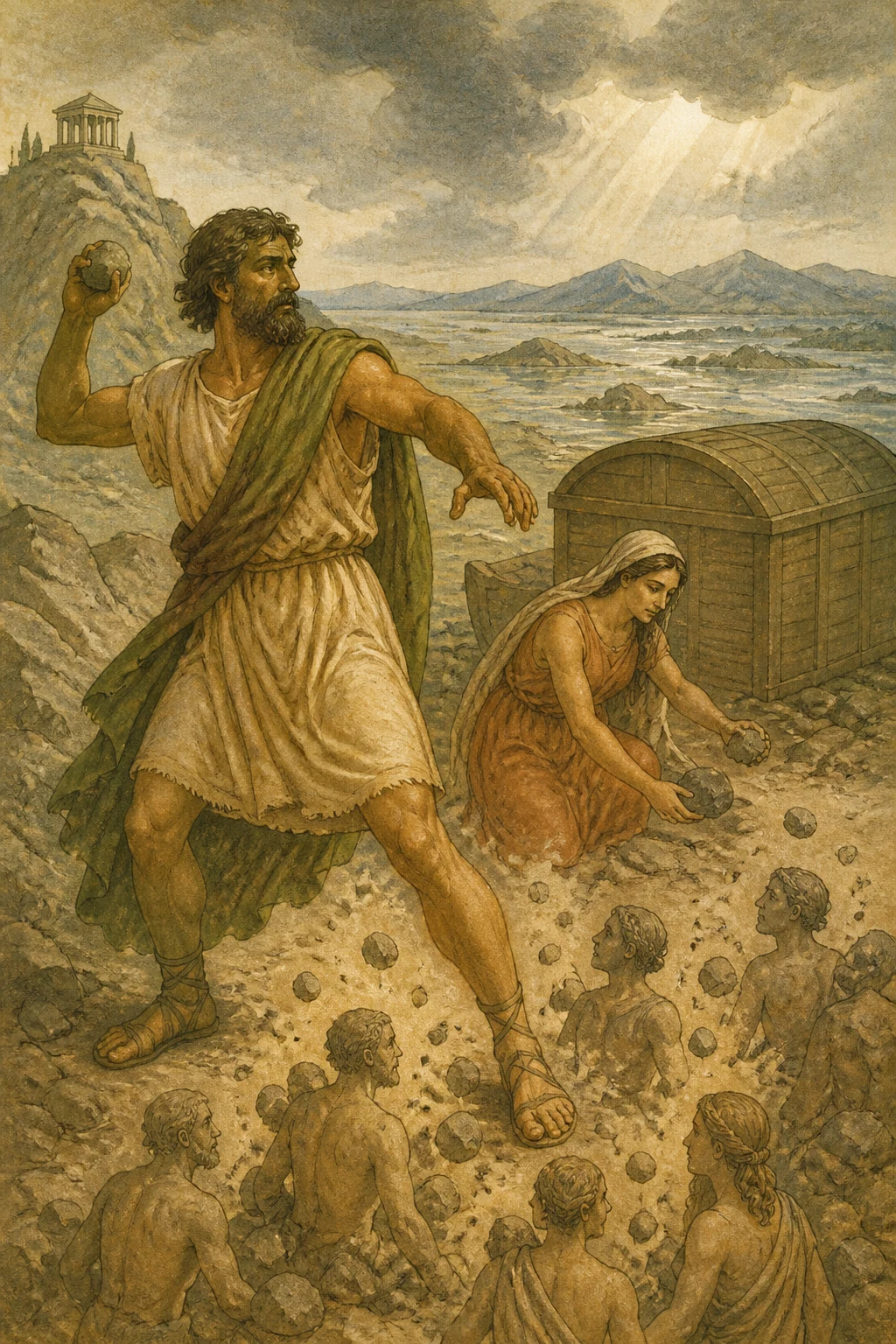
Though the Titan’s daughter was moved by her husband’s reading, her hope remained uncertain: both were so doubtful of heaven’s bidding. But what harm could there be in trying? They departed, veiled their heads, unbound their tunics, and cast the stones behind their footsteps as commanded. The stones—who would believe it, were antiquity not witness?— began to lose their hardness and rigidity, slowly softening, and as they softened, taking shape.
Soon, as they grew and acquired a gentler nature, a human form could be discerned, though still indistinct, like a figure begun in marble but not yet fully finished, closely resembling a rough-hewn statue. Yet whatever part of them was earthy and moist with any fluid changed to serve as flesh; what was solid and unyielding turned to bone; what had been a vein remained beneath the same name.
And in a little while, through the power of the gods, the stones thrown by the man’s hands took on the forms of men, and woman was restored from those the woman threw. Hence we are a hardy race, well schooled in toil, and give proof of the source from which we sprang.