Prevod
Then Alba, with its double name, and the Latin realm were under Ascanius’s sway. Silvius succeeded him. His son Latinus took the sceptre, reviving an ancient name. Illustrious Alba followed Latinus. Epytus was his son; after him came Capetus and Capys, though Capys ruled first. From them Tiberinus received the kingdom, and, drowned in the Tuscan river’s waves, gave that water his name. His sons were Remulus and fierce Acrota. Remulus, the elder, mimicked thunder and perished by a thunderbolt.
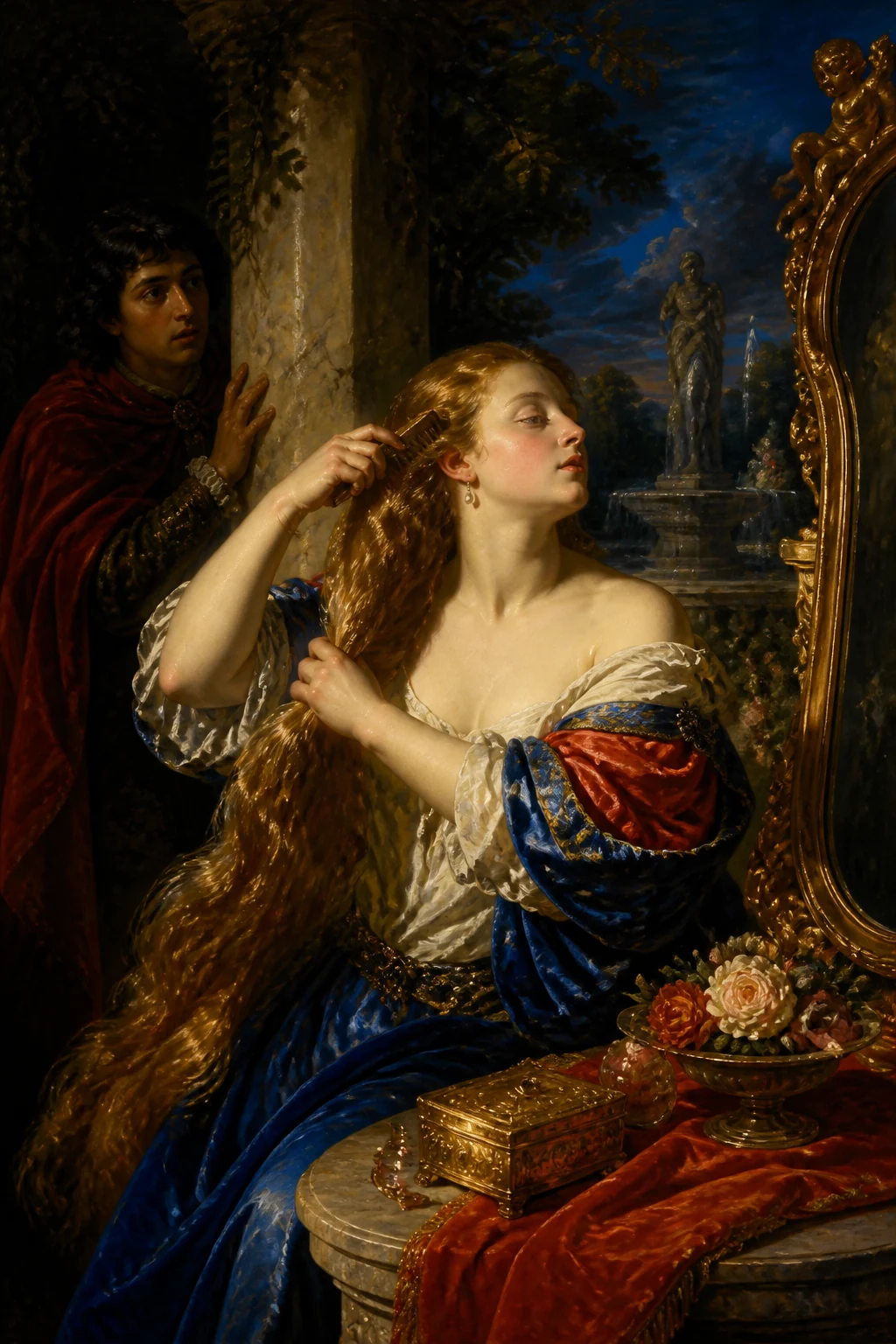
Acrota, more temperate than his brother, handed the sceptre to brave Aventinus, who lies buried on the very hill where he had ruled, and gave that hill his name. And now Proca held supreme power over the Palatine people. In this king’s reign lived Pomona: among the Latin wood-nymphs none tended gardens more skilfully, nor was any more devoted to the fruit of trees.
From this she takes her name. She loves neither woods nor rivers, but the countryside and branches laden with flourishing fruit. Her right hand bears no spear, but a curved pruning hook, with which she checks luxuriant growth and curbs the branches sprawling everywhere; or, splitting the bark, she grafts a shoot and gives sap to a foster-child not its own. Nor does she let her trees thirst, but waters the curling fibres of their thirsty roots with flowing streams.
This is her love, her passion; for love itself she has no desire. Yet, fearing violence from the country gods, she shuts herself inside her orchards, bars their entrance, and shuns all men. What did the satyrs, that troop so nimble in the dance, and the Pans, their horns wreathed in pine, and Silenus, always younger than his years, and the god who frightens thieves with sickle or phallus, not do to win her? Yet Vertumnus surpassed even these in love, though he was no more fortunate.
How often, dressed as a hardy reaper, he carried ears of corn in a basket, the very image of a reaper! Often, with fresh hay bound about his temples, he might have seemed to have been turning the cut grass; often he carried goads in his sturdy hand, so that you would have sworn he had just unyoked his weary oxen. Given a pruning hook, he was a dresser of trees and vines; with a ladder on his shoulders, you would think him off to gather fruit; with a sword he was a soldier, with a rod a fisherman.
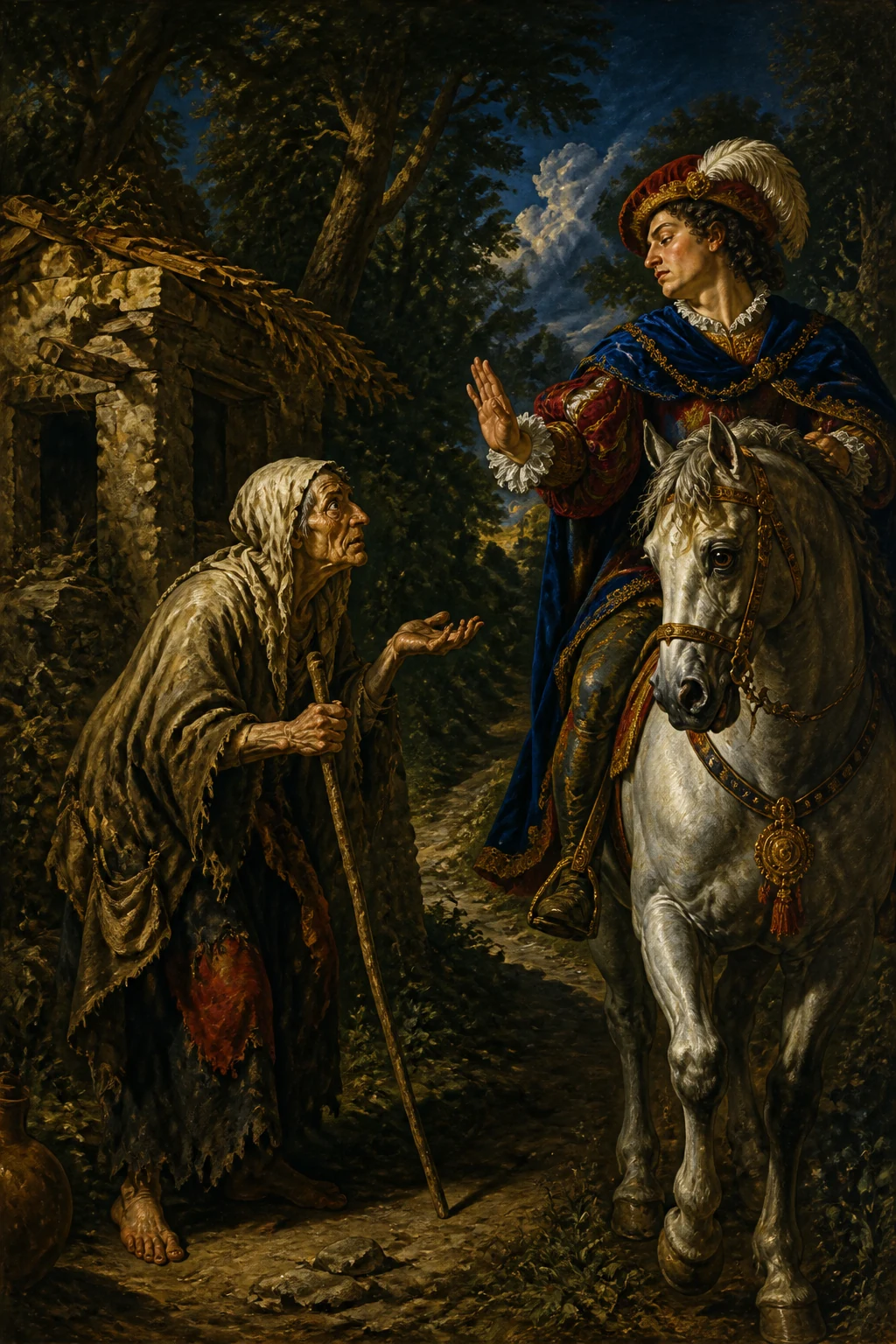
In short, through many disguises he often found a way inside, to enjoy the sight of her beauty. He even bound a patterned scarf about his head and, leaning on a staff, with grey hair spread over his temples, pretended to be an old woman and entered the well-tended gardens. He admired the fruit. “But you are lovelier still!” he said, and gave the woman he had praised a few kisses, such as no true old woman would ever have given, then sat upon a grassy mound, looking up at branches bowed beneath their autumn burden.
Opposite stood an elm, beautiful with gleaming grapes. After praising it and the vine that shared its life, he said, “Yet if that trunk stood unmarried, without its vine, it would have nothing but its leaves to make it desirable; and this vine entwined about it rests upon its strength: were it not wedded, it would lie trailing on the ground. Yet you are unmoved by this tree’s example, and shun love’s embrace, with no wish to wed.
If only you wished it! Helen would have had no more suitors pressing her, nor she who stirred the Lapiths to battle, nor the wife of Ulysses, so long delayed. Even now, though you flee and turn away from those who seek you, a thousand men desire you, and demigods and gods, and all the divinities who dwell in the Alban hills. But if you are wise, if you wish to marry well and listen to this old woman, who loves you more than all those others, more than you believe, reject these commonplace matches and choose Vertumnus to share your bed! For him you have my own pledge: he knows himself no better than I know him. He does not roam at random through the world:
he makes these broad lands his home. Nor, like most suitors, does he love whichever woman he has just seen: you will be his first and last passion, and to you alone he pledges all his years. Add to this that he is young, that nature has endowed him with beauty, and that he can readily assume any shape: whatever you command, however much you ask, he will become. And what of your shared delights? The fruit you tend is his first choice, and he holds your gifts in his glad hands.
But now he longs neither for fruit plucked from the tree, nor for the herbs your garden nourishes, with their pleasant juices, nor for anything but you. Have pity on his burning love; believe that he himself is here, pleading through my lips for what he seeks. Fear the avenging gods, the Idalian goddess who hates hard hearts, and the unforgetting wrath of Rhamnusia!
And to deepen your fear—for my long years have taught me many things—I will tell you a story known throughout Cyprus, one that may readily move you and soften your heart. Iphis, a youth of humble birth, had seen Anaxarete, a lady descended from the blood of ancient Teucer: he had seen her, and felt love’s fire through all his bones. Long he struggled, but when reason could not conquer his frenzy, he came as a suppliant to her threshold.
Now he confessed his unhappy love to her nurse, begging her, by her hopes for the girl, not to be cruel to him; now he flattered each of the many servants and pleaded anxiously for their kindly help. Often he sent his words upon coaxing tablets; sometimes he hung garlands, wet with the dew of his tears, upon her doorposts, and laid his tender body on the hard threshold, railing at the unyielding bolt.
More savage than the sea that rises when the Kids set, harder than iron smelted in Noric fires, or living rock still rooted in the earth, she scorns and mocks him, and to her pitiless deeds cruelly adds proud words, robbing her lover even of hope. Unable to endure the torment of his long suffering, Iphis spoke these final words before her doors: “You have won, Anaxarete, and at last you will no longer have to bear the nuisance of me. Prepare your joyful triumph, raise the cry of victory, and crown yourself with shining laurel!
You have won, and I die willingly. Come, iron-hearted one, rejoice! Surely you will be forced to praise one thing in my love, something that pleases you, and acknowledge what I have done. Remember, though: I did not cease to care for you before I ceased to live; I must lose two lights at once. Nor will rumour come to tell you of my death: I myself will be here, before your eyes, so you cannot doubt it, and may feast your cruel gaze upon my lifeless body.
Yet if you gods above behold the deeds of mortals, remember me—my tongue can bear to pray for nothing more—and let our story be told through distant ages; give to my fame the years you have taken from my life!” He spoke, and raised his tearful eyes and pallid arms to the doorposts he had so often adorned with garlands. As he fastened a noose to the top of the doorway, he said, “Does this garland please you, cruel, heartless woman?”
He put his head inside, still turned towards her, and hung there, a hapless burden, his throat strangled. Struck by the movement of his feet, the door opened, and the deed— struck by the movement of his feet, trembling and full of fear, it seemed to give a sound; the door opened and the deed was revealed. The servants cry out and, lifting him down in vain, carry him to his mother’s threshold, for his father was dead.
She takes him to her breast, embracing her son’s cold limbs; and after speaking the words that grieving mothers speak, and doing all that grieving mothers do, she led his funeral, weeping, through the heart of the city, his pale body borne upon a bier towards the pyre. By chance, the house stood near the road along which the mournful procession passed, and the sound of lamentation reached cruel Anaxarete’s ears. Already the avenging god drove her.
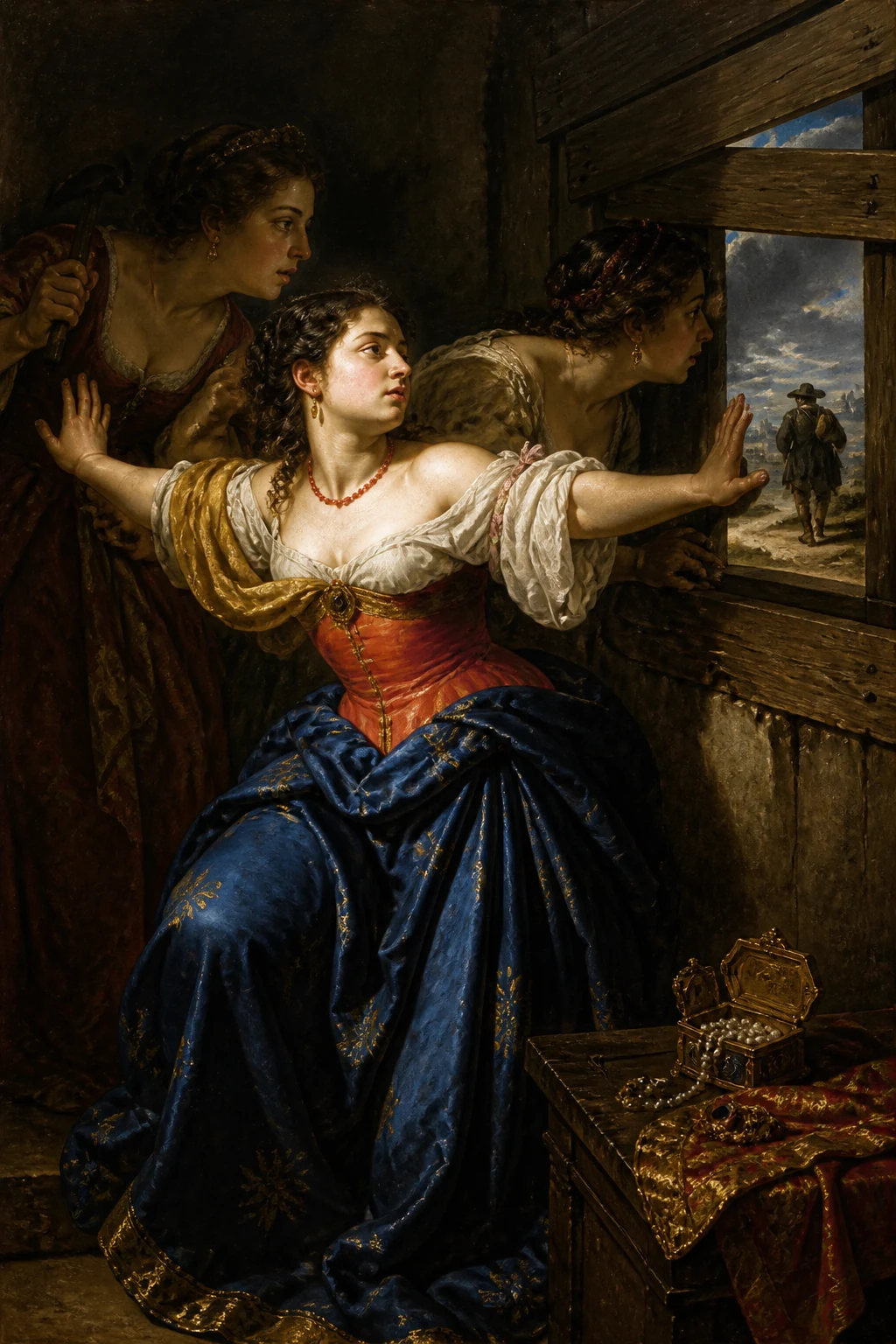
Stirred, she said, “Let us at least see this wretched funeral,” and went to an upper room with open windows. Scarcely had she caught sight of Iphis laid upon the bier when her eyes grew rigid, and the warm blood fled her body, leaving pallor in its place. She tried to step back, but stood rooted; she tried to turn her face away, but could not do that either. Little by little her limbs were seized by the stone that had long been in her unfeeling heart.
And lest you think this fiction, Salamis still preserves the statue in the lady’s likeness, and has a temple named for Venus of the Watching Gaze. Remember this, my dear, and lay aside, I beg you, your unyielding pride; unite with one who loves you, nymph. So may no spring frost scorch your budding fruit, nor rushing winds shake down its blossoms!” When the god, disguised as an old woman, had spoken these words in vain, he became a young man again, putting off the trappings of old age, and appeared before her as the sun’s most radiant face appears when it has conquered the clouds before it and shines out with nothing in its way.
He prepares to use force; but force is needless: the nymph, captivated by the god’s beauty, felt love’s answering wound.