Prevod
While Iole told this wondrous tale, and Alcmene reached out her thumb to dry the tears of Eurytus’ daughter (though she too was weeping), a strange new sight dispelled all their sorrow. For on the lofty threshold stood Iolaus, almost a boy, his cheeks barely veiled in down, his face restored to the freshness of his earliest youth. This gift had been bestowed on him by Hebe, Juno’s daughter, won over by her husband’s prayers. But when she was about to swear that she would grant such gifts to no one after him, Themis would not allow it. “For even now,” she said, “divided Thebes is stirring war. Capaneus can be conquered by none but Jupiter; the brothers will fall by wounds alike;
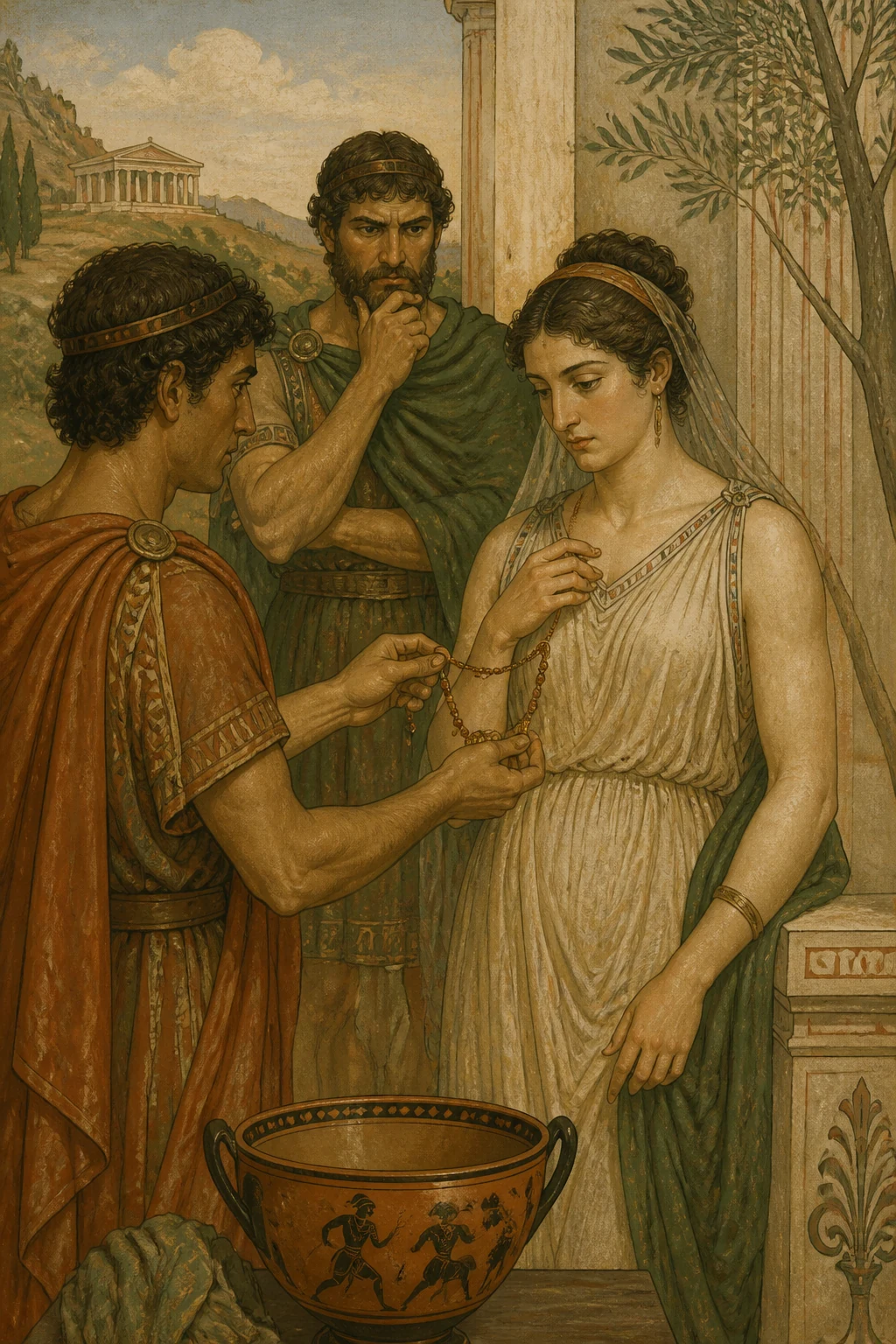
the earth will open, and the seer, still living, will behold his own shade. A son, avenging one parent upon the other, will be dutiful and wicked in a single deed; and, stunned by suffering, exiled from both home and reason, he will be hounded by the Furies’ faces and his mother’s ghost, until his wife demands of him the fatal gold, and a sword of Phegeus’ house pierces its kinsman’s side.
Then at last Callirhoe, Achelous’ daughter, will beseech great Jupiter to grant her infant sons these added years, so that their father’s murder may not long remain unavenged. Moved by her prayers, Jupiter will command his stepdaughter, his son’s wife, to grant this gift, and make them men before their time.”
Izvirnik
Source ID: ovid_metamorphoses_story_064 Citation: Ovid, Metamorphoses 9.394-9.417 Original language: Latin Source: PerseusDL canonical-latinLit Source URL: https://github.com/PerseusDL/canonical-latinLit/blob/master/data/phi0959/phi006/phi0959.phi006.perseus-lat2.xml Segmentation certainty: medium 394: Dumque refert Iole factum mirabile, dumque 395: Eurytidos lacrimas admoto pollice siccat 396: Alcmene (flet et ipsa tamen), conpescuit omnem 397: res nova tristitiam. Nam limine constitit alto 398: paene puer dubiaque tegens lanugine malas 399: ora reformatus primos Iolaus in annos.
400: Hoc illi dederat Iunonia muneris Hebe, 401: victa viri precibus. Quae cum iurare pararet 402: dona tributuram post hunc se talia nulli, 403: non est passa Themis: “Nam iam discordia Thebae 404: bella movent” dixit “Capaneusque nisi ab Iove vinci 405: haud poterit, fientque pares in vulnere fratres, 406: subductaque suos manes tellure videbit 407: vivus adhuc vates; ultusque parente parentem 408: natus erit facto pius et sceleratus eodem; 409: attonitusque malis exsul mentisque domusque, 410: vultibus Eumenidum matrisque agitabitur umbris, 411: donec eum coniunx fatale poposcerit aurum,
412: cognatumque latus Phegeius hauserit ensis. 413: Tum demum magno petet hos Acheloia supplex 414: ab Iove Callirhoe natis infantibus annos 415: neve necem sinat esse diu victoris inultam, 416: Iuppiter his motus privignae dona nurusque 417: praecipiet facietque viros inpubibus annis.”