Prevod
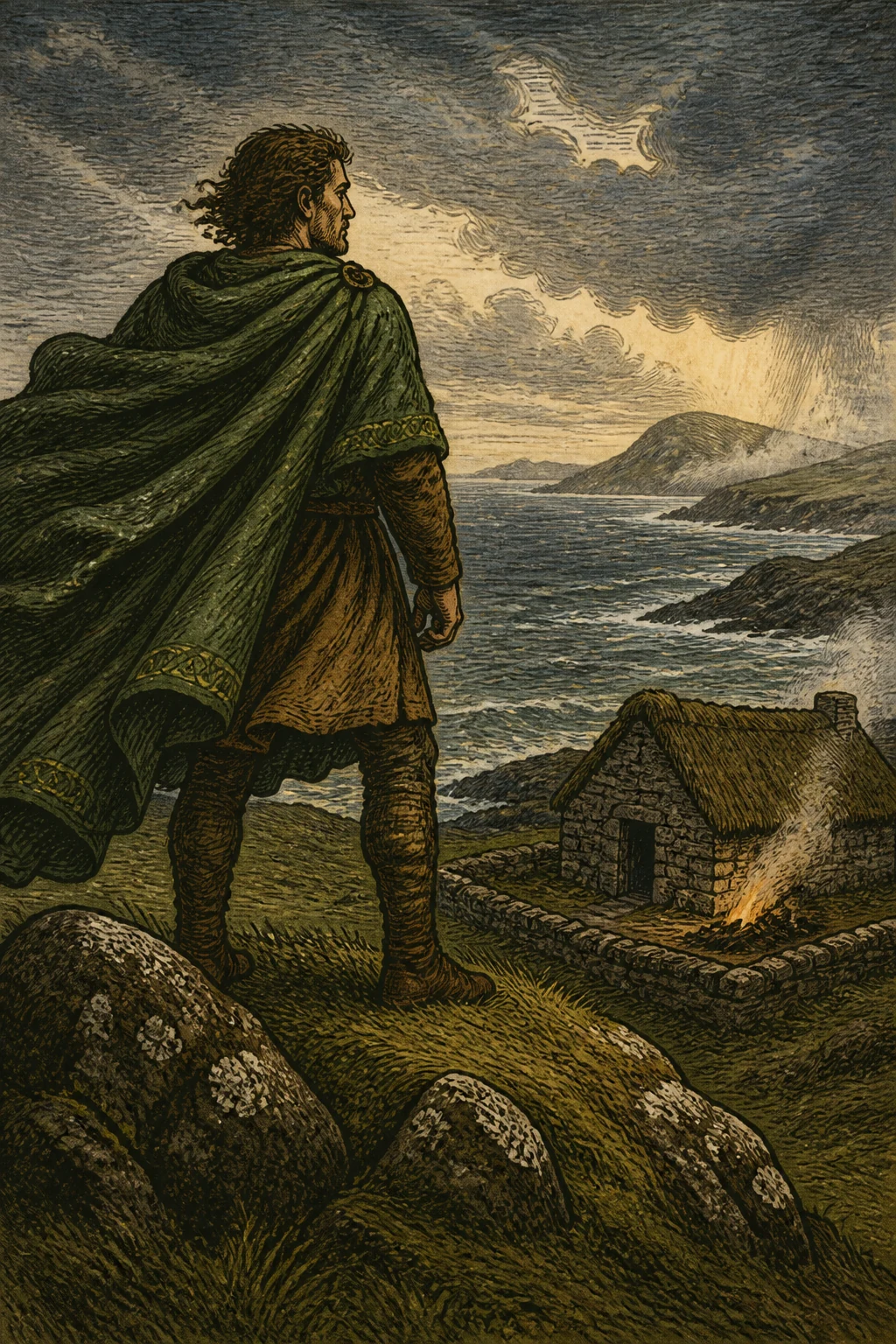
Long ago there lived a man named William Ó Ruanaigh, in a house near Claregalway. He was a farmer. One day his landlord came to him and said, “You owe me three years’ rent, and unless you have it for me within a week, I shall turn you out onto the roadside.”
“I am going to Galway tomorrow with a load of wheat to sell, and when I have the money for it I shall pay you,” said Liam. Early the following morning he loaded the wheat onto his cart and set off for Galway.
When he had gone about a mile and a half from home, a gentleman came up to him and asked, “Is that wheat you have on the cart?”
“It is,” said Liam. “I am taking it to sell so that I can pay my rent.” “How much is there?” asked the gentleman. “A good ton,” said Liam.
“I shall buy it from you,” said the gentleman, “and give you the highest price in the market. When you come to the cart track on your left, turn in and follow it until you reach a large house in a valley. I shall be there before you, ready to give you your money.” When Liam reached the cart track, he turned in and followed it until he came to a large house. He was astonished to see it, for he had been born and reared in that neighbourhood and had never seen the house before, though he knew every house within five miles.
As Liam approached a barn beside the great house, a little boy came out and said, “A hundred thousand welcomes to you, Liam Ó Ruanaigh.” He put a sack on his back and carried it inside. Another little boy came out, welcomed Liam, put a sack on his back, and went inside with it. The boys kept coming, welcoming Liam and carrying away sacks, until the whole ton of wheat was gone. Then all the boys gathered round, and Liam said to them, “You all know me, but I do not know any of you.” They said to him, “Go inside and eat your dinner. The master is waiting for you.”
Liam went in and sat down at the table. He had scarcely taken his second mouthful when a heavy sleep came over him and he fell beneath the table. Then the enchanter made a likeness of Liam and sent it home to Liam’s wife with his horse and cart. When it reached Liam’s house, it fell down on the floor, and before long word went round that Liam Ó Ruanaigh was dead. His wife put water on to heat, and when it was warm she washed the body and laid it out on a board. The neighbours came and lamented sorrowfully over the corpse, and there was great pity for the poor woman. She herself, however, was not very grieved, for Liam was old and she was young. The next day the body was buried, and no more thought was given to Liam.
Liam’s wife had a servant boy, and she said to him, “You ought to marry me and take Liam’s place.” “It is too soon yet, after a death in the house,” said the boy. “Wait until Liam has been buried a week.”
When Liam had slept for seven days and seven nights, a little boy came and woke him. Then he said, “You have been asleep for a week. We sent your horse and cart home. Here is your money, and be off with you.”
Liam came home, and as it was late at night, no one saw him. That morning Liam’s wife and the servant boy had gone to the priest and asked him to marry them.
“Have you the marriage fee?” asked the priest. “No,” said the woman, “but I have a fine pig at home, and you may have her instead of money.”
The priest married them and said, “I shall send for the pig tomorrow.” When Liam reached his own door, he knocked. His wife and the servant boy were going to bed, and they asked, “Who is there?”
When they heard his voice, they knew it was Liam, and his wife said, “I cannot let you in. You ought to be ashamed of yourself, coming back after you have been seven days in the grave.”
“Are you mad?” said Liam. “I am not mad,” said the woman. “Everyone in the parish knows that you died and that I gave you a decent burial. Go back to your grave, and I shall have a Mass said for your poor soul tomorrow.”
“Wait until daylight,” said Liam, “and I shall give you something to laugh about.” Then he went into the stable, where his horse and pig were, stretched himself out in the straw, and fell asleep.
Early the next morning the priest said to a little boy he kept, “Go to Liam Ó Ruanaigh’s house, and the woman I married yesterday will give you a pig to bring home.”
The boy came to the door of the house and began beating on it with a stick he carried. The woman was afraid to open the door, but she asked, “Who is there?”
“It is me,” said the boy. “The priest sent me to get a pig from you.” “She is outside in the stable,” said the woman. The boy went into the stable and began driving the pig out, when Liam rose and said, “Where are you going with my pig?”
When the boy saw Liam, he took to his heels and did not stop until he reached the priest, his heart almost coming out of his mouth with fright.
“What is the matter with you?” asked the priest. The boy told him that Liam Ó Ruanaigh was in the stable and would not let him take the pig. “Hold your tongue, you liar,” said the priest. “Liam Ó Ruanaigh is dead and has been in the grave for a week.”
“Even if he had been dead for seven years, I saw him in the stable two minutes ago. If you do not believe me, come yourself and you will see him.”
Then the priest and the boy went together to the stable door, and the priest said, “Go in and drive that pig out to me.”
“I would not go in for all you are worth,” said the boy. So the priest went in himself and was driving the pig out when Liam rose from the straw and said, “Where are you going with my pig, Father Patrick?”
When the priest saw Liam rising, he fled for his life, saying, “In the name of God, I command you to return to the grave, William Ó Ruanaigh!”
Liam began running after the priest, calling, “Father Patrick, are you mad? Wait and speak to me.” But the priest did not wait. He went home as fast as his legs could carry him, and when he got inside he shut the door. Liam beat on the door until he was weary, but the priest would not let him in. At last he put his head out of an upstairs window and said, “William Ó Ruanaigh, go back to your grave.”
“You are mad, Father Patrick. I am not dead, and I have never been in any grave since I left my mother’s womb,” said Liam. “I saw you dead,” said the priest. “You died suddenly, and I was there when you were put in the grave. I preached a fine sermon over you.”
“The devil take me, but you are as surely mad as I am alive,” said Liam. “Get out of my sight now, and I shall say a Mass for you tomorrow,” said the priest.
Liam went home and knocked at his own door, but his wife would not let him in. Then he said to himself, “I shall go and pay my rent.” Everyone who saw Liam on his way to the landlord’s house ran away from him, for they were certain he had died. When the landlord heard that Liam Ó Ruanaigh was coming, he shut the doors and would not let him in. Liam began pounding on the great door until the landlord thought he would break it down. He came to an upstairs window and asked, “What do you want?”
“I have come to pay my rent, like an honest man,” said Liam. “Go back to your grave, and I shall forgive you the debt,” said the landlord.
“I shall not leave here until I have it in writing from you that my rent is paid in full until next May Day.” The landlord gave him the paper, and he went home. He knocked at the door, but his wife would not let him in, saying that Liam Ó Ruanaigh was dead and buried and that the man at the door was nothing but an impostor.
“I am no impostor,” said Liam. “I have just paid three years’ rent to my landlord, and I shall have possession of my own house, or know the reason why.”
He went to the barn and found a large iron crowbar, and it was not long before he broke in the door. His wife and her new husband were terrified. They thought the hour of resurrection had come and the world was coming to an end.
“What made you think I was dead?” asked Liam. “Does not everyone in the parish know that—” “Your body to the devil!” said Liam. “You have made a fool of me long enough. Give me something to eat.”
The poor woman was very frightened and gave him food. When she saw him eating and drinking, she said, “It is a miracle.”
Then Liam told her his story from beginning to end, and when he had told her everything, he said, “I shall go to the grave tomorrow and see the scoundrel you buried in my place.”
The next day Liam took a party of men with him and went to the graveyard. They opened the grave and were about to open the coffin when, as they lifted it up, a great black dog leaped out and ran off at full speed, with Liam and the other men after it. They followed until they saw it go into the house where Liam had slept. Then the earth opened and the house sank down, and no one has seen it since, but the great hole can still be seen to this day.
When Liam and the young men went home, they told the parish priest everything, and he dissolved the marriage between Liam’s wife and the servant boy.
Liam lived for many years afterwards and left great wealth behind him. He is still remembered in Claregalway, and always will be, if this tale is passed from the old people to the young.