Prevod
_Pacione sends his five sons out into the world to learn a trade. When they all return with some useful skill, they set off to rescue a king’s daughter who has been carried away by an ogre. After various adventures, they dispute which of them has proved himself most deserving of her hand; but the king gives her to their father, as the tree from which all these branches sprang._ _When Antonella’s tale was finished, it was Ciulla’s turn to speak. Settling herself comfortably on her seat and casting a glance around, she began with a charming grace._ Anyone who sits brooding over the ashes has no more brains than a cat. He who never travels sees nothing; he who sees nothing knows nothing; he who ventures abroad comes home knowing his way about;
practice makes the physician, and getting off your straw mattress sharpens a man’s wits, as I shall show you by the living proof of the tale that follows.
Once upon a time there was a good, honest man named Pacione, who had five sons so utterly worthless that they were good for nothing. At last their poor father, unable to keep feeding them, resolved one day to get them off his hands. “My sons,” he said, “God knows how dearly I love you, for after all you sprang from my own loins. But I am old and can do little work, while you are young and eat far too much, and I can no longer make ends meet as I used to. Every man for himself, and Heaven for us all! So off you go: find yourselves masters and learn some useful occupation. But mind you do not engage yourselves for more than a year. When that time is up, I expect you home with some skill to your credit.” Hearing his decision, the sons took their leave, packed a few rags to change into, and set out, each along his own road, to seek their fortunes. At the end of the year, as agreed, they all returned to their father’s house, where he welcomed them most affectionately. He had the table laid at once, and, since they were weary and worn out, sat them down to eat. In the middle of the meal a bird was heard singing, whereupon the youngest of the five rose from the table and went outside to listen. By the time he returned, the cloth had been cleared away, and Pacione began questioning his sons. “Now then, give this heart of mine a little comfort. Let us hear what fine skills you have learned in all this time.” Luccio, the eldest, said, “I have learned the art of thieving, and have become the grand panjandrum of rogues, the master craftsman of robbers, the very quintessence of light-fingered fellows. You will find no match for this fine lad when it comes to deftly trimming and snipping cloaks, bundling up and whisking away the wash, clawing out and lightening pockets, ransacking and clearing shops, shaking down and picking purses, sweeping out and emptying chests. Wherever I go, I work wonders with my nimble fingers.” “Bravo indeed!” answered his father. “You have learned a fine merchant’s trade: exchanging flourishes of the fingers for receipts upon your back, turns of a key for strokes of an oar, and climbs through windows for drops from a rope. Alas for me! Better you had learned to turn a spinning wheel than set my insides spinning like one. Any moment I expect to see you in the middle of the court wearing a little paper cap, or stripped to your hide and handed an oar; and if you escape that, I shall end by seeing you swung round on a rope.”
With that he turned to Titillo, his second son, and said, “And you, what fine trade have you learned?” “Boatbuilding,” answered the son. “That is better,” replied his father, “for it is an honourable trade, and you can earn your living by it. And you, Renzone, what can you do after all this time?” “I can shoot a crossbow so straight,” said the son, “that I can put out a cock’s eye.” “That too is something,” said his father, “for you can get by hunting and earn your bread.” Turning to the fourth, he asked the same question. “As for me,” said Ghiacuccio, “I can recognise a herb that brings the dead back to life.” “Bravo, priest of Lanfusa!” answered Pacione. “Now we shall leave poverty behind us and make people live longer than the Verlascio of Capua.” Last of all he asked his youngest son, Menecuccio, what he could do.
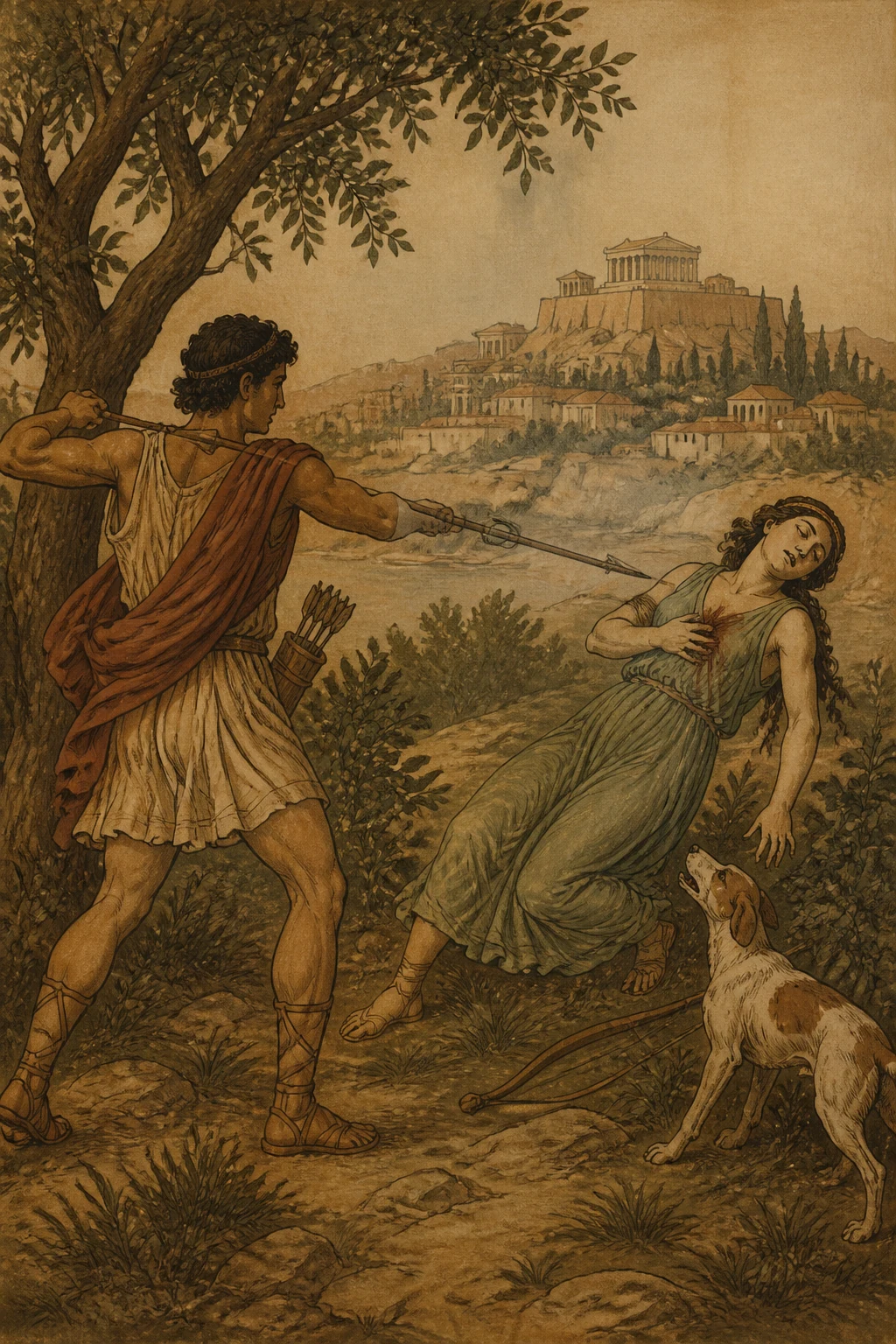
“I can understand the language of birds,” he said. “So that was why,” replied his father, “you got up while we were at table to listen to that sparrow’s twittering! Well, since you boast of understanding what they say, tell me what you heard from the bird up in the tree.” “It was saying,” answered Menecuccio, “that an ogre has carried off the daughter of the King of Autoguorfo and taken her to a rocky island, where no one can get any news of her, old or new. Her father has had a proclamation made that whoever finds his daughter and brings her back shall have her for his wife.” “If that is so, we are rich!” cried Luccio. “For I have skill enough to steal her from the ogre’s clutches.” “If you are sure you can do it,” the old man added, “let us go to the king this very instant, and, provided he gives his word to keep his promise, offer to find his daughter.” They all agreed, and Titillo promptly built a fine boat. They climbed aboard, set sail, and crossed to Auto-guorfo, where they obtained an audience with the king and offered to recover his daughter, receiving fresh assurances of his promise. They then sailed to the rocky island, where, by good fortune, they found that the ogre had come out into the sunshine and fallen asleep with his head in the lap of the king’s daughter, whose name was Cianna. At the sight of the approaching boat she was so overjoyed that she made to get up; but Pacione signalled her to keep quiet. They placed a large stone beneath the ogre’s head, helped Cianna to her feet, and, once aboard the boat, began plying their oars. They had not gone far from shore when the ogre awoke. Finding Cianna no longer beside him, he looked down towards the sea and saw the boat carrying her away. At once he changed himself into a black cloud and raced through the air to overtake it. Cianna, who knew the ogre’s tricks, realised that he was coming hidden inside the cloud, and was so terrified that she scarcely had time to warn Pacione and his sons before she died of fright. Renzone, seeing the cloud draw near, seized a crossbow and shot straight into the ogre’s eyes. In his agony the ogre fell out of the cloud like a hailstone—thump, down he went! All this time they had stood dumbfounded, their eyes fixed on the cloud; but when they turned to see how Cianna was faring in the boat, they found her stretched out stiff, knocked clean out of the game of life. At the sight, Pacione began tearing his beard. “There go the oil and the night’s watching, both wasted! There go our labours to the winds and our hopes to the sea! She has gone off to pasture and left us to starve. She has bidden us good night to give us a miserable day. She has snapped the thread of her life so that the whole cord of our hopes should snap as well. Plainly a poor man’s schemes never prosper! Plainly he who is born unlucky dies unhappy!
“So much for rescuing the king’s daughter! So much for returning to Auto-guorfo, winning a wife, holding splendid celebrations, gaining a sceptre—and landing flat on our backsides!” Jacuccio listened to this lamentation, but at last, seeing that the song was going on far too long, with ever more elaborate flourishes on the lute of grief, he said, “Easy, Father! We shall go to Auto-guorfo and be happier and better off than you imagine.” “May the Grand Turk have such happiness!” answered Pacione. “When we take this corpse to her father, he will make us count the cost, not count out money. Where others have sailed happily across this gulf with a single breath of wind, we shall choke and founder.” “Quiet!” replied Jacuccio. “Where have you sent your wits out to graze? Have you forgotten the skill I learned? Let us go ashore and let me look for the herb I have in mind, and you will see something worth seeing.” At these words his father took heart and embraced him. Eagerness tugged at him, and he in turn tugged at the oar, until before long they reached the shore of Auto-guorfo. Jacuccio went ashore, found the herb, and hurried back to the boat. He squeezed its juice into Cianna’s mouth, and at once she came back to life, like a frog that has been in the Cave of Dogs and is then thrown into Lake Agnano. Full of joy, they went to the king, who could not have enough of embracing and kissing his daughter and thanking those who had brought her back.
But when they pressed him to fulfil his promise, the king said, “To which of you am I to give Cianna? She is no millet cake to be cut into slices. One of you must get the bean in the sweetmeat, and the rest make do with a toothpick.” The eldest, who was a cunning fellow, replied, “Sire, the reward should be in proportion to the labour. Consider, then, who has done most to earn this delicious morsel, and judge as justice requires.” “You speak like Orlando,” answered the king. “So tell me what you have done, that my eyes may not stray when I come to judge straight.” When each had recounted his exploits, the king turned to Pacione and said, “And what part did you play in this business?” “I think I played a considerable one,” replied Pacione, “for I made men of these sons of mine, and it was by sheer kicks that I made them learn the skills they possess. Otherwise they would still be so many empty baskets, whereas now they bear such fine fruit.”
Having heard both sides, chewed over and pondered the arguments of one and another, and examined and considered what justice required, the king decreed that Cianna should belong to Pacione, as the first source of his daughter’s deliverance. And so it was done. The sons received a handful of coins to put to profitable use, while their father grew so joyful that he became like a boy of fifteen again. Thus the proverb fitted him to perfection: _When two men go to law,_ _The third enjoys the prize._