Prevod
The son of Hippotas had shut the winds in their everlasting prison, and Lucifer, who summons men to work, had risen, brightest in the lofty heavens. Perseus took up his wings and bound them to both feet, girded on his hooked blade, and, stirring his winged sandals, cleaved the clear air. Leaving countless nations behind him, around and below, he saw the peoples of Ethiopia and the fields of Cepheus.
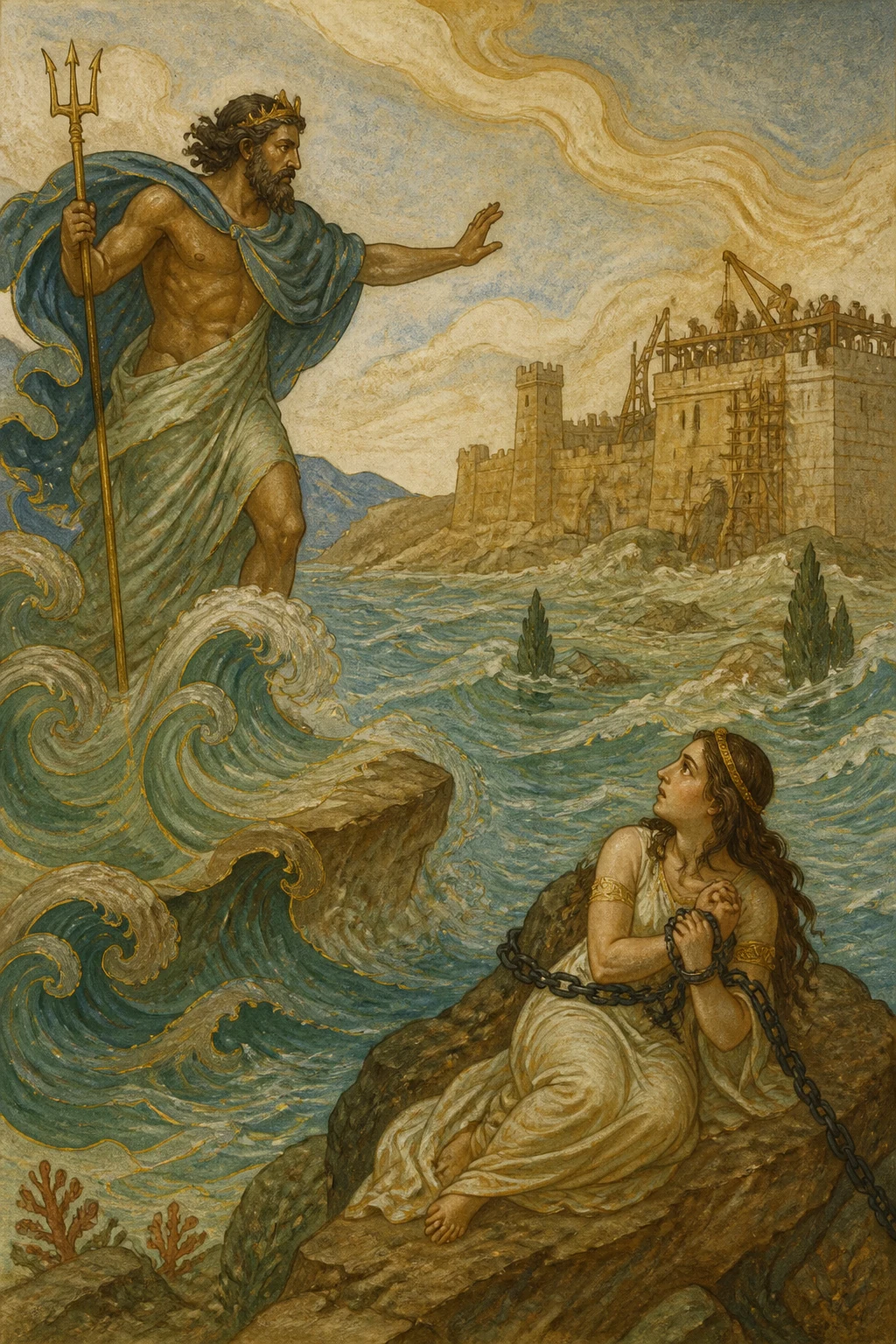
There unjust Ammon had decreed that innocent Andromeda must pay the penalty for her mother’s tongue. As soon as the descendant of Abas saw her, her arms bound to the unyielding rocks—had a light breeze not stirred her hair, and warm tears not streamed from her eyes, he would have thought her carved from marble—he unknowingly caught fire with love, and stood amazed; so spellbound by the beauty he beheld, he almost forgot to beat his wings in the air.
When he had come to a halt, he said, “You deserve no chains but those that bind ardent lovers to each other. Tell me, I beg you, your name and your country’s, and why you wear these bonds.” At first she was silent: a maiden, she dared not address a man, and would have hidden her modest face in her hands, had she not been bound. She did what she could: she filled her eyes with welling tears.
As he pressed her again and again, lest she seem unwilling to confess some fault of her own, she told him her name and her country’s, and how great her mother’s pride in her beauty had been. Before the tale was finished, the waves roared, and a monster advancing over the boundless sea loomed above them, its breast covering a broad stretch of water. The maiden cried out. Her grieving father came, and her mother with him, both wretched, though she more deservedly.
They brought no help, only tears befitting the hour and lamentation, and clung to their daughter’s fettered body, until the stranger spoke: “There will be time enough for tears; the hour for bringing help is brief. Were I to ask for her hand—I, Perseus, born of Jove and the woman whom Jupiter, though she was imprisoned, filled with fruitful gold; I, Perseus, conqueror of the snake-haired Gorgon, who dared to travel through the airy heavens on beating wings— surely you would prefer me to all others as your son-in-law.
To these great gifts I will try to add a service, if only the gods will favor me. My bargain is this: saved by my courage, let her be mine.” They accepted his terms—who could have hesitated?—and begged his help; her parents promised their kingdom as her dowry besides. Now, as a swift ship with its jutting beak plows the waters, driven by young men’s sweating arms, so the beast, parting the waves with the thrust of its breast, was just as far from the rocks as a Balearic sling can send its whirling lead shot through the open sky, when suddenly the young man thrust his feet against the earth and soared high into the clouds. When his shadow appeared on the surface of the sea, the beast raged at the shadow it saw.
And as Jove’s eagle, when it spies in an empty field a serpent exposing its livid back to Phoebus, swoops upon it from behind and, lest it turn its savage jaws, fixes its greedy talons in the scaly neck, so Perseus plunged headlong through the air in swift flight and landed on the monster’s back; into its roaring right shoulder the descendant of Inachus sank his blade up to the curving hook.
Stricken by the grievous wound, now it reared high into the air, now plunged beneath the waters, now twisted like a savage boar terrified by a pack of baying hounds. On his swift wings he escaped its ravenous bites, and wherever an opening offered—now its back, studded with hollow shells, now the ribs along its flanks, now where its tapering tail ended like a fish’s—he wounded it with his sickle-shaped sword.
The monster spewed seawater mingled with crimson blood from its mouth; the spray soaked his wings and weighed them down. No longer daring to trust his waterlogged sandals, Perseus spied a rock whose tip rose above the water when the sea was still, but vanished beneath the surging waves. Bracing himself upon it, and gripping its upper ledge with his left hand, he drove his blade three times, four times, through the monster’s flanks.
Shouts and applause filled the shores and the lofty homes of the gods. Cassiope and Cepheus, the father, rejoiced, hailed him as their son-in-law, and acknowledged him as the savior and protector of their house. Freed from her chains, the maiden came forward, both the cause and the reward of his labor. He scooped up water and washed his victorious hands; then, lest the harsh sand harm the snake-bearing head, he softened the ground with leaves, spread branches grown beneath the sea, and laid Medusa’s head, the daughter of Phorcys, upon them.
The fresh branches, still living, with their absorbent pith, drew in the monster’s power and hardened at its touch, taking on a strange new stiffness in their boughs and leaves. The sea nymphs tried this marvel on more branches, and rejoiced to see the same thing happen; then scattered seeds from them again and again through the waves. Even now coral retains this same nature: it hardens at the touch of air, and what was a pliant branch beneath the sea becomes stone above it.
For three gods he built three altars of turf: the left for Mercury, the right for you, warrior maiden, and the middle altar for Jove. A cow was sacrificed to Minerva, a calf to the wing-footed god, a bull to you, highest of the gods. At once he took Andromeda, without a dowry, as the reward for his great deed. Hymenaeus and Love shook wedding torches before them; the fires were fed with lavish incense, garlands hung from the roofs, and everywhere lyres, pipes, and songs resounded, joyful tokens of rejoicing hearts. The doors were thrown open, revealing all the golden halls, and the nobles of Cepheus’s court entered the king’s banquet, splendidly prepared.