Prevod
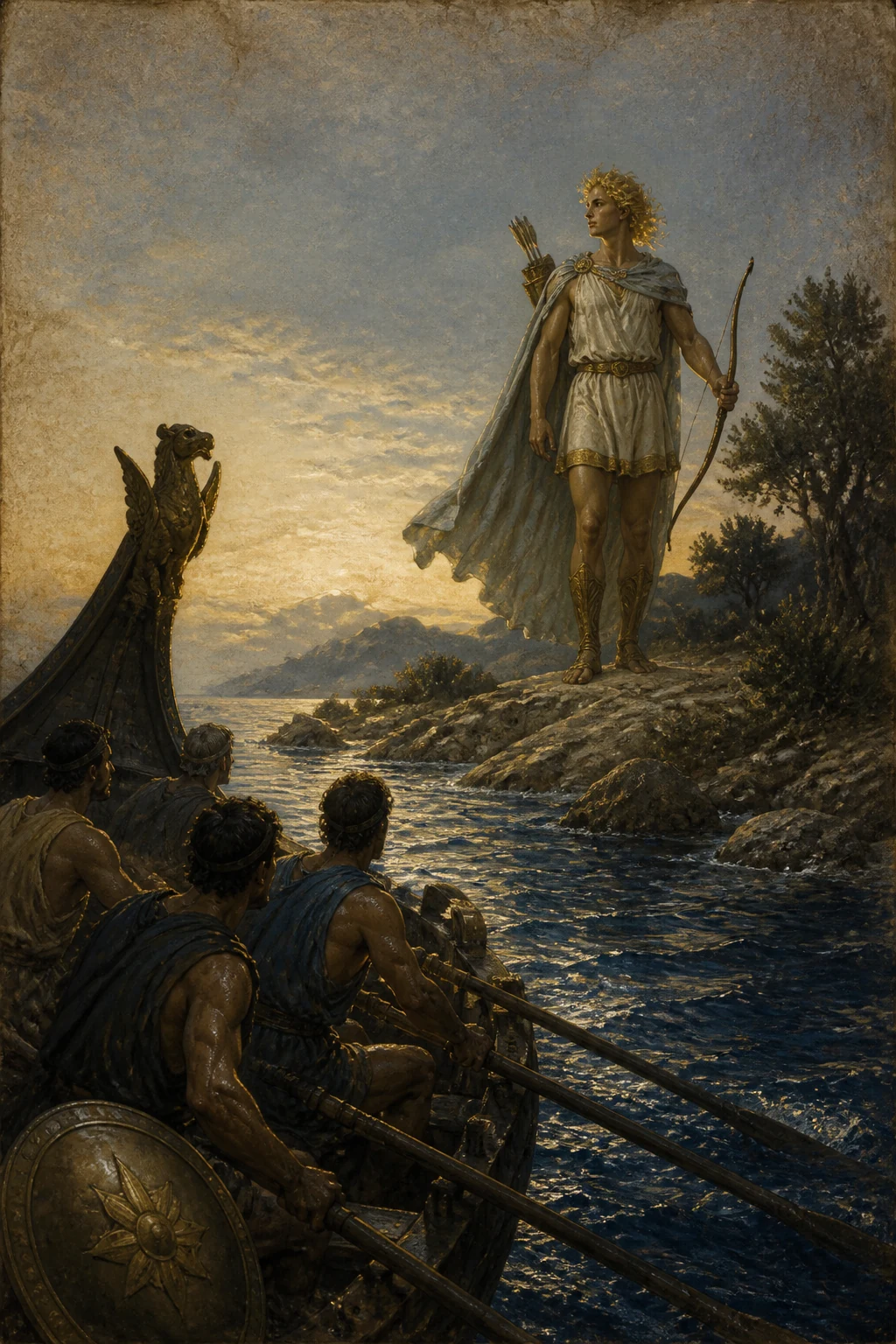
His vengeance taken, he left Tmolus and, borne through the clear air, came to rest, on this side of the narrow strait of Helle, Nephele’s daughter, in the fields of Laomedon—Apollo, the son of Latona. To the right of Sigeum, to the left of deep Rhoeteum, stands an ancient altar sacred to the Thunderer, source of every omen. From there he saw Laomedon beginning to raise the walls of new Troy, and the great undertaking growing through arduous toil and calling for no little wealth.
Together with the trident-bearing father of the swelling deep, he assumed a mortal shape and, for the ruler of Phrygia, built the walls, having agreed on gold as payment. The work stood finished: the king denied the debt and added, to crown his treachery, false oaths to his lying words. “You will not escape unpunished,” said the ruler of the sea, and drove all his waters against the shores of grasping Troy, flooding the land until it was a sea, stripping the farmers of their wealth and burying their fields beneath the waves.
Nor was this punishment enough: the king’s own daughter was demanded for a sea monster. Bound to the cruel rocks, she was rescued by Hercules, who claimed the promised reward, the horses pledged to him; and when payment for that great deed was refused, he captured the walls of twice-perjured Troy. Nor did Telamon, his comrade in arms, depart without honour: Hesione was given to him as his bride. For Peleus already was famed for his goddess-wife, and took no greater pride in his grandfather’s name than in his father-in-law’s: more than one man had been granted Jupiter as grandfather, but he alone a goddess as wife.
For old Proteus had said to Thetis, “Goddess of the waves, conceive a child: you will be mother to a youth who, in his prime, will surpass his father’s deeds and be called greater than he.” So, lest the world should hold anything greater than Jupiter, though he had felt no feeble flame of passion in his breast, Jupiter shunned marriage with Thetis of the sea and commanded his grandson, the son of Aeacus, to take his place in that desire and seek the sea-maiden’s embrace.
There is a bay in Thessaly, curved like a sickle’s blade: its arms reach out to form what, were the water deeper, would be a harbour; the sea barely covers the sand. Its beach is firm, neither retaining footprints nor hindering the traveller, nor yielding beneath a covering of weed. Nearby is a myrtle grove, laden with berries of two colours, and in its midst a cave—whether made by nature or art is doubtful, though it seems more likely art. There you often came, Thetis, naked, riding a dolphin with a bridle.
There Peleus seized you as you lay bound in sleep; and since you resisted when he tried to win you with entreaties, he resorted to force, locking both arms about your neck. Had you not turned to your accustomed arts, changing your shape again and again, he would have achieved his daring aim. But now you were a bird—yet he still held the bird; now a massive tree—yet Peleus clung to the tree; your third shape was a spotted tigress: terrified by that, the son of Aeacus loosened his arms from your body.
Then he worshipped the gods of the sea, pouring wine upon the waves, offering the entrails of sheep and the smoke of incense, until the prophet of Carpathus rose from the depths and said, “Son of Aeacus, you shall win the bride you seek! Only, when she lies asleep in the rocky cave, bind her unawares with cords and unyielding bonds. Do not let her deceive you by assuming a hundred shapes: hold fast, whatever she becomes, until she takes her own form again!”
So Proteus spoke and hid his face beneath the sea, letting his waves close over his final words. The Sun was sinking, and his sloping chariot-pole hung over the western sea, when the lovely Nereid returned, leaving the water to enter her familiar resting place in the rock. Scarcely had Peleus seized her maiden limbs when she changed shape, until she felt her body held fast and her arms stretched out to either side.
Then at last she groaned. “Not without a god’s help do you conquer,” she said, and revealed herself as Thetis. The hero embraced her, now acknowledged, fulfilled his desire, and made her pregnant with mighty Achilles. Happy in his son, happy in his wife was Peleus, a man who, were it not for the guilt of Phocus’s murder, had been granted everything. Guilty of shedding his brother’s blood and driven from his native home, he was received by the land of Trachis. There, without violence or bloodshed, Ceyx ruled, the son of Lucifer, the Morning Star, his father’s radiance shining in his face. At that time he was grieving, unlike his former self, mourning the loss of his brother.
When the son of Aeacus, weary with care and travel, arrived there and entered the city with a few companions, leaving the flocks and herds he had brought with him in a shady valley not far from the walls, he took the first chance offered to approach the king. Holding out a suppliant’s wool-wreathed branch, he told him who he was and from whom he sprang, concealing only his crime and inventing a reason for his exile. He asked for help, a home in town or country. The king of Trachis answered him with a kindly look: “Our resources are open even to ordinary people, Peleus; ours is no inhospitable kingdom.
Your coming strengthens that welcome—your power, your illustrious name, and Jupiter your grandfather. Waste no time in entreaties! You shall have all you ask. Regard as partly yours everything you see, such as it is. Would that you saw it happier!” And he wept. Peleus and his companions asked what cause had stirred such sorrow. He began: “Perhaps you think this bird, which lives by plunder and terrifies all other birds, has always worn feathers.
He was a man, and—so steadfast is the spirit—even then was fierce, savage in war and ready for violence: his name was Daedalion. We were born of that father who summons the dawn and is last to leave the heavens. My care was peace, the preservation of peace, and my marriage; my brother delighted in savage war. His valour subdued kings and nations— that valour which, transformed, now hunts the doves of Thisbe.
He had a daughter, Chione. Richly endowed with beauty, she had a thousand suitors, ripe for marriage at fourteen. By chance Phoebus and the son of Maia, returning, one from his Delphi, the other from Mount Cyllene, saw her at the same moment and burned with the same desire. Apollo deferred his hope of love until the night; the other could not bear delay, and with his sleep-bringing wand touched the maiden’s face. Beneath its potent touch she lay and suffered the god’s assault. Night had scattered stars across the sky when Phoebus assumed an old woman’s shape and took the pleasure another had forestalled.
When her womb had completed its appointed term, the wing-footed god’s cunning offspring was born: Autolycus, ingenious in every kind of theft, who could make white from black and black from white, no unworthy heir to his father’s arts. To Phoebus too a son was born—for she bore twins— Philammon, famed for his singing and his lyre. What use was it to have borne two sons, to have pleased two gods, to have a valiant father and the Thunderer for a grandfather?
Can glory itself do harm? It has harmed many; certainly it harmed her. She dared to set herself above Diana and disparaged the goddess’s beauty. Fierce anger rose in Diana. ‘Then I shall please you by my deeds,’ she said. At once she bent her bow, sent an arrow from its string, and pierced the tongue that had deserved the shaft. The tongue fell silent; no sound followed her efforts to speak, and, as she struggled for words, her life flowed out with her blood.
How I embraced her then, poor girl, and took her father’s grief into my own heart! What comfort I offered my loving brother! But the father heard it as a cliff hears the murmur of the sea, and bitterly lamented his lost daughter. When he saw her burning, four times he rushed to fling himself into the pyre; four times driven back, he gave his frenzied limbs to flight, and like a young bull with hornets’ stings embedded in its neck, he charged where there was no path. Even then he seemed to me to run faster than a man: you would have thought his feet had wings.
So he escaped us all and, swift in his longing for death, reached the summit of Parnassus. When Daedalion hurled himself from a lofty rock, Apollo pitied him, made him a bird and raised him, poised on sudden wings. He gave him a hooked beak and curved talons, his old courage and strength beyond his body’s size. And now, a hawk, showing mercy to none, he savages all birds, and in his grief gives others cause to grieve.”
While Lucifer’s son was telling this strange tale about his brother, a herdsman, Onetor of Phocis, came hurrying up, breathless from running. “Peleus, Peleus!” he cried. “I bring you news of a great disaster!” Peleus told him to report whatever it was; the king of Trachis too waited anxiously on his trembling lips. He said: “I had driven the weary cattle down to the curving shore when the Sun, at his highest in the middle of the sky, looked back on as much of his course as he saw still ahead.
Some of the cattle had bent their knees upon the golden sand and lay gazing over the wide fields of water; some wandered slowly here and there; others swam, their tall necks rising above the waves. A shrine stands near the sea, bright with neither marble nor gold, but shaded by close-set timbers and an ancient grove. Nereus and the Nereids dwell there: a fisherman told me these were the sea gods, as he dried his nets on the shore.
Beside it lies a marsh, hemmed in by thick willows, formed by seawater flooding in and lingering there. From it a heavy crashing terrified the country round: a monstrous beast—a wolf!—came out of the wet marshes, his jaws smeared with foam and spattered with blood, swift as lightning, his eyes suffused with crimson flame. Though he raged with hunger and with fury alike, his fury was the fiercer: he did not trouble to ease his ravenous hunger by slaughtering cattle, but wounded the whole herd and struck them all down like an enemy.
Some of us too, as we tried to defend them, were wounded by his deadly bite and killed. The shore and the water’s edge are red with blood, and the marshes ring with bellowing. But delay brings further loss; there is no time to hesitate. While anything remains, let us all unite and take up arms, arms, and together bring our weapons against him!” The herdsman finished. It was not the loss that troubled Peleus: remembering his crime, he understood that the bereaved Nereid was sending this destruction as an offering to the dead Phocus.
The king of Oeta ordered his men to put on armour and take up deadly weapons, and was preparing to go with them himself. But his wife Alcyone, roused by the uproar, rushed out and, though her hair was not yet fully dressed, tore it loose and threw her arms about her husband’s neck. With words and tears she begged him to send help without going himself, and save two lives in one.
The son of Aeacus said to her, “Queen, put aside those loving, loyal fears. My gratitude for your promise is complete. I have no wish to take up arms against this strange monster: we must pray to the divinity of the sea.” There was a lofty tower, a beacon on the citadel’s height, a welcome sight to weary ships. They climbed it and, groaning, looked down at the bulls strewn along the shore, and the savage destroyer, his jaws bloody, his long, shaggy coat stained with gore.
Then Peleus stretched his hands towards the shore of the open sea and prayed to sea-blue Psamathe to end her anger and bring help. She was not moved by the pleas of Aeacus’s son; but Thetis, pleading for her husband, won her forgiveness. Yet the wolf, though called back from his savage slaughter, persisted, maddened by the sweet taste of blood, until she turned him to marble as he clung to a mangled heifer’s neck. Except for its colour, his body kept every feature: only the stone’s colour showed that he was no longer a wolf, no longer to be feared.
Yet fate did not allow the fugitive Peleus to remain in that land. A wandering exile, he went to the Magnetes, and there received purification for his murder from Acastus of Thessaly.