O besedilu
Grki v Avlidi in Kiknos
- Vir
- Ovidove preobrazbe
- Avtor
- Ovid
- Jezik branja
- English
- Jezik izvirnika
- Latin
- Čas branja
- 8 min branja
- Obseg
- 6 strani
- Naslov izvirnika
- The Greeks at Aulis and Cygnus
O izvirniku
Ovidove preobrazbe
Pesniški tok antičnih preobrazb, kjer bogovi, ljudje in narava stalno menjavajo obliko. Bralni jezik je English, izvirnik pa prihaja iz vira Ovidove preobrazbe v jeziku Latin.
Besedilo
Grki v Avlidi in Kiknos
Unaware that Aesacus lived on with wings newly won, his father Priam mourned him; and at an empty tomb that bore his name Hector and his brothers had offered gifts to the dead. Paris alone was absent from that sorrowful rite— Paris, who would soon bring home a stolen wife and with her a long war. A thousand ships followed, bound by an oath, and with them all the united strength of Greece.
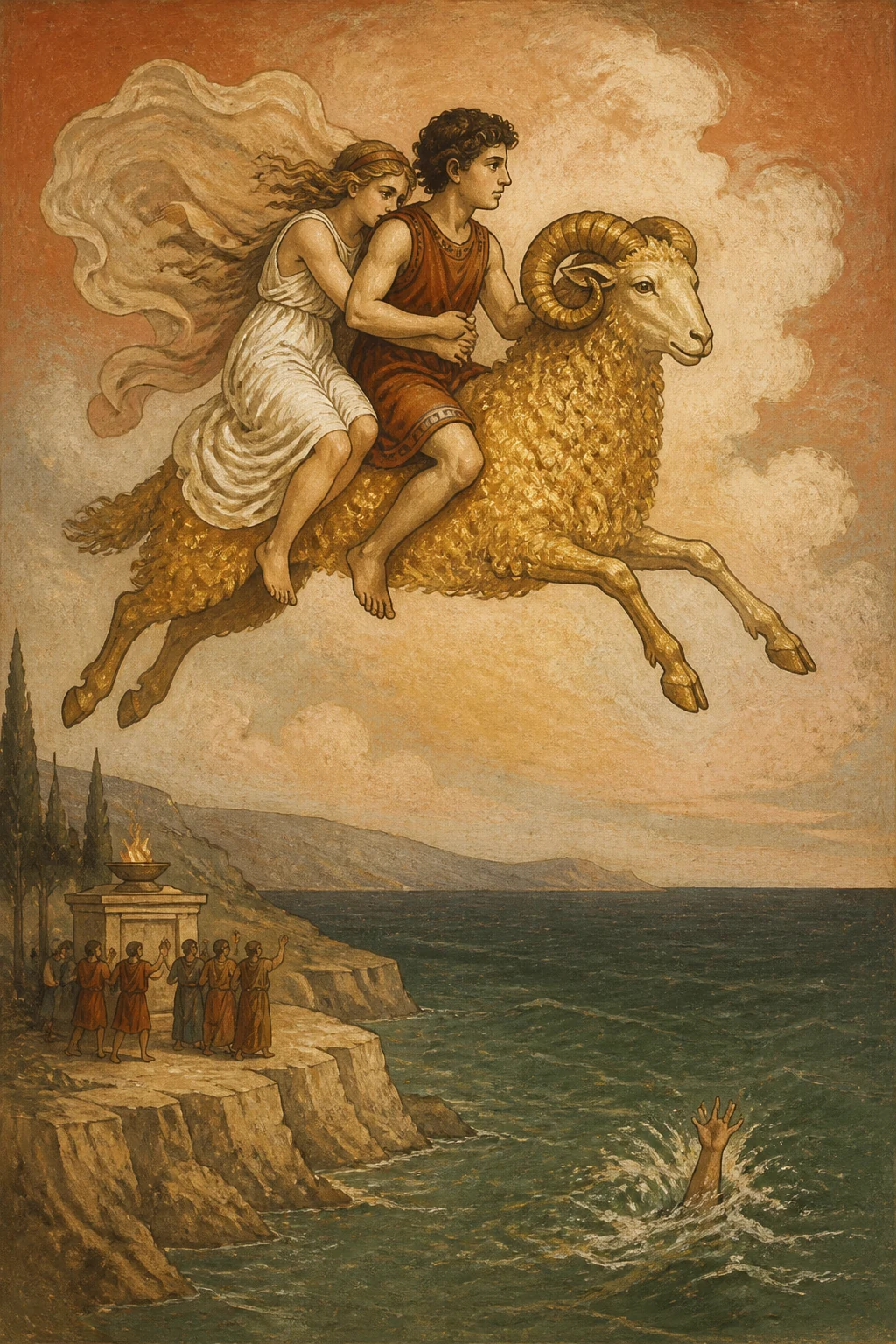
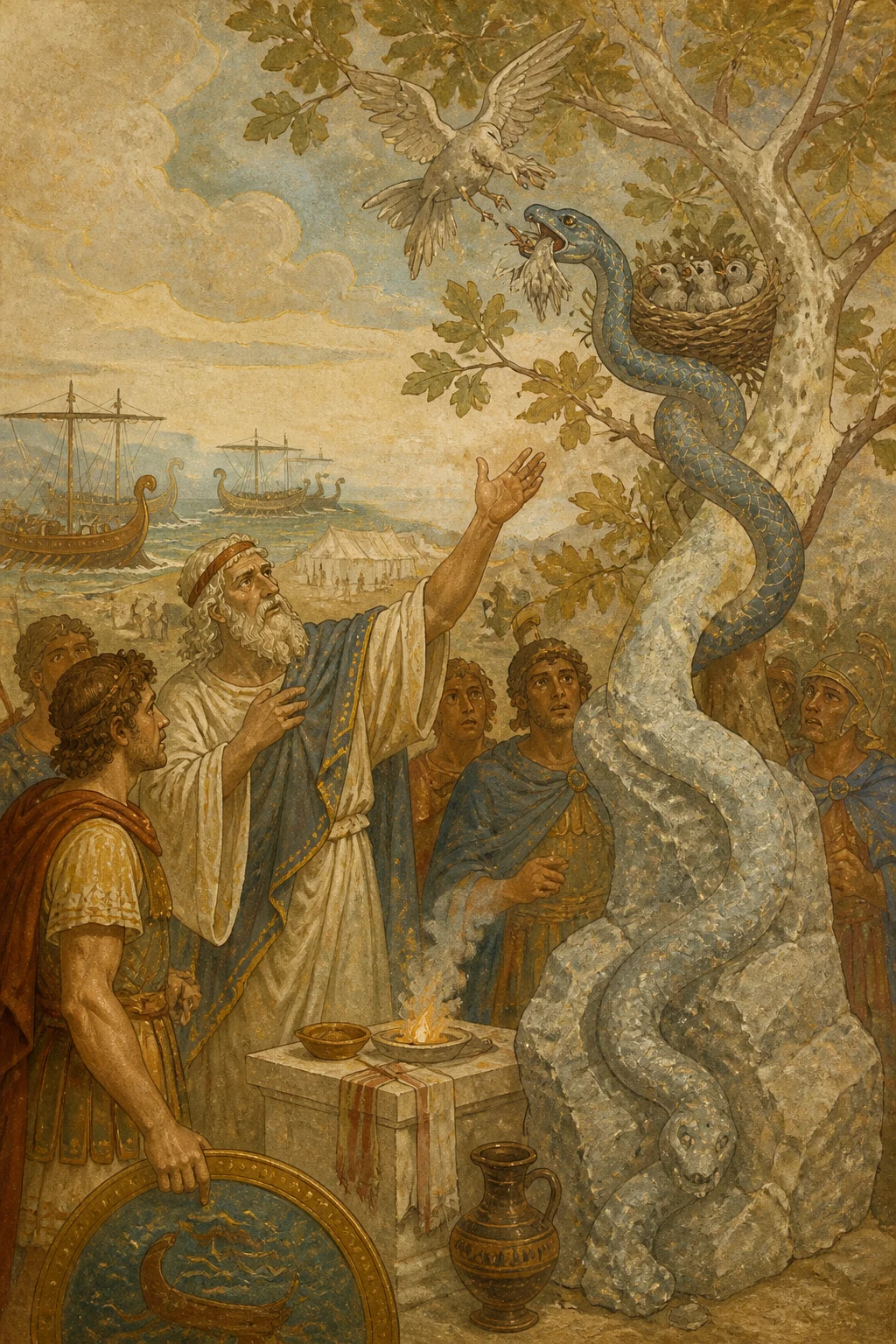
Vengeance would not have been delayed, had savage winds not made the seas impassable, and the Boeotian coast held the fleet at fish-rich Aulis as it tried to sail. Here, as they prepared a sacrifice to Jupiter in their fathers’ fashion, and the ancient altar glowed with kindled fires, the Greeks saw a dark-blue serpent crawl into a plane tree standing near the sacred rites.
High in the tree was a nest of eight young birds: these, together with their mother, who fluttered round her doomed brood, the serpent seized and swallowed in its greedy jaws. All stood aghast. But Thestor’s son, the seer who foresaw the truth, declared, “We shall conquer! Rejoice, men of Greece! Troy will fall, but our struggle will be long,” and he read in the nine birds as many years of war.
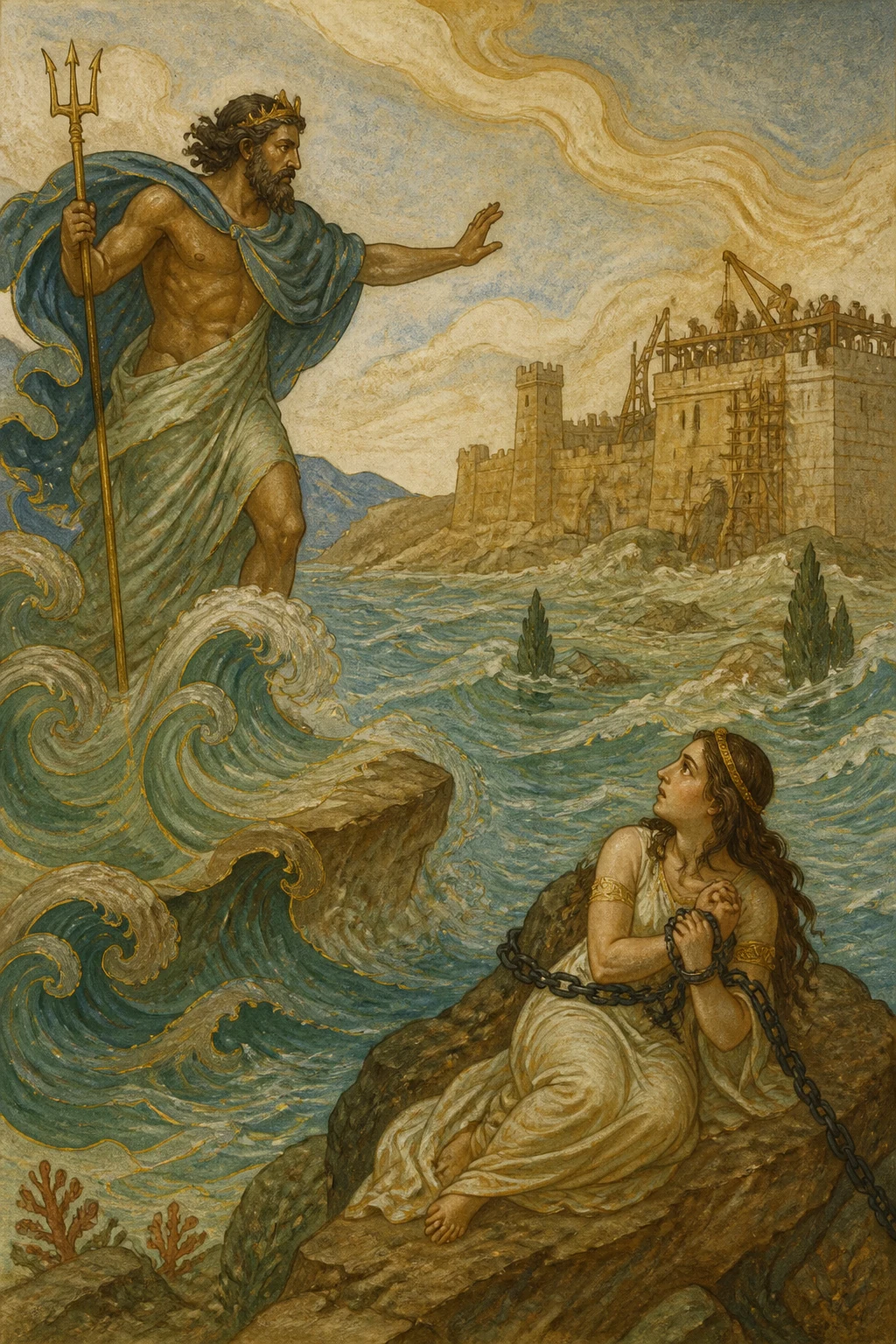
The serpent, still entwined about the tree’s green branches, turned to stone, and the stone preserved its serpent shape. Nereus raged on in the waters off Boeotia, refusing passage to the war; and some believed Neptune was sparing Troy because he had built its walls. But not Thestor’s son: he knew, and did not hide his knowledge, that a maiden’s blood must appease the anger of the maiden goddess. Once the common cause had conquered a father’s love, and the king had overcome the father, Iphigenia stood before the altar among weeping attendants, ready to shed her innocent blood.
Then the goddess relented, cast a cloud before their eyes, and amid the ritual, the throng of worshippers, and the voices raised in prayer, she is said to have stolen away the girl of Mycenae, leaving a hind in her place. Thus, when Diana was soothed by the blood of a fitting victim, and the anger of Phoebe and the sea alike had ebbed, a thousand ships received a following wind and, after many hardships, reached the Phrygian sands.
At the world’s heart there is a place between the land, the sea, and the regions of the sky, where the threefold universe meets. From there, whatever exists, however distant, can be seen, and every voice reaches its listening ears. Rumour dwells there, having chosen a home on the highest peak, with countless entrances and a thousand openings set in its walls, and no doors to close its thresholds: night and day it stands open. All is built of ringing bronze; the whole house hums, echoes voices, and repeats whatever it hears.
Within there is no rest, no silence anywhere, and yet no clamour, only a low murmuring, like the sound of ocean waves heard from far away, or like the dying rumble of thunder when Jupiter has clashed the dark clouds together. A crowd fills its halls, a fickle throng that comes and goes; inventions mingle everywhere with truths, and thousands of rumours wander, tossing out a jumble of words.
Some fill idle ears with talk, others carry elsewhere what they have heard; the measure of falsehood grows, and each new teller adds something to the tale. There dwell Credulity and reckless Error, groundless Joy and panic-stricken Fears, sudden Sedition and Whispers whose source no one knows. Rumour herself sees all that happens in the heavens, at sea, and on the earth, and searches out the whole wide world.
She had spread word that the Greek ships were approaching, laden with valiant soldiers, and so the armed enemy came as no surprise. The Trojans barred their landing and defended the shore; and you, Protesilaus, were the first to fall, as fate decreed, beneath Hector’s spear. The opening battles cost the Greeks dearly, and Hector’s slaughter of brave men made him known.
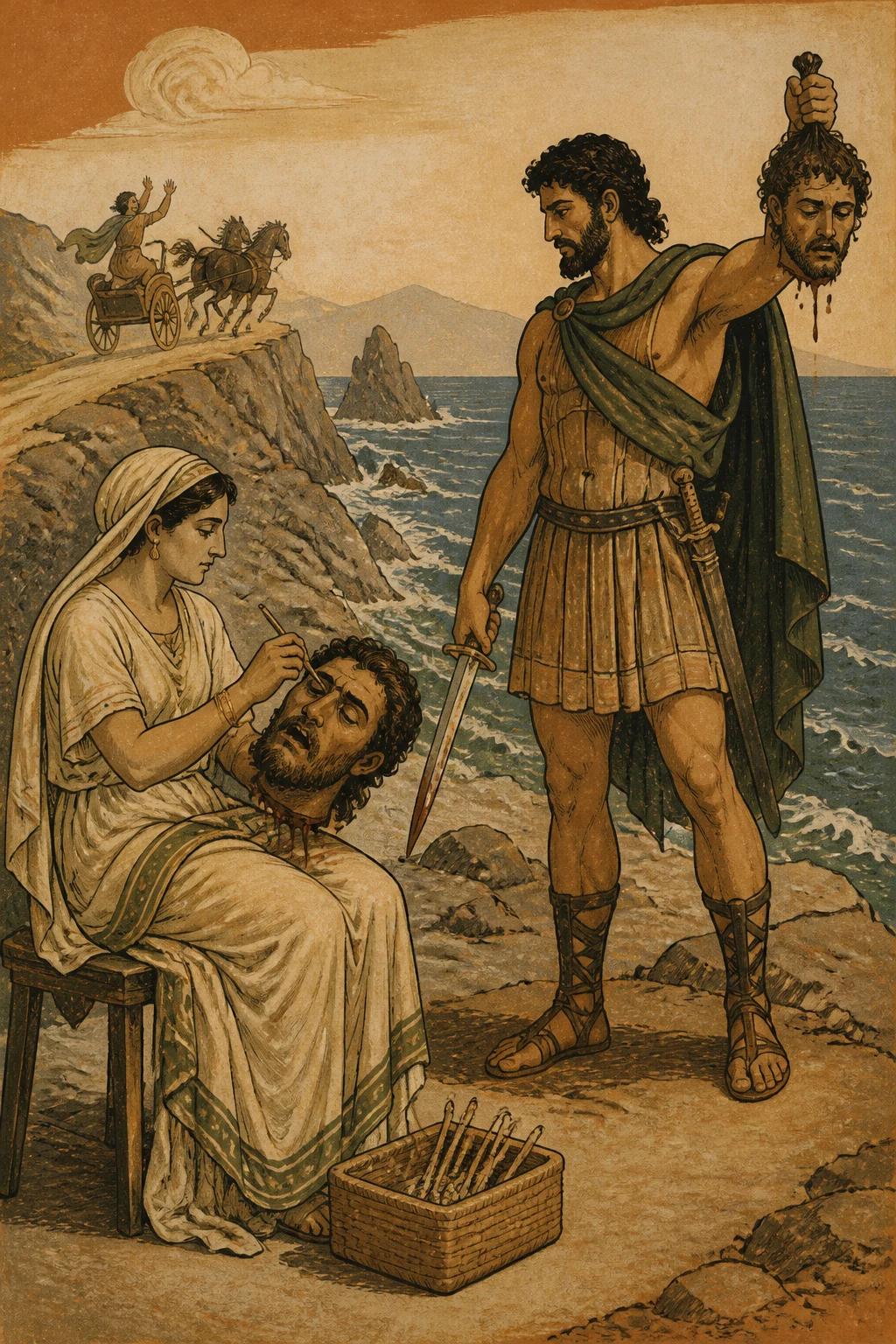
Nor did the Phrygians learn at little cost in blood what Greek hands could do. Already the shores of Sigeum ran red; already Cygnus, Neptune’s son, had sent a thousand men to death; already Achilles pressed on in his chariot, laying whole ranks low with strokes of his Pelian spear. Seeking either Cygnus or Hector through the battle lines, he encountered Cygnus—for his meeting with Hector was deferred until the tenth year. Urging on his horses, whose necks gleamed white beneath the yoke, he drove his chariot at the foe and, brandishing his quivering spear, cried, “Whoever you are, young man, take this consolation in death: that you were slain by Achilles of Thessaly.”
So spoke the grandson of Aeacus; his heavy spear followed his words. Yet though his aim was sure and the spear flew true, the iron point achieved nothing: it merely bruised the breast, as though its edge were blunt. “Son of a goddess—for your fame has reached us before you—” said Cygnus, “why marvel that I have no wound?” For Achilles was indeed amazed. “Neither this helmet you see, tawny with horsehair, nor the hollow shield that burdens my left arm protects me: I wear them only for adornment.
Mars, too, takes up his weapons for that reason. Strip away all this armour’s protection: I shall still leave unscathed. It counts for something to be born not of a Nereid, but of him who rules Nereus, his daughters, and the whole wide sea.” He spoke and hurled at Achilles a spear that would lodge in his rounded shield. It pierced the bronze and nine layers of oxhide beneath, but stopped in the tenth.
The hero shook it free and once more hurled his quivering spear with a mighty hand. Once more the body remained unharmed, without a wound. Nor could a third cast so much as graze Cygnus, though he stood exposed and offered himself. Achilles blazed with rage, like a bull in an open arena when it charges with its fearsome horns at the scarlet cloth that goads it, only to find its thrusts eluded.
He examined his spear to see whether the iron point had fallen off: it still clung to the shaft. “Then is my hand so weak,” he said, “and has all the strength it once possessed drained away against one man? Surely it had strength when I first brought down the walls of Lyrnesus, when I drenched Tenedos and Thebes, Eetion’s city, in their people’s blood; when the Caicus ran crimson with the slaughter of its folk, and Telephus twice felt the power of my spear.
Here, too, my right hand has been strong, and still is: witness all these dead, the heaps I made and now see lying along the shore.” He spoke and, as though mistrusting his past deeds, hurled his spear at Menoetes, a common Lycian facing him, and pierced both his breastplate and the breast beneath. As the dying man struck the hard earth with his chest, Achilles drew that same spear from the warm wound and said, “Here is my hand, here the spear with which I have just conquered.
I shall use them both against this man. Grant me, I pray, the same result!” With these words he attacked Cygnus again. The ashen spear flew true and struck his left shoulder with a clang, unavoided, then sprang back as though from a wall or solid cliff. Yet Achilles saw blood marking Cygnus where he had struck, and rejoiced in vain: there was no wound; the blood was Menoetes’.
Then, roaring with rage, he leapt headlong from his high chariot and attacked his untroubled foe at close quarters with his gleaming sword. He saw the blade dent shield and helmet, but on that hardened body even the iron lost its edge. He could endure no more. Drawing back his shield, he struck three times, four times at his enemy’s face, and battered his hollow temples with the hilt.
As Cygnus gave ground, Achilles pressed him, harried him, rushed him, and gave the stunned man no respite. Terror seized him; darkness swam before his eyes, and as he stepped backwards, a stone in the open field blocked his retreat. Over it Cygnus stumbled, falling backwards, and Achilles hurled him down with all his strength and dashed him to the ground. Then, pinning his breast beneath his shield and hard knees, he pulled the helmet’s straps. Drawn tight beneath the chin, they crushed his throat and closed both passages of his breath. Achilles was preparing to strip his conquered foe, but found only abandoned armour: the god of the sea had changed his body into the white bird whose name he had borne.
Izvirnik
The Greeks at Aulis and Cygnus
Naslednje strani prikazujejo izvirno besedilo za primerjavo.
Source ID: ovid_metamorphoses_story_081 Citation: Ovid, Metamorphoses 12.1-12.145 Original language: Latin Source: PerseusDL canonical-latinLit Source URL: https://github.com/PerseusDL/canonical-latinLit/blob/master/data/phi0959/phi006/phi0959.phi006.perseus-lat2.xml Segmentation certainty: medium 1: Nescius adsumptis Priamus pater Aesacon alis 2: vivere lugebat, tumulo quoque nomen habenti 3: inferias dederat cum fratribus Hector inani.
4: Defuit officio Paridis praesentia tristi, 5: postmodo qui rapta longum cum coniuge bellum 6: attulit in patriam; coniurataeque sequuntur 7: mille rates gentisque simul commune Pelasgae. 8: Nec dilata foret vindicta, nisi aequora saevi 9: invia fecissent venti Boeotaque tellus 10: Aulide piscosa puppes tenuisset ituras. 11: Hic patrio de more Iovi cum sacra parassent, 12: ut vetus accensis incanduit ignibus ara, 13: serpere caeruleum Danai videre draconem 14: in platanum, coeptis quae stabat proxima sacris.
15: Nidus erat volucrum bis quattuor arbore summa: 16: quas simul et matrem circum sua damna volantem 17: corripuit serpens avidoque recondidit ore. 18: Obstipuere omnes. At veri providus augur 19: Thestorides “vincemus” ait, “gaudete, Pelasgi! 20: Troia cadet, sed erit nostri mora longa laboris,” 21: atque novem volucres in belli digerit annos. 22: Ille, ut erat virides amplexus in arbore ramos, 23: fit lapis et servat serpentis imagine saxum.
24: Permanet Aoniis Nereus violentus in undis 25: bellaque non transfert; et sunt qui parcere Troiae 26: Neptunum credant, quia moenia fecerat urbi. 27: At non Thestorides: nec enim nescitve tacetve 28: sanguine virgineo placandam virginis iram 29: esse deae. Postquam pietatem publica causa 30: rexque patrem vicit castumque datura cruorem 31: flentibus ante aram stetit Iphigenia ministris, 32: victa dea est nubemque oculis obiecit et inter 33: officium turbamque sacri vocesque precantum 34: supposita fertur mutasse Mycenida cerva.
35: Ergo ubi, qua decuit, lenita est caede Diana, 36: et pariter Phoebes, pariter maris ira recessit, 37: accipiunt ventos a tergo mille carinae 38: multaque perpessae Phrygia potiuntur harena. 39: Orbe locus medio est inter terrasque fretumque 40: caelestesque plagas, triplicis confinia mundi, 41: unde quod est usquam, quamvis regionibus absit, 42: inspicitur, penetratque cavas vox omnis ad aures.
43: Fama tenet summaque domum sibi legit in arce, 44: innumerosque aditus ac mille foramina tectis 45: addidit et nullis inclusit limina portis: 46: nocte dieque patet. Tota est ex aere sonanti, 47: tota fremit vocesque refert iteratque quod audit. 48: Nulla quies intus nullaque silentia parte, 49: nec tamen est clamor, sed parvae murmura vocis, 50: qualia de pelagi, siquis procul audiat, undis 51: esse solent, qualemve sonum, cum Iuppiter atras 52: increpuit nubes, extrema tonitrua reddunt.
53: Atria turba tenet: veniunt, leve vulgus, euntque 54: mixtaque cum veris passim commenta vagantur 55: milia rumorum confusaque verba volutant. 56: E quibus hi vacuas inplent sermonibus aures, 57: hi narrata ferunt alio; mensuraque ficti 58: crescit, et auditis aliquid novus adicit auctor. 59: Illic Credulitas, illic temerarius Error 60: vanaque Laetitia est consternatique Timores 61: Seditioque recens dubioque auctore Susurri.
62: Ipsa, quid in caelo rerum pelagoque geratur 63: et tellure, videt totumque inquirit in orbem. 64: Fecerat haec notum Graias cum milite forti 65: adventare rates, neque inexspectatus in armis 66: hostis adest: prohibent aditus litusque tuentur 67: Troes, et Hectorea primus fataliter hasta, 68: Protesilae, cadis, commissaque proelia magno 69: stant Danais, fortisque animae nece cognitus Hector.
70: Nec Phryges exiguo, quid Achaica dextera possit 71: sanguine senserunt. Et iam Sigea rubebant 72: litora, iam leto proles Neptunia Cygnus 73: mille viros dederat, iam curru instabat Achilles 74: totaque Peliacae sternebat cuspidis ictu 75: agmina, perque acies aut Cygnum aut Hectora quaerens 76: congreditur Cygno (decimum dilatus in annum 77: Hector erat): tum colla iugo canentia pressos 78: exhortatus equos currum direxit in hostem 79: concutiensque suis vibrantia tela lacertis 80: “quisquis es, o iuvenis” dixit “solamen habeto 81: mortis, ab Haemonio quod sis iugulatus Achille.”
82: Hactenus Aeacides; vocem gravis hasta secuta est. 83: Sed quamquam certa nullus fuit error in hasta, 84: nil tamen emissi profecit acumine ferri 85: utque hebeti pectus tantummodo contudit ictu. 86: “Nate dea, nam te fama praenovimus,” inquit 87: ille “quid a nobis vulnus miraris abesse?” 88: (mirabatur enim) “non haec, quam cernis, equinis 89: fulva iubis cassis neque onus cava parma sinistrae 90: auxilio mihi sunt: decor est quaesitus ab istis.
91: Mars quoque ob hoc capere arma solet! Removebitur omne 92: tegminis officium, tamen indestrictus abibo. 93: Est aliquid non esse satum Nereide, sed qui 94: Nereaque et natas et totum temperat aequor.” 95: Dixit et haesurum clipei curvamine telum 96: misit in Aeaciden, quod et aes et proxima rupit 97: terga novena boum, decimo tamen orbe moratum est. 98: Excutit hoc heros rursusque trementia forti 99: tela manu torsit: rursus sine vulnere corpus 100: sincerumque fuit! Nec tertia cuspis apertum 101: et se praebentem valuit destringere Cygnum.
102: Haud secus exarsit, quam circo taurus aperto, 103: cum sua terribili petit inritamina cornu, 104: poeniceas vestes, elusaque vulnera sentit. 105: Num tamen exciderit ferrum, considerat hastae: 106: haerebat ligno. “Manus est mea debilis ergo, 107: quasque” ait “ante habuit vires, effudit in uno? 108: Nam certe valuit, vel cum Lyrnesia primus 109: moenia deieci, vel cum Tenedonque suoque 110: Eetioneas inplevi sanguine Thebas, 111: vel cum purpureus populari caede Caicus 112: fluxit opusque meae bis sensit Telephus hastae.
113: Hic quoque tot caesis, quorum per litus acervos 114: et feci et video, valuit mea dextra valetque.” 115: Dixit et, ante actis veluti male crederet, hastam 116: misit in adversum Lycia de plebe Menoeten 117: loricamque simul subiectaque pectora rupit. 118: Quo plangente gravem moribundo pectore terram 119: extrahit illud idem calido de vulnere telum 120: atque ait: “Haec manus est, haec, qua modo vicimus, hasta: 121: utar in hoc isdem; sit in hoc, precor, exitus idem!”
122: Sic fatus Cygnum repetit, nec fraxinus errat 123: inque umero sonuit non evitata sinistro, 124: inde velut muro solidaque a caute repulsa est; 125: qua tamen ictus erat, signatum sanguine Cygnum 126: viderat et frustra fuerat gavisus Achilles: 127: vulnus erat nullum, sanguis fuit ille Menoetae! 128: Tum vero praeceps curru fremebundus ab alto 129: desilit et nitido securum comminus hostem 130: ense petens parmam gladio galeamque cavari 131: cernit et in duro laedi quoque corpore ferrum!
132: Haud tulit ulterius, clipeoque adversa reducto 133: ter quater ora viri, capulo cava tempora pulsat 134: cedentique sequens instat turbatque ruitque 135: attonitoque negat requiem: pavor occupat illum, 136: ante oculosque natant tenebrae, retroque ferenti 137: aversos passus medio lapis obstitit arvo. 138: Quem super inpulsum resupino corpore Cygnum 139: vi multa vertit terraeque adflixit Achilles.
140: Tum clipeo genibusque premens praecordia duris 141: vincla trahit galeae: quae presso subdita mento 142: elidunt fauces et respiramen utrumque 143: eripiunt animae. Victum spoliare parabat: 144: arma relicta videt; corpus deus aequoris albam 145: contulit in volucrem, cuius modo nomen habebat.
Nadaljuj z branjem