Prevod
It is astonishing how much children know nowadays! One scarcely knows any longer what they do not know. That the stork fetched them from the well or the millpond and brought them as babies to their father and mother is now such an old story that they no longer believe it, and yet it is the only true one.
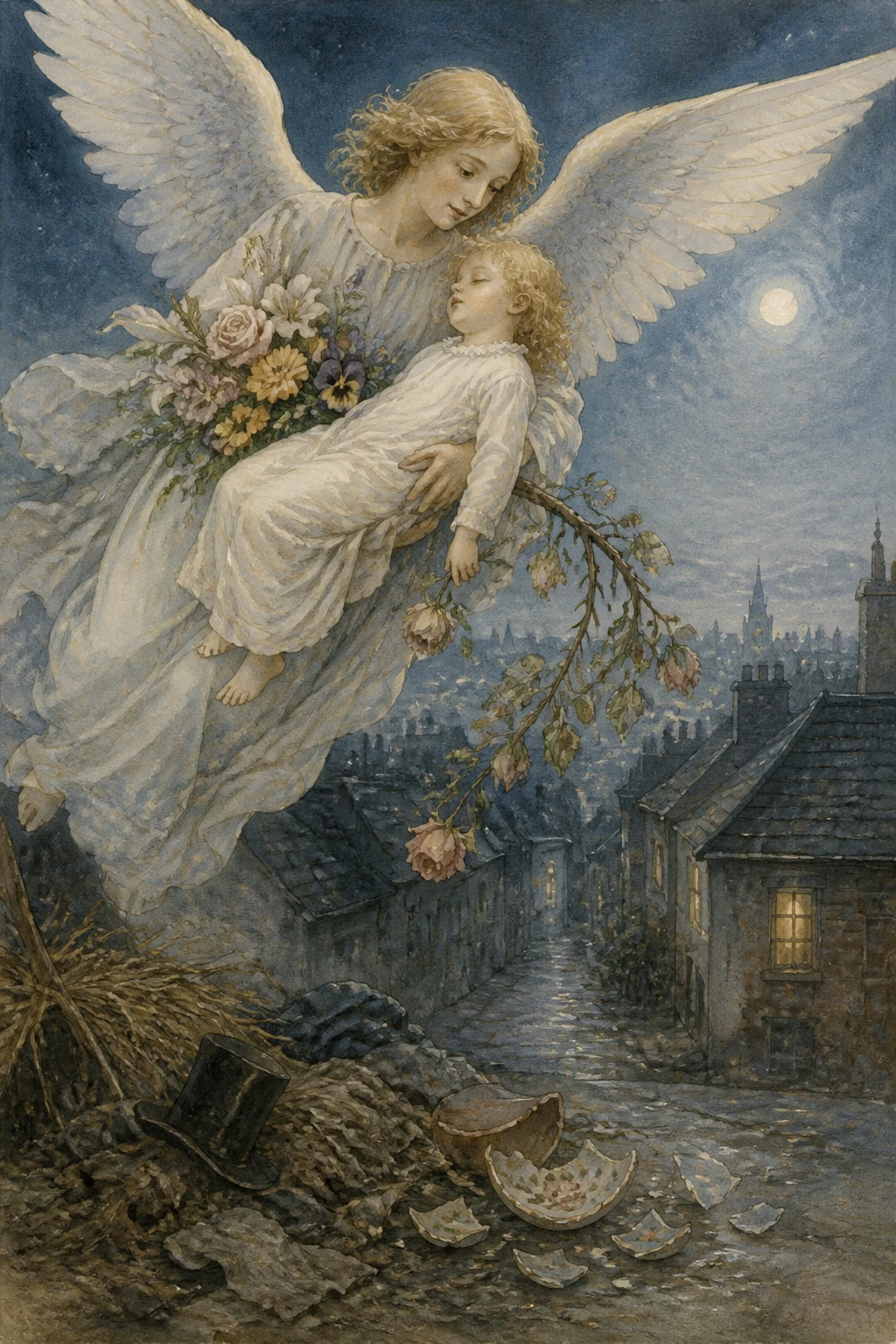
But how do the little ones get into the millpond and the well? Well, not everyone knows that, though some do. Have you ever looked closely at the sky on a starry night and seen all the shooting stars? It is as though a star fell and vanished! The most learned men cannot explain what they do not know themselves; but it can be explained, once you know. It is as though a little Christmas candle fell from heaven and went out; it is a spark of soul from Our Lord, darting down towards the earth, and as it enters our thicker, heavier air, its radiance fades. Nothing remains but what our eyes are powerless to see, for it is something far finer than our air: a child of heaven sent down, a little angel, but without wings, since the little one is to become a human being. Silently it glides through the air, and the wind carries it into a flower. This may be a sweet rocket, a devil’s dandelion, a rose, or a sweet william; there it lies, gathering its senses. It is so airy and light that a fly can carry it, and a bee can do so easily, and they come by turns to seek the sweetness in the flower. If the child of air happens to lie in their way, they do not kick it out; they cannot bring themselves to do that. They lay it in the sunshine on a water-lily leaf, and from there it creeps and crawls down into the water, where it sleeps and grows until the stork can see it and fetch it for a human family who are longing for a dear little one. But how dear it is, or is not, depends on whether the little one has drunk from the clear spring, or whether mud and duckweed have gone down the wrong way; that makes it so earthly. The stork takes the first one he sees, without picking and choosing. One comes to a good home with matchless parents; another comes to hard-hearted people in great misery, and would have been far better off staying in the millpond.
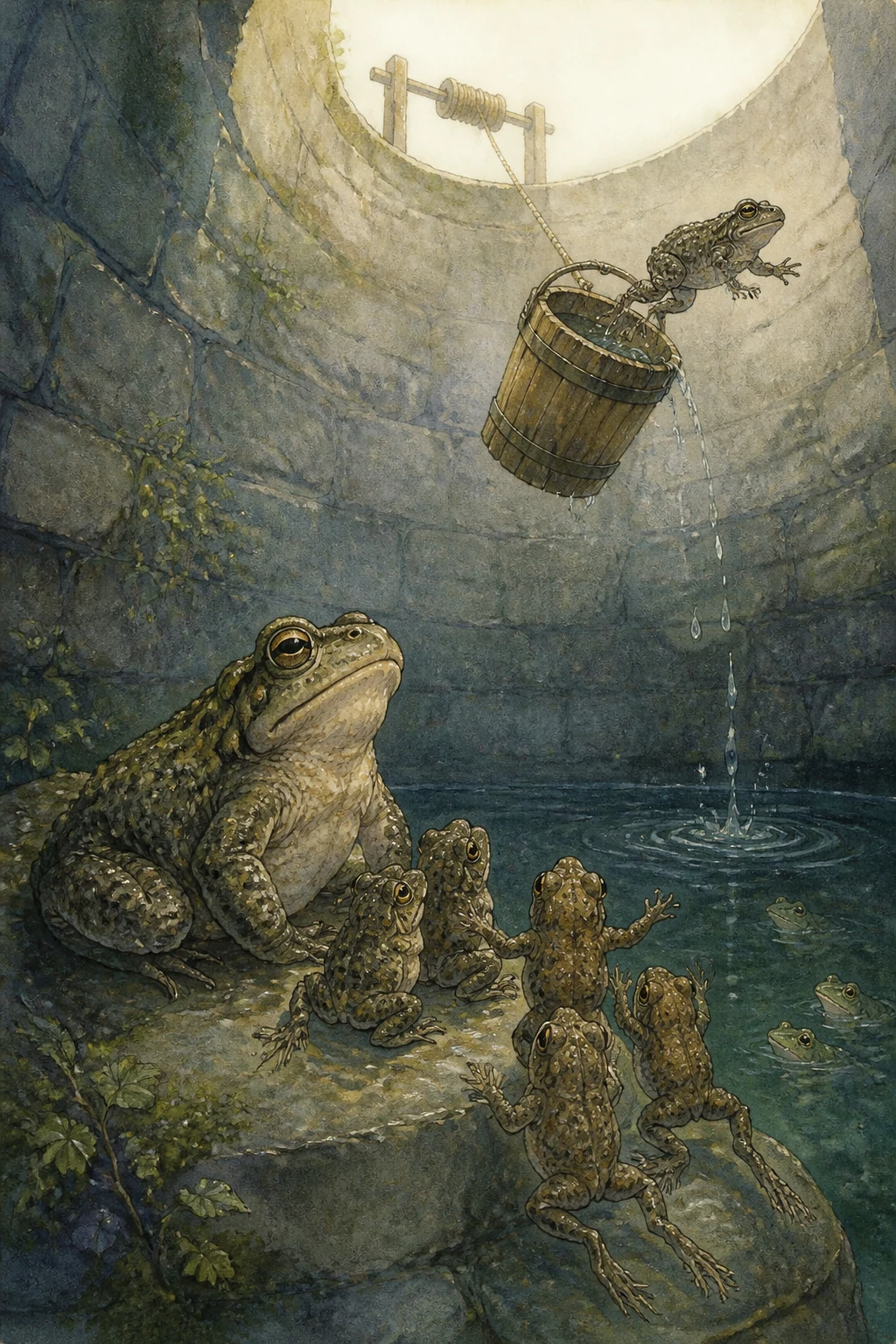
The little ones remember nothing at all of what they dreamed beneath the water-lily leaf, where in the evening the frogs sang to them: “Croak, croak! Quick, quick!” which in human language means: “Now see that you go to sleep and dream!” Nor can they remember which flower they first lay in, or what its fragrance was, and yet there is something within them, when they are grown, that says: “That is the flower we love best!” And it is the one they lay in as children of air.
The stork lives to a very great age, and he always keeps an eye on how the little ones he has brought are getting on, and how they conduct themselves in the world. To be sure, he can do nothing for them or alter their circumstances; he has his own family to provide for, but he never lets them slip from his thoughts.
I know an old, very respectable stork who has a great store of knowledge, has fetched many little ones, and knows their histories, in which there is always a little mud and duckweed from the millpond. I asked him to tell me the brief life story of one of them, and he said I should have three for one, from the Peitersen household.
The Peitersens were an exceedingly nice family. The husband was one of the town’s thirty-two councillors, and that was a distinction; he lived for the thirty-two and was entirely wrapped up in the thirty-two. Here the stork came and brought a little Peiter, for that was what they called the child. The following year the stork came again with another, whom they called Peter, and when the third was brought, he was given the name Peer, for in the names Peiter-Peter-Peer lies the name Peitersen.
So there were three brothers, three shooting stars, each cradled in his own flower, laid beneath a water-lily leaf in the millpond, and brought from there by the stork to the Peitersen family, whose house stands on the corner—you know where.
They grew in body and mind, and then they wanted to become something greater still than the thirty-two councillors. Peiter said he wanted to be a robber. He had seen the play “Fra Diavolo” and had decided that the robber’s trade was the most delightful in the world.
Peter wanted to be a dustman, and Peer, who was such a sweet, well-behaved boy, plump and round, though he bit his nails—that was his only fault—Peer wanted to be a “father.” Such were their answers whenever anyone asked what they wanted to be in the world.
Then they went to school. One came top of the class, one came bottom, and one came somewhere in between, but that need not prevent them from being equally good and equally clever, and so they were, said their very discerning parents.
They went to children’s dances; they smoked cigars when no one was looking; they grew in knowledge and experience. Peiter had been contrary from his earliest years, as a robber surely ought to be. He was a very naughty boy, but that was because, his mother said, he suffered from worms; naughty children always have worms—mud in their stomachs. One day his stubbornness and contrariness were visited upon his mother’s new silk dress.
“Do not knock against the coffee table, my little lamb of God!” she had said. “You might upset the cream jug and splash my new silk dress!” And the “lamb of God” took firm hold of the cream jug and with a steady hand poured the cream straight into Mama’s lap. She could not help saying: “Lamb! Lamb! That was not sensible, lamb!” But the child had a will of his own, she had to admit. Will shows character, and that is so promising to a mother.
He might certainly have become a robber, but he did not become one in the literal sense; he merely came to look like a robber. He wore a battered hat, an open collar, and long, flowing hair. He was to be an artist, but got no further than dressing the part, and looked like a hollyhock into the bargain; all the people he drew looked like hollyhocks, they were so tall. He was very fond of that flower; he had lain in a hollyhock himself, the stork said.
Peter had lain in a buttercup. He looked so buttery about the corners of his mouth, and his skin was so yellow, that you might have thought butter would come out if his cheek were cut. He seemed born to be a butter merchant, and could have served as his own shop sign, but at heart, deep inside, he was a “dustman”; he was the musical part of the Peitersen family, “and enough for the whole lot of them!” said the neighbours. He composed seventeen new polkas in a single week and put them together into an opera with trumpet and rattle; goodness, how splendid it was!
Peer was pink and white, small and ordinary; he had lain in a camomile flower. He never struck back when the other boys beat him; he said he was the most sensible, and the most sensible always gives way. First he collected slate pencils, then seals, and then he acquired a little natural-history cabinet containing the skeleton of a stickleback, three baby rats born blind and preserved in spirits, and a stuffed mole. Peer had a taste for science and an eye for nature, and this pleased both his parents and Peer himself. He would rather go to the woods than to school, rather be out in nature than under instruction. His brothers were already engaged while he was still living to complete his collection of waterbirds’ eggs. Before long he knew far more about animals than about people; indeed, he believed that we could not equal animals in the thing we prize most highly: love. He saw that when the female nightingale was sitting on her eggs, Father Nightingale sat singing all night to his little wife: “Cluck! Cluck! Zee zee! Lo lo lee!” Peer could never have managed that or devoted himself to it. When Mother Stork lay with her young in the nest, Father Stork stood all night on one leg on the roof ridge; Peer could not have stood like that for an hour. And when one day he studied a spider’s web and what was caught in it, he gave up all thought of marriage. Mr Spider weaves to catch unwary flies, young and old, full of blood or dried to a husk; he lives to weave and provide for his family, but Madame Spider lives solely and entirely for Papa. She eats him up out of sheer love; she eats his heart, his head, his stomach; only his long, thin legs remain in the web, where he sat worrying about how to feed the whole family. That is the plain truth, straight out of natural history. Peer saw it and pondered it. “To be loved like that by one’s wife, eaten by her in a frenzy of love! No! No human being carries it so far; and would it be desirable?”
Peer resolved never to marry! Never to give or take a kiss; that might look like the first step towards matrimony. Yet he did receive one kiss, the one we all receive: Death’s great smacking kiss. When we have lived long enough, Death is given the order: “Kiss away!” and then the human being is gone. A gleam of sunlight shines from Our Lord, so strong that everything goes black before our eyes; the human soul, which came like a shooting star, flies away again like a shooting star, but not to rest in a flower or dream beneath a water-lily leaf. It has more important things to do; it flies into the great land of eternity, but what it is like there, and how it looks, no one could say. No one has seen into it, not even the stork, however far he can see and however much he knows. Nor did he know anything more about Peer, though he did about Peiter and Peter; but I had heard enough about them, and so, I daresay, have you. So I thanked the stork for the present; but now he is asking three frogs and a young grass snake for this little, ordinary story. He takes his payment in provisions. Will you pay? I will not! I have neither frogs nor young grass snakes.