Prevod
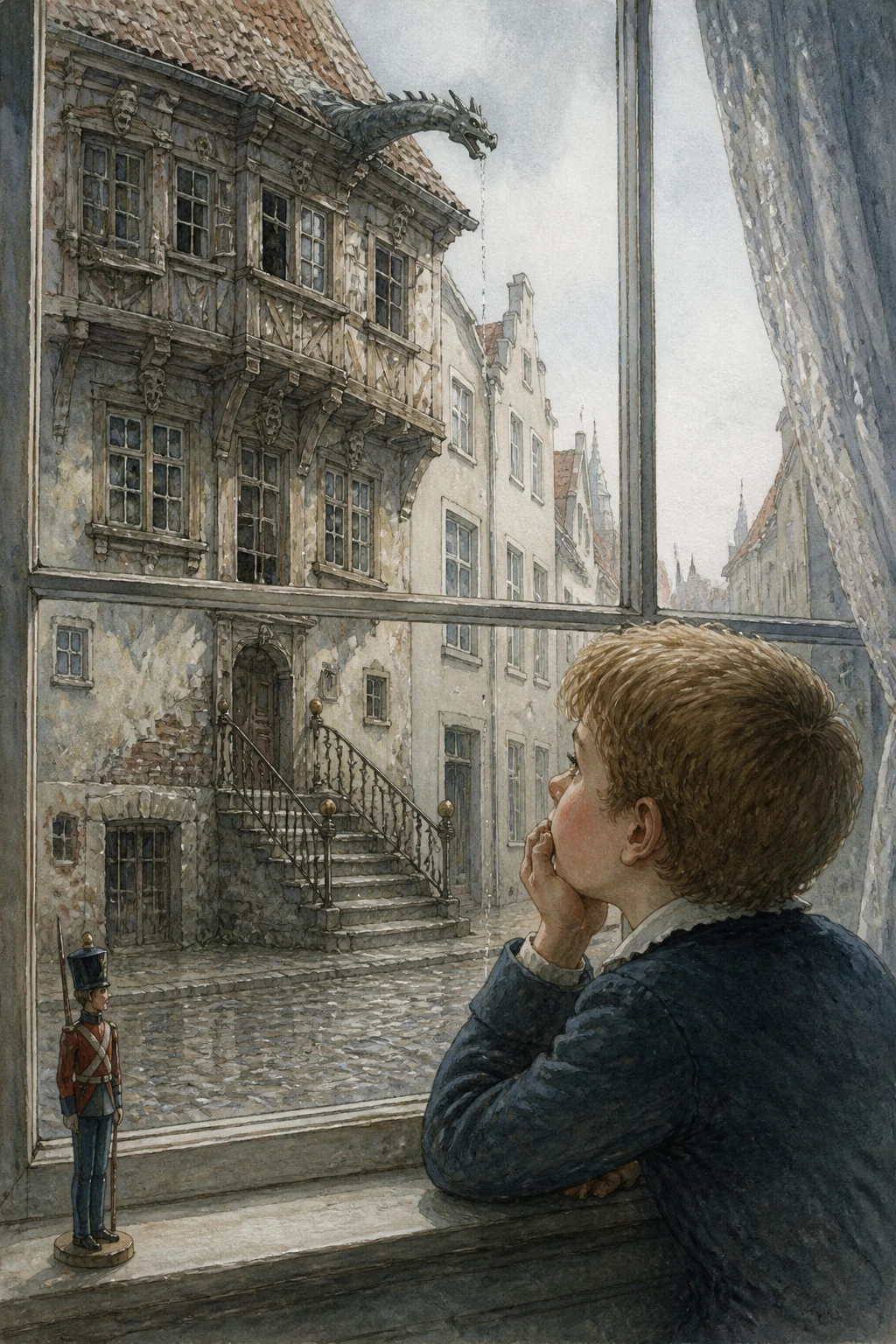
There is a street in Copenhagen with the strange name of “Hyskenstræde.” Why is it called that, and what does it mean? It is supposed to be German, but the German has been badly treated: “Häuschen” is what one ought to say, and that means “little houses.” In those days, and for many years, the houses there were little more than wooden booths, almost like those we now see set up at fairs; a little larger, perhaps, and with windows, but the panes were made of horn or bladder-skin, for in those days it was too costly to have glass windows in every house. But all this was so long ago that great-grandfather’s great-grandfather, when he told of it, also called it “the old days”; it was several hundred years ago.
The rich merchants of Bremen and Lübeck carried on the trade in Copenhagen. They did not come up here themselves, but sent their clerks, who lived in the wooden booths in the “Street of Little Houses” and sold beer and spices. That German beer was excellent, and there were so many kinds: Bremen beer, Prysing beer, Ems beer—yes, and Brunswick Mumme; and then all the spices, such as saffron, aniseed, ginger, and especially pepper. That was the most important of all here, and so the German clerks in Denmark came to be called “pepper fellows.” Before leaving home they had to promise not to marry while they were up here. Many of them grew old. They had to look after themselves, tend to their own comforts, and put out their own fires, if they had any. Some became lonely old men, with thoughts and habits of their own; and after them every unmarried man who has reached a fairly settled age is now called a “pepper fellow.” All this one must know to understand the story.
People make fun of the old bachelor; they tell him to put on his nightcap, pull it down over his eyes, and go to bed: “Saw, saw the wood in two, Poor bachelors, alas for you! A nightcap is your bedmate, And you must light your own light too!” Yes, that is what they sing about them! They mock the bachelor and his nightcap—simply because they know so little of either. Ah, never wish for that nightcap! And why not? Well, listen!
In the Street of Little Houses, in the very old days, there was no paving. People stepped from hole to hole, as in a deeply rutted sunken lane, and the street was narrow: the booths stood close together, and so near those opposite that in summer a * sailcloth was often stretched across the street from one booth to another. Beneath it the air smelled richly of pepper, saffron, and ginger. There were not many young men behind the counters; no, they were mostly old fellows. And they were not at all dressed as we imagine them, in wigs or nightcaps, with knee-breeches, waistcoats, and coats buttoned to the neck. No, that was how great-grandfather’s great-grandfather dressed, and that is how he is shown in his portrait. The pepper fellows could not afford to have their portraits painted, though it would certainly be worth something now to own a picture of one of them as he stood behind his counter or walked to church on holy days. His hat was broad-brimmed and high-crowned, and one of the younger clerks would often stick a feather in his. A turned-down linen collar covered his woollen shirt; his jacket was tightly buttoned, his cloak hung loosely over it, and his trousers reached right down to his broad-toed shoes, for they wore no stockings. In his belt were his eating knife and spoon, and another large knife for defending himself, which was often needed in those days. That was just how old Anthon, one of the oldest pepper fellows in the Street of Little Houses, dressed on feast days, except that instead of a high-crowned hat he wore a hooded cap, and beneath it a knitted cap, a proper nightcap. He had grown so used to it that he always kept it on, and he owned two of the kind. He would have made a fine subject for a painting: thin as a stick, with wrinkles round his mouth and eyes, long, bony fingers, and bushy grey eyebrows. A whole tuft hung over his left eye; it was not handsome, perhaps, but it made him easy to recognize. People knew that he came from Bremen, though that was not really his home; his master lived there. He himself came from Thuringia, from the town of Eisenach, just below the Wartburg. Old Anthon did not speak much of that, but he thought of it all the more!
The old clerks in the street seldom met. Each stayed in his own booth, which was shut early in the evening, and then all looked dark. Only a faint gleam came through the little horn window in the roof. Inside, usually sitting on his bed, the old fellow would sing his evening hymn from his German hymnbook, or potter about far into the night with whatever there was to do. It certainly was no merry life. To be a stranger in a foreign land is a bitter lot; no one has any concern with you, unless you happen to stand in their way.
Often, when the night outside was pitch-black, with rain and blustering wind, the place could seem so dismal and deserted. There were no lamps to be seen except a single, very small one hanging at one end of the street before a picture of the Holy Virgin painted on the wall. You could plainly hear the water swashing and splashing against the timberwork nearby, off the Castle Island, towards which the other end of the street faced. Such evenings grew long and lonely unless one found something to do. Unpacking and packing, making paper cones, and polishing the scales need not be done every day; so one found other tasks, and old Anthon did just that. He sewed his own clothes and patched his shoes. When at last he went to bed, he kept his nightcap on as usual and pulled it a little farther down; but soon he pushed it up again to see whether the candle was properly out. He felt it, pinched the wick, and lay down again, turning onto his other side and pulling the nightcap down once more. But often, at that very moment, a thought would come: had every coal in the little brazier downstairs quite burned out and been properly smothered? A tiny spark might still remain; it could catch fire and do harm. Then he would get out of bed and creep down the ladder—it could hardly be called a staircase—and when he reached the brazier there was not a spark to be seen, and he could turn back again. But often he got only halfway before he began to wonder whether the iron bar was across the door and the shutters were fastened. Then down he had to go again on his thin legs. He was freezing, and his teeth chattered as he crept into bed, for cold only begins to bite in earnest when it knows it must go. He pulled the quilt higher over himself and the nightcap lower over his eyes, and turned his thoughts away from the day’s business and troubles. But this brought him no comfort, for old memories came and hung up their curtains, and sometimes there are pins in those curtains that prick us. “Oh!” we say; and when they pierce the living flesh and burn, they can bring tears to our eyes. So they often did to old Anthon. Hot tears came, the clearest pearls; they fell upon the quilt or the floor, and rang as though a string of sorrow had snapped, with a sound that went straight to the heart. They might evaporate, they might flare into flame; but in doing so they lit up a picture of his life, one that never faded from his heart. When he wiped his eyes with his nightcap, the tear and the picture were crushed; but their source remained, deep in his heart. The pictures did not come in the order of the events themselves. Most often the most painful came; happy, wistful ones shone out too, but these now cast the deepest shadows.
“How beautiful the beech woods are in Denmark!” people said; but to Anthon the beech woods near the Wartburg rose more beautifully still. Mightier and more venerable seemed the old oaks about the proud knightly castle, where climbing plants trailed over the rocky boulders. The apple blossom smelled sweeter there than in Denmark. He could still feel and sense it all so vividly. A tear rolled down, rang out, and shone: in it he clearly saw two little children, a boy and a girl, at play. The boy had rosy cheeks, curly yellow hair, and honest blue eyes; he was the rich merchant’s son, little Anthon himself. The little girl had brown eyes and black hair, and looked bold and clever; she was the mayor’s daughter, Molly. The two were playing with an apple, shaking it and listening to the pips rattle inside. They cut the apple in half and each took a piece; they shared out the pips and ate them, all except one, which the little girl thought should be planted in the earth.
“Then you’ll see what comes of it. Something will come that you’d never imagine—a whole apple tree, though not straight away!” And they planted the pip in a flowerpot, both of them eager to help. The boy dug a hole in the earth with his finger, the little girl laid the pip in it, and together they covered it with soil.
“Now you mustn’t take it up tomorrow to see whether it has roots,” she said. “You mustn’t do that! I did it with my flowers, only twice, because I wanted to see whether they were growing. I didn’t know any better then, and the flowers died!”
The flowerpot stayed with Anthon, and every morning, all through the winter, he looked at it; but there was nothing to see except the dark earth. Then spring came, the sun shone so warmly, and two little green leaves peeped out of the flowerpot.
“That’s me and Molly!” said Anthon. “How lovely! How wonderful!” Soon a third leaf appeared. Who did that stand for? And then came another, and another! Every day and every week it grew bigger and bigger; the little plant became a whole tree. And all this was now reflected in a single tear, which was crushed and vanished; but it could come again from its wellspring—from old Anthon’s heart.
Near Eisenach stretches a range of rocky hills. One rises in a rounded slope, without trees, bushes, or grass; it is called the Mountain of Venus. Inside it lives Lady Venus, a heathen goddess from pagan times. Mother Holle she was called; every child in Eisenach knew that, and still does. Into her mountain she had lured the noble knight Tannhäuser, the minstrel from the Wartburg circle of singers.
Little Molly and Anthon often stood by the mountain, and once she said, “Do you dare knock and say, ‘Mother Holle! Mother Holle! Open up! Here is Tannhäuser!’” But Anthon did not dare. Molly did; though she said only the words “Mother Holle! Mother Holle!” loudly and clearly. The rest she spoke into the wind, so indistinctly that Anthon was certain she had not really said anything. How bold she looked! As bold as when she and the other little girls sometimes met him in the garden and all wanted to kiss him, just because he did not want to be kissed and fought them off. She alone dared do it.
“I dare kiss him!” she said proudly, and put her arms round his neck. She took pride in that, and Anthon submitted without giving it a thought. How lovely she was, how bold! Mother Holle in the mountain was said to be beautiful too; but that beauty, people said, was the seductive beauty of evil. The highest beauty, on the other hand, was such as Saint Elizabeth possessed, the country’s patron saint, the pious princess of Thuringia, whose good deeds, preserved in tales and legends, shed glory over so many places there. Her picture hung in the chapel with silver lamps around it—but she did not look at all like Molly.
The apple tree the two children had planted grew year by year. It became so large that it had to be planted out in the garden, in the fresh air, where the dew fell and the sun shone warmly, and it gained strength to withstand the winter. After winter’s harsh oppression, it seemed to put forth its spring blossoms for joy. In autumn it bore two apples, one for Molly and one for Anthon; it could scarcely have done less.
The tree had made haste to grow, and Molly grew like the tree; she was fresh as an apple blossom. But he was not to gaze upon that blossom much longer. Everything changes, everything alters! Molly’s father left their old home, and Molly went with him, far away. In our day it is only a journey of a few hours by steam, but then it took more than a day and a night to travel so far east from Eisenach, right to the very edge of Thuringia, to the town still called Weimar.
And Molly cried, and Anthon cried—all those tears now flowed together into a single tear, and it held the lovely rosy light of joy. Molly had told him she loved him more than all the splendours of Weimar.
A year went by, then two, then three, and in all that time two letters came. One was brought by the carrier, the other by a traveller; it was a long, hard, winding road, past towns and villages.
How often Anthon and Molly had listened together to the story of Tristan and Isolde, and how often it had made him think of himself and Molly, although Tristan’s name was said to mean that “he was born to them in sorrow,” and that did not fit Anthon. Nor could he ever think, as Tristan had, “She has forgotten me!” But Isolde had not forgotten her heart’s beloved either; and when they were both dead and buried on opposite sides of the church, the lime trees grew from their graves over the church roof and met there in blossom. Anthon thought it so beautiful, and yet so sad—but things could never turn out sadly for him and Molly. And then he would whistle a song by the minstrel Walther von der Vogelweide:
“Under the lime tree, beside the heath—!” And these words in it sounded especially sweet: “Beside the wood, in the quiet dale, Tandaradai! There sang to us a nightingale!” That song was always on his lips. He sang and whistled it on the moonlit night when he rode on horseback through the deep sunken lane on his way to Weimar to visit Molly. He meant to come unexpectedly, and unexpectedly he came.
He was welcomed, his goblet filled with wine; there was merry company, distinguished company, a comfortable room, and a good bed. And yet it was not at all as he had imagined and dreamed! He did not understand himself, he did not understand the others; but we can understand it! One may be in the house, one of the family, and yet take no root there. One talks as people talk in a mail coach, knows the others as people know one another in a mail coach, feels in the way, and wishes either to be off oneself or to see one’s good neighbour gone. That was something of what Anthon felt.
“I am an honest girl,” Molly said to him. “I want to tell you myself! So much has changed since we were children together; things are different, both around us and within us! Habit and will have no power over our hearts! Anthon, I don’t want you to be my enemy, now that I shall soon be far away from here! Believe me, I think kindly of you; but I have never loved you as I now know one person can love another. You must accept that! Goodbye, Anthon!”
And Anthon said goodbye too. Not a single tear came into his eyes, but he felt that he was no longer Molly’s friend. A red-hot iron bar and a frozen iron bar tear the skin from our lips with the same sensation when we kiss them; and he had pressed his kiss as fiercely into love as into hatred.
It took Anthon less than a day and a night to get home to Eisenach, but the horse he rode was ruined. “What does it matter!” he said. “I am ruined, and I will ruin everything that can remind me of her. Mother Holle, Lady Venus, you heathen woman! I’ll snap and break the apple tree, tear it up by the roots; never again shall it blossom or bear fruit!”
But the tree was not destroyed. He himself was laid low, and lay feverish in his bed. What could help him rise again? A medicine came that could do it, the bitterest there is, the kind that shakes the sick body and the shrinking soul awake: Anthon’s father was no longer a rich merchant. Hard days, days of trial, were at the door; misfortune poured in, sweeping like great waves through the once wealthy house. His father became a poor man, numbed by grief and disaster. Then Anthon had something else to think of besides disappointed love and anger at Molly. He had to be both father and mother in the house, had to arrange things, help, and set to work in earnest; he had to go out into the wide world himself and earn his bread.
He came to Bremen and knew want and hardship, which make the heart hard or soft, often much too soft. How different the world and the people in it were from what he had imagined as a child! What were the minstrels’ songs to him now? Jingle and jangle, empty wind! That was what he thought at times; but at others those songs rang within his soul and made his heart devout.
“God’s will is best!” he would say. “It was well that Our Lord did not let Molly’s heart cling to mine. What would have come of it, now that fortune has turned against us like this? She let me go before she knew or dreamed of this change from prosperity that lay ahead. It was the Lord’s mercy towards me. Everything has happened for the best! Everything was wisely ordered! She could not help it, and I have been so bitterly hostile to her!”
And years went by. Anthon’s father was dead; strangers lived in his father’s house. Yet Anthon was to see it again: his rich master sent him on business, and his journey took him through his native town of Eisenach. The old Wartburg stood unchanged up on the mountain, with the “Monk and Nun” in the rock; the mighty oaks gave the whole scene the same outline it had had in his childhood. The Mountain of Venus showed bare and grey in the valley. Gladly would he have said, “Mother Holle, Mother Holle! Open the mountain! Then at least I can stay here on my native soil!”
It was a sinful thought, and he crossed himself. Then a little bird sang from a bush, and the old minstrel’s song came into his mind: “Beside the wood, in the quiet dale, Tandaradai! There sang to us a nightingale!”
So many things came back to him here by his childhood town, which he saw again through tears. His father’s house stood as before, but the garden had been altered. A field path crossed one corner of the old garden ground, and the apple tree he had never managed to destroy still stood there, but outside the garden, on the other side of the path. Yet the sun shone on it as before, and the dew fell on it as before. It bore a wealth of fruit that bent its branches towards the earth.
“It thrives!” he said. “It can!” Yet one of its great branches had been broken; mischievous hands had done it, for the tree stood beside the public road.
“They pluck its blossoms without a word of thanks, steal its fruit, and break its branches. If one may speak of a tree as of a human being, one could say that no one sang over its cradle that it would come to this. Its story began so beautifully, and what came of it? Abandoned and forgotten, a garden tree beside a ditch, between field and highway! There it stands without shelter, battered and broken! It may not wither for that, but as the years pass the blossoms will grow fewer, there will be no fruit, and at last—yes, then the story is over!”
So Anthon thought beneath the tree, and so he thought many a night in his little lonely room in the wooden house in a foreign land, in the Street of Little Houses in Copenhagen, where his rich master, the merchant in Bremen, had sent him on condition that he must not marry.
“Marry! Ho, ho!” he laughed, deep and strangely. Winter had come early, and the frost was bitter. Outside a snowstorm raged, so that everyone who could stayed indoors. That was why Anthon’s neighbours opposite did not notice that his booth had remained unopened for two whole days, and that he himself had not appeared at all. Who went out in such weather if he could help it?
They were grey, dark days, and in the booth, where the windowpanes were not glass, there was only twilight and pitch-black night. Old Anthon had not left his bed for two days; he had not the strength. He had long felt the harsh weather outside in his limbs. The old bachelor lay abandoned and helpless, scarcely able to reach the water jug he had set beside his bed, and its last drop had been drunk. It was not fever, not illness; it was old age that had paralysed him. Up there where he lay, it was almost always night. A little spider he could not see busily and contentedly spun its web across him, as though at least a little fresh mourning crape should flutter there if the old man closed his eyes.
Time dragged on, long, drowsy, and empty. He had no tears, nor any pain; Molly was not in his thoughts at all. He had a sense that the world and its bustle were his no longer, that he lay outside it, and no one thought of him. For a moment he seemed to feel hunger, and thirst too—yes, he felt that! But no one came to refresh him; no one would come. He thought of those who languished in need, and remembered how Saint Elizabeth, when she lived here on earth—she, the saint of his homeland and childhood, the noble Duchess of Thuringia, that highborn lady—had herself entered the poorest hovel and brought hope and comfort to the sick. Her pious deeds shone into his thoughts. He remembered how she came and spoke words of consolation to the suffering, bathed their wounds, and brought food to the hungry, although her stern husband was angered by it. He remembered the legend of how, as she came carrying a well-filled basket of wine and food, her husband, who watched her movements, stepped forward and angrily demanded to know what she was carrying. In her fear she answered, “Roses I have picked in the garden.” He tore off the cloth, and a miracle had been wrought for the pious woman: the wine and bread, everything in the basket, lay transformed into roses.
So the saint lived in old Anthon’s thoughts; so she stood, living and radiant, before his failing eyes, at his bedside in the humble wooden booth in Denmark. He bared his head and looked into her gentle eyes, and everything around him was light and roses. The roses spread out, so fragrant; he caught a wonderfully sweet scent of apples, and saw that it was an apple tree in blossom stretching over him—the tree he and Molly had planted as a little pip.
And the tree scattered its fragrant petals upon his burning forehead and cooled it. They fell upon his parched lips, and were like strengthening wine and bread. They fell upon his breast, and he felt so light, so safe, ready to slumber.
“Now I shall sleep!” he whispered softly. “Sleep does one good! Tomorrow I shall be well and properly on my feet again! How lovely! How lovely! The apple tree planted in love—I see it in glory!”
And he slept. The next day, the third day the booth had been shut, the snow was no longer drifting, and the neighbour opposite went over to see old Anthon, who had not shown himself at all. He lay stretched out dead, with his old nightcap clasped between his hands. It was not put on him in his coffin, for he had another, clean and white.
Where now were the tears he had wept? Where were those pearls? They remained in the nightcap—real ones do not come out in the wash—and with the cap they were put away and forgotten. The old thoughts, the old dreams, yes, they stayed in the bachelor’s nightcap. Do not wish for it! It would make your forehead far too hot, quicken your pulse, and bring dreams as vivid as reality. That was what the first man to put it on discovered, though it was a full fifty years later; and he was the mayor himself, living snug within his four walls with a wife and eleven children. At once he dreamed of unhappy love, bankruptcy, and hunger.
“Ugh! How hot that nightcap is!” he said, tearing it off. And a pearl rolled out, then another, ringing and shining. “It’s the gout!” said the mayor. “It makes sparks dance before my eyes!”
They were tears, wept fifty years before, wept by old Anthon of Eisenach. Everyone who afterwards put on that nightcap had visions and dreams indeed; his own story became Anthon’s. It made a whole fairy tale; it made many. Others may tell them. We have now told the first, and with it our last word is this: never wish for the bachelor’s nightcap.