Prevod
So they fought around the well-benched ship. But Patroclus stood beside Achilles, shepherd of the people, shedding hot tears like a spring of dark water that pours its shadowy stream down a sheer rock.
At the sight of him, swift-footed, noble Achilles felt pity, and spoke to him with winged words: “Why are you weeping, Patroclus, like a little girl who runs beside her mother and begs to be picked up, clinging to her dress and holding her back as she hurries on, gazing up at her through tears until she takes her in her arms? Like her, Patroclus, you let your tender tears fall.
“Have you something to tell the Myrmidons, or me myself? Or have you alone heard some news from Phthia? They say Menoetius, Actor’s son, is still alive, and Peleus, son of Aeacus, lives among the Myrmidons.
“We should grieve deeply if either of them died. Or are you mourning for the Argives, dying beside the hollow ships because of their own arrogance? Speak out; hide nothing in your heart, so that we may both know.”
With a deep groan you answered him, Patroclus, master of horse: “Achilles, son of Peleus, far the greatest of the Achaeans, do not be angry. Such grief has overwhelmed the Achaeans. All those who once were our best men lie among the ships, struck down and wounded.
“Mighty Diomedes, son of Tydeus, has been struck; Odysseus, famed for his spear, is wounded, and Agamemnon too; Eurypylus also has been hit in the thigh by an arrow. The healers, skilled in many remedies, tend them and treat their wounds. But you, Achilles, are beyond all help.
“May such anger as you cherish never seize me, you whose greatness is a curse! What good will any man, even one born hereafter, have of you, unless you save the Argives from shameful ruin? Merciless man! Surely Peleus the horseman was not your father, nor Thetis your mother: the gray sea bore you, and the towering cliffs, so harsh is your heart.
“But if you shrink from some prophecy in your heart, if your royal mother has brought you some word from Zeus, then at least send me out quickly, and give me the rest of the Myrmidon army to follow me, so that I may bring some light of deliverance to the Danaans.
“And let me wear your armor on my shoulders, so that the Trojans may take me for you and draw back from battle, and the warlike sons of the Achaeans, worn out as they are, may breathe again. Brief indeed is the breathing space in war.
“Fresh as we are, we could easily drive men weary of the battle’s din away from the ships and huts and back toward the city.” So he pleaded, blind fool that he was: he was begging for his own evil death and doom.
Deeply troubled, swift-footed Achilles answered him: “Ah, Patroclus, born of Zeus, what have you said! I heed no prophecy that I know of, nor has my royal mother brought me any word from Zeus. But this bitter grief strikes my heart and spirit, when a man chooses to rob his equal and take back his prize because he has the greater power. That is my bitter grief, for I have suffered anguish in my heart.
“The girl whom the sons of the Achaeans chose out as my prize, whom I won with my own spear when I sacked a well-walled city—lord Agamemnon, son of Atreus, took her back out of my hands, as though I were some dishonored stranger.
“But let us leave what is past. A man cannot rage in his heart forever. Yet I did say I would not put aside my anger until the shouting and the fighting reached my own ships.
“Now put my glorious armor on your shoulders, and lead the war-loving Myrmidons into battle, since the Trojans’ dark cloud has closed so fiercely around the ships, and the Argives are pressed against the breaking sea, holding only a little strip of ground, while the whole city of Troy has come out against them in its confidence. They do not see the front of my helmet shining close at hand. Soon they would be fleeing, filling the gullies with their dead, if lord Agamemnon treated me with kindness. But now they fight all around our army.
“For no spear rages in the hands of Diomedes, son of Tydeus, to ward off ruin from the Danaans. Nor have I yet heard the son of Atreus shouting from that hated head of his. Instead, Hector the man-slayer’s voice breaks all around us as he urges on the Trojans, and their cries fill the whole plain as they conquer the Achaeans in battle.
“Even so, Patroclus, fall on them with all your strength and drive ruin from the ships, lest they burn them with blazing fire and rob us of our cherished homecoming. But obey me, and take to heart the full charge I give you, so that you may win me great honor and glory from all the Danaans, and they may send back the lovely girl and give splendid gifts besides.
“Once you have driven them from the ships, come back. And if Hera’s loud-thundering husband grants you glory, do not long to fight the war-loving Trojans without me: you will lessen my honor. Do not, in the joy of battle and slaughter, lead on toward Ilios as you kill the Trojans, lest one of the everlasting gods come down from Olympus against you. Apollo the far-worker loves them dearly. Turn back once you have brought deliverance to the ships, and leave the others to struggle on across the plain.
“Ah, Father Zeus, Athena, and Apollo, would that not one Trojan, of all their host, might escape death, nor one Argive either, but that we two alone might escape destruction and tear down Troy’s sacred crown of walls!”
So they spoke to one another. But Ajax could no longer hold his ground: the missiles were overpowering him. The will of Zeus and the proud Trojans’ blows were beating him down. His bright helmet rang terribly about his temples as it was struck, and blow after blow fell on its finely wrought cheekpieces. His left shoulder ached from holding his glittering shield steady without respite; yet for all their pressing spears, they could not shake it from him.
He labored always for breath, and sweat streamed from every limb. Nowhere could he find relief: evil pressed on evil all around him. Tell me now, Muses who dwell on Olympus, how fire first fell upon the Achaeans’ ships.
Hector came close and struck Ajax’s ash spear with his great sword, just behind the socket of its point, and sheared it clean through. Telamonian Ajax brandished a useless shaft in his hand, while far from him the bronze spearhead fell to the ground with a clang.
Ajax knew in his blameless heart that this was the work of the gods, and shuddered: Zeus who thunders on high was utterly cutting off his power to fight, and meant to give the Trojans victory. He drew back out of range. Then they flung untiring fire onto the swift ship, and at once an unquenchable blaze poured over her.
So the fire wrapped around the stern. Achilles struck his thighs and said to Patroclus: “Up, Patroclus, born of Zeus, master of horses! I can already see the glow of murderous fire beside the ships. They must not seize them and leave us no escape. Put on the armor quickly, and I will gather the men.”
So he spoke, and Patroclus armed himself in gleaming bronze. First he fastened the handsome greaves around his shins, fitted with silver ankle-clasps. Next he drew over his chest the swift-footed grandson of Aeacus’ breastplate, richly worked and bright as stars.
Over his shoulders he slung a bronze sword studded with silver, and then a great, strong shield. On his mighty head he set a well-wrought helmet crested with horsehair, and terribly the plume nodded above it.
He took two sturdy spears that fitted his hands. Only the blameless grandson of Aeacus’ own spear he did not take, so huge and heavy and strong. No other Achaean could wield it; Achilles alone knew how to brandish that ash spear from Pelion, which Chiron had given his dear father, cut from Pelion’s summit to bring death to heroes.
He ordered Automedon to harness the horses quickly. After Achilles, breaker of men’s ranks, he honored Automedon most, and found him the most faithful in battle, ready to stand firm at his call. So Automedon brought beneath the yoke the swift horses Xanthus and Balius, who flew with the winds. The Harpy Podarge had borne them to the West Wind as she grazed in a meadow beside the stream of Ocean.
In the side traces he harnessed noble Pedasus, whom Achilles had brought away when he captured Eetion’s city. Mortal though he was, he kept pace with the immortal horses. Meanwhile Achilles went among the huts and armed all the Myrmidons. They were like wolves that feed on raw flesh, their hearts filled with boundless courage, who have brought down a great antlered stag in the mountains and tear it apart, every jaw red with blood. Then in a pack they go to lap with slender tongues at a dark-watered spring, skimming its black surface, belching blood and slaughter, their hearts fearless in their breasts and their bellies swollen full. Such were the leaders and captains of the Myrmidons as they thronged around the brave companion of the swift-footed grandson of Aeacus. Among them stood warlike Achilles, urging on the horses and the shield-bearing men.
Fifty swift ships had Achilles, dear to Zeus, led to Troy, and in each sat fifty comrades at the rowing benches. He had appointed five leaders whom he trusted to command them, while he himself ruled over all in his great power.
The first company was led by Menesthius of the flashing breastplate, son of Spercheius, the river fed by Zeus. Beautiful Polydora, daughter of Peleus, had borne him to untiring Spercheius, a mortal woman lying with a god; but in name his father was Borus, son of Perieres, who had openly married her and given countless bridal gifts.
The second was led by warlike Eudorus, born out of wedlock to Polymela, daughter of Phylas, a beautiful dancer. Mighty Hermes, slayer of Argus, had fallen in love with her when he saw her among the women dancing and singing in honor of Artemis of the golden spindle, the loud-voiced goddess.
At once Hermes, giver of good things, went up to her upper chamber and lay with her in secret, and gave her a splendid son, Eudorus, outstanding in speed of foot and skill in battle. When Eileithyia, goddess of labor’s pangs, had brought him into the light and he had seen the sun’s rays, mighty Echecles, son of Actor, took Polymela home as his wife, giving countless bridal gifts. But old Phylas brought up the boy and cherished him, loving him dearly as though he were his own son.
The third company was led by warlike Peisander, son of Maemalus, who excelled all the Myrmidons in spear-fighting except the companion of Peleus’ son. The fourth was led by old Phoenix, the charioteer, and the fifth by noble Alcimedon, son of Laerces.
When Achilles had drawn them all up in their companies beneath their leaders, he laid a stern command upon them: “Myrmidons, let none of you forget the threats you made against the Trojans beside the swift ships all through the time of my anger, when each of you reproached me: ‘Cruel son of Peleus, surely your mother nursed you on gall! Merciless man, you keep your comrades here beside the ships against their will. At least let us sail home again in our seagoing ships, since such bitter anger has sunk into your heart.’
“That is what you often said when you gathered together. Now the great work of battle lies before you, the battle you longed for. Let every man face the Trojans with a courageous heart.” So he spoke, rousing each man’s strength and spirit.
Their ranks drew tighter when they heard their king. As a man fits close-set stones into the wall of a lofty house to keep out the force of the winds, so close were their helmets and bossed shields fitted together.
Shield pressed against shield, helmet against helmet, man against man. Their horsehair-crested helmets touched with their shining ridges as they nodded, so close they stood to one another. In front of them all two men were arming, Patroclus and Automedon, of one mind to fight at the head of the Myrmidons. But Achilles went into his hut and opened the lid of a beautiful, richly worked chest which silver-footed Thetis had put aboard his ship, filling it well with tunics, cloaks to keep out the wind, and fleecy rugs.
There he kept a finely fashioned cup. No other man drank gleaming wine from it, nor did he pour libations from it to any god but Father Zeus. He took it from the chest and first purified it with sulfur, then washed it in clear running water. He washed his own hands too, and drew the gleaming wine.
Then he stood in the middle of the courtyard and prayed, pouring out the wine and looking up to heaven. Zeus who delights in thunder did not fail to hear him: “Lord Zeus, god of Dodona and the Pelasgians, dwelling far away, ruler of wintry Dodona, where the Selloi, your interpreters, live around you with unwashed feet and sleep upon the ground: once before you heard my prayer and honored me, striking the Achaean army hard. Now fulfill this further wish of mine. I myself shall remain here where the ships are gathered, but I am sending my companion into battle with many Myrmidons. Send glory with him, far-seeing Zeus; put courage in his heart, so that Hector too may learn whether my companion knows how to fight alone, or whether his invincible hands rage only when I go with him into the turmoil of Ares.
“And when he has driven the battle and its shouting from the ships, may he come back to me unharmed beside the swift ships, with all his armor and his comrades who fight hand to hand.” So he prayed, and Zeus the wise counselor heard him.
One part the Father granted, but the other he refused. He granted that Patroclus should drive the fighting and battle from the ships, but refused to let him return safe from the war. When Achilles had poured his libation and prayed to Father Zeus, he went back into his hut and put the cup away in the chest. Then he came out and stood before the hut, still eager in his heart to watch the dreadful struggle of Trojans and Achaeans.
Those who had armed with great-hearted Patroclus marched out until, full of courage, they sprang upon the Trojans. At once they poured forth like wasps beside a road, whose nest foolish boys are always provoking, tormenting them where they live by the wayside and bringing trouble on many.
Then, if some passing traveler disturbs them unwittingly, every one flies straight at him with a courageous heart to defend its young. With hearts and spirits like theirs, the Myrmidons poured out from the ships, and an unquenchable shout arose.
Patroclus called loudly to his comrades: “Myrmidons, companions of Achilles, son of Peleus, be men, my friends, and remember your fierce courage! Let us win honor for Peleus’ son, far the best of the Argives beside the ships, whose companions too are the best in close combat. And let wide-ruling Agamemnon, son of Atreus, learn his folly in showing no honor to the greatest of the Achaeans.”
So he spoke, rousing each man’s strength and spirit, and they fell upon the Trojans in a body. The ships all around rang terribly with the Achaeans’ shouting. When the Trojans saw the valiant son of Menoetius and his attendant blazing in their armor, all their hearts were shaken and their ranks wavered. They thought that beside the ships swift-footed Peleus’ son had cast off his anger and chosen friendship again. Each man looked about for a way to escape sheer destruction.
Patroclus was first to cast his shining spear, straight into the thick of the surging crowd beside the stern of great-hearted Protesilaus’ ship. He struck Pyraechmes, who had led the Paeonian chariot warriors from Amydon and the broad-flowing Axius. He struck him in the right shoulder, and with a groan he fell backward in the dust. Around him his Paeonian comrades scattered, for Patroclus had put terror into them all by killing their leader, the foremost of their fighters.
He drove them from the ships and quenched the blazing fire. The half-burned ship was left where she lay, while the Trojans fled with a tremendous uproar. The Danaans poured among the hollow ships, and the din never ceased.
As when Zeus, gatherer of lightning, moves a thick cloud away from the lofty summit of a great mountain, and every lookout peak, high headland, and valley comes into view, while the boundless upper air breaks open from heaven, so the Danaans, having driven murderous fire from the ships, breathed a little easier. Yet there was no lull in the fighting. The Trojans had not yet been routed from the black ships by the war-loving Achaeans; they still stood against them, yielding ground from the ships only under pressure.
Then, as the battle spread out, the leaders each killed their man. First the valiant son of Menoetius struck Areilycus in the thigh with his sharp spear just as he turned, and drove the bronze clean through. The spear shattered the bone, and he fell face down on the earth. Warlike Menelaus struck Thoas in the chest where it lay bare beside his shield, and loosed his limbs.
The son of Phyleus watched Amphiclus charging at him and struck first, reaching the upper part of his leg, where a man’s muscle is thickest. The sinews tore apart around the spearpoint, and darkness covered his eyes.
Of Nestor’s sons, Antilochus struck Atymnius with his sharp spear and drove the bronze point through his flank. He fell before him. Maris, enraged for his brother, stood before the body and rushed at Antilochus with his spear at close quarters. But godlike Thrasymedes struck before he could thrust, and did not miss his shoulder. The spearpoint stripped the muscles from the upper arm and shattered the bone through. He fell with a crash, and darkness covered his eyes.
So those two, brought down by two brothers, went to Erebus, brave companions of Sarpedon, sons of Amisodarus, skilled with the spear. Their father had reared the raging Chimaera, a bane to many men.
Ajax, son of Oileus, sprang upon Cleobulus and took him alive, caught in the turmoil. But there on the spot he loosed his strength, striking his neck with his hilted sword. The whole blade grew hot with blood, and over his eyes came dark death and mighty fate.
Peneleos and Lycon rushed together. They had missed one another with their spears, both casting in vain, and now they closed again with swords. Lycon struck the ridge of the horsehair-crested helmet, but his sword snapped at the hilt. Peneleos struck him in the neck beneath the ear, and the blade sank all the way in. Only the skin held; his head hung to one side, and his limbs gave way.
Meriones overtook Acamas on his swift feet and stabbed him in the right shoulder as he was mounting his chariot. He fell from the car, and mist spread over his eyes. Idomeneus stabbed Erymas in the mouth with pitiless bronze. The bronze spear drove straight through beneath the brain and split the white bones. His teeth were dashed out, both eyes filled with blood, and he gaped, spurting blood through his mouth and nostrils. Death’s black cloud enfolded him.
These Danaan leaders each killed their man. As ravening wolves fall upon lambs or kids, snatching them from a flock scattered on the mountains through the shepherd’s carelessness, and at once, seeing them helpless, seize and tear them apart, so the Danaans fell upon the Trojans. They thought only of clamorous flight and forgot their fierce courage.
Great Ajax was always seeking to cast his spear at bronze-armored Hector. But Hector, skilled in warfare, kept his broad shoulders covered by his oxhide shield, watching for the whistling of arrows and the rush of spears.
He knew that victory in battle was turning to the other side. Even so he held his ground and saved his faithful comrades. As a cloud comes from Olympus into the heavens out of the clear upper air when Zeus spreads a storm, so shouting and rout swept from the ships. In disorder they crossed back again. Swift-footed horses bore Hector away in his armor, and he left the Trojan army behind, held against its will by the deep-dug trench.
Many swift chariot horses broke their masters’ cars at the end of the pole and left them in the trench. Patroclus pressed on, fiercely urging the Danaans forward, his heart bent on the Trojans’ ruin. Scattered now, they filled every road with shouting and flight. A whirlwind of dust rose high beneath the clouds, and the single-hoofed horses strained back toward the city, away from the ships and huts.
Where Patroclus saw the greatest mass of men in turmoil, there he drove with a shout. Men fell face down from their chariots beneath his axles, and the cars overturned. Straight over the trench leapt the swift immortal horses, the splendid gifts the gods had given Peleus, racing onward. His heart urged him against Hector, for he longed to strike him, but Hector’s swift horses carried him away.
As on an autumn day the whole dark earth is burdened by a storm, when Zeus pours down his fiercest rain in anger at men who give crooked judgments by force in the assembly and drive justice out, heedless of the gods’ punishment: then all their rivers run full, and torrents cut through many slopes, rushing headlong from the mountains with a great roar into the dark sea, while the works of men are swept away—so loudly groaned the Trojan horses as they ran.
When Patroclus had cut off their foremost ranks, he drove them back toward the ships again. He would not let them reach the city, eager though they were, but between the ships, the river, and the high wall he darted about and killed, exacting payment for many lives.
First he struck Pronous with his shining spear in the chest where it lay bare beside his shield, and loosed his limbs. He fell with a crash. Next he rushed at Thestor, son of Enops, who sat cowering in his polished chariot, his wits struck senseless with terror and the reins fallen from his hands. Patroclus came close and stabbed him in the right jaw, driving the spear through his teeth. Gripping the shaft, he hauled him over the chariot rail, as a man seated on a jutting rock draws a sacred fish from the sea with line and gleaming bronze. So with his shining spear he dragged him gaping from the chariot and flung him down on his face. As he fell, life left him.
Then he struck Erylaus with a stone in the middle of the head as he charged. The whole skull split apart inside his heavy helmet, and he fell face down on the earth, while life-destroying death poured over him.
Then Erymas, Amphoterus, Epaltes, Tlepolemus son of Damastor, Echius, Pyris, Ipheus, Euippus, and Polymelus son of Argeas—one after another he laid them all upon the earth that feeds so many.
When Sarpedon saw his comrades in their belted tunics brought down by the hands of Patroclus, son of Menoetius, he called out in rebuke to the godlike Lycians: “Shame, Lycians! Where are you running? Now be swift to fight!
“I myself will face this man and learn who he is that triumphs here and has done the Trojans so much harm, loosening the knees of so many brave men.” So he spoke, and leapt in his armor from his chariot to the ground.
On the other side, Patroclus saw him and sprang from his car. Like vultures with crooked talons and hooked beaks that fight on a lofty crag with piercing cries, so they rushed at one another, shouting.
The son of crooked-counseling Cronus saw them and felt pity. He spoke to Hera, his sister and his wife: “Ah me! It is fated that Sarpedon, dearest of men to me, should fall beneath Patroclus, son of Menoetius.
“My heart is torn as I ponder whether to snatch him living from this tearful battle and set him down in Lycia’s rich land, or let him fall now beneath the hands of Menoetius’ son.”
Then ox-eyed queen Hera answered him: “Dread son of Cronus, what have you said? A mortal man, long since doomed by fate, and you would free him again from grievous death?
“Do so. But not all the other gods will praise you. And I tell you this: take it to heart. If you send Sarpedon home alive, consider whether some other god may then wish to send his own dear son out of the fierce fighting. Many sons of the immortals fight around Priam’s great city, and you will stir bitter anger in their fathers.
“But if he is dear to you, and your heart mourns for him, let him fall in the fierce battle beneath the hands of Patroclus, son of Menoetius. Then, when his soul and life have left him, send Death and gentle Sleep to bear him away until they reach the broad land of Lycia. There his brothers and kinsmen will give him burial with a mound and a gravestone, for that is the honor due the dead.”
So she spoke, and the father of gods and men did not refuse. But he shed bloody raindrops upon the earth in honor of his dear son, whom Patroclus was soon to kill in fertile Troy, far from his native land.
When the two had drawn close in their advance upon one another, Patroclus struck the renowned Thrasymelus, a brave attendant of lord Sarpedon, in the lower belly, and loosed his limbs.
Sarpedon in his turn cast his shining spear and missed Patroclus, but struck the horse Pedasus in the right shoulder. The horse screamed as his life ebbed away, fell whinnying in the dust, and his spirit flew from him.
The other two horses swerved apart, the yoke creaked, and their reins became entangled as the trace-horse lay in the dust. But Automedon, famed for his spear, found the remedy. Drawing the long sword from beside his sturdy thigh, he darted forward and with a sure stroke cut the trace-horse free. The other two straightened and pulled taut upon the reins, while the two men closed again in life-devouring strife.
Again Sarpedon missed with his shining spear. Its point passed over Patroclus’ left shoulder without striking him. Then Patroclus launched his bronze in turn, and the weapon did not fly in vain from his hand: it struck where the midriff encloses the beating heart.
He fell as an oak falls, or a white poplar, or a towering pine which craftsmen in the mountains cut down with newly sharpened axes for a ship’s timber. So he lay stretched before his horses and chariot, roaring and clutching the bloodstained dust.
As a lion comes among a herd and kills a tawny, high-spirited bull amid the shambling cattle, and the bull dies groaning beneath the lion’s jaws, so the leader of the Lycian shield-bearers raged as Patroclus killed him. He called his dear companion by name: “Glaucus, dear friend, warrior among men, now above all you must be a spearman and a fearless fighter. Now let deadly war be your desire, if you are brave.
“First go everywhere among the Lycian leaders and urge them to fight around Sarpedon. Then you yourself must fight with bronze for me. For I shall be your shame and reproach forever, through all your days, if the Achaeans strip my armor where I have fallen beside their gathered ships.
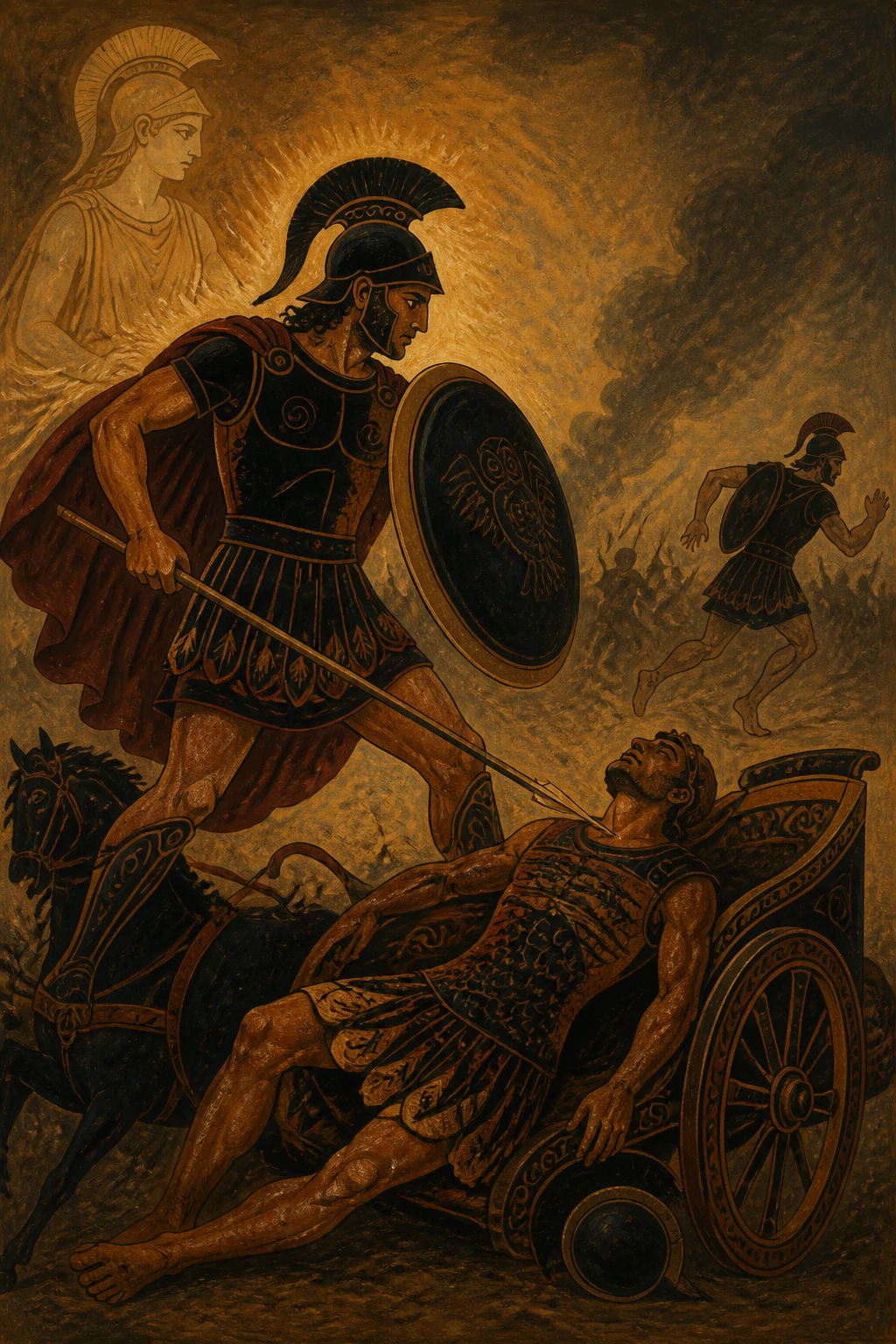
“Stand firm, then, and urge on all our men.” As he spoke, the end of death covered his eyes and nostrils. Patroclus set his foot against his chest and drew the spear from his flesh; the midriff came away with it, and together he drew out the spearpoint and Sarpedon’s soul.
The Myrmidons held his snorting horses where they stood, eager to flee now they had left their masters’ chariot. Bitter grief came over Glaucus as he heard Sarpedon’s voice, and his heart was shaken because he could not come to his aid.
He gripped his arm and pressed it with his hand, for the wound tormented him where Teucer had struck him with an arrow as he charged the high wall, while Teucer defended his comrades from destruction. Then he prayed to far-shooting Apollo: “Hear me, lord, wherever you may be, in Lycia’s rich land or here in Troy. Everywhere you can hear a man in distress, and distress has come upon me now.
“I have this grievous wound; my arm is pierced through with sharp pains, the blood will not stop flowing, and my shoulder is weighed down by it. I cannot hold my spear steady or go forward to fight the enemy. And the best of men has died, Sarpedon, son of Zeus, yet Zeus does not defend his own child.
“But you, lord, heal this grievous wound. Soothe my pain and give me strength, so that I may call to my Lycian comrades and urge them into battle, and myself fight around the body of the dead.”
So he spoke in prayer, and Phoebus Apollo heard him. At once he stilled the pain, dried the dark blood from the grievous wound, and put fresh strength into his heart. Glaucus knew it within himself and rejoiced that the great god had heard his prayer so swiftly.
First he went among the leaders of the Lycians, urging them on every side to fight around Sarpedon. Then, with long strides, he went among the Trojans, seeking Polydamas son of Panthous and noble Agenor, and went on to Aeneas and bronze-helmed Hector. Standing close beside them, he spoke these winged words: “Hector, now you have utterly forgotten your allies, who waste their lives for your sake far from their loved ones and their native land. Yet you will do nothing to defend them.
“Sarpedon lies dead, the leader of the shield-bearing Lycians, who guarded Lycia by his justice and his strength. Bronze-clad Ares has brought him down beneath Patroclus’ spear. Stand by him, friends, and let your hearts burn with indignation, lest the Myrmidons strip his armor and outrage his body in anger for the Danaans who have died, those we killed with our spears beside the swift ships.”
So he spoke, and grief swept over the Trojans from head to foot, unbearable and unrestrained, for though a stranger, Sarpedon had been a bulwark of their city. Many troops had followed him, and he himself was foremost among them in battle. Eagerly they advanced straight at the Danaans, led by Hector, enraged at Sarpedon’s death. But the stout heart of Patroclus son of Menoetius roused the Achaeans. First he addressed the two Ajaxes, who were themselves eager for battle: “You two Ajaxes, now let it be your joy to stand firm, as you have done before among our men—or better still.
“The man who first leapt over the Achaeans’ wall lies dead: Sarpedon. If only we could seize him and dishonor his body, strip the armor from his shoulders, and bring down with ruthless bronze some of his comrades as they defend him!”
So he spoke, but they too were eager to hold their ground. When both sides had strengthened their ranks—the Trojans and Lycians, the Myrmidons and Achaeans—they clashed around the dead man’s body with terrible cries, and the armor of the warriors rang out loudly.
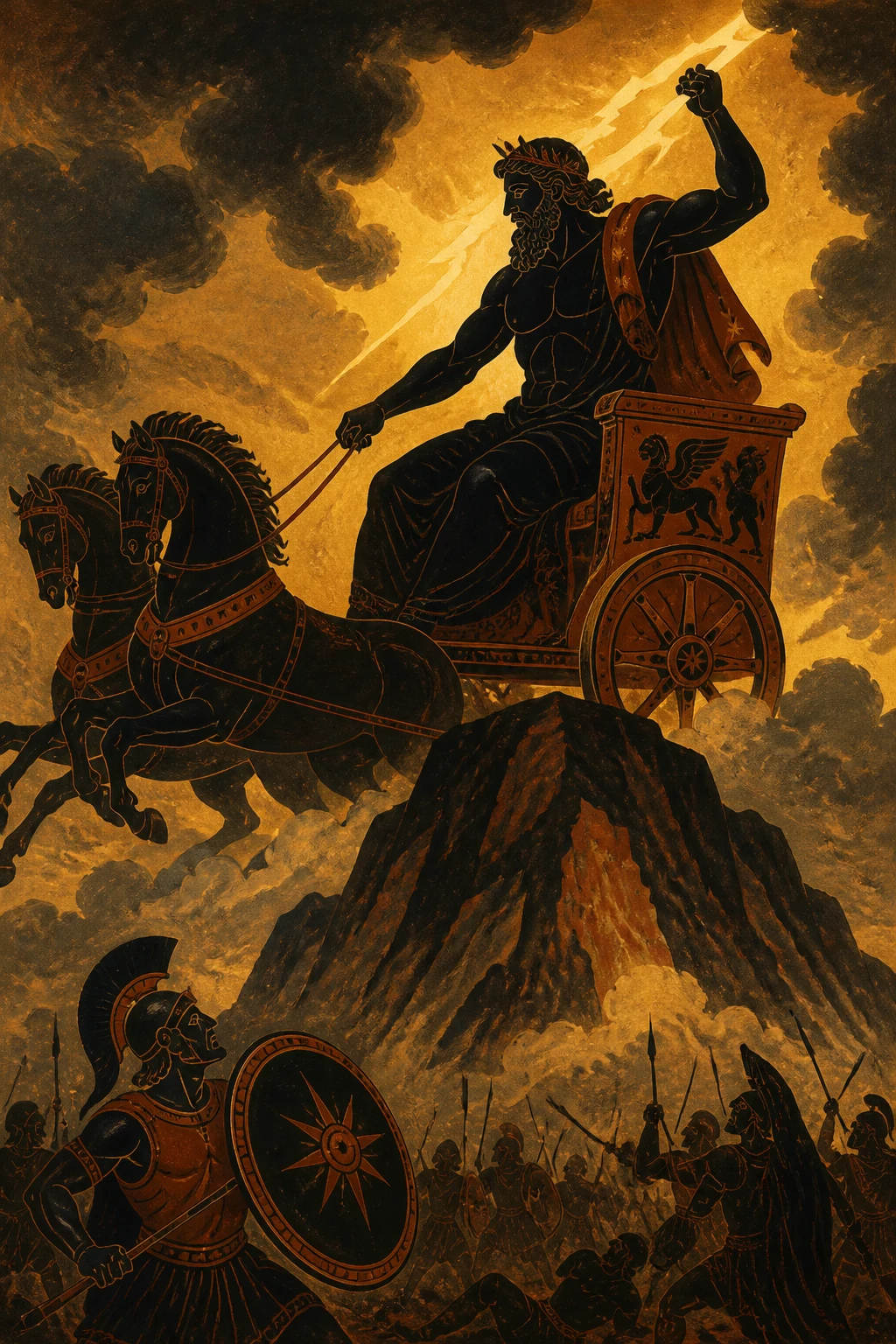
Zeus stretched a deadly darkness over the fierce encounter, so that around his dear son the toil of battle might be deadly indeed. First the Trojans drove back the keen-eyed Achaeans, for a man by no means the least among the Myrmidons was struck down: noble Epeigeus, son of great-hearted Agacles. Once he had ruled in well-peopled Budeion, but after killing a noble cousin he came as a suppliant to Peleus and silver-footed Thetis. They sent him with Achilles, breaker of men, to horse-rich Ilium to fight the Trojans.
As he laid hold of the corpse, glorious Hector struck him on the head with a stone. His skull split clean in two inside his heavy helmet, and he fell face downward upon the dead man, while life-destroying death poured over him.
Grief seized Patroclus for his fallen comrade, and he rushed through the foremost fighters like a swift hawk scattering jackdaws and starlings. So, Patroclus, driver of horses, you charged straight at the Lycians and Trojans, your heart enraged for your companion.
He struck Sthenelaus, the dear son of Ithaemenes, on the neck with a stone and tore the tendons apart. The foremost fighters gave ground, and glorious Hector with them. As far as a man can cast a long javelin, testing his strength in a contest or in war against life-destroying enemies, so far the Trojans fell back, and the Achaeans drove them on.
Glaucus, leader of the shield-bearing Lycians, was the first to turn. He killed great-hearted Bathycles, the dear son of Chalcon, who lived in Hellas and stood out among the Myrmidons for his wealth and prosperity.
As Bathycles pursued and was overtaking him, Glaucus suddenly turned and drove his spear into the middle of his chest. He fell with a crash. Deep grief seized the Achaeans at the fall of so fine a man, while the Trojans rejoiced greatly and gathered in a throng around him. Yet the Achaeans did not forget their courage, but bore straight down on them with all their strength.
Then Meriones killed a warrior of the Trojans, Laogonus, the bold son of Onetor, who was priest of Idaean Zeus and honored like a god among his people. He struck him beneath the jaw and ear. Swiftly his spirit left his limbs, and hateful darkness took him.
Aeneas hurled his bronze spear at Meriones, hoping to hit him as he advanced under cover of his shield. But Meriones saw the bronze spear coming and avoided it, stooping forward. The long spear lodged in the ground behind him, and its butt quivered; there mighty Ares spent its force.
The point of Aeneas’ spear sank trembling into the earth, for it had flown in vain from his strong hand. Angered at heart, Aeneas called out: “Meriones, dancer though you are, my spear would soon have stopped your dancing forever, if only I had hit you!”
Meriones, famed for his spear, answered him: “Aeneas, strong though you are, it would be hard for you to quench the strength of every man who comes against you to defend himself. You too are mortal.
“If I should strike you squarely with my sharp bronze, strong as you are and confident in your hands, you would soon give glory to me and your soul to Hades, famed for his horses.” So he spoke, and the valiant son of Menoetius rebuked him: “Meriones, brave as you are, why do you speak like this?
“My friend, the Trojans will not give ground from the corpse for taunting words. Before that, the earth will hold some of them. In battle the outcome rests with our hands; words belong in council. There is no need to heap up speeches, but to fight.”
With these words he led the way, and the godlike warrior followed. As the din of woodcutters rises in the glens of a mountain and can be heard far away, so from the broad-pathed earth rose the clash of bronze and hide and well-made oxhide shields, as swords and double-pointed spears struck home.
No man, however keen his sight, could now have recognized noble Sarpedon, for he was covered from head to the tips of his feet with missiles, blood, and dust. They swarmed around the corpse as flies buzz around brimming milk pails in a farmyard in springtime, when milk drenches the vessels. So they swarmed around the dead man. And Zeus never turned his shining eyes from the fierce encounter, but watched them always, pondering in his heart, considering at length the death of Patroclus: whether glorious Hector should kill him now with the bronze in the fierce battle, there over godlike Sarpedon, and strip the armor from his shoulders, or whether he should yet increase the bitter toil of war for many more.
As he considered, this seemed the better course: that the noble companion of Achilles son of Peleus should once more drive the Trojans and bronze-helmed Hector toward the city and take the lives of many.
First he put a cowardly spirit into Hector. Hector mounted his chariot, turned to flight, and called on the other Trojans to flee, for he recognized the sacred scales of Zeus. Then not even the mighty Lycians stood their ground, but all fled when they saw their king lying stricken to the heart amid a heap of dead. Many had fallen over him when the son of Cronus stretched the fierce struggle to its height.
The Achaeans stripped the gleaming bronze armor from Sarpedon’s shoulders, and the valiant son of Menoetius gave it to his comrades to carry to the hollow ships. Then Zeus the cloud-gatherer spoke to Apollo: “Come now, dear Phoebus, go and cleanse Sarpedon of the dark blood. Take him out of the missiles, carry him far away, and bathe him in a river’s streams. Anoint him with ambrosia and clothe him in immortal garments. Then send him with swift escorts to bear him away, the twin brothers Sleep and Death. They will quickly set him down in the rich land of broad Lycia, where his brothers and kinsmen will give him burial with a mound and a gravestone, for that is the honor due the dead.”
So he spoke, and Apollo did not disobey his father. He went down from the mountains of Ida into the dreadful battle. At once he lifted noble Sarpedon out of the missiles, carried him far away, and bathed him in a river’s streams. He anointed him with ambrosia and clothed him in immortal garments. Then he sent him with swift escorts to bear him away, the twin brothers Sleep and Death, who quickly set him down in the rich land of broad Lycia.
Patroclus called to his horses and Automedon and pursued the Trojans and Lycians. Great was his folly, poor fool! Had he kept the command of the son of Peleus, he would surely have escaped the evil doom of black death.
But the will of Zeus is always stronger than the will of men. Easily he puts even a valiant man to flight and robs him of victory, and at other times he himself urges a man to battle. It was he who now stirred the spirit in Patroclus’ breast.
Then whom did you kill first, whom last, Patroclus, when the gods were calling you to death? First Adrestus, Autonous, and Echeclus, Perimus son of Megas, Epistor and Melanippus, and then Elasus, Mulius, and Pylartes. These he killed, while all the others thought only of flight.
Then the sons of the Achaeans would have taken high-gated Troy by the hands of Patroclus, so far ahead of all he stormed with his spear, had not Phoebus Apollo stood upon the well-built tower, intent on his destruction and on helping the Trojans.
Three times Patroclus set foot upon an angle of the lofty wall, and three times Apollo thrust him back, striking his shining shield with immortal hands. But when he charged a fourth time, like a god, Apollo cried out terribly and spoke these winged words: “Fall back, Zeus-born Patroclus! It is not your fate to sack the city of the proud Trojans with your spear, nor even Achilles’ fate, though he is far better than you.”
So he spoke, and Patroclus drew back a long way, avoiding the wrath of far-shooting Apollo. Hector held his single-hoofed horses at the Scaean Gates, uncertain whether to drive back into the tumult and fight again, or to order his troops to gather within the walls.
As he pondered, Phoebus Apollo stood beside him in the likeness of a strong man in his prime, Asius, the maternal uncle of Hector, tamer of horses. He was Hecuba’s own brother, the son of Dymas, who lived in Phrygia beside the streams of the Sangarius. Taking his likeness, Apollo son of Zeus addressed Hector: “Hector, why have you left the fighting? You should not do so.
“If only I were as much stronger than you as I am weaker, you would soon withdraw from battle to your cost! Come, drive your strong-hoofed horses against Patroclus. Perhaps you may kill him, and Apollo grant you glory.”
With these words the god went back into the toil of men, and glorious Hector ordered wise Cebriones to whip the horses into battle. Apollo plunged into the throng, sent cruel panic among the Argives, and gave glory to the Trojans and Hector.
Hector left the other Danaans alone and did not kill them, but drove his strong-hoofed horses against Patroclus. On the other side Patroclus leapt from his chariot to the ground, holding his spear in his left hand. With the other he seized a jagged, gleaming stone that filled his grasp. Bracing himself, he hurled it, neither shrinking long from his opponent nor wasting his throw. The sharp stone struck Hector’s charioteer, Cebriones, the illegitimate son of renowned Priam, on the forehead as he held the horses’ reins.
The stone crushed both his brows, and the bone did not withstand it. His eyes fell to the ground in the dust before his feet, and like a diver he plunged from the well-made chariot. Life left his bones.
Then, Patroclus the horseman, you mocked him: “Well now, what an agile man! How easily he tumbles! If he were out on the fish-filled sea, this man could feed a great many people by diving for oysters, leaping from a ship even in rough weather, since he tumbles so easily from his chariot here on the plain.
“So the Trojans have acrobats too!” With these words he advanced upon the warrior Cebriones with the rush of a lion that, ravaging the folds, is struck in the chest and meets destruction through its own courage. So, Patroclus, you sprang eagerly upon Cebriones.
Hector in turn leapt from his chariot to the ground on the other side. Over Cebriones the two fought like lions, both hungry and fierce, battling on a mountain peak over a slain deer. So over Cebriones the two masters of the battle cry, Patroclus son of Menoetius and glorious Hector, strove to tear each other’s flesh with ruthless bronze.
Hector seized the body by the head and would not let go, while Patroclus on the other side held it by a foot. Around them the other Trojans and Danaans joined in fierce battle. As the east wind and the south wind contend in mountain glens, shaking the deep forest—oak and ash and smooth-barked cornel—and the trees strike their long branches against one another with a wondrous roar and the crash of breaking wood, so the Trojans and Achaeans leapt upon each other and killed, neither side thinking of ruinous flight.
Around Cebriones many sharp spears stood planted, and feathered arrows sprung from bowstrings; many great stones battered the shields of the men fighting over him. But he lay in the swirling dust, mighty in his mighty length, his horsemanship forgotten.
While the sun still strode across the middle of the sky, the weapons of both sides struck home, and men kept falling. But when the sun turned toward the hour when oxen are unyoked, then at last the Achaeans proved stronger, beyond their allotted share.
They dragged the warrior Cebriones out of the missiles and the Trojans’ battle cries, and stripped the armor from his shoulders. Then Patroclus charged the Trojans, bent on their destruction. Three times he charged like swift Ares, crying out terribly, and each time he killed nine men.
But when you charged a fourth time, Patroclus, like a god, then the end of your life appeared. For Phoebus met you in the fierce encounter, terrible to behold. Patroclus did not see him coming through the tumult, for he approached wrapped in thick mist. He stood behind him and struck his back and broad shoulders with the flat of his hand, and his eyes spun.
Phoebus Apollo knocked the helmet from his head. The crested helm rolled clattering beneath the horses’ feet, and its horsehair plumes were fouled with blood and dust. Until then it had not been permitted for that horsehair-crested helmet to be defiled with dust: it had guarded the head and noble brow of a godlike man, Achilles. But now Zeus granted Hector the right to wear it on his head, though destruction was close upon him.
In Patroclus’ hands his long-shadowed spear broke apart, heavy, huge, stout, and bronze-tipped. From his shoulders the broad-rimmed shield fell to the ground with its strap. And lord Apollo, son of Zeus, loosened his breastplate.
Blind bewilderment seized his mind; his splendid limbs gave way beneath him, and he stood stunned. Then from behind, at close range, a Dardanian struck him between the shoulders with a sharp spear: Euphorbus son of Panthous, who excelled all men of his age with the spear, in horsemanship, and in speed of foot. Already, on his first coming to war with his chariot, while still learning battle, he had brought twenty men down from their chariots. He was the first to drive a weapon into you, Patroclus the horseman, but he did not bring you down. Snatching his ash spear from the flesh, he ran back and mingled with the throng, unwilling to face Patroclus in battle even stripped of his armor.
Patroclus, overcome by the god’s blow and the spear, drew back toward the mass of his companions, seeking to escape death. But when Hector saw great-hearted Patroclus retreating, wounded by the sharp bronze, he came close through the ranks and stabbed him with his spear in the lower belly, driving the bronze clean through. Patroclus fell with a crash, and great grief struck the Achaean host. As a lion overcomes a tireless boar in combat, when the two fight fiercely on a mountain peak over a little spring from which both wish to drink, and the lion masters the hard-panting boar by force, so Hector son of Priam came close and with his spear took the life of Menoetius’ valiant son, who had killed so many. Boasting over him, he spoke these winged words: “Patroclus, you thought you would sack our city, rob the Trojan women of their day of freedom, and carry them away in your ships to your own dear native land. Fool! Before them Hector’s swift horses stretch out their legs for battle, and I myself stand foremost with the spear among the war-loving Trojans, keeping the day of slavery from them. But you—the vultures will devour you here.
“Poor wretch! Mighty though Achilles is, he did not save you. No doubt, as he stayed behind, he gave you many orders when you set out: ‘Do not return to the hollow ships, Patroclus, driver of horses, until you have torn the bloody tunic about the chest of Hector, slayer of men.’
“So he must have spoken, and persuaded your foolish heart.” Then, Patroclus the horseman, your strength failing, you answered him: “Boast loudly now, Hector, for Zeus son of Cronus and Apollo have given you victory. They overcame me easily; they themselves stripped the armor from my shoulders.
“Had twenty men like you come against me, all would have perished here, brought down beneath my spear. No, deadly fate and Leto’s son have killed me, and among men, Euphorbus. You are only the third to take my life.
“And I will tell you something else; lay it to heart. You too have not long to live. Already death and mighty fate stand close beside you, and you will fall by the hands of peerless Achilles, the descendant of Aeacus.”
As he spoke, the end of death enfolded him. His soul flew from his limbs and went to Hades, lamenting its fate, leaving manhood and youth behind. Though he was dead, glorious Hector answered him: “Patroclus, why do you prophesy sheer destruction for me?
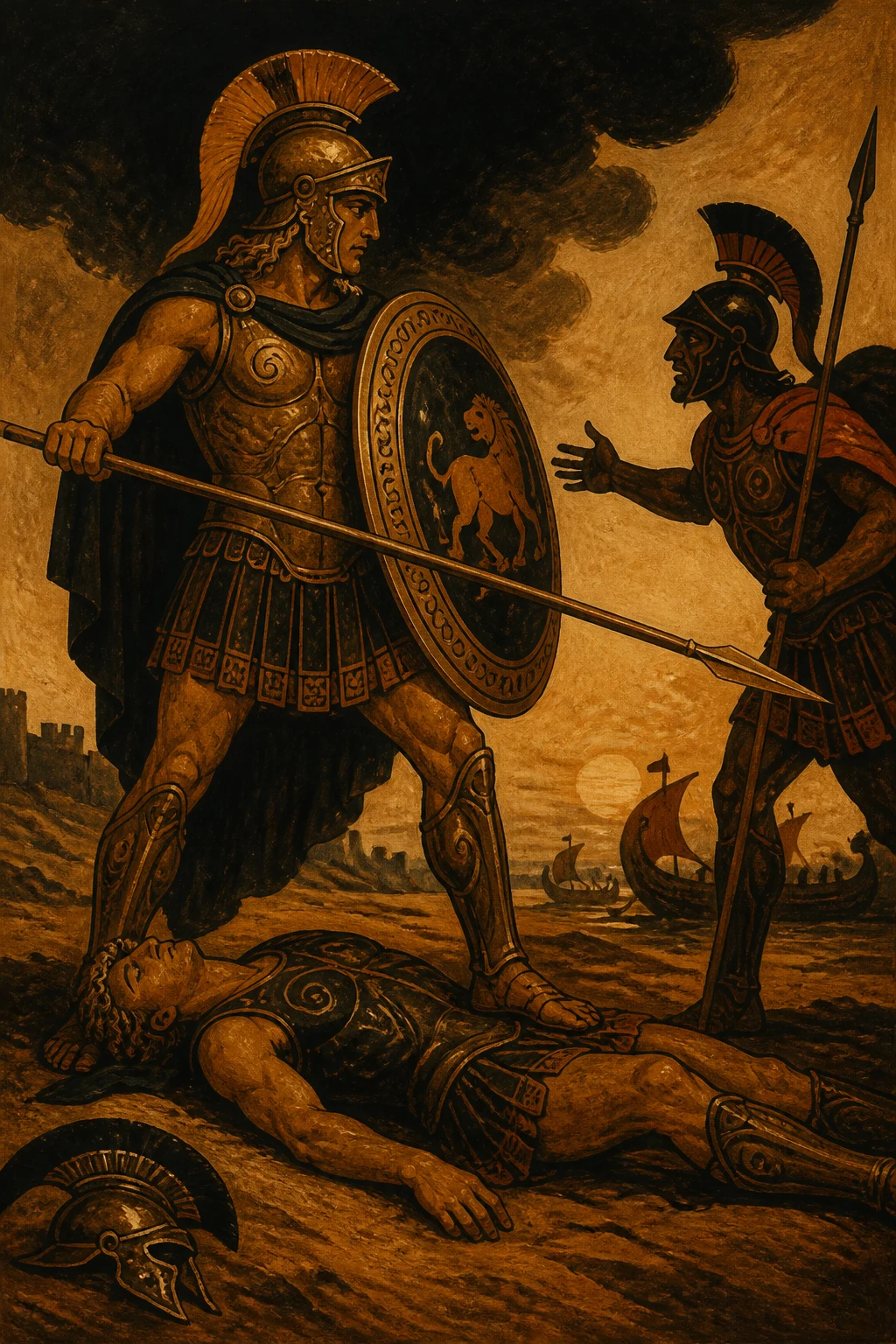
“Who knows whether Achilles, the son of lovely-haired Thetis, may not first be struck by my spear and lose his life?” With these words he set his foot upon the body, pulled the bronze spear from the wound, and pushed him backward off its point.
At once he went with his spear after Automedon, the godlike attendant of the swift-footed descendant of Aeacus, eager to strike him down. But the swift immortal horses carried him away, the splendid gifts the gods had given Peleus.