Prevod
When the Trojans had fled back across the stakes and ditch, and many had fallen beneath the Danaans’ hands, they halted beside their chariots, pale with terror. Then Zeus awoke on the peaks of Ida beside golden-throned Hera. Springing up, he stood and looked upon the Trojans and Achaeans: the former in confusion, the Argives driving them before them, and lord Poseidon among the pursuers. He saw Hector lying on the plain with his companions seated round him, struggling for breath, dazed and vomiting blood; for it was no weakling among the Achaeans who had struck him.
The father of gods and men pitied him at the sight, and with a terrible, lowering glance he spoke to Hera: “So, Hera, you incorrigible schemer, it was your cunning that put noble Hector out of battle and routed his army.
“I cannot say whether you will not be the first to reap the fruits of your wicked plotting, when I lash you with blows. Have you forgotten how you hung on high, with two anvils fastened to your feet and an unbreakable golden chain about your hands? There you hung amid the sky and clouds, while the gods throughout high Olympus raged in helpless anger. They could not come near and set you free: any I caught I seized and hurled from the threshold, to fall fainting to the earth. Yet even that did not ease the unrelenting grief in my heart for godlike Heracles, whom you, with evil intent, drove over the barren sea, persuading the North Wind to send storms against him, until you swept him away to well-peopled Cos.
“I rescued him from there and brought him back to horse-pasturing Argos, worn though he was by many trials. I shall remind you of all this again, to make you leave off your deceit, and let you see whether love and the bed we shared will help you—the bed to which you came from among the gods and beguiled me.”
So he spoke, and ox-eyed queen Hera shuddered. She answered him with winged words: “Let Earth now bear witness, and the broad Heaven above, and the downward-flowing water of Styx, the greatest and most dreadful oath for the blessed gods; let your own sacred head bear witness, and the marriage bed that is ours alone, by which I would never swear in vain: it is not at my urging that Poseidon the Earth-shaker harms the Trojans and Hector and helps their enemies. His own heart must spur and command him; he saw the Achaeans hard pressed beside their ships and pitied them.
“Indeed, I would counsel him myself to follow wherever you lead, lord of the dark clouds.” So she spoke, and the father of gods and men smiled and answered her with winged words: “If henceforth, ox-eyed queen Hera, you were to sit among the immortals sharing my purpose, then Poseidon, however much he wished otherwise, would soon turn his thoughts to accord with yours and mine.
“But if you are truly speaking in all sincerity, go now among the tribes of gods and summon Iris and Apollo of the glorious bow here to me. Iris shall go among the bronze-clad Achaeans and tell lord Poseidon to leave the battle and return to his own house. Phoebus Apollo shall rouse Hector to battle, breathe strength into him once more, and make him forget the pains that now torment his heart. Then he shall turn the Achaeans back, stirring cowardly panic among them, until in their flight they fall upon the many-benched ships of Achilles, son of Peleus. Achilles will send out his companion Patroclus; and glorious Hector will kill him with his spear before Ilium, after he has slain many other young warriors, among them my own son, noble Sarpedon.
“Then, in anger for Patroclus, godlike Achilles will kill Hector. From that time onward I shall bring about a continuous retreat from the ships, until the Achaeans take steep Ilium through Athena’s designs.
“But until then I shall neither relent in my anger nor allow any other immortal to help the Danaans here, before the wish of Peleus’ son is fulfilled, as I first promised him and confirmed with a nod of my head, on the day when the goddess Thetis clasped my knees and begged me to honour Achilles, sacker of cities.”
So he spoke, and white-armed Hera obeyed. She left the mountains of Ida for high Olympus. As the mind of a man who has travelled over many lands darts swiftly, and in his shrewd thoughts he thinks, “Would that I were here, or there,” and his desires range far and wide, so swiftly and eagerly queen Hera flew. She reached steep Olympus and came among the immortal gods assembled in Zeus’s house. At the sight of her they all sprang up and held out cups in greeting.
She passed the others by and accepted a cup from lovely-cheeked Themis, who had been the first to run to meet her and now addressed her with winged words: “Hera, why have you come? You look distraught. Surely the son of Cronus, your husband, has frightened you.”
White-armed Hera answered her: “Goddess Themis, do not question me about this. You know yourself how arrogant and harsh his heart is. But preside over the equal feast here in the hall. You shall hear, along with all the immortals, what evil deeds Zeus proclaims he will accomplish. I doubt that all alike, whether mortals or gods, will be glad at heart, however cheerfully some may be feasting now.”
With these words queen Hera sat down, and the gods throughout Zeus’s hall were troubled. She smiled with her lips, but her brow above her dark eyebrows did not brighten. Indignant, she addressed them all: “Fools that we are, to rage so senselessly against Zeus! Do we still hope to draw near and restrain him, by words or force? He sits apart, caring nothing, taking no heed, for he claims to stand far above all the immortal gods in might and strength.
“So bear whatever evil he sends each one of you. Already, I think, sorrow has come to Ares: his son has fallen in battle, Ascalaphus, dearest of men to him, whom mighty Ares calls his own.”
So she spoke, and Ares struck his sturdy thighs with the palms of his hands and cried out in grief: “You who dwell in the halls of Olympus, do not be angry with me now if I go to the Achaean ships to avenge my son’s murder, even if my fate is to be struck by Zeus’s thunderbolt and lie among the dead in blood and dust.”
With that he ordered Deimos and Phobos to harness his horses, while he put on his shining armour. Then a still greater and more grievous anger and wrath would have arisen in Zeus against the immortals, had not Athena, fearing for all the gods, sprung from the throne where she sat and hurried through the doorway. She took the helmet from Ares’ head and the shield from his shoulders, and, drawing the bronze spear from his powerful hand, set it aside. Then she rebuked furious Ares: “Madman! Your wits are gone, you are out of your mind! Have you ears only to hear in vain, and neither sense nor shame?
“Did you not hear what white-armed Hera said, who has only just come back from Olympian Zeus? Do you wish to suffer countless miseries yourself and then be forced, in anguish, to return to Olympus, while sowing great trouble for all the rest of us?
“For he will at once leave the proud Trojans and Achaeans and come to Olympus to throw us into confusion, seizing us one after another, guilty and innocent alike. So now I urge you to let go your anger for your son. Many a man better than he in strength and prowess has already been killed, or will be hereafter. It is hard to save every mortal’s children and descendants.”
With these words she seated furious Ares on his throne. Hera called Apollo and Iris, messenger of the immortal gods, outside the hall, and addressed them with winged words: “Zeus commands you both to go to Ida as quickly as you can. When you arrive and stand face to face with Zeus, do whatever he urges and commands.”
Having spoken, queen Hera went back and sat upon her throne, while the two sprang away in flight. They reached Ida of the many springs, mother of wild beasts, and found the far-seeing son of Cronus seated on the summit of Gargaron, wreathed in a fragrant cloud.
They came before Zeus the cloud-gatherer and stood there. At the sight of them he felt no anger, since they had so quickly obeyed his dear wife’s words. First he addressed Iris with winged words: “Go, swift Iris, and tell lord Poseidon all this, faithfully reporting my message.
“Command him to leave the fighting and warfare and go among the tribes of gods or into the sacred sea. If he will not obey my words but disregards them, let him consider in his heart and mind whether, strong though he is, he can endure my coming against him. For I declare that I am far mightier than he, and older-born. Yet his heart does not shrink from claiming equality with me, whom all the others dread.”
So he spoke, and swift, wind-footed Iris obeyed. She went down from the mountains of Ida towards sacred Ilium. As snow or freezing hail flies from the clouds beneath the blast of the North Wind born in the clear sky, so swiftly and eagerly Iris flew. Standing close to the glorious Earth-shaker, she said: “Earth-holder, dark-haired lord, I have come here bearing a message from Zeus who holds the aegis.
“He commands you to leave the fighting and warfare and go among the tribes of gods or into the sacred sea. If you will not obey his words but disregard them, he threatens to come here himself and fight you face to face. He bids you keep clear of his hands, for he declares that he is far mightier than you, and older-born. Yet your heart does not shrink from claiming equality with him, whom all the others dread.”
Deeply vexed, the glorious Earth-shaker answered her: “Outrageous! Mighty though he is, his words are arrogant indeed, if he means to restrain me by force against my will, when I am his equal in honour. We are three brothers, sons of Cronus whom Rhea bore: Zeus and I, and Hades the third, who rules the dead.
“All things were divided three ways, and each received his share of honour. When we shook the lots, I won the grey sea as my dwelling for ever; Hades won the misty darkness, and Zeus the broad heaven amid the upper air and clouds. But earth and high Olympus remain common to us all.
“So I will not live at Zeus’s bidding. Powerful though he is, let him stay content within his allotted third. Let him not threaten me with his fists as though I were some utter coward. Better to scold with his dreadful words the daughters and sons he himself has fathered: they must listen to his commands, whether they wish to or not.”
Swift, wind-footed Iris answered him: “Earth-holder, dark-haired lord, am I truly to carry this harsh and defiant answer to Zeus, or will you reconsider? Noble hearts can change.
“You know that the Erinyes always take the part of the elder-born.” Then Poseidon the Earth-shaker answered her: “Goddess Iris, you have spoken very fittingly. It is a good thing when a messenger knows what is right.
“But this bitter grief strikes me to the heart and soul, whenever he chooses to assail with angry words one who is his equal in rank and allotted an equal portion. Still, for now I shall yield, angry though I am. But I tell you this, and make the threat in earnest: if, against my will and that of Athena, bringer of spoil, and Hera and Hermes and lord Hephaestus, he spares steep Ilium and refuses to destroy it and give the Argives a great victory, let him know that there will be an incurable breach between us.”
With these words the Earth-shaker left the Achaean army and plunged into the sea, and the Achaean warriors sorely missed him. Then Zeus the cloud-gatherer addressed Apollo: “Go now, dear Phoebus, to bronze-armoured Hector. The Earth-holder, the Earth-shaker, has already gone into the sacred sea, avoiding my fierce anger. Otherwise even the gods beneath the earth, who dwell around Cronus, would have heard of our battle.
“Yet it was far better for me and for him that, angry though he was, he yielded before facing my hands; for we should not have settled the matter without sweat. Take the tasselled aegis in your hands and shake it fiercely, putting the Achaean warriors to flight. And take glorious Hector into your own care, Far-shooter: rouse great strength in him until the Achaeans flee back to their ships and the Hellespont.
“After that I myself shall consider what to do and say, so that the Achaeans may gain respite from their toil once more.” So he spoke, and Apollo did not disobey his father. He went down from the mountains of Ida like a swift, dove-killing hawk, fastest of flying things.
He found noble Hector, son of wise Priam, sitting up, no longer lying on the ground. He was just recovering his senses and recognizing the companions round him. His gasping and sweating were subsiding, for the will of Zeus who holds the aegis was reviving him.
Standing close beside him, far-working Apollo said: “Hector, son of Priam, why do you sit here apart from the others, faint and helpless? Has some trouble come upon you?” Weakly, Hector of the flashing helmet answered him: “Who are you, best of gods, who question me face to face?
“Have you not heard how Ajax, master of the war cry, struck me in the chest with a stone beside the sterns of the Achaean ships, while I was killing his companions, and stopped my furious onslaught? Indeed, I thought that this very day I would reach the dead and the house of Hades, for I felt my life ebbing away.”
Then lord Apollo, the far-worker, answered him: “Take courage now. Such a helper has the son of Cronus sent from Ida to stand beside you and defend you: Phoebus Apollo of the golden sword, who has saved you before, both you yourself and your towering city.
“Come now, urge your many charioteers to drive their swift horses against the hollow ships. I shall go before them and smooth the whole way for the horses, and turn the Achaean warriors to flight.”
With these words he breathed great strength into the shepherd of the people. As a stall-fed horse, well fed at the manger, breaks his tether and gallops thundering over the plain, eager for his accustomed bath in the fair-flowing river, glorying in his strength, his head held high and his mane streaming about his shoulders, while his legs swiftly carry him, proud of his beauty, to the haunts and pasture of the mares: so Hector moved his feet and knees swiftly, urging on the charioteers, when he heard the god’s voice.
As hounds and countrymen pursue a horned stag or a wild goat, which a sheer cliff and shadowy forest save, since it is not their fate to catch it, and at their clamour a thick-maned lion appears in their path and at once turns them all back, eager though they are: so the Danaans had been pursuing in a mass, striking with swords and double-edged spears. But when they saw Hector moving along the ranks of men, they were afraid, and every man’s courage sank to his feet.
Then Thoas, son of Andraemon, addressed them, far the best of the Aetolians, skilled with the javelin and brave in close combat. Few Achaeans could surpass him in assembly when the young men contended in debate. With their welfare at heart he spoke: “What a marvel meets my eyes! See how Hector has risen again and escaped death! Surely every one of us hoped he had died beneath the hands of Ajax, son of Telamon.
“But some god has once more rescued Hector and saved him, Hector who has loosened the knees of so many Danaans, as I think he will now do again. Not without the aid of loud-thundering Zeus does he stand in the front ranks so fiercely eager.
“Come, let us all do as I say. We will order the main body to return to the ships, while we ourselves, who claim to be the best in the army, stand firm and meet him with uplifted spears, to see whether we can hold him back at the outset. Eager though he is, I think he will fear to plunge into the mass of Danaans.”
So he spoke, and they listened and readily obeyed. Those around Ajax and lord Idomeneus, Teucer and Meriones and Meges, peer of Ares, called the bravest men to them and drew up a battle line to face Hector and the Trojans. Behind them the main body withdrew towards the Achaean ships.
The Trojans charged in close ranks, with Hector leading in long strides. Before him went Phoebus Apollo, his shoulders wrapped in cloud, holding the furious aegis, terrible, shaggy all round and dazzling, which Hephaestus the smith had given Zeus to carry and put men to flight. With this in his hands he led the army on.
The Argives held firm in close ranks. A piercing cry rose from both sides, and arrows leapt from bowstrings. Of the many spears hurled by daring hands, some lodged in the flesh of warriors swift in battle, while many others, before they could touch white flesh, stuck in the earth between the armies, yearning to glut themselves on flesh.
As long as Phoebus Apollo held the aegis motionless in his hands, the missiles of both sides struck home and men kept falling. But when he looked straight at the Danaans of the swift horses and shook it, and himself gave a great shout, he bewitched the hearts within their breasts, and they forgot their fighting spirit.
As two wild beasts, suddenly appearing in the dead of black night while the herdsman is away, scatter a herd of cattle or a great flock of sheep, so the Achaeans fled without resistance. Apollo had sent panic among them and was granting glory to Hector and the Trojans.
Then, as the battle line broke apart, man slew man. Hector killed Stichius and Arcesilaus, the latter a leader of the bronze-clad Boeotians, the former a trusted companion of great-hearted Menestheus. Aeneas stripped the armour from Medon and Iasus.
Medon was the bastard son of godlike Oileus and brother of Ajax. He lived in Phylace, far from his native land, because he had killed a kinsman of his stepmother Eriopis, Oileus’ wife. Iasus was a leader of the Athenians and was called the son of Sphelus, son of Bucolus.
Polydamas killed Mecisteus, and Polites slew Echius in the forefront of battle, while noble Agenor killed Clonius. Paris struck Deiochus from behind, low in the shoulder, as he fled among the foremost fighters, and drove the bronze clean through.
While they were stripping the armour from the dead, the Achaeans, running against the stakes and the dug ditch, fled this way and that and were driven back inside the wall. Hector shouted loudly to the Trojans, bidding them rush against the ships and leave the bloodstained spoils: “Any man I see elsewhere, away from the ships, I shall put to death on the spot. His brothers and sisters shall not give him his share of funeral fire when he is dead; dogs shall drag him about before our city.”
With these words he lashed his horses across the shoulders, calling to the Trojans along the ranks. All together they shouted and drove their chariot-horses after him with a tremendous din. Before them Phoebus Apollo easily kicked down the banks of the deep ditch, tumbling them into its midst, and made a causeway as long and broad as the flight of a spear when a man hurls it to test his strength.
Across it they poured in close array, Apollo before them with the priceless aegis. He broke down the Achaean wall as easily as a child beside the sea, who builds playthings in the sand in childish sport and then, still playing, scatters them again with hands and feet.
So, Phoebus, lord of the cry, you swept away the Argives’ long toil and hardship, and drove them into panic. They halted beside the ships, calling to one another, and each man lifted his hands to all the gods and prayed aloud. Above all, Gerenian Nestor, guardian of the Achaeans, stretched his hands towards the starry heaven and prayed: “Father Zeus, if ever anyone in wheat-rich Argos burned the fat thighbones of an ox or sheep to you and prayed for his return, and you promised and nodded assent, remember it now, Olympian, and ward off the pitiless day. Do not let the Achaeans be crushed like this by the Trojans.”
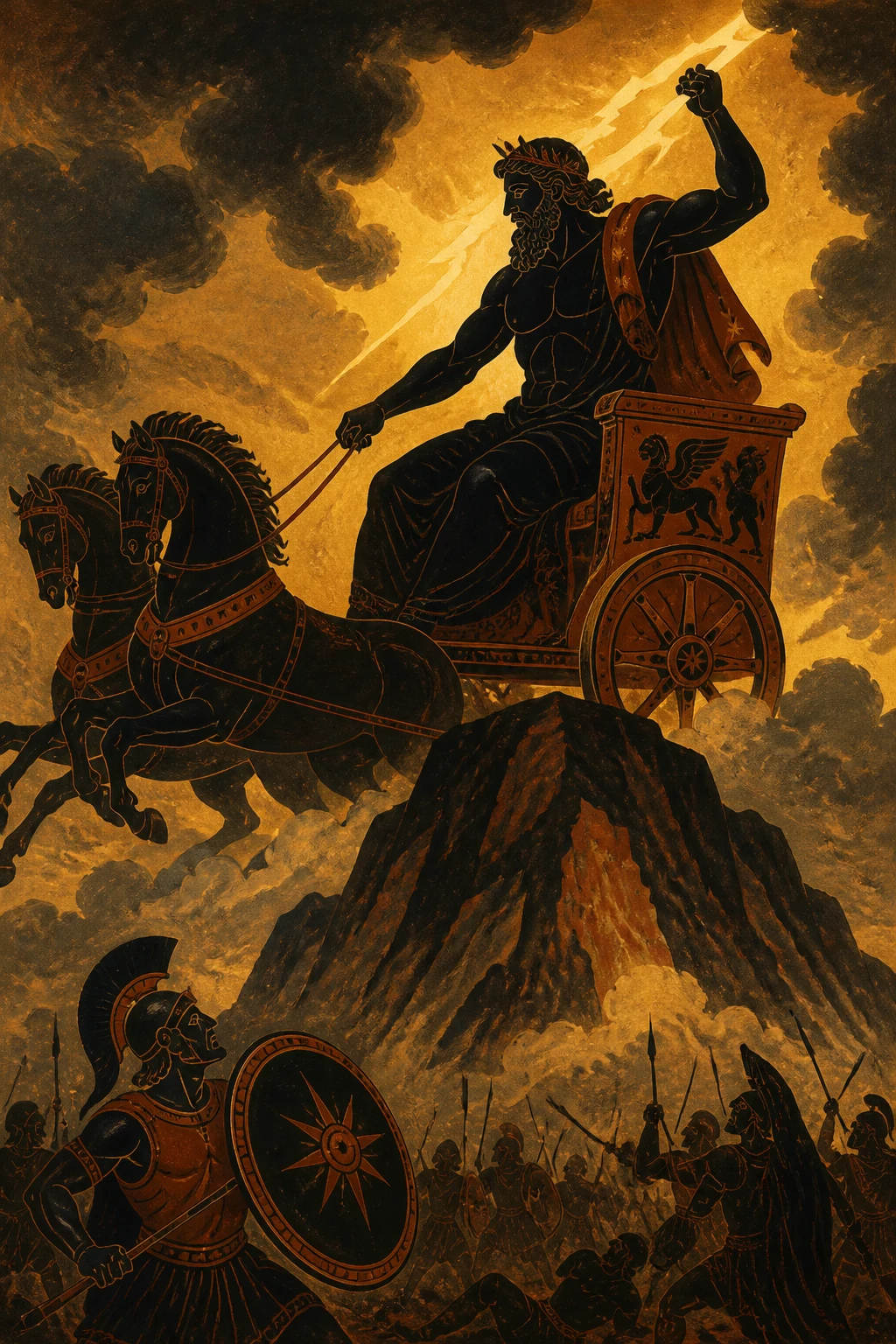
So he prayed, and Zeus the counsellor thundered loudly, hearing the prayer of the aged son of Neleus. When the Trojans heard the thunder of Zeus who holds the aegis, they sprang still more fiercely upon the Argives and remembered the joy of battle.
As a great wave of the wide sea falls over a ship’s sides when the force of the wind drives it on—for it is the wind above all that swells the waves—so the Trojans swept over the wall with a mighty shout. They drove their horses through and fought at close quarters beside the sterns with double-edged spears, the Trojans from their chariots, the Achaeans from high upon the black ships, using the long, jointed pikes kept aboard for sea fighting, their tips shod in bronze.
As long as the Achaeans and Trojans fought about the wall outside the swift ships, Patroclus sat in the hut of brave Eurypylus, cheering him with talk and sprinkling healing herbs upon his grievous wound to soothe the black pains.
But when he saw the Trojans rushing upon the wall, and shouting and panic arose among the Danaans, he groaned and struck his thighs with the palms of his hands. In grief he said: “Eurypylus, though you still need me, I can no longer stay here beside you, for a mighty struggle has arisen. Let your attendant comfort you, while I hurry to Achilles and urge him to fight.
“Who knows whether, with a god’s help, my words may move his heart? A friend’s persuasion is a good thing.” With these words his feet carried him away. Meanwhile the Achaeans stood firm against the advancing Trojans, yet could not drive them from the ships, though they were fewer; nor could the Trojans ever break the Danaan ranks and force their way among the huts and ships.
As a measuring line straightens a ship’s timber in the hands of a skilled carpenter, one who knows all his craft through Athena’s teaching, so evenly their battle and warfare were drawn. Different men fought at different ships, but Hector made for glorious Ajax.
The two struggled over a single ship. Neither could prevail: Hector could not drive Ajax off and burn the ship, nor Ajax thrust Hector back, since a god had brought him there. Then glorious Ajax struck Caletor, son of Clytius, in the chest with his spear as he carried fire towards the ship.
He fell with a crash, and the firebrand dropped from his hand. When Hector saw his cousin fallen in the dust before the black ship, he shouted loudly to the Trojans and Lycians: “Trojans, Lycians, and Dardanians who fight at close quarters, do not give ground in this narrow space! Save the son of Clytius, so that the Achaeans do not strip his armour where he has fallen among the ships.”
With these words he hurled his shining spear at Ajax. He missed him, but struck Lycophron, son of Mastor, Ajax’s attendant from Cythera, who lived with him because he had killed a man in sacred Cythera. As Lycophron stood close beside Ajax, Hector’s sharp bronze struck his head above the ear. He fell backwards from the ship’s stern into the dust, and his limbs went slack.
Ajax shuddered and spoke to his brother: “Dear Teucer, our trusted companion, Mastor’s son, has been killed, the man who came from Cythera to our house and whom we honoured in our halls as we did our own dear parents. Great-hearted Hector has killed him. Where are your deadly arrows now, and the bow Phoebus Apollo gave you?”
So he spoke, and Teucer understood. He ran to stand beside him with his bent bow in his hand and his quiver full of arrows, and swiftly shot his shafts among the Trojans. He struck Cleitus, the splendid son of Peisenor, companion of noble Polydamas, son of Panthous, as he held the reins. Cleitus was busy with his horses, driving where the ranks were thickest in confusion, to please Hector and the Trojans. But disaster soon came upon him, and no one, for all their eagerness, could ward it off.
The grievous arrow struck him in the back of the neck. He fell from the chariot, and his horses shied away, rattling the empty car. Lord Polydamas saw at once and was the first to come in front of the horses.
He gave them to Astynous, son of Protiaon, repeatedly urging him to keep watch and hold the horses close at hand. Then he went back to join the foremost fighters. Teucer took another arrow to shoot at bronze-armoured Hector, and would have ended the fighting beside the Achaean ships if he had struck him in his hour of triumph and taken his life.
But he did not escape the shrewd mind of Zeus, who was guarding Hector and deprived Teucer, son of Telamon, of glory. As Teucer drew the faultless bow, Zeus snapped its finely twisted string. The bronze-weighted arrow flew astray, and the bow dropped from his hand.
Teucer shuddered and spoke to his brother: “Ah, surely some god is utterly thwarting our plans for battle! He has knocked the bow from my hand and broken its newly twisted string, which I fastened to it only this morning, so that it would endure the arrows springing from it one after another.”
Great Ajax, son of Telamon, answered him: “Dear brother, let the bow and all your arrows lie, since a god has ruined them in malice towards the Danaans. Take a long spear in your hands and a shield upon your shoulder, fight the Trojans and rouse the rest of our men.
“Even if they overcome us, let them not take our well-benched ships without a struggle. Let us remember our courage.” So he spoke, and Teucer laid his bow in the hut. He slung a four-layered shield about his shoulders, set a well-made helmet on his sturdy head, plumed with horsehair, its crest nodding terribly above, and took a strong spear tipped with sharp bronze. Then he set out and quickly ran to Ajax’s side.
When Hector saw that Teucer’s weapons had been thwarted, he shouted loudly to the Trojans and Lycians: “Trojans, Lycians, and Dardanians who fight at close quarters, be men, my friends, and remember your furious courage among the hollow ships! I have seen with my own eyes the weapons of their finest warrior thwarted by Zeus.
“The power of Zeus is easy for men to recognize, both when he grants surpassing glory and when he weakens men and refuses to defend them. So now he weakens the Argives’ strength and helps us.
“Fight together beside the ships! And whoever among you is struck by a missile or a blow and meets his destined death, let him die. There is no dishonour in dying to defend one’s country. His wife and children will be safe behind him, his home and inheritance unharmed, if only the Achaeans sail away to their own dear native land.”
With these words he roused the spirit and courage of every man. On the other side Ajax called to his companions: “Shame on you, Argives! Now it is settled: either we perish, or we save ourselves and drive destruction from the ships.
“Do you suppose that, if Hector of the flashing helmet takes the ships, each of you will reach his native land on foot? Do you not hear Hector urging on his whole army, intent on burning the ships?
“He is not inviting them to a dance, but to battle. We have no better plan or counsel than to meet them at close quarters with all our strength. Better to settle life or death in a single moment than to be worn down endlessly in this dreadful fighting, trapped beside the ships by men inferior to ourselves.”
With these words he roused the spirit and courage of every man. Then Hector killed Schedius, son of Perimedes, leader of the Phocians, and Ajax slew Laodamas, captain of the foot soldiers, the splendid son of Antenor. Polydamas killed Otus of Cyllene, companion of Phyleus’ son and leader of the great-hearted Epeians.
Seeing him fall, Meges rushed at Polydamas, but he slipped aside, and Meges missed him; Apollo would not allow the son of Panthous to fall among the foremost fighters. Instead, Meges struck Croesmus in the middle of the chest with his spear.
He fell with a crash, and Meges began stripping the armour from his shoulders. Meanwhile Dolops, skilled with the spear, rushed upon him, the son of Lampus, whom Lampus, son of Laomedon, had fathered as his bravest son, well versed in furious battle. Charging from close at hand, he struck the middle of the shield of Phyleus’ son with his spear. But the stout breastplate he wore, fitted with curving plates, saved him: Phyleus had once brought it from Ephyra, from the river Selleis.
For his guest-friend Euphetes, lord of men, had given it to him to wear in battle as a defense against enemy warriors; and now it kept destruction from his son’s flesh. But Meges thrust his sharp spear into the very top of his bronze, horsehair-crested helmet and tore away the plume. The whole crest fell to the ground in the dust, bright with its fresh crimson dye.
While he stood fighting Meges, still hoping for victory, warlike Menelaus came to Meges’ aid. Unseen, he took his stand beside him with his spear and struck him in the shoulder from behind. The eager spearhead drove straight through his chest, and he pitched forward on his face.
The two rushed to strip the bronze armor from his shoulders. But Hector called urgently to all his kinsmen, and first rebuked mighty Melanippus, son of Hicetaon. In earlier days he had pastured his shambling cattle in Percote, far from the enemy. But when the curved ships of the Danaans came, he returned to Ilium, where he stood out among the Trojans and lived in Priam’s house; and Priam honored him like his own sons. Hector rebuked him now, calling him by name: “Melanippus, are we to hang back like this? Does your own heart feel no shame at your cousin’s death?
“Do you not see how they are busy over Dolops’ armor? Come with me! We can no longer fight the Argives at a distance: either we must kill them, or they must take steep Ilium from its heights and slaughter its people.”
With these words he led the way, and the godlike warrior followed. Meanwhile great Ajax, son of Telamon, urged on the Argives: “Friends, be men, and take shame to heart! Have regard for one another in the fierce fighting.
“When men feel shame, more are saved than killed; but those who flee win neither glory nor safety.” So he spoke, and they, already eager to defend themselves, took his words to heart and fenced the ships with a wall of bronze. But Zeus roused the Trojans against them.
Menelaus, great in the war cry, urged Antilochus on: “Antilochus, no other Achaean is younger than you, or swifter on his feet, or as stout a fighter. If only you would spring out and strike down a Trojan!”
With these words he drew back again, having stirred him to action. Antilochus leaped out from the front ranks, glanced about him, and cast his shining spear. The Trojans shrank back as he threw, and his weapon did not fly in vain: he struck high-hearted Melanippus, son of Hicetaon, in the chest beside the nipple as he advanced into battle.
He fell with a crash, and darkness covered his eyes. Antilochus rushed at him like a hound darting at a wounded fawn, which a hunter has struck as it sprang from its lair, loosening its limbs. So, Melanippus, did battle-loving Antilochus spring upon you to strip your armor. But he did not escape the notice of glorious Hector, who ran through the fighting straight toward him.
Antilochus did not stand his ground, swift warrior though he was, but fled like a beast that has done harm—killed a dog or a herdsman among the cattle—and runs before a crowd of men can gather. So Nestor’s son fled, while Hector and the Trojans, with a tremendous roar, showered him with deadly missiles. But when he reached the mass of his companions, he turned and stood.
The Trojans rushed upon the ships like lions ravening for raw flesh, fulfilling the commands of Zeus, who kept rousing their mighty spirit while he dulled the Argives’ hearts and robbed them of glory, spurring their enemies on.
For his heart was set on giving glory to Hector, Priam’s son, so that he might fling fierce, unquenchable fire upon the curved ships and fulfill to the last the fateful prayer of Thetis. Zeus the counselor was waiting to see with his own eyes the blaze of a burning ship.
For from that moment he intended to drive the Trojans back from the ships and grant glory to the Danaans. With this in mind he roused Hector, Priam’s son, against the hollow ships, eager though Hector already was.
He raged like spear-brandishing Ares, or like consuming fire raging in the mountains through the thickets of a deep forest. Foam gathered about his mouth; his eyes blazed beneath his grim brows, and the helmet shook terribly about his temples as he fought. For Zeus himself was his defender from the heavens, honoring and glorifying him alone among so many men. Yet his life was to be short: already Pallas Athena was bringing on his destined day of death beneath the might of Peleus’ son.
He sought to break the ranks of men, testing them wherever he saw the thickest throng and the finest armor. Yet even so, for all his fury, he could not break them. They held firm, locked together like a tower, or like a vast, sheer rock beside the gray sea, which withstands the swift onslaught of shrill winds and the swelling waves that thunder against it. So the Danaans stood fast against the Trojans and did not flee.
But Hector, blazing like fire on every side, leaped into the throng. He fell upon them as a violent wave, wind-driven from beneath the clouds, falls upon a swift ship: the whole vessel is hidden in foam, the terrible blast of wind roars in the sail, and the sailors tremble in their hearts with fear, for only a little space bears them clear of death. So the hearts within the Achaeans’ breasts were torn with anguish.
He was like a murderous lion attacking cattle that graze in countless numbers on the wet meadows of a great marsh. Among them is a herdsman who does not yet know how to fight a beast to save a crumple-horned cow from slaughter. He keeps pace now with the foremost cattle, now with the hindmost, but the lion springs into their midst and devours a cow, while all the others scatter in terror. So all the Achaeans were driven into headlong flight by Hector and father Zeus. Yet Hector killed only Periphetes of Mycenae, the dear son of Copreus, who used to carry the commands of lord Eurystheus to mighty Heracles.
From that far inferior father sprang a better son, gifted in every excellence, both speed of foot and skill in battle, and ranked among the foremost men of Mycenae for wisdom. Yet now he gave Hector still greater glory.
For as he turned back, he tripped over the rim of the shield he carried, a defense against spears that reached to his feet. Entangled in it, he fell backward, and his helmet rang terribly about his temples as he struck the ground.
Hector saw him at once, ran up, and stood close beside him. He drove his spear into his chest and killed him near his own companions. Grieved though they were for their friend, they could not help him, for they themselves were in great fear of glorious Hector.
They were now among the ships, hemmed in by the outermost vessels, those that had been hauled up first, and the Trojans poured after them. Forced back from the first line of ships, the Argives halted in a body beside the huts and did not scatter through the camp. Shame and fear held them together, and they shouted ceaselessly to one another.
Above all, Gerenian Nestor, guardian of the Achaeans, pleaded with them, beseeching each man in his parents’ name: “Friends, be men, and feel shame before your fellow men! Let each of you remember his children, his wife, his possessions, and his parents, whether they are living or dead. In the name of those who are not here, I implore you: stand firm, and do not turn to flight!”
With these words he roused the courage and spirit of every man. Then Athena swept the wondrous cloud of mist from their eyes, and a clear light shone on either side, both toward the ships and over the battle that spares no one.
They could see Hector, great in the war cry, and his companions, both those who stood behind and were not fighting and those who fought beside the swift ships. But great-hearted Ajax could no longer bear to stand where the other sons of the Achaeans had drawn back. Instead, he strode along the decks of the ships, wielding in his hands a great boarding pike, twenty-two cubits long, its sections joined with clamps.
As a man skilled in riding chooses four horses from a large herd and drives them from the plain toward a great city along a busy road, while many men and women watch in wonder, and he keeps leaping safely and surely from one horse to another as they fly along—so Ajax strode over the decks of many swift ships, and his voice reached the heavens. With terrible, ceaseless shouts he urged the Danaans to defend their ships and huts. Nor did Hector linger in the throng of the bronze-armored Trojans. As a fiery eagle swoops upon a flock of winged birds feeding beside a river—geese, cranes, or long-necked swans—so Hector rushed straight at a dark-prowed ship. Zeus drove him on from behind with his mighty hand, and roused the army to follow him.
Once more bitter fighting broke out beside the ships. You would have thought they were meeting one another in battle fresh and unworn, so furiously they fought. And this was the thought in the minds of the combatants: the Achaeans believed they would not escape disaster, but would perish; while every Trojan’s heart hoped to burn the ships and kill the Achaean warriors.
With these thoughts they faced one another. Hector seized the stern of a beautiful, swift, seagoing ship, the one that had brought Protesilaus to Troy but had not carried him home again to his native land.
Around that ship the Achaeans and Trojans slaughtered one another at close quarters. They no longer stood apart to await the flight of arrows or javelins, but stood close together, with a single purpose, fighting with sharp axes and hatchets, great swords and double-pointed spears.
Many fine swords with dark-bound hilts fell to the ground, some from the hands, others from the shoulders of the fighting men, and the black earth ran with blood. Hector, once he had seized the stern, would not let go, but held its carved sternpost in his hands and called to the Trojans: “Bring fire! Raise the battle cry together, all of you! Now Zeus has given us a day worth all the rest: we shall take the ships that came here against the gods’ will and brought us so much misery, through the cowardice of our elders. Whenever I longed to fight beside the ships’ sterns, they held me back and restrained the army. But if far-seeing Zeus clouded our minds then, now he himself urges us on and commands us!”
So he spoke, and they hurled themselves upon the Argives more fiercely still. Ajax could no longer hold his ground, overwhelmed by missiles. Expecting death, he drew back a little onto a seven-foot rower’s bench, leaving the deck of the well-built ship.
There he stood on the watch, always thrusting back with his spear any Trojan who brought tireless fire against the ships. With terrible, ceaseless shouts he urged the Danaans on: “Friends, Danaan warriors, servants of Ares, be men, my friends! Remember your fierce courage!
“Do we think there are helpers behind us, or some stronger wall to ward destruction from our men? There is no city near, fortified with towers, where we might defend ourselves with fresh forces to aid us. We are here on the plain of the bronze-armored Trojans, pressed against the sea, far from our native land. Our salvation lies in our hands, not in slackening the fight!”
He spoke, and lunged furiously with his sharp spear. Whenever a Trojan, eager to please Hector who had urged him on, charged at the hollow ships with blazing fire, Ajax awaited him and struck him with his long spear. Twelve men he wounded at close quarters before the ships.