Prevod
_The King of Roccaforte falls in love with an old woman’s voice, and, deceived by a finger she has sucked smooth, takes her to bed. But when he discovers her wrinkles, he has her thrown out of a window. Left hanging from a tree, she is enchanted by seven fairies and transformed into a beautiful young woman, whom the King marries. Her sister, envious of her good fortune, has herself flayed to become beautiful, and dies._ _There was not a soul who had not enjoyed Ciommetella’s tale, and their pleasure was doubled at seeing Canneloro set free and the ogre punished for the havoc he had wrought among the poor hunters. Ghiacova was then called upon to seal this letter of entertainment with her own coat of arms, and she began as follows._ That accursed vice ingrained in us women, the longing to look beautiful, brings us to such a pass that, to gild the frame of our foreheads, we spoil the picture of our flesh, ruin the bones of our teeth, and, to lend brightness to our bodies, cloud our sight with shadows. Thus, before the time has come to pay tribute to old age, our eyes grow rheumy, our faces wrinkled, and our teeth defective. But if a young girl deserves blame for giving herself up too vainly to these follies, how much more punishment is deserved by an old woman who, wishing to compete with the young, makes herself the laughingstock of others and brings about her own ruin! As I am about to tell you, if you will lend me your ears a little while.
Two little old women had settled in a garden overlooked by the King of Roccaforte’s windows. They were the sum of all misfortunes, the register of deformities, the great ledger of ugliness. Their hair was dishevelled and bristling, their foreheads wrinkled and knobbly, their eyebrows twisted and stiff, their eyelids swollen and drooping, their eyes withered and sunken, their faces yellow and shrivelled, their mouths slack and crooked. In short, they had the beards of goats, hairy chests, humps on their backs, crooked arms, lame and wasted legs, and hooked feet. So that not even the sun should see such ugly mugs, they kept themselves burrowed in a ground-floor hovel beneath that lord’s windows. The King was reduced to such straits that he could not let out a fart without offending the noses of these hideous old boils, who made a fuss and flew into a rage over every trifle. Now a jasmine blossom falling from above had raised a lump on a head; now a torn-up letter had bruised a shoulder; now a little dust had battered a thigh. Hearing this torrent of delicate complaints, the King concluded that beneath him lived the very quintessence of tenderness, the choicest cut of softness, the cream of all things dainty. And so a longing stirred in his very bones, a yearning in their marrow, to see this marvel and settle the matter for himself. He began to heave sighs up and down, to clear his throat though he had no phlegm, and at last to speak plainly and without beating about the bush. “Where, where are you hiding, jewel, treasure, wonder of the world? Come out, come out, sunshine, warm your emperor! Unveil those lovely charms; show those little lamps in Love’s fragrant shop! Put out that little head, the bank where all beauty’s ready money is amassed! Do not be so miserly with the sight of yourself. Open the gates to this poor falcon; give me a gift, if you mean to give me one! Let me see the instrument from which that lovely voice proceeds; let me see the bell that makes so sweet a chime; let me catch a glimpse of that little bird. Do not let me feed on wormwood like a sheep of Pontus, by refusing me the sight and contemplation of such wondrous beauty!” These and other words the King spoke, but he might as well have rung bells for a festival: the old women had stopped their ears, and this only added fuel to his fire. The King felt himself heated like iron in the furnace of desire, gripped by the pincers of thought, and beaten by the hammer of love’s torment, to make a key that might unlock the little jewel box for which he was pining away. Yet he did not retreat, but continued to send petitions and press his suit, never taking any rest. At last the old women, grown proud and puffed up by the King’s affection and promises, took counsel together not to let slip this chance of catching a bird that was flying of its own accord straight into their trap. So one day, while the King was making a great commotion at his window, they told him through the keyhole, in a low little voice, that the greatest favour they could grant him would be to show him just one finger of a hand in eight days’ time. The King, who knew as an experienced soldier that fortresses are won an inch at a time, did not reject these terms, hoping to gain, finger by finger, the stronghold he was besieging. He also knew the old saying, “Take what you can, and ask for more.” Having therefore accepted the appointed term of eight days in which to behold the eighth wonder of the world, he waited. Meanwhile, the old women did nothing but suck their fingers, like apothecaries who have emptied a jar of syrup, agreeing that when the day came, whichever had the smoother finger should display it to the King. All this while he was on the rack, waiting for the appointed hour to bring his desire to fruition. He counted the days, reckoned the nights, weighed the hours, measured the moments, noted the instants, and sounded the atoms of time allotted to his expectation of the longed-for bliss. Now he begged the sun to take some shortcut across the fields of heaven, so that, saving ground, it might arrive before its usual hour to unharness its fiery chariot and water the horses wearied by their long journey. Now he implored the night to scatter its darkness, so that he might see the light which, though still unseen, already kept him in the limekiln of love’s flames. Now he quarrelled with Time, who had put on crutches and leaden shoes expressly to spite him, so that the hour should not come too soon when he might settle accounts with his beloved and claim payment of the bond contracted between them. But, as the lordly sun would have it, the time arrived. Going in person to the garden, he knocked at the door, saying, “Come now, come now!” Then one of the old women, the more heavily burdened with years, having proved upon the touchstone that her finger was of finer quality than her sister’s, poked it through the keyhole and showed it to the King. It was no finger, but a pointed stick that pierced his heart; no stick, but a mallet that stunned his head. But why speak of sticks and mallets? It was a match kindled for the tinder of his cravings, a burning fuse for the ammunition of his desires. But why speak of sticks, mallets, matches, and fuses? It was a thorn beneath the tail of his thoughts; indeed, it gave them a fig-stalk enema, drawing out the wind of his amorous passion in a great discharge of sighs. Holding her hand and kissing that finger, which had changed from a cobbler’s rasp into a gilder’s burnisher,
he began to say, “O little chest of sweetness, O catalogue of joys, O register of Love’s privileges! For your sake I have become a warehouse of woes, a storehouse of anguish, a customhouse of torment.
“Can you possibly be so stubborn and hard that my laments will not move you? Ah, my darling heart, since you have shown your tail through the hole, put out your little muzzle now, and let us make a jelly of delights! Since you have shown me a razor clam, O sea of beauty, show me the flesh as well! Unveil those peregrine falcon’s eyes and let them feed upon this heart. Who has shut the treasure of that lovely face in a privy? Who has quarantined such fine merchandise in a burrow? Who keeps the might of Love imprisoned in that dungeon? Rise from that ditch, escape that stable, come out of that hole! Hop out, little snail, and give Cola your hand; spend me for all I am worth! You know very well that I am a king, not some pumpkin, and can make and unmake. But that false blind boy, the son of a cripple and a slut, who wields absolute power over sceptres, insists that I be your subject and beg as a favour what I could demand by my own authority. And I also know, as the fellow said, that Venus is lured by caresses, not by bluster.” The old woman, who knew where the devil kept his tail—a master fox, an old tomcat, cunning, crafty, and a sorceress of wiles—considered that when a superior begs, he commands, and that a vassal’s obstinacy stirs choleric humours in his master’s body, which may then burst into a bloody flux of destruction. She therefore softened, and in the voice of a skinned cat said, “My lord, since you stoop to submit yourself to one beneath you, deigning to descend from sceptre to distaff, from royal hall to stable, from splendour to rags, from greatness to misery, from terrace to cellar, and from horse to ass, I cannot, must not, and will not oppose the wishes of so great a king. Therefore, since you desire this union of prince and serving wench, this inlay of ivory and poplar wood, this setting of diamond among bits of glass, here I stand, ready and willing to obey your pleasure. I beg only one favour as the first token of your affection: that I be received into your bed at night and without a candle, for I cannot bear to be seen naked.” The King, all puffed up with joy, swore with one hand upon the other that he would gladly do so. And so, drawing a sugary kiss from a mouth of stinking asafoetida, he departed, impatient for the sun to finish ploughing the fields of heaven so that they might be sown with stars, and he might sow the field from which he planned to harvest joys by the bushel and pleasures by the hundredweight. Night came at last, and, seeing herself surrounded by so many shop-sign suns and golden cloak-clasps, had squirted out her ink like a cuttlefish. The old woman pulled together all the wrinkles of her body, gathered them into a fold behind her shoulders, and tied it tightly with a piece of string. Then a chamberlain led her by the hand through the darkness into the King’s room, where she took off her rags and slipped into bed. The King, who had been waiting like a match at the touchhole of a cannon, heard her come in and lie down. Having plastered himself with musk and civet and drenched himself in scented water, he sprang into bed like a mastiff. It was fortunate for the old woman that he wore so much perfume, for it hid the stench of her mouth, the reek of her armpits, and the foul vapours of that hideous body. But scarcely had he lain down and begun feeling about than he discovered the bundle behind her, becoming aware as he groped of the dried-up rags and flabby bladders at the back of the poor old woman’s shop. He was struck dumb, but for the moment would say nothing, wishing to make more certain of the truth. Forcing matters, he dropped anchor in a filthy harbour while believing himself off the coast of Posillipo, and sailed aboard a rotten hulk while imagining he was cruising in a galley. But no sooner had the old woman fallen into her first sleep than the King took from an ebony-and-silver cabinet a chamois pouch containing a tinderbox, lit a little lamp, and searched beneath the sheets. Finding a harpy instead of a nymph, a fury instead of a grace, a gorgon instead of a lovely maiden, he flew into such a rage that he longed to cut the cable by which this ship had made fast. Snorting with fury, he called all his servants, who, hearing the cry to arms, came rushing up in their nightshirts. Flailing like an octopus, the King said to them:
“Do you see the fine trick this drooling old scarecrow has played me? Thinking I was cuddling a milk-fed calf, I have found myself with a buffalo’s afterbirth! Believing I had caught a pretty painted dove, I find this screech owl in my hands! Fancying I had a morsel fit for a king, I find this chew-and-spit-out abomination in my clutches!
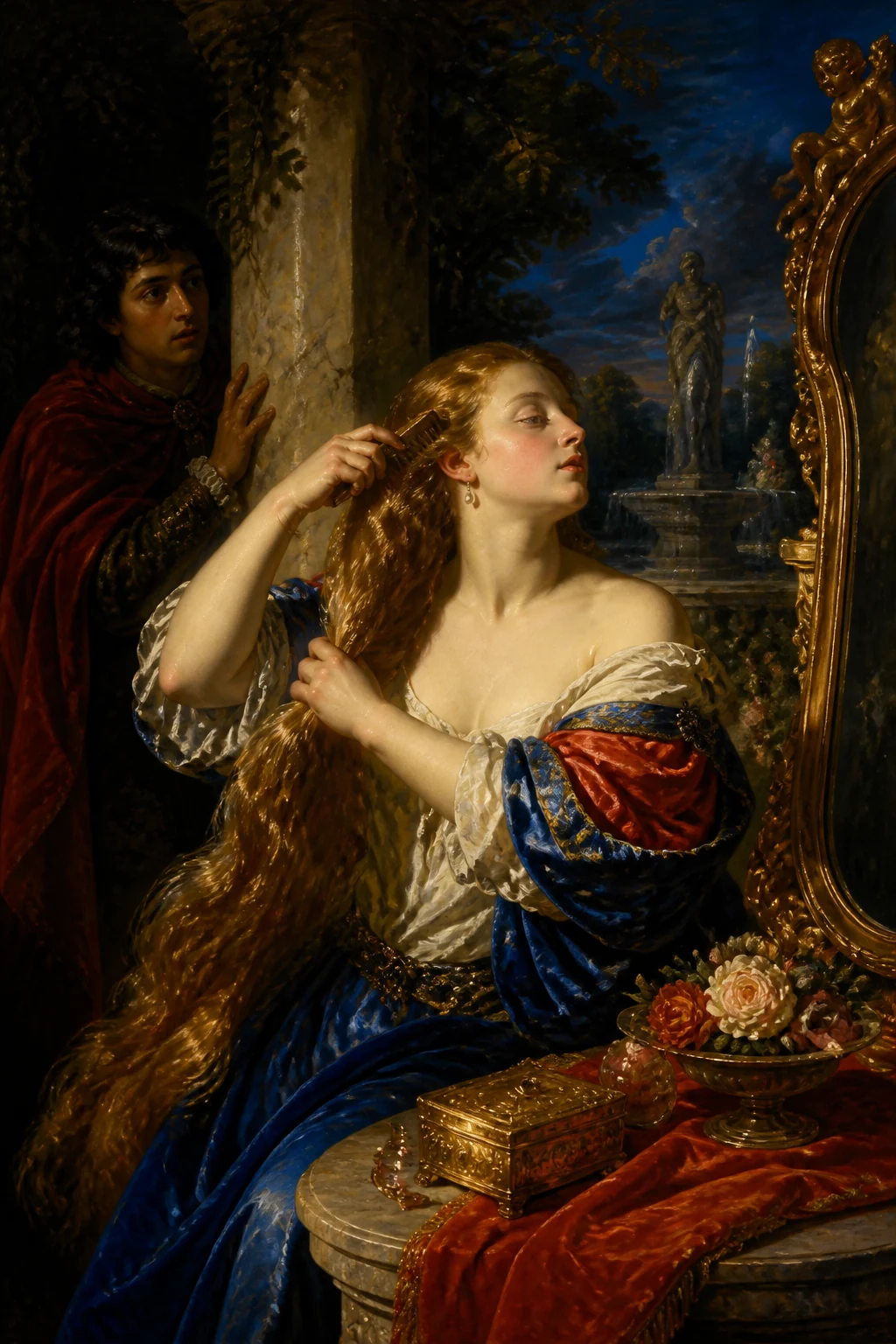
“But this and worse is what a man deserves who buys a cat in a sack. Yet she has made a fool of me, and she shall shit out her penance! So take her at once, just as she is, and fling her through that window!” Hearing this, the old woman began defending herself with kicks and bites, saying that she appealed against the sentence, since he himself had hauled her to his bed with a windlass. Besides, she could call a hundred learned doctors to her defence, and above all that text which says, “An old hen makes good broth,” and the other, “Never leave the old road for the new.” For all that, they seized her hand and foot, lifted her bodily, and hurled her into the garden. Luckily for her, she caught by her hair on a branch of a fig tree and did not break her neck. Now, very early that morning, before the sun took possession of the territories ceded to it by night, some fairies passed through the garden. Because of a certain ailment, they had never spoken or laughed; but when they saw that frightful apparition dangling from the tree, which had driven the shadows away before their time, such belly-shaking laughter seized them that they nearly burst. Once their tongues were set in motion, they could not shut their mouths for a good while over this delightful spectacle. To repay her for their amusement and pleasure, each bestowed her own enchantment upon her, saying one after another that she should become young, beautiful, rich, noble, virtuous, beloved, and fortunate. When the fairies had gone, the old woman found herself on the ground, seated in a chair of the finest velvet with gold fringe, beneath the very tree that had turned into a canopy of green velvet with a golden lining. Her face had become that of a girl of fifteen, so beautiful that other beauties beside her would have looked like worn-out boots next to a dainty, well-fitted slipper. Compared with this paragon of grace, all other graces would have been fit for the scrap-iron heap and the gutter; where she played her winning trumps of charm and elegance, every other woman would have gone bankrupt. She was dressed, adorned, and arrayed with such magnificence that she looked like Majesty itself. The gold dazzled, the jewels flashed, the flowers laughed in your face; so many servants and waiting women surrounded her that you might have thought a jubilee was being held. Meanwhile the King, throwing a coverlet about his shoulders and thrusting his feet into a pair of slippers, looked out of the window to see what had become of the old woman. At the sight of what he had never expected to see, he stood with his mouth a handbreadth open, gazing for a long while, spellbound, at that splendid creature from head to foot. Now he admired her hair, partly scattered over her shoulders and partly tethered by a golden ribbon, which made the sun envious; now he studied her eyebrows, poisoned crossbows that pierced men’s hearts; now he looked at her eyes, lanterns keeping watch for Love; now he contemplated her mouth, an amorous winepress where the Graces trod delight and drew off sweet Greco wine and heady Mangiaguerra. Then he spun like a spindle, quite out of his senses at the trinkets and pendants hanging about her neck and the rich finery she wore. Speaking to himself, he said, “Am I in my first sleep, or am I awake? Am I in my right mind, or am I raving? Am I myself, or am I not? From what billiard table has so beautiful a ball come to strike this king and knock him right out of play? I am undone, I am ruined, unless I come to my senses! How has this sun risen?
“How has this flower blossomed? How has this bird hatched, to lure my desires as to a decoy? What ship has brought her to these shores? What cloud has rained her down? What torrents of beauty are sweeping me into a sea of woes?” So saying, he tumbled down the stairs and ran into the garden. Coming before the rejuvenated old woman, he bowed almost to the ground and said, “O my little dove’s beak, O distillation of the Graces, painted dove from Venus’s chariot, triumphant chariot of Love! Unless you have soaked your heart in the river Sarno, unless reed seeds have sprouted in your ears, unless a swallow has dropped dung into your eyes, I am sure you will hear or see the pains and torments that your beauties have poured into my breast, both directly and on the rebound. If you do not believe the ashes in my face, believe the lye boiling in my breast; if you do not believe the flames of my sighs, believe the furnace burning in these veins. Being a woman of understanding and judgment, you may judge from your golden hair what ropes bind me, from your black eyes what coals scorch me, and from the red bows of your lips what arrows pierce me. Therefore do not bar the door of pity, do not raise the drawbridge of mercy, do not stop up the conduit of compassion! And if you do not think me worthy of a pardon from that lovely face, at least grant me the safeguard of kind words, a safe-conduct of some promise, a warrant of good hope. Otherwise I shall take my leave of life, and you will lose the mould from which I was made.” These and a thousand other words welled up from the depths of his breast and touched the rejuvenated old woman to the quick, so that at last she accepted him as her husband. She rose from her seat, and he took her by the hand, and together they went to the royal palace. There a magnificent feast was prepared on the instant, and invitations were sent to all the noblewomen of the country. Among the rest, the old bride wished her sister to attend; but there was much ado before they could find her and bring her to the banquet, for she had been so frightened that she had hidden and burrowed herself away, leaving no trace. At last, as God willed, she arrived and was seated beside her sister, whom she could scarcely recognise, and they began their merry feasting. But the wretched old woman had another hunger gnawing at her: envy was bursting her heart at the sight of her sister so sleek and shining. Every little while she tugged her sleeve, saying, “What did you do, sister dear? What did you do? Lucky you, with that necklace!” Her sister answered, “Attend to your food; we shall talk afterwards.” The King asked what she needed, and the bride, to cover things up, replied that her sister wanted a little green sauce. At once the King ordered garlic sauce, hot mustard, and a thousand other relishes to whet her appetite. But the old woman, to whom even the sweet spiced sauce tasted like cow’s gall, tugged her sister again and repeated, “What did you do, sister dear? What did you do? Just tell me, and I’ll give you a fig beneath your cloak!” Her sister answered, “Hush, we have more time than money. Eat now, may it set you on fire, and we shall talk later.” The King, curious, asked what she wanted; and the bride, tangled up like a chick in tow and wishing she had never tasted this headache, answered that her sister wanted something sweet. Then little pastries came showering down, blancmange poured in torrents, and sugar sticks rained from a cloudless sky. But the old woman, seized by her obsession and with a spinning wheel whirring in her belly, returned to the same tune. At last the bride, unable to endure it any longer, said, simply to get her off her back, “I had myself flayed, sister dear.” Hearing this, the envious creature muttered, “Well, you have not spoken to deaf ears! I too shall try my luck, for every soul has its appetite; and if the thing turns out as I hope, you shall not be the only one to enjoy yourself. I mean to have my share, down to the last mouthful of fennel!” By this time the tables had been cleared away. Pretending she had to attend to a call of nature, she ran straight to a barber’s shop. Finding the master, she drew him aside into a little room and said, “Here are fifty ducats: flay me from head to foot.” The barber, who thought her mad, answered, “Go along, sister. You are not talking sense, and surely you must have someone with you.” But the old woman replied, with a face as hard as stone, “You are the mad one, not to recognise your good fortune! For besides the fifty ducats, if a certain thing turns out well, I shall have you holding the basin while Fortune herself is shaved. So take up your tools and waste no time: this will be the making of you.” The barber argued, disputed, and protested for a good while, but at last, led by the nose, he followed the saying, “Tie the ass where its master wishes.” Seating her on a little stool, he began to butcher that miserable hide, which dripped and streamed with blood. From time to time she sprang up as if she were merely being shaved, saying, “Ah! Whoever would be fair must learn to suffer!” But he went on cutting away, and she went on repeating her saying, until, counterpointing one another, they had worked their way down the lute of her body to the rose of her navel. There her strength failed her, and she fired a farewell salute from below, proving at her own expense Sannazaro’s verse:
_Envy, my son, pierces its own heart._ She finished this tale just as the sun had been given an hour’s notice to quit the lodgings of the sky like a troublesome student. The Prince then sent for Fabiello and Ghiacovuccio, the household’s keeper of the wardrobe and steward, to come and provide the after-dinner entertainment for the day. They appeared promptly, ready as sergeants: one in close-fitting black breeches and a bell-shaped doublet with buttons as big as chamois balls, and a flat cap pulled down over his ears; the other in a platter-shaped cap, a padded-bellied doublet, and wide breeches of white silk. Emerging from behind a screen of myrtle as though it were a stage set, they spoke as follows:
THE CUPEL. ECLOGUE. _Fabiello and Jacovuccio._ _Fa._ Where are you off to in such haste, Where are you rushing, Jacovuccio? _Jac._ To carry this little thing home.
_Fab._ Is it something nice? _Jac._ Indeed it is, and something choice. _Fab._ But what? _Jac._ A cupel. _Fab._ What do you want it for? _Jac._ If only you knew!
_Fab._ Ho there, mind what you’re doing, And keep away from me! _Jac._ Why? _Fab._ Who knows What nasty trick might blind you now? You understand me. _Jac._ I understand you,
But you are a hundred miles wide of the mark. _Fab._ What am I doing? _Jac._ If you don’t know, keep quiet and shut your mouth. _Fab._ I know you are no goldsmith, Nor yet a distiller:
Draw your own conclusion. _Jac._ Let us step aside, Fabiello, For I mean to astonish and astound you. _Fab._ Let us go wherever you please. _Jac._ Let us stand beneath this awning, And I shall make you leap out of your skin.
_Fab._ Brother, get on with it, For you are making me faint with suspense. _Jac._ Easy, brother dear! What a fellow you are for hurrying! Tell me, did your mother make you quite so fast? Take a good look at this contrivance. _Fab._ I see it is a vessel In which silver is purified.
_Jac._ You have hit the nail on the head; You guessed it at the first try. _Fab._ Cover it up, lest some constable pass And have us hauled off to a dungeon.
_Jac._ What a scaredy-cat you are! Tremble without fear, for this is not one Of those things in which they knead their dough With such ingenious tricks That thirteen ounces turn into three. _Fab._ But tell me, what do you use it for?
_Jac._ To refine the things of this world And tell garlic from figs. _Fab._ You have taken on a great heap of flax to comb! You will soon grow old, Your hair will soon turn white.
_Jac._ Why, there are men on earth Who would pay an eye and a back tooth To possess a contrivance like this, Which at the very first trial would expose The alloy in every man’s heart, The worth of every trade, of every fortune. For here inside you can see Whether a head is an empty pumpkin or has salt in it, Whether a thing is counterfeit or true.
_Fab._ What do you mean by that? _Jac._ Listen closely, and see whether I do not make myself quite clear. As for the frame and the first impression, a thing may look precious, yet it is all a trick of the eye, all dust in people’s faces, all sheer appearance. Do not skim the surface, do not stop at the rind, but pierce it and get inside, for anyone who does not fish deep is a proper fool in this world. Use this crucible to test whether the business is genuine or counterfeit, whether it is a sprouted onion or a substantial pie.
_Fab._ A marvellous thing, by the life of Lanfusa! _Jac._ Hear me out, and marvel. Let us go further: sharpen your wits, for you shall hear wonders. Listen now: suppose, for instance, you are bursting with envy.
You puff and swell yourself into a rupture over some lord, count, or knight, because he rides in a carriage, because you see him served and attended by such a rabble of fellows, such a mob:
One grins at him like a dog, another bows like a spaniel; one doffs his cap, another says, “Your humble little slave.” He tears through silk and gold. When he chatters, they fan him, and even his chamber pot is silver;
Do not fall in love at once with all this pomp and outward show; do not sigh and let your mouth water. Put it into this crucible, and you will see how many sores, how many galls lie beneath the velvet saddle;
You will find how many snakes lie coiled among the flowers and grass. Lift the lid of that close-stool, with its fringes and embroidery of gold thread and silk, and you will discover whether the business smells of perfume or of filth.
He has a golden basin, and spits blood into it. He has delicious morsels, and they stick in his throat. Measure carefully and examine better, and what you take for Fortune’s gift is a punishment from Heaven.
He feeds so many ravens that peck his eyes out; he keeps so many dogs that bark about his heels; he pays wages to his own enemies, who make a fool of him, suck him dry, and entangle him. One wheedles him on this side with grimaces and fine speeches;
Another pumps him up on that side with a pair of bellows. One poses as a holy vessel of charity, a wolf beneath a sheepskin, with a fair face and a foul heart, and makes him commit acts of oppression and injustice;
Another weaves schemes for him; this one carries tales and brings reports, and puts his wretched head in jeopardy; that one betrays him and drives him distracted, so that he never sleeps in peace, never eats with pleasure, never laughs from the heart;
Music, when he eats, splits his skull; dreams, when he sleeps, terrify him. Anxiety torments him like the bird of Tityus. His vanities are the water and fruit in whose midst he stands, dying of hunger;
His affairs, tangled beyond all reason, are Ixion’s wheel, which never gives him rest. His plans and fantasies are the stones Sisyphus rolls up the mountain, only for them to tumble down again. He sits upon a golden chair inlaid with ivory and studded with gilded nails;
Under his feet he has cushions of brocade and rich damask, and Turkish carpets; but a sharpened blade hangs above his pate, held up by nothing but a hair. Thus he is always in a flutter, always walking a knife-edge and shaking with fear, always eaten up with worry, always spinning out his terrors, always startled and afraid;
And at the very end of all, this pomp and all this grandeur are nothing but shadows and rubbish; and a little earth in a narrow pit covers a king as surely as a beggar.
_Fab._ You are right, by my father’s soul! Indeed, there is more to it than you say, for the greater the lords, the deeper-rooted the troubles they endure;
And, in short, that fellow from the Trecchiena who went about selling nuts said it well: “Not all that shines is gold.” _Jac._ Listen to this next one, and stand there like a soft little apple.
There are those who praise war, set it upon a pedestal, and the moment a standard is unfurled and they hear the rat-a-tat, they rush to enlist, drawn by the gullet towards four little coins spread out upon a table;
They pocket the fresh money, dress themselves in a strange new rig, sling on their sword-belt, and look like a carrier’s mule, with their plume and all their trappings. If a friend asks, “Where are we off to?”
They answer gaily, their feet scarcely touching the ground, “To war, to war!” They carouse in taverns, lord it through the streets, march off to their quarters, buy up billets, make a din and a racket, and would not yield an inch even to Gradasso;
Woe to the fellow when he melts in this crucible, for all these joys, these swaggerings and swellings turn to tribulations and torments. Cold stiffens him, heat melts him, hunger gnaws him, fatigue cuts his throat; danger is always at his side, and reward far away;
Wounds are paid in ready money, wages on credit; hardships are long and pleasures short, life uncertain and death assured. In the end, either, worn out by so much suffering, he takes to his heels, and in three quick bounds discovers whether hemp makes a match-cord or a halter;
Or he is killed outright, or left a cripple; and nothing remains for him but the support of a crutch, the lasting company of an itch, or, as the least of his evils, to fill a useless bed in a hospital.
_Fab._ You have laid the rot bare. There is nothing to be said against it: true, and more than true, for the dregs of a poor soldier’s fortune are to come home either a beggar or full of holes.
_Jac._ But what will you say of a fellow all puffed up, walking on tiptoe, strutting like a peacock, swelling and boasting that he comes of the stock and lineage of Achilles or Alexander? All day long he draws family trees, and makes a branch of holm oak spring from a chestnut stump;
All day long he writes histories and genealogies of fathers who never had any children. He would make a man who sells oil by the quart a nobleman of sixteen quarterings;
He doctors privileges on parchment, aged over smoke, to feed his pride and vanity; he buys tombs and sticks epitaphs upon them, full of endless rigmaroles;
To patch up his ragged pedigree he pays handsomely for rubbish; to set his bells in harmony, he lavishes money on bell-towers; and to lay some sort of foundation beneath a ruined house, he spends an eye out of his head on stones;
But put him to the assay, and the one who stretches himself highest, the one who claims the most, who flourishes and swaggers, still has the hoe’s calluses on his hands. _Fab._ You touch the sore spot. Nothing more need be said: you have hit the nail;
That reminds me—and mark my words—of what a wise man said: “There is nothing worse than a peasant risen in the world.” _Jac._ Now look at some ninny, some chamber-pot shitter, full of conceit, who lays claim to lordly honours and carries himself with such solemn grandeur, blowing himself up like a balloon, spouting nonsense, mouthing rounded phrases and swaggering, twisting and wrinkling his muzzle, sucking his lips as he speaks:
He measures every step. Go on, guess what he thinks he is! He puffs himself up and drools over himself. “Ho there, bring the dun mare—or the piebald! Summon twenty of my men! See whether my nephew the Count would care to come out for a little airing.
“When will our steward bring me the revenue? Tell the tailor I want my breeches embroidered in gold before this evening. Answer that lady who is pining for me that perhaps, perhaps, I may look kindly upon her.”
But when he is tested in this crucible, you will not find a farthing. It is all a fire of straw: the more he girds himself up, the more he flaps about. He is always talking of doubloons, yet has not a penny; he plays the lavish fellow, yet has nothing in his purse. His collar is well starched, but his fortunes are limp;
A contented belly without a coin! And to conclude, every full beard of his turns out a wisp, every pole a little stick, every pie nothing but boiled dough, and his great cannon dwindles to a fart.
_Fab._ Bless that tongue of yours! How you have picked him to the marrow, how neatly you have measured him! In short, the old saying is true: a vain fool is like a bladder.
_Jac._ The man who follows the court, bewitched by that ugly hag, fills himself with wind and feeds on the smoke of the roast, his bladders swollen with hope. He waits for bubbles of soap and lye that burst along the way before they reach him; and there he stands open-mouthed, beguiled by so much splendour. For an old rag, for the chance to sip broth from a little bowl with a stale, hard loaf, he sells his liberty, which costs so dear.
Whoever applies the assay to this false gold will see labyrinths of fraud and treachery; he will find, brother, abysses of deceit and pretence; he will discover vast countries of biting, malicious tongues:
Now he finds himself cherished in the palm of a hand, now thrust into the depths; now dear to his master, now cast aside; now poor, now rich; now fat and flourishing, now shrivelled and thin;
He serves, suffers, and labours, sweats like a dog, goes more often at a trot than at a walk, and would even carry water in his ears. Yet he loses his time, his labour, and his seed;
Everything is done for the wind, everything cast into the sea. Do what you will, it is swallowed up. Build your plans and patterns out of hope, merit, and hardship: the slightest contrary breeze lays all your labour low.
In the end you see promoted over your head a buffoon, a spy, a Ganymede, some thick-skinned lout, or else a man who keeps a house with two doors, or has two faces.
_Fab._ Brother, you give me life! Believe me, I have learned more in this little while, more at this one sitting, than in all the years I spent at school.
A doctor’s verdict: “He who serves at court dies in a straw hut.” _Jac._ You have heard what a courtier is; now hear about those who serve in humbler places. You hire a servant, handsome, neat, and clean, well brought up, who makes a hundred bows, puts your house in order, draws water, sets your dinner cooking, brushes your clothes, curries the mule, and scours the dishes;
If you send him to the market, he is back before a gob of spit has dried. He never stands with his hands on his hips, never knows an idle moment; he rinses glasses and empties the chamber pot.
But put him to the royal test, and you will find that every new thing looks fine, and that a donkey’s gallop does not last. For after three days you discover he is a rogue, a born idler;
A thoroughgoing pimp, a cheat, a glutton, a gambler. If he does the shopping, he rakes off his share; if he feeds the mule, he gives her a single grape instead of a bunch. He debauches your maid, searches your pockets, and finally, as an extra pound thrown onto the scales, gathers everything into a bundle, sweeps you clean, and slips away. Go tie up your pigs with cucumber vines!
_Fab._ Substantial words, every one full of juice! Unhappy and unfortunate is the man who falls in with a servant schooled in vice. _Jac._ Here comes a swaggerer, the grand high master of coat-slashers, chief architect of split windpipes, captain-general of the faction-leaders, past master in the art of neck-breaking, the true arch-braggart of the bravos, prior of all valiant men:
He prides himself and presumes upon terrifying people, making you start with a mere roll of his eyes. His stride is a pikeman’s, his cloak flung back, his hat pulled low, his collar cocked up, his moustache bristling, his eyes glaring. With one hand on his hip he snorts and stamps; even bits of straw offend him, and he is ready to pick a quarrel with the flies;
He always goes about with a scowl. You hear him talk of nothing but slaughter: who gets pierced, who gets bored through, who gets finished off; who gets his spleen ripped out, who his bowels, who gets slashed; who gets smashed, throttled, or gashed; who gets knocked flat, who gets uncorked; who gets disembowelled, who gets his skull split, who gets his brains dashed out; one gutted, another livered, another pummelled, another punched in the belly, another battered, another riddled.
Hear him boast, and the earth itself had better stand firm! One he puts in the book of the dead, another he removes from this world, another he sends to join his ancestors. He lets the pennies out of one, puts another in salt, plants this one in the ground, makes dried meat of that one, knocks down a hundred and mangles a hundred more, always with an uproar and a racket;
Splitting heads and hamstringing legs! Yet for all the strength and valour he displays, his sword is a virgin to blood and a widow to honour. But this crucible exposes him as copper: his mouth’s bravado is his heart’s trembling, his eyes’ fierce sallies are his feet’s retreat;
His eastern thunderclaps are the flutterings of fear; his dream-slaughterings are the beatings he gets awake. All those writs he serves on people’s foreheads are an injunction against drawing his blade, which, like an honourable woman, is ashamed to show itself naked;
If he looks all bitter gall, he is always spinning excuses; if he chews up lions, he shits rabbits. If he issues a challenge, he gets stitched up and lined; if he threatens, he gets beaten, and takes the loss;
If he throws the dice of swagger, someone always calls his bluff. In words he is a bravo, in deeds a mere scrap. He puts his hand to the steel, then whisks the iron away;
He seeks a brawl, then stands clear of it, and is much more flighty than mighty. Let him find someone to stop him and teach him sense, someone to straighten his jacket, someone to knock him about and change his tune, to set his shirt straight, to card his wool, to lay into his ribs, to give him a shearing, to make his ears whistle and his back teeth ring, to find his tender spot, to rain blows upon him, to draw blood from him, or light him up with a black eye.
Or give him a combing, or dress him for the holidays, or take a cudgel to him, or thrash him with a stick, or grab him by the scruff, or catch him under the jaw, or rinse his teeth with a fist: slaps, backhanders, stunning blows, cuffs, clouts, cap-knockers, thumps, skull-rattlers, kicks, shop-shutters, and punches in the belly, and a good choking or a thorough pounding;
Enough that he takes the points and avoids the edges, with a man’s voice and a goat’s running feet. He sows spittle and reaps bruises; and when you think he is about to charge like a battering ram, lay waste to an army, and spill everyone’s brains;
He bursts out, “Good day!” and turns out to be a horse already headed home. He bolts, slips off, darts away and ducks out, clears off, makes tracks, vanishes, plunges away, and fires his parting shot. He takes to his heels, scampers, and runs;
He picks up his bundles. “Help me, heels, and I will keep you shod!” His heels touch his shoulders, his feet turn to a hare’s, and he flourishes his great two-legged sword. Like the great coward he is, he strides and flees: take a beating and then go to prison?
_Fab._ A perfect likeness of these street-corner cut-throats! How true to life! And never tell me you cannot find more than one such fellow, who works wonders with his tongue and is not worth a quail-dog.
_Jac._ Now a flatterer praises you and hoists you above the circle of the moon; he always falls in with your mood, feeds you sweet words and lets out line, fills your sails with wind, and never contradicts you;
If you are an ogre or an Aesop, he says you are Narcissus; and if you have a scar across your face, he swears it is a beauty spot, a painted masterpiece. If you are a coward, he declares you a Hercules or a Samson;
If you come of lowly stock, he swears yours is the lineage of counts. In short, he is always stroking and fondling you. But take care not to be bound by the words of these greedy babblers;
And mind you build nothing upon them. Do not believe a jot of it, do not value them a straw, do not let their barking beguile you, but try them in this crucible. Then you will know by touch that these fellows have two faces, one in front and one behind, and one thing on their tongues, another in their hearts;
They are all face-washing and pretence. He mocks you, makes a fool of you, plays tricks on you, pastures you like a sheep, takes you for a country bumpkin, entangles you, hooks you, gulls you, bamboozles you, blinds you, and stuffs your head with nonsense.
When he agrees with you, know that you are running into storms. He bites you with his little smile, bespatters you with praise, inflates your vanity and bursts your purse. His whole aim is to nibble away at you and wheedle things out of you; with his hounds of praise, his rigmaroles and fine speeches, he plucks the very feathers from your heart. Merely to cadge a little silver for the brothels or the taverns, he sells you bladders for lanterns.
_Fab._ May the whole breed of them die out, these masked men fit to be stuffed into a sack! Narcissus outside, Parasacco within. _Jac._ Now hear about a woman who kisses whoever comes and whoever goes:
You see a dainty little thing, a beauty to make you cry out, a dazzling creature, a dove, a treasure, a jewel, a painted darling, a Morgan le Fay, a great round moon, a beauty drawn by the brush. You could drink her down in a glass of water: a morsel for a lord, a little sweetheart to steal your heart;
With her tresses she ties you in knots, with her eyes she disembowels you, with her voice she runs you through. But once she is assayed—oh, what fire you see, what snares and traps, what mousetraps and tricks, what skeins and tangles! A thousand limed twigs are set, a thousand deceits invented, a thousand traps and engines, ambushes and stratagems, plots and counterplots, entanglements and unravellings. She pulls like a hook, bleeds you like a barber, cheats like a Gypsy; and a thousand times you think you have wine that will keep, when it is meat that is going bad;
If she speaks, she plots; if she walks, she weaves. If she laughs, she schemes; if she touches you, she stains. And when she does not send you to the hospital, she treats you as a bird or beast, and by her cursed arts leaves you without feathers or without fur.
_Fab._ If you put all you have said on paper, this tale would sell out six editions, for one can learn from it how to be sharp, stay on guard, and not deliver oneself into the hands of those shameless creatures. They are counterfeit coin, the ruin of flesh and gravy alike.
_Jac._ If by chance you see at a window a woman who seems a fairy to you, with fair hair that looks like little strings of caciocavallo cheese;
A forehead like a mirror; eyes that speak to you; and, when you look closely, two lips like slices of ham; a splendid hunk of woman, tall and stately as a processional banner—and you have scarcely set eyes on her before you are dying of desire, wasting away with longing, you blockhead, you simpleton! Learn to assay her. What seems to you a dazzling beauty you will find to be a dressed-up privy, a plastered wall, a Ferrarese mask. The bride has spread out all her trappings: her tresses are false, her eyebrows blackened from the frying pan, her face redder than a dish with ochre, fresh lime, and varnish. She smooths herself, daubs herself, polishes herself, plasters herself, smears herself all over—nothing but ointments and salves, nothing but rags, pots, powders, and little bottles, so that with all these preparations she seems about to doctor a man covered in sores.
How many defects, how very many, gowns and petticoats conceal! Besides, if she takes off her high pattens, with all their layers and trimmings, you will see a giant turned into a dwarf.
_Fab._ Upon my word, you are working wonders before my eyes! I turn into a mummy, I stand astonished, I am beside myself. Every sentence you utter, brother, is worth seventy crowns;
You could hammer at these sayings with a mallet, and they would not budge an inch from that old proverb: “A woman is like a chestnut: fair outside, faulty within.”
_Jac._ Let us come to the merchant who deals in exchanges and re-exchanges, insures ships and finds means of settlement; he traffics, intrigues, and schemes, takes shares in tax-farms, buys consignments and draws dividends, builds ships and houses, and fills his own great drain handsomely;
He decks his house like a bride, displays the splendour of a count, rustles in silk and fringes, keeps menservants, maids, and mistresses, and everyone envies him;
Poor wretch, if he is assayed! His is wealth in the air, a fortune in smoke, a fortune made of glass, exposed to a thousand winds and the hazards of the waves. It is a fine appearance, but it cheats the eye; and when you see his money coming fastest, in a headlong gallop, he loses the whole game through a single mistake.
_Fab._ I could count you thousands of that sort, who have brought households to ruin. Their riches vanish into thin air: now you see me, now you do not! And in this world, at other people’s expense, with little sense in their heads, they have kept a fine cooking pot and left a miserable will.
_Jac._ Here is the lover: he counts as happy the hours he spends and squanders in Love’s service. He finds the flames and chains sweet, cherishes the arrow that pierces him for some great beauty;
He admits that he is worn out with dying, exhausted with living. He calls suffering joy, headaches and burnings amusement, heartbreak and jealous pangs delight. He eats no meal that nourishes him, sleeps no sleep worth having; he dreams with his eyes open and suffers without a wound. Without drawing pay, he stands sentry round his beloved’s doors;
Without being an architect he draws plans and builds castles in the air; and without being an executioner he is forever tormenting his own life. Yet for all this he flourishes and grows fat, laying on more lard the deeper the dart pricks and pierces him?
The more the fire burns, the more he makes merry; and he counts it the happiest fortune to be knotted in a rope. But assay him and you will see it is a branch of madness, a kind of wasting sickness, a perpetual uncertainty between fear and hope, a perpetual hanging between doubts and suspicions;
A perpetual misery, like Messer Vasile’s cat, now weeping and now laughing; a languid, distracted walk, speech full of pauses and broken phrases, a sending of one’s brains out to pasture at every hour;
And always a heart like a dirty dishcloth, a face like laundry water, a burning breast and a shrivelled soul. And even if at last he melts the ice and chips away the stone of the creature he loves—who, the farther away she is, the closer he feels her—he has scarcely tasted the sweetness before he repents.
_Fab._ Wretched is the man who falls in with such short weights! Woe to whoever puts a foot in that trap, for that blind fellow measures pleasures by the finger and torments by the yard.
_Jac._ And the poor poet floods the world with octaves and blows sonnets like a gale, wastes paper and ink, dries up his brains, wears out his elbows and his time, merely so that people will think him an oracle upon earth;
He goes about like a man possessed, haggard and dazed, thinking of the conceits he kneads in his imagination, and talks to himself in the street, finding new expressions by the thousand:
“Towering pupils”; “liquid surmounting of flowers and leaves”; “funereal and shrill waves”; “living rubies of slippery hope”—oh, what immeasurable presumption!
But assay him, and he all goes up in smoke. “Oh, what a beautiful composition!”—and there it ends. What madrigal is this? It is money spent. And when the sounding is taken, the further you go towards him, the less depth you find. He praises those who despise him, exalts those who torment him, preserves an eternal memory of those who forget him, gives his labours to those who never give him a straw;
Thus he wears his life away: sings for glory and weeps for poverty. _Fab._ Indeed, those golden days are gone, when every poet was carried in the palm of a hand;
For in this wretched age the Maecenases have all been ground to dust; and in Naples above all—and it makes me burst with grief—the laurel is put behind the cabbage leaf.
_Jac._ The astrologer, too, has questions coming at him by the hundred from every quarter. One wants to know whether he will have a son, another whether his fortunes will prosper; one whether he will win his little lawsuit, another whether ill luck awaits him; one whether his lady thinks of him, another whether there will be thunder or a storm;
And there he dishes out whopping tales enough to need a crowbar, gets half a guess right and misses a hundred. But in this crucible you can see whether he is dust or flour;
For though he casts squares, he finds himself long and lean; and though he draws houses, he has neither house nor hearth. He displays figures and reveals ugly tales; he climbs up to the stars and comes down on his backside;
In the end, ragged and tattered, all shreds and lice, his breeches fall down, and there you behold his truest astrology, for he displays his astrolabe and its sphere.
_Fab._ You make me laugh, brother, though I have little wish to; but I laugh louder still at those who believe such people. He claims to foretell other men’s fortunes and cannot foresee what is coming upon himself: he watches the stars and stumbles into a ditch.
_Jac._ Another thinks himself a great authority, pulls up his stockings, weighs his words, speaks in rounded phrases, and considers himself the finest fellow in the world. If he discusses poetry, he leaves Petrarch behind with a standing jump;
If philosophy, he gives Aristotle fifteen points and a fault to start. In arithmetic, Cantone cannot match him; in the art of war, Cornazzaro is done for; in architecture, go home, Euclid; in music he leaves Venosa limping; in law, Farinaccio has gone to the wall; and in matters of language he shits all over Boccaccio;
He strings together maxims and pours out counsels, yet is not worth a fig at the simplest game. But when he is put to the test, he proves, in conclusion, to be a great empty basket among a cabinetful of books.
_Fab._ Oh, what a brutish thing it is to think too highly of oneself! A learned scholar used to say, “The more a man thinks he knows, the more ignorant he is.” _Jac._ And what of alchemy and the alchemist?
How pleased he is with himself, how fortunate he thinks himself already! In twenty or thirty years he promises wonders, and tells astonishing tales of what he has discovered by distilling in his alembic;
He hopes to grow rich; but when he is put to the test, he finds everything eaten away, and sees what a fraudulent art it is. He sees how blind he has been, how deluded and befogged, having set the pillars of his hopes upon vessels of glass;
Having placed all his thoughts and schemes amid the smoke, so that, while he works the bellows to raise the flames, his words meanwhile feed the longing of those who await what never comes.
Hunting after secrets, he earns himself a madman’s name; in seeking the primal matter, he loses his own true form. He thinks to multiply gold, and diminishes what he has;
He imagines he can cure sick metals, and off he runs to the hospital himself. Instead of making quicksilver solid, for all his sweating and bustling, he melts his very life away with toil;
And while he thinks to turn every metal into pure gold, he turns himself from a man into an ass. _Fab._ It is madness, beyond a doubt, to undertake such a business. I have seen a hundred households ruined and brought low by it. No one ever made anything of it; yet, driven to despair by his great hopes, he goes on, always smoke-stained and starving.
_Jac._ But tell me, do you want any more for your three farthings? _Fab._ My mouth is hanging open as I listen. _Jac._ And I could go on till dawn. _Fab._ Then carry on, now that you are in the mood.
_Jac._ I would, if my soul were not hovering on my lips, for dinner-time is long past. So let us slip away, and come, if you please, to my shop, where we can ply our teeth together: even a beggar’s house has crusts to spare.
_The words of this eclogue were accompanied by such amusing gestures and such delightful grimaces that everyone who heard it was showing their teeth with laughter. And since the crickets were calling people home, the Prince dismissed the women, bidding them return the next morning to carry on with their undertaking, while he retired to his chambers with the slave girl._ End of the First Day.
THE SECOND DAY OF ENTERTAINMENTS FOR LITTLE ONES. Dawn had come out to grease the wheels of the Sun’s chariot, and with the effort of pounding the grass with her pestle in the mortar, she had grown as red as an apple, when Taddeo rose from bed and, after a mighty stretch, called the slave girl. Dressed in a twinkling, they went down to the garden, where they found the ten women already gathered. He had four fresh figs picked for each of them, which, with their beggar’s coats, their hanged men’s necks, and their harlots’ tears, made everyone’s mouth water. Then they began a thousand games to while away the time until dinner, leaving out neither Anca Nicola, nor the Wheel of Kicks, nor Watch Your Wife, nor Covalera; My Comrade, I Am Wounded; nor Proclamation and Command, nor Welcome to the Master, nor Rentinola, My Rentinola; nor Sareta la Botta; nor Jump a Handspan;
Nor Stone in the Lap; nor Fish of the Sea; nor the Lamb, nor Anola Tranola Pizza Fontanola; nor the King with the Mace, nor Blind Cat, nor Lamp to Lamp; nor Stretch My Curtain, nor Fife and Drum; nor the Long Beam;
Nor the Little Hens; nor the Old Man Has Come; nor Unload the Barrel; nor Mammara a Nnocella, nor Climb, Little Top; nor the Outlaws; nor Sgarriglia Mastodatto; nor Come Along, Come Along; nor What Have You in Your Hand? A Needle and Thread;
Nor Little Bird, Little Bird, Sleeve of Iron; nor Greek Wine or Vinegar, nor Open, Open the Gates to Poor Falcon. But when the time came to fill their bellies, they sat down at table, and once they had eaten, the Prince told Zeza to show her mettle and begin her tale. She had so many in her head that they were spilling out; so, calling them all to council, she chose as the best this one, which I shall now tell you.