Waltey
Oče zet
070 THE STICKLEBACK FATHER
Živalske zgodbe Clare Dillingham Pierson · Clara Dillingham PiersonO besedilu
Oče zet
- Vir
- Živalske zgodbe Clare Dillingham Pierson
- Avtor
- Clara Dillingham Pierson
- Jezik branja
- Slovenščina
- Jezik izvirnika
- English
- Čas branja
- 9 min branja
- Obseg
- 7 strani
- Naslov izvirnika
- 070 THE STICKLEBACK FATHER
O izvirniku
Živalske zgodbe Clare Dillingham Pierson
Devetindevetdeset avtorskih zgodb o živalih na kmetiji, travniku, v gozdu, ob ribniku in ponoči. Bralni jezik je Slovenščina, izvirnik pa prihaja iz vira Živalske zgodbe Clare Dillingham Pierson v jeziku English.
Besedilo
Oče zet
Nihče ne more po pravici reči, da zeti niso dobri očetje. Med ribami ni očetov, ki bi se za svoje otroke trudili bolj kakor zeti. Kar pa zadeva matere zetke — no, to je že druga zgodba.
Ta oče zet je vse od takrat, ko je zapustil gnezdo, živel z majhno druščino prijateljev v mirnem kotičku ob robu ribnika. Kadar so se naveličali mirnega življenja doma, so se odpravili na kratek izlet po potoku, ki se je izlival v ribnik. Potok je blago tekel po ravni strugi, sicer ne bi nikoli zašli vanj, saj imajo zeti radi mirne vode. Kadar so plavali po tem potočku, so srečevali potočne postrvi, ki so bile precej večje od njih in so tam veljale za najimenitnejše prebivalke.
Zdaj je bil ta zet star leto dni in je vedel veliko več kakor prejšnje poletje. Ko so spomladi nad robom ribnika visele jelševe mačice in vrbovi puhasti popki, je začel resno razmišljati o življenju. Prav mlad ni bil več in minili so dnevi, ko je bil zadovoljen že s tem, da je plaval, jedel in spal. Če je hotel kdaj postati dedek, je bil čas, da si zgradi dom in ustvari družino. Imel je nekaj sorodnikov, ki so bili že pradedki, in enega, ki je bil celo prapradedek. To se ne zgodi pogosto, kajti zet mora biti star štiri leta, da postane prapradedek, le malo zetov pa dočaka tolikšno starost.
Ko je začel premišljevati o teh rečeh, je zapustil prijateljsko druščino in odšel živet na svoje. Za dom si je izbral prostor ob robu ribnika in tam z repom pometal po dnu, dokler ni odstranil vseh prostih vejic in razbitih lupin. Nekaj vodnim polžem, ki so živeli tam, je povedal, da se morajo odseliti, ker si je ta prostor izbral zase. Sprva niso hoteli oditi, ko pa so videli, kako srdit je videti, so še enkrat premislili in sklenili, da morda obstajajo tudi drugi kraji, ki bi jim prav tako ustrezali — nemara bi našli celo takšnega, ki bi jim bil še bolj všeč. Poleg tega, kakor je eden izmed njih rekel svojemu bratu, ne smejo pozabiti, da je v ribnikih vedno prav, če šibki popustijo močnim.
»Kar nekaj časa bomo potrebovali za selitev,« so mu rekli, »saj veš, da ne moremo hiteti, a začeli bomo takoj.« Ves preostanek dneva je vsak polž iztegoval in krčil svojo edino nogo, saj je le tako lahko hodil. Lahko si mislite, kako počasi je šlo, kajti polž ne more dvigniti noge z enega mesta in je postaviti na drugo, saj medtem ne bi imel na čem stati. Zanje je bil to zelo naporen dan, vendar so ostali vedri in se trudili iz njega potegniti najboljše.
»No,« je rekel eden, ko se je ustavil, da bi si odpočil nogo, »vesel sem, da nama ne bo treba graditi doma, ko najdeva pravi kraj. Kako se mi smilijo tisti, ki morajo to početi!«
»Res je,« je rekel njegov brat. »Le malokdo je lahko tako prepričan, da ima dom, kakor midva. In zakaj kdo potrebuje toliko prostora, tega res ne razumem! Pižmovka mi je rekla, da hoče imeti v svoji hiši dovolj prostora, da se lahko obrne. Ne vem, čemu bi se sploh obračala. Pa ti?«
»Tudi jaz ne,« je odgovoril drugi polž in spet začel hoditi. »To je le ena njenih neumnih zamisli. Moja hišica je dovolj velika, da lahko vanjo potegnem vse telo, in toliko prostora bi moralo zadostovati vsakomur!«
Zet ni nameraval biti videti srdit pred vodnimi polži. Tak je bil zato, ker ni mogel biti drugačen. Vse njegove plavuti so bile našopirjene z ostrimi koščenimi konicami, dodatne bodice so mu štrlele iz hrbta, poleg tega pa je precej svojih ploščatih kosti nosil kar na zunanji strani telesa. Vsi v njegovi družini so imeli te dodatne kosti in prav po njih so bili zeti znani. Bili so pogumna družina in čeprav so bili tako majhni, se niso bali prav veliko reči. Prišel je tudi čas, ko je oče zet hotel biti videti srdit, a to je bilo pozneje. Zdaj se je lotil gradnje gnezda.
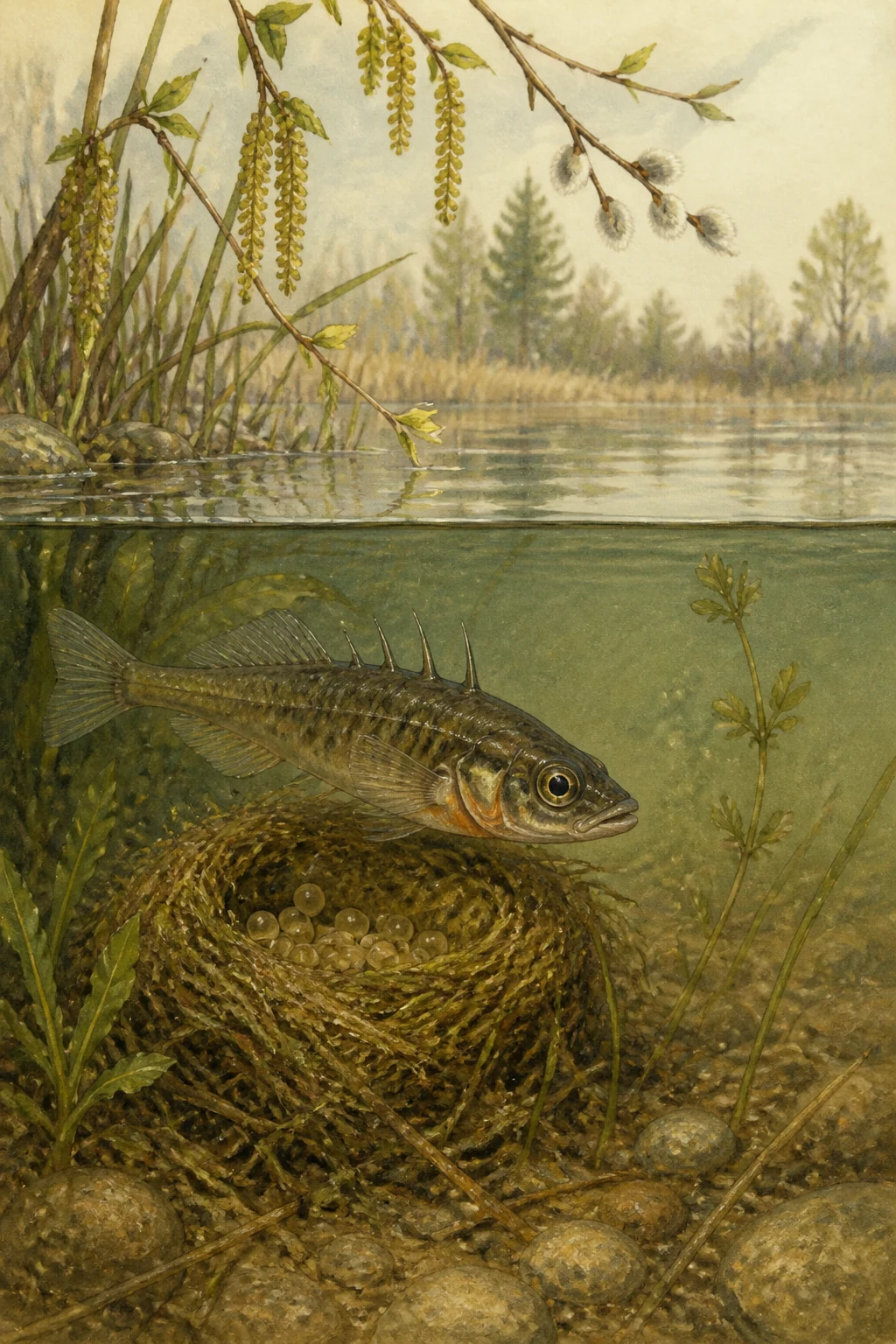
Najprej je v dno ribnika izdolbel plitvo jamico in jo obložil z vodno travo ter drobnimi koščki korenin. Nato je iz istega gradiva naredil stranske stene in nazadnje še streho. Ko je bilo gnezdo končano, je previdno zaplaval vanj in se ozrl naokrog. Pod njim, ob njem in nad njim so bile mehke trave in koreninice. Na obeh koncih je bil odprt vhod. »Dobro gnezdo je,« je rekel, »za moje prvo gnezdo prav zelo dobro. Zdaj moram poprositi nekaj prijateljic, naj mi vanj odložijo ikre.«
Preden pa je to storil, si je šel ogledat domove, ki so jih zgradili njegovi sosedje. Potem ko je zapustil druščino v mirnem tolmunu, so ga mnogi posnemali, dokler niso tam ostale le zetke medlih barv, tiste, ki so odlagale ikre. Tudi graditelji gnezd so bili prej medlih barv, a spomladi so se jim po telesu pojavile čudovite rdeče in modre lise, tako da so bili zdaj prav postavni fantje. Žalostno je povedati, vendar je res, da so takrat postali tudi zelo prepirljivi. Morda sta jih takšne naredila delo in skrb z gradnjo gnezda, a naj je bil razlog kakršen koli, vsak živo obarvani zet se je hotel spopasti z vsakim drugim živo obarvanim zetom. Tako se je zgodilo, da je naš zet obiskal gnezdo starega prijatelja, s katerim se je igral, odkar se je izlegel, ta isti prijatelj pa mu je zavpil: »Da se mi ne približaš gnezdu!«
Zet, ki je prišel na obisk, mu je odvrnil: »Pa se bom, če bom hotel!« Nato sta planila drug proti drugemu, se premetavala, pljuskala, odrivala in zbadala, dokler nista bila oba utrujena in razbolena ter je bil vsak vesel, da je lahko ostal ob svojem domu. Takrat sta res hotela biti videti srdita.
Kmalu so mimo priplavale zetke medlih barv, graciozno mahale z repi in se pogovarjale med seboj. In naš postavni fant, ki je odgnal polže in zgradil gnezdo, se spopadel s starim prijateljem in se spet vrnil domov, je priplaval k eni izmed njih ter rekel: »Ali bi odložila nekaj iker v moje gnezdo? Prepričan sem, da ti bo v njem udobno.«
Odgovorila je: »O, seveda! Prav rada jih nekaj odložim vanj.« Pri tem se je trudila biti videti, kakor da povabila ni pričakovala. Medtem ko je skrbno odlagala ikre v gnezdo, je bil on pripravljen napasti vsakogar, ki bi jo motil. Čez nekaj časa je prišla ven in odplavala. Preden je odšla, je rekla: »Te ni sram, da se tako pretepaš? Me medlo obarvane se nikoli ne pretepamo.« Med govorjenjem je držala plavuti zelo togo, ker se ji je zdelo, da ga je dolžna ošteti. Zetke medlih barv so to pogosto počele. Mislile so, da so nekoliko boljše od drugih, zato so skupaj plavale naokrog in se pogovarjale o vsem mogočem, včasih pa pozabile, kako težko je graditi gnezdo, ostajati doma in delati. Potem so obiskovale živo obarvane zete, saj so jih imele v resnici zelo rade, in jim pripovedovale, kaj bi morali početi. Zato je tudi ta rekla: »Me medlo obarvane se nikoli ne pretepamo.«
»Si bila že kdaj rdeča in modra?« jo je vprašal graditelj gnezda. »N-ne,« je rekla. »Ampak ne vem, kaj ima to opraviti s tem.« »Pa ima,« je rekel on. »Ko je fant rdeč in moder, si ne more kaj, da se ne bi pretepal. Ko ne bom več rdeč in moder, bom prav tako dobrodušen kakor ve.«
Po tem seveda ni mogla reči ničesar več, zato je odplavala k svojim sestram. Živo obarvani zet si je ogledal ikre, ki jih je odložila. Bile so lepljive kakor ikre vseh rib, zato so se prilepile na dno gnezda. Skrbno jih je prekril in odtlej je bil zares oče zet. Resda še ni imel zetovskih otročičev, ki bi plavali okoli njega in proti njemu odpirali svoje ljubke gobčke, a vedel je, da se bodo ikre kmalu izlegle in da so drobceni zeti začeli rasti, potem ko je zgradil gnezdo in v njem prekril ikre.
Vendar si je v gnezdu želel še več iker, zato je počakal na drugo medlo obarvano zetko in jo povabil, naj mu pomaga. To je počel, dokler ni imel v gnezdu skoraj sto iker, ves ta čas pa se je spopadal z vsakim živo obarvanim zetom, ki se mu je približal. Bil je že zelo utrujen, a moral se je pretepati, saj je bil, veste, rdeč in moder. In vse ikre je prekril ter jih varoval, sicer se ne bi nikoli izlegle.
Tudi medlo obarvane zetke so bile utrujene. Plavale so od gnezda do gnezda in v vsakem odložile nekaj iker. Zdaj so skupaj odšle v miren tolmun, pojedle vse, kar so našle užitnega, kramljale med seboj in govorile, kako sramotno je, da so se živo obarvani zeti tako pretepali, ter razlagale, kako bi bilo treba vzgajati male zete.
Rdeče in modre lise očeta zeta pa so postajale vse bolj blede, dokler se mu sploh ni bilo več treba pretepati in je lahko obiskoval prijatelje ter gledal, kako se izlegajo njihovi otročiči. Nekega lepega dne je njegov prvi otrok predrl ovoj ikre, nato še drugi in tretji, dokler ni imel sto prelepih zetovskih mladičkov, ki jih je bilo treba hraniti. Zanje je trdo delal in včasih so ga ponoči, ko se je lahko ustavil in si odpočil, plavuti tako bolele, kakor da mu bodo odpadle. A nikoli mu niso.
Ko so zetovski otročiči postajali močnejši, so drug za drugim odplavali, da bi skrbeli sami zase, in oče je imel vse manj dela. Ko je odšel še zadnji, je zapustil staro gnezdo in se odpravil v tolmun, kjer so bivale medlo obarvane zetke. Povedale so mu, da ni videti dobro, da z otroki ni ravnal prav in da se jim zdi, da si je naložil preveč dela.
Bil je preutrujen, da bi razpravljal o tem, zato je rekel le: »Morda,« in začel nekaj jesti. A globoko v svojem očetovskem srcu je vedel, da je bilo vredno truda. Vedel je tudi, da bo, ko bo spet prišla pomlad, znova postal rdeč in moder, zgradil novo gnezdo ter se pretepal, delal in ljubil prav kakor prej. »Na svetu ni nič lepšega kakor delati za svoje male zete,« je rekel.
Izvirnik
070 THE STICKLEBACK FATHER
Naslednje strani prikazujejo izvirno besedilo za primerjavo.
Nobody can truthfully say that the Sticklebacks are not good fathers. There are no other fish fathers who work so hard for their children as the Sticklebacks do. As to the Stickleback Mothers--well, that is different.
This particular Stickleback Father had lived, ever since he had left the nest, with a little company of his friends in a quiet place near the edge of the pond. Sometimes, when they tired of staying quietly at home, they had made short journeys up a brook that emptied into the pond. It was a brook that flowed gently over an even bed, else they would never have gone there, for Sticklebacks like quiet waters. When they swam in this little stream, they met the Brook Trout, who were much larger than they, and who were the most important people there.
Now this Stickleback was a year old and knew much more than he did the summer before. When the alder tassels and pussy willows hung over the edge of the pond in the spring-time, he began to think seriously of life. He was no longer really young, and the days were past in which he was contented to just swim and eat and sleep. It was time he should build a home and raise a family if he wanted to ever be a grandfather. He had a few relatives who were great-grandfathers, and one who was a great-great-grandfather. That does not often happen, because to be a Stickleback Great-great-grandfather, one must be four years old, and few Sticklebacks live to that age.
As he began to think about these things, he left the company of his friends and went to live by himself. He chose a place near the edge of the pond to be his home; and he brushed the pond-bottom there with his tail until he had swept away all the loose sticks and broken shells. He told some Pond Snails, who were there, that they must move away because he wanted the place. At first they didn't want to go, but when they saw how fierce he looked, they thought about it again and decided that perhaps there were other places which would suit them quite as well--indeed, they might find one that they liked even better. Besides, as one of them said to his brother, they had to remember that in ponds it is always right for the weak people to give up to the strong people.
"It will take us quite a while to move," they said to him, "for you know we cannot hurry, but we will begin at once."
All the rest of that day each Snail was lengthening and shortening his one foot, which was his only way of walking. You can see how slow that must be, for a Snail cannot lift his foot from one place and put it down in another, or he would have nothing to stand on while he was lifting it. This was a very hard day for them, yet they were cheerful and made the best of it.
"Well," said one, as he stopped to rest his foot, "I'm glad we don't have to build a home when we do find the right place. How I pity people who have to do that!"
"Yes," said his brother. "There are not many so sure of their homes as we. And what people want of so much room, I can't understand! A Muskrat told me he wanted room to turn around in his house. I don't see what use there is in turning round, do you?"
"No," answered the other Snail, beginning to walk again. "It is just one of his silly ideas. My shell is big enough to let me draw in my whole body, and that is house room enough for any person!"
The Stickleback had not meant to look fierce at the Pond Snails. He had done so because he couldn't help it. All his fins were bristling with sharp points of bone, and he had extra bone-points sticking out of his back, besides wearing a great many of his flat bones on the outside. All his family had these extra bones, and that was why they were called Sticklebacks. They were a brave family and not afraid of many things, although they were so small. There came a time when the Stickleback Father wanted to look fierce, but that was later. Now he went to work to build his nest.
First he made a little hollow in the pond-bottom, and lined it with watergrass and tiny pieces of roots. Next, he made the side-walls of the same things, and last of all, the roof. When it was done, he swam carefully into it and looked around. Under and beside and over him were soft grasses and roots. At each end was an open doorway. "It is a good nest," he said, "a very good nest for my first one. Now I must ask some of my friends to lay eggs in it for me."
Before doing this, he went to look at the homes built by his neighbors. After he left the company in the quiet pool, many others did the same, until the only Sticklebacks left there were the dull-colored ones, the egg-layers. The nest-builders had been dull-colored, too, but in the spring-time there came beautiful red and blue markings on their bodies, until now they were very handsome fellows. It is sad to tell, still it is true, that they also became very cross at this time. Perhaps it was the work and worry of nest-building that made them so, yet, whatever it was, every bright-colored Stickleback wanted to fight every other bright-colored Stickleback. That was how it happened that, when this one went to look at the nest of an old friend, with whom he had played ever since he was hatched, this same friend called out, "Don't you come near my nest!"
The visiting Stickleback replied, "I shall if I want to!" Then they swam at each other and flopped and splashed and pushed and jabbed until both were very tired and sore, and each was glad to stay by his own home. This was the time when they wanted to look fierce.
Soon the dull-colored Sticklebacks came swimming past, waving their tails gracefully, and talking to each other. Now this fine fellow, who had sent the Snails away and built his nest, who had fought his old friend and come home again, swam up to a dull-colored Stickleback, and said, "Won't you lay a few eggs in my nest? I'm sure you will find it comfortable."
She answered, "Why, yes! I wouldn't mind laying a few there." And she tried to look as though she had not expected the invitation. While she was carefully laying the eggs in the nest, he stood ready to fight anybody who disturbed her. She came out after a while and swam away. Before she went, she said, "Aren't you ashamed to fight so? We dull-colored ones never fight." She held her fins very stiff as she spoke, because she thought it her duty to scold him. The dull-colored Sticklebacks often did this. They thought that they were a little better than the others; so they swam around together and talked about things, and sometimes forgot how hard it was to be the nest-builder and stay at home and work. Then they called upon the bright-colored Sticklebacks, for they really liked them very much, and told them what they should do. That was why this one said, "We dull-colored ones never fight."
"Have you ever been red and blue?" asked the nest-builder.
"N--no," said she. "But I don't see what difference that makes."
"Well, it does make a difference," said he. "When a fellow is red and blue, he can't help fighting. I'll be as good-natured as any of you after I stop being red and blue."
Of course she could not say anything more after that, so she swam off to her sisters. The bright-colored Stickleback looked at the eggs she had laid. They were sticky, like the eggs of all fishes, so that they stuck to the bottom of the nest. He covered them carefully, and after that he was really a Stickleback Father. It is true that he did not have any Stickleback children to swim around him and open their dear little mouths at him, but he knew that the eggs would hatch soon, and that after he had built a nest and covered the eggs in it, the tiny Sticklebacks were beginning to grow.
However, he wanted more eggs in his nest, so he watched for another dull-colored Stickleback and called her in to help him. He did this until he had almost an hundred eggs there, and all this time he had fought every bright-colored Stickleback who came near him. He became very tired indeed; but he had to fight, you know, because he was red and blue. And he had covered all the eggs and guarded them, else they would never have hatched.
The dull-colored Sticklebacks were also tired. They had been swimming from nest to nest, laying a few eggs in each. Now they went off together to a quiet pool and ate everything they could find to eat, and visited with each other, and said it was a shame that the bright-colored Sticklebacks had fought so, and told how they thought little Sticklebacks should be brought up.
And now the red and blue markings on the Stickleback Father grew paler and paler, until he did not have to fight at all, and could call upon his friends and see how their children were hatching. One fine day, his first child broke the shell, and then another and another, until he had an hundred beautiful Stickleback babies to feed. He worked hard for them, and some nights, when he could stop and rest, his fins ached as though they would drop off. But they never did.
As the Stickleback children grew stronger, they swam off to take care of themselves, and he had less to do. When the last had gone, he left the old nest and went to the pool where the dull-colored Sticklebacks were. They told him he was not looking well, and that he hadn't managed the children right, and that they thought he tried to do too much.
He was too tired to talk about it, so he just said, "Perhaps," and began to eat something. Yet, down in his fatherly heart he knew it was worth doing. He knew, too, that when spring should come once more, he would become red and blue again, and build another nest, and fight and work and love as he had done before. "There is nothing in the world better than working for one's own little Sticklebacks," said he.
Nadaljuj z branjem