O besedilu
Oče in sin
- Vir
- Odiseja
- Avtor
- Homer
- Jezik branja
- English
- Jezik izvirnika
- Ancient Greek
- Čas branja
- 23 min branja
- Obseg
- 19 strani
- Naslov izvirnika
- Father and Son
O izvirniku
Odiseja
Dolga vrnitev domov čez morja, otoke, preizkušnje in prepoznavanja. Bralni jezik je English, izvirnik pa prihaja iz vira Odiseja v jeziku Ancient Greek.
Besedilo
Oče in sin
Meanwhile, in the hut, Odysseus and the noble swineherd were preparing breakfast at dawn. They had kindled a fire and sent the herdsmen out with the gathered pigs. The dogs, so fierce in their barking, fawned around Telemachus and did not bark as he approached. Noble Odysseus noticed the dogs wagging their tails, and the sound of footsteps reached his ears.
At once he spoke winged words to Eumaeus: “Eumaeus, surely some friend of yours is coming here, or someone else you know. The dogs are not barking but fawning around him, and I can hear the tread of feet.”
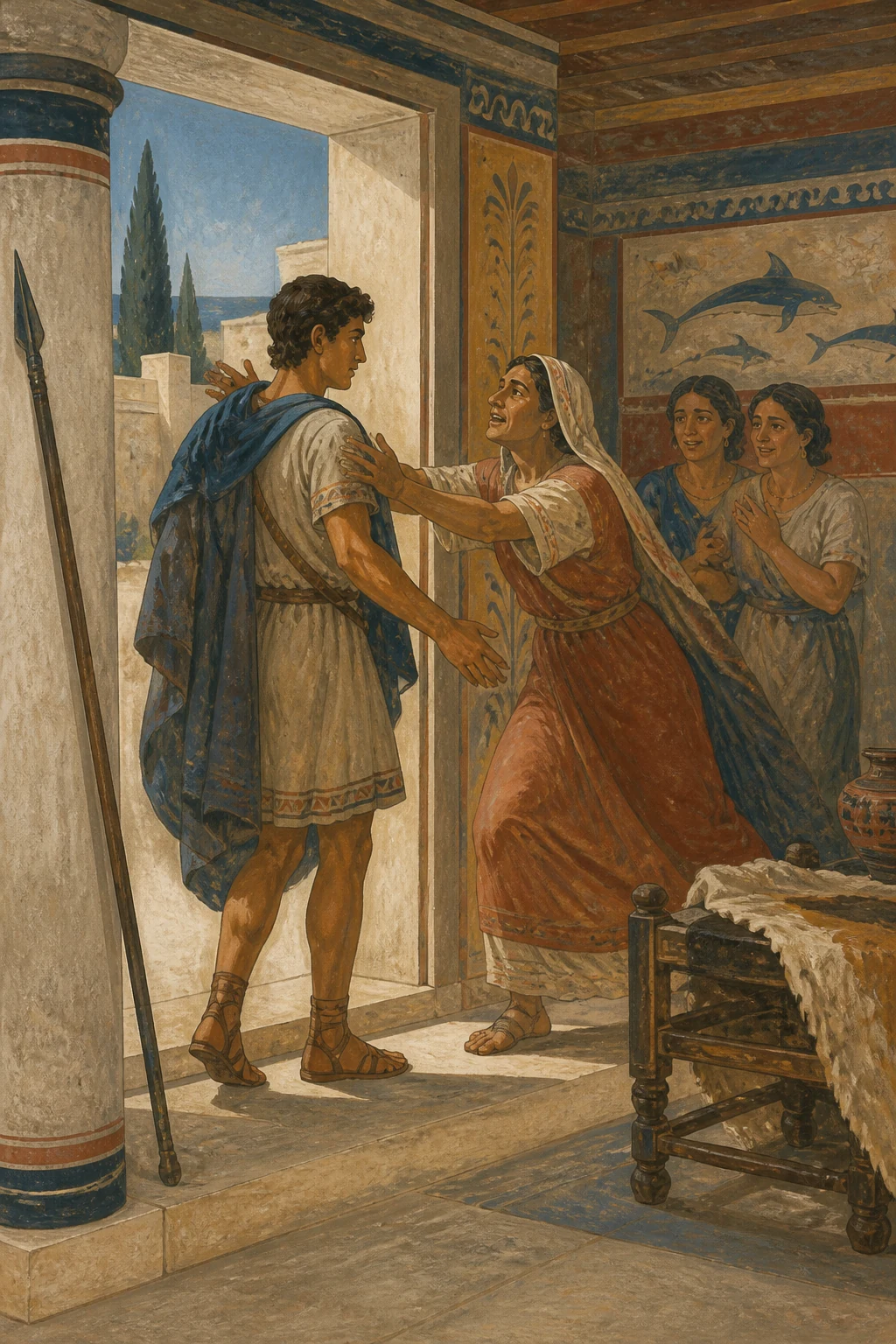
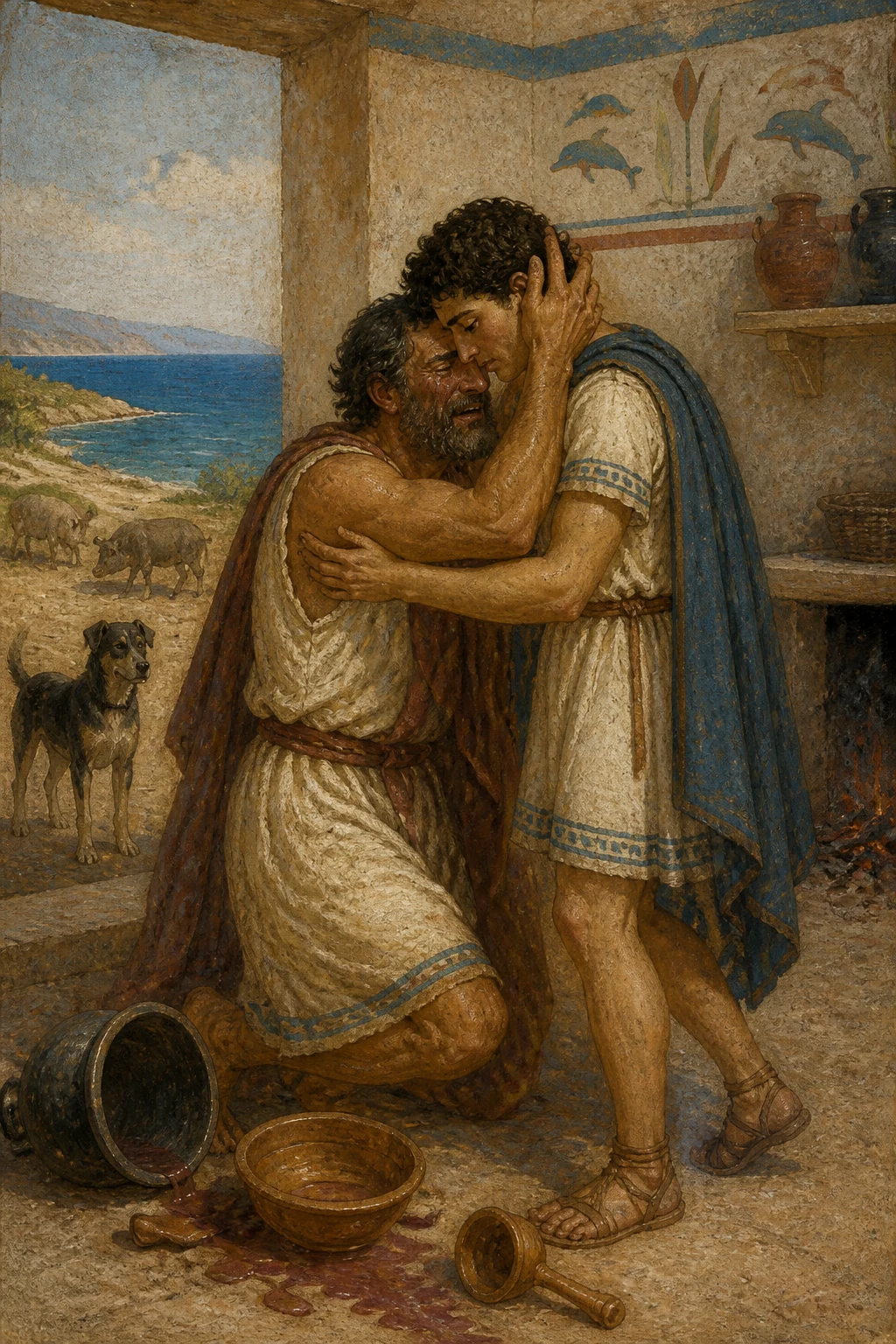
He had not finished speaking when his dear son stood in the doorway. The swineherd sprang up in astonishment, and the vessels in which he had been mixing the gleaming wine fell from his hands. He went straight to meet his young master and kissed his head, both his lovely eyes, and both his hands, while the tears streamed down.
As a loving father welcomes his son home from a distant land in the tenth year—his only son, the darling of his age, for whose sake he has endured much sorrow—so the noble swineherd threw his arms around godlike Telemachus and kissed him all over, as though he had escaped from death. Weeping, he spoke winged words: “You have come, Telemachus, my sweet light! I thought I would never see you again, once you sailed away to Pylos.
“But come inside now, dear child, so that my heart may rejoice at the sight of you, newly returned from abroad and here beneath my roof. You do not often visit the country or the herdsmen, but stay in town. It seems your heart prefers to watch that ruinous throng of suitors.”
Thoughtful Telemachus answered him: “So be it, old father. It is for your sake that I have come here, to see you with my own eyes and hear whether my mother still remains in our house, or whether some other man has married her by now, and Odysseus’ bed lies empty, draped in foul cobwebs, with no one to sleep in it.”
The swineherd, a leader among men, replied: “Indeed she remains in your house, with steadfast heart. But her nights and days waste away in misery, and always she sheds tears.”
With these words he took the bronze spear from him. Telemachus went inside and stepped across the stone threshold. As he approached, his father Odysseus began to yield his seat, but Telemachus stopped him from where he stood and said: “Stay seated, stranger. We can find another seat somewhere in our own hut, and here is the man to set it out.”
So he spoke, and Odysseus went back and sat down. For Telemachus the swineherd spread fresh brushwood on the ground, with a fleece over it, and there Odysseus’ dear son took his seat. Then the swineherd set before them platters of roast meat left from the previous day’s meal, hurriedly heaped bread in baskets, and mixed honey-sweet wine in an ivy-wood cup. He himself sat down opposite noble Odysseus.
They reached out their hands to the good food set ready before them. When they had satisfied their hunger and thirst, Telemachus addressed the noble swineherd: “Old father, where has this stranger come from? How did sailors bring him to Ithaca, and who did they claim to be?
“For I do not suppose he came here on foot.” Then you answered him, Eumaeus the swineherd: “My child, I will tell you the whole truth. He says he comes from the broad land of Crete, and that he has wandered through many cities of men. Such was the fate a god spun out for him.
“Now he has escaped from a ship of Thesprotians and come to my hut. I place him in your hands: do with him as you wish. He declares himself your suppliant.” Thoughtful Telemachus answered: “Eumaeus, what you have said cuts me to the heart. How can I welcome this stranger into my house?
“I am young myself, and do not yet trust my strength to defend myself against a man who starts a quarrel. And my mother’s heart is divided: should she stay here with me and tend the house, out of respect for her husband’s bed and the people’s opinion, or should she now follow whichever of the Achaeans courting her in the hall is the noblest and offers the richest gifts?
“Still, since this stranger has come beneath your roof, I will clothe him in a fine cloak and tunic, and give him a two-edged sword and sandals for his feet. I will send him wherever his heart desires.
“If you wish, keep him here in the hut and care for him. I will send clothes and all the food he needs, so that he will not be a burden to you and your companions. But I would not let him go there among the suitors. Their insolence is utterly reckless, and they might mock him, which would grieve me bitterly.
“Even a mighty man can do little against a crowd, for numbers give them far greater strength.” Then long-enduring, noble Odysseus replied: “My friend, since surely I too may speak in answer, my heart is eaten away as I listen to what you say of the suitors’ reckless schemes in your house, against your will, a man such as you.
“Tell me, do you submit willingly? Or do the people throughout the land hate you, obeying some divine command? Or have you cause to blame your brothers, whose help a man can trust in battle, even when a great quarrel breaks out?
“If only I were as young as you, with the spirit I have now, or were the son of blameless Odysseus—or Odysseus himself! Then let a stranger strike my head from my shoulders if I did not become a curse to every one of them when I entered the hall of Odysseus, son of Laertes.
“And if they overwhelmed me by their numbers, one man alone, I would rather be killed and die in my own house than watch such shameful deeds forever: strangers abused, serving women dragged disgracefully through the lovely halls, wine drained away, and bread devoured to no purpose, without end, for a courtship that comes to nothing.”
Thoughtful Telemachus answered him: “Stranger, I will tell you the exact truth. It is not that the whole people hate me and turn against me, nor have I cause to blame any brothers, whose help a man can trust in battle, even when a great quarrel breaks out.
“For this is how the son of Cronus has narrowed our line to single sons. Arceisius had only one son, Laertes, and Laertes in turn had only one, Odysseus. And Odysseus fathered only me, then left me in his house and had no joy of me.
“So now there are enemies without number in our home. All the nobles who rule the islands—Dulichium, Same, and wooded Zacynthus—and all who hold power in rocky Ithaca are courting my mother and devouring my estate.
“She neither refuses the hateful marriage nor can she bring it to an end, while they eat away my house. Soon they will tear me to pieces too. But all this lies on the knees of the gods. Old father, go quickly and tell wise Penelope that I am safe and have returned from Pylos.
“I will stay here. Give the message to her alone, then come back. Let none of the other Achaeans hear of it, for many are plotting harm against me.” Then you answered him, Eumaeus the swineherd: “I understand; I take your meaning. You are speaking to one who knows.
“But tell me this, and tell me plainly: should I go on the same journey to bring the news to unhappy Laertes? Until now, though deeply grieving for Odysseus, he used to oversee the work and eat and drink with the servants in his house whenever his heart prompted him. But ever since you sailed to Pylos, they say he has neither eaten nor drunk as he used to, nor looked after the work. He sits lamenting with groans and tears, and the flesh wastes away around his bones.”
Thoughtful Telemachus answered: “That is all the more sorrowful. Still, grieving though we are, we must leave him be. If mortals could have everything they wished, the first thing we would choose would be the day of my father’s homecoming.
“But return as soon as you have delivered your message. Do not wander through the fields to find him. Tell my mother to send her housekeeper quickly and in secret; she can carry the news to the old man.”
With these words he sent the swineherd on his way. Eumaeus took up his sandals, bound them beneath his feet, and set off for town. His departure from the farm did not escape Athena’s notice. She drew near in the likeness of a woman, beautiful and tall, skilled in splendid handiwork.
She stood opposite the doorway of the hut, visible to Odysseus. Telemachus neither saw nor noticed her there, for the gods do not reveal themselves openly to everyone. But Odysseus and the dogs saw her. The dogs did not bark; whining, they fled in fear to the far side of the yard.
She signaled with her brows, and noble Odysseus understood. He left the hut, passed beyond the great courtyard wall, and stood before her. Athena addressed him: “Son of Laertes, sprung from Zeus, resourceful Odysseus,
“now tell your son who you are; hide it no longer. Then, when you have planned the suitors’ death and doom together, go to the famous town. I myself will not stay away from you for long, for I am eager for the fight.”
So Athena spoke, and touched him with her golden wand. First she put a freshly washed cloak and tunic about his body, then increased his stature and restored his youthful vigor. His skin grew dark again, his cheeks filled out, and a blue-black beard spread over his chin.
When she had done this, she went away, and Odysseus returned to the hut. His dear son gazed at him in wonder, then turned his eyes aside in fear, thinking he might be a god. He spoke winged words: “Stranger, you look quite different now from what you did before. Your clothes are different, and your skin is no longer the same.
“Surely you are one of the gods who hold the broad heavens. Be gracious to us, so that we may offer you pleasing sacrifices and gifts of wrought gold. Spare us!” Long-enduring, noble Odysseus answered: “I am no god. Why do you liken me to the immortals?
“I am your father, for whose sake you groan and suffer many sorrows, enduring the violence of men.” With these words he kissed his son, and let the tears fall from his cheeks to the ground, though until then he had always held them back.
But Telemachus, still unconvinced that this was his father, answered him again: “You are not Odysseus, my father. Some divine power is bewitching me, so that I may grieve and groan still more.
“No mortal man could bring this about by his own wit, unless a god himself came and, if he wished, easily made him young or old. Just now you were an old man dressed in rags, but now you resemble the gods who hold the broad heavens.”
Resourceful Odysseus answered: “Telemachus, with your own father here before you, you should not be so overwhelmed with wonder and amazement. No other Odysseus will ever come here. I am he, just as you see me. After suffering much and wandering far, I have come home to my native land in the twentieth year.
“This is the work of Athena, who brings the spoils of battle. She makes me look as she pleases, for she has the power: now like a beggar, now like a young man with fine clothes about his body.
“It is easy for the gods who hold the broad heavens to glorify a mortal man or bring him low.” With these words he sat down. Telemachus threw his arms around his noble father and wept, shedding tears. A longing to weep arose in them both. They cried aloud, more piercingly than birds—ospreys or vultures with crooked talons—whose young the countrymen have stolen before they could fly. So pitifully the tears poured from beneath their brows.
The sunlight would have faded while they wept, had Telemachus not suddenly spoken to his father: “Dear father, in what ship did sailors bring you here to Ithaca? Who did they claim to be?
“For I do not suppose you came here on foot.” Long-enduring, noble Odysseus answered: “My child, I will tell you the truth. The Phaeacians, famed for their ships, brought me here, as they escort any man who comes to them. They carried me sleeping over the sea in their swift ship and set me down in Ithaca. They also gave me splendid gifts—bronze and gold in abundance, and woven clothing.
“Those gifts lie hidden in a cave by the gods’ will. Now I have come here at Athena’s bidding, so that we may plan our enemies’ destruction. Come, count the suitors for me and tell me of them, so that I may know how many they are and what sort of men. Then I will weigh it carefully in my mind and decide whether we two can stand against them alone, without help, or whether we must seek others.”
Thoughtful Telemachus answered him: “Father, I have always heard of your great renown, your strength as a warrior and your wisdom in council. But what you have said is too much; I am amazed. Two men cannot fight against so many strong opponents.
“There are not merely ten suitors, nor twice ten, but far more. You shall hear their number now. From Dulichium come fifty-two chosen young men, with six servants in attendance. From Same there are twenty-four men, from Zacynthus twenty young Achaeans, and from Ithaca itself twelve, all nobles. With them are Medon the herald, the inspired bard, and two attendants skilled in carving meat.
“If we face them all together inside the house, I fear you will pay a bitter and terrible price for coming to avenge their violence. Think whether you can find some defender who will stand beside us wholeheartedly.”
Long-enduring, noble Odysseus answered: “Then I will tell you. Listen closely and consider whether Athena, with Father Zeus, will be enough for us, or whether I should think of some other defender.”
Thoughtful Telemachus answered: “Those are two mighty defenders you name, though they sit high among the clouds. They rule over other men and the immortal gods as well.”
Long-enduring, noble Odysseus replied: “Those two will not remain far from the fierce battle for long, when the might of Ares decides between the suitors and ourselves within my halls.
“But now, at the first light of dawn, go home and mingle with the arrogant suitors. The swineherd will bring me to town later, looking like a wretched old beggar.
“If they dishonor me in the house, let your heart endure the sight of my suffering. Even if they drag me by the feet through the hall and out of doors, or strike me with missiles, you must look on and bear it.
“You may urge them to stop their folly, speaking gently to them, but they will not listen. Their appointed day is already upon them. And I will tell you something else; lay it to heart. When Athena, rich in counsel, puts it into my mind, I will nod to you. When you see my signal, carry away all the weapons of war that lie in the hall and store them in a corner of the lofty storeroom, every one. When the suitors miss them and question you, soothe them with gentle words: ‘I have put them away from the smoke. They no longer look as they did when Odysseus left them here on his way to Troy; the breath of the fire has tarnished them.
“‘And the son of Cronus put another, weightier thought into my mind: you might get drunk, quarrel among yourselves, and wound one another, disgracing the feast and your courtship. Iron itself draws a man to it.’
“But leave two swords and two spears for us alone, and two oxhide shields to take up in our hands, so that we can rush upon them and seize them. Then Pallas Athena and Zeus the counselor will bewilder them.
“And I will tell you something else; lay it to heart. If you truly are my son and of my blood, let no one hear that Odysseus is home. Let neither Laertes nor the swineherd know, nor any of the servants, nor Penelope herself. You and I alone will discover the women’s loyalties. We will also test some of the serving men, to learn who honors and fears us in his heart, and who cares nothing for us and dishonors you, a man such as you.”
His splendid son answered him: “Father, I think you will come to know my spirit soon enough. No lack of resolve possesses me. But I do not think this plan will benefit us both, and I urge you to consider it.
“You will spend a long time going about the farms, testing each man, while they sit at ease in the hall and recklessly devour your wealth, sparing nothing. I do urge you to discover which women dishonor you and which are innocent. But I would not have us test the men throughout the farms. Let that wait until later, if you have truly received some sign from Zeus who bears the aegis.”
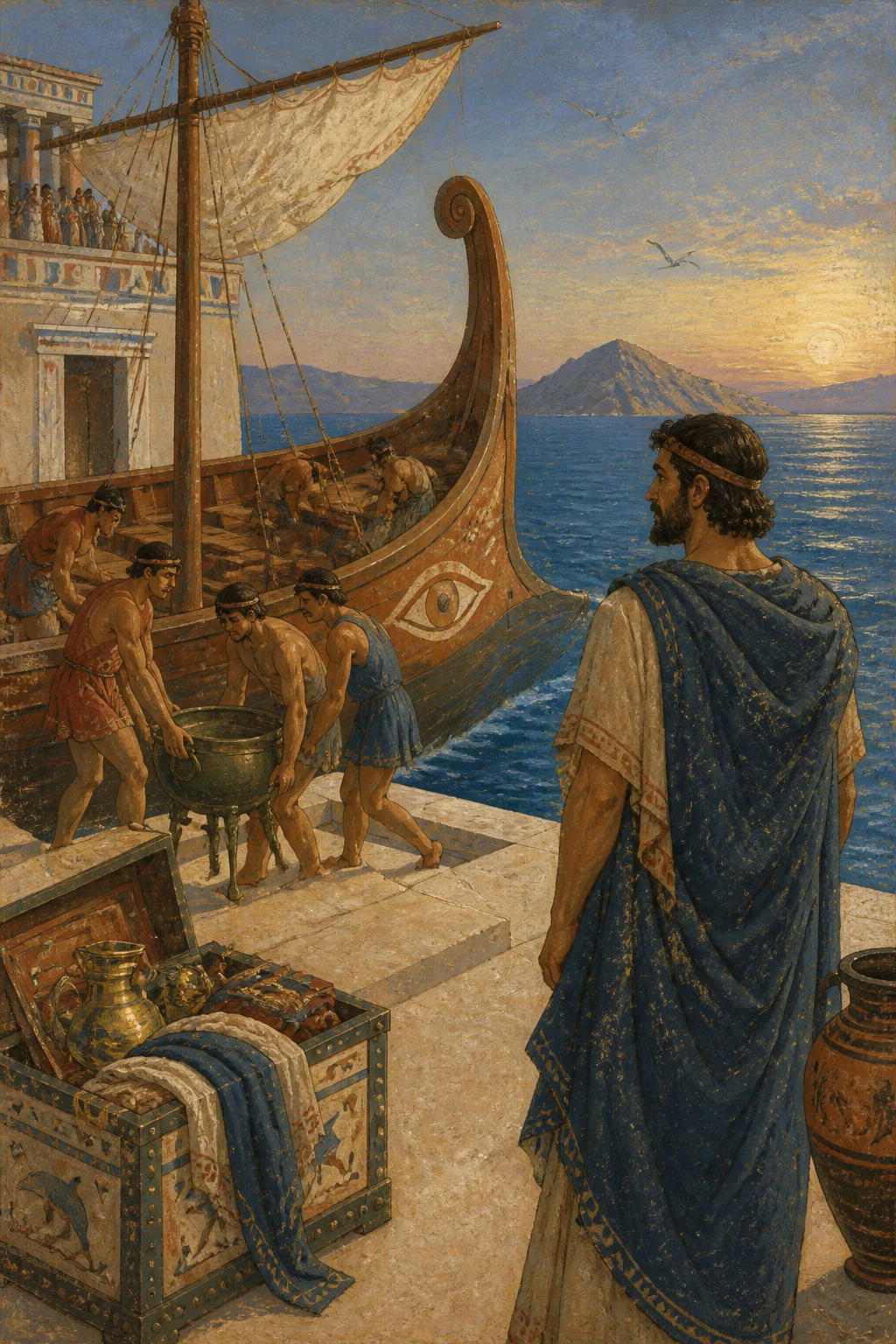
While they spoke together in this way, the well-built ship that had carried Telemachus and all his companions from Pylos was drawing into Ithaca. When they reached the deep harbor, they hauled the black ship onto the shore. Eager servants carried away their gear, and at once they took the splendid gifts to the house of Clytius.
They sent a herald ahead to Odysseus’ house to tell wise Penelope that Telemachus was in the country and had ordered the ship to sail on to town, so that the noble queen should not grow afraid and shed tender tears. The herald and the noble swineherd met on their way, both bearing the same news to the lady.
When they reached the house of the godlike king, the herald spoke in the midst of the serving women: “My queen, your dear son has returned.” But the swineherd stood close beside Penelope and told her everything her dear son had instructed him to say.
When he had delivered his whole message, he set off back to the pigs, leaving the courtyard and the hall. The suitors were troubled and downcast at heart. They went out of the hall, beyond the great courtyard wall, and sat there in front of the gates.
Eurymachus, son of Polybus, was the first to speak: “Friends, Telemachus has accomplished a great feat in carrying out this voyage, insolent though it was. We thought he would never bring it off. Come, let us launch the best black ship we have and gather a crew of seafaring oarsmen, so that they can quickly tell our men to return home at once.”
He had not finished speaking when Amphinomus turned where he sat and saw a ship inside the deep harbor, its crew lowering the sail and taking up their oars. He laughed pleasantly and said to his companions: “There is no need to send a message. Here they are.
“Either some god has told them, or they saw the ship passing and could not catch it.” So he spoke, and they rose and went down to the seashore. They quickly hauled the black ship onto the land, and eager servants carried away their gear.
Then they went in a body to their meeting place and allowed no one else, young or old, to sit with them. Antinous, son of Eupeithes, addressed them: “Damn it! How the gods have rescued this man from disaster!
“All day our lookouts sat in constant watch upon the windy heights. And after sunset we never spent the night ashore, but sailed our swift ship out at sea and waited for bright Dawn, lying in ambush for Telemachus so that we could catch and kill him. But meanwhile some god has brought him home. Here, then, let us devise a wretched death for Telemachus, and let him not escape us. For I do not think we can succeed in our purpose while he lives.
“He has understanding and good judgment himself, and the people no longer favor us at all. Come, we must act before he gathers the Achaeans into assembly. I do not think he will let the matter rest: he will be furious and stand up before them all to tell them how we plotted his violent death and failed to catch him. They will not approve when they hear of our wicked deeds. They may do us harm and drive us from our own land, forcing us to seek another country. Let us strike first and kill him in the fields far from town, or on the road. We can keep his livelihood and possessions, dividing them fairly among ourselves, and give the house to his mother and the man who marries her.
“But if this proposal displeases you, and you want him to live and keep all his father’s property, then let us no longer gather here and feast away his pleasant wealth. Let each man woo her from his own house and seek her with gifts. Then she can marry whoever offers most and is destined to win her.”
So he spoke, and they all fell silent. Then Amphinomus addressed them, the splendid son of Nisus, lord Aretias’ son. He led the suitors from Dulichium, rich in wheat and grassy meadows, and his words pleased Penelope most, for he had good sense. With their welfare in mind, he said: “Friends, I would not wish to kill Telemachus. It is a fearful thing to kill a man of royal blood. First let us seek the gods’ counsel.
“If the ordinances of great Zeus approve, I will kill him myself and urge all the others to do the same. But if the gods forbid it, I advise you to stop.” So Amphinomus spoke, and his words pleased them.
At once they rose and went to Odysseus’ house, where they sat down on polished chairs. Meanwhile, wise Penelope formed another plan: to show herself before the suitors in their outrageous insolence.
For she had learned of the plot to kill her son in the palace. Medon the herald had told her, having overheard their counsels. She went to the hall with her serving women. When the noble lady reached the suitors, she stood beside a pillar of the solidly built hall, holding her shining veil before her cheeks. She rebuked Antinous, calling him by name: “Antinous, insolent schemer! They say that among men of your age in Ithaca you are foremost in counsel and speech. It seems you are nothing of the kind.
“Madman, why are you weaving death and doom for Telemachus? Have you no regard for suppliants, whose witness is Zeus? It is an unholy thing to plot harm against one another. Do you not know how your father fled here once in fear of the people? They were furious with him because he had joined Taphian raiders and attacked the Thesprotians, who were our allies. They wanted to kill him, tear the heart from his body, and devour his great and cherished wealth. But Odysseus held them back and restrained them, eager though they were.
“Now you devour his house without payment, court his wife, seek to kill his son, and bring me bitter grief. I tell you to stop, and to make the others stop as well.” Eurymachus, son of Polybus, answered her: “Daughter of Icarius, wise Penelope, take courage. Do not let these things trouble your heart.
“There is no man now, nor will there ever be, who shall lay hands on your son Telemachus while I am alive and see the light upon this earth. I tell you this, and it shall surely come to pass: his dark blood will soon flow around my spear. For often Odysseus, sacker of cities, set me on his knees, put roast meat into my hands, and held red wine to my lips.
“For that reason Telemachus is far dearer to me than any other man, and I tell him to fear no death from the suitors. But death sent by a god cannot be avoided.” So he spoke to reassure her, while he himself was plotting her son’s destruction.
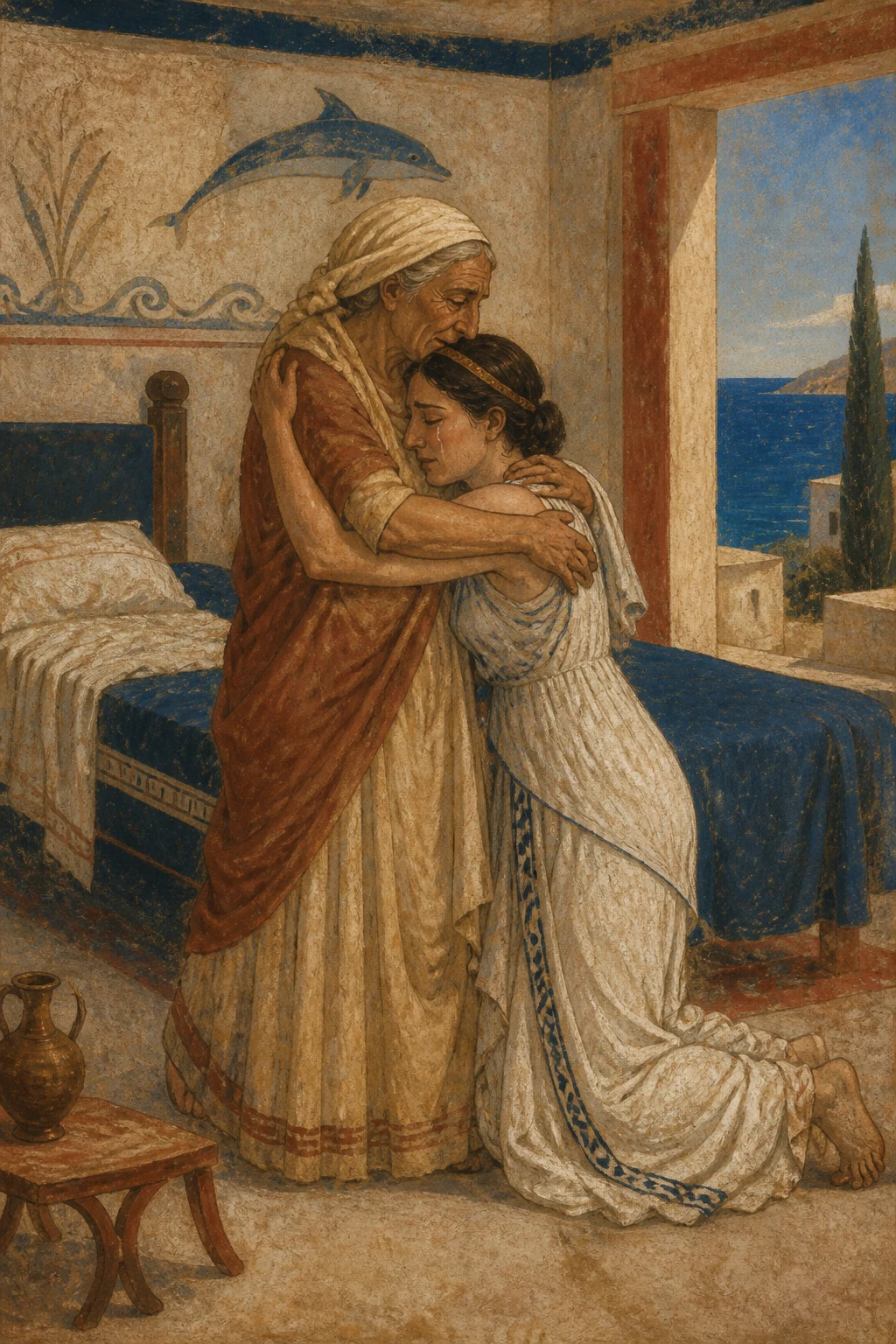
She went upstairs to her bright upper chamber and wept for Odysseus, her dear husband, until bright-eyed Athena cast sweet sleep upon her eyelids. At evening the noble swineherd came back to Odysseus and his son. They were busy preparing supper, having slaughtered a year-old pig. But Athena came close to Odysseus, son of Laertes, struck him with her wand, and made him an old man again. She dressed his body in wretched clothes, lest the swineherd see him face to face and recognize him, then go to tell wise Penelope, unable to keep the secret in his heart.
Telemachus was the first to speak to him: “You have come, good Eumaeus. What news is there in town? Are the proud suitors back from their ambush now, or are they still waiting for me to come home?”
Then you answered him, Eumaeus the swineherd: “I did not trouble to inquire about that as I went through town. My heart urged me to deliver the message and return here as quickly as I could.
“A swift messenger from your companions met me on the way, a herald who was the first to tell your mother the news. But there is something else I know, for I saw it with my own eyes. I was already above the town, near the hill of Hermes, when I saw a swift ship coming into our harbor. There were many men aboard, and she was laden with shields and double-edged spears. I thought it was them, but I cannot be certain.”
So he spoke, and strong Telemachus smiled, glancing toward his father, but taking care that the swineherd did not see. When they had finished their work and made the meal ready, they feasted, and no one’s appetite lacked a fair share.
When they had satisfied their hunger and thirst, they thought of bed and accepted the gift of sleep.
Izvirnik
Father and Son
Naslednje strani prikazujejo izvirno besedilo za primerjavo.
τὼ δʼ αὖτʼ ἐν κλισίῃ Ὀδυσεὺς καὶ δῖος ὑφορβὸς ἐντύνοντο ἄριστον ἅμʼ ἠοῖ, κηαμένω πῦρ, ἔκπεμψάν τε νομῆας ἅμʼ ἀγρομένοισι σύεσσι· Τηλέμαχον δὲ περίσσαινον κύνες ὑλακόμωροι, οὐδʼ ὕλαον προσιόντα. νόησε δὲ δῖος Ὀδυσσεὺς σαίνοντάς τε κύνας, περί τε κτύπος ἦλθε ποδοῖϊν. αἶψα δʼ ἄρʼ Εὔμαιον ἔπεα πτερόεντα προσηύδα· Εὔμαιʼ, ἦ μάλα τίς τοι ἐλεύσεται ἐνθάδʼ ἑταῖρος ἢ καὶ γνώριμος ἄλλος, ἐπεὶ κύνες οὐχ ὑλάουσιν, ἀλλὰ περισσαίνουσι· ποδῶν δʼ ὑπὸ δοῦπον ἀκούω.
οὔ πω πᾶν εἴρητο ἔπος, ὅτε οἱ φίλος υἱὸς ἔστη ἐνὶ προθύροισι. ταφὼν δʼ ἀνόρουσε συβώτης, ἐκ δʼ ἄρα οἱ χειρῶν πέσον ἄγγεα, τοῖς ἐπονεῖτο, κιρνὰς αἴθοπα οἶνον. ὁ δʼ ἀντίος ἦλθεν ἄνακτος, κύσσε δέ μιν κεφαλήν τε καὶ ἄμφω φάεα καλὰ χεῖράς τʼ ἀμφοτέρας· θαλερὸν δέ οἱ ἔκπεσε δάκρυ. ὡς δὲ πατὴρ ὃν παῖδα φίλα φρονέων ἀγαπάζῃ ἐλθόντʼ ἐξ ἀπίης γαίης δεκάτῳ ἐνιαυτῷ, μοῦνον τηλύγετον, τῷ ἔπʼ ἄλγεα πολλὰ μογήσῃ, ὣς τότε Τηλέμαχον θεοειδέα δῖος ὑφορβὸς πάντα κύσεν περιφύς, ὡς ἐκ θανάτοιο φυγόντα· καί ῥʼ ὀλοφυρόμενος ἔπεα πτερόεντα προσηύδα·
ἦλθες, Τηλέμαχε, γλυκερὸν φάος. οὔ σʼ ἔτʼ ἐγώ γε ὄψεσθαι ἐφάμην, ἐπεὶ ᾤχεο νηῒ Πύλονδε. ἀλλʼ ἄγε νῦν εἴσελθε, φίλον τέκος, ὄφρα σε θυμῷ τέρψομαι εἰσορόων νέον ἄλλοθεν ἔνδον ἐόντα. οὐ μὲν γάρ τι θάμʼ ἀγρὸν ἐπέρχεαι οὐδὲ νομῆας, ἀλλʼ ἐπιδημεύεις· ὣς γάρ νύ τοι εὔαδε θυμῷ, ἀνδρῶν μνηστήρων ἐσορᾶν ἀΐδηλον ὅμιλον. τὸν δʼ αὖ Τηλέμαχος πεπνυμένος ἀντίον ηὔδα· ἔσσεται οὕτως, ἄττα· σέθεν δʼ ἕνεκʼ ἐνθάδʼ ἱκάνω, ὄφρα σέ τʼ ὀφθαλμοῖσιν ἴδω καὶ μῦθον ἀκούσω, ἤ μοι ἔτʼ ἐν μεγάροις μήτηρ μένει, ἦέ τις ἤδη ἀνδρῶν ἄλλος ἔγημεν, Ὀδυσσῆος δέ που εὐνὴ
χήτει ἐνευναίων κάκʼ ἀράχνια κεῖται ἔχουσα. τὸν δʼ αὖτε προσέειπε συβώτης, ὄρχαμος ἀνδρῶν· καὶ λίην κείνη γε μένει τετληότι θυμῷ σοῖσιν ἐνὶ μεγάροισιν· ὀϊζυραὶ δέ οἱ αἰεὶ φθίνουσιν νύκτες τε καὶ ἤματα δάκρυ χεούσῃ. ὣς ἄρα φωνήσας οἱ ἐδέξατο χάλκεον ἔγχος· αὐτὰρ ὅ γʼ εἴσω ἴεν καὶ ὑπέρβη λάϊνον οὐδόν. τῷ δʼ ἕδρης ἐπιόντι πατὴρ ὑπόειξεν Ὀδυσσεύς· Τηλέμαχος δʼ ἑτέρωθεν ἐρήτυε φώνησέν τε· ἧσʼ, ὦ ξεῖνʼ· ἡμεῖς δὲ καὶ ἄλλοθι δήομεν ἕδρην σταθμῷ ἐν ἡμετέρῳ· πάρα δʼ ἀνὴρ ὃς καταθήσει.
ὣς φάθʼ, ὁ δʼ αὖτις ἰὼν κατʼ ἄρʼ ἕζετο· τῷ δὲ συβώτης. χεῦεν ὕπο χλωρὰς ῥῶπας καὶ κῶας ὕπερθεν· ἔνθα καθέζετʼ ἔπειτα Ὀδυσσῆος φίλος υἱός. τοῖσιν δʼ αὖ κρειῶν πίνακας παρέθηκε συβώτης ὀπταλέων, ἅ ῥα τῇ προτέρῃ ὑπέλειπον ἔδοντες, σῖτον δʼ ἐσσυμένως παρενήνεεν ἐν κανέοισιν, ἐν δʼ ἄρα κισσυβίῳ κίρνη μελιηδέα οἶνον· αὐτὸς δʼ ἀντίον ἷζεν Ὀδυσσῆος θείοιο. οἱ δʼ ἐπʼ ὀνείαθʼ ἑτοῖμα προκείμενα χεῖρας ἴαλλον.
αὐτὰρ ἐπεὶ πόσιος καὶ ἐδητύος ἐξ ἔρον ἕντο, δὴ τότε Τηλέμαχος προσεφώνεε δῖον ὑφορβόν· ἄττα, πόθεν τοι ξεῖνος ὅδʼ ἵκετο; πῶς δέ ἑ ναῦται ἤγαγον εἰς Ἰθάκην; τίνες ἔμμεναι εὐχετόωντο; οὐ μὲν γάρ τί ἑ πεζὸν ὀΐομαι ἐνθάδʼ ἱκέσθαι. τὸν δʼ ἀπαμειβόμενος προσέφης, Εὔμαιε συβῶτα· τοιγὰρ ἐγώ τοι, τέκνον, ἀληθέα πάντʼ ἀγορεύσω. ἐκ μὲν Κρητάων γένος εὔχεται εὐρειάων, φησὶ δὲ πολλὰ βροτῶν ἐπὶ ἄστεα δινηθῆναι πλαζόμενος· ὣς γάρ οἱ ἐπέκλωσεν τά γε δαίμων.
νῦν αὖ Θεσπρωτῶν ἀνδρῶν ἐκ νηὸς ἀποδρὰς ἤλυθʼ ἐμὸν πρὸς σταθμόν, ἐγὼ δέ τοι ἐγγυαλίξω· ἔρξον ὅπως ἐθέλεις· ἱκέτης δέ τοι εὔχεται εἶναι. τὸν δʼ αὖ Τηλέμαχος πεπνυμένος ἀντίον ηὔδα· Εὔμαιʼ, ἦ μάλα τοῦτο ἔπος θυμαλγὲς ἔειπες· πῶς γὰρ δὴ τὸν ξεῖνον ἐγὼν ὑποδέξομαι οἴκῳ; αὐτὸς μὲν νέος εἰμὶ καὶ οὔ πω χερσὶ πέποιθα ἄνδρʼ ἀπαμύνασθαι, ὅτε τις πρότερος χαλεπήνῃ· μητρὶ δʼ ἐμῇ δίχα θυμὸς ἐνὶ φρεσὶ μερμηρίζει, ἢ αὐτοῦ παρʼ ἐμοί τε μένῃ καὶ δῶμα κομίζῃ, εὐνήν τʼ αἰδομένη πόσιος δήμοιό τε φῆμιν, ἦ ἤδη ἅμʼ ἕπηται Ἀχαιῶν ὅς τις ἄριστος
μνᾶται ἐνὶ μεγάροισιν ἀνὴρ καὶ πλεῖστα πόρῃσιν. ἀλλʼ ἦ τοὶ τὸν ξεῖνον, ἐπεὶ τεὸν ἵκετο δῶμα, ἕσσω μιν χλαῖνάν τε χιτῶνά τε, εἵματα καλά, δώσω δὲ ξίφος ἄμφηκες καὶ ποσσὶ πέδιλα, πέμψω δʼ ὅππη μιν κραδίη θυμός τε κελεύει. εἰ δʼ ἐθέλεις, σὺ κόμισσον ἐνὶ σταθμοῖσιν ἐρύξας· εἵματα δʼ ἐνθάδʼ ἐγὼ πέμψω καὶ σῖτον ἅπαντα ἔδμεναι, ὡς ἂν μή σε κατατρύχῃ καὶ ἑταίρους. κεῖσε δʼ ἂν οὔ μιν ἐγώ γε μετὰ μνηστῆρας ἐῷμι ἔρχεσθαι· λίην γὰρ ἀτάσθαλον ὕβριν ἔχουσι· μή μιν κερτομέωσιν, ἐμοὶ δʼ ἄχος ἔσσεται αἰνόν.
πρῆξαι δʼ ἀργαλέον τι μετὰ πλεόνεσσιν ἐόντα ἄνδρα καὶ ἴφθιμον, ἐπεὶ ἦ πολὺ φέρτεροί εἰσι. τὸν δʼ αὖτε προσέειπε πολύτλας δῖος Ὀδυσσεύς· ὦ φίλʼ, ἐπεί θήν μοι καὶ ἀμείψασθαι θέμις ἐστίν, ἦ μάλα μευ καταδάπτετʼ ἀκούοντος φίλον ἦτορ, οἷά φατε μνηστῆρας ἀτάσθαλα μηχανάασθαι ἐν μεγάροις, ἀέκητι σέθεν τοιούτου ἐόντος. εἰπέ μοι ἠὲ ἑκὼν ὑποδάμνασαι, ἦ σέ γε λαοὶ ἐχθαίρουσʼ ἀνὰ δῆμον, ἐπισπόμενοι θεοῦ ὀμφῇ, ἦ τι κασιγνήτοις ἐπιμέμφεαι, οἷσί περ ἀνὴρ μαρναμένοισι πέποιθε, καὶ εἰ μέγα νεῖκος ὄρηται.
αἲ γὰρ ἐγὼν οὕτω νέος εἴην τῷδʼ ἐπὶ θυμῷ, ἢ παῖς ἐξ Ὀδυσῆος ἀμύμονος ἠὲ καὶ αὐτός· αὐτίκʼ ἔπειτʼ ἀπʼ ἐμεῖο κάρη τάμοι ἀλλότριος φώς, εἰ μὴ ἐγὼ κείνοισι κακὸν πάντεσσι γενοίμην, ἐλθὼν ἐς μέγαρον Λαερτιάδεω Ὀδυσῆος. εἰ δʼ αὖ με πληθυῖ δαμασαίατο μοῦνον ἐόντα, βουλοίμην κʼ ἐν ἐμοῖσι κατακτάμενος μεγάροισι τεθνάμεν ἢ τάδε γʼ αἰὲν ἀεικέα ἔργʼ ὁράασθαι, ξείνους τε στυφελιζομένους δμῳάς τε γυναῖκας ῥυστάζοντας ἀεικελίως κατὰ δώματα καλά, καὶ οἶνον διαφυσσόμενον, καὶ σῖτον ἔδοντας μὰψ αὔτως, ἀτέλεστον, ἀνηνύστῳ ἐπὶ ἔργῳ.
τὸν δʼ αὖ Τηλέμαχος πεπνυμένος ἀντίον ηὔδα· τοιγὰρ ἐγώ τοι, ξεῖνε, μάλʼ ἀτρεκέως ἀγορεύσω. οὔτε τί μοι πᾶς δῆμος ἀπεχθόμενος χαλεπαίνει, οὔτε κασιγνήτοις ἐπιμέμφομαι, οἷσί περ ἀνὴρ μαρναμένοισι πέποιθε, καὶ εἰ μέγα νεῖκος ὄρηται. ὧδε γὰρ ἡμετέρην γενεὴν μούνωσε Κρονίων· μοῦνον Λαέρτην Ἀρκείσιος υἱὸν ἔτικτε, μοῦνον δʼ αὖτʼ Ὀδυσῆα πατὴρ τέκεν· αὐτὰρ Ὀδυσσεὺς μοῦνον ἔμʼ ἐν μεγάροισι τεκὼν λίπεν οὐδʼ ἀπόνητο.
τῷ νῦν δυσμενέες μάλα μυρίοι εἴσʼ ἐνὶ οἴκῳ. ὅσσοι γὰρ νήσοισιν ἐπικρατέουσιν ἄριστοι, Δουλιχίῳ τε Σάμῃ τε καὶ ὑλήεντι Ζακύνθῳ, ἠδʼ ὅσσοι κραναὴν Ἰθάκην κάτα κοιρανέουσι, τόσσοι μητέρʼ ἐμὴν μνῶνται, τρύχουσι δὲ οἶκον. ἡ δʼ οὔτʼ ἀρνεῖται στυγερὸν γάμον οὔτε τελευτὴν ποιῆσαι δύναται· τοὶ δὲ φθινύθουσιν ἔδοντες οἶκον ἐμόν· τάχα δή με διαρραίσουσι καὶ αὐτόν. ἀλλʼ ἦ τοι μὲν ταῦτα θεῶν ἐν γούνασι κεῖται· ἄττα, σὺ δʼ ἔρχεο θᾶσσον, ἐχέφρονι Πηνελοπείῃ εἴφʼ ὅτι οἱ σῶς εἰμὶ καὶ ἐκ Πύλου εἰλήλουθα.
αὐτὰρ ἐγὼν αὐτοῦ μενέω, σὺ δὲ δεῦρο νέεσθαι, οἴῃ ἀπαγγείλας· τῶν δʼ ἄλλων μή τις Ἀχαιῶν πευθέσθω· πολλοὶ γὰρ ἐμοὶ κακὰ μηχανόωνται. τὸν δʼ ἀπαμειβόμενος προσέφης, Εὔμαιε συβῶτα· γιγνώσκω, φρονέω· τά γε δὴ νοέοντι κελεύεις. ἀλλʼ ἄγε μοι τόδε εἰπὲ καὶ ἀτρεκέως κατάλεξον, ἦ καὶ Λαέρτῃ αὐτὴν ὁδὸν ἄγγελος ἔλθω δυσμόρῳ, ὃς τῆος μὲν Ὀδυσσῆος μέγʼ ἀχεύων ἔργα τʼ ἐποπτεύεσκε μετὰ δμώων τʼ ἐνὶ οἴκῳ πῖνε καὶ ἦσθʼ, ὅτε θυμὸς ἐνὶ στήθεσσιν ἀνώγοι· αὐτὰρ νῦν, ἐξ οὗ σύ γε ᾤχεο νηῒ Πύλονδε, οὔ πω μίν φασιν φαγέμεν καὶ πιέμεν αὔτως,
οὐδʼ ἐπὶ ἔργα ἰδεῖν, ἀλλὰ στοναχῇ τε γόῳ τε ἧσται ὀδυρόμενος, φθινύθει δʼ ἀμφʼ ὀστεόφι χρώς. τὸν δʼ αὖ Τηλέμαχος πεπνυμένος ἀντίον ηὔδα· ἄλγιον, ἀλλʼ ἔμπης μιν ἐάσομεν, ἀχνύμενοί περ· εἰ γάρ πως εἴη αὐτάγρετα πάντα βροτοῖσι, πρῶτόν κεν τοῦ πατρὸς ἑλοίμεθα νόστιμον ἦμαρ. ἀλλὰ σύ γʼ ἀγγείλας ὀπίσω κίε, μηδὲ κατʼ ἀγροὺς πλάζεσθαι μετʼ ἐκεῖνον· ἀτὰρ πρὸς μητέρα εἰπεῖν ἀμφίπολον ταμίην ὀτρυνέμεν ὅττι τάχιστα κρύβδην· κείνη γάρ κεν ἀπαγγείλειε γέροντι.
ἦ ῥα καὶ ὦρσε συφορβόν· ὁ δʼ εἵλετο χερσὶ πέδιλα, δησάμενος δʼ ὑπὸ ποσσὶ πόλινδʼ ἴεν. οὐδʼ ἄρʼ Ἀθήνην λῆθεν ἀπὸ σταθμοῖο κιὼν Εὔμαιος ὑφορβός, ἀλλʼ ἥ γε σχεδὸν ἦλθε· δέμας δʼ ἤϊκτο γυναικὶ καλῇ τε μεγάλῃ τε καὶ ἀγλαὰ ἔργα ἰδυίῃ. στῆ δὲ κατʼ ἀντίθυρον κλισίης Ὀδυσῆϊ φανεῖσα· οὐδʼ ἄρα Τηλέμαχος ἴδεν ἀντίον οὐδʼ ἐνόησεν, οὐ γάρ πω πάντεσσι θεοὶ φαίνονται ἐναργεῖς, ἀλλʼ Ὀδυσεύς τε κύνες τε ἴδον, καί ῥʼ οὐχ ὑλάοντο κνυζηθμῷ δʼ ἑτέρωσε διὰ σταθμοῖο φόβηθεν.
ἡ δʼ ἄρʼ ἐπʼ ὀφρύσι νεῦσε· νόησε δὲ δῖος Ὀδυσσεύς, ἐκ δʼ ἦλθεν μεγάροιο παρὲκ μέγα τειχίον αὐλῆς, στῆ δὲ πάροιθʼ αὐτῆς· τὸν δὲ προσέειπεν Ἀθήνη· διογενὲς Λαερτιάδη, πολυμήχανʼ Ὀδυσσεῦ. ἤδη νῦν σῷ παιδὶ ἔπος φάο μηδʼ ἐπίκευθε, ὡς ἂν μνηστῆρσιν θάνατον καὶ κῆρʼ ἀραρόντε ἔρχησθον προτὶ ἄστυ περικλυτόν· οὐδʼ ἐγὼ αὐτὴ δηρὸν ἀπὸ σφῶϊν ἔσομαι μεμαυῖα μάχεσθαι. ἦ καὶ χρυσείῃ ῥάβδῳ ἐπεμάσσατʼ Ἀθήνη.
φᾶρος μέν οἱ πρῶτον ἐϋπλυνὲς ἠδὲ χιτῶνα θῆκʼ ἀμφὶ στήθεσσι, δέμας δʼ ὤφελλε καὶ ἥβην. ἂψ δὲ μελαγχροιὴς γένετο, γναθμοὶ δὲ τάνυσθεν, κυάνεαι δʼ ἐγένοντο γενειάδες ἀμφὶ γένειον. ἡ μὲν ἄρʼ ὣς ἔρξασα πάλιν κίεν· αὐτὰρ Ὀδυσσεὺς ἤϊεν ἐς κλισίην· θάμβησε δέ μιν φίλος υἱός, ταρβήσας δʼ ἑτέρωσε βάλʼ ὄμματα, μὴ θεὸς εἴη, καί μιν φωνήσας ἔπεα πτερόεντα προσηύδα· ἀλλοῖός μοι, ξεῖνε, φάνης νέον ἠὲ πάροιθεν, ἄλλα δὲ εἵματʼ ἔχεις, καί τοι χρὼς οὐκέθʼ ὁμοῖος.
ἦ μάλα τις θεός ἐσσι, τοὶ οὐρανὸν εὐρὺν ἔχουσιν· ἀλλʼ ἵληθʼ, ἵνα τοι κεχαρισμένα δώομεν ἱρὰ ἠδὲ χρύσεα δῶρα, τετυγμένα· φείδεο δʼ ἡμέων τὸν δʼ ἠμείβετʼ ἔπειτα πολύτλας δῖος Ὀδυσσεύς· οὔ τίς τοι θεός εἰμι· τί μʼ ἀθανάτοισιν ἐΐσκεις; ἀλλὰ πατὴρ τεός εἰμι, τοῦ εἵνεκα σὺ στεναχίζων πάσχεις ἄλγεα πολλά, βίας ὑποδέγμενος ἀνδρῶν. ὣς ἄρα φωνήσας υἱὸν κύσε, κὰδ δὲ παρειῶν δάκρυον ἧκε χαμᾶζε· πάρος δʼ ἔχε νωλεμὲς αἰεί.
Τηλέμαχος δʼ, οὐ γάρ πω ἐπείθετο ὃν πατέρʼ εἶναι, ἐξαῦτίς μιν ἔπεσσιν ἀμειβόμενος προσέειπεν· οὐ σύ γʼ Ὀδυσσεύς ἐσσι, πατὴρ ἐμός, ἀλλά με δαίμων θέλγει, ὄφρʼ ἔτι μᾶλλον ὀδυρόμενος στεναχίζω. οὐ γάρ πως ἂν θνητὸς ἀνὴρ τάδε μηχανόῳτο ᾧ αὐτοῦ γε νόῳ, ὅτε μὴ θεὸς αὐτὸς ἐπελθὼν ῥηϊδίως ἐθέλων θείη νέον ἠὲ γέροντα. ἦ γάρ τοι νέον ἦσθα γέρων καὶ ἀεικέα ἕσσο· νῦν δὲ θεοῖσιν ἔοικας, οἳ οὐρανὸν εὐρὺν ἔχουσι.
τὸν δʼ ἀπαμειβόμενος προσέφη πολύμητις Ὀδυσσεύς· Τηλέμαχʼ, οὔ σε ἔοικε φίλον πατέρ ἔνδον ἐόντα οὔτε τι θαυμάζειν περιώσιον οὔτʼ ἀγάασθαι· οὐ μὲν γάρ τοι ἔτʼ ἄλλος ἐλεύσεται ἐνθάδʼ Ὀδυσσεύς, ἀλλʼ ὅδʼ ἐγὼ τοιόσδε, παθὼν κακά, πολλὰ δʼ ἀληθείς, ἤλυθον εἰκοστῷ ἔτεϊ ἐς πατρίδα γαῖαν. αὐτάρ τοι τόδε ἔργον Ἀθηναίης ἀγελείης, ἥ τέ με τοῖον ἔθηκεν, ὅπως ἐθέλει, δύναται γάρ, ἄλλοτε μὲν πτωχῷ ἐναλίγκιον, ἄλλοτε δʼ αὖτε ἀνδρὶ νέῳ καὶ καλὰ περὶ χροῒ εἵματʼ ἔχοντι.
ῥηΐδιον δὲ θεοῖσι, τοὶ οὐρανὸν εὐρὺν ἔχουσιν, ἠμὲν κυδῆναι θνητὸν βροτὸν ἠδὲ κακῶσαι. ὣς ἄρα φωνήσας κατʼ ἄρʼ ἕζετο, Τηλέμαχος δὲ ἀμφιχυθεὶς πατέρʼ ἐσθλὸν ὀδύρετο, δάκρυα λείβων, ἀμφοτέροισι δὲ τοῖσιν ὑφʼ ἵμερος ὦρτο γόοιο· κλαῖον δὲ λιγέως, ἀδινώτερον ἤ τʼ οἰωνοί, φῆναι ἢ αἰγυπιοὶ γαμψώνυχες, οἷσί τε τέκνα ἀγρόται ἐξείλοντο πάρος πετεηνὰ γενέσθαι· ὣς ἄρα τοί γʼ ἐλεεινὸν ὑπʼ ὀφρύσι δάκρυον εἶβον.
καί νύ κʼ ὀδυρομένοισιν ἔδυ φάος ἠελίοιο, εἰ μὴ Τηλέμαχος προσεφώνεεν ὃν πατέρʼ αἶψα· ποίῃ γὰρ νῦν δεῦρο, πάτερ φίλε, νηΐ σε ναῦται ἤγαγον εἰς Ἰθάκην; τίνες ἔμμεναι εὐχετόωντο; οὐ μὲν γάρ τί σε πεζὸν ὀΐομαι ἐνθάδʼ ἱκέσθαι. τὸν δʼ αὖτε προσέειπε πολύτλας δῖος Ὀδυσσεύς· τοιγὰρ ἐγώ τοι, τέκνον, ἀληθείην καταλέξω. Φαίηκές μʼ ἄγαγον ναυσίκλυτοι, οἵ τε καὶ ἄλλους ἀνθρώπους πέμπουσιν, ὅτις σφέας εἰσαφίκηται· καί μʼ εὕδοντʼ ἐν νηῒ θοῇ ἐπὶ πόντον ἄγοντες κάτθεσαν εἰς Ἰθάκην, ἔπορον δέ μοι ἀγλαὰ δῶρα, χαλκόν τε χρυσόν τε ἅλις ἐσθῆτά θʼ ὑφαντήν.
καὶ τὰ μὲν ἐν σπήεσσι θεῶν ἰότητι κέονται· νῦν αὖ δεῦρʼ ἱκόμην ὑποθημοσύνῃσιν Ἀθήνης, ὄφρα κε δυσμενέεσσι φόνου πέρι βουλεύσωμεν. ἀλλʼ ἄγε μοι μνηστῆρας ἀριθμήσας κατάλεξον, ὄφρʼ εἰδέω ὅσσοι τε καὶ οἵ τινες ἀνέρες εἰσί· καί κεν ἐμὸν κατὰ θυμὸν ἀμύμονα μερμηρίξας φράσσομαι, ἤ κεν νῶϊ δυνησόμεθʼ ἀντιφέρεσθαι μούνω ἄνευθʼ ἄλλων, ἦ καὶ διζησόμεθʼ ἄλλους. τὸν δʼ αὖ Τηλέμαχος πεπνυμένος ἀντίον ηὔδα· ὦ πάτερ, ἦ τοι σεῖο μέγα κλέος αἰὲν ἄκουον, χεῖράς τʼ αἰχμητὴν ἔμεναι καὶ ἐπίφρονα βουλήν· ἀλλὰ λίην μέγα εἶπες· ἄγη μʼ ἔχει· οὐδέ κεν εἴη
ἄνδρε δύω πολλοῖσι καὶ ἰφθίμοισι μάχεσθαι. μνηστήρων δʼ οὔτʼ ἂρ δεκὰς ἀτρεκὲς οὔτε δύʼ οἶαι, ἀλλὰ πολὺ πλέονες· τάχα δʼ εἴσεαι ἐνθάδʼ ἀριθμόν. ἐκ μὲν Δουλιχίοιο δύω καὶ πεντήκοντα κοῦροι κεκριμένοι, ἓξ δὲ δρηστῆρες ἕπονται· ἐκ δὲ Σάμης πίσυρές τε καὶ εἴκοσι φῶτες ἔασιν, ἐκ δὲ Ζακύνθου ἔασιν ἐείκοσι κοῦροι Ἀχαιῶν, ἐκ δʼ αὐτῆς Ἰθάκης δυοκαίδεκα πάντες ἄριστοι, καί σφιν ἅμʼ ἐστὶ Μέδων κῆρυξ καὶ θεῖος ἀοιδὸς καὶ δοιὼ θεράποντε, δαήμονε δαιτροσυνάων.
τῶν εἴ κεν πάντων ἀντήσομεν ἔνδον ἐόντων, μὴ πολύπικρα καὶ αἰνὰ βίας ἀποτίσεαι ἐλθών. ἀλλὰ σύ γʼ, εἰ δύνασαί τινʼ ἀμύντορα μερμηρίξαι, φράζευ, ὅ κέν τις νῶϊν ἀμύνοι πρόφρονι θυμῷ. τὸν δʼ αὖτε προσέειπε πολύτλας δῖος Ὀδυσσεύς· τοιγὰρ ἐγὼν ἐρέω, σὺ δὲ σύνθεο καί μευ ἄκουσον· καὶ φράσαι ἤ κεν νῶϊν Ἀθήνη σὺν Διὶ πατρὶ ἀρκέσει, ἦέ τινʼ ἄλλον ἀμύντορα μερμηρίξω. τὸν δʼ αὖ Τηλέμαχος πεπνυμένος ἀντίον ηὔδα· ἐσθλώ τοι τούτω γʼ ἐπαμύντορε, τοὺς ἀγορεύεις, ὕψι περ ἐν νεφέεσσι καθημένω· ὥ τε καὶ ἄλλοις ἀνδράσι τε κρατέουσι καὶ ἀθανάτοισι θεοῖσι.
τὸν δʼ αὖτε προσέειπε πολύτλας δῖος Ὀδυσσεύς· οὐ μέν τοι κείνω γε πολὺν χρόνον ἀμφὶς ἔσεσθον φυλόπιδος κρατερῆς, ὁπότε μνηστῆρσι καὶ ἡμῖν ἐν μεγάροισιν ἐμοῖσι μένος κρίνηται Ἄρηος. ἀλλὰ σὺ μὲν νῦν ἔρχευ ἅμʼ ἠοῖ φαινομένηφιν οἴκαδε, καὶ μνηστῆρσιν ὑπερφιάλοισιν ὁμίλει· αὐτὰρ ἐμὲ προτὶ ἄστυ συβώτης ὕστερον ἄξει, πτωχῷ λευγαλέῳ ἐναλίγκιον ἠδὲ γέροντι. εἰ δέ μʼ ἀτιμήσουσι δόμον κάτα, σὸν δὲ φίλον κῆρ τετλάτω ἐν στήθεσσι κακῶς πάσχοντος ἐμεῖο, ἤν περ καὶ διὰ δῶμα ποδῶν ἕλκωσι θύραζε ἢ βέλεσι βάλλωσι· σὺ δʼ εἰσορόων ἀνέχεσθαι.
ἀλλʼ ἦ τοι παύεσθαι ἀνωγέμεν ἀφροσυνάων, μειλιχίοις ἐπέεσσι παραυδῶν· οἱ δέ τοι οὔ τι πείσονται· δὴ γάρ σφι παρίσταται αἴσιμον ἦμαρ. ἄλλο δέ τοι ἐρέω, σὺ δʼ ἐνὶ φρεσὶ βάλλεο σῇσιν· ὁππότε κεν πολύβουλος ἐνὶ φρεσὶ θῇσιν Ἀθήνη, νεύσω μέν τοι ἐγὼ κεφαλῇ, σὺ δʼ ἔπειτα νοήσας ὅσσα τοι ἐν μεγάροισιν Ἀρήϊα τεύχεα κεῖται ἐς μυχὸν ὑψηλοῦ θαλάμου καταθεῖναι ἀείρας πάντα μάλʼ· αὐτὰρ μνηστῆρας μαλακοῖς ἐπέεσσι παρφάσθαι, ὅτε κέν σε μεταλλῶσιν ποθέοντες· ἐκ καπνοῦ κατέθηκʼ, ἐπεὶ οὐκέτι τοῖσιν ἐῴκει οἷά ποτε Τροίηνδε κιὼν κατέλειπεν Ὀδυσσεύς,
ἀλλὰ κατῄκισται, ὅσσον πυρὸς ἵκετʼ ἀϋτμή. πρὸς δʼ ἔτι καὶ τόδε μεῖζον ἐνὶ φρεσὶ θῆκε Κρονίων, μή πως οἰνωθέντες, ἔριν στήσαντες ἐν ὑμῖν, ἀλλήλους τρώσητε καταισχύνητέ τε δαῖτα καὶ μνηστύν· αὐτὸς γὰρ ἐφέλκεται ἄνδρα σίδηρος. νῶϊν δʼ οἴοισιν δύο φάσγανα καὶ δύο δοῦρε καλλιπέειν καὶ δοιὰ βοάγρια χερσὶν ἑλέσθαι, ὡς ἂν ἐπιθύσαντες ἑλοίμεθα· τοὺς δέ κʼ ἔπειτα Παλλὰς Ἀθηναίη θέλξει καὶ μητίετα Ζεύς.
ἄλλο δέ τοι ἐρέω, σὺ δʼ ἐνὶ φρεσὶ βάλλεο σῇσιν· εἰ ἐτεόν γʼ ἐμός ἐσσι καὶ αἵματος ἡμετέροιο, μή τις ἔπειτʼ Ὀδυσῆος ἀκουσάτω ἔνδον ἐόντος, μήτʼ οὖν Λαέρτης ἴστω τό γε μήτε συβώτης μήτε τις οἰκήων μήτʼ αὐτὴ Πηνελόπεια, ἀλλʼ οἶοι σύ τʼ ἐγώ τε γυναικῶν γνώομεν ἰθύν· καί κέ τεο δμώων ἀνδρῶν ἔτι πειρηθεῖμεν, ἠμὲν ὅπου τις νῶϊ τίει καὶ δείδιε θυμῷ, ἠδʼ ὅτις οὐκ ἀλέγει, σὲ δʼ ἀτιμᾷ τοῖον ἐόντα.
τὸν δʼ ἀπαμειβόμενος προσεφώνεε φαίδιμος υἱός ὦ πάτερ, ἦ τοι ἐμὸν θυμὸν καὶ ἔπειτά γʼ, ὀΐω, γνώσεαι· οὐ μὲν γάρ τι χαλιφροσύναι γέ μʼ ἔχουσιν· ἀλλʼ οὔ τοι τόδε κέρδος ἐγὼν ἔσσεσθαι ὀΐω ἡμῖν ἀμφοτέροισι· σὲ δὲ φράζεσθαι ἄνωγα. δηθὰ γὰρ αὔτως εἴσῃ ἑκάστου πειρητίζων, ἔργα μετερχόμενος· τοὶ δʼ ἐν μεγάροισιν ἕκηλοι χρήματα δαρδάπτουσιν ὑπέρβιον οὐδʼ ἔπι φειδώ. ἀλλʼ ἦ τοί σε γυναῖκας ἐγὼ δεδάασθαι ἄνωγα, αἵ τέ σʼ ἀτιμάζουσι καὶ αἳ νηλείτιδές εἰσιν· ἀνδρῶν δʼ οὐκ ἂν ἐγώ γε κατὰ σταθμοὺς ἐθέλοιμι ἡμέας πειράζειν, ἀλλʼ ὕστερα ταῦτα πένεσθαι,
εἰ ἐτεόν γέ τι οἶσθα Διὸς τέρας αἰγιόχοιο. ὣς οἱ μὲν τοιαῦτα πρὸς ἀλλήλους ἀγόρευον, ἡ δʼ ἄρʼ ἔπειτʼ Ἰθάκηνδε κατήγετο νηῦς εὐεργής, ἣ φέρε Τηλέμαχον Πυλόθεν καὶ πάντας ἑταίρους. οἱ δʼ ὅτε δὴ λιμένος πολυβενθέος ἐντὸς ἵκοντο, νῆα μὲν οἵ γε μέλαιναν ἐπʼ ἠπείροιο ἔρυσσαν, τεύχεα δέ σφʼ ἀπένεικαν ὑπέρθυμοι θεράποντες, αὐτίκα δʼ ἐς Κλυτίοιο φέρον περικαλλέα δῶρα. αὐτὰρ κήρυκα πρόεσαν δόμον εἰς Ὀδυσῆος, ἀγγελίην ἐρέοντα περίφρονι Πηνελοπείῃ, οὕνεκα Τηλέμαχος μὲν ἐπʼ ἀγροῦ, νῆα δʼ ἀνώγει ἄστυδʼ ἀποπλείειν, ἵνα μὴ δείσασʼ ἐνὶ θυμῷ
ἰφθίμη βασίλεια τέρεν κατὰ δάκρυον εἴβοι τὼ δὲ συναντήτην κῆρυξ καὶ δῖος ὑφορβὸς τῆς αὐτῆς ἕνεκʼ ἀγγελίης, ἐρέοντε γυναικί. ἀλλʼ ὅτε δή ῥʼ ἵκοντο δόμον θείου βασιλῆος, κῆρυξ μέν ῥα μέσῃσι μετὰ δμῳῇσιν ἔειπεν· ἤδη τοι, βασίλεια, φίλος πάϊς εἰλήλουθε. Πηνελοπείῃ δʼ εἶπε συβώτης ἄγχι παραστὰς πάνθʼ ὅσα οἱ φίλος υἱὸς ἀνώγει μυθήσασθαι. αὐτὰρ ἐπεὶ δὴ πᾶσαν ἐφημοσύνην ἀπέειπε, βῆ ῥʼ ἴμεναι μεθʼ ὕας, λίπε δʼ ἕρκεά τε μέγαρόν τε.
μνηστῆρες δʼ ἀκάχοντο κατήφησάν τʼ ἐνὶ θυμῷ, ἐκ δʼ ἦλθον μεγάροιο παρὲκ μέγα τειχίον αὐλῆς, αὐτοῦ δὲ προπάροιθε θυράων ἑδριόωντο. τοῖσιν δʼ Εὐρύμαχος, Πολύβου πάϊς, ἦρχʼ ἀγορεύειν· ὦ φίλοι, ἦ μέγα ἔργον ὑπερφιάλως τετέλεσται Τηλεμάχῳ ὁδὸς ἥδε· φάμεν δέ οἱ οὐ τελέεσθαι. ἀλλʼ ἄγε νῆα μέλαιναν ἐρύσσομεν ἥ τις ἀρίστη, ἐς δʼ ἐρέτας ἁλιῆας ἀγείρομεν, οἵ κε τάχιστα κείνοις ἀγγείλωσι θοῶς οἶκόνδε νέεσθαι.
οὔ πω πᾶν εἴρηθʼ, ὅτʼ ἄρʼ Ἀμφίνομος ἴδε νῆα, στρεφθεὶς ἐκ χώρης, λιμένος πολυβενθέος ἐντός, ἱστία τε στέλλοντας ἐρετμά τε χερσὶν ἔχοντας. ἡδὺ δʼ ἄρʼ ἐκγελάσας μετεφώνεεν οἷς ἑτάροισι· μή τινʼ ἔτʼ ἀγγελίην ὀτρύνομεν· οἵδε γὰρ ἔνδον. ἤ τίς σφιν τόδʼ ἔειπε θεῶν, ἢ εἴσιδον αὐτοὶ νῆα παρερχομένην, τὴν δʼ οὐκ ἐδύναντο κιχῆναι. ὣς ἔφαθʼ, οἱ δʼ ἀνστάντες ἔβαν ἐπὶ θῖνα θαλάσσης, αἶψα δὲ νῆα μέλαιναν ἐπʼ ἠπείροιο ἔρυσσαν, τεύχεα δέ σφʼ ἀπένεικαν ὑπέρθυμοι θεράποντες.
αὐτοὶ δʼ εἰς ἀγορὴν κίον ἀθρόοι, οὐδέ τινʼ ἄλλον εἴων οὔτε νέων μεταΐζειν οὔτε γερόντων. τοῖσιν δʼ Ἀντίνοος μετέφη, Εὐπείθεος υἱός· ὢ πόποι, ὡς τόνδʼ ἄνδρα θεοὶ κακότητος ἔλυσαν. ἤματα μὲν σκοποὶ ἷζον ἐπʼ ἄκριας ἠνεμοέσσας αἰὲν ἐπασσύτεροι· ἅμα δʼ ἠελίῳ καταδύντι οὔ ποτʼ ἐπʼ ἠπείρου νύκτʼ ἄσαμεν, ἀλλʼ ἐνὶ πόντῳ νηῒ θοῇ πλείοντες ἐμίμνομεν Ἠῶ δῖαν, Τηλέμαχον λοχόωντες, ἵνα φθίσωμεν ἑλόντες αὐτόν· τὸν δʼ ἄρα τῆος ἀπήγαγεν οἴκαδε δαίμων, ἡμεῖς δʼ ἐνθάδε οἱ φραζώμεθα λυγρὸν ὄλεθρον Τηλεμάχῳ, μηδʼ ἧμας ὑπεκφύγοι· οὐ γὰρ ὀΐω
τούτου γε ζώοντος ἀνύσσεσθαι τάδε ἔργα. αὐτὸς μὲν γὰρ ἐπιστήμων βουλῇ τε νόῳ τε, λαοὶ δʼ οὐκέτι πάμπαν ἐφʼ ἡμῖν ἦρα φέρουσιν. ἀλλʼ ἄγετε, πρὶν κεῖνον ὁμηγυρίσασθαι Ἀχαιοὺς εἰς ἀγορήν—οὐ γάρ τι μεθησέμεναί μιν ὀΐω, ἀλλʼ ἀπομηνίσει, ἐρέει δʼ ἐν πᾶσιν ἀναστὰς οὕνεκά οἱ φόνον αἰπὺν ἐράπτομεν οὐδʼ ἐκίχημεν· οἱ δʼ οὐκ αἰνήσουσιν ἀκούοντες κακὰ ἔργα· μή τι κακὸν ῥέξωσι καὶ ἡμέας ἐξελάσωσι γαίης ἡμετέρης, ἄλλων δʼ ἀφικώμεθα δῆμον· ἀλλὰ φθέωμεν ἑλόντες ἐπʼ ἀγροῦ νόσφι πόληος ἢ ἐν ὁδῷ· βίοτον δʼ αὐτοὶ καὶ κτήματʼ ἔχωμεν,
δασσάμενοι κατὰ μοῖραν ἐφʼ ἡμέας, οἰκία δʼ αὖτε κείνου μητέρι δοῖμεν ἔχειν ἠδʼ ὅστις ὀπυίοι. εἰ δʼ ὑμῖν ὅδε μῦθος ἀφανδάνει, ἀλλὰ βόλεσθε αὐτόν τε ζώειν καὶ ἔχειν πατρώϊα πάντα, μή οἱ χρήματʼ ἔπειτα ἅλις θυμηδέʼ ἔδωμεν ἐνθάδʼ ἀγειρόμενοι, ἀλλʼ ἐκ μεγάροιο ἕκαστος μνάσθω ἐέδνοισιν διζήμενος· ἡ δέ κʼ ἔπειτα γήμαιθʼ ὅς κε πλεῖστα πόροι καὶ μόρσιμος ἔλθοι. ὣς ἔφαθʼ, οἱ δʼ ἄρα πάντες ἀκὴν ἐγένοντο σιωπῇ.
τοῖσιν δʼ Ἀμφίνομος ἀγορήσατο καὶ μετέειπε, Νίσου φαίδιμος υἱός, Ἀρητιάδαο ἄνακτος, ὅς ῥʼ ἐκ Δουλιχίου πολυπύρου, ποιήεντος, ἡγεῖτο μνηστῆρσι, μάλιστα δὲ Πηνελοπείῃ ἥνδανε μύθοισι· φρεσὶ γὰρ κέχρητʼ ἀγαθῇσιν· ὅ σφιν ἐϋφρονέων ἀγορήσατο καὶ μετέειπεν· ὦ φίλοι, οὐκ ἂν ἐγώ γε κατακτείνειν ἐθέλοιμι Τηλέμαχον· δεινὸν δὲ γένος βασιλήϊόν ἐστιν κτείνειν· ἀλλὰ πρῶτα θεῶν εἰρώμεθα βουλάς.
εἰ μέν κʼ αἰνήσωσι Διὸς μεγάλοιο θέμιστες, αὐτός τε κτενέω τούς τʼ ἄλλους πάντας ἀνώξω· εἰ δέ κʼ ἀποτρωπῶσι θεοί, παύσασθαι ἄνωγα. ὣς ἔφατʼ Ἀμφίνομος, τοῖσιν δʼ ἐπιήνδανε μῦθος. αὐτίκʼ ἔπειτʼ ἀνστάντες ἔβαν δόμον εἰς Ὀδυσῆος, ἐλθόντες δὲ καθῖζον ἐπὶ ξεστοῖσι θρόνοισιν. ἡ δʼ αὖτʼ ἄλλʼ ἐνόησε περίφρων Πηνελόπεια, μνηστήρεσσι φανῆναι ὑπέρβιον ὕβριν ἔχουσι. πεύθετο γὰρ οὗ παιδὸς ἐνὶ μεγάροισιν ὄλεθρον· κῆρυξ γάρ οἱ ἔειπε Μέδων, ὃς ἐπεύθετο βουλάς.
βῆ δʼ ἰέναι μέγαρόνδε σὺν ἀμφιπόλοισι γυναιξίν. ἀλλʼ ὅτε δὴ μνηστῆρας ἀφίκετο δῖα γυναικῶν, στῆ ῥα παρὰ σταθμὸν τέγεος πύκα ποιητοῖο, ἄντα παρειάων σχομένη λιπαρὰ κρήδεμνα, Ἀντίνοον δʼ ἐνένιπεν ἔπος τʼ ἔφατʼ ἔκ τʼ ὀνόμαζεν· Ἀντίνοʼ, ὕβριν ἔχων, κακομήχανε, καὶ δέ σέ φασιν ἐν δήμῳ Ἰθάκης μεθʼ ὁμήλικας ἔμμεν ἄριστον βουλῇ καὶ μύθοισι· σὺ δʼ οὐκ ἄρα τοῖος ἔησθα. μάργε, τίη δὲ σὺ Τηλεμάχῳ θάνατόν τε μόρον τε ῥάπτεις, οὐδʼ ἱκέτας ἐμπάζεαι, οἷσιν ἄρα Ζεὺς μάρτυρος; οὐδʼ ὁσίη κακὰ ῥάπτειν ἀλλήλοισιν.
ἦ οὐκ οἶσθʼ ὅτε δεῦρο πατὴρ τεὸς ἵκετο φεύγων, δῆμον ὑποδείσας; δὴ γὰρ κεχολώατο λίην, οὕνεκα ληϊστῆρσιν ἐπισπόμενος Ταφίοισιν ἤκαχε Θεσπρωτούς· οἱ δʼ ἡμῖν ἄρθμιοι ἦσαν· τόν ῥʼ ἔθελον φθῖσαι καὶ ἀπορραῖσαι φίλον ἦτορ ἠδὲ κατὰ ζωὴν φαγέειν μενοεικέα πολλήν· ἀλλʼ Ὀδυσεὺς κατέρυκε καὶ ἔσχεθεν ἱεμένους περ. τοῦ νῦν οἶκον ἄτιμον ἔδεις, μνάᾳ δὲ γυναῖκα παῖδά τʼ ἀποκτείνεις, ἐμὲ δὲ μεγάλως ἀκαχίζεις· ἀλλά σε παύσασθαι κέλομαι καὶ ἀνωγέμεν ἄλλους.
τὴν δʼ αὖτʼ Εὐρύμαχος, Πολύβου πάϊς, ἀντίον ηὔδα· κούρη Ἰκαρίοιο, περίφρον Πηνελόπεια, θάρσει· μή τοι ταῦτα μετὰ φρεσὶ σῇσι μελόντων. οὐκ ἔσθʼ οὗτος ἀνὴρ οὐδʼ ἔσσεται οὐδὲ γένηται, ὅς κεν Τηλεμάχῳ σῷ υἱέϊ χεῖρας ἐποίσει ζώοντός γʼ ἐμέθεν καὶ ἐπὶ χθονὶ δερκομένοιο. ὧδε γὰρ ἐξερέω, καὶ μὴν τετελεσμένον ἔσται· αἶψά οἱ αἷμα κελαινὸν ἐρωήσει περὶ δουρὶ ἡμετέρῳ, ἐπεὶ ἦ καὶ ἐμὲ πτολίπορθος Ὀδυσσεὺς πολλάκι γούνασιν οἷσιν ἐφεσσάμενος κρέας ὀπτὸν ἐν χείρεσσιν ἔθηκεν, ἐπέσχε τε οἶνον ἐρυθρόν.
τῷ μοι Τηλέμαχος πάντων πολὺ φίλτατός ἐστιν ἀνδρῶν, οὐδέ τί μιν θάνατον τρομέεσθαι ἄνωγα ἔκ γε μνηστήρων· θεόθεν δʼ οὐκ ἔστʼ ἀλέασθαι. ὣς φάτο θαρσύνων, τῷ δʼ ἤρτυεν αὐτὸς ὄλεθρον. ἡ μὲν ἄρʼ εἰσαναβᾶσʼ ὑπερώϊα σιγαλόεντα κλαῖεν ἔπειτʼ Ὀδυσῆα, φίλον πόσιν, ὄφρα οἱ ὕπνον ἡδὺν ἐπὶ βλεφάροισι βάλε γλαυκῶπις Ἀθήνη. ἑσπέριος δʼ Ὀδυσῆϊ καὶ υἱέϊ δῖος ὑφορβὸς ἤλυθεν· οἱ δʼ ἄρα δόρπον ἐπισταδὸν ὡπλίζοντο, σῦν ἱερεύσαντες ἐνιαύσιον. αὐτὰρ Ἀθήνη, ἄγχι παρισταμένη, Λαερτιάδην Ὀδυσῆα ῥάβδῳ πεπληγυῖα πάλιν ποίησε γέροντα,
λυγρὰ δὲ εἵματα ἕσσε περὶ χροΐ, μή ἑ συβώτης γνοίη ἐσάντα ἰδὼν καὶ ἐχέφρονι Πηνελοπείῃ ἔλθοι ἀπαγγέλλων μηδὲ φρεσὶν εἰρύσσαιτο. τὸν καὶ Τηλέμαχος πρότερος πρὸς μῦθον ἔειπεν· ἦλθες, δῖʼ Εὔμαιε. τί δὴ κλέος ἔστʼ ἀνὰ ἄστυ; ἦ ῥʼ ἤδη μνηστῆρες ἀγήνορες ἔνδον ἔασιν ἐκ λόχου, ἦ ἔτι μʼ αὖτʼ εἰρύαται οἴκαδʼ ἰόντα; τὸν δʼ ἀπαμειβόμενος προσέφης, Εὔμαιε συβῶτα· οὐκ ἔμελέν μοι ταῦτα μεταλλῆσαι καὶ ἐρέσθαι ἄστυ καταβλώσκοντα· τάχιστά με θυμὸς ἀνώγει ἀγγελίην εἰπόντα πάλιν δεῦρʼ ἀπονέεσθαι.
ὡμήρησε δέ μοι παρʼ ἑταίρων ἄγγελος ὠκύς, κῆρυξ, ὃς δὴ πρῶτος ἔπος σῇ μητρὶ ἔειπεν. ἄλλο δέ τοι τό γε οἶδα· τὸ γὰρ ἴδον ὀφθαλμοῖσιν. ἤδη ὑπὲρ πόλιος, ὅθι θʼ Ἕρμαιος λόφος ἐστίν, ἦα κιών, ὅτε νῆα θοὴν ἰδόμην κατιοῦσαν ἐς λιμένʼ ἡμέτερον· πολλοὶ δʼ ἔσαν ἄνδρες ἐν αὐτῇ, βεβρίθει δὲ σάκεσσι καὶ ἔγχεσιν ἀμφιγύοισι· καὶ σφέας ὠΐσθην τοὺς ἔμμεναι, οὐδέ τι οἶδα. ὣς φάτο, μείδησεν δʼ ἱερὴ ἲς Τηλεμάχοιο ἐς πατέρʼ ὀφθαλμοῖσιν ἰδών, ἀλέεινε δʼ ὑφορβόν.
οἱ δʼ ἐπεὶ οὖν παύσαντο πόνου τετύκοντό τε δαῖτα, δαίνυντʼ, οὐδέ τι θυμὸς ἐδεύετο δαιτὸς ἐΐσης. αὐτὰρ ἐπεὶ πόσιος καὶ ἐδητύος ἐξ ἔρον ἕντο, κοίτου τε μνήσαντο καὶ ὕπνου δῶρον ἕλοντο.
Nadaljuj z branjem