O besedilu
Berač v palači
- Vir
- Odiseja
- Avtor
- Homer
- Jezik branja
- English
- Jezik izvirnika
- Ancient Greek
- Čas branja
- 30 min branja
- Obseg
- 24 strani
- Naslov izvirnika
- The Beggar in the Palace
O izvirniku
Odiseja
Dolga vrnitev domov čez morja, otoke, preizkušnje in prepoznavanja. Bralni jezik je English, izvirnik pa prihaja iz vira Odiseja v jeziku Ancient Greek.
Besedilo
Berač v palači
When early-born, rosy-fingered Dawn appeared, Telemachus, the dear son of godlike Odysseus, bound his fine sandals beneath his feet and took up a sturdy spear that fitted his hand. Eager to be off to town, he spoke to his swineherd: “Father, I am going to the city so that my mother may see me. I do not think she will cease her bitter weeping and tearful lamentation until she sees me with her own eyes. But here are my instructions to you.
“Take this unfortunate stranger to town, so that he may beg his food there. Whoever wishes can give him a crust and a cup to drink. I cannot support everyone, burdened as I am with sorrows of my own. If the stranger takes great offense, it will be the worse for him. I prefer to speak the truth.”
Resourceful Odysseus answered him: “My friend, I have no wish to be kept here myself. A beggar is better off seeking his food in town than in the countryside. Whoever wishes will give me something.
“I am no longer of an age to stay on a farm and obey every order a master gives me. Go, then. This man, as you have instructed, will take me there as soon as I have warmed myself by the fire and the day grows mild.
“These clothes of mine are wretched indeed. I fear the morning frost may overcome me, and you say the town is far away.” So he spoke, and Telemachus strode swiftly out through the farmyard, sowing ruin for the suitors.
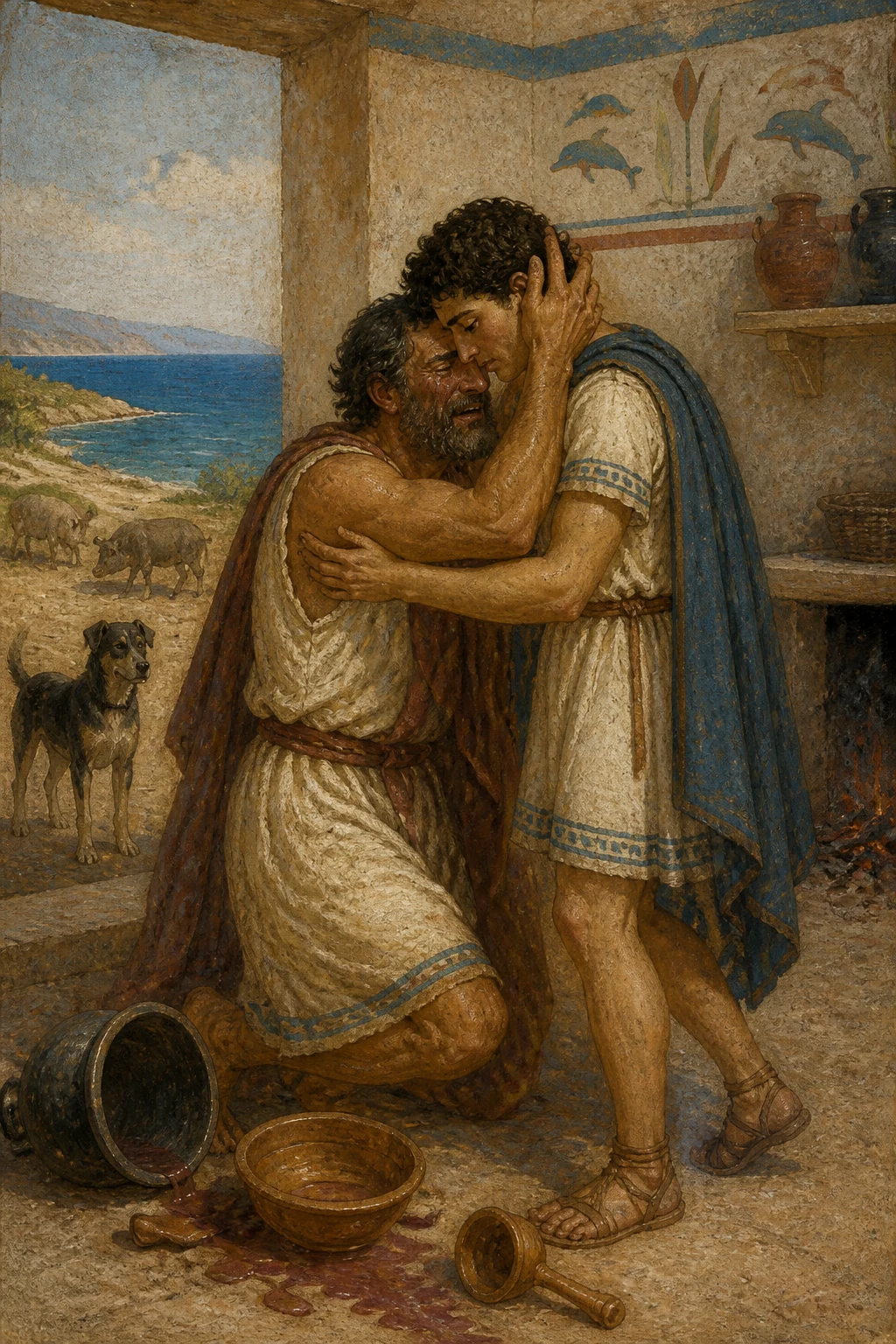
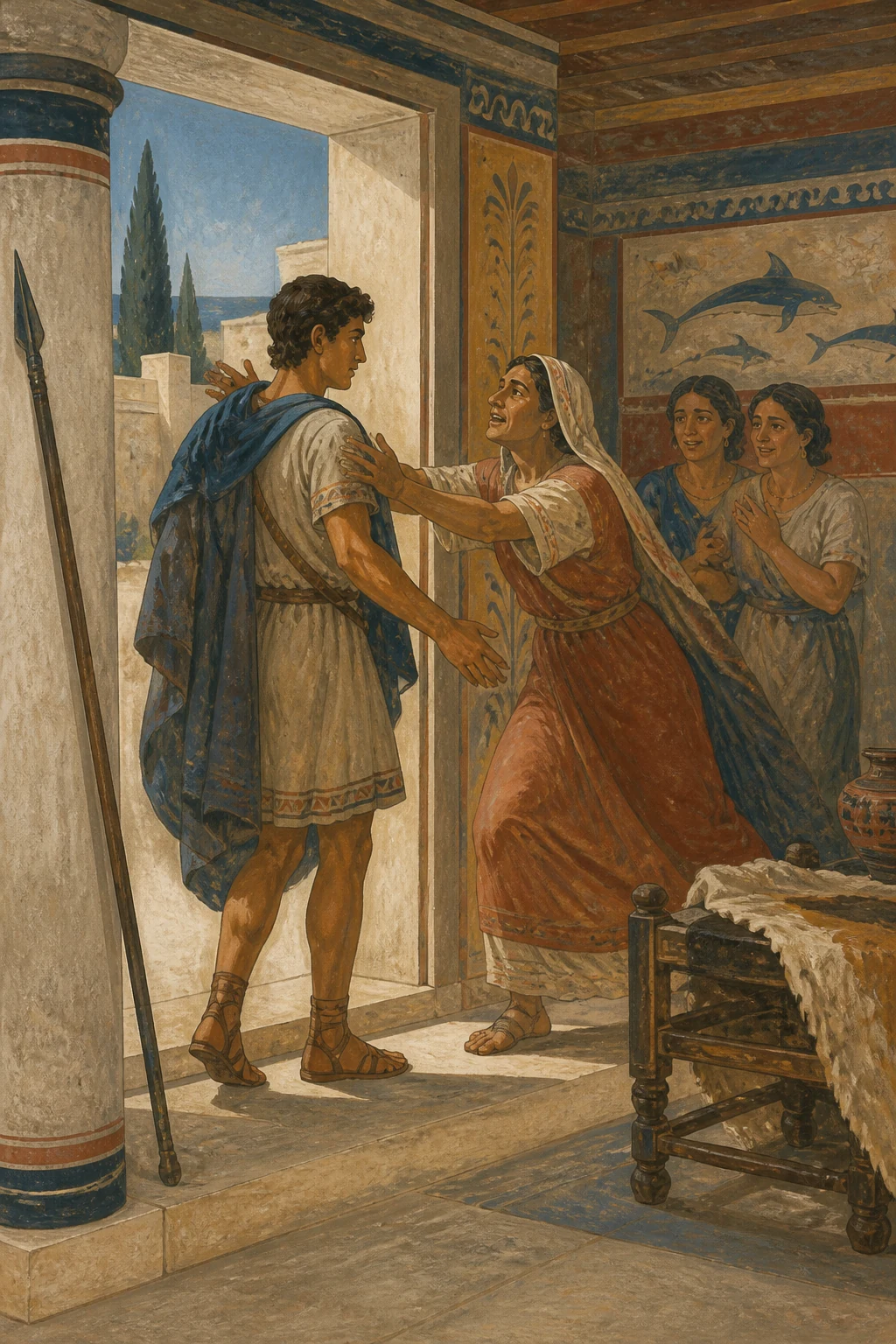
When he reached the well-built house, he carried his spear to a tall pillar and stood it there, then went inside, crossing the stone threshold. His nurse Eurycleia was the first by far to see him, as she spread fleeces over the richly worked chairs. Bursting into tears, she came straight toward him. The other slave women of steadfast Odysseus gathered around him too, lovingly kissing his head and shoulders.
Then wise Penelope came from her chamber, looking like Artemis or golden Aphrodite. Weeping, she threw her arms around her dear son and kissed his head and both his lovely eyes. Through her grief she spoke winged words: “You have come, Telemachus, my sweet light! I thought I would never see you again, when you sailed away secretly to Pylos, against my wishes, to seek news of your dear father.
“Come, tell me what you saw on your journey.” Thoughtful Telemachus answered her: “Mother, do not stir me to grief or trouble the heart within my breast, now that I have escaped sheer destruction. Wash yourself, put clean clothes upon your body, and go upstairs with your women. Pray to all the gods and vow to offer perfect hecatombs, if Zeus will bring about a day of reckoning.
“I will go to the meeting place to summon a stranger who followed me home from there. I sent him ahead with my godlike companions, and told Peiraeus to take him to his house and entertain him kindly and honor him until I came.”
So he spoke, and his words did not go unheeded. She washed herself, put clean clothes upon her body, and prayed to all the gods, vowing to offer perfect hecatombs if Zeus would bring about a day of reckoning.
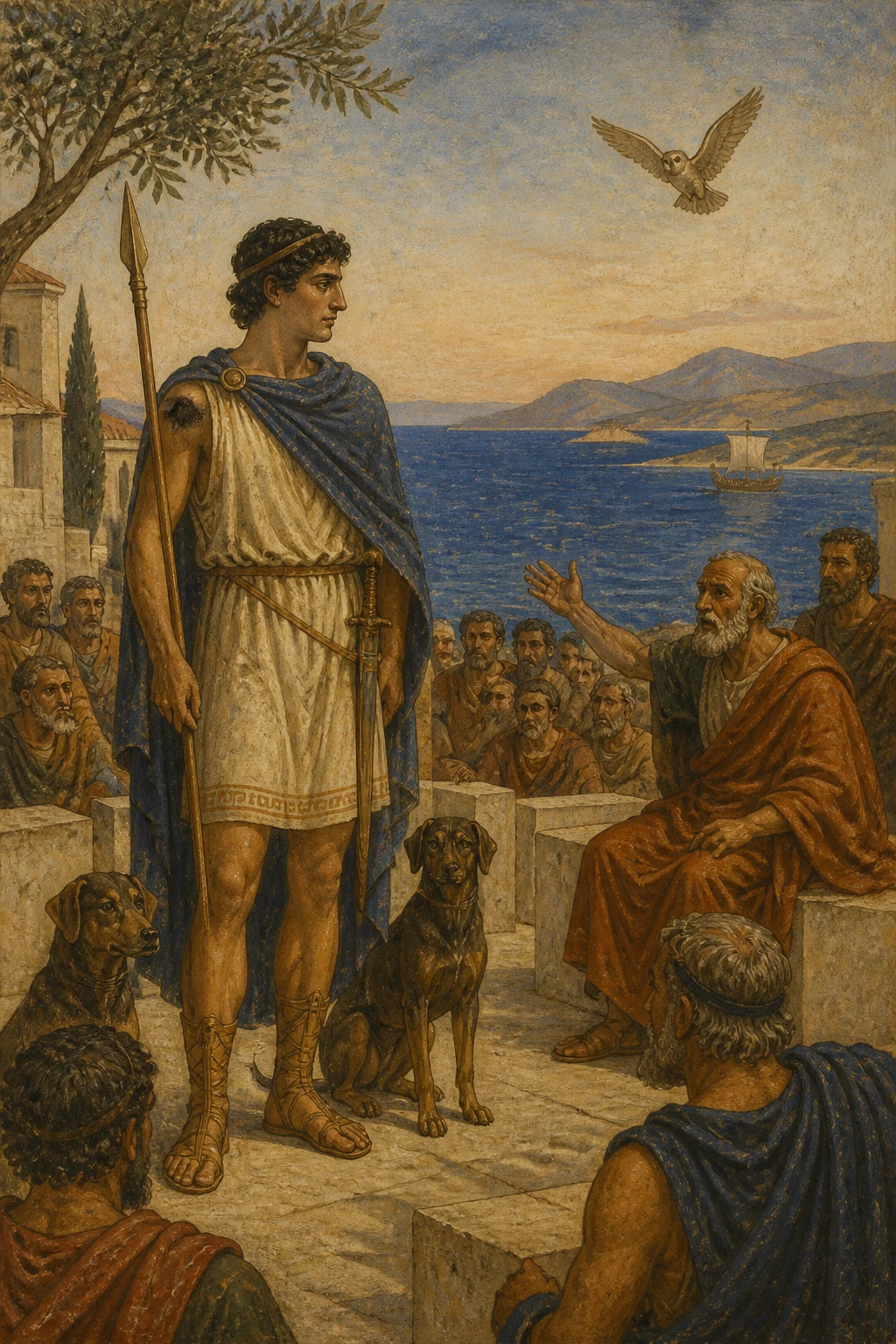
Then Telemachus went out through the hall, spear in hand, with two swift dogs following him. Athena shed a wondrous grace upon him, and all the people gazed in admiration as he came.
The arrogant suitors gathered around him, speaking fair words while deep in their hearts they plotted evil. But he avoided their throng and went to sit where Mentor, Antiphus, and Halitherses were sitting, old friends of his father from the beginning. They questioned him about everything.
Then Peiraeus, famed for his spear, came up to them, bringing the stranger through the city to the meeting place. Telemachus did not remain apart from his guest for long, but went to his side. Peiraeus spoke first: “Telemachus, send women to my house at once, so that I may send you the gifts Menelaus gave you.”
Thoughtful Telemachus answered him: “Peiraeus, we do not know how these affairs will end. If the arrogant suitors murder me secretly in my hall and divide all my father’s possessions, I would rather you had those gifts and enjoyed them than any of these men. But if I sow death and destruction for them, then bring the gifts gladly to my house, and gladly I will receive them.”
With these words he led the much-traveled stranger home. When they reached the well-built house, they laid their cloaks on chairs and seats, then stepped into the smooth-polished baths and washed.
When the slave women had bathed them and anointed them with oil, and clothed them in thick cloaks and tunics, they stepped out of the baths and sat on chairs. A maid brought water in a beautiful golden pitcher and poured it over a silver basin for them to wash their hands, then drew a polished table beside them.
The worthy housekeeper brought bread and set it before them, adding many dishes and giving freely of what was in store. His mother sat opposite, beside a pillar of the hall, reclining in a chair and spinning fine yarn.
They reached for the good food set before them. When they had satisfied their desire for food and drink, wise Penelope began to speak: “Telemachus, I shall go upstairs and lie on my bed, that bed of sorrow, forever drenched with my tears since Odysseus went to Ilium with the sons of Atreus. Yet before the arrogant suitors return to this house, you have not brought yourself to tell me plainly what news, if any, you have heard of your father’s return.”
Thoughtful Telemachus answered her: “Then, Mother, I will tell you the whole truth. We went to Pylos and to Nestor, shepherd of his people. He welcomed me into his lofty house and treated me with loving kindness, as a father treats a young son who has returned from abroad after a long absence. So kindly did he and his glorious sons care for me.
“But he said he had heard from no man on earth whether steadfast Odysseus was alive or dead. Instead, he sent me on with horses and a well-built chariot to the son of Atreus, Menelaus, famed for his spear.
“There I saw Helen of Argos, for whose sake Argives and Trojans suffered so much by the gods’ will. Menelaus, loud in the war cry, asked me at once what need had brought me to holy Lacedaemon. I told him the whole truth, and then he answered me with these words: ‘Shame on them! So they would lie in the bed of a strong-hearted man, cowards though they are!
“‘As when a doe has laid her newborn, suckling fawns in a mighty lion’s lair, then wanders over the mountain slopes and grassy valleys to graze, and the lion comes back to his den and brings a hideous death upon them both, so Odysseus will bring a hideous death upon those men.
“‘Father Zeus, Athena, and Apollo, if only Odysseus would meet the suitors as he was that day in well-built Lesbos, when he rose to wrestle Philomeleides in a challenge and threw him mightily, while all the Achaeans rejoiced! They would all find a swift death and a bitter wedding.
“‘But as for what you ask and entreat me to tell you, I will neither turn aside from the truth nor deceive you. Of all that the unerring Old Man of the Sea told me, I will not hide or conceal a single word.
“‘He said he had seen him on an island, suffering bitterly in the halls of the nymph Calypso, who keeps him there against his will. He cannot reach his native land, for he has neither ships with oars nor companions to carry him over the sea’s broad back.’ So spoke the son of Atreus, Menelaus, famed for his spear.
“When I had finished my business there, I came home. The immortals gave me a following wind and brought me swiftly to my own dear country.” So he spoke, stirring the heart within her breast. Then godlike Theoclymenus addressed them: “Honored wife of Odysseus, son of Laertes, he does not know for certain, but listen to my words. I will prophesy truly to you and hide nothing. Let Zeus first among the gods be my witness, and this hospitable table, and the hearth of noble Odysseus to which I have come: Odysseus is already in his native land, resting or moving about, learning of these evil deeds. He is here, and he is sowing ruin for all the suitors. Such was the bird omen I observed as I sat aboard the well-benched ship, and I declared it to Telemachus.”
Wise Penelope answered him: “Stranger, if only your words might be fulfilled! You would soon know such kindness and receive so many gifts from me that anyone who met you would call you fortunate.”
While they spoke together, the suitors were amusing themselves outside Odysseus’ house, throwing discuses and hunting spears on the level ground where they had so often displayed their insolence.
But when it was time for dinner, and flocks came in from the fields on every side, driven by the usual herdsmen, Medon spoke to them. Of all the heralds, he was the one they liked best, and he attended their feasts. “Young men, now that you have all enjoyed your sports, come into the house so that we may prepare the meal. It is no bad thing to dine at the proper hour.”
So he spoke, and they rose and went, obeying his words. When they reached the well-built house, they laid their cloaks on chairs and seats, and slaughtered great sheep and fat goats, fattened hogs and a heifer from the herd, preparing their feast. Meanwhile Odysseus and the noble swineherd were making ready to leave the country for the town.
The swineherd, a leader of men, spoke first: “Stranger, since you are determined to go to town today, as my master ordered—though I myself would rather leave you here to guard the farm, I respect and fear him, lest he reproach me afterward, and a master’s rebukes are harsh—come, let us go. The day is already far advanced, and soon, toward evening, you will find it colder.”
Resourceful Odysseus answered him: “I know, I understand. You are advising a man who sees your meaning. Let us go, then, and you lead the way throughout. But give me a staff, if you have one cut somewhere, to lean on, for you say the road is very slippery.”
With that he slung his wretched bag over his shoulders, tattered all over, with a twisted cord for its strap. Eumaeus gave him a staff to his liking, and the two set out, leaving the dogs and herdsmen behind to guard the farm. He led his master toward the city, looking like a pitiful old beggar, leaning on a stick, with miserable rags about his body.
As they walked along the rugged road and drew near the town, they came to the well-built, clear-flowing fountain where the townspeople fetched their water. Ithacus, Neritus, and Polyctor had built it. A grove of water-loving poplars circled it on every side, and cold water streamed down from a rock above. Over it stood an altar to the nymphs, where all wayfarers made offerings. There Melantheus, son of Dolius, came upon them, driving goats that were the finest in all his herds for the suitors’ dinner. Two herdsmen followed with him.
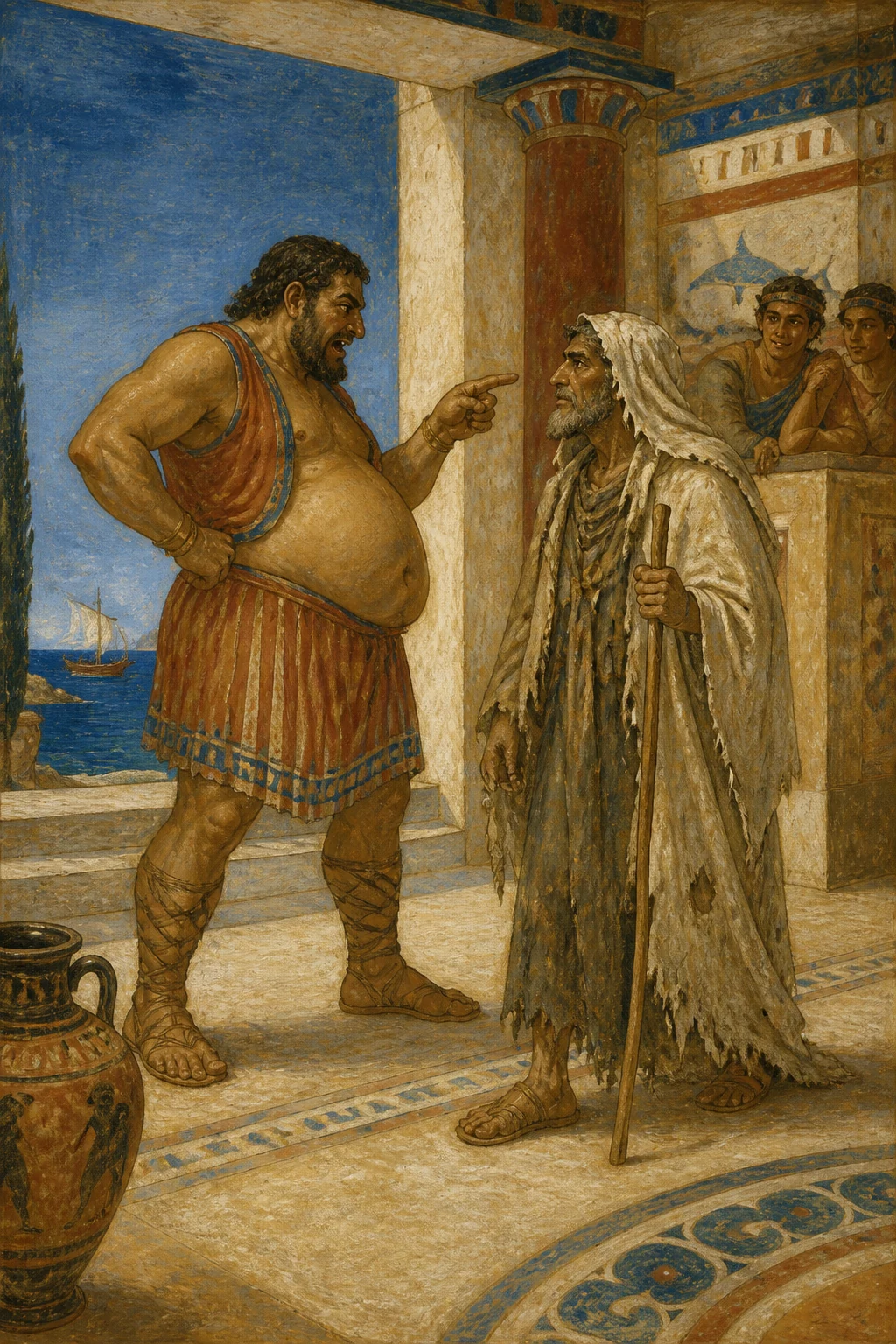
When he saw them, he began to rail at them, addressing them with outrageous, shameful words that stirred Odysseus’ heart: “Now here is a villain leading a villain! As always, the gods bring like to like.
“Where are you taking this glutton, you miserable swineherd, this troublesome beggar who spoils our feasts? He will stand at every doorway, rubbing his shoulders against the posts, begging scraps—not swords or cauldrons! If you gave him to me to guard my farm, clean the pens, and carry leafy branches to the kids, he could drink whey and put some flesh on those thighs.
“But since he has learned nothing but wicked ways, he will not care to turn his hand to work. He would rather go cringing through the country, begging to feed his bottomless belly. But I tell you this, and it will surely happen: if he comes to the house of godlike Odysseus, many a footstool flung from men’s hands will batter his ribs about his head as he is pelted through the hall.”
So he spoke, and as he passed he foolishly kicked Odysseus on the hip. But he could not knock him off the path: Odysseus stood firm. He pondered whether to spring at him and kill him with his staff, or lift him up and dash his head against the ground.
But he endured it and restrained himself. The swineherd looked Melantheus full in the face and rebuked him, then raised his hands and prayed aloud: “Nymphs of the fountain, daughters of Zeus, if ever Odysseus burned for you the thighbones of lambs and kids, wrapped in rich fat, fulfill this wish of mine: let that man return, and let a god guide him here! Then he would scatter all the finery you now flaunt so insolently, forever roaming the town, while worthless herdsmen ruin your flocks.”
Melanthius the goatherd answered him: “Well, well, what talk from this vicious dog! One day I will carry him far from Ithaca in a black, well-benched ship, so that his sale may fetch me a handsome living.
“If only silver-bowed Apollo would strike Telemachus down in the hall today, or the suitors kill him, as surely as Odysseus’ day of homecoming has perished far away!” With these words he left them to make their slow way onward, while he hurried ahead and soon reached his master’s house.
He went straight inside and sat among the suitors opposite Eurymachus, whom he favored most. Those serving set a portion of meat before him, and the worthy housekeeper brought him bread to eat. Meanwhile Odysseus and the noble swineherd came near and halted, and the sound of the hollow lyre reached them, for Phemius was striking up a song. Odysseus took the swineherd by the hand and said: “Eumaeus, this is surely the beautiful house of Odysseus. It is easy to recognize, even among many others.
“One building follows another, and the courtyard is enclosed by a wall with a coping, and the double doors are strongly made. No man could easily force his way in. I can tell that many men are feasting inside, for the smell of roasting meat rises up, and the lyre sounds within—the lyre that the gods made the companion of feasts.”
And you, swineherd Eumaeus, answered him: “You recognized it easily, as you are no fool in other matters either. But come, let us consider what we should do. Either you go first into the well-built house and mingle with the suitors, while I remain here, or, if you prefer, wait here and I will go ahead. But do not linger, lest someone notice you outside and throw something at you or strike you. I advise you to keep that in mind.”
Then much-enduring, noble Odysseus answered him: “I know, I understand. You are advising a man who sees your meaning. Go ahead, then, and I will remain here.
“I am no stranger to blows and missiles. My heart is patient, for I have suffered many hardships in battle and among the waves. Let this be added to them. But there is no hiding the demands of a hungry belly, that accursed thing which brings so many troubles upon men. For its sake well-benched ships are fitted out to cross the barren sea and carry ruin to their enemies.”
While they spoke together, a dog lying there raised his head and ears: Argos, the dog of steadfast Odysseus. His master himself had reared him long ago, but before he could enjoy him he had sailed for holy Ilium. In former days the young men used to take him out to hunt wild goats, deer, and hares. But now, with his master gone, he lay neglected on a great heap of mule and cattle dung piled before the doors, waiting for Odysseus’ slaves to carry it away and manure his great estate. There lay the dog Argos, infested with ticks.
Now, when he sensed Odysseus near, he wagged his tail and dropped both ears, but he no longer had the strength to come closer to his master. Odysseus turned his eyes aside and wiped away a tear, easily hiding it from Eumaeus, then quickly asked him: “Eumaeus, it is a strange thing to see this dog lying in the dung.
“He is beautifully formed, but I cannot tell whether he once had speed to match his looks, or whether he was merely one of those dogs men feed at their tables, kept by their masters only for show.”
And you, swineherd Eumaeus, answered him: “Indeed, this is the dog of a man who died far away. If he were still in form and prowess what he was when Odysseus left him to go to Troy, you would marvel at his speed and strength.
“No wild creature he pursued ever escaped him in the depths of the thick forest, for he was a master at tracking too. But now misery has taken hold of him. His master has perished far from his country, and the careless women do not tend him.
“Slaves no longer care to do their rightful work when their masters are no longer there to rule them. For far-seeing Zeus takes away half a man’s worth when the day of slavery overtakes him.”
With these words he entered the well-built house and went straight through the hall among the lordly suitors. But the doom of black death seized Argos the moment he had seen Odysseus again, in the twentieth year.
Godlike Telemachus was the first by far to see the swineherd coming through the hall, and quickly beckoned him over. Eumaeus looked around and took a stool lying nearby, where the carver used to sit as he divided the plentiful meat among the suitors feasting in the hall. He carried it over and set it opposite Telemachus at his table, then sat down. A herald took a portion of meat and set it before him, with bread lifted from a basket.
Soon afterward Odysseus slipped into the house, looking like a pitiful old beggar, leaning on a stick, with miserable rags about his body. He sat on the ashwood threshold inside the doors, leaning against the cypress doorpost that a carpenter had once skillfully smoothed and straightened to the line.
Telemachus called the swineherd to him, taking a whole loaf from the beautiful basket and as much meat as his hands could hold. “Take these to the stranger and give them to him. Tell him to go around and beg from every one of the suitors. Shame is no good companion for a man in need.”
So he spoke, and the swineherd went when he heard the command. Standing close to Odysseus, he spoke winged words: “Stranger, Telemachus gives you this, and tells you to go around and beg from every one of the suitors. He says shame is no good thing for a beggar.”
Resourceful Odysseus answered him: “Lord Zeus, grant that Telemachus may prosper among men, and may everything he desires in his heart come to pass.”
With that he received the food in both hands and set it down before his feet on his wretched bag. He ate while the singer sang in the hall, and just as he finished his meal, the inspired singer ceased.
The suitors raised a clamor through the hall. Then Athena stood close to Odysseus, son of Laertes, and urged him to gather crusts from the suitors, so that he might learn which of them were decent and which lawless. Yet even so, she was not to save any of them from destruction.
He set off to beg from each man in turn, moving to the right and stretching out his hand on every side, as though he had long been a beggar. They pitied him and gave, marveling at him and asking one another who he was and where he came from.
Then Melanthius the goatherd spoke among them: “Listen to me, suitors of our glorious queen, about this stranger, for I have seen him before. The swineherd brought him here, but I do not know for certain what ancestry he claims.”
So he spoke, and Antinous rebuked the swineherd: “You notorious swineherd, why did you bring this fellow to town? Have we not enough other vagabonds already, troublesome beggars who spoil our feasts?
“Are you displeased that men gather here to devour your master’s livelihood, and so you have invited this one too?” And you, swineherd Eumaeus, answered him: “Antinous, noble though you are, your words are not noble. Who would go abroad to invite a stranger home unless he were one of those who practice a public craft—a prophet, a healer of sickness, a worker in wood, or an inspired singer whose songs delight us?
“Such men are welcomed everywhere throughout the boundless earth. But no one would invite a beggar to eat away his substance. Yet of all the suitors you are always the harshest to Odysseus’ slaves, and to me above all. But I do not care, so long as wise Penelope and godlike Telemachus are alive in this house.”
Thoughtful Telemachus answered him: “Be quiet. Do not waste many words replying to this man. Antinous is always accustomed to provoke us with bitter insults, and he urges the others on as well.”
Then he spoke winged words to Antinous: “Antinous, how kindly you care for me, like a father for his son, when you order me to drive this stranger from the hall with harsh commands! May the gods never bring that about.
“Take something and give it to him. I do not begrudge it; indeed, I urge you to do so. Do not hold back out of regard for my mother or any of the slaves in godlike Odysseus’ house. But no such thought is in your breast: you would much rather eat yourself than give to someone else.”
Antinous answered him: “Telemachus, you lofty talker, unrestrained in spirit, what a speech you have made! If all the suitors gave him as much as I will, this house would keep him at a distance for three months.”
So he spoke, and reached beneath the table to display the footstool on which he rested his sleek feet as he feasted. But all the others gave, filling the bag with bread and meat. Odysseus was just about to return to the threshold and taste the Achaeans’ charity, but first he stood beside Antinous and spoke: “Give me something, friend. You seem to me not the worst of the Achaeans, but the best, for you look like a king.
“Therefore you should give me a better share of bread than the others, and I would spread your fame throughout the boundless earth. I too once lived prosperously among men in a wealthy house, and often gave to a wanderer, whoever he might be and whatever need brought him. I had slaves beyond counting, and many other possessions by which men live well and are called wealthy.
“But Zeus, son of Cronus, brought me to ruin—for such, I suppose, was his will. He sent me on the long voyage to Egypt with far-roaming pirates, to bring about my destruction. In the river of Egypt I moored my curved ships.
“There I ordered my trusty companions to remain by the ships and guard them, and sent scouts out to the lookout points. But they yielded to their own arrogance and violent impulses, and at once began laying waste the Egyptians’ lovely fields, carrying off their wives and little children and killing the men. Soon the alarm reached the city.
“Hearing the shouting, they came at daybreak. The whole plain filled with foot soldiers and horses and the flashing of bronze. Then Zeus, who delights in thunder, cast a deadly panic upon my companions, and not one had the courage to stand and face them, for destruction surrounded us on every side.
“There they killed many of us with sharp bronze, and led the rest away alive to work for them by force. As for me, they gave me to a stranger who happened to be there, Dmetor, son of Iasus, who ruled mightily over Cyprus. From there I have now come here, enduring hardship.”
Antinous answered him: “What god has brought us this plague, this nuisance at our feast? Stand out there in the middle, away from my table, or you may soon find yourself in an Egypt and Cyprus bitter indeed! What a bold and shameless beggar you are!
“You stand beside each man in turn, and they give recklessly, since no one feels restraint or pity when giving away another’s goods, and each has plenty before him.” Resourceful Odysseus drew back and answered: “Well, well, your heart does not match your looks after all! You would not give even salt from your own house to a suppliant, when you sit here at another man’s table and cannot bring yourself to take a morsel of bread and give it to me, though plenty lies before you.”
So he spoke, and Antinous grew angrier still at heart. Scowling at him, he spoke winged words: “Now I think you will not get back out of this hall unscathed, since you have even begun to insult me.”
With that he seized the footstool and hurled it, striking Odysseus on the right shoulder, high on his back. But he stood firm as a rock, and Antinous’ missile did not stagger him. Silently he shook his head, brooding on revenge.
Then he went back to the threshold and sat down, laying down his well-filled bag, and addressed the suitors: “Listen to me, suitors of our glorious queen, while I tell you what the heart within my breast commands.
“There is no real bitterness or grief in a man’s heart when he is struck while fighting for his own possessions, his cattle or his white-fleeced sheep. But Antinous has struck me for the sake of this wretched belly, this accursed thing that brings so many troubles upon men.
“Yet if beggars have gods and Furies to defend them, may death overtake Antinous before his wedding.” Antinous, son of Eupeithes, answered him: “Sit still and eat, stranger, or go somewhere else. Keep talking like that, and the young men may drag you through the house by hand or foot and tear the skin from your whole body.”
So he spoke, but they were all deeply indignant, and one of the proud young men would say: “Antinous, you did wrong to strike that unfortunate wanderer. You are doomed if he proves to be some god from heaven!
“For the gods take on all manner of shapes and go about our cities in the guise of strangers from distant lands, observing the violence and good conduct of men.” So the suitors spoke, but he paid no heed to their words.
Telemachus nursed a great anguish in his heart at the blow, yet let no tear fall from his eyes. Silently he shook his head, brooding on revenge. When wise Penelope heard that the stranger had been struck in the hall, she said among her women: “May Apollo, famed for his bow, strike you down in just that way!”
Then Eurynome the housekeeper said to her: “If only our prayers could be fulfilled! Not one of them would reach fair-throned Dawn.” Wise Penelope answered her: “Nurse, they are all hateful, for they plot evil, but Antinous most of all is like black death.
“Some unfortunate stranger is wandering through the house, begging from the men, driven by poverty. All the others gave to him and filled his bag, but this man struck him on the right shoulder with a footstool.”
So she spoke among her serving women as she sat in her chamber, while noble Odysseus ate his meal. Then she called the noble swineherd to her and said: “Go, good Eumaeus, and tell the stranger to come here, so that I may greet him and ask whether he has heard anything of steadfast Odysseus, or seen him with his own eyes. He seems to have traveled far.”
And you, swineherd Eumaeus, answered her: “My queen, if only the Achaeans would keep quiet for you! The tales he tells would enchant your heart. I kept him three nights and three days in my hut, for I was the first he came to after escaping from a ship, yet he has not finished telling of his sufferings.
“As a man gazes at a singer taught by the gods to sing lovely tales to mortals, and his listeners long to hear him without end whenever he sings, so this man enchanted me as he sat beside me in my house.”
“He says he is an old guest-friend of Odysseus through his father, and that he lives in Crete, where the descendants of Minos dwell. From there he has now made his way here, driven from place to place and suffering many hardships. He declares that he has heard of Odysseus, alive and nearby, in the rich land of the Thesprotians, and says he is bringing many treasures home to this house.”
Then thoughtful Penelope answered him: “Go and call him here, so that he can tell me himself, face to face. As for these men, let them sit at the doors and amuse themselves, or here in the halls, since their hearts are so merry.
“Their own possessions lie untouched at home, their grain and sweet wine, which their servants consume. But they come to our house day after day, slaughtering cattle and sheep and fat goats, feasting and drinking the fiery wine without restraint. Our wealth is being squandered. For there is no man here like Odysseus to ward off ruin from the house.
“If Odysseus should come back to his native land, he and his son would soon make these men pay for their violence.” So she spoke, and Telemachus gave a mighty sneeze that rang fearfully through the hall. Penelope laughed, and at once addressed Eumaeus with winged words: “Go, call the stranger here into my presence.
“Do you not see how my son has sneezed at all my words? Surely, then, death will come to every one of the suitors: not one will escape death and doom. And I will tell you something else; take it to heart. If I find that everything he tells me is true, I will clothe him in a cloak and tunic, fine garments.”
So she spoke, and the swineherd went when he had heard her message. Standing close to Odysseus, he addressed him with winged words: “Old friend, thoughtful Penelope, the mother of Telemachus, is calling for you. Despite all the sorrows she has suffered, her heart urges her to question you about her husband.
“If she finds that everything you tell her is true, she will clothe you in a cloak and tunic, the things you need most. As for food, you can fill your belly by begging through the country; whoever wishes will give you something.”
Then steadfast, noble Odysseus answered him: “Eumaeus, I would gladly tell the whole truth to Icarius’ daughter, thoughtful Penelope. I know her husband well, for we have shared the same suffering.
“But I am afraid of this crowd of brutal suitors, whose arrogance and violence reach the iron sky. Just now, when that man struck me as I walked through the hall, though I had done no wrong, and caused me pain, neither Telemachus nor anyone else did anything to protect me.
“So now tell Penelope, eager though she is, to wait in her chambers until the sun has set. Then let her ask me about her husband’s homecoming, and seat me nearer the fire, for the clothes I wear are wretched. You know that yourself, since it was to you I first came for help.”
So he spoke, and the swineherd went when he had heard his message. As he crossed the threshold, Penelope said to him: “You have not brought him, Eumaeus. What does the wanderer mean by this?
“Is he afraid of someone’s violence, or is he simply ashamed to come into the hall? A beggar does himself no good by being shy.” And you, Eumaeus the swineherd, answered her: “He speaks reasonably, as anyone else might who wished to escape the brutality of overbearing men.
“He asks you to wait until the sun has set. And it would be far better for you yourself, my queen, to speak with the stranger alone and hear what he has to say.” Then thoughtful Penelope answered him: “The stranger is no fool. He sees things as they truly are. Surely nowhere among mortal men are there any who act with such arrogance and devise such wicked deeds.”
So she spoke, and the good swineherd went back among the suitors, having delivered the whole message. At once he addressed Telemachus with winged words, holding his head close so the others would not hear: “My dear boy, I am going away to look after the pigs and everything there, your livelihood and mine. You must see to everything here.
“Above all, keep yourself safe, and take care that no harm comes to you. Many of the Achaeans are plotting evil. May Zeus destroy them before they bring disaster upon us.” Then wise Telemachus answered him: “It shall be as you say, father. But have your evening meal before you go. Come at dawn and bring fine beasts for sacrifice. Everything here will be the concern of the immortals and me.”
So he spoke, and Eumaeus sat down again on the polished stool. When he had satisfied his appetite with food and drink, he set off for his pigs, leaving the courtyard and the hall full of banqueters. They were taking their pleasure in dancing and song, for evening had already come.
Izvirnik
The Beggar in the Palace
Naslednje strani prikazujejo izvirno besedilo za primerjavo.
ἦμος δʼ ἠριγένεια φάνη ῥοδοδάκτυλος Ἠώς, δὴ τότʼ ἔπειθʼ ὑπὸ ποσσὶν ἐδήσατο καλὰ πέδιλα Τηλέμαχος, φίλος υἱὸς Ὀδυσσῆος θείοιο, εἵλετο δʼ ἄλκιμον ἔγχος, ὅ οἱ παλάμηφιν ἀρήρει, ἄστυδε ἱέμενος, καὶ ἑὸν προσέειπε συβώτην· ἄττʼ, ἦ τοι μὲν ἐγὼν εἶμʼ ἐς πόλιν, ὄφρα με μήτηρ ὄψεται· οὐ γάρ μιν πρόσθεν παύσεσθαι ὀΐω κλαυθμοῦ τε στυγεροῖο γόοιό τε δακρυόεντος, πρίν γʼ αὐτόν με ἴδηται· ἀτὰρ σοί γʼ ὧδʼ ἐπιτέλλω.
τὸν ξεῖνον δύστηνον ἄγʼ ἐς πόλιν, ὄφρʼ ἂν ἐκεῖθι δαῖτα πτωχεύῃ· δώσει δέ οἱ ὅς κʼ ἐθέλῃσι πύρνον καὶ κοτύλην· ἐμὲ δʼ οὔ πως ἔστιν ἅπαντας ἀνθρώπους ἀνέχεσθαι, ἔχοντά περ ἄλγεα θυμῷ· ὁ ξεῖνος δʼ εἴ περ μάλα μηνίει, ἄλγιον αὐτῷ ἔσσεται· ἦ γὰρ ἐμοὶ φίλʼ ἀληθέα μυθήσασθαι. τὸν δʼ ἀπαμειβόμενος προσέφη πολύμητις Ὀδυσσεύς· ὦ φίλος, οὐδέ τοι αὐτὸς ἐρύκεσθαι μενεαίνω· πτωχῷ βέλτερόν ἐστι κατὰ πτόλιν ἠὲ κατʼ ἀγροὺς δαῖτα πτωχεύειν· δώσει δέ μοι ὅς κʼ ἐθέλῃσιν.
οὐ γὰρ ἐπὶ σταθμοῖσι μένειν ἔτι τηλίκος εἰμί, ὥστʼ ἐπιτειλαμένῳ σημάντορι πάντα πιθέσθαι. ἀλλʼ ἔρχευ· ἐμὲ δʼ ἄξει ἀνὴρ ὅδε, τὸν σὺ κελεύεις, αὐτίκʼ ἐπεί κε πυρὸς θερέω ἀλέη τε γένηται. αἰνῶς γὰρ τάδε εἵματʼ ἔχω κακά· μή με δαμάσσῃ στίβη ὑπηοίη· ἕκαθεν δέ τε ἄστυ φάτʼ εἶναι. ὣς φάτο, Τηλέμαχος δὲ διὰ σταθμοῖο βεβήκει, κραιπνὰ ποσὶ προβιβάς, κακὰ δὲ μνηστῆρσι φύτευεν.
αὐτὰρ ἐπεί ῥʼ ἵκανε δόμους εὖ ναιετάοντας, ἔγχος μέν ῥʼ ἔστησε φέρων πρὸς κίονα μακρήν, αὐτὸς δʼ εἴσω ἴεν καὶ ὑπέρβη λάϊνον οὐδόν. τὸν δὲ πολὺ πρώτη εἶδε τροφὸς Εὐρύκλεια, κώεα καστορνῦσα θρόνοις ἔνι δαιδαλέοισι, δακρύσασα δʼ ἔπειτʼ ἰθὺς κίεν· ἀμφὶ δʼ ἄρʼ ἄλλαι δμῳαὶ Ὀδυσσῆος ταλασίφρονος ἠγερέθοντο, καὶ κύνεον ἀγαπαζόμεναι κεφαλήν τε καὶ ὤμους. ἡ δʼ ἴεν ἐκ θαλάμοιο περίφρων Πηνελόπεια, Ἀρτέμιδι ἰκέλη ἠὲ χρυσέῃ Ἀφροδίτῃ, ἀμφὶ δὲ παιδὶ φίλῳ βάλε πήχεε δακρύσασα, κύσσε δέ μιν κεφαλήν τε καὶ ἄμφω φάεα καλά,
καί ῥʼ ὀλοφυρομένη ἔπεα πτερόεντα προσηύδα· ἦλθες, Τηλέμαχε, γλυκερὸν φάος. οὔ σʼ ἔτʼ ἐγώ γε ὄψεσθαι ἐφάμην, ἐπεὶ ᾤχεο νηῒ Πύλονδε λάθρη, ἐμεῦ ἀέκητι, φίλου μετὰ πατρὸς ἀκουήν. ἀλλʼ ἄγε μοι κατάλεξον ὅπως ἤντησας ὀπωπῆς. τὴν δʼ αὖ Τηλέμαχος πεπνυμένος ἀντίον ηὔδα· μῆτερ ἐμή, μή μοι γόον ὄρνυθι μηδέ μοι ἦτορ ἐν στήθεσσιν ὄρινε φυγόντι περ αἰπὺν ὄλεθρον· ἀλλʼ ὑδρηναμένη, καθαρὰ χροῒ εἵμαθʼ ἑλοῦσα, εἰς ὑπερῷʼ ἀναβᾶσα σὺν ἀμφιπόλοισι γυναιξὶν εὔχεο πᾶσι θεοῖσι τεληέσσας ἑκατόμβας ῥέξειν, αἴ κέ ποθι Ζεὺς ἄντιτα ἔργα τελέσσῃ.
αὐτὰρ ἐγὼν ἀγορὴν ἐσελεύσομαι, ὄφρα καλέσσω ξεῖνον, ὅτις μοι κεῖθεν ἅμʼ ἕσπετο δεῦρο κιόντι. τὸν μὲν ἐγὼ προὔπεμψα σὺν ἀντιθέοις ἑτάροισι, Πείραιον δέ μιν ἠνώγεα προτὶ οἶκον ἄγοντα ἐνδυκέως φιλέειν καὶ τιέμεν, εἰς ὅ κεν ἔλθω. ὣς ἄρʼ ἐφώνησεν, τῇ δʼ ἄπτερος ἔπλετο μῦθος. ἡ δʼ ὑδρηναμένη, καθαρὰ χροῒ εἵμαθʼ ἑλοῦσα, εὔχετο πᾶσι θεοῖσι τεληέσσας ἑκατόμβας ῥέξειν, αἴ κέ ποθι Ζεὺς ἄντιτα ἔργα τελέσσῃ.
Τηλέμαχος δʼ ἄρʼ ἔπειτα διὲκ μεγάροιο βεβήκει ἔγχος ἔχων· ἅμα τῷ γε δύω κύνες ἀργοὶ ἕποντο. θεσπεσίην δʼ ἄρα τῷ γε χάριν κατέχευεν Ἀθήνη· τὸν δʼ ἄρα πάντες λαοὶ ἐπερχόμενον θηεῦντο. ἀμφὶ δέ μιν μνηστῆρες ἀγήνορες ἠγερέθοντο ἔσθλʼ ἀγορεύοντες, κακὰ δὲ φρεσὶ βυσσοδόμευον. αὐτὰρ ὁ τῶν μὲν ἔπειτα ἀλεύατο πουλὺν ὅμιλον, ἀλλʼ ἵνα Μέντωρ ἧστο καὶ Ἄντιφος ἠδʼ Ἁλιθέρσης, οἵ τε οἱ ἐξ ἀρχῆς πατρώϊοι ἦσαν ἑταῖροι, ἔνθα καθέζετʼ ἰών· τοὶ δʼ ἐξερέεινον ἕκαστα.
τοῖσι δὲ Πείραιος δουρικλυτὸς ἐγγύθεν ἦλθεν ξεῖνον ἄγων ἀγορήνδε διὰ πτόλιν· οὐδʼ ἄρʼ ἔτι δὴν Τηλέμαχος ξείνοιο ἑκὰς τράπετʼ, ἀλλὰ παρέστη. τὸν καὶ Πείραιος πρότερος πρὸς μῦθον ἔειπε· Τηλέμαχʼ, αἶψʼ ὄτρυνον ἐμὸν ποτὶ δῶμα γυναῖκας, ὥς τοι δῶρʼ ἀποπέμψω, ἅ τοι Μενέλαος ἔδωκε. τὸν δʼ αὖ Τηλέμαχος πεπνυμένος ἀντίον ηὔδα· Πείραιʼ, οὐ γάρ τʼ ἴδμεν ὅπως ἔσται τάδε ἔργα. εἴ κεν ἐμὲ μνηστῆρες ἀγήνορες ἐν μεγάροισι λάθρη κτείναντες πατρώϊα πάντα δάσωνται, αὐτὸν ἔχοντά σε βούλομʼ ἐπαυρέμεν, ἤ τινα τῶνδε· εἰ δέ κʼ ἐγὼ τούτοισι φόνον καὶ κῆρα φυτεύσω,
δὴ τότε μοι χαίροντι φέρειν πρὸς δώματα χαίρων. ὣς εἰπὼν ξεῖνον ταλαπείριον ἦγεν ἐς οἶκον. αὐτὰρ ἐπεί ῥʼ ἵκοντο δόμους εὖ ναιετάοντας, χλαίνας μὲν κατέθεντο κατὰ κλισμούς τε θρόνους τε, ἐς δʼ ἀσαμίνθους βάντες ἐϋξέστας λούσαντο. τοὺς δʼ ἐπεὶ οὖν δμῳαὶ λοῦσαν καὶ χρῖσαν ἐλαίῳ, ἀμφὶ δʼ ἄρα χλαίνας οὔλας βάλον ἠδὲ χιτῶνας, ἔκ ῥʼ ἀσαμίνθων βάντες ἐπὶ κλισμοῖσι καθῖζον.
χέρνιβα δʼ ἀμφίπολος προχόῳ ἐπέχευε φέρουσα καλῇ χρυσείῃ, ὑπὲρ ἀργυρέοιο λέβητος, νίψασθαι· παρὰ δὲ ξεστὴν ἐτάνυσσε τράπεζαν. σῖτον δʼ αἰδοίη ταμίη παρέθηκε φέρουσα, εἴδατα πόλλʼ ἐπιθεῖσα, χαριζομένη παρεόντων. μήτηρ δʼ ἀντίον ἷζε παρὰ σταθμὸν μεγάροιο κλισμῷ κεκλιμένη, λέπτʼ ἠλάκατα στρωφῶσα. οἱ δʼ ἐπʼ ὀνείαθʼ ἑτοῖμα προκείμενα χεῖρας ἴαλλον, αὐτὰρ ἐπεὶ πόσιος καὶ ἐδητύος ἐξ ἔρον ἕντο, τοῖσι δὲ μύθων ἦρχε περίφρων Πηνελόπεια· Τηλέμαχʼ, ἦ τοι ἐγὼν ὑπερώϊον εἰσαναβᾶσα λέξομαι εἰς εὐνήν, ἥ μοι στονόεσσα τέτυκται,
αἰεὶ δάκρυσʼ ἐμοῖσι πεφυρμένη, ἐξ οὗ Ὀδυσσεὺς ᾤχεθʼ ἅμʼ Ἀτρεΐδῃσιν ἐς Ἴλιον· οὐδέ μοι ἔτλης, πρὶν ἐλθεῖν μνηστῆρας ἀγήνορας ἐς τόδε δῶμα, νόστον σοῦ πατρὸς σάφα εἰπέμεν, εἴ που ἄκουσας. τὴν δʼ αὖ Τηλέμαχος πεπνυμένος ἀντίον ηὔδα· τοιγὰρ ἐγώ τοι, μῆτερ, ἀληθείην καταλέξω. ᾠχόμεθʼ ἔς τε Πύλον καὶ Νέστορα, ποιμένα λαῶν· δεξάμενος δέ με κεῖνος ἐν ὑψηλοῖσι δόμοισιν ἐνδυκέως ἐφίλει, ὡς εἴ τε πατὴρ ἑὸν υἱὸν ἐλθόντα χρόνιον νέον ἄλλοθεν· ὣς ἐμὲ κεῖνος ἐνδυκέως ἐκόμιζε σὺν υἱάσι κυδαλίμοισιν.
αὐτὰρ Ὀδυσσῆος ταλασίφρονος οὔ ποτʼ ἔφασκεν, ζωοῦ οὐδὲ θανόντος, ἐπιχθονίων τευ ἀκοῦσαι· ἀλλά μʼ ἐς Ἀτρεΐδην, δουρικλειτὸν Μενέλαον, ἵπποισι προὔπεμψε καὶ ἅρμασι κολλητοῖσιν. ἔνθʼ ἴδον Ἀργείην Ἑλένην, ἧς εἵνεκα πολλὰ Ἀργεῖοι Τρῶές τε θεῶν ἰότητι μόγησαν. εἴρετο δʼ αὐτίκʼ ἔπειτα βοὴν ἀγαθὸς Μενέλαος ὅττευ χρηΐζων ἱκόμην Λακεδαίμονα δῖαν· αὐτὰρ ἐγὼ τῷ πᾶσαν ἀληθείην κατέλεξα· καὶ τότε δή με ἔπεσσιν ἀμειβόμενος προσέειπεν· ὢ πόποι, ἦ μάλα δὴ κρατερόφρονος ἀνδρὸς ἐν εὐνῇ ἤθελον εὐνηθῆναι, ἀνάλκιδες αὐτοὶ ἐόντες.
ὡς δʼ ὁπότʼ ἐν ξυλόχῳ ἔλαφος κρατεροῖο λέοντος νεβροὺς κοιμήσασα νεηγενέας γαλαθηνοὺς κνημοὺς ἐξερέῃσι καὶ ἄγκεα ποιήεντα βοσκομένη, ὁ δʼ ἔπειτα ἑὴν εἰσήλυθεν εὐνήν, ἀμφοτέροισι δὲ τοῖσιν ἀεικέα πότμον ἐφῆκεν, ὣς Ὀδυσεὺς κείνοισιν ἀεικέα πότμον ἐφήσει. αἲ γάρ, Ζεῦ τε πάτερ καὶ Ἀθηναίη καὶ Ἄπολλον, τοῖος ἐὼν οἷός ποτʼ ἐϋκτιμένῃ ἐνὶ Λέσβῳ ἐξ ἔριδος Φιλομηλεΐδῃ ἐπάλαισεν ἀναστάς, κὰδ δʼ ἔβαλε κρατερῶς, κεχάροντο δὲ πάντες Ἀχαιοί, τοῖος ἐὼν μνηστῆρσιν ὁμιλήσειεν Ὀδυσσεύς· πάντες κʼ ὠκύμοροί τε γενοίατο πικρόγαμοί τε.
ταῦτα δʼ ἅ μʼ εἰρωτᾷς καὶ λίσσεαι, οὐκ ἂν ἐγώ γε ἄλλα παρὲξ εἴποιμι παρακλιδὸν οὐδʼ ἀπατήσω, ἀλλὰ τὰ μέν μοι ἔειπε γέρων ἅλιος νημερτής, τῶν οὐδέν τοι ἐγὼ κρύψω ἔπος οὐδʼ ἐπικεύσω. φῆ μιν ὅ γʼ ἐν νήσῳ ἰδέειν κρατέρʼ ἄλγεʼ ἔχοντα, νύμφης ἐν μεγάροισι Καλυψοῦς, ἥ μιν ἀνάγκῃ ἴσχει· ὁ δʼ οὐ δύναται ἣν πατρίδα γαῖαν ἱκέσθαι. οὐ γάρ οἱ πάρα νῆες ἐπήρετμοι καὶ ἑταῖροι, οἵ κέν μιν πέμποιεν ἐπʼ εὐρέα νῶτα θαλάσσης ὣς ἔφατʼ Ἀτρεΐδης, δουρικλειτὸς Μενέλαος.
ταῦτα τελευτήσας νεόμην· ἔδοσαν δέ μοι οὖρον ἀθάνατοι, τοί μʼ ὦκα φίλην ἐς πατρίδʼ ἔπεμψαν. ὣς φάτο, τῇ δʼ ἄρα θυμὸν ἐνὶ στήθεσσιν ὄρινε. τοῖσι δὲ καὶ μετέειπε Θεοκλύμενος θεοειδής· ὦ γύναι αἰδοίη Λαερτιάδεω Ὀδυσῆος, ἦ τοι ὅ γʼ οὐ σάφα οἶδεν, ἐμεῖο δὲ σύνθεο μῦθον· ἀτρεκέως γάρ σοι μαντεύσομαι οὐδʼ ἐπικεύσω· ἴστω νῦν Ζεὺς πρῶτα θεῶν, ξενίη τε τράπεζα ἱστίη τʼ Ὀδυσῆος ἀμύμονος, ἣν ἀφικάνω, ὡς ἦ τοι Ὀδυσεὺς ἤδη ἐν πατρίδι γαίῃ, ἥμενος ἢ ἕρπων, τάδε πευθόμενος κακὰ ἔργα, ἔστιν, ἀτὰρ μνηστῆρσι κακὸν πάντεσσι φυτεύει·
τοῖον ἐγὼν οἰωνὸν ἐϋσσέλμου ἐπὶ νηὸς ἥμενος ἐφρασάμην καὶ Τηλεμάχῳ ἐγεγώνευν. τὸν δʼ αὖτε προσέειπε περίφρων Πηνελόπεια· αἲ γὰρ τοῦτο, ξεῖνε, ἔπος τετελεσμένον εἴη· τῷ κε τάχα γνοίης φιλότητά τε πολλά τε δῶρα ἐξ ἐμεῦ, ὡς ἄν τίς σε συναντόμενος μακαρίζοι. ὣς οἱ μὲν τοιαῦτα πρὸς ἀλλήλους ἀγόρευον, μνηστῆρες δὲ πάροιθεν Ὀδυσσῆος μεγάροιο δίσκοισιν τέρποντο καὶ αἰγανέῃσιν ἱέντες, ἐν τυκτῷ δαπέδῳ, ὅθι περ πάρος ὕβριν ἔχοντες.
ἀλλʼ ὅτε δὴ δείπνηστος ἔην καὶ ἐπήλυθε μῆλα πάντοθεν ἐξ ἀγρῶν, οἱ δʼ ἤγαγον οἳ τὸ πάρος περ, καὶ τότε δή σφιν ἔειπε Μέδων· ὃς γάρ ῥα μάλιστα ἥνδανε κηρύκων, καί σφιν παρεγίγνετο δαιτί· κοῦροι, ἐπεὶ δὴ πάντες ἐτέρφθητε φρένʼ ἀέθλοις, ἔρχεσθε πρὸς δώμαθʼ, ἵνʼ ἐντυνώμεθα δαῖτα· οὐ μὲν γάρ τι χέρειον ἐν ὥρῃ δεῖπνον ἑλέσθαι. ὣς ἔφαθʼ, οἱ δʼ ἀνστάντες ἔβαν πείθοντό τε μύθῳ.
αὐτὰρ ἐπεί ῥʼ ἵκοντο δόμους εὖ ναιετάοντας, χλαίνας μὲν κατέθεντο κατὰ κλισμούς τε θρόνους τε, οἱ δʼ ἱέρευον ὄϊς μεγάλους καὶ πίονας αἶγας, ἵρευον δὲ σύας σιάλους καὶ βοῦν ἀγελαίην, δαῖτʼ ἐντυνόμενοι. τοὶ δʼ ἐξ ἀγροῖο πόλινδε ὠτρύνοντʼ Ὀδυσεύς τʼ ἰέναι καὶ δῖος ὑφορβός. τοῖσι δὲ μύθων ἦρχε συβώτης, ὄρχαμος ἀνδρῶν· ξεῖνʼ, ἐπεὶ ἂρ δὴ ἔπειτα πόλινδʼ ἰέναι μενεαίνεις σήμερον, ὡς ἐπέτελλεν ἄναξ ἐμός—ἦ σʼ ἂν ἐγώ γε αὐτοῦ βουλοίμην σταθμῶν ῥυτῆρα λιπέσθαι· ἀλλὰ τὸν αἰδέομαι καὶ δείδια, μή μοι ὀπίσσω νεικείῃ· χαλεπαὶ δέ τʼ ἀνάκτων εἰσὶν ὁμοκλαί—
ἀλλʼ ἄγε νῦν ἴομεν· δὴ γὰρ μέμβλωκε μάλιστα ἦμαρ, ἀτὰρ τάχα τοι ποτὶ ἕσπερα ῥίγιον ἔσται. τὸν δʼ ἀπαμειβόμενος προσέφη πολύμητις Ὀδυσσεύς· γιγνώσκω, φρονέω· τά γε δὴ νοέοντι κελεύεις. ἀλλʼ ἴομεν, σὺ δʼ ἔπειτα διαμπερὲς ἡγεμόνευε. δὸς δέ μοι, εἴ ποθί τοι ῥόπαλον τετμημένον ἐστίν, σκηρίπτεσθʼ, ἐπεὶ ἦ φατʼ ἀρισφαλέʼ ἔμμεναι οὐδόν. ἦ ῥα καὶ ἀμφʼ ὤμοισιν ἀεικέα βάλλετο πήρην, πυκνὰ ῥωγαλέην· ἐν δὲ στρόφος ἦεν ἀορτήρ· Εὔμαιος δʼ ἄρα οἱ σκῆπτρον θυμαρὲς ἔδωκε.
τὼ βήτην, σταθμὸν δὲ κύνες καὶ βώτορες ἄνδρες ῥύατʼ ὄπισθε μένοντες· ὁ δʼ ἐς πόλιν ἦγεν ἄνακτα πτωχῷ λευγαλέῳ ἐναλίγκιον ἠδὲ γέροντι, σκηπτόμενον· τὰ δὲ λυγρὰ περὶ χροῒ εἵματα ἕστο. ἀλλʼ ὅτε δὴ στείχοντες ὁδὸν κάτα παιπαλόεσσαν ἄστεος ἐγγὺς ἔσαν καὶ ἐπὶ κρήνην ἀφίκοντο τυκτὴν καλλίροον, ὅθεν ὑδρεύοντο πολῖται, τὴν ποίησʼ Ἴθακος καὶ Νήριτος ἠδὲ Πολύκτωρ· ἀμφὶ δʼ ἄρʼ αἰγείρων ὑδατοτρεφέων ἦν ἄλσος, πάντοσε κυκλοτερές, κατὰ δὲ ψυχρὸν ῥέεν ὕδωρ ὑψόθεν ἐκ πέτρης· βωμὸς δʼ ἐφύπερθε τέτυκτο νυμφάων, ὅθι πάντες ἐπιρρέζεσκον ὁδῖται·
ἔνθα σφέας ἐκίχανʼ υἱὸς Δολίοιο Μελανθεὺς αἶγας ἄγων, αἳ πᾶσι μετέπρεπον αἰπολίοισι, δεῖπνον μνηστήρεσσι· δύω δʼ ἅμʼ ἕποντο νομῆες. τοὺς δὲ ἰδὼν νείκεσσεν ἔπος τʼ ἔφατʼ ἔκ τʼ ὀνόμαζεν, ἔκπαγλον καὶ ἀεικές· ὄρινε δὲ κῆρ Ὀδυσῆος· νῦν μὲν δὴ μάλα πάγχυ κακὸς κακὸν ἡγηλάζει, ὡς αἰεὶ τὸν ὁμοῖον ἄγει θεὸς ὡς τὸν ὁμοῖον. πῇ δὴ τόνδε μολοβρὸν ἄγεις, ἀμέγαρτε συβῶτα, πτωχὸν ἀνιηρόν δαιτῶν ἀπολυμαντῆρα; ὃς πολλῇς φλιῇσι παραστὰς θλίψεται ὤμους, αἰτίζων ἀκόλους, οὐκ ἄορας οὐδὲ λέβητας· τόν κʼ εἴ μοι δοίης σταθμῶν ῥυτῆρα γενέσθαι
σηκοκόρον τʼ ἔμεναι θαλλόν τʼ ἐρίφοισι φορῆναι, καί κεν ὀρὸν πίνων μεγάλην ἐπιγουνίδα θεῖτο. ἀλλʼ ἐπεὶ οὖν δὴ ἔργα κάκʼ ἔμμαθεν, οὐκ ἐθελήσει ἔργον ἐποίχεσθαι, ἀλλὰ πτώσσων κατὰ δῆμον βούλεται αἰτίζων βόσκειν ἣν γαστέρʼ ἄναλτον. ἀλλʼ ἔκ τοι ἐρέω, τὸ δὲ καὶ τετελεσμένον ἔσται· αἴ κʼ ἔλθῃ πρὸς δώματʼ Ὀδυσσῆος θείοιο, πολλά οἱ ἀμφὶ κάρη σφέλα ἀνδρῶν ἐκ παλαμάων πλευραὶ ἀποτρίψουσι δόμον κάτα βαλλομένοιο.
ὣς φάτο, καὶ παριὼν λὰξ ἔνθορεν ἀφραδίῃσιν ἰσχίῳ· οὐδέ μιν ἐκτὸς ἀταρπιτοῦ ἐστυφέλιξεν, ἀλλʼ ἔμενʼ ἀσφαλέως· ὁ δὲ μερμήριξεν Ὀδυσσεὺς ἠὲ μεταΐξας ῥοπάλῳ ἐκ θυμὸν ἕλοιτο, ἦ πρὸς γῆν ἐλάσειε κάρη ἀμφουδὶς ἀείρας. ἀλλʼ ἐπετόλμησε, φρεσὶ δʼ ἔσχετο· τὸν δὲ συβώτης νείκεσʼ ἐσάντα ἰδών, μέγα δʼ εὔξατο χεῖρας ἀνασχών· νύμφαι κρηναῖαι, κοῦραι Διός, εἴ ποτʼ Ὀδυσσεὺς ὔμμʼ ἐπὶ μηρίʼ ἔκηε, καλύψας πίονι δημῷ, ἀρνῶν ἠδʼ ἐρίφων, τόδε μοι κρηήνατʼ ἐέλδωρ, ὡς ἔλθοι μὲν κεῖνος ἀνήρ, ἀγάγοι δέ ἑ δαίμων· τῷ κέ τοι ἀγλαΐας γε διασκεδάσειεν ἁπάσας,
τὰς νῦν ὑβρίζων φορέεις, ἀλαλήμενος αἰεὶ ἄστυ κάτʼ· αὐτὰρ μῆλα κακοὶ φθείρουσι νομῆες. τὸν δʼ αὖτε προσέειπε Μελάνθιος, αἰπόλος αἰγῶν· ὢ πόποι, οἷον ἔειπε κύων ὀλοφώϊα εἰδώς, τόν ποτʼ ἐγὼν ἐπὶ νηὸς ἐϋσσέλμοιο μελαίνης ἄξω τῆλʼ Ἰθάκης, ἵνα μοι βίοτον πολὺν ἄλφοι. αἲ γὰρ Τηλέμαχον βάλοι ἀργυρότοξος Ἀπόλλων σήμερον ἐν μεγάροις, ἢ ὑπὸ μνηστῆρσι δαμείη, ὡς Ὀδυσῆΐ γε τηλοῦ ἀπώλετο νόστιμον ἦμαρ.
ὣς εἰπὼν τοὺς μὲν λίπεν αὐτοῦ ἦκα κιόντας, αὐτὰρ ὁ βῆ, μάλα δʼ ὦκα δόμους ἵκανεν ἄνακτος. αὐτίκα δʼ εἴσω ἴεν, μετὰ δὲ μνηστῆρσι καθῖζεν, ἀντίον Εὐρυμάχου· τὸν γὰρ φιλέεσκε μάλιστα. τῷ πάρα μὲν κρειῶν μοῖραν θέσαν οἳ πονέοντο, σῖτον δʼ αἰδοίη ταμίη παρέθηκε φέρουσα ἔδμεναι. ἀγχίμολον δʼ Ὀδυσεὺς καὶ δῖος ὑφορβὸς στήτην ἐρχομένω, περὶ δέ σφεας ἤλυθʼ ἰωὴ φόρμιγγος γλαφυρῆς· ἀνὰ γάρ σφισι βάλλετʼ ἀείδειν Φήμιος· αὐτὰρ ὁ χειρὸς ἑλὼν προσέειπε συβώτην· Εὔμαιʼ, ἦ μάλα δὴ τάδε δώματα κάλʼ Ὀδυσῆος, ῥεῖα δʼ ἀρίγνωτʼ ἐστὶ καὶ ἐν πολλοῖσιν ἰδέσθαι.
ἐξ ἑτέρων ἕτερʼ ἐστίν, ἐπήσκηται δέ οἱ αὐλὴ τοίχῳ καὶ θριγκοῖσι, θύραι δʼ εὐερκέες εἰσὶ δικλίδες· οὐκ ἄν τίς μιν ἀνὴρ ὑπεροπλίσσαιτο. γιγνώσκω δʼ ὅτι πολλοὶ ἐν αὐτῷ δαῖτα τίθενται ἄνδρες, ἐπεὶ κνίση μὲν ἀνήνοθεν, ἐν δέ τε φόρμιγξ ἠπύει, ἣν ἄρα δαιτὶ θεοὶ ποίησαν ἑταίρην. τὸν δʼ ἀπαμειβόμενος προσέφης, Εὔμαιε συβῶτα· ῥεῖʼ ἔγνως, ἐπεὶ οὐδὲ τά τʼ ἄλλα πέρ ἐσσʼ ἀνοήμων.
ἀλλʼ ἄγε δὴ φραζώμεθʼ ὅπως ἔσται τάδε ἔργα. ἠὲ σὺ πρῶτος ἔσελθε δόμους εὖ ναιετάοντας, δύσεο δὲ μνηστῆρας, ἐγὼ δʼ ὑπολείψομαι αὐτοῦ· εἰ δʼ ἐθέλεις, ἐπίμεινον, ἐγὼ δʼ εἶμι προπάροιθε· μηδὲ σὺ δηθύνειν, μή τίς σʼ ἔκτοσθε νοήσας ἢ βάλῃ ἢ ἐλάσῃ· τὰ δέ σε φράζεσθαι ἄνωγα. τὸν δʼ ἠμείβετʼ ἔπειτα πολύτλας δῖος Ὀδυσσεύς· γιγνώσκω, φρονέω· τά γε δὴ νοέοντι κελεύεις. ἀλλʼ ἔρχευ προπάροιθεν, ἐγὼ δʼ ὑπολείψομαι αὐτοῦ.
οὐ γάρ τι πληγέων ἀδαήμων οὐδὲ βολάων· τολμήεις μοι θυμός, ἐπεὶ κακὰ πολλὰ πέπονθα κύμασι καὶ πολέμῳ· μετὰ καὶ τόδε τοῖσι γενέσθω· γαστέρα δʼ οὔ πως ἔστιν ἀποκρύψαι μεμαυῖαν, οὐλομένην, ἣ πολλὰ κάκʼ ἀνθρώποισι δίδωσι, τῆς ἕνεκεν καὶ νῆες ἐΰζυγοι ὁπλίζονται πόντον ἐπʼ ἀτρύγετον, κακὰ δυσμενέεσσι φέρουσαι. ὣς οἱ μὲν τοιαῦτα πρὸς ἀλλήλους ἀγόρευον· ἂν δὲ κύων κεφαλήν τε καὶ οὔατα κείμενος ἔσχεν, Ἄργος, Ὀδυσσῆος ταλασίφρονος, ὅν ῥά ποτʼ αὐτὸς θρέψε μέν, οὐδʼ ἀπόνητο, πάρος δʼ εἰς Ἴλιον ἱρὴν ᾤχετο. τὸν δὲ πάροιθεν ἀγίνεσκον νέοι ἄνδρες
αἶγας ἐπʼ ἀγροτέρας ἠδὲ πρόκας ἠδὲ λαγωούς· δὴ τότε κεῖτʼ ἀπόθεστος ἀποιχομένοιο ἄνακτος, ἐν πολλῇ κόπρῳ, ἥ οἱ προπάροιθε θυράων ἡμιόνων τε βοῶν τε ἅλις κέχυτʼ, ὄφρʼ ἂν ἄγοιεν δμῶες Ὀδυσσῆος τέμενος μέγα κοπρήσοντες· ἔνθα κύων κεῖτʼ Ἄργος, ἐνίπλειος κυνοραιστέων. δὴ τότε γʼ, ὡς ἐνόησεν Ὀδυσσέα ἐγγὺς ἐόντα, οὐρῇ μέν ῥʼ ὅ γʼ ἔσηνε καὶ οὔατα κάββαλεν ἄμφω, ἆσσον δʼ οὐκέτʼ ἔπειτα δυνήσατο οἷο ἄνακτος ἐλθέμεν· αὐτὰρ ὁ νόσφιν ἰδὼν ἀπομόρξατο δάκρυ, ῥεῖα λαθὼν Εὔμαιον, ἄφαρ δʼ ἐρεείνετο μύθῳ· Εὔμαιʼ, ἦ μάλα θαῦμα, κύων ὅδε κεῖτʼ ἐνὶ κόπρῳ.
καλὸς μὲν δέμας ἐστίν, ἀτὰρ τόδε γʼ οὐ σάφα οἶδα, εἰ δὴ καὶ ταχὺς ἔσκε θέειν ἐπὶ εἴδεϊ τῷδε, ἦ αὔτως οἷοί τε τραπεζῆες κύνες ἀνδρῶν γίγνοντʼ· ἀγλαΐης δʼ ἕνεκεν κομέουσιν ἄνακτες. τὸν δʼ ἀπαμειβόμενος προσέφης, Εὔμαιε συβῶτα· καὶ λίην ἀνδρός γε κύων ὅδε τῆλε θανόντος. εἰ τοιόσδʼ εἴη ἠμὲν δέμας ἠδὲ καὶ ἔργα, οἷόν μιν Τροίηνδε κιὼν κατέλειπεν Ὀδυσσεύς, αἶψά κε θηήσαιο ἰδὼν ταχυτῆτα καὶ ἀλκήν.
οὐ μὲν γάρ τι φύγεσκε βαθείης βένθεσιν ὕλης κνώδαλον, ὅττι δίοιτο· καὶ ἴχνεσι γὰρ περιῄδη· νῦν δʼ ἔχεται κακότητι, ἄναξ δέ οἱ ἄλλοθι πάτρης ὤλετο, τὸν δὲ γυναῖκες ἀκηδέες οὐ κομέουσι. δμῶες δʼ, εὖτʼ ἂν μηκέτʼ ἐπικρατέωσιν ἄνακτες, οὐκέτʼ ἔπειτʼ ἐθέλουσιν ἐναίσιμα ἐργάζεσθαι· ἥμισυ γάρ τʼ ἀρετῆς ἀποαίνυται εὐρύοπα Ζεὺς ἀνέρος, εὖτʼ ἄν μιν κατὰ δούλιον ἦμαρ ἕλῃσιν. ὣς εἰπὼν εἰσῆλθε δόμους εὖ ναιετάοντας, βῆ δʼ ἰθὺς μεγάροιο μετὰ μνηστῆρας ἀγαυούς.
Ἄργον δʼ αὖ κατὰ μοῖρʼ ἔλαβεν μέλανος θανάτοιο, αὐτίκʼ ἰδόντʼ Ὀδυσῆα ἐεικοστῷ ἐνιαυτῷ. τὸν δὲ πολὺ πρῶτος ἴδε Τηλέμαχος θεοειδὴς ἐρχόμενον κατὰ δῶμα συβώτην, ὦκα δʼ ἔπειτα νεῦσʼ ἐπὶ οἷ καλέσας· ὁ δὲ παπτήνας ἕλε δίφρον κείμενον, ἔνθα τε δαιτρὸς ἐφίζεσκε κρέα πολλὰ δαιόμενος μνηστῆρσι δόμον κάτα δαινυμένοισι· τὸν κατέθηκε φέρων πρὸς Τηλεμάχοιο τράπεζαν ἀντίον, ἔνθα δʼ ἄρʼ αὐτὸς ἐφέζετο· τῷ δʼ ἄρα κῆρυξ μοῖραν ἑλὼν ἐτίθει κανέου τʼ ἐκ σῖτον ἀείρας.
ἀγχίμολον δὲ μετʼ αὐτὸν ἐδύσετο δώματʼ Ὀδυσσεύς, πτωχῷ λευγαλέῳ ἐναλίγκιος ἠδὲ γέροντι, σκηπτόμενος· τὰ δὲ λυγρὰ περὶ χροΐ εἵματα ἕστο. ἷζε δʼ ἐπὶ μελίνου οὐδοῦ ἔντοσθε θυράων, κλινάμενος σταθμῷ κυπαρισσίνῳ, ὅν ποτε τέκτων ξέσσεν ἐπισταμένως καὶ ἐπὶ στάθμην ἴθυνεν. Τηλέμαχος δʼ ἐπὶ οἷ καλέσας προσέειπε συβώτην, ἄρτον τʼ οὖλον ἑλὼν περικαλλέος ἐκ κανέοιο καὶ κρέας, ὥς οἱ χεῖρες ἐχάνδανον ἀμφιβαλόντι· δὸς τῷ ξείνῳ ταῦτα φέρων αὐτόν τε κέλευε αἰτίζειν μάλα πάντας ἐποιχόμενον μνηστῆρας· αἰδὼς δʼ οὐκ ἀγαθὴ κεχρημένῳ ἀνδρὶ παρεῖναι.
ὣς φάτο, βῆ δὲ συφορβός, ἐπεὶ τὸν μῦθον ἄκουσεν, ἀγχοῦ δʼ ἱστάμενος ἔπεα πτερόεντʼ ἀγόρευε· Τηλέμαχός τοι, ξεῖνε, διδοῖ τάδε, καί σε κελεύει αἰτίζειν μάλα πάντας ἐποιχόμενον μνηστῆρας· αἰδῶ δʼ οὐκ ἀγαθήν φησʼ ἔμμεναι ἀνδρὶ προΐκτῃ. τὸν δʼ ἀπαμειβόμενος προσέφη πολύμητις Ὀδυσσεύς· Ζεῦ ἄνα, Τηλέμαχόν μοι ἐν ἀνδράσιν ὄλβιον εἶναι, καί οἱ πάντα γένοιθʼ ὅσσα φρεσὶν ᾗσι μενοινᾷ.
ἦ ῥα καὶ ἀμφοτέρῃσιν ἐδέξατο καὶ κατέθηκεν αὖθι ποδῶν προπάροιθεν, ἀεικελίης ἐπὶ πήρης, ἤσθιε δʼ ἧος ἀοιδὸς ἐνὶ μεγάροισιν ἄειδεν· εὖθʼ ὁ δεδειπνήκειν, ὁ δʼ ἐπαύετο θεῖος ἀοιδός. μνηστῆρες δʼ ὁμάδησαν ἀνὰ μέγαρʼ. αὐτὰρ Ἀθήνη, ἄγχι παρισταμένη Λαερτιάδην Ὀδυσῆα ὤτρυνʼ, ὡς ἂν πύρνα κατὰ μνηστῆρας ἀγείροι, γνοίη θʼ οἵ τινές εἰσιν ἐναίσιμοι οἵ τʼ ἀθέμιστοι· ἀλλʼ οὐδʼ ὥς τινʼ ἔμελλʼ ἀπαλεξήσειν κακότητος.
βῆ δʼ ἴμεν αἰτήσων ἐνδέξια φῶτα ἕκαστον, πάντοσε χεῖρʼ ὀρέγων, ὡς εἰ πτωχὸς πάλαι εἴη. οἱ δʼ ἐλεαίροντες δίδοσαν, καὶ ἐθάμβεον αὐτόν, ἀλλήλους τʼ εἴροντο τίς εἴη καὶ πόθεν ἔλθοι. τοῖσι δὲ καὶ μετέειπε Μελάνθιος, αἰπόλος αἰγῶν· κέκλυτέ μευ, μνηστῆρες ἀγακλειτῆς βασιλείης, τοῦδε περὶ ξείνου· ἦ γάρ μιν πρόσθεν ὄπωπα. ἦ τοι μέν οἱ δεῦρο συβώτης ἡγεμόνευεν, αὐτὸν δʼ οὐ σάφα οἶδα, πόθεν γένος εὔχεται εἶναι.
ὣς ἔφατʼ, Ἀντίνοος δʼ ἔπεσιν νείκεσσε συβώτην· ὦ ἀρίγνωτε συβῶτα, τίη δὲ σὺ τόνδε πόλινδε ἤγαγες; ἦ οὐχ ἅλις ἧμιν ἀλήμονές εἰσι καὶ ἄλλοι, πτωχοὶ ἀνιηροί, δαιτῶν ἀπολυμαντῆρες; ἦ ὄνοσαι ὅτι τοι βίοτον κατέδουσιν ἄνακτος ἐνθάδʼ ἀγειρόμενοι, σὺ δὲ καὶ προτὶ τόνδʼ ἐκάλεσσας; τὸν δʼ ἀπαμειβόμενος προσέφης, Εὔμαιε συβῶτα· Ἀντίνοʼ, οὐ μὲν καλὰ καὶ ἐσθλὸς ἐὼν ἀγορεύεις· τίς γὰρ δὴ ξεῖνον καλεῖ ἄλλοθεν αὐτὸς ἐπελθὼν ἄλλον γʼ, εἰ μὴ τῶν οἳ δημιοεργοὶ ἔασι, μάντιν ἢ ἰητῆρα κακῶν ἢ τέκτονα δούρων, ἢ καὶ θέσπιν ἀοιδόν, ὅ κεν τέρπῃσιν ἀείδων;
οὗτοι γὰρ κλητοί γε βροτῶν ἐπʼ ἀπείρονα γαῖαν· πτωχὸν δʼ οὐκ ἄν τις καλέοι τρύξοντα ἓ αὐτόν. ἀλλʼ αἰεὶ χαλεπὸς περὶ πάντων εἶς μνηστήρων δμωσὶν Ὀδυσσῆος, πέρι δʼ αὖτʼ ἐμοί· αὐτὰρ ἐγώ γε οὐκ ἀλέγω, ἧός μοι ἐχέφρων Πηνελόπεια ζώει ἐνὶ μεγάροις καὶ Τηλέμαχος θεοειδής. τὸν δʼ αὖ Τηλέμαχος πεπνυμένος ἀντίον ηὔδα· σίγα, μή μοι τοῦτον ἀμείβεο πολλὰ ἔπεσσιν· Ἀντίνοος δʼ εἴωθε κακῶς ἐρεθιζέμεν αἰεὶ μύθοισιν χαλεποῖσιν, ἐποτρύνει δὲ καὶ ἄλλους.
ἦ ῥα καὶ Ἀντίνοον ἔπεα πτερόεντα προσηύδα· Ἀντίνοʼ, ἦ μευ καλὰ πατὴρ ὣς κήδεαι υἷος, ὃς τὸν ξεῖνον ἄνωγας ἀπὸ μεγάροιο διέσθαι μύθῳ ἀναγκαίῳ· μὴ τοῦτο θεὸς τελέσειε. δός οἱ ἑλών· οὔ τοι φθονέω· κέλομαι γὰρ ἐγώ γε· μήτʼ οὖν μητέρʼ ἐμὴν ἅζευ τό γε μήτε τινʼ ἄλλον δμώων, οἳ κατὰ δώματʼ Ὀδυσσῆος θείοιο. ἀλλʼ οὔ τοι τοιοῦτον ἐνὶ στήθεσσι νόημα· αὐτὸς γὰρ φαγέμεν πολὺ βούλεαι ἢ δόμεν ἄλλῳ.
τὸν δʼ αὖτʼ Ἀντίνοος ἀπαμειβόμενος προσέειπε· Τηλέμαχʼ ὑψαγόρη, μένος ἄσχετε, ποῖον ἔειπες. εἴ οἱ τόσσον ἅπαντες ὀρέξειαν μνηστῆρες, καί κέν μιν τρεῖς μῆνας ἀπόπροθεν οἶκος ἐρύκοι. ὣς ἄρʼ ἔφη, καὶ θρῆνυν ἑλὼν ὑπέφηνε τραπέζης κείμενον, ᾧ ῥʼ ἔπεχεν λιπαροὺς πόδας εἰλαπινάζων· οἱ δʼ ἄλλοι πάντες δίδοσαν, πλῆσαν δʼ ἄρα πήρην σίτου καὶ κρειῶν· τάχα δὴ καὶ ἔμελλεν Ὀδυσσεὺς αὖτις ἐπʼ οὐδὸν ἰὼν προικὸς γεύσεσθαι Ἀχαιῶν· στῆ δὲ παρʼ Ἀντίνοον, καί μιν πρὸς μῦθον ἔειπε· δός, φίλος· οὐ μέν μοι δοκέεις ὁ κάκιστος Ἀχαιῶν ἔμμεναι, ἀλλʼ ὤριστος, ἐπεὶ βασιλῆϊ ἔοικας.
τῷ σε χρὴ δόμεναι καὶ λώϊον ἠέ περ ἄλλοι σίτου· ἐγὼ δέ κέ σε κλείω κατʼ ἀπείρονα γαῖαν. καὶ γὰρ ἐγώ ποτε οἶκον ἐν ἀνθρώποισιν ἔναιον ὄλβιος ἀφνειὸν καὶ πολλάκι δόσκον ἀλήτῃ, τοίῳ ὁποῖος ἔοι καὶ ὅτευ κεχρημένος ἔλθοι· ἦσαν δὲ δμῶες μάλα μυρίοι ἄλλα τε πολλὰ οἷσίν τʼ εὖ ζώουσι καὶ ἀφνειοὶ καλέονται. ἀλλὰ Ζεὺς ἀλάπαξε Κρονίων—ἤθελε γάρ που— ὅς μʼ ἅμα ληϊστῆρσι πολυπλάγκτοισιν ἀνῆκεν Αἴγυπτόνδʼ ἰέναι, δολιχὴν ὁδόν, ὄφρʼ ἀπολοίμην.
στῆσα δʼ ἐν Αἰγύπτῳ ποταμῷ νέας ἀμφιελίσσας. ἔνθʼ ἦ τοι μὲν ἐγὼ κελόμην ἐρίηρας ἑταίρους αὐτοῦ πὰρ νήεσσι μένειν καὶ νῆας ἔρυσθαι, ὀπτῆρας δὲ κατὰ σκοπιὰς ὤτρυνα νέεσθαι. οἱ δʼ ὕβρει εἴξαντες, ἐπισπόμενοι μένεϊ σφῷ, αἶψα μάλʼ Αἰγυπτίων ἀνδρῶν περικαλλέας ἀγροὺς πόρθεον, ἐκ δὲ γυναῖκας ἄγον καὶ νήπια τέκνα, αὐτούς τʼ ἔκτεινον· τάχα δʼ ἐς πόλιν ἵκετʼ ἀϋτή. οἱ δὲ βοῆς ἀΐοντες ἅμʼ ἠοῖ φαινομένηφιν ἦλθον· πλῆτο δὲ πᾶν πεδίον πεζῶν τε καὶ ἵππων χαλκοῦ τε στεροπῆς· ἐν δὲ Ζεὺς τερπικέραυνος φύζαν ἐμοῖς ἑτάροισι κακὴν βάλεν, οὐδέ τις ἔτλη
στῆναι ἐναντίβιον· περὶ γὰρ κακὰ πάντοθεν ἔστη. ἔνθʼ ἡμέων πολλοὺς μὲν ἀπέκτανον ὀξέϊ χαλκῷ, τοὺς δʼ ἄναγον ζωούς, σφίσιν ἐργάζεσθαι ἀνάγκῃ. αὐτὰρ ἔμʼ ἐς Κύπρον ξείνῳ δόσαν ἀντιάσαντι, Δμήτορι Ἰασίδῃ, ὃς Κύπρου ἶφι ἄνασσεν· ἔνθεν δὴ νῦν δεῦρο τόδʼ ἵκω πήματα πάσχων. τὸν δʼ αὖτʼ Ἀντίνοος ἀπαμείβετο φώνησέν τε· τίς δαίμων τόδε πῆμα προσήγαγε, δαιτὸς ἀνίην; στῆθʼ οὕτως ἐς μέσσον, ἐμῆς ἀπάνευθε τραπέζης, μὴ τάχα πικρὴν Αἴγυπτον καὶ Κύπρον ἵκηαι· ὥς τις θαρσαλέος καὶ ἀναιδής ἐσσι προΐκτης.
ἑξείης πάντεσσι παρίστασαι· οἱ δὲ διδοῦσι μαψιδίως, ἐπεὶ οὔ τις ἐπίσχεσις οὐδʼ ἐλεητὺς ἀλλοτρίων χαρίσασθαι, ἐπεὶ πάρα πολλὰ ἑκάστῳ. τὸν δʼ ἀναχωρήσας προσέφη πολύμητις Ὀδυσσεύς· ὢ πόποι, οὐκ ἄρα σοί γʼ ἐπὶ εἴδεϊ καὶ φρένες ἦσαν· οὐ σύ γʼ ἂν ἐξ οἴκου σῷ ἐπιστάτῃ οὐδʼ ἅλα δοίης, ὃς νῦν ἀλλοτρίοισι παρήμενος οὔ τί μοι ἔτλης σίτου ἀποπροελὼν δόμεναι· τὰ δὲ πολλὰ πάρεστιν.
ὣς ἔφατʼ, Ἀντίνοος δʼ ἐχολώσατο κηρόθι μᾶλλον, καί μιν ὑπόδρα ἰδὼν ἔπεα πτερόεντα προσηύδα· νῦν δή σʼ οὐκέτι καλὰ διὲκ μεγάροιό γʼ ὀΐω ἂψ ἀναχωρήσειν, ὅτε δὴ καὶ ὀνείδεα βάζεις. ὣς ἄρʼ ἔφη, καὶ θρῆνυν ἑλὼν βάλε δεξιὸν ὦμον, πρυμνότατον κατὰ νῶτον· ὁ δʼ ἐστάθη ἠΰτε πέτρη ἔμπεδον, οὐδʼ ἄρα μιν σφῆλεν βέλος Ἀντινόοιο, ἀλλʼ ἀκέων κίνησε κάρη, κακὰ βυσσοδομεύων. ἂψ δʼ ὅ γʼ ἐπʼ οὐδὸν ἰὼν κατʼ ἄρʼ ἕζετο, κὰδ δʼ ἄρα πήρην θῆκεν ἐϋπλείην, μετὰ δὲ μνηστῆρσιν ἔειπε· κέκλυτέ μευ, μνηστῆρες ἀγακλειτῆς βασιλείης, ὄφρʼ εἴπω τά με θυμὸς ἐνὶ στήθεσσι κελεύει.
οὐ μὰν οὔτʼ ἄχος ἐστὶ μετὰ φρεσὶν οὔτε τι πένθος, ὁππότʼ ἀνὴρ περὶ οἷσι μαχειόμενος κτεάτεσσι βλήεται, ἢ περὶ βουσὶν ἢ ἀργεννῇς ὀΐεσσιν· αὐτὰρ ἔμʼ Ἀντίνοος βάλε γαστέρος εἵνεκα λυγρῆς, οὐλομένης, ἣ πολλὰ κάκʼ ἀνθρώποισι δίδωσιν. ἀλλʼ εἴ που πτωχῶν γε θεοὶ καὶ Ἐρινύες εἰσίν, Ἀντίνοον πρὸ γάμοιο τέλος θανάτοιο κιχείη. τὸν δʼ αὖτʼ Ἀντίνοος προσέφη, Εὐπείθεος υἱός· ἔσθιʼ ἕκηλος, ξεῖνε, καθήμενος, ἢ ἄπιθʼ ἄλλῃ, μή σε νέοι διὰ δώματʼ ἐρύσσωσʼ, οἷʼ ἀγορεύεις, ἢ ποδὸς ἢ καὶ χειρός, ἀποδρύψωσι δὲ πάντα.
ὣς ἔφαθʼ, οἱ δʼ ἄρα πάντες ὑπερφιάλως νεμέσησαν· ὧδε δέ τις εἴπεσκε νέων ὑπερηνορεόντων· Ἀντίνοʼ, οὐ μὲν κάλʼ ἔβαλες δύστηνον ἀλήτην, οὐλόμενʼ, εἰ δή πού τις ἐπουράνιος θεός ἐστιν. καί τε θεοὶ ξείνοισιν ἐοικότες ἀλλοδαποῖσι, παντοῖοι τελέθοντες, ἐπιστρωφῶσι πόληας, ἀνθρώπων ὕβριν τε καὶ εὐνομίην ἐφορῶντες. ὣς ἄρʼ ἔφαν μνηστῆρες, ὁ δʼ οὐκ ἐμπάζετο μύθων. Τηλέμαχος δʼ ἐν μὲν κραδίῃ μέγα πένθος ἄεξε βλημένου, οὐδʼ ἄρα δάκρυ χαμαὶ βάλεν ἐκ βλεφάροιϊν, ἀλλʼ ἀκέων κίνησε κάρη, κακὰ βυσσοδομεύων.
τοῦ δʼ ὡς οὖν ἤκουσε περίφρων Πηνελόπεια βλημένου ἐν μεγάρῳ, μετʼ ἄρα δμῳῇσιν ἔειπεν· αἴθʼ οὕτως αὐτόν σε βάλοι κλυτότοξος Ἀπόλλων. τὴν δʼ αὖτʼ Εὐρυνόμη ταμίη πρὸς μῦθον ἔειπεν· εἰ γὰρ ἐπʼ ἀρῇσιν τέλος ἡμετέρῃσι γένοιτο· οὐκ ἄν τις τούτων γε ἐΰθρονον Ἠῶ ἵκοιτο. τὴν δʼ αὖτε προσέειπε περίφρων Πηνελόπεια· μαῖʼ, ἐχθροὶ μὲν πάντες, ἐπεὶ κακὰ μηχανόωνται· Ἀντίνοος δὲ μάλιστα μελαίνῃ κηρὶ ἔοικε.
ξεῖνός τις δύστηνος ἀλητεύει κατὰ δῶμα ἀνέρας αἰτίζων· ἀχρημοσύνη γὰρ ἀνώγει· ἔνθʼ ἄλλοι μὲν πάντες ἐνέπλησάν τʼ ἔδοσάν τε, οὗτος δὲ θρήνυι πρυμνὸν βάλε δεξιὸν ὦμον. ἡ μὲν ἄρʼ ὣς ἀγόρευε μετὰ δμῳῇσι γυναιξίν, ἡμένη ἐν θαλάμῳ· ὁ δʼ ἐδείπνεε δῖος Ὀδυσσεύς· ἡ δʼ ἐπὶ οἷ καλέσασα προσηύδα δῖον ὑφορβόν· ἔρχεο, δῖʼ Εὔμαιε, κιὼν τὸν ξεῖνον ἄνωχθι ἐλθέμεν, ὄφρα τί μιν προσπτύξομαι ἠδʼ ἐρέωμαι εἴ που Ὀδυσσῆος ταλασίφρονος ἠὲ πέπυσται ἢ ἴδεν ὀφθαλμοῖσι· πολυπλάγκτῳ γὰρ ἔοικε.
τὴν δʼ ἀπαμειβόμενος προσέφης, Εὔμαιε συβῶτα εἰ γάρ τοι, βασίλεια, σιωπήσειαν Ἀχαιοί· οἷʼ ὅ γε μυθεῖται, θέλγοιτό κέ τοι φίλον ἦτορ. τρεῖς γὰρ δή μιν νύκτας ἔχον, τρία δʼ ἤματʼ ἔρυξα ἐν κλισίῃ· πρῶτον γὰρ ἔμʼ ἵκετο νηὸς ἀποδράς· ἀλλʼ οὔ πω κακότητα διήνυσεν ἣν ἀγορεύων. ὡς δʼ ὅτʼ ἀοιδὸν ἀνὴρ ποτιδέρκεται, ὅς τε θεῶν ἒξ ἀείδει δεδαὼς ἔπεʼ ἱμερόεντα βροτοῖσι, τοῦ δʼ ἄμοτον μεμάασιν ἀκουέμεν, ὁππότʼ ἀείδῃ· ὣς ἐμὲ κεῖνος ἔθελγε παρήμενος ἐν μεγάροισι.
φησὶ δʼ Ὀδυσσῆος ξεῖνος πατρώϊος εἶναι, Κρήτῃ ναιετάων, ὅθι Μίνωος γένος ἐστίν. ἔνθεν δὴ νῦν δεῦρο τόδʼ ἵκετο πήματα πάσχων, προπροκυλινδόμενος· στεῦται δʼ Ὀδυσῆος ἀκοῦσαι, ἀγχοῦ, Θεσπρωτῶν ἀνδρῶν ἐν πίονι δήμῳ, ζωοῦ· πολλὰ δʼ ἄγει κειμήλια ὅνδε δόμονδε. τὸν δʼ αὖτε προσέειπε περίφρων Πηνελόπεια· ἔρχεο, δεῦρο κάλεσσον, ἵνʼ ἀντίον αὐτὸς ἐνίσπῃ. οὗτοι δʼ ἠὲ θύρῃσι καθήμενοι ἑψιαάσθων.
ἢ αὐτοῦ κατὰ δώματʼ, ἐπεί σφισι θυμὸς ἐΰφρων. αὐτῶν μὲν γὰρ κτήματʼ ἀκήρατα κεῖτʼ ἐνὶ οἴκῳ, σῖτος καὶ μέθυ ἡδύ· τὰ μὲν οἰκῆες ἔδουσιν, οἱ δʼ εἰς ἡμέτερον πωλεύμενοι ἤματα πάντα, βοῦς ἱερεύοντες καὶ ὄϊς καὶ πίονας αἶγας, εἰλαπινάζουσιν πίνουσί τε αἴθοπα οἶνον, μαψιδίως· τὰ δὲ πολλὰ κατάνεται. οὐ γὰρ ἔπʼ ἀνήρ, οἷος Ὀδυσσεὺς ἔσκεν, ἀρὴν ἀπὸ οἴκου ἀμῦναι. εἰ δʼ Ὀδυσεὺς ἔλθοι καὶ ἵκοιτʼ ἐς πατρίδα γαῖαν, αἶψά κε σὺν ᾧ παιδὶ βίας ἀποτίσεται ἀνδρῶν.
ὣς φάτο, Τηλέμαχος δὲ μέγʼ ἔπταρεν, ἀμφὶ δὲ δῶμα σμερδαλέον κονάβησε· γέλασσε δὲ Πηνελόπεια, αἶψα δʼ ἄρʼ Εὔμαιον ἔπεα πτερόεντα προσηύδα· ἔρχεό μοι, τὸν ξεῖνον ἐναντίον ὧδε κάλεσσον. οὐχ ὁράᾳς ὅ μοι υἱὸς ἐπέπταρε πᾶσιν ἔπεσσι; τῷ κε καὶ οὐκ ἀτελὴς θάνατος μνηστῆρσι γένοιτο πᾶσι μάλʼ, οὐδέ κέ τις θάνατον καὶ κῆρας ἀλύξει. ἄλλο δέ τοι ἐρέω, σὺ δʼ ἐνὶ φρεσὶ βάλλεο σῇσιν· αἴ κʼ αὐτὸν γνώω νημερτέα πάντʼ ἐνέποντα, ἕσσω μιν χλαῖνάν τε χιτῶνά τε, εἵματα καλά.
ὣς φάτο, βῆ δὲ συφορβός, ἐπεὶ τὸν μῦθον ἄκουσεν· ἀγχοῦ δʼ ἱστάμενος ἔπεα πτερόεντα προσηύδα· ξεῖνε πάτερ, καλέει σε περίφρων Πηνελόπεια, μήτηρ Τηλεμάχοιο· μεταλλῆσαί τί ἑ θυμὸς ἀμφὶ πόσει κέλεται, καὶ κήδεά περ πεπαθυίῃ. εἰ δέ κέ σε γνώῃ νημερτέα πάντʼ ἐνέποντα, ἕσσει σε χλαῖνάν τε χιτῶνά τε, τῶν σὺ μάλιστα χρηΐζεις· σῖτον δὲ καὶ αἰτίζων κατὰ δῆμον γαστέρα βοσκήσεις· δώσει δέ τοι ὅς κʼ ἐθέλῃσι.
τὸν δʼ αὖτε προσέειπε πολύτλας δῖος Ὀδυσσεύς· Εὔμαιʼ, αἶψά κʼ ἐγὼ νημερτέα πάντʼ ἐνέποιμι κούρῃ Ἰκαρίοιο, περίφρονι Πηνελοπείῃ· οἶδα γὰρ εὖ περὶ κείνου, ὁμὴν δʼ ἀνεδέγμεθʼ ὀϊζύν. ἀλλὰ μνηστήρων χαλεπῶν ὑποδείδιʼ ὅμιλον, τῶν ὕβρις τε βίη τε σιδήρεον οὐρανὸν ἵκει. καὶ γὰρ νῦν, ὅτε μʼ οὗτος ἀνὴρ κατὰ δῶμα κιόντα οὔ τι κακὸν ῥέξαντα βαλὼν ὀδύνῃσιν ἔδωκεν, οὔτε τι Τηλέμαχος τό γʼ ἐπήρκεσεν οὔτε τις ἄλλος.
τῷ νῦν Πηνελόπειαν ἐνὶ μεγάροισιν ἄνωχθι μεῖναι, ἐπειγομένην περ, ἐς ἠέλιον καταδύντα· καὶ τότε μʼ εἰρέσθω πόσιος πέρι νόστιμον ἦμαρ, ἀσσοτέρω καθίσασα παραὶ πυρί· εἵματα γάρ τοι λύγρʼ ἔχω· οἶσθα καὶ αὐτός, ἐπεί σε πρῶθʼ ἱκέτευσα. ὣς φάτο, βῆ δὲ συφορβός, ἐπεὶ τὸν μῦθον ἄκουσε. τὸν δʼ ὑπὲρ οὐδοῦ βάντα προσηύδα Πηνελόπεια· οὐ σύ γʼ ἄγεις, Εὔμαιε· τί τοῦτʼ ἐνόησεν ἀλήτης; ἦ τινά που δείσας ἐξαίσιον ἦε καὶ ἄλλως αἰδεῖται κατὰ δῶμα; κακὸς δʼ αἰδοῖος ἀλήτης.
τὴν δʼ ἀπαμειβόμενος προσέφης, Εὔμαιε συβῶτα· μυθεῖται κατὰ μοῖραν, ἅ πέρ κʼ οἴοιτο καὶ ἄλλος, ὕβριν ἀλυσκάζων ἀνδρῶν ὑπερηνορεόντων. ἀλλά σε μεῖναι ἄνωγεν ἐς ἠέλιον καταδύντα. καὶ δὲ σοὶ ὧδʼ αὐτῇ πολὺ κάλλιον, ὦ βασίλεια, οἴην πρὸς ξεῖνον φάσθαι ἔπος ἠδʼ ἐπακοῦσαι. τὸν δʼ αὖτε προσέειπε περίφρων Πηνελόπεια· οὐκ ἄφρων ὁ ξεῖνος· ὀΐεται, ὥς περ ἂν εἴη· οὐ γάρ πού τινες ὧδε καταθνητῶν ἀνθρώπων ἀνέρες ὑβρίζοντες ἀτάσθαλα μηχανόωνται.
ἡ μὲν ἄρʼ ὣς ἀγόρευεν, ὁ δʼ ᾤχετο δῖος ὑφορβὸς μνηστήρων ἐς ὅμιλον, ἐπεὶ διεπέφραδε πάντα. αἶψα δὲ Τηλέμαχον ἔπεα πτερόεντα προσηύδα, ἄγχι σχὼν κεφαλήν, ἵνα μὴ πευθοίαθʼ οἱ ἄλλοι· ὦ φίλʼ, ἐγὼ μὲν ἄπειμι, σύας καὶ κεῖνα φυλάξων, σὸν καὶ ἐμὸν βίοτον· σοὶ δʼ ἐνθάδε πάντα μελόντων. αὐτὸν μέν σε πρῶτα σάω, καὶ φράζεο θυμῷ μή τι πάθῃς· πολλοὶ δὲ κακὰ φρονέουσιν Ἀχαιῶν, τοὺς Ζεὺς ἐξολέσειε πρὶν ἡμῖν πῆμα γενέσθαι.
τὸν δʼ αὖ Τηλέμαχος πεπνυμένος ἀντίον ηὔδα· ἔσσεται οὕτως, ἄττα· σὺ δʼ ἔρχεο δειελιήσας· ἠῶθεν δʼ ἰέναι καὶ ἄγειν ἱερήϊα καλά· αὐτὰρ ἐμοὶ τάδε πάντα καὶ ἀθανάτοισι μελήσει. ὣς φάθʼ, ὁ δʼ αὖτις ἄρʼ ἕζετʼ ἐϋξέστου ἐπὶ δίφρου, πλησάμενος δʼ ἄρα θυμὸν ἐδητύος ἠδὲ ποτῆτος βῆ ῥʼ ἴμεναι μεθʼ ὕας, λίπε δʼ ἕρκεά τε μέγαρόν τε, πλεῖον δαιτυμόνων· οἱ δʼ ὀρχηστυῖ καὶ ἀοιδῇ τέρποντʼ· ἤδη γὰρ καὶ ἐπήλυθε δείελον ἦμαρ.
Nadaljuj z branjem