O besedilu
Odisej in Penelopa
- Vir
- Odiseja
- Avtor
- Homer
- Jezik branja
- English
- Jezik izvirnika
- Ancient Greek
- Čas branja
- 18 min branja
- Obseg
- 15 strani
- Naslov izvirnika
- Odysseus and Penelope
O izvirniku
Odiseja
Dolga vrnitev domov čez morja, otoke, preizkušnje in prepoznavanja. Bralni jezik je English, izvirnik pa prihaja iz vira Odiseja v jeziku Ancient Greek.
Besedilo
Odisej in Penelopa
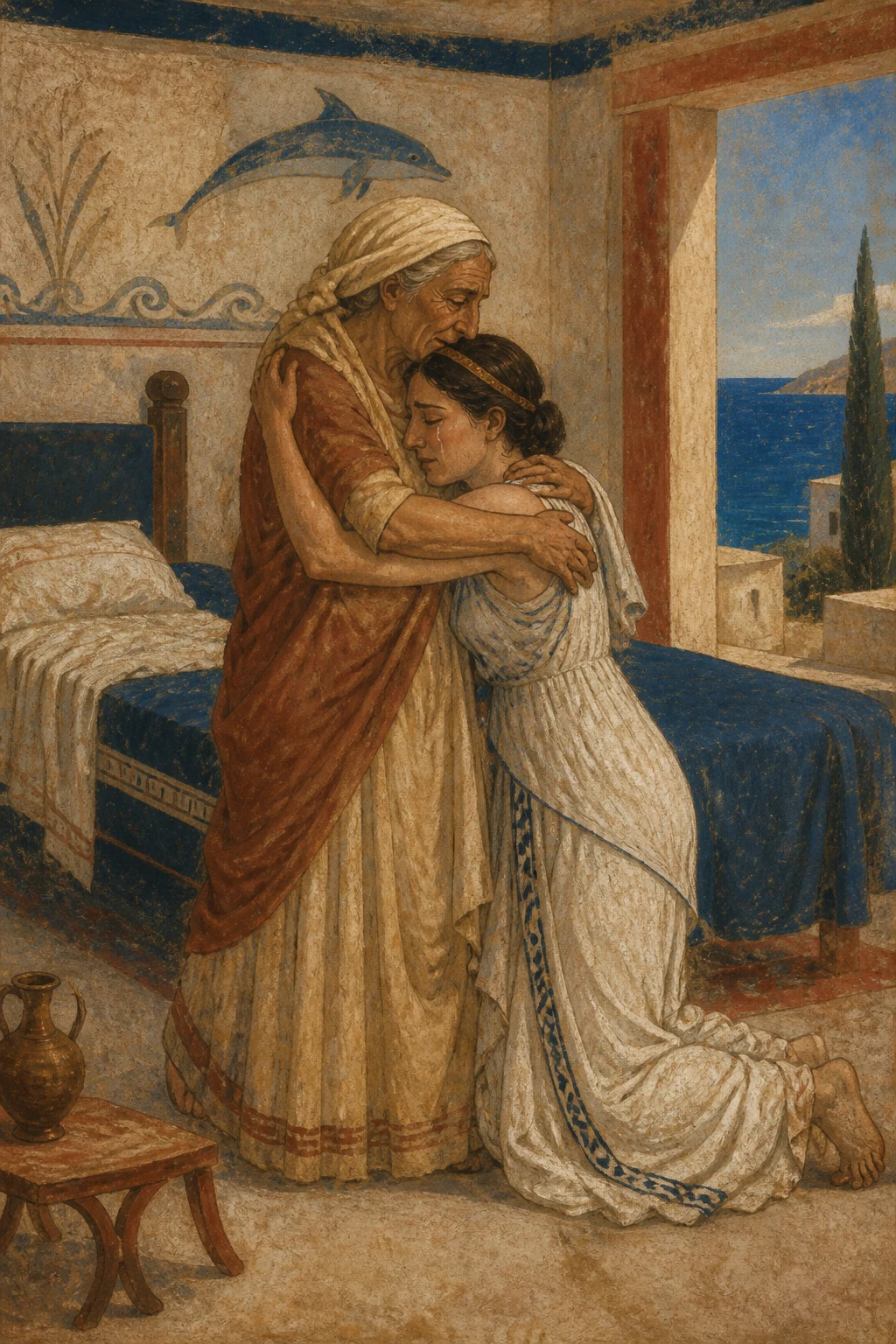
The old woman climbed to the upper room, laughing with delight, to tell her mistress that her beloved husband was home. Her knees were strong again, and her feet sped beneath her. She stood at Penelope’s head and said, “Wake, Penelope, dear child, and see with your own eyes what you have longed for all these days.
“Odysseus has come! He is home at last, though he has been so long in coming. He has killed the arrogant suitors who laid waste his house, devoured his wealth, and oppressed his son.” Wise Penelope answered her, “Dear nurse, the gods have driven you mad. They can rob even the wisest of their senses, and bring the foolish back to sound judgment. They have unhinged your mind; before this, you were sensible enough.
“Why do you mock me in my sorrow, telling such wild tales, and wake me from the sweet sleep that held me, enfolding my eyelids? I have never slept so soundly since Odysseus went away to see that accursed city, Troy—whose very name I hate to speak.
“Come now, go downstairs and back into the hall. Had any other woman in my household come to tell me this and roused me from sleep, I would soon have sent her back to the hall with a harsh dismissal. Your old age will spare you that.”
Her dear nurse Eurycleia answered, “I am not mocking you, dear child. Odysseus truly has come and is home, just as I say—the stranger whom everyone treated with contempt in the hall.
“Telemachus knew long ago that he was in the house, but wisely kept his father’s plans a secret, so that he could take revenge on those overbearing men for their violence.” At these words Penelope rejoiced. She sprang from bed, threw her arms around the old woman, and let the tears fall from her eyes. Then she spoke to her with winged words: “Come, dear nurse, tell me the truth. If he really is home, as you say, how could he have laid hands on the shameless suitors all alone? They were always gathered together in the house.”
Her dear nurse Eurycleia answered, “I did not see it, nor did I hear how it happened. I only heard the groans of men being killed. We sat trembling in the inner rooms of the well-built house, with the doors shut fast, until your son Telemachus called me from the hall. His father had sent him to fetch me.
“Then I found Odysseus standing among the slaughtered dead. All around him they lay heaped on one another across the hard-packed floor. The sight would have gladdened your heart.
“Now they have all been piled by the courtyard gates, and he has kindled a great fire and is cleansing the beautiful hall with sulphur. He sent me to call you. Come with me, so that both your hearts may find happiness after all you have suffered.
“Now at last your long-held wish has been fulfilled. He has come back alive to his own hearth, and found you and his son at home. And on all the suitors who wronged him he has taken vengeance in his own house.”
Wise Penelope answered her, “Dear nurse, do not exult so loudly yet. You know how welcome he would be to everyone in this house, and above all to me and to the son we brought into the world. But this story cannot be true as you tell it. One of the immortals has killed the proud suitors, outraged by their grievous insolence and wicked deeds.
“They showed no respect to anyone on earth who came among them, whether humble or noble. Their own recklessness has brought them to ruin. But Odysseus has lost all hope of returning, far from Achaea, and has himself perished.”
Then her dear nurse Eurycleia replied, “My child, what words have escaped the barrier of your teeth! Your husband is here beside his own hearth, yet you declare that he will never come home. Your heart is always unbelieving.
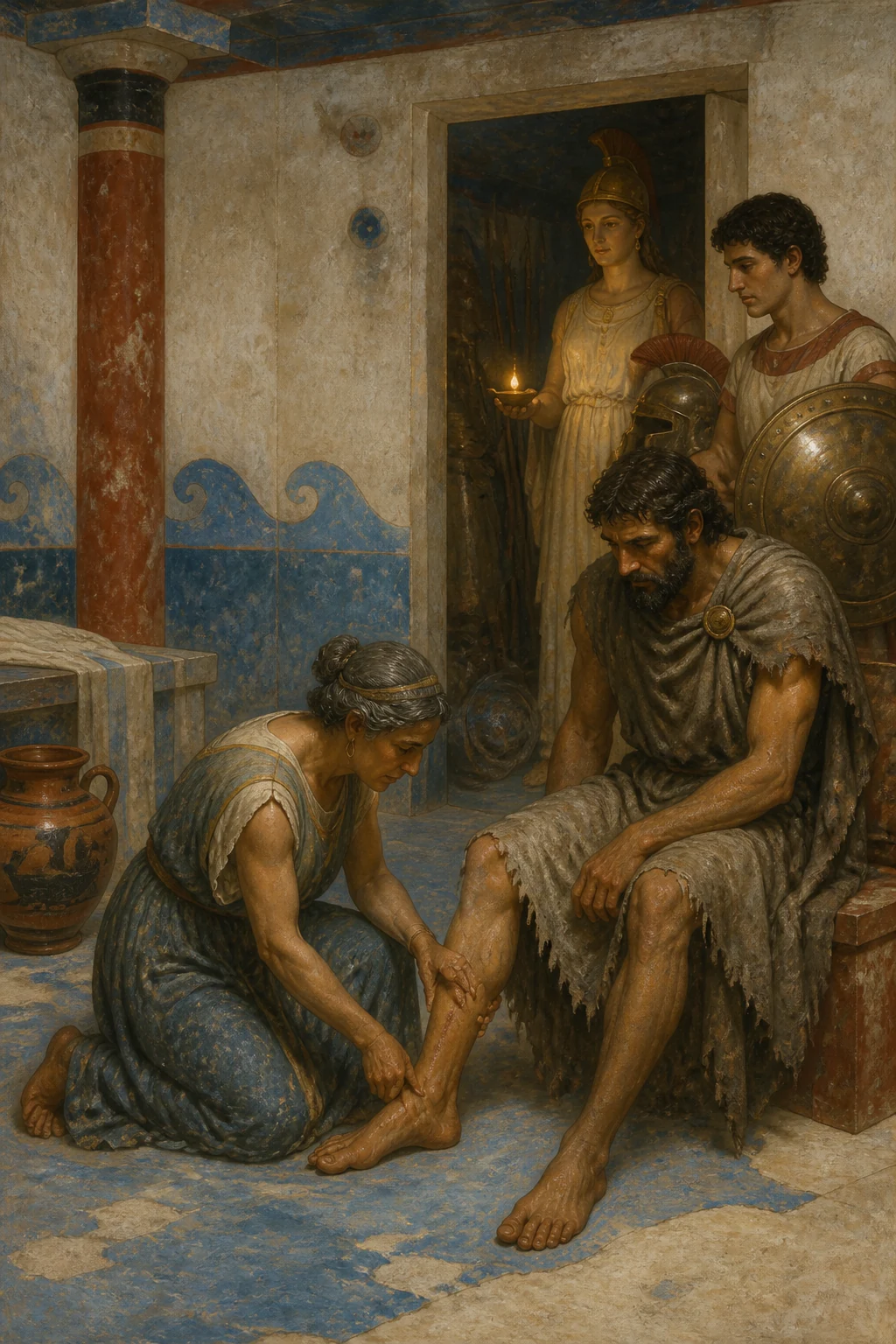
“Come, let me give you another unmistakable sign: the scar a boar once gave him with its white tusk. I recognized it as I washed his feet, and wanted to tell you yourself. But he clapped his hand over my mouth and would not let me speak, so shrewdly did he lay his plans.
“Come with me. I will stake my own life on it: if I am deceiving you, kill me by the cruelest death.” Wise Penelope answered her, “Dear nurse, wise as you are, it is hard for you to fathom the purposes of the everlasting gods.
“Still, let us go to my son, so that I may see the suitors lying dead, and the man who killed them.” With these words she went down from her upper room, her heart turning over many thoughts: should she stand at a distance and question her dear husband, or go to him, take his hands, and kiss his head?
When she had entered and crossed the stone threshold, she sat opposite Odysseus, in the firelight, against the farther wall. He sat beside a tall pillar, his eyes lowered, waiting to see whether his noble wife would speak to him now that she had seen him with her own eyes.
She sat a long time in silence, wonder overwhelming her heart. Sometimes she looked straight into his face; sometimes, with those wretched clothes upon him, she could not recognize him. Telemachus rebuked her, addressing her by name: “Mother—cruel mother, with your unfeeling heart! Why do you hold yourself so far from my father? Why not sit beside him and speak to him, ask him questions?
“No other woman could harden her heart like this and stand aloof from a husband who had come back to his native land in the twentieth year, after suffering so much. Your heart is always harder than stone.”
Wise Penelope answered him, “My child, my heart is stunned within me. I cannot speak to him or question him, or even look him in the face. But if this truly is Odysseus, come home at last, we shall know each other more surely. There are signs that we two alone know, hidden from everyone else.”
At her words the much-enduring, noble Odysseus smiled, and at once addressed Telemachus with winged words: “Telemachus, let your mother test me here in our house. Soon she will know more certainly.
“For now, because I am filthy and wear these wretched clothes, she holds me in little esteem and will not yet admit that I am he. But we must consider how best to manage what lies ahead. Even a man who kills a single person in his own country, one who leaves few supporters to avenge him, goes into exile, abandoning his kin and native land. We have killed the mainstay of this city, by far the finest young men in Ithaca. I urge you to consider that.”
Thoughtful Telemachus answered him, “You must see to this yourself, dear father. They say your wisdom is the greatest among men, and no other mortal could rival you.
“We shall follow you eagerly, and I promise that we shall not fail in courage, so far as our strength allows.” Resourceful Odysseus answered him, “Then I will tell you what seems best to me.
“First, bathe and put on tunics, and tell the serving women to dress themselves as well. Then let the inspired bard take his clear-toned lyre and lead us in a merry dance, so that anyone who hears us from outside—a passerby in the street or one of our neighbors—will think a wedding is being held. We must not let news of the suitors’ deaths spread through the town before we have gone out to our orchard estate. Once there, we shall consider whatever advantage the Olympian may put within our reach.”
So he spoke, and they listened closely and obeyed. First they bathed and put on tunics, and the women dressed themselves. Then the inspired bard took up his hollow lyre and stirred in them a longing for sweet song and graceful dancing.
The great house echoed to the feet of dancing men and beautifully girdled women. And someone listening outside would say, “So someone has married the much-courted queen at last! Heartless woman! She could not bear to guard her wedded husband’s great house faithfully until he returned.”
So people spoke, not knowing what had happened. Meanwhile, in his own house, the housekeeper Eurynome bathed great-hearted Odysseus, anointed him with oil, and dressed him in a fine cloak and tunic. And Athena shed beauty over him from head to foot, making him seem taller and more powerfully built, and letting his hair fall in curls like the hyacinth flower.
As a craftsman overlays silver with gold, a skilled man whom Hephaestus and Pallas Athena have taught every art, so that he creates works of beauty, so she poured grace over his head and shoulders.
He stepped from the bath like an immortal in his bearing. Then he returned to the chair from which he had risen and sat opposite his wife, saying, “Strange woman, the gods who dwell on Olympus have given you a heart more unyielding than any other woman’s. No other woman could harden herself like this and stand aloof from a husband who had come back to his native land in the twentieth year, after suffering so much.
“Come, nurse, make me a bed, so that I too may lie down. Her heart is surely made of iron.” Wise Penelope answered him, “Strange man, I am neither setting myself above you nor slighting you, nor am I overwhelmed with wonder. I know very well what you looked like when you sailed from Ithaca in your long-oared ship.
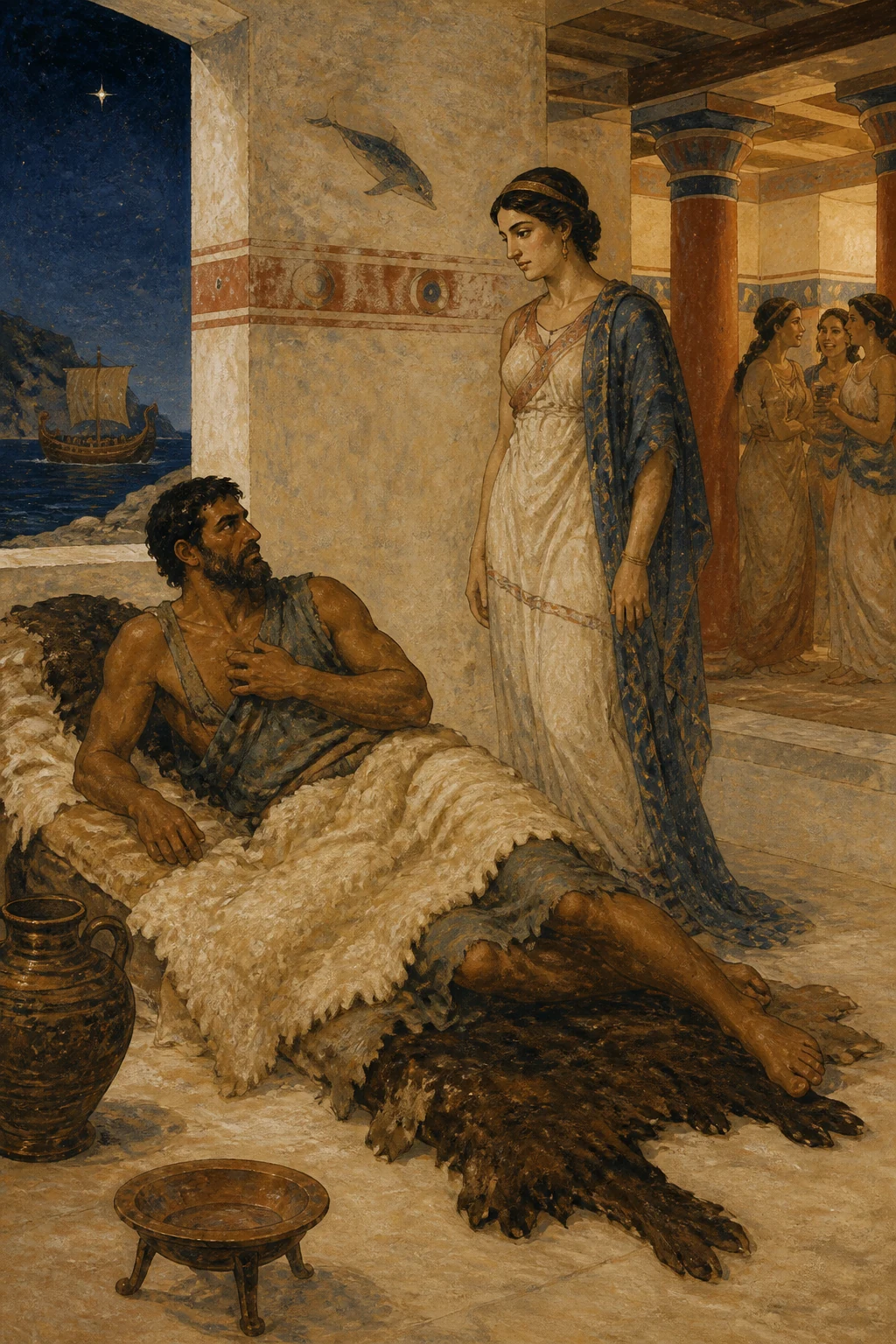
“Come, Eurycleia, prepare his sturdy bed outside the well-built chamber he made himself. Put the bed out there for him, and lay the bedding on it—fleeces, blankets, and shining coverlets.”
She said this to test her husband. But Odysseus, deeply troubled, spoke to his faithful wife: “Woman, those words have cut me to the heart. Who has moved my bed elsewhere? That would be hard even for a very skilled man, unless a god himself came and chose to move it easily to another place.
“No mortal man alive, not even in the prime of youth, could readily shift it. There is a great secret in the making of that bed. I built it myself, and no one else.
“Within the courtyard grew a long-leaved olive tree, vigorous and flourishing, its trunk as thick as a pillar. Around it I built our chamber, laying the stones close together until the walls were finished. I roofed it well, and fitted it with strong, closely joined doors.
“Then I cut away the crown of the long-leaved olive, trimmed the trunk above the roots, and dressed it carefully and skillfully with bronze tools. I made it straight to the line, fashioned it into a bedpost, and bored all the holes with an auger.
“Beginning with that, I worked on the bed until I had finished it, adorning it with gold and silver and ivory, and stretching across it oxhide straps dyed a brilliant purple. That is the sign I give you. But I do not know, woman, whether my bed still stands fast, or whether someone has cut through the olive trunk beneath it and moved it elsewhere.”
As he spoke, her knees and heart gave way, for she recognized the sure signs Odysseus had described. Bursting into tears, she ran straight to him, threw her arms around his neck, kissed his head, and said, “Do not be angry with me, Odysseus, you who have always been the wisest of men. The gods brought misery upon us; they begrudged us the happiness of remaining together, enjoying our youth and reaching the threshold of old age.
“Do not be angry now, or resent me because I did not welcome you like this the moment I saw you. My heart has always trembled with fear that someone might come and deceive me with words. There are so many who scheme for wicked gain.
“Even Helen of Argos, daughter of Zeus, would never have shared a stranger’s bed in love if she had known that the warlike sons of the Achaeans would bring her home again to her own dear country.
“A god must have driven her to that shameful act. She had never before harbored in her heart that disastrous blindness from which our own sorrows first arose. But now you have described the unmistakable signs of our bed, which no other mortal has ever seen—only you and I and one serving woman, Actoris, whom my father gave me when I came here, and who guarded the doors of our strong-built chamber. Now you have convinced my heart, unyielding though it was.”
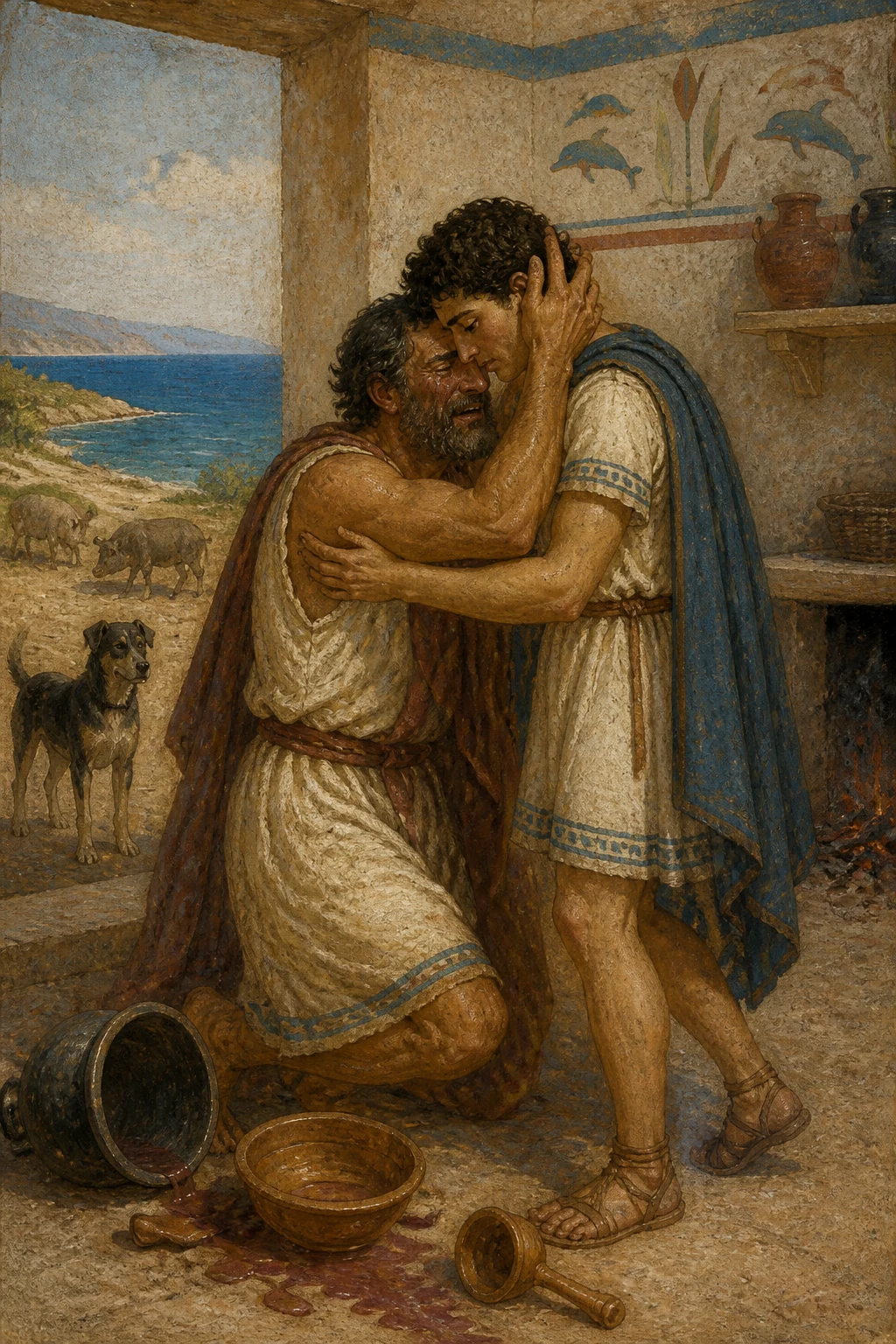
Her words stirred in him a still deeper longing to weep. He wept as he held his cherished, faithful wife. As land is welcome to swimmers whose sturdy ship Poseidon has shattered at sea, driven by the wind and the pounding waves—only a few escape the grey sea and swim ashore, their bodies crusted thick with salt, and joyfully set foot on land, delivered from disaster—so welcome was her husband as she gazed at him. Her white arms would not yet loosen their hold about his neck.
Rosy-fingered Dawn would have risen upon them while they still wept, had not the grey-eyed goddess Athena taken thought for them. She held the long night at its farthest edge, and kept golden-throned Dawn beside Ocean, not allowing her to harness the swift-footed horses that bring light to men, Lampus and Phaethon, the steeds that draw Dawn’s chariot.
Then resourceful Odysseus said to his wife, “Woman, we have not yet reached the end of all our trials. There is still immeasurable toil ahead, long and hard, which I must carry through to the end.
“So the spirit of Teiresias foretold to me on the day I went down into the house of Hades, seeking a way home for my companions and myself. But come, wife, let us go to bed, so that at last we may lie down and enjoy sweet sleep.”
Wise Penelope answered him, “Your bed will be ready whenever your heart desires it, now that the gods have brought you back to your well-built house and your native land. But since you have thought of this, and a god has put it into your mind, come, tell me of this trial. I shall learn of it later, I suppose, and it is no worse to know at once.”
Resourceful Odysseus answered her, “Strange woman, why do you press me so insistently to tell you? Still, I will speak and hide nothing.
“It will bring your heart no joy. I take no joy in it myself, for he told me to travel through many cities of men, carrying a well-shaped oar in my hands, until I reached a people who know nothing of the sea and eat no food seasoned with salt. They know nothing of crimson-prowed ships, or of the well-shaped oars that are a ship’s wings.
“He gave me this unmistakable sign, and I will not keep it from you: when another traveler meets me and says that I am carrying a winnowing fan on my sturdy shoulder, then, he told me, I must plant the oar in the earth and offer a splendid sacrifice to lord Poseidon—a ram, a bull, and a boar that mates with sows. Then I must return home and offer sacred hecatombs to the immortal gods who hold the broad heavens, to every one of them in due order. And death will come to me far from the sea, a gentle death, taking me when I am worn down by a prosperous old age, with my people living happily around me. All this, he said, would be fulfilled.”
Wise Penelope answered him, “If the gods are indeed to grant you a happier old age, then there is hope that you will escape your troubles.” So they spoke together. Meanwhile Eurynome and the nurse prepared their bed with soft bedding by the light of blazing torches.
When they had busily made the sturdy bed, the old woman went back to her own quarters to sleep, while the chambermaid Eurynome led them to their bed, carrying a torch in her hands. She brought them into the chamber and then withdrew. Joyfully they returned to the familiar rites of their old marriage bed. Meanwhile Telemachus, the cowherd, and the swineherd stopped their dancing and had the women stop as well, then lay down to sleep in the shadowy hall.
When the two had taken their delight in love, they took delight in talking together. She, that noble woman, told of all she had endured in the house, watching the destructive throng of suitors slaughter cattle and fat sheep in great numbers for her sake, and draw so much wine from the jars. And Zeus-descended Odysseus told of all the suffering he had brought upon others, and all the misery he himself had borne. He told her everything, and she listened with delight; sleep did not fall upon her eyelids until he had related it all.
He began with how he had first defeated the Cicones, and then reached the fertile land of the Lotus-Eaters; what the Cyclops had done, and how he had taken vengeance for his brave companions whom the monster had devoured without pity; how he had come to Aeolus, who welcomed him warmly and sent him on his way, though it was not yet his fate to reach his dear homeland, and a storm had seized him once more and carried him, groaning bitterly, over the fish-filled sea; how he had reached Telepylus of the Laestrygonians, who destroyed his ships and all his well-greaved companions, while Odysseus alone escaped with his black ship. He told of Circe’s cunning and her many wiles; how he had sailed in his many-benched ship to the dank house of Hades to consult the spirit of Teiresias of Thebes, and had seen all his companions and the mother who had borne him and nurtured him as a little child; how he had heard the song of the sweet-voiced Sirens, and come to the Wandering Rocks, to dreadful Charybdis, and to Scylla, whom no men had ever passed unharmed; how his companions had killed the cattle of the Sun, and how Zeus, thundering on high, had struck their swift ship with a blazing thunderbolt, so that all his good companions perished together, while he alone escaped an evil fate; how he had come to the island of Ogygia and the nymph Calypso, who kept him in her hollow caves, longing to make him her husband, tending him and promising to make him immortal and ageless for all his days, yet never persuading the heart within his breast; and how, after much suffering, he had reached the Phaeacians, who honored him from their hearts as though he were a god and sent him by ship to his native land, giving him bronze and gold and clothing in abundance.
That was the last thing he said before sweet sleep, loosening his limbs and easing the cares of his heart, swept over him. Then the grey-eyed goddess Athena took thought once more. When she judged that Odysseus had enjoyed enough of his wife’s bed and of sleep, she at once roused golden-throned, early-born Dawn from Ocean to bring light to men. Odysseus rose from the soft bed and gave his wife these instructions: “Woman, we have both had our fill of many trials—you here, weeping for my sorrow-laden return, while Zeus and the other gods kept me bound in misery far from my native land, though I longed to return. But now that we have both come back to the bed we yearned for, take care of the possessions that remain to me in this house. As for the flocks those arrogant suitors slaughtered, I shall seize many myself in raids, and the Achaeans will give me others, until all my folds are full again.
“Now I shall go to our orchard estate to see my good father, who has grieved so deeply for me. And though you are wise, wife, I give you these instructions: as soon as the sun rises, word will spread of the suitors I killed in the hall. Go upstairs with your serving women and stay there. Do not look out at anyone or ask any questions.”
With these words he put his splendid armor about his shoulders, then roused Telemachus, the cowherd, and the swineherd, and told them all to take their weapons of war in their hands. They obeyed him, armed themselves in bronze, opened the doors, and went out, with Odysseus leading the way.
Daylight already lay upon the earth, but Athena shrouded them in night and led them swiftly out of the city.
Izvirnik
Odysseus and Penelope
Naslednje strani prikazujejo izvirno besedilo za primerjavo.
γρηῢς δʼ εἰς ὑπερῷʼ ἀνεβήσετο καγχαλόωσα, δεσποίνῃ ἐρέουσα φίλον πόσιν ἔνδον ἐόντα· γούνατα δʼ ἐρρώσαντο, πόδες δʼ ὑπερικταίνοντο. στῆ δʼ ἄρʼ ὑπὲρ κεφαλῆς καί μιν πρὸς μῦθον ἔειπεν· ἔγρεο, Πηνελόπεια, φίλον τέκος, ὄφρα ἴδηαι ὀφθαλμοῖσι τεοῖσι τά τʼ ἔλδεαι ἤματα πάντα. ἦλθʼ Ὀδυσεὺς καὶ οἶκον ἱκάνεται, ὀψέ περ ἐλθών. μνηστῆρας δʼ ἔκτεινεν ἀγήνορας, οἵ θʼ ἑὸν οἶκον κήδεσκον καὶ κτήματʼ ἔδον βιόωντό τε παῖδα.
τὴν δʼ αὖτε προσέειπε περίφρων Πηνελόπεια· μαῖα φίλη, μάργην σε θεοὶ θέσαν, οἵ τε δύνανται ἄφρονα ποιῆσαι καὶ ἐπίφρονά περ μάλʼ ἐόντα, καί τε χαλιφρονέοντα σαοφροσύνης ἐπέβησαν· οἵ σέ περ ἔβλαψαν· πρὶν δὲ φρένας αἰσίμη ἦσθα. τίπτε με λωβεύεις πολυπενθέα θυμὸν ἔχουσαν ταῦτα παρὲξ ἐρέουσα καὶ ἐξ ὕπνου μʼ ἀνεγείρεις ἡδέος, ὅς μʼ ἐπέδησε φίλα βλέφαρʼ ἀμφικαλύψας; οὐ γάρ πω τοιόνδε κατέδραθον, ἐξ οὗ Ὀδυσσεὺς ᾤχετʼ ἐποψόμενος Κακοΐλιον οὐκ ὀνομαστήν.
ἀλλʼ ἄγε νῦν κατάβηθι καὶ ἂψ ἔρχευ μέγαρόνδε. εἰ γάρ τίς μʼ ἄλλη γε γυναικῶν, αἵ μοι ἔασι, ταῦτʼ ἐλθοῦσʼ ἤγγειλε καὶ ἐξ ὕπνου ἀνέγειρεν, τῷ κε τάχα στυγερῶς μιν ἐγὼν ἀπέπεμψα νέεσθαι αὖτις ἔσω μέγαρον· σὲ δὲ τοῦτό γε γῆρας ὀνήσει. τὴν δʼ αὖτε προσέειπε φίλη τροφὸς Εὐρύκλεια· οὔ τί σε λωβεύω, τέκνον φίλον, ἀλλʼ ἔτυμόν τοι ἦλθʼ Ὀδυσεὺς καὶ οἶκον ἱκάνεται, ὡς ἀγορεύω, ὁ ξεῖνος, τὸν πάντες ἀτίμων ἐν μεγάροισι.
Τηλέμαχος δʼ ἄρα μιν πάλαι ᾔδεεν ἔνδον ἐόντα, ἀλλὰ σαοφροσύνῃσι νοήματα πατρὸς ἔκευθεν, ὄφρʼ ἀνδρῶν τίσαιτο βίην ὑπερηνορεόντων. ὣς ἔφαθʼ, ἡ δʼ ἐχάρη καὶ ἀπὸ λέκτροιο θοροῦσα γρηῒ περιπλέχθη, βλεφάρων δʼ ἀπὸ δάκρυον ἧκεν· καί μιν φωνήσασʼ ἔπεα πτερόεντα προσηύδα· εἰ δʼ ἄγε δή μοι, μαῖα φίλη, νημερτὲς ἐνίσπες, εἰ ἐτεὸν δὴ οἶκον ἱκάνεται, ὡς ἀγορεύεις, ὅππως δὴ μνηστῆρσιν ἀναιδέσι χεῖρας ἐφῆκε μοῦνος ἐών, οἱ δʼ αἰὲν ἀολλέες ἔνδον ἔμιμνον.
τὴν δʼ αὖτε προσέειπε φίλη τροφὸς Εὐρύκλεια· οὐκ ἴδον, οὐ πυθόμην, ἀλλὰ στόνον οἶον ἄκουσα κτεινομένων· ἡμεῖς δὲ μυχῷ θαλάμων εὐπήκτων ἥμεθʼ ἀτυζόμεναι, σανίδες δʼ ἔχον εὖ ἀραρυῖαι, πρίν γʼ ὅτε δή με σὸς υἱὸς ἀπὸ μεγάροιο κάλεσσε Τηλέμαχος· τὸν γάρ ῥα πατὴρ προέηκε καλέσσαι. εὗρον ἔπειτʼ Ὀδυσῆα μετὰ κταμένοισι νέκυσσιν ἑσταόθʼ· οἱ δέ μιν ἀμφί, κραταίπεδον οὖδας ἔχοντες, κείατʼ ἐπʼ ἀλλήλοισιν· ἰδοῦσά κε θυμὸν ἰάνθης.
νῦν δʼ οἱ μὲν δὴ πάντες ἐπʼ αὐλείῃσι θύρῃσιν ἀθρόοι, αὐτὰρ ὁ δῶμα θεειοῦται περικαλλές, πῦρ μέγα κηάμενος· σὲ δέ με προέηκε καλέσσαι. ἀλλʼ ἕπευ, ὄφρα σφῶϊν ἐϋφροσύνης ἐπιβῆτον ἀμφοτέρω φίλον ἦτορ, ἐπεὶ κακὰ πολλὰ πέποσθε. νῦν δʼ ἤδη τόδε μακρὸν ἐέλδωρ ἐκτετέλεσται· ἦλθε μὲν αὐτὸς ζωὸς ἐφέστιος, εὗρε δὲ καὶ σὲ καὶ παῖδʼ ἐν μεγάροισι· κακῶς δʼ οἵ πέρ μιν ἔρεζον μνηστῆρες, τοὺς πάντας ἐτίσατο ᾧ ἐνὶ οἴκῳ.
τὴν δʼ αὖτε προσέειπε περίφρων Πηνελόπεια· μαῖα φίλη, μή πω μέγʼ ἐπεύχεο καγχαλόωσα. οἶσθα γὰρ ὥς κʼ ἀσπαστὸς ἐνὶ μεγάροισι φανείη πᾶσι, μάλιστα δʼ ἐμοί τε καὶ υἱέϊ, τὸν τεκόμεσθα· ἀλλʼ οὐκ ἔσθʼ ὅδε μῦθος ἐτήτυμος, ὡς ἀγορεύεις, ἀλλά τις ἀθανάτων κτεῖνε μνηστῆρας ἀγαυούς, ὕβριν ἀγασσάμενος θυμαλγέα καὶ κακὰ ἔργα. οὔ τινα γὰρ τίεσκον ἐπιχθονίων ἀνθρώπων, οὐ κακὸν οὐδὲ μὲν ἐσθλόν, ὅτις σφέας εἰσαφίκοιτο· τῷ διʼ ἀτασθαλίας ἔπαθον κακόν· αὐτὰρ Ὀδυσσεὺς ὤλεσε τηλοῦ νόστον Ἀχαιΐδος, ὤλετο δʼ αὐτός.
τὴν δʼ ἠμείβετʼ ἔπειτα φίλη τροφὸς Εὐρύκλεια· τέκνον ἐμόν, ποῖόν σε ἔπος φύγεν ἕρκος ὀδόντων, ἣ πόσιν ἔνδον ἐόντα παρʼ ἐσχάρῃ οὔ ποτʼ ἔφησθα οἴκαδʼ ἐλεύσεσθαι· θυμὸς δέ τοι αἰὲν ἄπιστος. ἀλλʼ ἄγε τοι καὶ σῆμα ἀριφραδὲς ἄλλο τι εἴπω, οὐλήν, τήν ποτέ μιν σῦς ἤλασε λευκῷ ὀδόντι. τὴν ἀπονίζουσα φρασάμην, ἔθελον δὲ σοὶ αὐτῇ εἰπέμεν· ἀλλά με κεῖνος ἑλὼν ἐπὶ μάστακα χερσὶν οὐκ ἔα εἰπέμεναι πολυϊδρείῃσι νόοιο.
ἀλλʼ ἕπευ· αὐτὰρ ἐγὼν ἐμέθεν περιδώσομαι αὐτῆς, αἴ κέν σʼ ἐξαπάφω, κτεῖναί μʼ οἰκτίστῳ ὀλέθρῳ. τὴν δʼ ἠμείβετʼ ἔπειτα περίφρων Πηνελόπεια· μαῖα φίλη, χαλεπόν σε θεῶν αἰειγενετάων δήνεα εἴρυσθαι, μάλα περ πολύϊδριν ἐοῦσαν. ἀλλʼ ἔμπης ἴομεν μετὰ παῖδʼ ἐμόν, ὄφρα ἴδωμαι ἄνδρας μνηστῆρας τεθνηότας, ἠδʼ ὃς ἔπεφνεν. ὣς φαμένη κατέβαινʼ ὑπερώϊα· πολλὰ δέ οἱ κῆρ ὥρμαινʼ, ἢ ἀπάνευθε φίλον πόσιν ἐξερεείνοι, ἦ παρστᾶσα κύσειε κάρη καὶ χεῖρε λαβοῦσα.
ἡ δʼ ἐπεὶ εἰσῆλθεν καὶ ὑπέρβη λάϊνον οὐδόν, ἕζετʼ ἔπειτʼ Ὀδυσῆος ἐναντίη, ἐν πυρὸς αὐγῇ, τοίχου τοῦ ἑτέρου· ὁ δʼ ἄρα πρὸς κίονα μακρὴν ἧστο κάτω ὁρόων, ποτιδέγμενος εἴ τί μιν εἴποι ἰφθίμη παράκοιτις, ἐπεὶ ἴδεν ὀφθαλμοῖσιν. ἡ δʼ ἄνεω δὴν ἧστο, τάφος δέ οἱ ἦτορ ἵκανεν· ὄψει δʼ ἄλλοτε μέν μιν ἐνωπαδίως ἐσίδεσκεν, ἄλλοτε δʼ ἀγνώσασκε κακὰ χροῒ εἵματʼ ἔχοντα. Τηλέμαχος δʼ ἐνένιπεν ἔπος τʼ ἔφατʼ ἔκ τʼ ὀνόμαζε· μῆτερ ἐμή, δύσμητερ, ἀπηνέα θυμὸν ἔχουσα, τίφθʼ οὕτω πατρὸς νοσφίζεαι, οὐδὲ παρʼ αὐτὸν ἑζομένη μύθοισιν ἀνείρεαι οὐδὲ μεταλλᾷς;
οὐ μέν κʼ ἄλλη γʼ ὧδε γυνὴ τετληότι θυμῷ ἀνδρὸς ἀφεσταίη, ὅς οἱ κακὰ πολλὰ μογήσας ἔλθοι ἐεικοστῷ ἔτεϊ ἐς πατρίδα γαῖαν· σοὶ δʼ αἰεὶ κραδίη στερεωτέρη ἐστὶ λίθοιο. τὸν δʼ αὖτε προσέειπε περίφρων Πηνελόπεια· τέκνον ἐμόν, θυμός μοι ἐνὶ στήθεσσι τέθηπεν, οὐδέ τι προσφάσθαι δύναμαι ἔπος οὐδʼ ἐρέεσθαι οὐδʼ εἰς ὦπα ἰδέσθαι ἐναντίον. εἰ δʼ ἐτεὸν δὴ ἔστʼ Ὀδυσεὺς καὶ οἶκον ἱκάνεται, ἦ μάλα νῶϊ γνωσόμεθʼ ἀλλήλων καὶ λώϊον· ἔστι γὰρ ἡμῖν σήμαθʼ, ἃ δὴ καὶ νῶϊ κεκρυμμένα ἴδμεν ἀπʼ ἄλλων.
ὣς φάτο, μείδησεν δὲ πολύτλας δῖος Ὀδυσσεύς, αἶψα δὲ Τηλέμαχον ἔπεα πτερόεντα προσηύδα· Τηλέμαχʼ, ἦ τοι μητέρʼ ἐνὶ μεγάροισιν ἔασον πειράζειν ἐμέθεν· τάχα δὲ φράσεται καὶ ἄρειον. νῦν δʼ ὅττι ῥυπόω, κακὰ δὲ χροῒ εἵματα εἷμαι, τοὔνεκʼ ἀτιμάζει με καὶ οὔ πω φησὶ τὸν εἶναι. ἡμεῖς δὲ φραζώμεθʼ ὅπως ὄχʼ ἄριστα γένηται. καὶ γάρ τίς θʼ ἕνα φῶτα κατακτείνας ἐνὶ δήμῳ, ᾧ μὴ πολλοὶ ἔωσιν ἀοσσητῆρες ὀπίσσω, φεύγει πηούς τε προλιπὼν καὶ πατρίδα γαῖαν· ἡμεῖς δʼ ἕρμα πόληος ἀπέκταμεν, οἳ μέγʼ ἄριστοι κούρων εἰν Ἰθάκῃ· τὰ δέ σε φράζεσθαι ἄνωγα.
τὸν δʼ αὖ Τηλέμαχος πεπνυμένος ἀντίον ηὔδα· αὐτὸς ταῦτά γε λεῦσσε, πάτερ φίλε· σὴν γὰρ ἀρίστην μῆτιν ἐπʼ ἀνθρώπους φάσʼ ἔμμεναι, οὐδέ κέ τίς τοι ἄλλος ἀνὴρ ἐρίσειε καταθνητῶν ἀνθρώπων. ἡμεῖς δʼ ἐμμεμαῶτες ἅμʼ ἑψόμεθʼ, οὐδέ τί φημι ἀλκῆς δευήσεσθαι, ὅση δύναμίς γε πάρεστιν. τὸν δʼ ἀπαμειβόμενος προσέφη πολύμητις Ὀδυσσεύς τοιγὰρ ἐγὼν ἐρέω ὥς μοι δοκεῖ εἶναι ἄριστα. πρῶτα μὲν ἂρ λούσασθε καὶ ἀμφιέσασθε χιτῶνας, δμῳὰς δʼ ἐν μεγάροισιν ἀνώγετε εἵμαθʼ ἑλέσθαι· αὐτὰρ θεῖος ἀοιδὸς ἔχων φόρμιγγα λίγειαν ἡμῖν ἡγείσθω φιλοπαίγμονος ὀρχηθμοῖο,
ὥς κέν τις φαίη γάμον ἔμμεναι ἐκτὸς ἀκούων, ἢ ἀνʼ ὁδὸν στείχων, ἢ οἳ περιναιετάουσι· μὴ πρόσθε κλέος εὐρὺ φόνου κατὰ ἄστυ γένηται ἀνδρῶν μνηστήρων, πρίν γʼ ἡμέας ἐλθέμεν ἔξω ἀγρὸν ἐς ἡμέτερον πολυδένδρεον· ἔνθα δʼ ἔπειτα φρασσόμεθʼ ὅττι κε κέρδος Ὀλύμπιος ἐγγυαλίξῃ. ὣς ἔφαθʼ, οἱ δʼ ἄρα τοῦ μάλα μὲν κλύον ἠδʼ ἐπίθοντο πρῶτα μὲν οὖν λούσαντο καὶ ἀμφιέσαντο χιτῶνας, ὅπλισθεν δὲ γυναῖκες· ὁ δʼ εἵλετο θεῖος ἀοιδὸς φόρμιγγα γλαφυρήν, ἐν δέ σφισιν ἵμερον ὦρσε μολπῆς τε γλυκερῆς καὶ ἀμύμονος ὀρχηθμοῖο.
τοῖσιν δὲ μέγα δῶμα περιστεναχίζετο ποσσὶν ἀνδρῶν παιζόντων καλλιζώνων τε γυναικῶν. ὧδε δέ τις εἴπεσκε δόμων ἔκτοσθεν ἀκούων· ἦ μάλα δή τις ἔγημε πολυμνήστην βασίλειαν· σχετλίη, οὐδʼ ἔτλη πόσιος οὗ κουριδίοιο εἴρυσθαι μέγα δῶμα διαμπερές, ἧος ἵκοιτο. ὣς ἄρα τις εἴπεσκε, τὰ δʼ οὐκ ἴσαν ὡς ἐτέτυκτο. αὐτὰρ Ὀδυσσῆα μεγαλήτορα ᾧ ἐνὶ οἴκῳ Εὐρυνόμη ταμίη λοῦσεν καὶ χρῖσεν ἐλαίῳ, ἀμφὶ δέ μιν φᾶρος καλὸν βάλεν ἠδὲ χιτῶνα· αὐτὰρ κὰκ κεφαλῆς κάλλος πολὺ χεῦεν Ἀθήνη μείζονά τʼ εἰσιδέειν καὶ πάσσονα· κὰδ δὲ κάρητος
οὔλας ἧκε κόμας, ὑακινθίνῳ ἄνθει ὁμοίας. ὡς δʼ ὅτε τις χρυσὸν περιχεύεται ἀργύρῳ ἀνὴρ ἴδρις, ὃν Ἥφαιστος δέδαεν καὶ Παλλὰς Ἀθήνη τέχνην παντοίην, χαρίεντα δὲ ἔργα τελείει· ὣς μὲν τῷ περίχευε χάριν κεφαλῇ τε καὶ ὤμοις. ἐκ δʼ ἀσαμίνθου βῆ δέμας ἀθανάτοισιν ὁμοῖος· ἂψ δʼ αὖτις κατʼ ἄρʼ ἕζετʼ ἐπὶ θρόνου ἔνθεν ἀνέστη, ἀντίον ἧς ἀλόχου, καί μιν πρὸς μῦθον ἔειπε· δαιμονίη, περί σοί γε γυναικῶν θηλυτεράων κῆρ ἀτέραμνον ἔθηκαν Ὀλύμπια δώματʼ ἔχοντες· οὐ μέν κʼ ἄλλη γʼ ὧδε γυνὴ τετληότι θυμῷ ἀνδρὸς ἀφεσταίη, ὅς οἱ κακὰ πολλὰ μογήσας
ἔλθοι ἐεικοστῷ ἔτεϊ ἐς πατρίδα γαῖαν. ἀλλʼ ἄγε μοι, μαῖα, στόρεσον λέχος, ὄφρα καὶ αὐτὸς λέξομαι· ἦ γὰρ τῇ γε σιδήρεον ἐν φρεσὶ ἦτορ. τὸν δʼ αὖτε προσέειπε περίφρων Πηνελόπεια· δαιμόνιʼ, οὔτʼ ἄρ τι μεγαλίζομαι οὔτʼ ἀθερίζω οὔτε λίην ἄγαμαι, μάλα δʼ εὖ οἶδʼ οἷος ἔησθα ἐξ Ἰθάκης ἐπὶ νηὸς ἰὼν δολιχηρέτμοιο. ἀλλʼ ἄγε οἱ στόρεσον πυκινὸν λέχος, Εὐρύκλεια, ἐκτὸς ἐϋσταθέος θαλάμου, τόν ῥʼ αὐτὸς ἐποίει· ἔνθα οἱ ἐκθεῖσαι πυκινὸν λέχος ἐμβάλετʼ εὐνήν, κώεα καὶ χλαίνας καὶ ῥήγεα σιγαλόεντα.
ὣς ἄρʼ ἔφη πόσιος πειρωμένη· αὐτὰρ Ὀδυσσεὺς ὀχθήσας ἄλοχον προσεφώνεε κεδνὰ ἰδυῖαν· ὦ γύναι, ἦ μάλα τοῦτο ἔπος θυμαλγὲς ἔειπες· τίς δέ μοι ἄλλοσε θῆκε λέχος; χαλεπὸν δέ κεν εἴη καὶ μάλʼ ἐπισταμένῳ, ὅτε μὴ θεὸς αὐτὸς ἐπελθὼν ῥηϊδίως ἐθέλων θείη ἄλλῃ ἐνὶ χώρῃ. ἀνδρῶν δʼ οὔ κέν τις ζωὸς βροτός, οὐδὲ μάλʼ ἡβῶν, ῥεῖα μετοχλίσσειεν, ἐπεὶ μέγα σῆμα τέτυκται ἐν λέχει ἀσκητῷ· τὸ δʼ ἐγὼ κάμον οὐδέ τις ἄλλος.
θάμνος ἔφυ τανύφυλλος ἐλαίης ἕρκεος ἐντός, ἀκμηνὸς θαλέθων· πάχετος δʼ ἦν ἠΰτε κίων. τῷ δʼ ἐγὼ ἀμφιβαλὼν θάλαμον δέμον, ὄφρʼ ἐτέλεσσα, πυκνῇσιν λιθάδεσσι, καὶ εὖ καθύπερθεν ἔρεψα, κολλητὰς δʼ ἐπέθηκα θύρας, πυκινῶς ἀραρυίας. καὶ τότʼ ἔπειτʼ ἀπέκοψα κόμην τανυφύλλου ἐλαίης, κορμὸν δʼ ἐκ ῥίζης προταμὼν ἀμφέξεσα χαλκῷ εὖ καὶ ἐπισταμένως, καὶ ἐπὶ στάθμην ἴθυνα, ἑρμῖνʼ ἀσκήσας, τέτρηνα δὲ πάντα τερέτρῳ.
ἐκ δὲ τοῦ ἀρχόμενος λέχος ἔξεον, ὄφρʼ ἐτέλεσσα, δαιδάλλων χρυσῷ τε καὶ ἀργύρῳ ἠδʼ ἐλέφαντι· ἐκ δʼ ἐτάνυσσα ἱμάντα βοὸς φοίνικι φαεινόν. οὕτω τοι τόδε σῆμα πιφαύσκομαι· οὐδέ τι οἶδα, ἤ μοι ἔτʼ ἔμπεδόν ἐστι, γύναι, λέχος, ἦέ τις ἤδη ἀνδρῶν ἄλλοσε θῆκε, ταμὼν ὕπο πυθμένʼ ἐλαίης. ὣς φάτο, τῆς δʼ αὐτοῦ λύτο γούνατα καὶ φίλον ἦτορ, σήματʼ ἀναγνούσῃ τά οἱ ἔμπεδα πέφραδʼ Ὀδυσσεύς· δακρύσασα δʼ ἔπειτʼ ἰθὺς δράμεν, ἀμφὶ δὲ χεῖρας δειρῇ βάλλʼ Ὀδυσῆϊ, κάρη δʼ ἔκυσʼ ἠδὲ προσηύδα· μή μοι, Ὀδυσσεῦ, σκύζευ, ἐπεὶ τά περ ἄλλα μάλιστα ἀνθρώπων πέπνυσο· θεοὶ δʼ ὤπαζον ὀϊζύν,
οἳ νῶϊν ἀγάσαντο παρʼ ἀλλήλοισι μένοντε ἥβης ταρπῆναι καὶ γήραος οὐδὸν ἱκέσθαι. αὐτὰρ μὴ νῦν μοι τόδε χώεο μηδὲ νεμέσσα, οὕνεκά σʼ οὐ τὸ πρῶτον, ἐπεὶ ἴδον, ὧδʼ ἀγάπησα. αἰεὶ γάρ μοι θυμὸς ἐνὶ στήθεσσι φίλοισιν ἐρρίγει μή τίς με βροτῶν ἀπάφοιτο ἔπεσσιν ἐλθών· πολλοὶ γὰρ κακὰ κέρδεα βουλεύουσιν. οὐδέ κεν Ἀργείη Ἑλένη, Διὸς ἐκγεγαυῖα, ἀνδρὶ παρʼ ἀλλοδαπῷ ἐμίγη φιλότητι καὶ εὐνῇ, εἰ ᾔδη ὅ μιν αὖτις ἀρήϊοι υἷες Ἀχαιῶν ἀξέμεναι οἶκόνδε φίλην ἐς πατρίδʼ ἔμελλον.
τὴν δʼ ἦ τοι ῥέξαι θεὸς ὤρορεν ἔργον ἀεικές· τὴν δʼ ἄτην οὐ πρόσθεν ἑῷ ἐγκάτθετο θυμῷ λυγρήν, ἐξ ἧς πρῶτα καὶ ἡμέας ἵκετο πένθος. νῦν δʼ, ἐπεὶ ἤδη σήματʼ ἀριφραδέα κατέλεξας εὐνῆς ἡμετέρης, ἣν οὐ βροτὸς ἄλλος ὀπώπει, ἀλλʼ οἶοι σύ τʼ ἐγώ τε καὶ ἀμφίπολος μία μούνη, Ἀκτορίς, ἥν μοι δῶκε πατὴρ ἔτι δεῦρο κιούσῃ, ἣ νῶϊν εἴρυτο θύρας πυκινοῦ θαλάμοιο, πείθεις δή μευ θυμόν, ἀπηνέα περ μάλʼ ἐόντα.
ὣς φάτο, τῷ δʼ ἔτι μᾶλλον ὑφʼ ἵμερον ὦρσε γόοιο· κλαῖε δʼ ἔχων ἄλοχον θυμαρέα, κεδνὰ ἰδυῖαν. ὡς δʼ ὅτʼ ἂν ἀσπάσιος γῆ νηχομένοισι φανήῃ, ὧν τε Ποσειδάων εὐεργέα νῆʼ ἐνὶ πόντῳ ῥαίσῃ, ἐπειγομένην ἀνέμῳ καὶ κύματι πηγῷ· παῦροι δʼ ἐξέφυγον πολιῆς ἁλὸς ἤπειρόνδε νηχόμενοι, πολλὴ δὲ περὶ χροῒ τέτροφεν ἅλμη, ἀσπάσιοι δʼ ἐπέβαν γαίης, κακότητα φυγόντες· ὣς ἄρα τῇ ἀσπαστὸς ἔην πόσις εἰσοροώσῃ, δειρῆς δʼ οὔ πω πάμπαν ἀφίετο πήχεε λευκώ.
καί νύ κʼ ὀδυρομένοισι φάνη ῥοδοδάκτυλος Ἠώς, εἰ μὴ ἄρʼ ἄλλʼ ἐνόησε θεὰ γλαυκῶπις Ἀθήνη. νύκτα μὲν ἐν περάτῃ δολιχὴν σχέθεν, Ἠῶ δʼ αὖτε ῥύσατʼ ἐπʼ Ὠκεανῷ χρυσόθρονον, οὐδʼ ἔα ἵππους ζεύγνυσθʼ ὠκύποδας, φάος ἀνθρώποισι φέροντας, Λάμπον καὶ Φαέθονθʼ, οἵ τʼ Ἠῶ πῶλοι ἄγουσι. καὶ τότʼ ἄρʼ ἣν ἄλοχον προσέφη πολύμητις Ὀδυσσεύς ὦ γύναι, οὐ γάρ πω πάντων ἐπὶ πείρατʼ ἀέθλων ἤλθομεν, ἀλλʼ ἔτʼ ὄπισθεν ἀμέτρητος πόνος ἔσται, πολλὸς καὶ χαλεπός, τὸν ἐμὲ χρὴ πάντα τελέσσαι.
ὣς γάρ μοι ψυχὴ μαντεύσατο Τειρεσίαο ἤματι τῷ ὅτε δὴ κατέβην δόμον Ἄϊδος εἴσω, νόστον ἑταίροισιν διζήμενος ἠδʼ ἐμοὶ αὐτῷ. ἀλλʼ ἔρχευ, λέκτρονδʼ ἴομεν, γύναι, ὄφρα καὶ ἤδη ὕπνῳ ὕπο γλυκερῷ ταρπώμεθα κοιμηθέντε. τὸν δʼ αὖτε προσέειπε περίφρων Πηνελόπεια· εὐνὴ μὲν δή σοί γε τότʼ ἔσσεται ὁππότε θυμῷ σῷ ἐθέλῃς, ἐπεὶ ἄρ σε θεοὶ ποίησαν ἱκέσθαι οἶκον ἐϋκτίμενον καὶ σὴν ἐς πατρίδα γαῖαν· ἀλλʼ ἐπεὶ ἐφράσθης καί τοι θεὸς ἔμβαλε θυμῷ, εἴπʼ ἄγε μοι τὸν ἄεθλον, ἐπεὶ καὶ ὄπισθεν, ὀΐω, πεύσομαι, αὐτίκα δʼ ἐστὶ δαήμεναι οὔ τι χέρειον.
τὴν δʼ ἀπαμειβόμενος προσέφη πολύμητις Ὀδυσσεύς· δαιμονίη, τί τʼ ἄρʼ αὖ με μάλʼ ὀτρύνουσα κελεύεις εἰπέμεν; αὐτὰρ ἐγὼ μυθήσομαι οὐδʼ ἐπικεύσω. οὐ μέν τοι θυμὸς κεχαρήσεται· οὐδὲ γὰρ αὐτὸς χαίρω, ἐπεὶ μάλα πολλὰ βροτῶν ἐπὶ ἄστεʼ ἄνωγεν ἐλθεῖν, ἐν χείρεσσιν ἔχοντʼ εὐῆρες ἐρετμόν, εἰς ὅ κε τοὺς ἀφίκωμαι οἳ οὐκ ἴσασι θάλασσαν ἀνέρες, οὐδέ θʼ ἅλεσσι μεμιγμένον εἶδαρ ἔδουσιν· οὐδʼ ἄρα τοί γʼ ἴσασι νέας φοινικοπαρῄους, οὐδʼ εὐήρεʼ ἐρετμά, τά τε πτερὰ νηυσὶ πέλονται.
σῆμα δέ μοι τόδʼ ἔειπεν ἀριφραδές, οὐδέ σε κεύσω· ὁππότε κεν δή μοι ξυμβλήμενος ἄλλος ὁδίτης φήῃ ἀθηρηλοιγὸν ἔχειν ἀνὰ φαιδίμῳ ὤμῳ, καὶ τότε μʼ ἐν γαίῃ πήξαντʼ ἐκέλευεν ἐρετμόν, ἔρξανθʼ ἱερὰ καλὰ Ποσειδάωνι ἄνακτι, ἀρνειὸν ταῦρόν τε συῶν τʼ ἐπιβήτορα κάπρον, οἴκαδʼ ἀποστείχειν, ἔρδειν θʼ ἱερὰς ἑκατόμβας ἀθανάτοισι θεοῖσι, τοὶ οὐρανὸν εὐρὺν ἔχουσι, πᾶσι μάλʼ ἑξείης· θάνατος δέ μοι ἐξ ἁλὸς αὐτῷ ἀβληχρὸς μάλα τοῖος ἐλεύσεται, ὅς κέ με πέφνῃ γήρα’ ὕπο λιπαρῷ ἀρημένον· ἀμφὶ δὲ λαοὶ ὄλβιοι ἔσσονται· τὰ δέ μοι φάτο πάντα τελεῖσθαι.
τὸν δʼ αὖτε προσέειπε περίφρων Πηνελόπεια· εἰ μὲν δὴ γῆράς γε θεοὶ τελέουσιν ἄρειον, ἐλπωρή τοι ἔπειτα κακῶν ὑπάλυξιν ἔσεσθαι. ὣς οἱ μὲν τοιαῦτα πρὸς ἀλλήλους ἀγόρευον· τόφρα δʼ ἄρʼ Εὐρυνόμη τε ἰδὲ τροφὸς ἔντυον εὐνὴν ἐσθῆτος μαλακῆς, δαΐδων ὕπο λαμπομενάων. αὐτὰρ ἐπεὶ στόρεσαν πυκινὸν λέχος ἐγκονέουσαι, γρηῢς μὲν κείουσα πάλιν οἶκόνδε βεβήκει, τοῖσιν δʼ Εὐρυνόμη θαλαμηπόλος ἡγεμόνευεν ἐρχομένοισι λέχοσδε, δάος μετὰ χερσὶν ἔχουσα· ἐς θάλαμον δʼ ἀγαγοῦσα πάλιν κίεν. οἱ μὲν ἔπειτα ἀσπάσιοι λέκτροιο παλαιοῦ θεσμὸν ἵκοντο·
αὐτὰρ Τηλέμαχος καὶ βουκόλος ἠδὲ συβώτης παῦσαν ἄρʼ ὀρχηθμοῖο πόδας, παῦσαν δὲ γυναῖκας, αὐτοὶ δʼ εὐνάζοντο κατὰ μέγαρα σκιόεντα. τὼ δʼ ἐπεὶ οὖν φιλότητος ἐταρπήτην ἐρατεινῆς, τερπέσθην μύθοισι, πρὸς ἀλλήλους ἐνέποντε, ἡ μὲν ὅσʼ ἐν μεγάροισιν ἀνέσχετο δῖα γυναικῶν, ἀνδρῶν μνηστήρων ἐσορῶσʼ ἀΐδηλον ὅμιλον, οἳ ἕθεν εἵνεκα πολλά, βόας καὶ ἴφια μῆλα, ἔσφαζον, πολλὸς δὲ πίθων ἠφύσσετο οἶνος· αὐτὰρ ὁ διογενὴς Ὀδυσεὺς ὅσα κήδεʼ ἔθηκεν ἀνθρώποις ὅσα τʼ αὐτὸς ὀϊζύσας ἐμόγησε, πάντʼ ἔλεγʼ· ἡ δʼ ἄρʼ ἐτέρπετʼ ἀκούουσʼ, οὐδέ οἱ ὕπνος
πῖπτεν ἐπὶ βλεφάροισι πάρος καταλέξαι ἅπαντα. ἤρξατο δʼ ὡς πρῶτον Κίκονας δάμασʼ, αὐτὰρ ἔπειτα ἦλθʼ ἐς Λωτοφάγων ἀνδρῶν πίειραν ἄρουραν· ἠδʼ ὅσα Κύκλωψ ἔρξε, καὶ ὡς ἀπετίσατο ποινὴν ἰφθίμων ἑτάρων, οὓς ἤσθιεν οὐδʼ ἐλέαιρεν· ἠδʼ ὡς Αἴολον ἵκεθʼ, ὅ μιν πρόφρων ὑπέδεκτο καὶ πέμπʼ, οὐδέ πω αἶσα φίλην ἐς πατρίδʼ ἱκέσθαι ἤην, ἀλλά μιν αὖτις ἀναρπάξασα θύελλα πόντον ἐπʼ ἰχθυόεντα φέρεν βαρέα στενάχοντα· ἠδʼ ὡς Τηλέπυλον Λαιστρυγονίην ἀφίκανεν, οἳ νῆάς τʼ ὄλεσαν καὶ ἐϋκνήμιδας ἑταίρους πάντας· Ὀδυσσεὺς δʼ οἶος ὑπέκφυγε νηῒ μελαίνῃ·
καὶ Κίρκης κατέλεξε δόλον πολυμηχανίην τε, ἠδʼ ὡς εἰς Ἀΐδεω δόμον ἤλυθεν εὐρώεντα, ψυχῇ χρησόμενος Θηβαίου Τειρεσίαο, νηῒ πολυκλήϊδι, καὶ εἴσιδε πάντας ἑταίρους μητέρα θʼ, ἥ μιν ἔτικτε καὶ ἔτρεφε τυτθὸν ἐόντα· ἠδʼ ὡς Σειρήνων ἁδινάων φθόγγον ἄκουσεν, ὥς θʼ ἵκετο Πλαγκτὰς πέτρας δεινήν τε Χάρυβδιν Σκύλλην θʼ, ἣν οὔ πώ ποτʼ ἀκήριοι ἄνδρες ἄλυξαν· ἠδʼ ὡς Ἠελίοιο βόας κατέπεφνον ἑταῖροι· ἠδʼ ὡς νῆα θοὴν ἔβαλε ψολόεντι κεραυνῷ Ζεὺς ὑψιβρεμέτης, ἀπὸ δʼ ἔφθιθεν ἐσθλοὶ ἑταῖροι πάντες ὁμῶς, αὐτὸς δὲ κακὰς ὑπὸ κῆρας ἄλυξεν·
ὥς θʼ ἵκετʼ Ὠγυγίην νῆσον νύμφην τε Καλυψώ, ἣ δή μιν κατέρυκε, λιλαιομένη πόσιν εἶναι, ἐν σπέσσι γλαφυροῖσι, καὶ ἔτρεφεν ἠδὲ ἔφασκε θήσειν ἀθάνατον καὶ ἀγήραον ἤματα πάντα· ἀλλὰ τοῦ οὔ ποτε θυμὸν ἐνὶ στήθεσσιν ἔπειθεν· ἠδʼ ὡς ἐς Φαίηκας ἀφίκετο πολλὰ μογήσας, οἳ δή μιν περὶ κῆρι θεὸν ὣς τιμήσαντο καὶ πέμψαν σὺν νηῒ φίλην ἐς πατρίδα γαῖαν, χαλκόν τε χρυσόν τε ἅλις ἐσθῆτά τε δόντες.
τοῦτʼ ἄρα δεύτατον εἶπεν ἔπος, ὅτε οἱ γλυκὺς ὕπνος λυσιμελὴς ἐπόρουσε, λύων μελεδήματα θυμοῦ. ἡ δʼ αὖτʼ ἄλλʼ ἐνόησε θεὰ γλαυκῶπις Ἀθήνη· ὁππότε δή ῥʼ Ὀδυσῆα ἐέλπετο ὃν κατὰ θυμὸν εὐνῆς ἧς ἀλόχου ταρπήμεναι ἠδὲ καὶ ὕπνου, αὐτίκʼ ἀπʼ Ὠκεανοῦ χρυσόθρονον ἠριγένειαν ὦρσεν, ἵνʼ ἀνθρώποισι φόως φέροι· ὦρτο δʼ Ὀδυσσεὺς εὐνῆς ἐκ μαλακῆς, ἀλόχῳ δʼ ἐπὶ μῦθον ἔτελλεν· ὦ γύναι, ἤδη μὲν πολέων κεκορήμεθʼ ἀέθλων ἀμφοτέρω, σὺ μὲν ἐνθάδʼ ἐμὸν πολυκηδέα νόστον κλαίουσʼ. αὐτὰρ ἐμὲ Ζεὺς ἄλγεσι καὶ θεοὶ ἄλλοι ἱέμενον πεδάασκον ἐμῆς ἀπὸ πατρίδος αἴης·
νῦν δʼ ἐπεὶ ἀμφοτέρω πολυήρατον ἱκόμεθʼ εὐνήν, κτήματα μὲν τά μοι ἔστι, κομιζέμεν ἐν μεγάροισι, μῆλα δʼ ἅ μοι μνηστῆρες ὑπερφίαλοι κατέκειραν, πολλὰ μὲν αὐτὸς ἐγὼ ληΐσσομαι, ἄλλα δʼ Ἀχαιοὶ δώσουσʼ, εἰς ὅ κε πάντας ἐνιπλήσωσιν ἐπαύλους. ἀλλʼ ἦ τοι μὲν ἐγὼ πολυδένδρεον ἀγρὸν ἔπειμι, ὀψόμενος πατέρʼ ἐσθλόν, ὅ μοι πυκινῶς ἀκάχηται· σοὶ δέ, γύναι, τάδʼ ἐπιτέλλω, πινυτῇ περ ἐούσῃ· αὐτίκα γὰρ φάτις εἶσιν ἅμʼ ἠελίῳ ἀνιόντι ἀνδρῶν μνηστήρων, οὓς ἔκτανον ἐν μεγάροισιν· εἰς ὑπερῷʼ ἀναβᾶσα σὺν ἀμφιπόλοισι γυναιξὶν ἧσθαι, μηδέ τινα προτιόσσεο μηδʼ ἐρέεινε.
ἦ ῥα καὶ ἀμφʼ ὤμοισιν ἐδύσετο τεύχεα καλά, ὦρσε δὲ Τηλέμαχον καὶ βουκόλον ἠδὲ συβώτην, πάντας δʼ ἔντεʼ ἄνωγεν ἀρήϊα χερσὶν ἑλέσθαι. οἱ δέ οἱ οὐκ ἀπίθησαν, ἐθωρήσσοντο δὲ χαλκῷ, ὤϊξαν δὲ θύρας, ἐκ δʼ ἤϊον· ἦρχε δʼ Ὀδυσσεύς. ἤδη μὲν φάος ἦεν ἐπὶ χθόνα, τοὺς δʼ ἄρʼ Ἀθήνη νυκτὶ κατακρύψασα θοῶς ἐξῆγε πόληος.
Nadaljuj z branjem