Prevod
Once upon a time there were three brothers; I do not quite know how it came about, but each had been granted a wish, so that he might have any one thing he wanted. The two eldest did not take long to make up their minds: they wished that whenever they put their hands into their pockets, they would always find money there. “For when a man has all the money he wants, he is sure to make his way in the world,” they said. But the youngest knew how to wish for something better: he wished that all women should fall in love with him the moment they saw him, and, as you shall hear, that was better than money or property. Once they had made their wishes, the two eldest wanted to set out into the world, and Askeladden asked whether he might come along; but they would not hear of it. “Wherever we go, we shall be received like counts and princes,” they said. “But you, you starving wretch, who have nothing and never will have anything, how can you suppose anyone will care about you?” “Still, you might let me travel with you,” said Askeladden;
“there might be a scrap of roast meat left over for me too, if I were in the company of such grand gentlemen.” At long last they agreed to let him come, provided he would be their servant; otherwise they would have nothing to do with him.
When they had travelled for a day or so, they came to an inn. The two who had money went inside and ordered roast meat and fish, brandy and mead, and everything that was good, while poor Askeladden had to look after all the belongings of the two fine gentlemen. But as he wandered to and fro about the yard, the innkeeper’s wife happened to look out of the window and caught sight of the two gentlemen’s servant. Never in all her days, she thought, had she seen so handsome a fellow. She looked and looked at him, and the longer she looked, the handsomer the lad seemed to grow. “What in the devil’s skin and bones are you standing there gaping and staring out of the window at?” said her husband. “I should think you might do better to see to the roasting pig than stand idling there. You can see what sort of guests we have today, surely.” “Much I care for those fine good-for-nothings!” said his wife. “If they do not like it here, they can go back where they came from. But come here and look at someone walking about the yard! Never in my life have I seen so handsome a man. If you agree, we ought to invite him in and give him something to eat and drink, for he has little enough to get by on, poor soul.” “Have you lost even the little scrap of sense you had, wife?” said her husband, so angry that sparks fairly flew from him. “Off to the kitchen with you, and see to the cooking! Do not stand here staring at strange fellows!” There was nothing for her to do but go to the kitchen and attend to the food. She was not allowed to look at the lad, nor did she dare offer him anything; but while she was busy in the kitchen putting the pig on the spit, she found an errand to take her out into the yard. There she gave Askeladden a pair of scissors of such a kind that he had only to snip the air with them, and they would cut out the finest clothes anyone could wish to set eyes on, in silk and velvet and every splendid stuff;
“You shall have these because you are so handsome,” said the woman. When the two brothers had eaten their fill of all the roasted and fried dishes, they wanted to be off again. Askeladden stood at the back of the carriage once more, serving them, and they travelled another good stretch until they came to a second inn. The brothers wanted to stop there, but they would not take Askeladden inside, since he had no money. He was to stay outside and look after everything that belonged to them. “And if anyone asks whose servant you are, say you serve two foreign princes,” they told him. But the same thing happened as before: while Askeladden stood idling in the yard, the innkeeper’s wife came to the window and saw him, and she fell just as much in love with him as the first innkeeper’s wife had done. She stood looking and looking, and could never have her fill of the sight. Then her husband came hurrying through the room with something the two princes had ordered. “Do not stand there gaping like a cow at a barn door! Take this and get out to your fish kettle in the kitchen, wife!” he said. “You can see what sort of guests we have today, surely.” “Much I care for that grand rabble!” said his wife. “If they do not want what they are given, they can make do with what they brought. But come here and look, you too! Never in all the world have I seen so handsome a man as the one walking about the yard. If you agree, we ought to invite him in and give him something to eat and drink. He looks as though he could do with it, poor soul. And he is so very handsome!” said the woman.
“You never had much sense, and now I can see that what little you had has gone too,” said her husband. He grew even angrier than the first innkeeper and drove his wife into the kitchen. “Off to the kitchen with you, and do not stand here staring at lads!” he said. So she had to go back to her fish kettle. She dared not offer Askeladden anything, for she was afraid of her husband; but while she was tending the fire, she found an errand to take her into the yard, and there she gave Askeladden a tablecloth of such a kind that he had only to spread it out, and it would serve up all the finest food imaginable. “You shall have this because you are so handsome,” she told Askeladden.
When the two brothers had eaten and drunk their fill of everything there was and paid dearly for it, they set off again, with Askeladden standing at the back of the carriage. When they had travelled long enough to grow hungry again, they stopped at another inn and ordered all the best and dearest dishes they could name;
“for we are two kings on our travels, and we have money like grass,” they said. Well, when the innkeeper heard that, such frying and roasting began that they could smell it at the nearest neighbouring farm, and there was no end to the treats he tried to devise for the two kings;
but here too Askeladden had to stand outside and look after everything in the carriage. Then it happened just as it had the other two times: the innkeeper’s wife happened to glance out of the window and saw the servant standing beside the carriage. Never before had she seen so handsome a fellow. She looked and looked, and the more she gazed at him, the handsomer he seemed to her. The innkeeper came hurrying through the room with the food the two travelling kings had ordered, and he was none too pleased to see his wife standing at the window, staring.
“Do you know no better than to stand there gaping when we have such people in the house?” he said to her. “Out to the kitchen and your cream porridge, and be quick about it!” “Oh, surely there is no such hurry. If they will not wait until the cream porridge is cooked, they can be on their way,” his wife replied. “But come here and look! Never in all my days have I set eyes on so handsome a fellow as the one standing in the yard. If you agree, we ought to invite him in and give him something to eat and drink, for he looks as though he could do with it. And he is so wonderfully handsome!” “You have been mad about boys all your life, and so you are still,” said her husband, so angry that he hardly knew which leg to stand on. “But if you do not get out to your porridge pot, I shall see if I cannot put some life into your legs!” His wife had to hurry to the kitchen as fast as she could, for she knew her husband was not to be trifled with;
but before long she slipped out into the yard and gave Askeladden a spigot. “You have only to turn the peg,” she said, “and you will have all the finest drinks you could wish for, mead and wine and brandy alike. You shall have it because you are so handsome,” she said.
When the two brothers had eaten and drunk all they wanted, they left the inn, and once more Askeladden stood at the back of the carriage as their servant. They drove a long way and for a long time, until they came to a royal palace. There the elder brothers passed themselves off as two emperors’ sons, and since they had plenty of money and were so splendidly dressed that they shone from afar, they were very warmly received. They were to stay at the palace, and the king could not do enough to honour them.
But Askeladden, who was still wearing the same rags he had left home in and had not a penny in his pocket, was seized by the palace guards and put out on an island;
there they rowed all the beggars and vagabonds who came to the palace, by order of the king, so that they should not spoil the merriment at court by going about in all their rags and ugliness;
and no more food was taken out to them than would just keep them alive. Askeladden’s brothers saw well enough that the guards were rowing him out to the island, but they were glad to be rid of him and did not care in the least. Once Askeladden reached the island, however, he simply took out his scissors and snipped the air with them. The scissors cut out the finest clothes anyone could wish for, in velvet and silk, until the vagabonds on the island were dressed far more splendidly than the king and everyone at the palace. Then Askeladden took his tablecloth and spread it out, and the poor vagabonds had plenty to eat as well. Never had there been such a feast at the king’s palace as there was that day on Beggars’ Island. “You must be thirsty too,” said Askeladden. Out came his spigot, and he gave the peg a little turn; then the vagabonds certainly had something to drink. The king himself had never tasted such ale and mead in all his life.
When the men whose duty it was to bring food to the ragged vagabonds on the island came rowing out with their cold porridge scrapings and bottles of whey—for that was the food the poor souls were given—the people on the island would not so much as taste it. The men from the palace were greatly surprised, but they were more surprised still when they took a proper look at the vagabonds, for they were so splendidly dressed that the men thought they must all be emperors and popes, and that they had rowed to the wrong island. But when they looked about more carefully, they saw that they were in the right place after all. Then they understood that the lad they had rowed out the day before must have provided the vagabonds with all this splendour and luxury. When they returned to the palace, they lost no time in telling how the fellow they had rowed out the previous day had dressed all the vagabonds so richly and magnificently that they fairly dripped with finery. “They would not even taste the porridge and whey we brought them, they have grown so high and mighty,” they said. One of them had also managed to discover that the lad had a pair of scissors with which he had cut out the clothes. “When he holds those scissors up in the air and snips with them, he cuts through nothing but silk and velvet,” he said. When the princess heard this, she could neither rest nor be easy until she had seen the lad and the scissors that cut silk and velvet out of thin air. Those scissors would be well worth having, she thought; with them she could have all the finery she wished for. So she begged the king until at last he had to send for the lad who owned the scissors. When he came to the palace, the princess asked whether it was true that he had such a pair of scissors, and whether he would sell them to her. Yes, he did have such a pair, said Askeladden, but he would not sell them. Then he took the scissors out of his pocket and snipped the air, so that scraps of silk and velvet flew about him. “Oh, but you must sell them to me,” said the princess. “You may ask whatever you like for them, but have them I must!” No, he would not sell them on any account, for he could never get another such pair of scissors, he said. As they stood bargaining over the scissors, the princess looked more and more closely at Askeladden, and, like the innkeepers’ wives, she thought she had never seen so handsome a fellow before. Then she began bargaining for the scissors again, begging and pleading with Askeladden to sell them to her;
he might ask as many hundreds of dalers as he pleased; it was all the same to her, so long as she could have them. “No, I will not sell them,” said Askeladden. “But never mind:
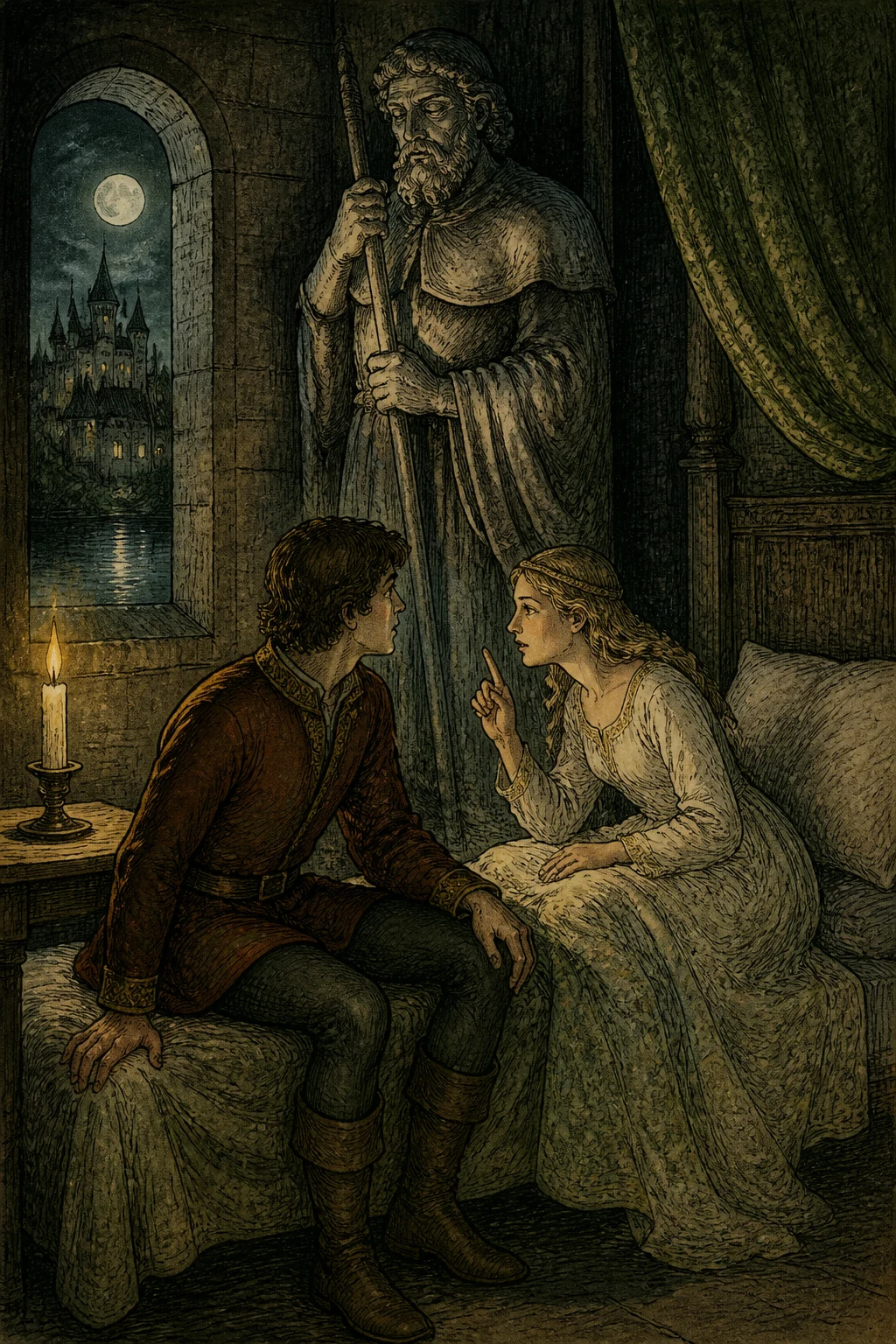
if I am allowed to sleep on the floor of the princess’s bedchamber tonight, close by the door, she shall have the scissors. I shall do her no harm, but if she is afraid, she may have two men stand guard in the room.” Yes, the princess was quite willing to allow that; as long as she got the scissors, she was content. So Askeladden slept on the floor of the princess’s chamber that night, with the two men standing guard. But the princess got little enough sleep even so, for every now and then she felt she must open her eyes and look at Askeladden again. So it went on all night: no sooner had she shut her eyes than she had to steal another glance at him, so handsome did she think him.
In the morning Askeladden was rowed back out to Beggars’ Island, but when the men from the palace came with their porridge scrapings and bottles of whey, no one would taste them that day either;
and the men who brought them were more surprised than ever. Then one of them managed to discover that the lad who had owned the scissors had a tablecloth, and that he had only to spread it out to have all the finest food he wished for. When the man returned to the palace, it was not long before he told the news;
“There have never been such roasts and such cream porridge at the king’s palace,” he said. When the princess heard this, she told the king and begged and pleaded until he had to send to the island for the owner of the tablecloth. So Askeladden came up to the palace again. The princess was determined to have the tablecloth from him, and offered him gold and all the riches in the world for it, but Askeladden would not sell it on any terms or at any price. “But if I am allowed to sleep on the bed-bench in the princess’s bedchamber tonight, she shall have my tablecloth,” said the lad. “I shall certainly do her no harm, but if she is afraid, she may post four men on guard in there.” The princess agreed to this. Askeladden lay on the bed-bench in front of the princess, and the four men stood guard. But if the princess had slept little the night before, she slept still less that night. She could scarcely close her eyes; she had to lie looking at the handsome lad the whole night through, and even then she thought the night too short.
In the morning Askeladden was rowed back out to Beggars’ Island, though certainly not with the princess’s good will, for she had already grown so fond of him. But there was no use pleading: back he had to go. When the men from the palace arrived with the porridge crusts and bottles of whey that were to feed the vagabonds, not one of them would so much as look at what the king had sent. This no longer surprised the palace men, but they did think it strange that none of the vagabonds was thirsty. Then one of the king’s messengers managed to discover that the lad who had owned the scissors and the tablecloth had a spigot of such a kind that he had only to give the peg a little turn, and he would have the finest drinks imaginable, ale and mead and wine alike. When the man returned to the palace, he could no more hold his tongue than on the two previous occasions. He talked at great length about the spigot and how easily it provided every sort of drink. “I am sure the like of that ale and mead has never been tasted at the king’s palace,” he said. “It is sweeter than honey or syrup.” When the princess heard this, she wanted to get hold of the spigot at once, and she had no objection to bargaining with its owner either. So she went to the king again and begged him to send out to Beggars’ Island for the lad who had owned the scissors and the tablecloth, for he had one more thing well worth having, she said. And when the king heard that it was a spigot that supplied the best ale and the best wine anyone could wish to drink, merely by turning its peg, I dare say he was not long in sending the messenger.
When Askeladden came up to the palace, the princess asked whether it was true that he had a spigot of such and such a kind. Yes, he had it in his waistcoat pocket, said Askeladden. But when the princess was determined to buy it, Askeladden said, just as he had the other two times, that he would not sell it on any account, even if the princess offered him half the kingdom. “But never mind,” said Askeladden. “If I am allowed to lie on the outer edge of the princess’s bed tonight, on top of the fur coverlet, she shall have my spigot. I shall do her no harm, but if she is afraid, she may post eight men on guard in the chamber.” Oh no, there was no need for that, said the princess; she knew him well enough by now. So that night Askeladden lay on the edge of the bed, in front of the princess.
But if she had slept little the two previous nights, she slept less still that night. She could not close an eye; all the while she had to lie looking at Askeladden, who lay before her on the edge of the bed.
When she rose in the morning and they were about to row Askeladden back to Beggars’ Island, she asked them to wait a little. Then she ran in to the king and begged him most sweetly to let her marry Askeladden, for she loved him so dearly that if she could not have him, she did not wish to live, she said.
“Oh, certainly you may have him, if you are so set upon it,” said the king. “A man who owns such things is every bit as rich as you.” So Askeladden won the princess and half the kingdom—the other half was to be his when the king died—and all was well and good. But his brothers, who had always treated him so badly, he put out on Beggars’ Island. “There they can stay until they have found out who is best off: the man with his pockets full of money, or the man whom all women love,” said Askeladden. And I dare say it was little use reaching into their pockets and jingling their money on Beggars’ Island. Unless Askeladden has taken them off the island, they are still there eating cold porridge and whey to this very day.