Prevod
The town magistrate stood at the open window in his shirtsleeves, a pin in his frilled shirtfront, and exceedingly clean-shaven, all his own work; he had, however, given himself a little cut, and a scrap of newspaper was stuck over it.
“Here, you little fellow!” he called. And the little fellow was none other than the washerwoman’s son, who happened to be passing and respectfully took off his cap; its peak was broken so that it could be folded into his pocket. In his poor but clean and very neatly patched clothes, and his heavy wooden shoes, the boy stood as respectfully as though he were before the king himself.
“You’re a good boy!” said the magistrate. “You’re a polite boy! Your mother is rinsing clothes down at the river, I suppose; that’s where you’re taking what you have in your pocket. It’s a bad business with your mother! How much have you got there?”
“Half a pægl!” said the boy in a frightened, almost inaudible voice. “And she had as much this morning!” the man went on. “No, that was yesterday!” answered the boy.
“Two halves make a whole! She’s no good! It’s a sad business with that class of people! Tell your mother she ought to be ashamed of herself! And don’t you ever become a drunkard, though I dare say you will! Poor child! Off you go!”
And the boy went on his way, keeping his cap in his hand, while the wind blew through his yellow hair and lifted it in long tufts. He went round by the street, into the alley, and down to the river, where his mother stood in the water beside the washing bench, beating the heavy linen with her wooden paddle. The current was strong, for the mill sluices were open; the sheet was being swept along and threatened to overturn the bench, and the washerwoman had to brace herself against it.
“I’m nearly afloat!” she said. “It’s a good thing you’ve come, for I could do with something to give me strength! It’s cold out here in the water; I’ve been standing here for six hours. Have you brought me anything?”
The boy took out the bottle, and his mother put it to her lips and drank a mouthful. “Oh, what good that does! How it warms me! It’s as good as a hot meal, and not so dear! Have a drink, my boy! You look so pale; you’re cold in those thin clothes! And it’s autumn now, after all. Ugh! The water’s cold! If only I don’t fall ill! But I shan’t! Give me another sip, and have some yourself, but only a little drop; you mustn’t get into the habit, my poor, poor child!”
And she went round to the little landing where the boy stood and stepped ashore; water streamed from the rush mat she wore about her waist and poured from her skirt. “I toil and slave till the blood is ready to burst out from under my nails! But that’s no matter, if only I can bring you up honestly, my dear child!”
Just then a somewhat older woman came along, poor in clothes and flesh, lame in one leg, and with an enormous false curl hanging over one eye. The curl was meant to hide the eye, but only made its defect more noticeable. She was a friend of the washerwoman’s; the neighbours called her “Lame Maren with the Curl.”
“Poor soul, how you toil and slave, standing in that cold water! You could certainly do with a little something to warm you, and yet they begrudge you the drop you get!” And soon almost everything the magistrate had said to the boy had been repeated to the washerwoman, for Maren had heard it all. She was indignant that he should speak to the child in that way about his own mother and the little drop she drank, just when the magistrate himself was giving a grand dinner, with wine by the bottle! “Fine wines and strong wines! And plenty of them taking more than they need to quench their thirst! But that isn’t called drinking! They’re good enough, but you’re no good!”
“So he spoke to you, child!” said the washerwoman, and her lips trembled. “You have a mother who’s no good! Perhaps he’s right! But he ought not to have said it to the child! Still, much has come upon me from that house!”
“You were in service there, weren’t you, when the magistrate’s parents were alive and living in the house? That’s many years ago! Many a bushel of salt has been eaten since then, enough to make anyone thirsty!” And Maren laughed. “There’s a grand dinner at the magistrate’s today. It ought to have been called off, but it was too late, and the food was ready. I heard it from the yardman. A letter came about an hour ago to say that the younger brother has died in Copenhagen.”
“Dead!” cried the washerwoman, turning deathly pale. “Dear me!” said the other woman. “Do you take it so much to heart? Well, you knew him when you were in service there.” “Is he dead? He was the best, the kindest soul! Our Lord does not receive many like him!” And the tears ran down her cheeks. “Oh, my God! Everything is spinning round me! It’s because I finished the bottle! It was too much for me! I feel so ill!” And she leaned against the wooden fence.
“Good heavens, you’re quite poorly, my dear!” said the woman. “Let’s see if it will pass! No, you really are ill! I’d better get you home!” “But the washing!”
“I’ll see to that! Take my arm! The boy can stay here and watch it for the time being, and then I’ll come and wash the rest; there’s only a little left!”
And the washerwoman’s legs shook beneath her. “I’ve stood too long in the cold water! I’ve had neither bite nor sup since this morning! There’s fever in my body! Oh, Lord Jesus! Help me home! My poor child!” And she wept.
The boy wept too, and soon he was sitting alone by the river beside the wet washing. The two women went slowly up the alley and along the street, the washerwoman staggering as she walked. They passed the magistrate’s house, and just outside it she collapsed on the cobblestones. People gathered round.
Lame Maren ran into the courtyard for help. The magistrate and his guests looked out of the windows. “It’s the washerwoman!” he said. “She’s had a little more than she needed to quench her thirst; she’s no good! It’s a pity for that pretty boy of hers. I really do feel kindly towards the child. His mother is no good!”
She was brought round and helped to her poor home, where she was put to bed. Good-hearted Maren set about making a bowl of hot beer with butter and sugar; she believed that was the best medicine. Then she went down to the rinsing place and rinsed the clothes very badly, though with the best intentions; in truth, she did little more than drag the wet washing ashore and put it into a box.
That evening she sat in the poor little room beside the washerwoman. She had got a couple of browned potatoes and a lovely fat piece of ham from the magistrate’s cook for the sick woman, but it was the boy and Maren who enjoyed them; the sick woman took pleasure in the smell, which was so nourishing, she said.
And the boy was put to bed in the very same bed where his mother lay, but his place was crosswise at her feet, with an old rug over him, sewn together from blue and red strips.
And the washerwoman was a little better; the hot beer had strengthened her, and the smell of the fine food did her good. “Thank you, you kind soul!” she said to Maren. “I’ll tell you everything, too, once the boy is asleep! I think he is already! How sweet and blessed he looks, with his eyes closed! He doesn’t know how his mother feels. May Our Lord never let him know such suffering! I was in service with the councillor’s family, the magistrate’s parents, and it happened that the youngest son came home from his studies. I was young then, wild and foolish, but respectable; I dare say that before the face of God!” said the washerwoman. “The student was so merry and happy, such a dear soul! Every drop of blood in him was honest and good! There never was a better person on earth. He was a son of the house, and I only a servant girl, but we became sweethearts, honourably and chastely! Surely a kiss is no sin when two people truly love each other. And he told his mother; she was like Our Lord to him here on earth! And she was so wise, so loving and kind! He went away, and he put his gold ring on my finger. Once he was gone, my mistress called me in to her. She stood there so grave and yet so gentle, and spoke as Our Lord himself might have spoken; she made clear to me the distance between him and me in mind and spirit. ‘Now he sees how pretty you are, but looks will fade! You have not been educated as he has; you cannot meet as equals in the realm of the mind, and that is where unhappiness lies. I respect the poor,’ she said. ‘With God they may perhaps have a higher place than many of the rich, but here on earth one must not turn into the wrong track as one drives along, or the carriage will overturn, and you two will overturn! I know that a worthy man, a craftsman, has proposed to you. It is Erik the glovemaker; he is a widower, has no children, and is comfortably off. Think it over!’ Every word she spoke was like a knife through my heart, but the lady was right! And it crushed me and weighed me down! I kissed her hand and wept bitter tears, and still more when I reached my little room and threw myself across my bed. A dreadful night followed; Our Lord knows what I suffered and how I struggled. Then on Sunday I went to the Lord’s table, to find light within me. And it was as though Providence had arranged it: as I came out of church, I met Erik the glovemaker. Then there was no longer any doubt in my mind; we were suited to each other in station and circumstances—indeed, he was quite a well-to-do man! So I went straight up to him, took his hand, and said, ‘Do you still think of me?’ ‘Yes, for ever and always!’ he said. ‘Will you take a girl who respects and honours you, but does not love you? Though that may come!’ ‘It will come!’ he said, and we gave each other our hands. I went home to my mistress. The gold ring her son had given me lay against my bare breast; I could not wear it on my finger by day, but only each evening when I went to bed. I kissed the ring until my lips bled, and then I gave it to my mistress and told her that the banns would be read from the pulpit next week for the glovemaker and me. Then my mistress took me in her arms and kissed me. She did not say I was no good, though perhaps I was better then, before I had known so much of the world’s adversity. And so we were married at Candlemas; and the first year went well. We kept a journeyman and an apprentice, and you, Maren, were our servant.”
“Oh, you were a blessed mistress!” said Maren. “I shall never forget how kind you and your husband were!” “Those were the good years, when you were with us! We had no children then. I never saw the student! Yes, I did see him, but he did not see me! He came here for his mother’s funeral. I saw him standing by the grave; he was white as chalk and so sorrowful, but that was for his mother’s sake. Later, when his father died, he was abroad and did not come here, nor has he been here since. He never married, I know; I believe he was a lawyer! He did not remember me, and even if he had seen me, I doubt he would have recognised me, I look so dreadful. And perhaps that is just as well!”
And she spoke of the hard days of her trials, of how misfortune seemed to come pouring down upon them. They had five hundred rigsdalers, and when a house in the street came up for sale for two hundred, and it seemed profitable to pull it down and build a new one, they bought it. The mason and carpenter estimated that the further work would cost a thousand and twenty. Erik the glovemaker had good credit and borrowed the money in Copenhagen, but the skipper who was to bring it was shipwrecked, and the money was lost with him.
“That was when I gave birth to my dear boy, who lies sleeping here. His father fell gravely ill, and his illness lasted a long time; for nine months I had to dress and undress him. Everything went downhill for us; we borrowed and borrowed. All our belongings went, and his father died and left us! I have toiled and slaved, struggled and striven for the child’s sake, scrubbed stairs and washed linen, coarse and fine, but Our Lord does not mean me to have an easier lot! Still, he will surely release me and provide for the boy.”
And then she slept. Towards morning she felt refreshed and strong enough, she thought, to go back to work. She had only just stepped into the cold water when a trembling and faintness seized her; she reached out convulsively with her hand, took a step towards the bank, and fell. Her head lay on dry land, but her feet were out in the river; the wooden shoes she had worn while standing on the riverbed, each with a wisp of straw inside, drifted away on the current. Here Maren found her when she came with coffee.
A messenger from the magistrate had been to her home to say that she must come to him at once; he had something to tell her. It was too late. A barber was fetched to bleed her; the washerwoman was dead.
“She drank herself to death!” said the magistrate. The letter bringing news of his brother’s death had also given the contents of the will, which stated that six hundred rigsdalers were left to the glovemaker’s widow, who had once been in service with his parents. The money was to be given to her and her child in larger or smaller sums, as seemed best.
“There was some hanky-panky between my brother and her!” said the magistrate. “It’s a good thing she’s out of the way; now the boy will have it all, and I shall place him with respectable people. He may become a good craftsman!” And upon those words Our Lord laid his blessing.
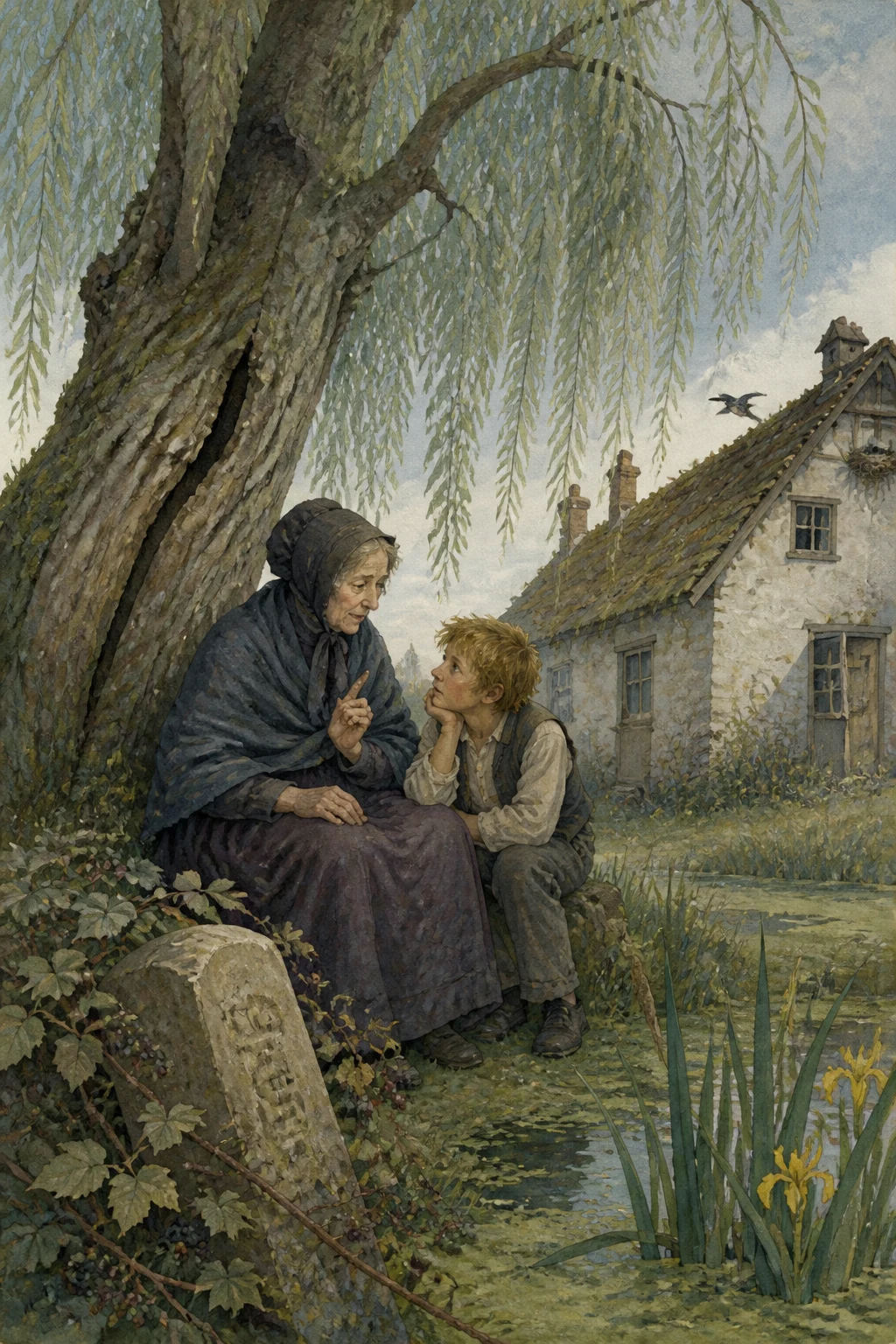
And the magistrate sent for the boy, promised to provide for him, and told him what a good thing it was that his mother was dead; she was no good! She was taken to the churchyard, the burial ground of the poor. Maren planted a little rosebush on the grave, and the boy stood beside her.
“My dear mother!” he said, his tears streaming. “Is it true that she was no good?” “No, she was good!” said the old woman, looking up towards heaven. “I know it from all those years, and from her last night. I tell you, she was good! And Our Lord in the kingdom of heaven says so too. Let the world say, ‘She was no good!’”