Prevod
_Jannuccio has two children by his first wife and marries a second time. Their stepmother hates them so bitterly that he takes them into a wood, where they become separated. Nennillo becomes a prince’s favorite courtier, while Nennella throws herself into the sea and is swallowed by an enchanted fish. When it casts her up onto a rock, her brother recognizes her, and the prince marries her off to a very wealthy man._ _Ciulla having finished her race, Paola made ready to run for the prize, and after clearing her throat with a hearty rasp and wiping her mouth with a new handkerchief of linen and hemp, she began as follows._ Wretched is the man who, having children, hopes to provide for them by giving them a stepmother, for he brings into his house the very engine of their ruin. Never yet was a stepmother seen to look kindly on another woman’s brood; and if, by some chance, one has been found, you may stop the hole with a twig and call her a white crow. But among the many you may have heard spoken of, I shall tell you of one who deserves a place on the roll of heartless stepmothers, and whom you will judge worthy of the punishment she bought with ready money.
Once upon a time there was a father called Jannuccio, who had two children, Nennillo and Nennella, whom he loved as dearly as the pupils of his eyes. But Death, with the silent file of time, having broken through the bars that imprisoned his wife’s soul, he married an ugly shrew, a cursed she-dog, who had scarcely set foot in her husband’s house before she began to insist on having the stable all to herself, saying, “Have I come here to pick the lice off another woman’s children?
“This was all I needed now, to saddle myself with somebody else’s burdens and have these little wretches forever underfoot! Better to have broken my neck than come into this hell, to eat badly, drink worse, and sleep worse still, plagued by these little shits! This is no life to put up with. I came here as a wife, not a serving wench. We must find some way out of this and somewhere to put these plasters, or I shall find somewhere for myself. Better to blush once than turn pale a hundred times. Let us settle matters for good:
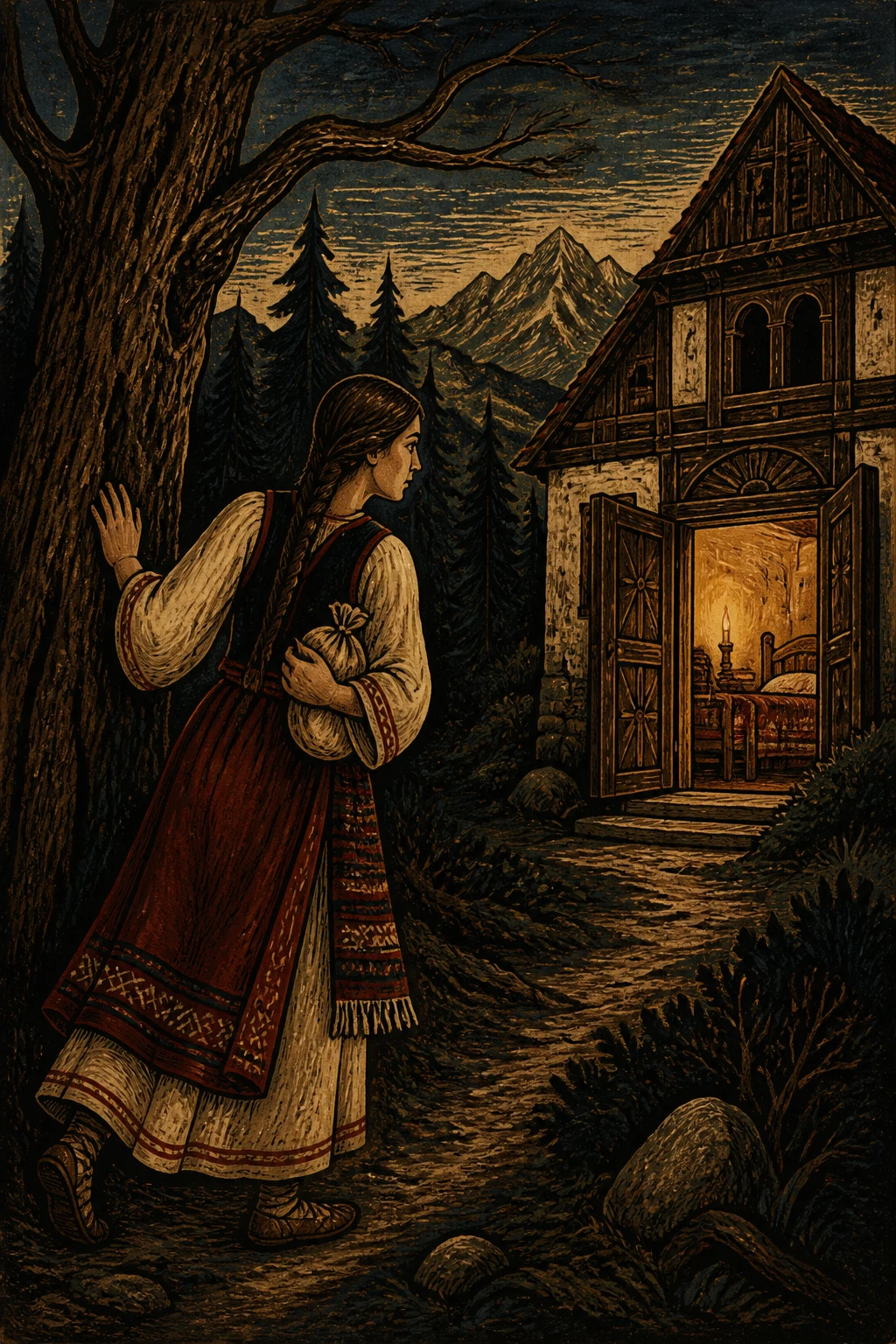
“I am quite determined to see this business through, or break with you altogether.” The poor husband, who had grown somewhat fond of this woman, said to her, “Do not lose your temper, my wife; sugar is dear. Tomorrow morning, before the cock crows, I shall rid you of this trouble, to keep you happy.” And so, the next morning, before Dawn spread her red Spanish blanket to shake the fleas out of the window of the East, he took his children, one by each hand, and, with a good basket of food hanging from his arm, led them into a wood where an army of poplars and beeches held the shadows under siege. When they arrived, Jannuccio said, “My little ones, stay here, and eat and drink merrily. When you need anything, look for this trail of ashes I am scattering: it will be the thread to lead you out of the labyrinth and bring you straight home.” Then he gave each of them a kiss and went back to his house in tears. But when all the animals, summoned by the bailiffs of night, were paying nature her due of necessary rest, the little ones—perhaps frightened at being in that lonely place, where the waters of a river thrashed the impudent stones that got in its way with a noise that would have made a Rodomonte shudder—set off slowly along the little trail of ashes. It was already midnight when, step by little step, they reached home. There Pascozza, their stepmother, behaved not like a woman but like a fury from hell, shrieking to the skies, stamping her feet and beating her hands, and snorting like a startled horse. “What a fine business this is!” she cried. “Where have these rags and tatters sprung from?
“Is there no quicksilver to prise them out of this house? Must you keep them here to break my heart? Go and take them out of my sight this very instant! I will wait for neither the music of cocks nor the lamentations of hens. Otherwise, you may pick your teeth with the hope of my sleeping with you, and tomorrow morning I shall slip away to my own people, for you do not deserve me. And to think I brought so much fine furniture into this house, only to see the shit and smell the stink of other people’s backsides! I did not bring such a handsome dowry to be a slave to children who are not mine.” Unfortunate Jannuccio, seeing his boat headed for the rocks and the business growing far too heated, took the little ones away that very moment and went back to the wood. There he gave the children another little basket of food and said, “You see, my darlings, how that bitch of a wife of mine loathes you. She came into my house to be your ruin and a nail driven through my heart.
“So stay here in this wood, where the trees, more merciful than she, will spread a canopy to shelter you from the sun; where the river, more charitable, will give you drink without poison; and where the earth, more kindly, will give you mattresses of grass without danger. And when you run out of food, here is a little path of bran I am making for you, straight as can be, along which you may come to seek help.” Having said this, he turned his face away so that they would not see him weeping and lose heart, poor little scraps. When they had eaten everything in the basket, they wished to go home; but because some ill-starred donkey had gobbled up the bran scattered on the ground, they lost their way. For several days they wandered about the wood, feeding on acorns and chestnuts they found fallen on the earth. But since Heaven always holds its hand over the innocent, it so happened that a prince came hunting in that wood. When Nennillo heard the barking of the dogs, he was so frightened that he hid inside a hollow tree he found, while Nennella ran so far that she came out of the wood and reached the seashore. Some corsairs had landed there to gather firewood; they seized her, and their captain took her home, where he and his wife, who had lately lost a little daughter, adopted her as their own. But to return to Nennillo: as he crouched inside the hollow tree, the dogs surrounded him, raising a din fit to deafen anyone. The prince went to see what was there and found this handsome little boy, who was too young to tell him who his father and mother were. He had him set upon one of the hunters’ saddles and, taking him back to the royal palace, brought him up with great care and had him taught many accomplishments. Among other things, he had him trained as a carver, and within three or four years the boy became so skilled at his art that he could cut to a hair’s breadth. Meanwhile, it had been discovered that the corsair who was keeping Nennella was a sea robber, and orders were given for his arrest. But he had friends among the clerks, whose mouths he kept well fed, and so he slipped away with his whole household. Perhaps it was Heaven’s justice that a man who had committed his crimes at sea should pay the penalty at sea; for he embarked in a frail boat, and when he was out in the open water, such a squall arose, and the waves grew so furious, that the boat capsized and they all went under like ducks. Nennella alone, who had no share in his robberies as his wife and children had, escaped this danger. For at that very moment a great enchanted fish happened to be near the boat, and, opening the enormous gulf of its throat, it swallowed her. But just when the girl thought her days were ended, she found something to marvel at inside the fish’s belly: beautiful fields, wondrous gardens, and a lordly house with every comfort, where she lived like a princess. The fish carried her, snug and dry, to a rocky islet where the prince had come to take the air, for it was the most sultry part of summer and the heat was fierce. While a magnificent banquet was being prepared, Nennillo had stationed himself on a balcony of the palace overlooking the rock to sharpen some knives, taking great delight in his craft and wishing to do himself credit. Nennella, seeing him through the fish’s throat, called out in a hollow voice, “Brother, brother dear, the knives are whetted, the tables are set, and I weary of life without you inside this fish.” The first time, Nennillo paid no heed to the voice.
But the prince, who was on another balcony, turned at this lament, saw the fish, and heard the same words repeated. He was beside himself with astonishment and sent a number of servants to see whether they could somehow entice the fish ashore. At last, hearing it repeat the same cry over and over—“My brother, my brother!”—he asked all his people, one by one, whether any of them had a sister who had gone missing. Nennillo answered that he was beginning to remember, as though in a dream, that when the prince had found him in the wood, he had had a sister of whom he had never heard any more. The prince told him to go up to the fish and see what the matter was: perhaps this good fortune had been kept in store for him. Nennillo approached, and the fish laid its head upon the rock and opened its throat six spans wide. Out came Nennella, so beautiful that she looked like a nymph appearing in a stage interlude, conjured out of the creature by some magician’s spell. When the king asked how all this had come about, she told him something of their troubles and their stepmother’s hatred. But since they could remember neither their father’s name nor where they lived, the king had it proclaimed that whoever had lost two children called Nennillo and Nennella in a wood should come to the royal palace, where he would hear good news of them. Jannuccio, whose heart had remained dark and desolate, believing they had been eaten by wolves, ran in great joy to the prince and said that he was the one who had lost these children. When he had told the story of how he had been forced to take them into the wood, the prince gave him a sound scolding, calling him a worthless sheep who had let a wretched woman plant her heel upon his throat and bring him to the point of sending two such jewels as his children wandering into the wild. But after cracking his skull with these words, he laid on the plaster of consolation by showing him his children, whom for half an hour he could not kiss and embrace enough. The prince had the rags stripped from his back and dressed him as a gentleman. Then he sent for Jannuccio’s wife and showed her those two nuggets of gold, asking, “What would someone deserve who harmed them and put them in danger of death?” She answered, “For my part, I would shut her in a barrel and roll her down a mountain.” “Then you shall have it,” said the prince. “The goat has turned her horns against herself. Come now: since you have passed your own sentence, you must pay for having borne such hatred toward these beautiful stepchildren.” And so he ordered that the sentence she herself had pronounced should be carried out. Then he found a very wealthy gentleman among his vassals and gave him Nennella in marriage, while to her brother he gave the daughter of another gentleman of equal standing. He granted them enough income to support themselves and their father, so that they had no need of anyone in the world. As for the stepmother, wrapped in a barrel, she brought her life to a shattering end, crying through the bunghole as long as she had breath, _Misfortune may be slow, but woe to whoever awaits it._ _Then comes one stroke of luck, and pays for all._