Prevod
_Cenzullo wants no wife, but after cutting his finger over a ricotta, he longs for a woman whose complexion is white and red, like the mingling of cheese and blood. He therefore wanders the world as a pilgrim, and on the Island of the Three Fairies receives three citrons. From one of these, when he cuts it open, he obtains a beautiful fairy after his own heart. A slave woman kills her, and he takes the black woman in place of the white; but when the treachery is discovered, the slave is put to death, and the fairy, restored to life, becomes queen._ _There is no saying how much all the companions enjoyed Paola’s tale. But now it was Ciommetella’s turn to speak, and, having received the signal, she began as follows._ That wise man spoke well indeed who said, “Do not tell all you do, nor do all you can,” for either may bring dangers unforeseen and ruin unexpected, as you shall hear of a certain slave woman—with all due respect to Her Highness the Princess—who, in striving to do every possible harm to a poor girl, so mishandled the business that she became the judge of her own crime and pronounced upon herself the punishment she deserved.
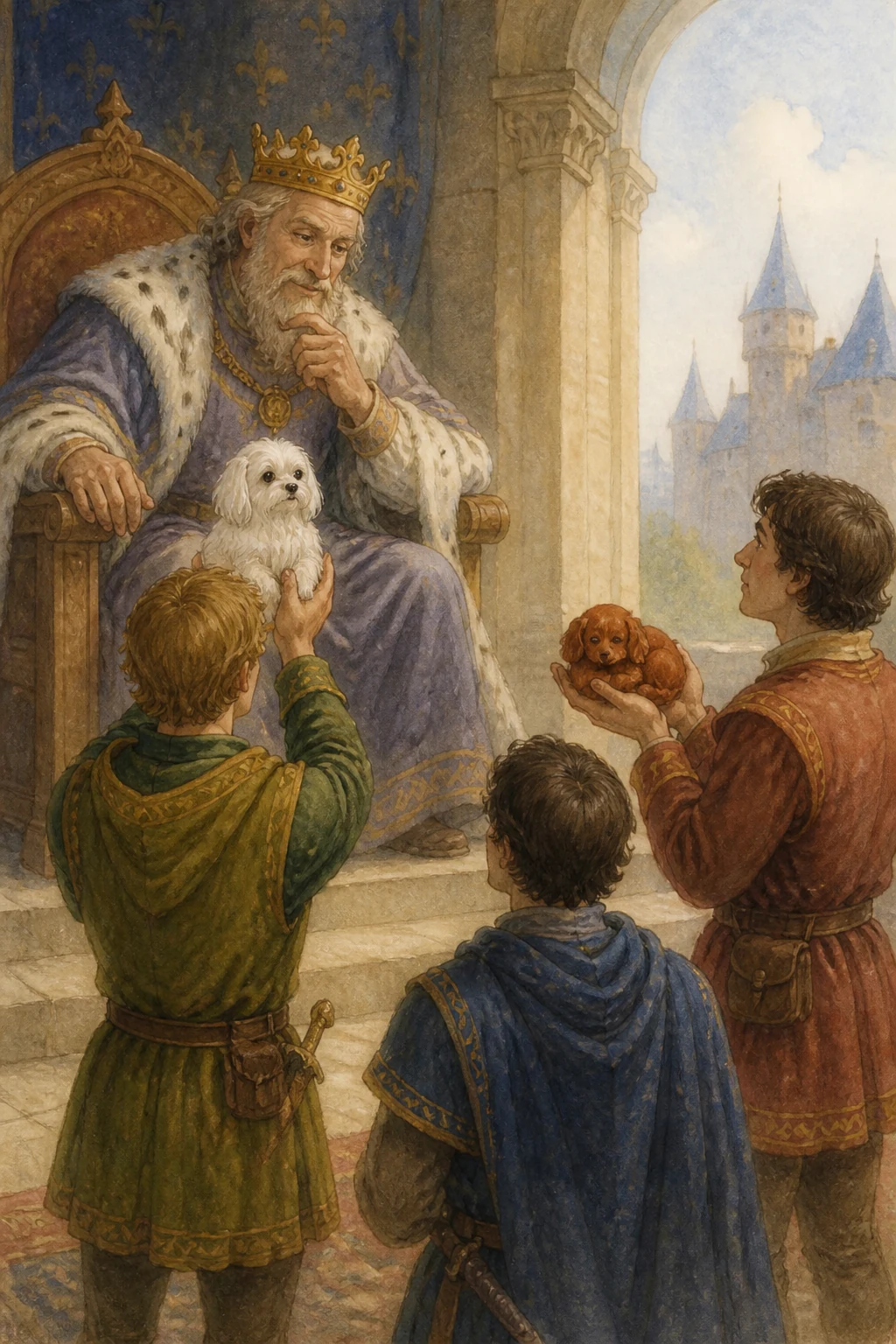
The King of Torre-longa had a son who was the apple of his eye, upon whom he had built every hope, and he could hardly wait to find him a good match and hear himself called Grandfather. But this prince was so unsociable and uncouth that whenever a wife was mentioned he shook his head, and you would find him a hundred miles away. Thus the poor father, seeing his son so stubborn and obstinate, and all his hopes come to nothing, was more bursting with vexation, more choked and swollen with rage, than a whore who has lost her regular customer, a merchant whose correspondent has gone bankrupt, or a farmer whose donkey has died. For neither his father’s tears nor his subjects’ entreaties could soften him, nor could the counsel of worthy men turn him from his course. They set before his eyes the pleasure of the man who had begotten him, the needs of his people, and his own interests, since he was putting a full stop to the royal line; but with the wilfulness of Carella, the obstinacy of an old mule, and a hide four fingers thick at its thinnest, he had planted his feet, plugged his ears, and boarded up his heart so tightly that you might sound the call to arms against it. But since more often happens in an hour than in a hundred years, and no one can say, “I shall never go down that road,” it happened one day, when they were all at table together, that the prince, meaning to cut a ricotta in half while watching the jackdaws fly past, unfortunately nicked his finger. Two drops of blood fell upon the cheese, making so lovely and charming a mingling of colours that—whether it was a punishment from Love, who lay in wait for him, or the will of Heaven, wishing to console his worthy father, whom no domestic colt could ever have plagued as this wild one tormented him—he took it into his head to find a woman as white and red as that ricotta stained with his own blood. And he said to his father, “My lord, unless I have a little darling of this complexion, I am done for. No woman ever stirred my blood before, and now I want a woman like my own blood. So, if you wish me alive and well, resolve to give me the means to travel the world in search of a beauty who matches this ricotta to a hair; otherwise I shall finish my course and go to the devil.” When the king heard this monstrous resolve, the house seemed to come tumbling about his ears. He stood thunderstruck, one colour leaving his face as another entered it; and when he came to himself and could speak, he said, “My son, core of my soul, apple of my heart, crutch of my old age, what madness has seized you? Have you lost your senses? Have your wits deserted you? It is all one thing or the other: first you would have no wife, to rob me of an heir; now you crave one, to drive me out of this world. Where, where do you mean to wander, forlorn and forsaken, wasting your life and leaving your own home—your own home, your own little hearth, your own dear doorstep? Do you not know how many hardships and dangers a traveller faces? Let this whim pass, my son; listen to reason. Do not seek to see this life of mine cut short, this house fallen to the ground, this kingdom gone to ruin.” But these and all his other words went in at one ear and out at the other: they were so much seed cast into the sea. At last the wretched king, seeing that his son was as deaf to him as a bell-ringer’s jackdaw, gave him a good handful of crowns and two or three servants, and let him go, feeling his soul torn from his body. Then he leaned out from a balcony, weeping as though his very life were being cut away, and followed him with his eyes until he vanished from sight. So the prince departed, leaving his father miserable and embittered, and began to trot through fields and woods, over mountains and valleys, across plains and down slopes, seeing many countries, dealing with many peoples, and always keeping his eyes open in hopes of finding the object of his desire. After four months he reached the coast of France, where he left his servants in hospital with gout in their feet and embarked alone in a Genoese sailing boat. Making for the Strait of Gibraltar, he boarded a larger ship there and sailed towards the Indies, searching from kingdom to kingdom, province to province, town to town, street to street, house to house, and hovel to hovel, to see whether he could find the living original of the beautiful image painted upon his heart. So long did he ply his legs and turn his feet that he came at last to the Island of the Ogresses. There he cast anchor and went ashore, and found an old, old woman, who was thin, thin, and ugly, ugly in the face. He told her what had drawn him to those parts, and she was beside herself on hearing of this prince’s fine fancy and fanciful chimera, and the hardships and perils he had endured to satisfy his whim. “My son,” she said, “be off! If my three daughters catch sight of you—and they are the slaughterhouse of human flesh—I would not give three farthings for you. Half alive and half roasted, you will have a pan for your bier and a belly for your grave. But make your feet as swift as a hare’s, for you have not much farther to go before you find your fortune.”
Hearing this, the prince, all shudders and chills, terrified and bewildered, set the road between his legs and, without so much as saying, “Let me gather myself,” began wearing out his shoes until he reached another country. There he found another old woman, worse than the first, and told her the whole affair down to the last crumb. She too said, “Clear out of here quickly, unless you want to serve as luncheon for my little ogress daughters. But get along, for night is falling: a little farther on you will find your fortune.” At this the poor prince began to take to his heels as though firecrackers were tied to his tail, and walked on until he found another old woman. She was sitting upon a wheel, with a basket hanging from her arm, full of little pastries and sweetmeats, which she fed to a troop of donkeys. Afterwards they went leaping along a riverbank, kicking at some poor swans. The prince came before the old woman, paid her a hundred honeyed compliments, and told her the story of his pilgrimage. She comforted him with kindly words and gave him so good a meal that he licked his fingers. When he rose from the table, she handed him three citrons that looked as though they had that instant been picked from the tree, and also gave him a fine knife, saying, “You may turn straight back towards Italy now, for your spindle is full, and you have found what you are seeking. Go, then, and when you are not far from your own kingdom, cut open a citron at the first fountain you find. A fairy will come out and say, ‘Give me a drink,’ and you must be quick with the water, or she will slip away like quicksilver. If you are not quick enough with the second fairy either, keep your eyes open and be prompt with the third, so that she does not escape you. Give her a drink at once, and you will have a wife after your own heart.” Overjoyed, the prince kissed a hundred times that hairy hand, which looked like a porcupine’s back, then took his leave and departed from those lands. Reaching the shore, he sailed towards the Pillars of Hercules and entered our seas; and after a thousand storms and perils he made port a day’s journey from his kingdom. He came to a lovely little wood, where the shadows built a palace for the meadows to keep them hidden from the sun, and dismounted beside a fountain whose crystal tongue whistled to passers-by to come and cool their mouths. Sitting upon a Syrian carpet woven of grass and flowers, he drew his knife from its sheath and began to cut the first citron. And behold, like a flash of lightning, out came a most beautiful girl, white as milk and cream, red as a cluster of strawberries, saying, “Give me a drink.” The prince was so astonished, so open-mouthed and spellbound at the fairy’s beauty, that he was not quick enough to give her water, and her appearing and disappearing were all one instant. What a blow this was to the prince’s skull may be imagined by anyone who, longing for some great thing, has had it in his grasp and lost it. But when he cut the second citron, the same thing happened, and this was a second cudgel-blow upon his temples. He made two little brooks of his eyes and shed tears drop for drop with the fountain, face to face, head to head, cheek to cheek, matching it without yielding an inch. Meanwhile he lamented, “What an unlucky wretch I am—bless this year of mine! Twice I have let her slip away, as though my hands were tied. A plague on me! How I move like a rock when I ought to run like a greyhound! Upon my word, I have done a fine thing! Wake up, poor fool: there is still another. At the third throw the king wins. Either this knife shall give me the fairy, or it shall do something foul.” So saying, he cut the third citron; out came the third fairy, and she said, like the others, “Give me a drink.” The prince instantly offered her water, and there remained in his hands a girl tender and white as fresh curd, streaked with red like a ham from Abruzzo or a sausage from Nola: a thing never before seen in the world, beauty beyond measure, whiteness beyond all whiteness, grace surpassing grace. Jupiter had showered gold upon her hair, from which Love fashioned arrows to pierce men’s hearts. Upon that face Love had worked a spell, so that some innocent soul might hang upon the gallows of desire. In those eyes the sun had lit two blazing illuminations, so that in the breast of anyone who saw her the powder barrels would catch fire and send up rockets and firecrackers of sighs. Venus had passed across those lips with her paint, colouring the rose whose thorns would prick a thousand loving souls. Into that bosom Juno had pressed the milk from her breasts to nourish human longing. In short, she was so beautiful from head to foot that no more exquisite thing could be imagined. The prince scarcely knew what had happened to him, and gazed in rapture at so lovely an offspring of a citron, so fine a figure of a woman sprung from the cutting of a fruit. He said to himself, “Are you asleep or awake, Ciommetiello? Is your sight bewitched, or have you put your eyes on backwards? What a white thing has come out of a yellow rind! What sweet pastry from the sourness of a citron!
What a splendid firework from a pip!” At last, finding that it was no dream and that the game was being played in earnest, he embraced the fairy, giving her hundreds upon hundreds of little nibbling kisses. And after a thousand loving words passed back and forth between them, words whose plainchant was embroidered with the counterpoint of sugary kisses, the prince said:
“My soul, I will not take you to my father’s country without finery worthy of your lovely person and an escort befitting a queen. So climb this oak, where nature seems to have made a little recess shaped like a chamber expressly for our needs, and wait for me to return. I shall put on wings, and before this spittle dries I shall be back, to convey you to my kingdom dressed and attended as you deserve.” And so, after the proper courtesies, he departed. Meanwhile a black slave woman was sent by her mistress with a pitcher to fetch water from that fountain. Happening to see the fairy’s image in the water, she thought it was her own, and began to say in great amazement, _“What this mean, unlucky Lucia? You be so beautiful, and mistress send you fetch water, and me put up with this?”_ So saying, she broke the pitcher and went home. When her mistress asked why she had done such a bad piece of service, she answered, _“Me go little fountain, stone knock pitcher.”_ Her mistress swallowed this tale, and the next day gave her a fine barrel to fill with water. Returning to the fountain, and again seeing that beauty shining in the water, she heaved a great sigh and said, _“Me not thick-lipped slave, me not ugly fright, since me be beautiful and gentle, and carry barrel to fountain?”_ And with that, crash went the barrel once more: she smashed it into seventy pieces, and, going home, told her mistress in a jumble of words, _“Donkey go past, barrel get knock, fall on ground, all break to bits.”_ At this the poor mistress could restrain herself no longer. Seizing a broomstick, she thrashed her so soundly that she felt it for days, then took a leather water-bag and said, “Run, breakneck, beggarly slave, grasshopper-legs, you black wretch with your backside full of holes! Run, and no dawdling, no shilly-shallying, Lucia! Bring me this full of water, or I shall pound you like an octopus and give you such a cropping that you will remember me.” Away ran the slave, heels over head, for she had seen the lightning and feared the thunder. As she filled the water-bag, she gazed once more at the lovely image and said, _“Me be fool if me fetch water. Better me find husband for myself. This beauty not meant to work self to death and serve angry mistress.”_ So saying, she took a large pin she wore in her hair and began to prick the water-bag until it looked like a garden plot full of hidden water-jets, sending out a hundred little fountains. At the sight, the fairy burst into peals of laughter. The slave heard her, looked up, and discovered the trick, saying to herself:
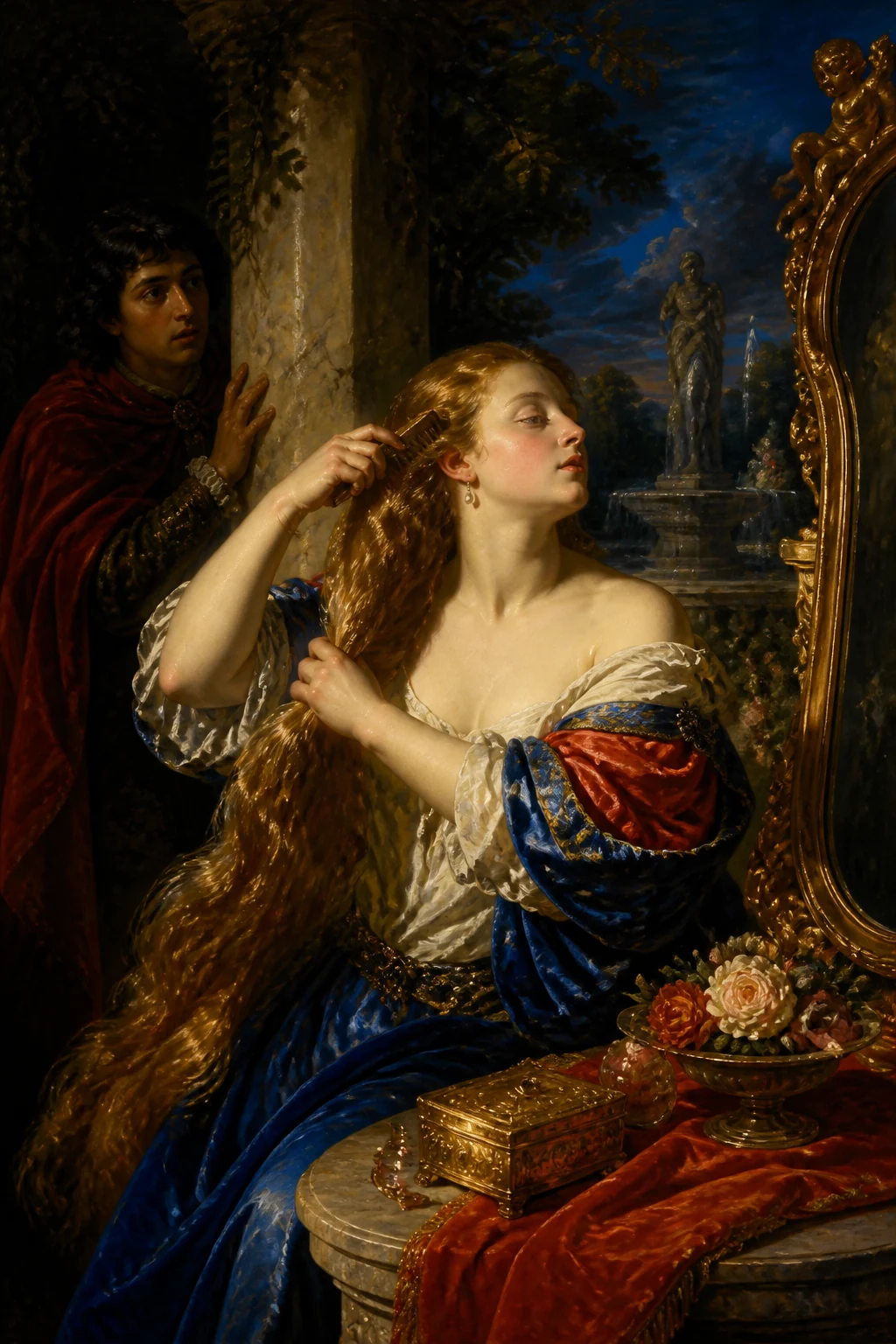
_“You cause me get beaten, but never mind!”_ Then she said to the fairy, _“What you doing up there, pretty girl?”_ And the fairy, who was courtesy itself, poured out everything in her heart, leaving out not a jot of what had happened with the prince, whom she was expecting any hour, any moment, with clothes and an escort, to take her to his father’s kingdom and marry her. Hearing this, the hairy-legged slave resolved to win the hand before the cards were played, and said to the fairy, _“Since you waiting for husband, let me come up, comb your hair, make you more beautiful.”_ The fairy replied, “You are as welcome as the first of May.” The slave climbed up, and the fairy held out her little white hand, which, grasped by those black twigs, looked like a crystal mirror in an ebony frame. Once up, the slave began to search through her hair, and drove the great pin into her head. Feeling herself pierced, the fairy cried, “Dove, dove!” and, turning into a little dove, took wing and flew away. The slave stripped naked, bundled up the rags and tatters she had been wearing, and flung them a mile away. Remaining in the tree as her mother had made her, she looked like a statue of jet inside a house of emerald. Meanwhile the prince returned with a great cavalcade, and, finding a barrel of caviar where he had left a little tub of milk, was out of his senses for a while. At last he said, “Who has made this blot of sour ink upon the royal paper where I thought to write my happiest days?
Who has hung in mourning that freshly whitewashed house where I expected to take my pleasure? Who makes me find this black touchstone where I left a silver mine that was to make me rich and blessed?”
But the sly slave, seeing the prince’s amazement, said, _“No wonder, my prince, for me be black girl under spell: white in swaddling-clothes, black when grown.”_ The poor prince, since there was no remedy for the evil, grew horns like an ox and swallowed this bitter pill. He had the lump of coal brought down, dressed her from head to foot in new clothes, and decked her out in all her finery. Then, choked, swollen, puffed up and sulking, he set off for home. The king and queen came six miles out of the city to meet them, and received them with as much pleasure as a prisoner receives notice of a decree that he be hanged, seeing what a fine result their foolish son had achieved: he had travelled so far to find a white dove and brought home a black crow. Nevertheless, since there was no help for it, they resigned the crown to the bridal pair and set the golden circlet above that coal-black face. Now, while astonishing festivities and stupendous banquets were being prepared, and the cooks were plucking geese, slaughtering pigs, skinning kids, larding roasts, skimming capons, and making a thousand other dainty morsels, a beautiful dove came to a little kitchen window and said:
_“Cook in the kitchen, tell me true,_ _What does the king with the Saracen do?”_ The cook paid little heed; but when the dove returned a second and a third time to do the same, he ran to tell those at table of this marvel. When the lady heard that tune, she ordered the dove to be caught at once and made into a baked dish. So the cook went and contrived to catch her, and carried out the command of that old witch. Having scalded the bird to pluck it, he threw the water and feathers onto a patch of ground beyond a balcony. Before three days had passed, a fine citron tree sprang up there and grew in the twinkling of an eye. It happened that the king, looking out of a window on that side, saw this tree, which he had never noticed before. He summoned the cook and asked when and by whom it had been planted. On hearing the whole story from Master Ladle, he began to suspect something, and ordered, on pain of death, that no one touch the tree, but that it be tended with every care. Within a few days three beautiful citrons appeared, like those the ogress had given him. When they were ripe, he had them picked and shut himself in a room with a great bowl of water and the same knife he always carried at his side. He began to cut them, and the same thing happened with the first and second fairy as had happened before. At last he cut the third citron, and gave the fairy who came out the drink she asked for; and there remained with him the very girl he had left in the tree. From her he learned all the wickedness the slave had done. Who could tell the least part of the king’s joy at this good fortune? Who could tell how he strutted, leaped, gloated and gloried? Imagine him swimming in sweetness, unable to contain himself in his own skin, transported to another world, clogs and all. After pressing her tight in his arms, he had her splendidly dressed, and, taking her by the hand, led her into the hall, where all the ladies of the court and the people of the city had gathered to honour the feast. Calling them one by one, he said, “Tell me, what punishment would someone deserve who had harmed this beautiful lady?” One replied that such a person deserved a hempen necklace;
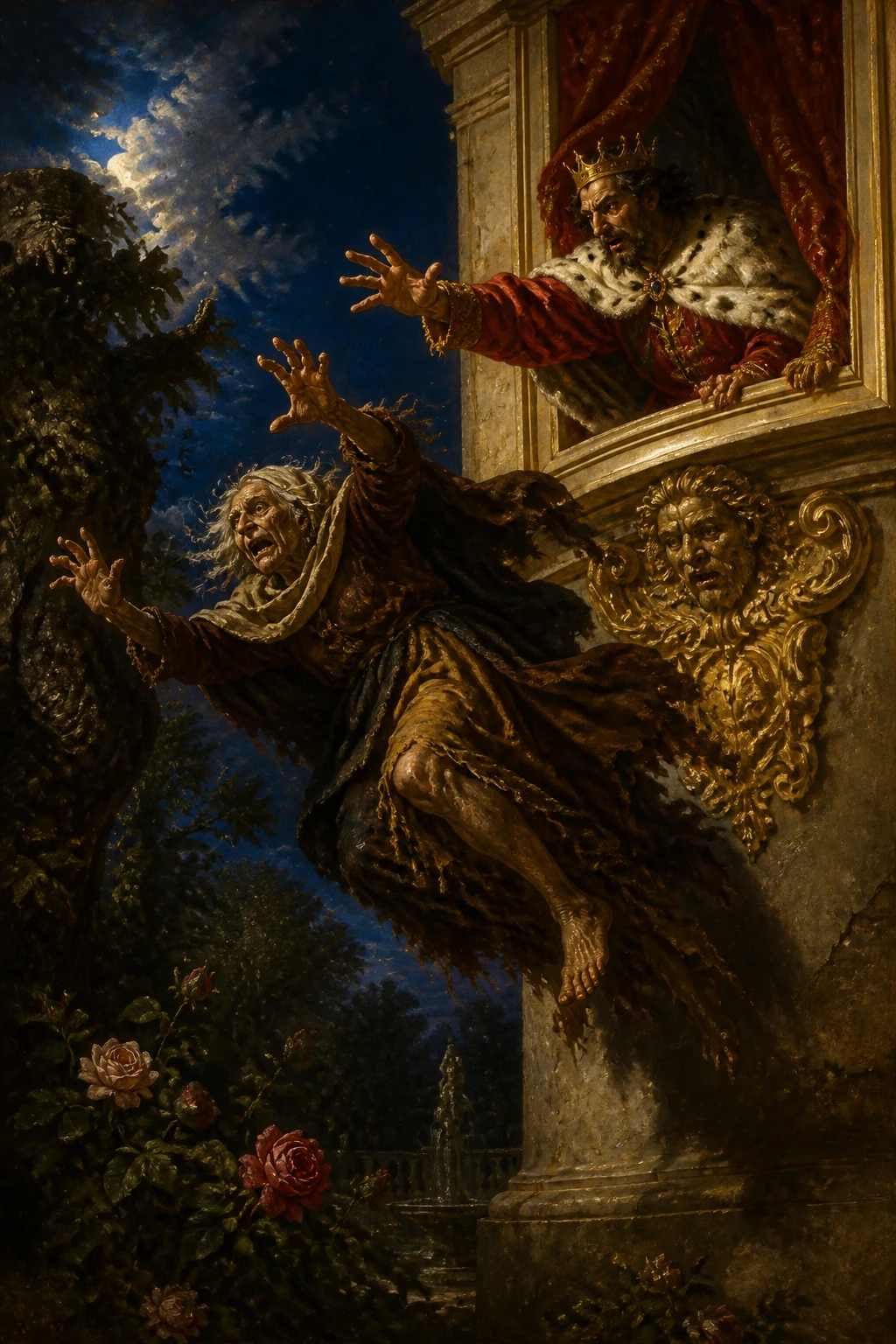
another, a breakfast of stones; another, a tune beaten with a mallet upon the skin of the belly; another, a draught of scammony; another, a millstone for a bracelet; and so they proposed one thing and another. At last he called the black queen and put the same question to her. She answered, _“Deserve burn, and ashes throw from castle.”_ Hearing this, the king said, “You have struck your own foot with the axe; you have built your own stocks, sharpened your own knife, mixed your own poison. For no one has harmed her more than you, you cur, you bitch, you faithless wretch! Do you know that this is the lovely girl whose head you pierced with your pin? Do you know that this is the beautiful dove you had killed and cooked in the pot? Well, Cecca, what do you think of that nag? Shake yourself—the load has not fallen yet! A fine mess you have made! Who does evil must expect evil; who cooks twigs serves smoke.” So saying, he had her lifted bodily and placed alive upon a great pile of wood. When she had been reduced to ashes, they scattered them to the wind from the top of the castle, proving the truth of the saying, _“Let him who sows thorns never go barefoot.”_