Prevod
Once upon a time there were a man and his wife who needed to sow their fields, but they had neither seed corn nor money to buy any. They owned just one cow, and the man was to take it to town and sell it to get money for seed. But when it came to the point, his wife dared not let him go, for she was afraid he would drink the money away. So she set off with the cow herself, and took a hen along as well.
Near the town she met a butcher. “Are you selling that cow, mother?” he asked. “Yes, indeed I am,” she said. “And what are you asking for her?” “I suppose I must have a mark for the cow, but you shall have the hen for ten dalers,” she said. “Well,” he answered, “I have no use for the hen, and you will surely find someone to take her when you get to town, but I will give you a mark for the cow.” She sold her cow and received her mark, but there was no one in town who would give ten dalers for a scrawny, mangy hen. So the woman went back to the butcher and said, “I cannot get rid of the hen, father!
You had better take her too, since you have got the cow.” “I dare say we can settle that,” said the butcher. Then he treated her to a meal and gave her so much brandy that she grew drunk and lost all her wits.
While she was sleeping it off, the butcher dipped her in a barrel of tar and then laid her in a heap of feathers. When she woke, she was feathered all over and began to wonder: “Is it me, or is it not me? No, it can never be me! It must be some great strange bird.
But how am I to find out whether it is me or not? Ah, now I know how I can tell whether it is me: if the calves lick me and the dog does not bark at me when I get home, then it is me!” No sooner did the dog catch sight of such a monster than it began barking as though the farm were full of thieves and rogues.
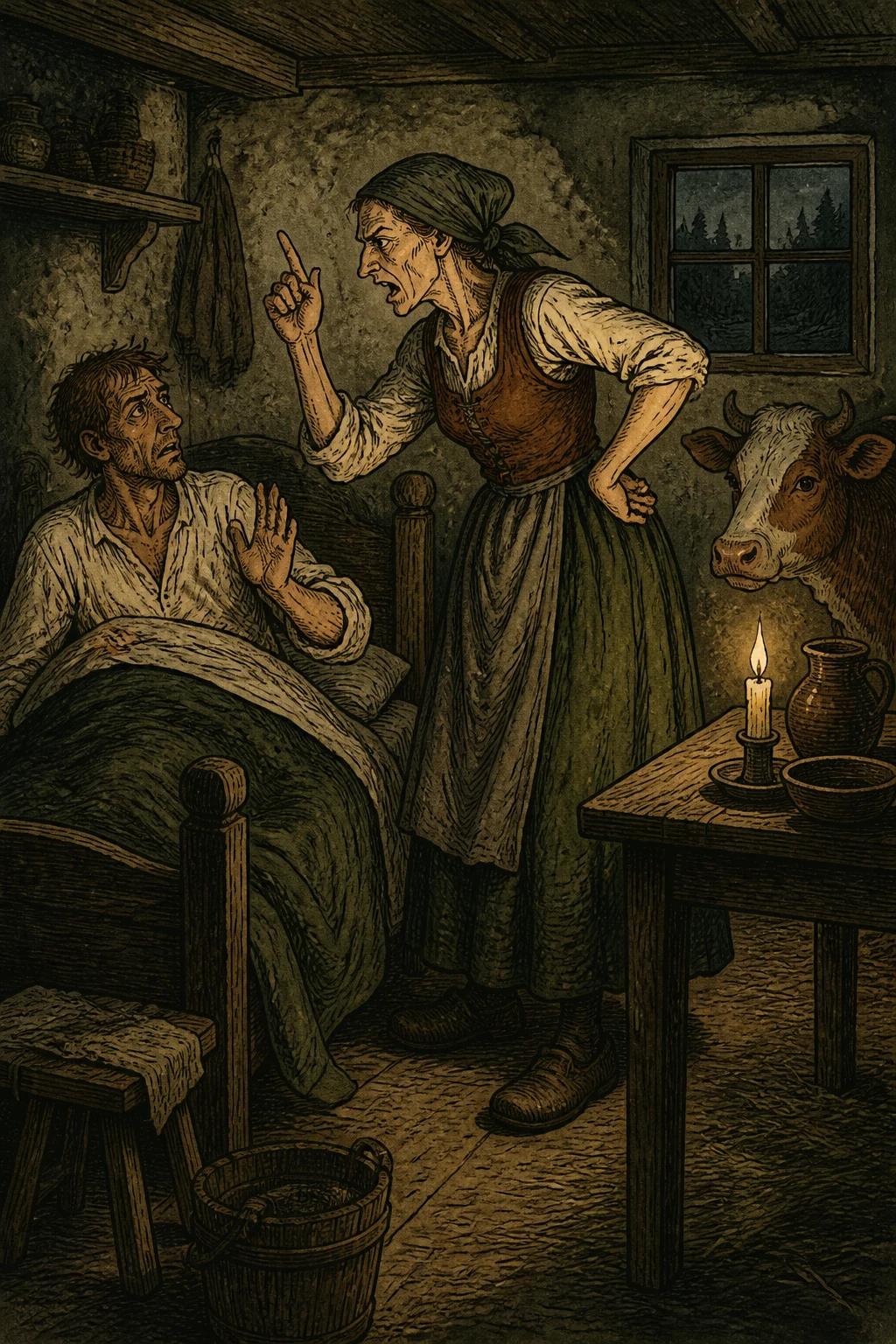
“No, it surely cannot be me,” she said. When she went into the cowshed, the calves would not lick her, for they smelled the reek of tar. “No, it cannot be me; it must be a strange bird,” she said. Then she climbed onto the storehouse roof, began flapping her arms as if they were wings, and tried to fly. When her husband saw this, he came out with his rifle and began to take aim. “Oh, do not shoot, do not shoot!” cried his wife. “It is me!” “If it is you,” said the man, “then do not stand up there like a goat, but come down and give an account of yourself.” So she climbed down again, but she had not a single penny, for she had thrown away the mark the butcher had given her while she was drunk. When her husband heard this, he said, “You are twice as foolish as ever,” and he grew so angry that he said he would leave the whole place behind and never come back unless he met three other women who were just as foolish.
So off he wandered, and when he had gone some way along the road, he saw a woman running in and out of a newly built timber cottage with an empty sieve. Every time she ran inside, she threw her apron over the sieve, as though she had something in it, and tipped it out onto the floor. “Why are you doing that, mother?” he asked. “Oh, I am only trying to carry in a little sunshine,” she answered, “but I cannot understand it: when I am outside, I have the sunshine in my sieve, but when I come in, I have lost it. And in my old cottage I had sunshine enough, though I never carried in the least little bit. If only someone could get me some sunshine, I would gladly give him three hundred dalers.” “If you have an axe,” said the man, “I will soon get you some sunshine.” He was given an axe and chopped openings for windows, for the carpenters had forgotten them. At once the sunshine came in, and he received his three hundred dalers. That was one, thought the man, and off he went again.
After a while he came to a house where there was a dreadful screaming and shouting. He went inside and saw a woman busy beating her husband over the head with a laundry bat; she had pulled a shirt over his head without any opening for his neck. “Are you trying to kill your husband, mother?” he asked. “No,” she said, “I only want to make a neck hole in this shirt.” The husband screamed and made a terrible fuss, saying:
“Heaven help anyone who has to put on a new shirt! If someone could teach my wife another way of making a neck hole in a shirt, I would gladly give him three hundred dalers.” “That will soon be done; just bring me a pair of scissors,” said the other man. He was given some scissors, cut a hole, and went on his way with his three hundred dalers. “That was the second,” he said to himself.
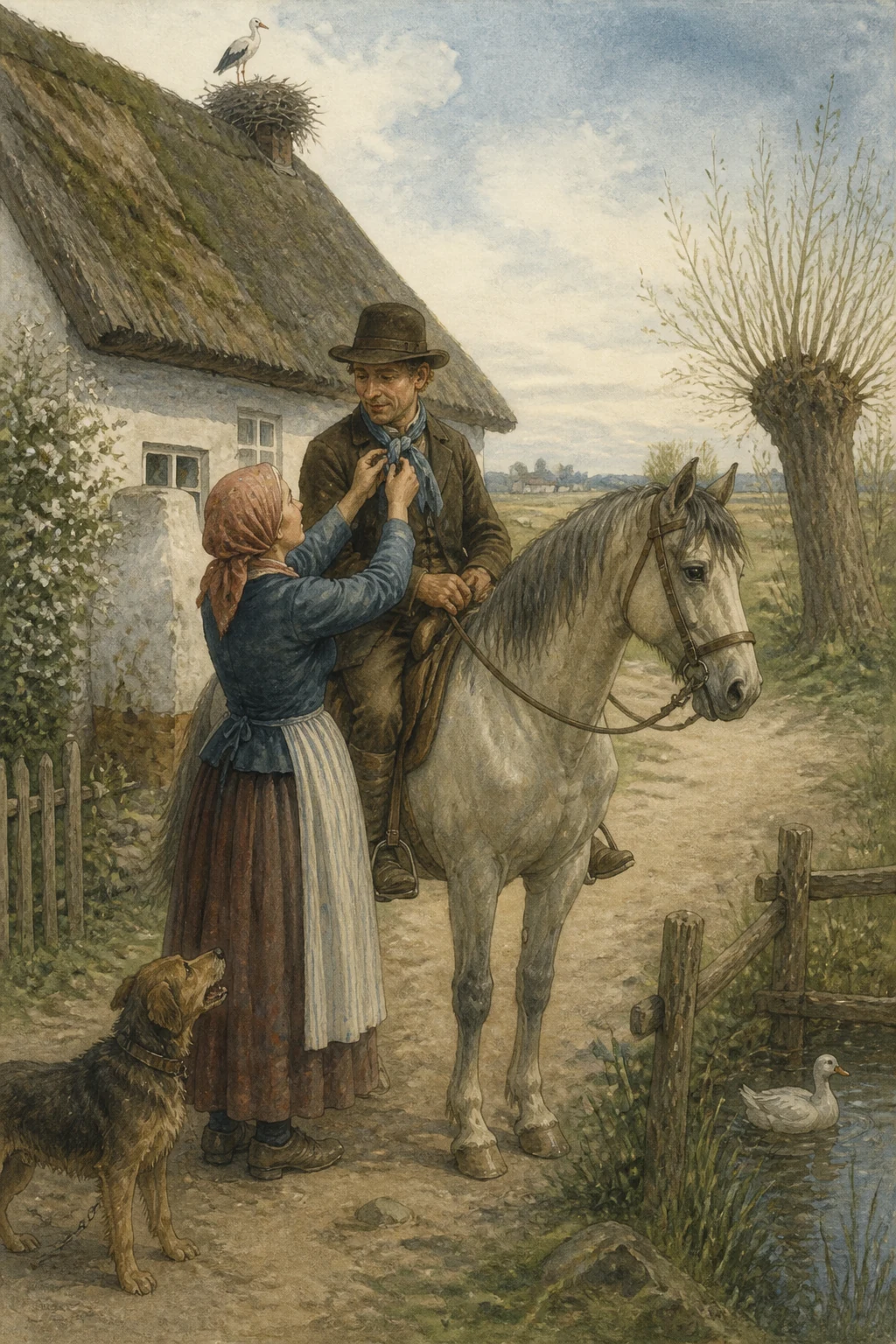
At long last he came to a farm where he thought he would rest a while. When he went inside, the woman asked, “Where do you come from, father?” “I come from Ringerike,” he answered. “Oh, my goodness! Do you come from the kingdom of Heaven? Then surely you know Peer the Second, my late husband?” (The woman had been married three times; her first and last husbands were wicked, so she believed that only the second, who had been kind, had gone to Heaven.) “Yes, I know him well,” said the traveller. “And how is he getting on now?” asked the woman. “Oh, he is poorly off,” answered the man from Ringerike. “He wanders from farm to farm up there, with neither food to eat nor clothes to his back—and as for money, that is out of the question.” “Heaven have mercy on the poor man!” cried the woman. “He need not live in such misery, with all that he left behind! There is a whole loft full of his clothes hanging here, and a great chest of money here too. If you will take it along, you shall have a horse and cart to carry it in, and he can keep the horse up there and ride about from farm to farm in the cart, for there is no need for him to walk.” The man from Ringerike was given a whole cartload of clothes and a chest full of bright silver coins, and as much food and drink as he wanted. When he had got it all, he climbed onto the cart and drove away. “That was the third,” he said to himself. But the woman’s third husband was out ploughing in the field, and when he saw a stranger leaving the farm with his horse and cart, he went home and asked his wife who it was that had driven off with the blue-grey horse. “Oh, him,” she said, “that was a man from the kingdom of Heaven. He said that Peer the Second, my late husband, was so badly off that he wanders from farm to farm with neither clothes nor money, so I sent along all those old clothes he left hanging here, and the old money chest with the silver coins in it.” The husband understood at once what had happened, saddled a horse, and galloped off at full speed.
It was not long before he was close behind the man driving the cart; but when the other noticed him, he drove the horse and cart into a thicket, pulled a handful of hair from the horse’s tail, and ran up a hill, where he tied the horsehair to a birch tree. Then he lay down beneath it, gazing and staring up at the clouds. “Well, well, well!” he said, as though to himself, when Peer the Third came riding up. “Never have I seen anything so strange! No, never have I seen the like!” Peer stopped and watched him for a while, wondering what was the matter with him. At last he asked, “What are you lying there gaping at?” “Never have I seen the like,” said the other. “A man went straight up to Heaven with a blue-grey horse! Here you can see the tail hair still hanging in the birch, and up there in the clouds you can see his blue-grey horse.” Peer looked first at the clouds and then at the man, and said, “I cannot see anything but the horsehair in the birch.” “No, you cannot see it from where you are standing,” said the other. “Come here and lie down just in this spot, and stare straight up, and be sure not to take your eyes off the clouds.” While Peer the Third lay staring up at the clouds until his eyes watered, the man from Ringerike took the horse, mounted it, and set off with both it and the cartload. When the rumbling began on the road, Peer the Third sprang up, but he was so bewildered at seeing the other man making off with his horses that he did not think to run after him until it was too late.
He was rather crestfallen when he came home to his wife, but when she asked what he had done with the horse, he said, “I gave him that too, for Peer the Second, for I did not think it right that he should sit rattling about from farm to farm in Heaven in a cart. Now he can sell the cart and buy himself a carriage to ride in.” “Bless you for that! I should never have thought you were such a kind man,” said his wife.
Now when the man who had got the six hundred dalers and the cartload of clothes and money came home, he saw that all the fields had been ploughed and sown. The first thing he asked his wife was where she had got the seed corn. “Oh,” she said, “I have always heard that he who sows something reaps something, so I sowed the salt the northbound traders left here, and if only we get some rain, I think it will come up beautifully.” “A fool you are, and a fool you will be as long as you live,” said the man, “but it makes no difference now, for the others are no wiser than you.”