Prevod
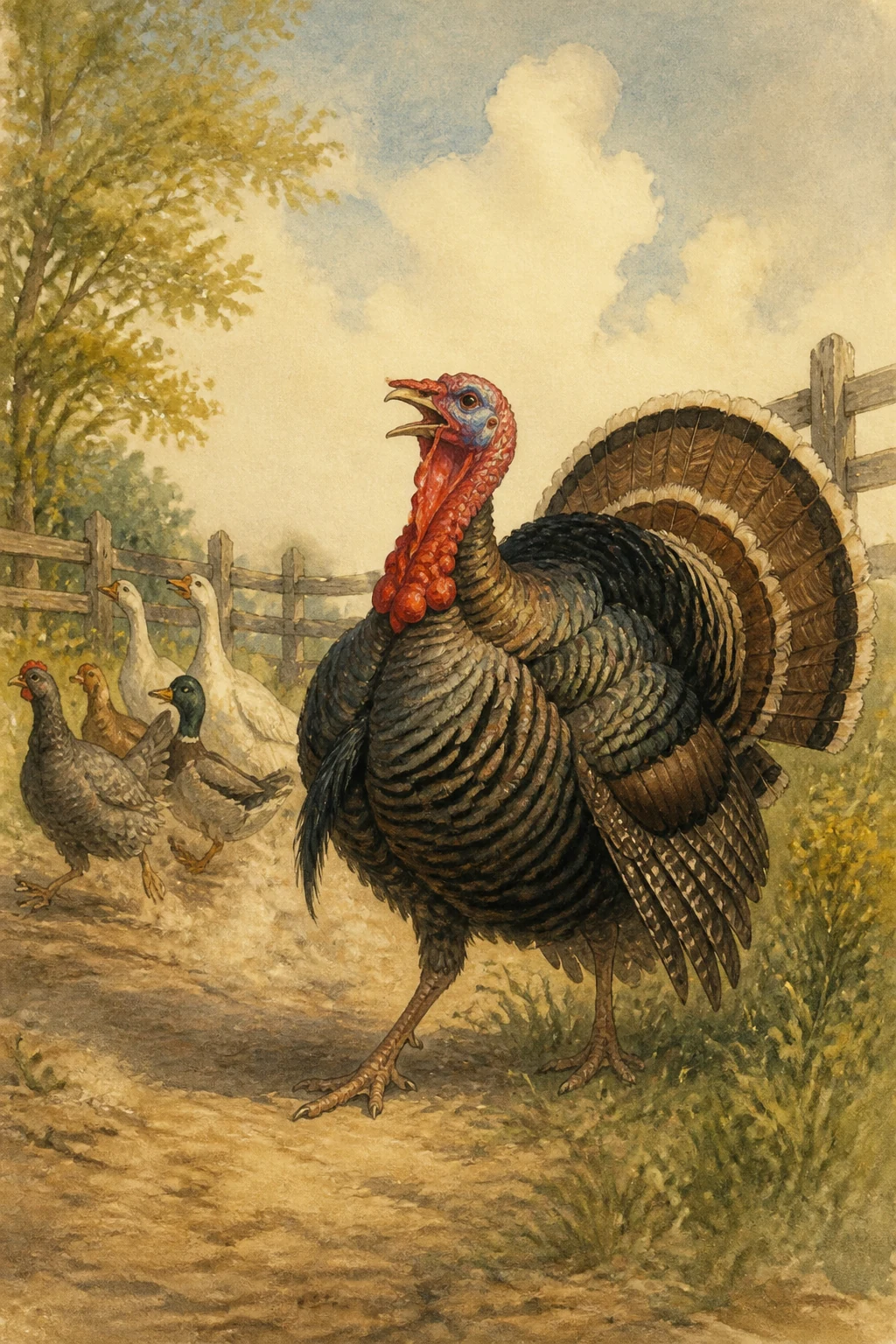
There came a duck from Portugal; some said she came from Spain, but that is neither here nor there. She was called the Portuguese. She laid eggs, was slaughtered, and was served up; that was the story of her life. All who hatched from her eggs were called the Portuguese, and that was something to be proud of. Now only one of the whole family remained in the duck yard, a yard to which the hens also had access, and where the cock strutted about with boundless conceit.
"He offends me with his dreadful crowing!" said the Portuguese. "But he is handsome, there is no denying that, although he is no drake. He ought to restrain himself, but self-restraint is an art; it shows refinement. The little songbirds up in the lime tree in the next garden have that! How sweetly they sing! There is something so touching in their song; I call it Portugal! If I had a little songbird like that, I would be a mother to him, loving and kind. It is in my blood, in my Portuguese nature!"
And just as she spoke, a little songbird came tumbling headlong from the roof. The cat was after him, but the bird escaped with a broken wing and fell into the duck yard.
"Just like the cat, the scoundrel!" said the Portuguese. "I have known him since I had ducklings myself! To think that such a creature is allowed to live and prowl about on the roofs! I do not believe that is permitted in Portugal!"
And she pitied the little songbird, and the other ducks, who were not Portuguese, pitied him too. "Poor little creature!" they said, and first one came up, then another. "We may not be singers ourselves," they said, "but we have a sounding board inside us, or something of the sort. We feel it, even if we do not talk about it!"
"Well, I shall talk about it!" said the Portuguese, "and I shall do something for him, for that is one's duty!" And she stepped into the water trough and splashed about until she nearly drowned the little songbird in the drenching he received; but it was well meant. "That is a good deed," she said. "The others can watch and follow my example!"
"Peep!" said the little bird. One of his wings was broken, and he found it hard to shake himself, but he quite understood how kindly the splashing was meant. "You are so good-hearted, madam!" he said, but asked for no more.
"I have never given any thought to my heart!" said the Portuguese, "but I do know that I love all my fellow creatures except the cat, and surely no one can expect that of me! He has eaten two of mine. But make yourself at home here; you are welcome to. I myself come from foreign parts, as you can no doubt tell by my bearing and my plumage! My drake is a native; he has none of my blood, but I do not put on airs! If anyone here understands you, I venture to say it is I!"
"She's got portulak in her crop!" said a witty little common duckling, and the other common ducks thought "portulak" was splendid, for it sounded like "Portugal." They nudged one another and said, "Quack!" He was so wonderfully witty! Then they began talking to the little songbird.
"The Portuguese certainly has a way with words!" they said. "We do not go about with grand words in our beaks, but we feel just as much sympathy. If we do nothing for you, at least we keep quiet about it, and we think that is the nicest way!"
"You have a lovely voice!" said one of the oldest. "It must be delightful to know that you give pleasure to so many! Of course, I understand nothing whatever about it! That is why I hold my tongue, which is always better than saying foolish things, as so many others do to you!"
"Do not pester him!" said the Portuguese. "He needs rest and care. Little songbird, shall I splash you again?" "Oh no, let me stay dry!" he pleaded.
"The water cure is the only thing that does me any good," said the Portuguese. "A little diversion is good too! The hens from next door will soon be coming to visit. There are two Chinese hens among them; they wear pantaloons, are highly cultivated, and have been imported, which raises them in my esteem!"
And the hens came, and the cock came too. Today he was so polite that he was not rude. "You are a true songbird!" he said, "and you make everything of your little voice that can be made of such a little voice. But one must have rather more locomotive power, so that people can hear one belongs to the male sex."
The two Chinese hens were enchanted by the sight of the songbird. He looked so bedraggled after his drenching that they thought he resembled a Chinese chick. "He is charming!" And they began talking to him, whispering in refined Chinese with a great many p-sounds.
"Now, we belong to your kind. The ducks, even the Portuguese, belong to the swimming birds, as you have no doubt noticed. You do not know us yet, but how many people do know us, or take the trouble to? No one, even among the hens, although we were born to sit on a higher perch than most. Still, no matter; we go quietly on our way among the others, whose principles are not ours, but we look only at their good points and speak only of what is good, though that is difficult to find where there is none. Apart from ourselves and the cock, there is no one in the henhouse with any gifts, but they are respectable! That cannot be said of the inhabitants of the duck yard. We warn you, little songbird! Do not trust that one with the stumpy tail; she is sly! That speckled one over there, with the crooked patch on her wings, is mad about arguing and never lets anyone have the last word, and she is always wrong into the bargain! The fat duck speaks ill of everyone, and that is against our nature; if one cannot say anything good, one ought to hold one's tongue. The Portuguese is the only one with a little refinement, the only one fit to associate with, but she is hot-tempered and talks too much about Portugal!"
"What a lot those two Chinese hens have to whisper about!" said a couple of the ducks. "They bore me; I have never spoken to them!" Now the drake came along! He thought the songbird was a sparrow. "Well, I cannot tell them apart!" he said, "and it is all the same, anyway! He is one of the musical boxes, and if you have them, you have them!"
"Never mind what he says!" whispered the Portuguese. "He is a respectable man of business, and business comes before everything. But now I am going to lie down for a rest! One owes it to oneself to be nice and fat by the time one is to be embalmed with apples and prunes!"
And she lay down in the sunshine and blinked one eye. She was so comfortable, she was so good, and then she slept so well. The little songbird preened his broken wing and nestled close against his protectress. The sun shone warm and lovely; it was a good place to be.
The hens from next door went about scratching; they had really come only for the food. The Chinese hens were the first to leave, and then the others followed. The witty duckling said of the Portuguese that the old thing would soon be in her "second ducklinghood," and the other ducks cackled. "Ducklinghood! He is wonderfully witty!" Then they repeated his earlier joke: "Portulak!" It was very funny; and then they lay down.
They had been lying there a while when suddenly some scraps were thrown into the duck yard. They landed with such a splat that the whole sleeping company sprang up and flapped their wings. The Portuguese woke too, rolled over, and gave the little songbird a dreadful squeeze.
"Peep!" he said. "You trod on me so hard, madam!" "Why do you lie in the way?" she said. "You must not be so sensitive! I have nerves too, but I have never said a peep!"
"Do not be angry!" said the little bird. "That peep slipped out of my beak!" The Portuguese paid no attention, but rushed at the scraps and made a hearty meal. When she had finished and lay down again, the little songbird came over, wishing to please her:
"Trill-a-lee, trill-a-lay! Of your kind heart I'll sing all day, as I fly far, far away!" "Now I must rest after my dinner!" she said. "You must learn the ways of the household here! I am going to sleep now!"
The little songbird was quite taken aback, for he had meant so well. When the lady woke later, he stood before her with a little grain he had found, and laid it at her feet. But she had not slept well, and so, naturally, she was cross.
"You can give that to a chicken!" she said. "Do not stand there hanging over me!" "But you are angry with me!" he said. "What have I done?" "Done!" said the Portuguese. "That is not the most refined expression, I would have you know!"
"Yesterday there was sunshine here," said the little bird. "Today it is dark and grey! I am so very sad!" "You do not seem to understand how time is reckoned!" said the Portuguese. "The day is not over yet. Do not stand there looking so foolish!"
"You look at me as angrily as those two wicked eyes did when I fell down here into the yard!" "Insolent creature!" said the Portuguese. "Do you compare me to the cat, that beast of prey! There is not a drop of wicked blood in me. I have taken you under my wing, and I shall teach you good manners!"
And then she bit off the songbird's head, and he lay dead. "Now what is this!" she said. "Could he not stand that? Well, then, he certainly was not made for this world! I have been like a mother to him, that I know! For I have a heart!"
And the neighbour's cock poked his head into the yard and crowed with the power of a locomotive. "You will be the death of one with that crowing!" she said. "It is all your fault; he lost his head, and I am very nearly losing mine."
"He does not take up much room lying there!" said the cock. "Speak of him with respect!" said the Portuguese. "He had tone, he had song, and he was highly cultivated! He was loving and gentle, and that is fitting for animals as well as for so-called human beings."
And all the ducks gathered round the little dead songbird. Ducks have strong passions: they are given either to envy or to pity, and as there was nothing here to envy, they were full of pity; so were the two Chinese hens.
"We shall never have another songbird like him! He was almost Chinese!" And they wept until their sobs turned to clucking, and all the hens clucked, while the ducks went about with the reddest eyes.
"We have hearts!" they said. "No one can deny us that!" "Hearts!" said the Portuguese. "Yes, we have—almost as much as in Portugal!"
"Let us think about getting something into our bellies now!" said the drake. "That is more important! If one of the musical boxes breaks, we still have plenty left!"