Prevod
There was once a cottager who had three sons. He had no inheritance to leave them and no work to set them to, nor did he know what else to do with them. So he told them they were free to take up whatever they pleased and liked best, and go wherever they wished; he would gladly go part of the way with them, and so he did. He went with them until they came to a place where three roads met. There each took his own road, and their father bade them farewell and went home again. What became of the two eldest I have never heard, but the youngest walked far and long.
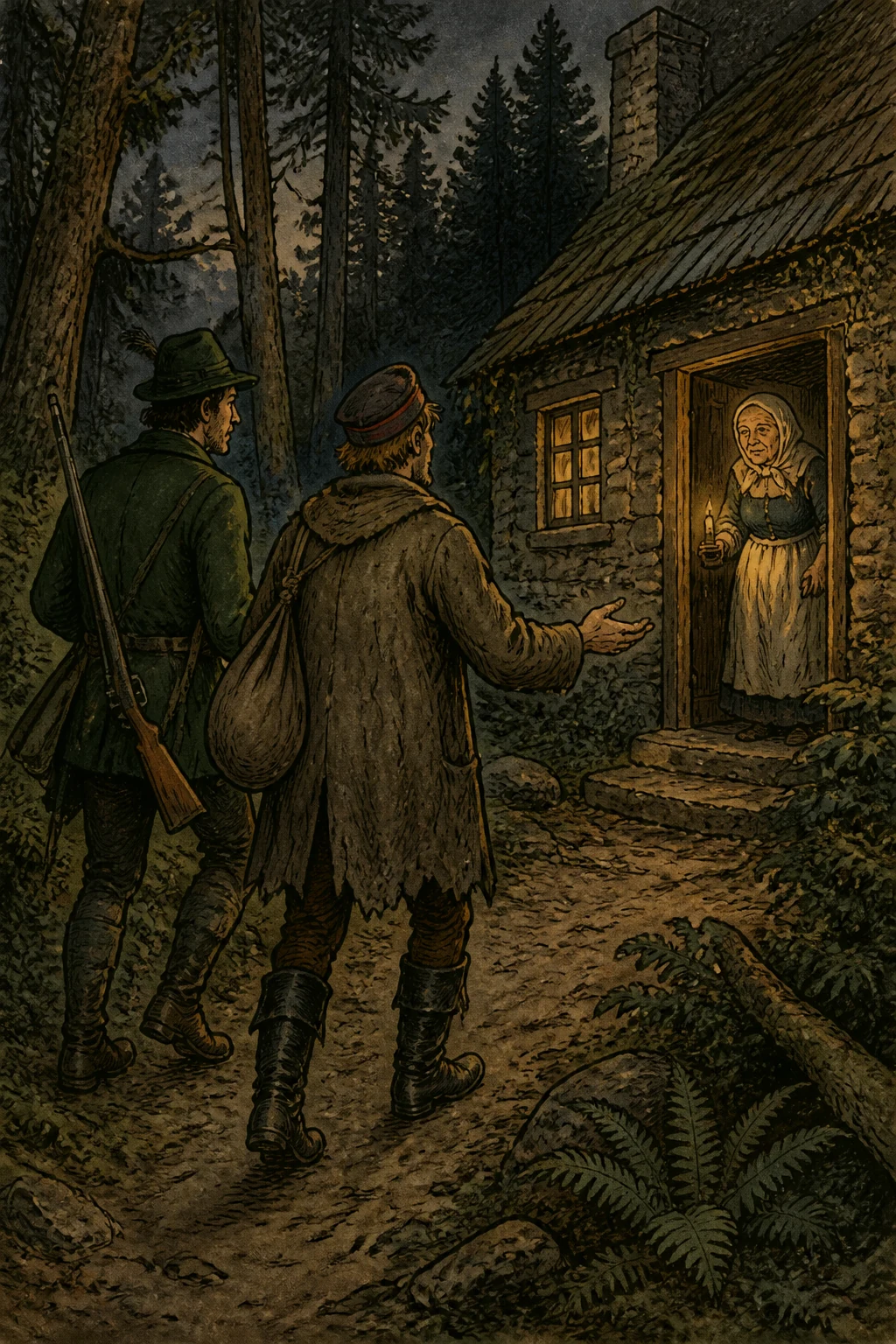
One night, as he was passing through a great forest, he was caught in dreadful weather. The wind blew and the snow swirled so fiercely that he could scarcely keep his eyes open, and before he knew it he was hopelessly lost and could find neither road nor path. But as he wandered along, he at last saw a light far away in the forest. He thought he had better try to reach it, and after a long while he did. There stood a large house, with such a bright fire burning inside that he could tell the people had not yet gone to bed. So he went in, and there was an old woman going about her work.
“Good evening!” said the lad. “Good evening!” said the old woman. “Brrr, what dreadful weather it is out there tonight,” said the lad. “So it is,” said the old woman. “May I sleep here and have shelter for the night?” asked the lad. “It would hardly be safe for you to sleep here,” said the old woman, “for if the people who live here come home and find you, they will kill us both.” “What sort of people live here, then?” said the lad. “Oh, robbers and such riffraff,” said the old woman. “They carried me off when I was little and have kept me as their housekeeper ever since.” “I think I shall lie down all the same,” said the lad. “Let things turn out as they may; I am not going out again at night in weather like this.” “Well, you will be the one to suffer for it,” said the old woman.
So the lad lay down in a bed that stood there, but he dared not sleep. Before long the robbers came home, and the old woman told them that a strange fellow had arrived whom she could not persuade to leave.
“Did you see whether he had any money?” said the robbers. “Money? That poor wretch?” said the old woman. “He has scarcely enough clothes to cover his back.” Then the robbers began talking quietly among themselves about what to do with him, whether to kill him or what else they might do. Meanwhile the lad got up and began talking to them, asking whether they needed a serving man, for he would be quite willing to work for them. “Yes,” they said, “if you are willing to practise our trade, you can certainly find employment here.” “Well, it makes no difference to me what trade it is,” said the lad, “for when I left home my father gave me leave to take up whatever I pleased.” “Would you care to steal, then?” said the robbers. “Yes,” said the lad; he thought he could learn that trade well enough.
Now a man who lived some way off had three oxen. He was going to take one of them to town to sell, and the robbers had heard of it. So they told the lad that if he could steal the ox from him on the road without his knowing it, and without doing him any harm, he could stay as their serving man. Well, the lad took a fine shoe with a silver buckle that stood there and set off. He placed it in the road where the man would pass with his ox, then went into the forest and hid beneath a bush. When the man came along, he saw the shoe at once. “That is a splendid shoe,” he said. “If I had its fellow, I would take it home with me, and perhaps for once I could put my wife in a good humour.” For his wife was so ill-tempered and wicked that she gave him a beating every little while. But he thought one shoe was no use to him without its fellow, so he went on and left it where it stood. The lad picked up the shoe and hurried through the forest as fast as he could to get ahead of the man, then set it in the road before him again. When the man came up with his ox, he was vexed with himself for having been so foolish as to leave the matching shoe behind instead of taking it along. “I had better run back and fetch the other,” he said to himself, and tied the ox to the rail fence. “Then I shall have a pair of good shoes for my wife, and perhaps she will be in a good humour for once.” So he went back and searched high and low, far and wide, but no shoe could he find. At last he had to return with the one he had. Meanwhile the lad had taken the ox and made off with it. When the man returned and saw that the ox was gone, he began to weep and wail, for he was afraid his wife would beat him to death when she heard it was lost. But then it occurred to him to go home and fetch the second ox, take it to town and get a good price for it, and never let his wife know anything about it. And so he did: he went home and fetched the ox without his wife knowing, and set off for town with it. But the robbers knew all about it, and they told the lad that if he could take this one too, without the man knowing it and without doing him any harm, he would be their equal. Yes, the lad thought that would be no great matter.
This time he took a rope with him and hung himself by the armpits from a tree right in the man’s path. When the man came along with his ox and saw this dreadful sight hanging there, he felt rather strange. “You must have had a heavy heart indeed to hang yourself there!” he said. “Ah well, you may hang there for all I can do; I cannot breathe life into you again.” And on he went with his ox. Down came the lad from the tree, ran by a shortcut to get ahead of him, and hung himself right in his path again.
“I wonder whether your heart was really so heavy that you hanged yourself there, or whether it is only a ghost I am seeing,” said the man. “Ah well, you may hang there for all I care, whether you are a ghost or whatever you are.” And on he went with his ox. The lad did just as he had done twice before: he jumped down from the tree, ran by a shortcut through the forest, and hung himself right in the man’s path again. When the man saw him once more, he said to himself, “This is dreadful! Can all three of them have been so heavy-hearted that they hanged themselves? No, I cannot believe it is anything but ghosts playing tricks on me. But now I mean to know for certain,” he said. “If the other two are still hanging there, then it is real; but if they are not, it is only a haunting.” So he tied up his ox and ran back to see whether they really were hanging there. While he went about peering up into all the trees, the lad jumped down, took his ox, and made off with it. When the man returned and saw that the ox was gone, he was in a terrible state, as you may well imagine, and began weeping and wailing. At last, however, he took comfort and thought to himself: there is nothing for it but to go home and fetch the third without my wife knowing, and I must try all the harder to sell that one well and get plenty of money for it. So he went home, fetched it, and set off without his wife knowing anything about it. But the robbers knew very well, and they told the lad that if he could steal this one as he had the other two, he would be master of them all.
Well, the lad set off and ran into the forest, and when the man came along with the ox, he began bellowing mightily among the trees, just like a great ox. When the man heard it, he was overjoyed, for he thought he recognized the voice of his big ox, and now he hoped to find them both again. So he tied up the third and ran off the road to search in the forest. Meanwhile the lad made off with the third ox.
When the man returned and found that he had lost this one too, there was no end to his distress. He wept and wailed, and for many days he dared not go home, for fear his wife would beat him to death.
The robbers were none too pleased either at having to admit that the lad was master of them all. One day they decided to try to do something he could not manage, so they all set off together and left him at home alone.
The very first thing he did, once they were well away, was to drive the oxen out onto the road, so that they went home again to the man he had taken them from; and glad the man was, as you may well imagine. Then he took all the robbers’ horses and loaded them with the best he could find of gold and silver and clothes and other splendid things. He asked the old woman to give the robbers his regards and his thanks: he was leaving now, and they would find it no easy matter to catch him again. And with that he was off.
After a long while he came to the road he had followed when he first found the robbers. As he drew near his father’s home, he put on a uniform he had found among the things he had taken from the robbers, made just like a general’s, and drove into the yard like some great gentleman. Then he went in and asked whether he could lodge there. No, that he certainly could not. “How could I give lodging to such a grand gentleman?” said the man. “I have scarcely any bedding to sleep on myself, and poor stuff it is.” “You were always hard-hearted,” said the lad, “and so you are still, if you will not give your own son shelter.” “Are you my son?” said the man. “Do you not recognize me?” said the lad. Yes, then he recognized him well enough. “But what have you taken up, to have become such a fine fellow in so short a time?” said the man. “Well, I will tell you,” said the lad. “You said I could take up whatever I pleased, so I apprenticed myself to some thieves and robbers. Now I have finished my apprenticeship and become a master thief.” Now close to his father’s cottage there lived a governor, who had such a great estate and so much money that he could not count it all, and he had a daughter too, who was both pretty and fair. The Master Thief wanted her for his wife, and told his father to go to the governor and ask for his daughter’s hand on his behalf. “If he asks what trade I follow, you can say I am a master thief,” he said. “I think you must be out of your wits,” said the man, “for you cannot be in your right mind if you are thinking of such madness.” But go he must to the governor and ask for his daughter; there was no help for it, said the lad.
“No indeed, I dare not go and speak for you to the governor, rich as he is, with all his money,” said the man. But the Master Thief said there was no help for it: he must go, willing or not, and if he would not go by fair means, he would make him go by foul. Still the man refused, so the lad followed him with a great birch cudgel and threatened him until he went weeping straight through the governor’s door. “Well, my good man, what is the matter?” said the governor. So he told him that he had three sons who had gone away one day, and that he had promised them they might go wherever they pleased and take up whatever they liked. “And now the youngest has come home, and he has threatened me into coming to ask for your daughter on his behalf, and to tell you he is a master thief,” said the man, weeping and wailing. “There, there, my good man, set your mind at rest,” said the governor, laughing. “Tell him from me that he must prove it first. If he can steal the roast from the spit in the kitchen on Sunday, while we are all watching it, he shall have my daughter. Tell him that!” So the man did, and the lad thought it would be an easy matter. He got hold of three live hares, put them in a sack, and dressed himself in rags until he looked so poor and wretched that he was a pitiful sight. Then on Sunday morning he slipped into the passage with his sack, like any ragged beggar boy.
The governor himself and all his household were in the kitchen, keeping watch over the roast. Before long the lad let out one of the hares, and away it dashed, racing about the yard.
“Oh, look at that hare!” cried the people in the kitchen, and they wanted to go out and catch it. The governor saw it too. “Oh, let it run,” he said. “There is no use thinking you can catch a hare on the run.” Before long the lad let out the second hare. They saw it from the kitchen and thought it was the same one, and again they wanted to go out and catch it, but the governor said it was no use. After a while the lad let out the third as well, and it dashed away and ran about the yard. They saw this one from the kitchen too, and thought it was the same hare running about again, and wanted to go out and catch it. “That is a strange hare indeed,” said the governor. “Come, let us see whether we can get hold of it.” Out he went with all the others, the hare in front and everyone after it, and a fine chase it was. Meanwhile the Master Thief took the roast and ran off with it. Where the governor found a roast for his dinner that day I cannot say, but this I do know: it was not roast hare, though he ran until he was hot and weary.
The parson came to dinner, and when the governor told him the trick the Master Thief had played on him, there was no end to his mockery.
“I cannot imagine how I could ever let myself be fooled by such a fellow!” said the parson. “Well, you had better take care!” said the governor. “Perhaps he will be paying you a visit before you know it.” But the parson stuck to his opinion and went on making fun of the governor for letting himself be fooled.
Later that afternoon the Master Thief came to claim the governor’s daughter, as he had been promised. “You must give us a few more proofs of your skill first,” said the governor coaxingly, “for what you did today was nothing so very remarkable. Could you not play a really fine trick on the parson? He is sitting in there making fun of me for letting a fellow like you lead me by the nose.” Yes, that would be no trouble, said the Master Thief. He dressed himself up as a bird, draped a large white sheet over himself, broke the wings off a goose and fastened them to his back, then climbed into a great maple tree in the parson’s garden. When the parson came home that evening, the lad began to cry, “Master Lars! Master Lars!” for the parson’s name was Master Lars. “Who is calling me?” said the parson. “I am an angel sent by Our Lord to proclaim that, for your godliness, you are to be taken alive into the kingdom of God,” said the Master Thief. “Next Monday evening you must be ready for your journey, for then I shall come and fetch you in a sack. All your gold and silver, and whatever you possess of this world’s vanities, you must gather into a heap in your parlour.” Master Lars thanked the angel and fell upon his knees before him, and the following Sunday he preached a farewell sermon. He told how an angel from God had come into the great maple tree in his garden and proclaimed that, for his godliness, he was to enter the kingdom of God alive. He preached and expounded so movingly that everyone in the church wept, both young and old.
On Monday the Master Thief came again as an angel, and the parson knelt and thanked him before being put into the sack. Once he was safely inside, the Master Thief hauled and dragged him away over stock and stone. “Ow!
Ow!” cried the parson in the sack. “Where is this taking me?” “This is the narrow way that leads to the kingdom of Heaven!” said the Master Thief, dragging him along so roughly that he nearly killed him. At last he threw him into the governor’s goose-house, and the geese began hissing and nipping him until he was more dead than alive. “Ow, ow, ow! Where am I now?” said the parson. “Now you are in Purgatory, to be cleansed and purified for eternal life!” said the Master Thief. Then he went away and took all the gold and silver and splendid things the parson had piled up in his parlour.
In the morning, when the goose-girl came to let the geese out, she heard the parson lying in the sack and moaning inside the goose-house. “Oh, in Jesus’ name, who is there, and what is the matter with you?” she said. “Oh, if you are an angel from Heaven, let me out and allow me to return to earth, for it is worse here than in Hell! The little devils are pinching me with tongs!” said the parson. “I am no angel, God help us!” said the girl, helping the parson out of the sack. “I only look after the governor’s geese, and I daresay those are the little devils that have been nipping Your Reverence.” “Oh, this is the Master Thief’s doing! Oh, my gold and my silver and my splendid clothes!” cried the parson, making such a fuss and running home so wildly that the goose-girl thought he had lost his wits on the spot.
When the governor heard what had happened to the parson, and how he had travelled the narrow way and been in Purgatory, he nearly split his sides laughing. But when the Master Thief came to claim his daughter as promised, he spoke coaxingly to him and said, “You must give me a better proof of your skill, so that I can truly see what you are capable of.
“I have twelve horses in my stable,” he said, “and I shall set twelve men on them, one on each. If you can steal the horses from under them, I shall see what I can do.” “Yes, that can be managed,” said the Master Thief, “if only I am sure of getting your daughter—”
“Yes, if you can do that, I shall do my best,” said the governor. The Master Thief went to the shopkeeper and bought brandy to fill two pocket flasks. Into one he poured a sleeping draught, but in the other he left plain brandy. Then he hired eleven men to lie behind the governor’s barn that night. With fair words and payment he persuaded an old woman to lend him a ragged skirt and jacket; then he took a staff in his hand and a sack on his back, and towards evening he hobbled off to the governor’s stable. When he arrived, the men were busy watering the horses for the night and had their hands full. “What the devil do you want?” one of the stablemen said to the old woman. “Oh, brrr, it is so cold,” said the old woman, shivering and shuddering and making a great fuss. “Brrr, it is so cold a poor soul might freeze to death.” And she shook and trembled again. “Oh, dear Lord, may I sit here just inside the stable door?” she said. “The devil you may! Be off this instant, for if the governor sees you here, we shall be in for it,” said one. “Oh, the poor, bent old creature!” said another, who felt sorry for her. “Surely she can sit there; she will do no harm.” The others would not hear of it, but while they argued and tended the horses, she edged farther into the stable until at last she was sitting behind the door, and after that no one took any notice of her.
As the night wore on, the men began to feel rather cold, sitting so still on horseback. “Brrr, it is devilishly cold!” said one, flapping his arms. “Yes, I am shivering with cold,” said another. “If only we had a little tobacco!” said a third. Well, one of them had a quarter of a pound, and they shared it out. There was not much for each man, but they chewed and spat. That helped a little, but before long they were just as badly off as ever. “Brrr!” said one of them, shaking himself. “Brrr!” said the old woman, her teeth chattering and rattling in her head. Then she took out the flask of plain brandy, her hand trembling so much that the liquor splashed about inside it, and drank with a loud gurgle. “What have you got in that flask, old woman?” said one of the stablemen. “Oh, just a little drop of brandy, master,” she said. “Brandy?
What is that? Let me have a sip! Let me have a sip!” all twelve cried at once. “Oh, I have so little,” whined the old woman. “It would not even wet your mouths.” But they wanted some and must have some; there was no help for it. So she took the flask with the sleeping draught and put it to the first man’s lips. Her hands no longer shook; she guided the flask so that each got as much as he needed, and before the twelfth had drunk, the first was already sitting there snoring. Then the Master Thief threw off his beggar’s rags, lifted down the men one after another as easily as could be, and set them astride the stall partitions. Then he called his eleven men and made off with the governor’s twelve horses.
When the governor came out towards morning to see how the men were doing, they were just beginning to stir. They dug their spurs into the partitions until the splinters flew; some fell off, while others remained dangling there, looking like fools. “Oh yes,” said the governor, “I can see well enough who has been here. But what a miserable lot you are, sitting here and letting the Master Thief steal the horses from under your very backsides!” And they got a thrashing for not keeping better watch.
Later that day the Master Thief came again, told the governor how he had done it, and asked for his daughter as promised. But the governor gave him a hundred dollars and said he must do something better still.
“Do you think you can steal my horse from under me while I am out riding it?” said the governor. “Oh, that can be managed,” said the Master Thief, “if only I am sure of getting your daughter.” Well, he would see what he could do, said the governor, and he named a day when he would ride out on a large parade ground.
The Master Thief at once got hold of an old, worn-out jade, made a harness out of nothing but willow withies and broom twigs, and bought a ramshackle old cart and a large barrel. Then he told an old toothless beggar woman that he would give her ten dollars if she would lie inside the barrel with her mouth open over the bunghole, where he would put his finger. No harm would come to her; she would merely be taken for a little ride, and if he took his finger out more than once, she should have ten dollars more. He dressed himself in rags, smeared himself with soot, and put on a wig and a great beard of goat hair, so that no one could recognize him. Then he set off for the parade ground, where the governor had already been riding for some time.
When he arrived, he moved so slowly and feebly that he scarcely seemed to get anywhere. He crawled and crept along, then came to a complete standstill, then crept a little farther; it was such a sorry performance that the governor could never have imagined this was the Master Thief. He rode straight up to him and asked whether he had seen anyone prowling about in the forest nearby. “No,” said the man, he had seen no one at all. “Now listen,” said the governor. “If you will ride into the forest and look carefully to see whether you can find anyone lurking there, you may borrow my horse, and I shall give you a handsome tip for your trouble.” “No, I cannot do that,” said the man, “for I am on my way to a wedding with this barrel of mead I have been sent to fetch, and the bung fell out on the road, so now I have to walk along with my finger in the hole.” “Go on and ride,” said the governor. “I shall look after both your horse and the barrel.” Well, then he would do it, but he begged the governor to take great care and be quick to put his finger into the bunghole when he drew his own out. Yes, the governor said he would do his best, and the Master Thief mounted the horse. But time passed, and the hours wore on, and no one came back. At last the governor grew tired of walking about with his finger in the bunghole and pulled it out. “Now I am to have ten dollars more!” shrieked the old woman inside the barrel. Then he understood how matters stood and set off for home. But he had only gone a little way when someone met him with a horse, for the Master Thief had already been to his house.
The next day he went to the Governor and asked for his daughter, as he had been promised. The Governor coaxed him once again, gave him two hundred dalers, and said he must perform one more feat; if he could manage that, he should have her. Oh yes, the Master Thief thought he could, once he had heard what it was. “Do you think you can steal the sheet from our bed and the shift off my wife?” said the Governor. “That can surely be done,” said the Master Thief, “so long as I truly get your daughter afterward.” When night drew on, the Master Thief went out and cut down a thief who was hanging from the gallows, slung him over his shoulder, and carried him away. Then he got hold of a long ladder and set it against the Governor’s bedroom window, climbed up, and bobbed the dead man up and down, just as though someone were peeping in. “There’s the Master Thief, Mother!” said the Governor, nudging his wife. “Now I’ll shoot him,” he said, taking up a rifle he had laid beside the bed. “Oh no, you mustn’t do that,” said his wife. “You asked him to come here yourself.” “Yes, I’ll shoot him, Mother,” he said, and lay there taking aim and taking aim. But one moment the head was up, so that he could just glimpse it, and the next it was gone again. At last he got a clear shot. The rifle cracked, and the dead man fell with a thud to the ground. The Master Thief scrambled down as fast as he could.
“Well, I may be the highest authority here,” said the Governor, “but people are quick to talk, and it would be an awkward business if they saw this dead man. I had better go out and bury him.” “Do as you think best, Father,” said his wife. The Governor got up and went downstairs, and the moment he had gone out through the door, the Master Thief slipped in and hurried straight up to his wife. “Well, Father,” she said, for she thought it was her husband, “have you finished already?” “Oh yes, I put him in a hole,” he said, “and scraped a little earth over him, just enough to hide him, for the weather is so foul out there. I’ll do it properly later. But let me have the sheet to wipe myself with, for he was so bloody that I’ve got it all over me.” She gave it to him. “You’ll have to let me have your shift as well,” he said, “for I find the sheet isn’t enough.” Oh yes, she would. But then he remembered that he had forgotten to shut the door, and he would have to go down and do that before he could get back into bed. And off he went with both the sheet and the shift. A little while later, the real Governor came back.
“My, what a time you’ve taken to shut that door, Father,” said his wife. “Where have you put the shift and the sheet?” “What’s that?” said the Governor. “I’m asking where you’ve put the shift and the sheet I gave you to wipe the blood off yourself,” she said. “Well, damn him!” said the Governor. “Has he managed that too?” That day the Master Thief came and demanded the Governor’s daughter, as he had been promised, and the Governor dared do nothing but give her to him, with a great deal of money besides. For he was afraid the Master Thief would steal the very eyes out of his head, and that he himself would become the talk of the town if he refused. After that the Master Thief lived in ease and comfort. Whether he ever stole again I cannot say, but if he did, it was surely only for the fun of it.