Prevod
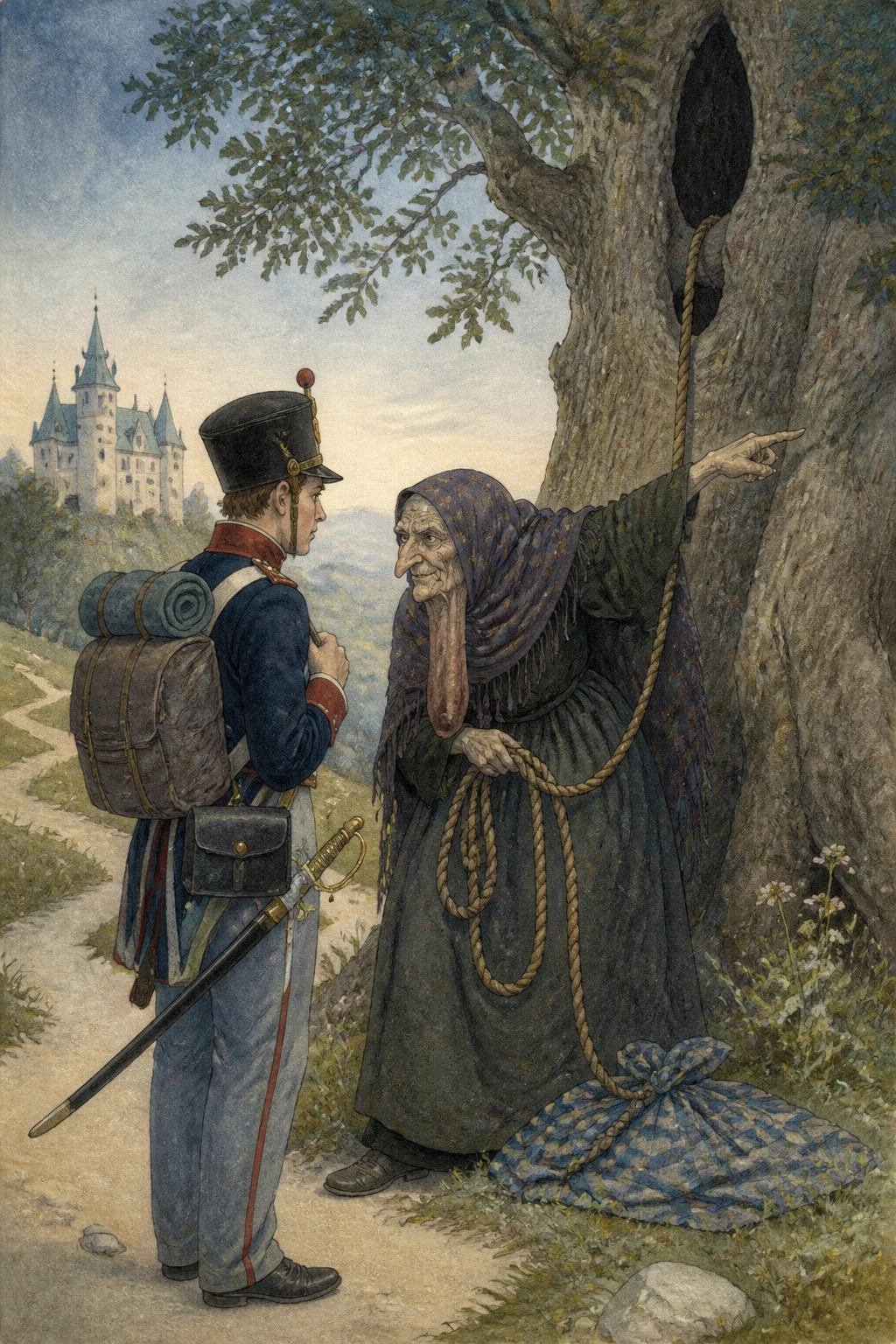
Once upon a time there was a soldier who had served the king faithfully for many years. But when the war was over and the soldier could no longer serve because of the many wounds he had received, the king said to him, “You may go home. I have no further need of you, and you will receive no more money, for I pay only those who serve me.” The soldier did not know how he was to keep himself alive. He went away full of care and walked all day, until in the evening he came to a forest. As darkness fell, he saw a light and made his way towards it, coming at last to a house where a witch lived. “Please give me a bed for the night and a little food and drink,” he said to her, “or I shall perish.” “Oh ho!” she answered. “Who would give anything to a stray soldier? Still, I will be merciful and take you in, if you do as I ask.” “What do you ask?” said the soldier. “That you dig over my garden tomorrow.” The soldier agreed, and the next day he worked with all his might, but could not finish before evening. “I can see,” said the witch, “that you can do no more today. I will keep you another night, and in return you must split and chop a cartload of wood for me tomorrow.” This took the soldier the whole day, and in the evening the witch offered to let him stay another night. “Tomorrow you need only do one small task for me. Behind my house is an old, dry well, and my light has fallen into it. It burns blue and never goes out. You must fetch it up for me.” The next day the old woman led him to the well and lowered him in a basket. He found the blue light and signalled to her to pull him up again. She drew him up, but when he was near the rim, she reached down to take the blue light from him. “No,” he said, seeing her evil intent. “I shall not give you the light until I have both feet on solid ground.” At this the witch flew into a rage, let him fall back into the well, and went away.
The poor soldier landed unharmed on the damp bottom, and the blue light went on burning. But what good was that to him? He could see that there was no escaping death. For a while he sat there in despair. Then, happening to reach into his pocket, he found his tobacco pipe, still half full. “This shall be my last pleasure,” he thought. He took it out, lit it at the blue light, and began to smoke. As the smoke drifted about the cavern, a little black man suddenly stood before him and asked, “Master, what is your command?” “What should I have to command you?” replied the soldier in astonishment. “I must do whatever you ask,” said the little man. “Very well,” said the soldier. “First help me out of this well.” The little man took him by the hand and led him through an underground passage, taking care not to forget the blue light. On the way he showed him the treasures the witch had gathered and hidden there, and the soldier took as much gold as he could carry. When he was above ground, he said to the little man, “Now go and bind the old witch, and bring her before the court.” Before long she came riding past on a wild tomcat, swift as the wind and shrieking horribly. A little while later the little man returned. “Everything is done,” he said, “and the witch is already hanging on the gallows. What else does my master command?” “Nothing at present,” answered the soldier. “You may go home. Only be ready as soon as I call you.” “You need only light your pipe at the blue light,” said the little man, “and I shall be standing before you at once.” Then he vanished before the soldier’s eyes.
The soldier returned to the town he had come from. He went to the best inn and had fine clothes made for himself, then told the innkeeper to furnish him a room as splendidly as possible. When it was ready and the soldier had moved in, he summoned the little black man and said, “I served the king faithfully, but he sent me away and left me to starve. Now I mean to have my revenge.” “What shall I do?” asked the little man. “Late tonight, when the king’s daughter is in bed, bring her here in her sleep. She shall work as my maid.” “That is easy enough for me,” said the little man, “but dangerous for you. If it is discovered, it will go badly with you.” When the clock struck twelve, the door sprang open and the little man carried in the king’s daughter. “Aha, there you are!” cried the soldier. “Set to work! Go and fetch the broom and sweep the room.” When she had finished, he told her to come to his armchair, stretched out his feet towards her, and said, “Pull off my boots.” Then he threw them in her face, and she had to pick them up, clean them, and polish them until they shone. She did everything he commanded without resistance, silently and with her eyes half closed. At the first cockcrow, the little man carried her back to the royal palace and put her in her bed.
The next morning, when the king’s daughter had risen, she went to her father and told him she had had a strange dream. “I was carried through the streets as swift as lightning and brought into a soldier’s room. I had to serve him as a maid, wait on him, and do all the menial work, sweeping the room and cleaning his boots. It was only a dream, yet I am as tired as if I had really done it all.” “The dream may have been real,” said the king. “I will give you some advice. Fill your pocket with peas and make a little hole in it. If you are carried off again, they will fall out and leave a trail in the street.” As the king spoke, the little man stood invisibly beside him and heard everything. That night, as he carried the sleeping princess through the streets again, a few peas did indeed fall from her pocket, but they could leave no trail, for the cunning little man had scattered peas through every street beforehand. And once again the king’s daughter had to work as a maid until cockcrow.
The following morning the king sent his men out to look for the trail, but it was in vain. In every street poor children sat gathering peas, saying, “It rained peas last night.” “We must think of something else,” said the king. “Keep your shoes on when you go to bed, and before you return from that place, hide one of them there. I shall be sure to find it.” The little black man heard the plan, and that evening, when the soldier told him to bring the king’s daughter again, he advised him against it. He said he knew no way to defeat this trick, and that if the shoe were found in the soldier’s room, things might go badly for him. “Do as I say,” replied the soldier. So on the third night the king’s daughter had to work like a maid once more, but before she was carried back, she hid one of her shoes under the bed.
The next morning the king ordered a search throughout the town for his daughter’s shoe. It was found in the soldier’s room, and the soldier himself, who had left by the town gate at the little man’s urging, was soon overtaken and thrown into prison. In his flight he had forgotten his most precious possessions, the blue light and the gold, and had only a single ducat left in his pocket. As he stood in chains at the window of his prison, he saw one of his comrades passing by. He tapped on the pane, and when the man came over, he said, “Be so good as to fetch me the little bundle I left at the inn. I will give you a ducat for it.” His comrade hurried off and brought him what he had asked for. As soon as the soldier was alone again, he lit his pipe and summoned the little black man. “Have no fear,” he said to his master. “Go wherever they lead you and let everything take its course. Only be sure to take the blue light with you.” The next day the soldier was brought to trial, and although he had done nothing wrong, the judge sentenced him to death. As he was being led away, he begged the king for one last favour. “What favour?” asked the king. “That I may smoke one more pipe on the way.” “You may smoke three,” answered the king, “but do not imagine that I shall spare your life.” The soldier took out his pipe and lit it at the blue light. No sooner had a few rings of smoke risen than the little man stood before him, holding a small cudgel in his hand. “What does my master command?” he asked. “Strike down those false judges and their officers, and do not spare the king, who has treated me so badly.” Then the little man darted this way and that, zigzagging like lightning, and anyone he so much as touched with his cudgel fell to the ground and dared not move again. The king grew frightened and began to plead, and to save his life he gave the soldier his kingdom and his daughter’s hand in marriage.