Waltey
Mizarjev sveti večer
Cuentos de Navidad y Reyes
Cuentos de Navidad, de la patria y antiguos · Emilia Pardo BazánO besedilu
Mizarjev sveti večer
- Vir
- Cuentos de Navidad, de la patria y antiguos
- Avtor
- Emilia Pardo Bazán
- Jezik branja
- English
- Jezik izvirnika
- Español
- Čas branja
- 10 min branja
- Obseg
- 8 strani
- Naslov izvirnika
- 011 La Nochebuena del carpintero
O izvirniku
Cuentos de Navidad, de la patria y antiguos
Sedemintrideset avtorskih zgodb v treh zgodovinskih knjižnih skupinah. Bralni jezik je English, izvirnik pa prihaja iz vira Cuentos de Navidad, de la patria y antiguos v jeziku Español.
Besedilo
Mizarjev sveti večer
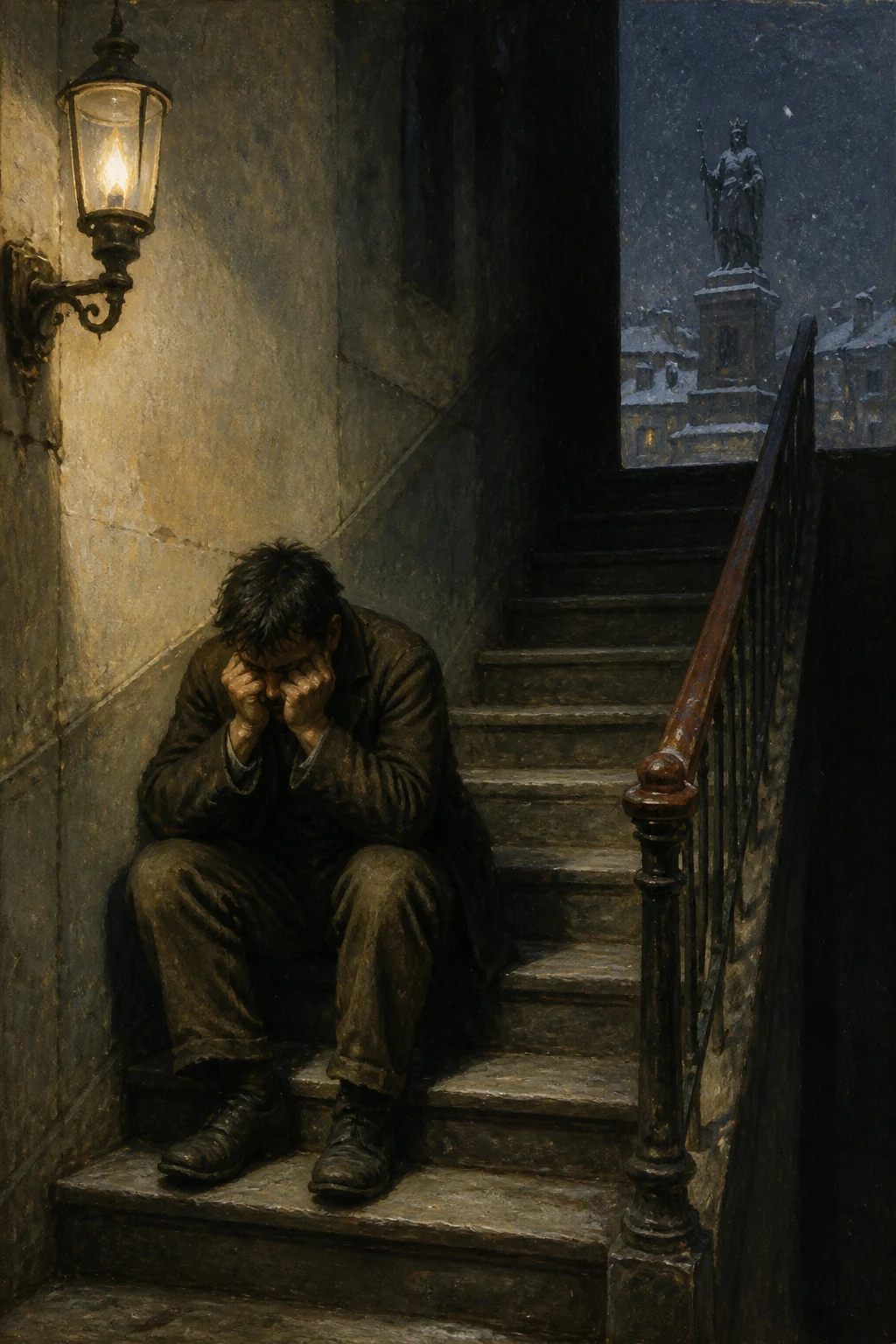
José returned home at nightfall. His heart was heavy: snow was falling within it, just as it was beginning to fall on the roofs and streets, on the trees along the promenades and the granite statues of Spanish kings standing in the square. White flakes of mournful sorrow drifted slowly into the soul of the unemployed carpenter, who was going home with no light, warmth, supper, or hope to bring.
As he climbed the stairs and drew near his dwelling, he felt so disheartened that he sank onto a step, intending to spend what remained of that joyous night there. It was the icy, narrow staircase of a tenement house, where people of means lived on the mezzanine, first, and second floors, while needy artisans lodged on the third and fourth floors and in attics large and small. A gas jet lit the stairs as far as the second floor; above that, the darkness thickened, the air grew black and as foul as the breath of a filthy well. Never had the desolate appearance of the staircase and its landings affected José so deeply. For the first time, he shrank back, afraid to knock at his own door. Such fine news he had to bring!
With his knees drawn up, his elbows planted on them, and his clenched fists pressed against his face, the shivering carpenter went over the sources of his despair and stirred up the bitter sediment of his anger against everything and everyone. A dog's life, damn it, for the man who lived by the sweat of his brow! In summer, onions to eat, because the heat was scorching and the wealthy went away to bathe and cool themselves. At Christmas, onions again, because no one wanted building work done in cold weather, and no amount of money was enough for oak firewood and fur coats. Well, did a carpenter not eat in the dog days? Did he not need charcoal and coal when it froze? The master of the workshop had shaken his head and said, “What can I do, my boy? I can't make curls where there's no hair... Not a single order coming in, for love or money... You know I let three others go before you... But I'm not going to turn off my nephews, my sister's boys... understood? They're all I'm keeping on now... You'll have to find a living somewhere else... Use your wits, that's the thing...” Use his wits! And how was a man to use his wits when all he knew was working wood, and he could find no one who wanted that sort of work?
José had been out of work for a month. What weary days he spent tramping through Madrid in search of employment! In one place they sent him away with pitying words and vague promises; in another, with curt, harsh answers, even with open sarcasm... “Work! There's none for anyone this year...” the masters replied, angry, ill-tempered, or dejected. From every quarter rose the same cry of scarcity and distress; everywhere people lamented the same misfortunes: war, ruin, sickness, unrest, disasters, fear, tightened purse strings... And José went from door to door, begging for work as he might have begged for alms, only to return at night with a sullen face and furrowed brow, answering his wife's unchanging question with an equally unchanging shrug that plainly meant, “No, not yet.”
This run of bad luck had caught them already drained, after a long illness—typhoid fever in their eldest girl, Felisa, who was still convalescent and needed nourishing food; after the purchase of a chest of drawers and two wool mattresses, which had promptly found their way to the pawnshop; after paying three months' overdue rent all at once and hearing from the agent that they would not be allowed to fall behind again, and that at the first lapse they and their belongings would be put straight out into the street... At such a time, a month of idleness meant immediate hunger and a struggle to keep their heads above water for the whole of the coming year. And hunger in a large family! No one can imagine the torment of a man whose duty is to carry food in his beak to the nest of his loved ones, and who must return to it with his beak empty, his feathers wet, his wings drooping... Each time José knocked and entered the attic, the chill of the bare floor tiles and the snow-cold emptiness of the unlit stove took a stronger hold on his spirit; for winter is a terrible ally of hunger, and on an empty stomach the north wind bites a thousand times more fiercely as it slips through the cracks, bearing on its wings the furious cries of cats...
José brooded. No, he could not cross that threshold without bringing those who awaited him inside, hungry and chilled to the bone, if not the sweets and treats proper to Christmas Eve, at least something to clear the shadows from their eyes and hearten their spirits. He remained there in one of those states of dreadful indecision that are true crises of the soul, in which ideas and feelings rooted in habit and tradition founder. José was an honest man, and even in that hour of trial he entertained no criminal intent; his hands would wither before he stretched them out to take another man's property. But his honesty was in some measure instinctive; what was troubled and confused in José was his conscience, which now struggled against his natural instinct for decency and almost condemned it. He would never steal, no, never... But let us see: were those who stole in circumstances like his really as guilty as they seemed? He had no wish to suffer shame, to bear the ugly name of thief; a few hours in prison would cost him his life; he would die of rage and humiliation. Very well; those were his own concerns, refinements of his dignity—and a carpenter could have dignity too. But those who suffered no such scruples and did something desperate, not to indulge their vices but to support their wives and little ones... who knew whether they might be right? Who knew whether they might be better husbands, better fathers? He gave his family nothing but want and tears...
He groaned, dug his fingers into his hair, and, stupefied by bitterness, looked down toward the lighted part of the staircase. There was a great bustle below, doors opening, servants and shop assistants going up and down with parcels, little notes, trays: the last preparations for supper, the nougat arriving from the nougat shop, the great sponge cake sent by the confectioner, the gift from a friend who shared in the family's rejoicing with six bottles of sweet sherry and red pomegranates. Only one door, that of the elderly, devout widow, Doña Amparo, had not opened once. Suddenly there was a clatter, and a swarm of children set upon the bell: they were the lady's nephews and nieces, her only love, her weakness, her darlings... They entered like a flock of birds into a tomb; the house, silent until then, filled with voices, running feet, and laughter. A moment later the maid, a little old woman as pious as her mistress, came out onto the landing and called in a cracked voice:
“Hello, Señor José! Is Señor José there? Come down, I've a job for you...” In moments of despair, any echo of life seems a help, a comfort. A man who shuts his windows to light a brazier of charcoal and suffocate himself hears with tenderness the noises of the street, the strains of a street band, the barking of a stray dog... José started, rose, and, his voice hoarse with emotion, answered as he bounded down the stairs:
“Coming, coming, Señora Baltasara!”... “Come in,” murmured the old woman. “If you've nothing to do, you can put up the Nativity scene for us, because the children have come, and my mistress, well, she dotes on them so...”
“I'll fetch my tools,” answered the carpenter, pale with joy. “No need... We've a hammer and pincers here, and there were nails left over from last year; I keep everything, you see, so I put them away nice and tidy...”
José entered the apartment overrun by children and went into the room where the Nativity figures lay scattered among the boards of the framework on which the scene was to stand. Amid the uproar, the carpenter began to set about his work. With what joy he wielded the hammer, chose a nail, drove it into the wood, and clinched it! What a renewal of his whole being, what vigor and moral strength flowed into him as he grasped the tools of his trade after so long! Piece by piece, board by board, he set and fitted the parts of the platform on which the Nativity scene would display its painted cardboard turrets, its mossy meadows, its simple, roughly fashioned clay figures. The children followed the carpenter's work with interest, missing not a hammer stroke, asking questions, offering opinions, and greeting every advance of the contraption with claps and squeals. Meanwhile, the lady was hanging bronze-and-glass candle sconces on the wall. The servants came and went, busy and contented. Outside it was snowing, but no one remembered that; snow, which deepens the sufferings of poverty, also heightens the pleasant sense of comfort within, of a warm and kindly home. And José fitted and nailed the wood until he had swiftly finished his work, in a kind of rapture, a reaction to the dejection that only moments before had brought him to the brink of utter despair...
When the platform was quite ready, and José had made that final circuit with which a craftsman inspects his work, Doña Amparo, frail and asthmatic, beckoned him to follow her and led him to her sitting room, where she left him alone for a moment. José's eyes rested involuntarily on the furniture and decorations of that room, neither luxurious nor shabby; above all, his attention was caught from the first by an image standing prominently on the console table, lit by a little lamp of fine glass. It was a carved Saint Joseph, a modern sculpture of no artistic merit, though not without a certain feeling; and instead of being shown holding the Child in his arms or by the hand, as was usual, the saint stood at a carpenter's bench, wielding an adze and teaching the attentive, smiling little Jesus the law of work, the supreme law of the world. José stood spellbound. He thought the image was speaking to him; he thought it uttered words of comfort and infinite affection, words he had never heard before. When the lady returned and slipped two five-peseta coins into his hand, the carpenter, instead of thanking her, looked first at his benefactress and then at the image; and the mute eloquence of his eyes was answered by that of the little old woman's, who read as in a book the soul of that unfortunate man, shattered in body and spirit by a month of anxiety and unspeakable bitterness. And Doña Amparo, well accustomed to helping the poor, felt as though she had been struck in the heart: the want she went out to seek, visiting wretched garrets, was there within her own walls, two steps away, silent and ashamed, yet urgent and absolute. She raised her eyes once more to the image of the hardworking Patriarch and, coughing a little, said kindly to the carpenter:
“We'll send supper up to your home now, so that you can celebrate Christmas.”
Izvirnik
011 La Nochebuena del carpintero
Naslednje strani prikazujejo izvirno besedilo za primerjavo.
José volvió á su casa al anochecer. Su corazón estaba triste: nevaba en él, como empezaba á nevar sobre tejados y calles, sobre los árboles de los paseos y las graníticas estatuas de los reyes españoles, erguidas en la plaza. Blancos copos de fúnebre dolor caían pausadamente en el alma del carpintero sin trabajo, que regresaba á su hogar y no podía traer á él luz, abrigo, cena, esperanzas.
Al emprender la subida de la escalera, al llegar cerca de su mansión, se sintió tan descorazonado, que se dejó caer en un peldaño con ánimo de pasar allí lo que faltaba de la alegre noche. Era la escalera glacial y angosta de una casa de vecindad, en cuyos entresuelos, principales y segundos vivía gente acomodada, mientras en los terceros ó cuartos, buhardillas y buhardillones, se albergaban artesanos menesterosos. Un mechero de gas alumbraba los tramos hasta la altura de los segundos; desde allí arriba, la obscuridad se condensaba, el ambiente se hacía negro y era fétido como el que exhala la boca de un sucio pozo. Nunca el aspecto desolado de la escalera y sus rellanos había impresionado así á José. Por primera vez retrocedía, temeroso de llamar á su propia puerta. ¡Para las buenas noticias que llevaba!
Altas las rodillas, afincados en ellas los codos, fijos en el rostro los crispados puños, tiritando, el carpintero repasó los temas de su desesperación y removió el sedimento amargo de su ira contra todo y contra todos. ¡Perra condición, centellas, la del que vive de su sudor! En verano, cebolla, porque hace un bochorno que abrasa y los pudientes se marchan á bañarse y tomar el fresco. En Navidad, cebolla, porque nadie quiere meterse en obras con frío, y porque todo el dinero es poco para leña de encina y abrigos de pieles. Y qué, ¿el carpintero no come en la canícula, no necesita carbón y mineral cuando hiela? El patrón del taller le había dicho, meneando la cabeza: «Qué quieres, hijo, yo no puedo sacar rizos donde no hay pelo... Ni para Dios sale un encargo... Ya sabes que antes de soltarte á ti, he soltao á otros tres... Pero no voy á soltar á mis sobrinos, los hijos de mi hermana..., ¿estamos? Ya me quedo con ellos solos... Búscate tú por ahí la vida... A ingeniarse se ha dicho...» ¡A ingeniarse! ¿Y cómo se ingenia el que sólo sabe labrar madera, y no encuentra quien le pida esa clase de obra?
Un mes llevaba José sin trabajar. ¡Qué jornadas tan penosas las que pasaba en recorrer á Madrid buscando ocupación! De aquí le despedían con frases de conmiseración y vagas promesas; de allá, con secas y duras palabras, hasta con marcada ironía... «¡Trabajo! Este año para nadie lo hay...» respondían los maestros, coléricos, malhumorados ó abatidos. De todas partes brotaba el mismo clamor de escasez y de angustia; doquiera se lloraban los mismos males: guerra, ruina, enfermedades, disturbios, catástrofes, miedo, encogimiento de los bolsillos... Y José iba de puerta en puerta, mendigando trabajo como mendigaría limosna, para regresar á la noche, de semblante hosco y ceño fruncido, y contestar á la interrogación siempre igual de su mujer, con un movimiento de hombros siempre idéntico, que significaba claramente: «No, todavía no.»
La mala racha les cogía sangrados, después de larga enfermedad, una tifoidea de la chica mayor, Felisa, convaleciente aún y necesitada de alimento substancioso; después de la adquisición de una cómoda y dos colchones de lana, que tomaron el camino de la casa de empeños á escape; después de haber pagado de un golpe el trimestre atrasado de la vivienda y oído de boca del administrador que no se les permitiría atrasarse otra vez, y al primer descuido se les pondría de patitas en la calle con sus trastos... En ocasión tal, un mes de holganza era el hambre en seguida, el ahogo para el resto del venidero año. ¡Y el hambre en una familia numerosa! Nadie se figura el tormento del que tiene obligación de traer en el pico la pitanza al nido de sus amores, y se ve precisado á volver á él con el pico vacío, las plumas mojadas, las alas caídas... Cada vez que José llamaba y se metía buhardilla adentro, el frío de los desnudos baldosines, la nieve de la apagada cocina se le apoderaban del espíritu con fuerza mayor; porque el invierno es un terrible aliado del hambre, y con el estómago desmantelado muerde mil veces más riguroso el soplo del cierzo que entra por las rendijas y trae en sus alas la voz rabiosa de los gatos...
Cavilaba José. No, no era posible que él pasase aquel umbral sin llevar á los que le aguardaban dentro, famélicos y transidos, ya que no las dulzuras y regalos propios de la noche de Navidad, por lo menos algo que desanublase sus ojos y reconfortase su espíritu. Permanecía así, en uno de esos estados de indecisión horrible que constituyen verdaderas crisis del alma, en las cuales zozobran ideas y sentimientos arraigados por la costumbre, por la tradición. Honrado era José, y á ningún propósito criminal daba acogida, ni aun en aquel instante de prueba; las manos se le caerían antes que extenderlas á la ajena propiedad; pero esta honradez tenía algo de instintivo; y lo que se le turbaba y confundía á José era la conciencia, en pugna entonces con el instinto natural de la hombría de bien, y casi reprobándolo. Él no robaría jamás, eso no...; pero vamos á ver, los que roban en casos análogos al suyo, ¿son tan culpables como parece? A él no le daba la gana de abochornarse, de arrostrar el feo nombre de ladrón; unas horas en la cárcel le costarían la vida; moriría del berrinche, de la afrenta; bueno; esas eran cosas suyas, repulgos de su dignidad, que un carpintero puede tenerla también; mas los que no padeciesen de tales escrúpulos y cometiesen una barbaridad, no por sostener vicios, por mantener á la mujer y á los pequeños..., ¿quién sabe si tenían razón? ¿Quién sabe si eran mejores maridos, mejores padres? El no daba á los suyos más que necesidad y lágrimas...
Gimió, se clavó los dedos en el pelo, y estúpido de amargura, miró hacia abajo, hacia la parte iluminada de la escalera. Por allí mucho movimiento, mucho abrir de puertas, mucho subir y bajar de criados y dependientes llevando paquetes, cartitas, bandejas: los últimos preparativos de la cena, el turrón que viene de la turronería, el bizcochón que remite el confitero, el obsequio del amigo, que se asocia al júbilo de la familia con las seis botellas de Jerez dulce y las rojas granadas. Una puerta sola, la de la anciana viuda y devota, doña Amparo, no se había abierto ni una vez; de pronto se oyó estrépito, una turba de chiquillos se colgó de la campanilla; eran los sobrinos de la señora, su único amor, su debilidad, su mimo... Entraron como bandada de pájaros en un panteón; la casa, hasta entonces muda, se llenó de rumores, de carreras, de risas. Un momento después, la criada, viejecita tan beata como su ama, salía al descanso y gritaba en cascada voz:
--¡Eh, Sr. José! ¿Esta por ahí el Sr. José? Baje, que le quiero un recado...
En los momentos de desesperación, cualquier eco de la vida nos parece un auxilio, un consuelo. El que cierra las ventanas para encender un hornillo de carbón y asfixiarse, oye con enternecimiento los ruidos de la calle, los ecos de una murga, el ladrido del perro vagabundo... José se estremeció, se levantó, y ronco de emoción contestó bajando á saltos:
--¡Allá voy, allá voy, señora Baltasara!...
--Entre...--murmuró la vieja.--Si está desocupado nos va á armar el Nacimiento, porque han venío los chicos, y mi ama, como está con ellos que se le cae la baba pura...
--Voy por la herramienta--contestó el carpintero pálido de alegría.
--No hace falta... Martillo y tenazas hay aquí, y clavos quedaron del año pasao; como yo lo guardo todo, bien apañaditos los guardé...
José entró en el piso invadido por los chiquillos y en el aposento donde yacían desparramadas las figuras del belén y las tablas del armadijo en que había de descansar. Entre la algazara empezó el carpintero á disponer su labor. ¡Con qué gozo esgrimía el martillo, escogía la punta, la hincaba en la madera, la remachaba! ¡Qué renovación de su sér, qué bríos y qué fuerzas morales le entraban al empuñar, después de tanto tiempo, los útiles del trabajo! Pedazo á pedazo, y tabla tras tabla, iba sentando y ajustando las piezas de la plataforma en que el belén debía lucir sus torrecillas de cartón pintado, sus praderas de musgo, sus figuras de barro toscas é ingenuas. Los niños seguían con interés la obra del carpintero, no perdían martillazo, preguntaban, daban parecer, y coreaban con palmadas y chillidos cada adelanto del armatoste. La señora, entretanto, colgaba en la pared unas agrupaciones de bronce y vidrio para colocar en ellas bujías. Los criados iban y venían, atareados y contentos. Fuera nevaba, pero nadie se acordaba de eso; la nieve, que aumenta los padecimientos de la miseria, también aumenta la grata sensación del bienestar íntimo, del hogar abrigado y dulce. Y José asentaba, clavaba la madera, hasta terminar su obra rápidamente, en una especie de transporte, reacción del abatimiento que momentos antes le ponía al borde de la desesperación total...
Cuando el tablado estuvo enteramente listo, y José hubo dado alrededor de él esa última vuelta del artífice que repasa la labor, doña Amparo, muy acabadita y asmática, le hizo seña de que la siguiese, y le llevó á su gabinete, donde le dejó solo un momento. Los ojos de José se fijaron involuntariamente en los muebles y decorado de aquella habitación ni lujosa ni mezquina, y sobre todo, le atrajo desde el primer momento una imagen que campeaba sobre la consola, alumbrada por una lamparilla de fino cristal. Era un San José de talla, escultura moderna, sin mérito, aunque no desprovista de cierto sentimiento; y el santo, en vez de hallarse representado con el Niño en brazos ó de la mano, según suele, estaba al pie de un banco de carpintero, manejando la azuela y enseñando al Jesusín, atento y sonriente, la ley del trabajo, la suprema ley del mundo. José se quedó absorto. Creía que la imagen le hablaba; creía que pronunciaba frases de consuelo y de cariño infinito, frases no oídas jamás. Cuando la señora volvió y le deslizó dos duros en la mano, el carpintero, en vez de dar gracias, miró primero á su bienhechora y después á la imagen; y á la elocuencia muda de sus ojos respondió la de los ojos de la viejecita, que leyó como en un libro en el alma de aquel desventurado, deshecho física y moralmente por un mes de ansiedad y amargura sin nombre.--Y doña Amparo, muy acostumbrada á socorrer pobres, sintió como un golpe en el corazón: la necesidad que iba á buscar fuera de casa, visitando zaquizamíes, la tenía allí, á dos pasos, callada y vergonzante, pero urgente y completa. Alzó los ojos de nuevo hacia la efigie del laborioso Patriarca, y bondadosamente, tosiqueando, dijo al carpintero:
«Ahora subirán de aquí cena á su casa de usted, para que celebren la Navidad.»
Nadaljuj z branjem