Prevod
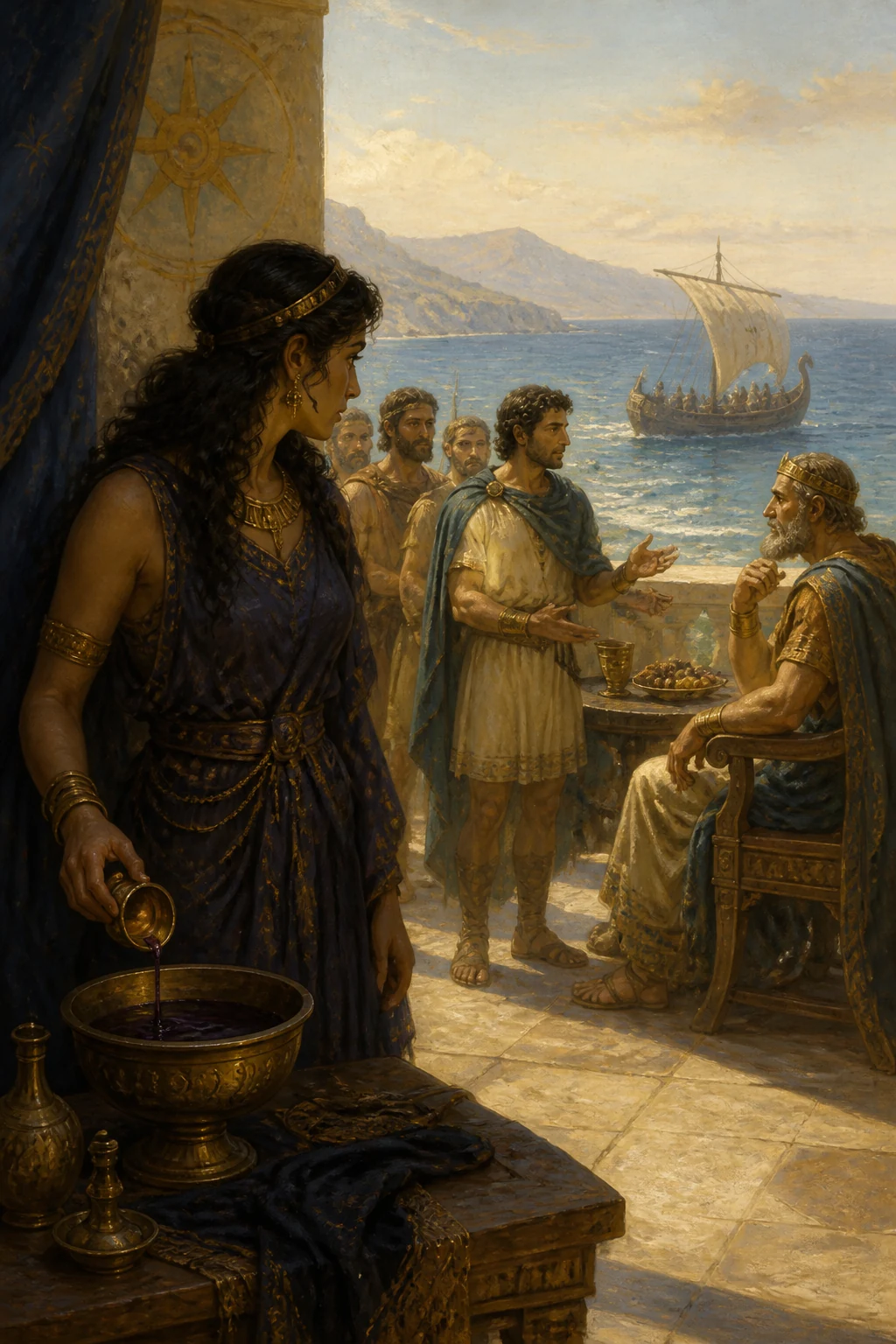
There Argus told his brothers to remain where they were, so that they could learn the girl’s thoughts and intentions; he himself withdrew and went back to the ship. As soon as the maiden saw the first light of dawn, she gathered up with her hands the golden hair that hung loose and disordered in her neglect, and wiped her tear-parched cheeks. She refreshed her skin with nectar-sweet ointment and put on a lovely robe, fastened with gracefully curved brooches; over her lovely head she cast a silvery-white veil. Then she paced to and fro within her chambers, forgetting the dreadful sorrows already at her feet, and those still destined to grow in the days to come.
She called to her maids, twelve in all, who slept in the antechamber of her fragrant room, girls of her own age who had not yet shared a marriage bed, and told them to make haste and harness the mules to the wagon, to carry her to Hecate’s beautiful temple.
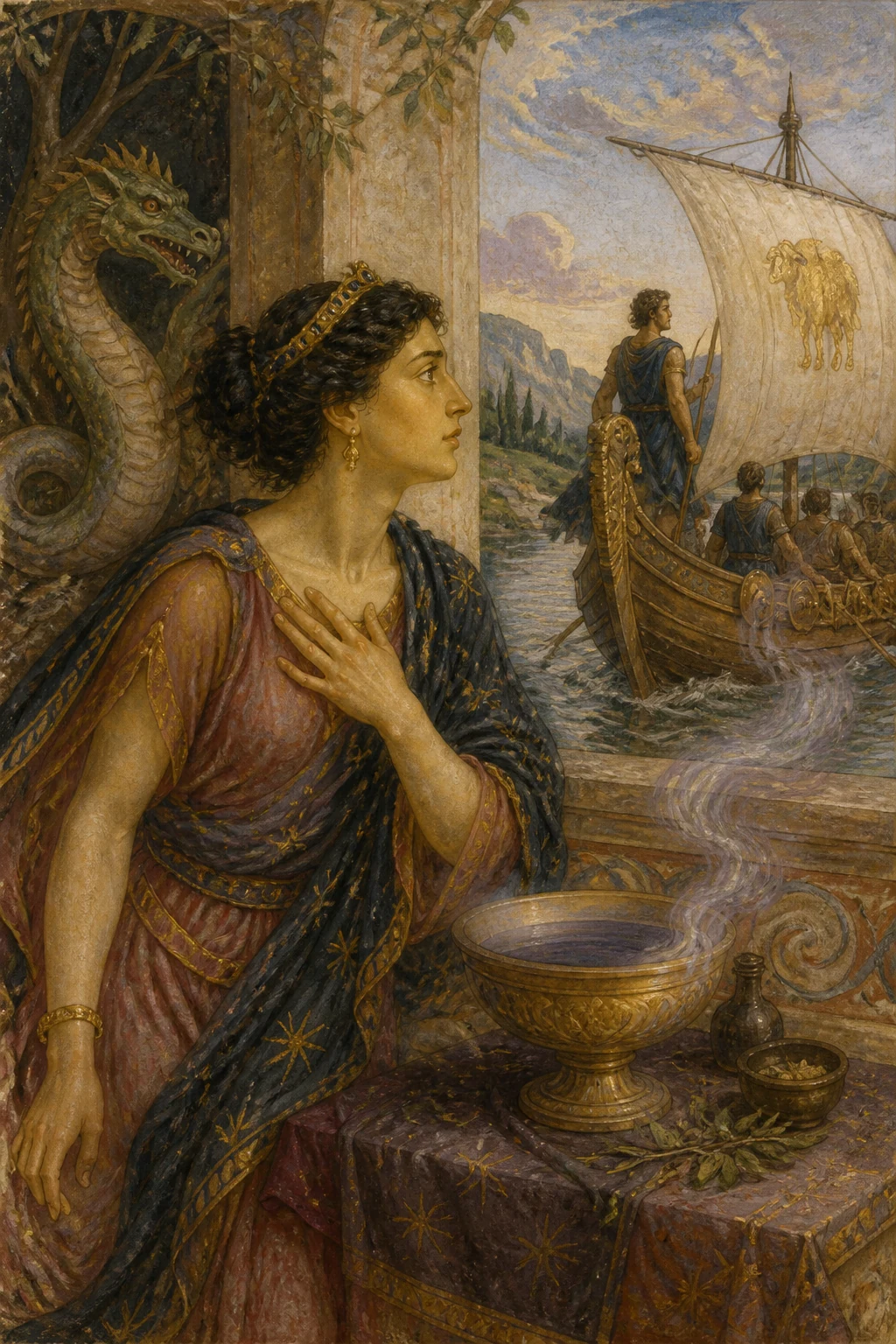
While the maids were making the wagon ready, she took from a hollow chest the drug which, they say, is called Promethean. If a man first propitiated the only-begotten maiden with sacrifices by night and then moistened his body with it, neither bronze weapons could wound him nor blazing fire overcome him; for that day, moreover, his courage and strength would be greater than before.
It first sprang up when the flesh-eating eagle let the bloody ichor of suffering Prometheus drip upon the earth among the slopes of the Caucasus. Its flower rose a cubit above the ground, like the Corycian crocus in color, poised on twin stalks; its root beneath the earth resembled freshly cut flesh.
Its juice, dark as the sap of a mountain oak, she had gathered in a Caspian shell to make her charm, after bathing seven times in ever-flowing waters and seven times invoking Brimo, nurse of the young—Brimo who walks by night, goddess of the underworld, queen of the dead—in the murky darkness, clothed in black garments.
The dark earth beneath her shook and bellowed as the Titan’s root was cut, and the son of Iapetus himself groaned, his heart distraught with pain. She took out the drug and tucked it into the fragrant band that lay about her lovely breast.
Then she went outside and mounted the swift wagon; two maids climbed up beside her, one on either side. She herself took the reins and a well-made whip in her right hand and drove through the city. The other maids ran behind along the broad highway, holding on to the wagon’s frame and lifting their delicate tunics as high as their white knees.
As Leto’s daughter, after bathing in the warm waters of the Parthenius or the river Amnisus, stands in her golden chariot and drives her swift deer over the hills, coming from afar to receive a sacrifice of a hundred beasts, rich in the savor of burning fat, while attendant nymphs follow her, some gathering at the very spring of Amnisus, others through the groves and over the heights with their many springs, and wild beasts fawn and whimper around her, trembling as she passes—so they hastened through the city, and the people on either side gave way, avoiding the royal maiden’s gaze.
When she had left the city’s well-built streets and driven across the plain to the temple, she quickly stepped down from the smooth-running wagon and spoke to her servants: “Dear friends, I have made a great mistake. I never thought of the foreign men who are wandering through our land, or that we ought not to go out among them. The whole city is stricken with bewilderment; that is why none of the women who used to gather here each day has come.
“But now that we are here, and no one else is coming, let us take our fill of sweet song without restraint; then, when we have gathered lovely flowers from the tender grass, we shall go home at the usual hour.
“And you might return home today with many gifts, if you will help me carry out a plan. Argus is urging me to it, and Chalciope herself as well. But keep what you hear from me locked silently in your hearts, so that no word of it reaches my father’s ears.
“They are asking me to accept gifts from the stranger who has undertaken the trial with the bulls, and save him from his deadly ordeal. I agreed, and have summoned him here to meet me alone, without his companions, so that we may divide among ourselves whatever gifts he brings, and give him some other, harmful drug in return. But when he comes, keep away from me.”
So she spoke, and all the girls were delighted with her cunning plan. Meanwhile Argus, as soon as he heard from his brothers that she had set out at dawn for Hecate’s holy temple, drew the son of Aeson away from his companions and led him across the plain. With them went Mopsus, son of Ampycus, skilled in interpreting the birds that appeared before them, and skilled too in giving sound advice to those he traveled with.
Never among the men of earlier days—not among the descendants of Zeus himself, nor among the heroes sprung from the blood of other immortals—had there been anyone such as Zeus’s wife made Jason that day, whether to look upon face to face or to hear in conversation.
Even his own companions gazed at him in wonder, so radiant was his charm; and the son of Ampycus rejoiced as they went, already foreseeing how everything would turn out. Beside the path across the plain, near the temple, stood a poplar crowned with countless leaves, where chattering crows often roosted.
One of them, fluttering its wings high among the branches, cried out at Hera’s prompting: “A sorry prophet this, who cannot even grasp what children know—that a maiden will say no sweet or loving word to a young man when strangers are tagging along with them.
“Away with you, wretched prophet, witless fool! Neither Cypris nor the gentle Loves breathe their favor upon you.” So the bird spoke in mockery. Mopsus smiled when he heard its divinely prompted voice and said: “Go on to the goddess’s temple, son of Aeson; there you will find the maiden. You will meet with a kindly welcome, through the designs of Cypris, who will stand beside you in your trials, just as Phineus, son of Agenor, foretold.
“Argus and I will stay here in this very spot and wait for your return. Go to her alone, and win her over with persuasive words.” So he wisely spoke, and the other two at once agreed.
Yet Medea’s mind could turn to nothing else, even as she sang. Whatever song she took up, she found no lasting pleasure in it. Bewildered, she kept breaking off, and her eyes would never rest upon the gathering of her maids; instead she turned her face aside and gazed far down the paths.
Again and again her heart faltered within her whenever she fancied she heard a passing footstep or the wind. But before long he appeared before her longing eyes, like Sirius springing high above Ocean—a star that rises beautiful and brilliant to behold, yet brings untold misery upon the flocks. So the son of Aeson came toward her, lovely to look upon, but at his appearing he stirred the anguish of consuming desire.
Her heart sank within her breast, her eyes grew dim, and a hot blush spread over her cheeks. She could neither lift her knees to move backward nor step forward, but stood with her feet rooted beneath her. Meanwhile all her maids withdrew and left them alone.
The two stood facing one another, silent and speechless, like oaks or tall firs rooted side by side upon the mountains, motionless in a calm; then a sudden gust sets them stirring, and their rustling knows no end. So these two were soon to speak at length beneath the breath of Love.
The son of Aeson saw that she was overcome by a heaven-sent bewilderment, and spoke to her gently: “Why are you so afraid of me, maiden, when I am alone? I am not like other men who boast and swagger, nor was I ever so, even when I lived in my own country. Do not be too shy, dear girl, to ask me whatever you wish, or to speak your mind.
“Since we have come here with goodwill toward one another, in a holy place where it is forbidden to do wrong, speak openly and ask what you will. Do not deceive me with pleasant words, since you have already promised your own sister that you would give me the drugs I need.
“By Hecate herself I implore you, by your parents, and by Zeus, who holds his hand over strangers and suppliants. I come to you as both stranger and suppliant, driven by cruel necessity to clasp your knees. Without your help I cannot overcome this grievous trial.
“Afterward I would repay your kindness as honor demands and as befits those who live far apart, by bringing you fame and a glorious name. The other heroes too will praise you when they return to Greece, and so will the heroes’ wives and mothers, who even now, perhaps, sit upon the shores mourning for us. You could scatter their bitter sorrows.
“Once before, the maiden Ariadne, daughter of Minos, kindly delivered Theseus from deadly trials—Ariadne whom Pasiphae, daughter of the Sun, bore. When Minos had laid aside his anger, she sailed away with Theseus and left her native land. The immortals themselves loved her, and as a sign of their favor, the starry crown men call Ariadne’s wheels all night amid the heavenly constellations.
“So too the gods will favor you, if you save such a company of noble men. Indeed, your beauty seems to promise a nature rich in gentle kindness.” So he spoke in praise of her. She lowered her eyes and smiled with heavenly sweetness; her heart melted within her, uplifted by his praise, and she looked straight into his eyes. She could not decide what to say to him first, but longed to tell him everything at once.
Without hesitation she took the drug from her fragrant breastband, and he joyfully received it in his hands. Had he needed it, she would have drawn the whole soul from her breast and gladly given it to him. Such was the sweet flame Love shed from Jason’s golden head; it caught and held the light of her eyes, and her heart warmed and melted within her, as dew upon roses melts in the warmth of the morning sun.
Now both would lower their eyes to the ground in shyness, now look at one another again, smiling with desire beneath their radiant brows. At last, with difficulty, the maiden found words to address him: “Listen now, and I will tell you how I mean to help you.
“When my father gives you the deadly teeth from the serpent’s jaws to sow, wait until the night is exactly half spent, then bathe in the waters of an ever-flowing river. Alone, apart from all the others, and dressed in dark garments, dig a round pit. Slaughter a ewe over it and lay the carcass there whole, building a good pile of firewood over the pit itself.
“Then propitiate Hecate, the only-begotten daughter of Perses, pouring from a cup the honey that bees labor to store in their hives. When you have duly invoked the goddess and won her favor, withdraw from the fire. Do not let the sound of footsteps or the barking of dogs make you turn around, lest you spoil the rite and fail to return unharmed to your companions.
“At dawn, moisten this drug, strip yourself, and rub it over your body like oil. It will give you boundless courage and mighty strength; you will feel yourself a match not for men but for the immortal gods.
“Smear it also over your shield, your spear, and your sword. Then neither the weapons of the earthborn men nor the irresistible flame bursting from the deadly bulls will wound you. You will not remain like this for long, but only for that day; even so, never shrink from the trial. And I will give you one more piece of helpful advice.
“When you have yoked the mighty bulls and with your strong hands swiftly plowed the whole stubborn field, and the Giants are springing up along the furrows where the serpent’s teeth were sown in the dark soil, watch until you see a great crowd rising from the earth. Then secretly throw a heavy stone among them. They will fall upon it and slaughter one another, like ravenous dogs over food. You too must hasten into the battle. In this way you will carry the fleece far away from Aea to Greece. Then go wherever you wish, wherever it pleases you to sail when you set out.”
So she spoke, and silently lowered her eyes to the ground before her feet. Warm tears streamed over her lovely cheek as she wept to think that he would wander across the sea far away from her. Then she spoke to him again in sorrow and took his right hand, for now all shyness had left her eyes: “If ever you return to your own home, remember Medea’s name. I too will remember you when we are far apart. But tell me kindly, where is your home? Where will you sail from here across the sea? Will you go somewhere near wealthy Orchomenus, or near the island of Aeaea? And tell me about the famous maiden you named, the daughter of Pasiphae, who is my father’s sister.”
So she spoke, and at the maiden’s tears destructive Love stole into his own heart. He answered her: “Never by night or day, I think, shall I forget you, if I escape death—if indeed I reach the land of Achaea unharmed, and Aeetes sets no other, still more dreadful trial before us.
“If you would like to know about my country, I will tell you; my own heart urges me to do so. There is a land encircled by steep mountains, rich in sheep and pastures, where Prometheus, son of Iapetus, fathered noble Deucalion, the first man to found cities and build temples to the immortals, and the first to rule over men.
“The neighboring peoples call that land Haemonia. There stands Iolcus, my own city, and many other towns, where even the name of the island of Aeaea is unknown. As for Minyas, the son of Aeolus, they say that he set out from our country long ago and founded Orchomenus, a city bordering on the land of Cadmus’s people.
“But why do I tell you all these idle things about our home and far-famed Ariadne, Minos’s daughter? For that was the lovely name of the beautiful maiden you asked about.
“If only your father might be as friendly toward us as Minos was toward Theseus on her account!” So he spoke, soothing her with tender words. But the bitterest grief stirred in her heart, and in her distress she answered him with passionate words: “In Greece, perhaps, it is a fine thing to honor such agreements.
“But Aeetes is not the sort of man you say Minos, Pasiphae’s husband, was; nor am I the equal of Ariadne. So speak no more of friendship between our houses. Only remember me when you reach Iolcus; and I will remember you, even against my parents’ wishes. May some distant rumor reach me, or some messenger bird, if ever you forget me. Or may the swift storm winds snatch me up and carry me from here across the sea to Iolcus, so that I may reproach you to your face and remind you that it was through me you escaped. If only I might appear then, unannounced, beside the hearth within your house!”
So she spoke, shedding pitiful tears down her cheeks. He answered her in turn: “Dear girl, let the wandering winds blow idly on, and the messenger bird as well; these are empty words you speak.
“But if you come to that home of mine in the land of Greece, you will be honored and revered by women and men alike. They will cherish you as a goddess, for by your counsel their sons will have returned home, their brothers and kinsmen, their beloved husbands, saved from terrible suffering.
“You will share my bed in our bridal chamber, and nothing shall part us in our love until the death appointed to us enfolds us.” So he spoke, and her heart melted as she listened; yet she shuddered at the thought of terrible deeds to come.
Poor girl! She was not to refuse for long to make her home in Greece. For Hera had devised this very thing, that Medea of Aea should leave her native land and come to holy Iolcus as a bane to Pelias.
Already the maids, watching from a distance, were growing silently uneasy; the hour required the maiden to return home to her mother. Yet she had no thought of going, so delighted was her heart by his beauty and his beguiling words, until at last the son of Aeson took heed and said: “It is time to go, before the sunlight fades and some stranger notices everything. We shall come here and meet again.”
So far did the two venture with one another in gentle words; then they parted. Jason set off joyfully to return to his companions and the ship, while she went toward her maids. They all came up together to meet her, but she did not notice them crowding around.
For her soul had taken wing among the clouds. Her feet carried her of themselves onto the swift wagon; she took the reins in one hand and the finely worked whip in the other to drive the mules. They sped toward the city, hastening home. When she arrived, Chalciope, anxious for her sons, questioned her; but Medea, bewildered by the turmoil of her thoughts, neither heard what she said nor felt any wish to answer.
She sat on a low stool beneath her bed, leaning sideways with her cheek resting on her left hand. Her eyes were wet beneath their lids as she brooded over the dreadful deed in which her own resolve had made her share.